For custom apron programs, fabric often receives the first discussion, but strap construction and apron strap hardware decide how the garment performs after repeated shifts, washing and daily adjustment. A 10 oz cotton canvas apron can fail early if the neck strap slips, the rivets rust, or the crossback system is sized poorly for the end user.
From a factory sourcing point of view, the correct decision is rarely the most expensive hardware. It is the combination of strap width, reinforcement, buckle type, rivet material and packing method that matches the brand position, wash method, user environment and target landed cost.
This guide explains the main apron strap, apron buckle, apron rivets and crossback apron options we quote for bulk OEM orders in China, including practical cost ranges, MOQ considerations, lead-time impact and inspection points.
- Strap width and fabric weight should be decided together, because a heavy apron with a narrow neck strap creates comfort complaints.
- Metal hardware adds durability but also plating, rust and airport/security considerations, especially for foodservice and institutional buyers.
- Crossback apron construction reduces neck pressure, but it requires more sewing time, longer straps and more size control during production.
- Rivets should reinforce stress points, not replace correct bartack sewing, because rivets alone can tear through weak fabric.
- Hardware choices can change FOB cost by USD 0.08 to 0.75 per piece, depending on material, finish, quantity and packing method.
- Pre-production testing should include wash, pull and adjustment checks, not only visual approval of the sample.
Why apron strap hardware deserves sourcing attention
In bulk apron sourcing, strap and hardware choices affect comfort, breakage rate, packing volume, metal detection issues, replacement claims and perceived quality. For a café chain ordering 20,000 bib aprons, a loose slider buckle can create daily complaints even if the fabric and logo embroidery are correct. For a workshop apron, a weak rivet at the waist tie can fail when the user bends or carries tools. These are small components, but they are high-contact components.
The main decision points are strap material, strap width, neck adjustment method, waist tie construction, rivet placement, buckle finish and whether the apron uses a traditional neck strap or a crossback apron design. A simple 7 oz poly-cotton kitchen apron may only need self-fabric ties and no metal hardware. A 12 oz waxed canvas apron for barbers, florists or makers may need brass-tone buckles, reinforced rivets and wider straps to support the garment weight.
As a working reference, the apron strap hardware package can add from about USD 0.05 per piece for basic plastic adjusters to more than USD 1.20 per piece for branded metal buckles, antique brass rivets and detachable leather components. In most mid-range OEM apron orders, the realistic incremental cost is USD 0.15 to 0.45 per piece. The buyer should confirm the cost target before sample development, because changing from fabric ties to metal hardware after sampling often changes both pattern and labor time.
- For low-cost promotional aprons, keep hardware minimal and focus on clean sewing and stable fabric.
- For uniform programs, prioritize adjustability, wash resistance and comfort across different body sizes.
- For retail aprons, hardware appearance matters more, but it must still pass pull and wash testing.
- For heavy-duty aprons, reinforce stress points with both stitching and rivets instead of relying on one method.
Apron strap materials, widths and sewing construction
The apron strap is usually made from self-fabric, cotton twill tape, polyester webbing, herringbone tape, faux leather or genuine leather. Self-fabric straps are cost-efficient and match the apron body, but they need proper folding and stitching to avoid twisting. Cotton twill tape is comfortable and natural-looking, but it can shrink if not preshrunk. Polyester webbing is stable, strong and low-shrinkage, but it can look more technical than craft-oriented. Leather looks premium but increases MOQ, care-label restrictions and export documentation requirements.
Width is a functional choice. For light aprons under 180 GSM, 1.5 cm to 2 cm ties may be acceptable. For standard bib aprons in 220 to 280 GSM twill or canvas, 2.5 cm straps are common. For heavy canvas, denim or waxed apron bodies above 300 GSM, 3 cm to 4 cm straps distribute load better, especially at the neck and shoulder. We normally advise against a narrow 1.5 cm neck strap on a 10 oz to 12 oz canvas apron because the user feels pressure during long shifts.
Sewing method also matters. A strap inserted into the top hem with a single straight stitch is faster, but it is not suitable for a heavy apron. Better methods include double-needle stitching, box stitching, bartack reinforcement at the corners and folded ends to prevent fraying. On dark canvas or denim, thread contrast should be confirmed early because contrast thread makes uneven stitching more visible and increases inspection pressure.
- Self-fabric strap: low material cost, good color match, higher sewing labor than ready tape.
- Cotton twill tape: comfortable hand feel, suitable for casual dining and retail, check shrinkage before bulk.
- Polyester webbing: strong and stable, suitable for industrial laundry and uniform programs.
- Faux leather strap: good visual upgrade, but heat and washing limitations must be stated clearly.
- Genuine leather strap: premium appearance, higher MOQ and longer sourcing lead time, usually not machine-wash friendly.
Apron strap hardware options: buckles, sliders, D-rings and snaps
The most common apron strap hardware for neck adjustment includes metal slider buckles, ladder buckles, D-rings, snap buttons and grommet-and-stud systems. The selection depends on the desired adjustment range and how often the user changes the fit. A slider buckle gives continuous adjustment and works well for uniform programs. D-rings are simple and inexpensive, but the strap can slip if the tape is smooth or too thin. Snap buttons look clean but offer fixed adjustment points only.
For metal apron buckle selection, the usual materials are iron, zinc alloy, stainless steel and brass. Iron is cost-effective but requires stable plating to prevent rust. Zinc alloy gives more shape options and is common for fashion-style buckles. Stainless steel is preferred for high-wash or food production environments, although it costs more. Solid brass is durable and attractive, but the material cost and color variation must be accepted by the buyer. For most restaurant apron orders, plated iron or zinc alloy is used; for industrial laundry, we recommend stainless steel or well-tested plastic hardware.
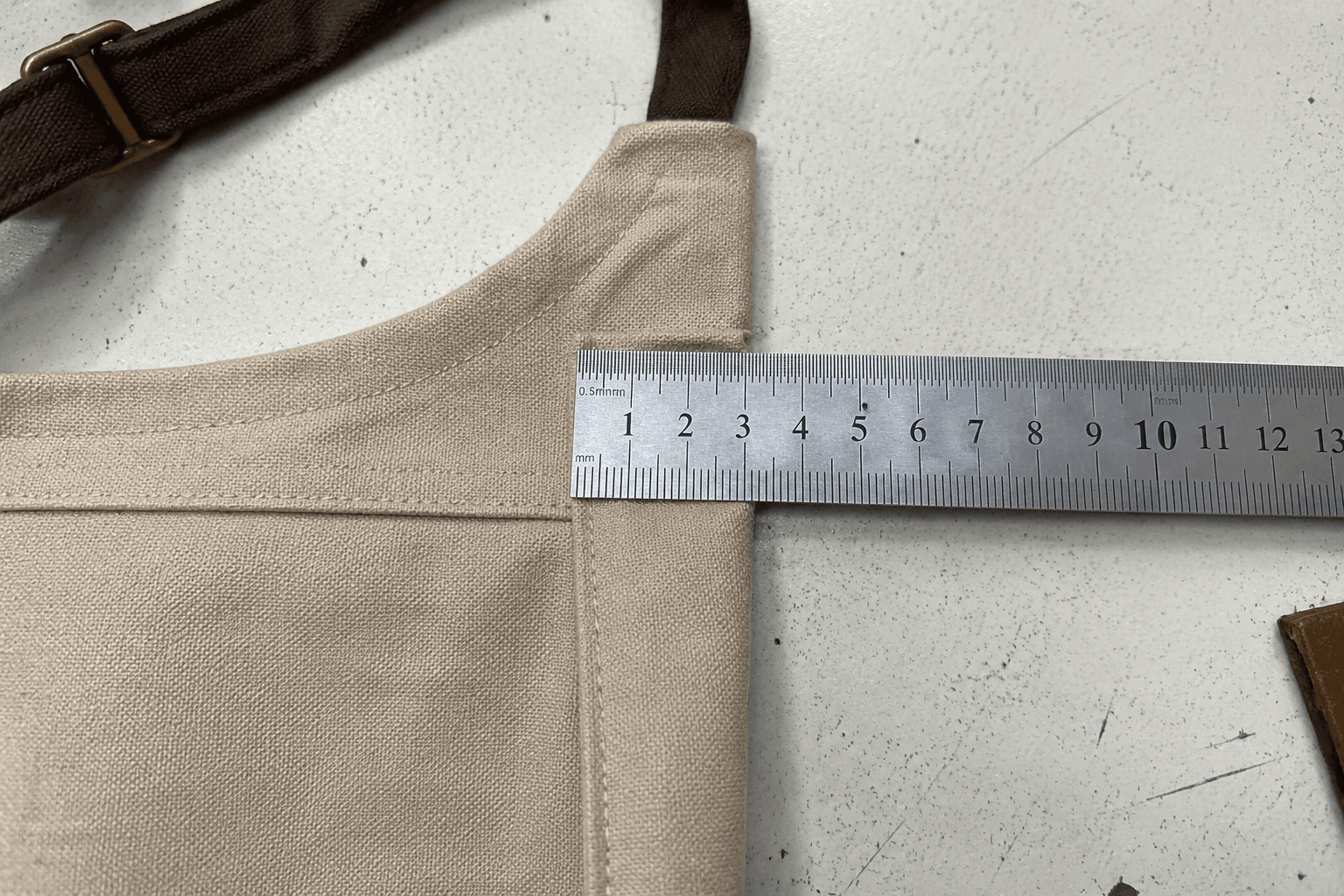
A practical issue is strap thickness. A 2.5 cm cotton tape may pass smoothly through a 2.5 cm inner-width buckle, but a folded self-fabric strap may need a 3 cm buckle because the thickness is greater. If the buckle opening is too tight, workers spend more time threading during production and users find adjustment difficult. If the buckle is too loose, the neck strap slips during wear. We normally test the exact strap and buckle together before confirming the pre-production sample.
- Metal slider buckle: good adjustability, standard choice for mid-range bib aprons.
- D-ring: simple appearance and low cost, but must be tested for strap slippage.
- Plastic ladder buckle: light and rust-free, suitable for wash-heavy uniforms, less premium in appearance.
- Snap button adjustment: clean look, limited size range, requires accurate placement.
- Grommet and stud: strong visual style, higher labor and hardware cost, best for retail or heavy-duty aprons.
Apron rivets: where they help and where they create risk
Apron rivets are useful at pocket corners, waist tie attachment points, strap connection points and stress areas near tool loops. They improve both strength and appearance when used correctly. However, rivets should not be treated as a substitute for correct sewing. If the fabric is too loose, too light or not reinforced, a rivet can pull through the fabric under force. For 160 GSM promotional fabric, we usually do not recommend metal rivets unless there is backing reinforcement.
The standard rivet materials are iron, brass, zinc alloy and stainless steel. Iron rivets are the lowest cost but require good plating and rust testing. Brass rivets are common for denim and waxed canvas aprons because the color matches antique hardware. Stainless steel is more expensive but useful for high-wash or damp environments. For rivet caps, 7 mm to 10 mm diameter is common on aprons. Heavy tool aprons may use larger caps, but oversized rivets on light aprons can look unbalanced and may damage fabric during pressing.
Rivet placement must consider both performance and washing. A rivet too close to the fabric edge may tear out. A rivet through too many fabric layers may not close evenly. A sharp or poorly capped rivet can scratch tables, laundry drums or the wearer’s clothing. For export bulk production, we check rivet cap tightness, cap surface, backside smoothness and placement consistency. If the apron includes embroidery near rivets, the sequence must be planned so the rivet setting does not crush the logo area.
- Use rivets at pocket corners when the pocket carries pens, tools, order pads or scissors.
- Add hidden fabric reinforcement behind rivets on canvas below 260 GSM or on loose-weave fabrics.
- Avoid cheap plating for wet kitchens, breweries, dishwashing areas and industrial laundry programs.
- Keep rivets away from direct logo embroidery unless the decoration and hardware sequence is tested.
- Combine rivets with bartack stitching for heavy-duty aprons instead of choosing only one reinforcement method.
Crossback apron construction and hardware trade-offs
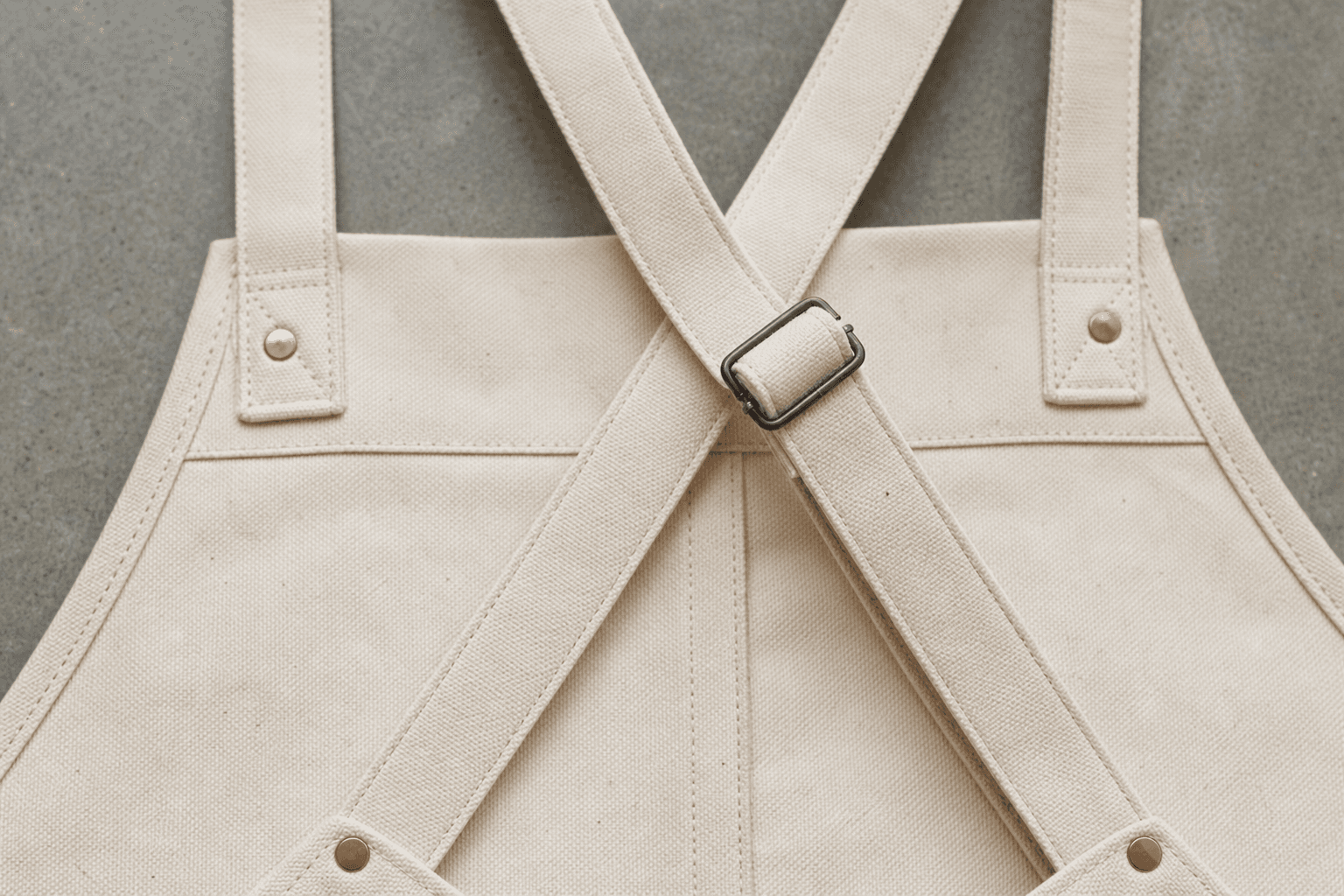
A crossback apron shifts weight from the neck to the shoulders and upper back. This is the main comfort advantage, especially for baristas, chefs, florists, barbers and workshop users who wear aprons for 6 to 10 hours per shift. A traditional neck strap is simpler and cheaper, but on a heavy apron it can cause neck fatigue. When the apron body is 300 GSM or higher, or when pockets carry tools, a crossback layout is often a better product decision.
There are two common crossback systems. The first uses long straps that pass through waist-side loops or grommets and tie at the back or front. The second uses fixed shoulder straps with buckles, snaps or detachable hooks. The long-strap system is flexible for different body sizes and avoids some metal hardware, but it uses more strap length, often 220 cm to 280 cm total depending on size and tying method. The fixed system looks cleaner but requires more accurate grading and more hardware control.
Crossback production is less forgiving than a standard bib apron. If strap length is wrong by 5 cm to 8 cm, the apron may sit too low or too high. If the crossing point is not stable, straps can twist during use. During sampling, we test on at least two body sizes, commonly one around 165 cm height and one around 180 cm height, because a sample that fits only the merchandiser may not represent the end user. For unisex programs, adjustable hardware is usually worth the additional cost.
- A basic neck strap apron can be 8 to 15 minutes faster to sew than a complex crossback apron, depending on pocket and hardware details.
- A crossback apron often requires 0.8 m to 1.6 m more strap material than a standard neck strap design.
- Crossback sampling should confirm strap length, crossing comfort, pocket height and tying position together.
- For one-size unisex orders, adjustable crossback straps reduce fit complaints more than fixed-length straps.
- For retail packaging, crossback straps need careful folding to avoid tangling and uneven presentation.
Cost, MOQ and lead-time impact of apron hardware choices
For sourcing managers, the key question is how hardware affects the unit price and production calendar. Basic self-fabric neck ties with no hardware are the lowest cost and the easiest to control. Adding a standard metal slider buckle may add USD 0.05 to 0.12 per piece for hardware plus minor sewing time. Adding rivets at four pocket corners may add around USD 0.06 to 0.18 per piece depending on material and finish. A full crossback system with metal buckles, grommets and longer straps can add USD 0.35 to 0.75 per piece compared with a simple neck strap apron.
MOQ varies by component. Standard black, nickel, gunmetal and antique brass buckles are usually available from stock in common widths such as 2.5 cm and 3.8 cm. Custom logo buckles, special plating, matte finishes or non-standard sizes may require 3,000 to 10,000 pieces per hardware style. Leather straps may have color MOQ by hide or roll, and color matching can be difficult across batches. If the apron order quantity is only 500 to 1,000 pieces, buyers should use stock hardware unless the retail price supports custom development.
Lead time also changes. For a simple apron with stock fabric and stock hardware, sampling may take 5 to 7 days and bulk production 25 to 35 days after approval. If the project includes custom hardware tooling, plating approval or leather strap sourcing, sample development can extend to 12 to 20 days and bulk lead time to 40 to 55 days. Plating rework is a common delay, especially for antique brass, matte black and custom logo hardware. The buyer should freeze hardware finish before bulk fabric cutting, because strap length, buckle width and rivet placement are connected to the pattern.
- Stock metal slider buckle: normally no separate MOQ if common size and finish are available.
- Custom plated hardware: usually requires color approval and 7 to 15 additional days.
- Logo-engraved buckle or rivet: tooling cost often ranges from USD 80 to 250 per design, depending on complexity.
- Plastic hardware: stable for washing and light in weight, but MOQ may be higher for exact color matching.
- Leather strap components: confirm care label, export requirements and washing limitation before sales launch.
Testing and inspection standards for apron strap hardware
Apron hardware testing should simulate real wearing and washing, not only check appearance. For straps, we check shrinkage, twisting, colorfastness and seam strength. For buckles, we check slippage, plating adhesion and sharp edges. For rivets, we check pull resistance and cap security. For crossback apron styles, we also check strap routing and whether the user can put on the apron quickly without instructions. A design that looks good on a flat sample may be inconvenient during a busy service shift.
A practical internal test is a manual pull test at the strap joint and rivet point. For standard restaurant aprons, we typically target no visible failure under a firm manual pull of around 8 kg to 12 kg at stress points, although exact testing depends on fabric and buyer standard. For heavy-duty aprons, the requirement should be higher and may need lab testing. Wash testing should use the buyer’s real method: home wash at 30°C is very different from industrial laundry at 60°C with tumble drying.
Final inspection should include both AQL visual checks and functional checks. Inspectors should not only count broken stitches; they should thread buckles, pull D-rings, check rivet backs by hand and verify that left and right straps are equal length. For crossback aprons, inspectors should measure strap length because a 2 cm variation may be acceptable in some styles but a 6 cm variation can affect fit. Hardware defects are often small, so the inspection checklist must mention them clearly.
- Check buckle slippage after the strap is pulled and released several times.
- Check rivet backside smoothness to avoid scratching garments, tables or the wearer’s skin.
- Check plating after washing or soaking when aprons are used in wet service environments.
- Check strap shrinkage separately from apron body shrinkage when materials are different.
- Check packing layout so metal hardware does not press marks into waxed canvas, denim or printed logos.
How to specify apron strap hardware in an OEM purchase order
The clearest purchase orders describe apron hardware with measurable details. Instead of writing “brass buckle,” specify “3.8 cm inner width zinc alloy slider buckle, antique brass plating, no sharp edges, matched to 3.8 cm cotton webbing.” Instead of writing “rivets on pockets,” specify rivet material, cap diameter, finish, quantity and placement. Ambiguous hardware descriptions create sample revisions and slow down production approval.
A good tech pack should include strap length before and after folding, strap width tolerance, hardware finish reference, reinforcement method and wash requirement. If the buyer has a brand standard for nickel-free hardware, lead content, food-contact environment or industrial laundry, it should be stated before quotation. These requirements can change the supplier’s component source and price. For example, stainless steel hardware may be necessary for certain wash environments but may not match the warm antique look expected for a retail canvas apron.
For most B2B apron programs, we recommend approving a complete pre-production sample with bulk-correct fabric, bulk-correct strap, bulk-correct apron buckle and bulk-correct apron rivets. Substituting similar hardware for sampling is acceptable only at early concept stage. Before mass production, the actual apron strap hardware should be confirmed in hand, because small differences in buckle opening, rivet stem length or strap thickness affect both function and sewing efficiency.
- Specify strap material, width, finished length and color tolerance.
- Specify buckle type, inner width, base material, plating color and test requirement.
- Specify rivet cap diameter, stem length, finish, placement and backing reinforcement.
- Specify whether the apron is home-wash, commercial-wash, industrial-laundry or wipe-clean only.
- Specify packing method when hardware could scratch, mark or deform the apron during shipment.