For bulk apron programs, shrinkage is not a small technical detail. It affects neck drop, waist tie length, bib coverage, pocket position, and the way an apron sits on the body after repeated laundering. When a buyer approves a pre-production sample in raw fabric but the end user washes the apron at 40-60°C, the approved fit can change by 2-6% in length and 1-4% in width, depending on fiber, weave, dyeing and finishing.
In factory terms, apron shrinkage has to be controlled through fabric selection, cutting allowance, wash testing and clear tolerance standards. A 280 GSM cotton twill apron, a 10 oz denim apron, and a 65/35 poly-cotton service apron will not behave the same way. Even within cotton, canvas, duck, twill and herringbone constructions respond differently after garment wash, enzyme wash or repeated home laundry.
This article explains how a Zhejiang apron factory normally evaluates shrinkage risk, when a buyer should choose a pre-wash apron, and how to write specifications that protect apron fit after wash without overpaying for unnecessary processing.
- Cotton apron shrink is usually higher in length than width, especially on twill, canvas and denim fabrics.
- Pre-wash apron production reduces post-purchase size change but adds cost, lead time and shade variation risk.
- A practical bulk tolerance is often +/-1.0 cm for key apron dimensions after wash, but only if the test method is fixed.
- Garment wash apron programs need larger cutting panels, extra sampling rounds and separate approvals for shade, hand feel and measurement.
- Poly-cotton aprons normally shrink less than 100% cotton, but heat setting, fabric quality and laundry temperature still matter.
- The most reliable specification defines both before-wash and after-wash measurements.
Why apron shrinkage matters more than the label suggests
An apron is a functional garment, not only a flat textile item. A 2 cm loss in total length may be acceptable on a promotional waist apron, but the same loss on a bib apron can change the coverage for a barista, chef or workshop user. If the bib becomes shorter, the chest coverage drops. If the waist narrows, the side coverage changes. If the neck loop shrinks, the bib pulls upward and the wearer compensates by loosening the tie or adjusting the hardware.
Most buyer complaints about apron fit after wash are not expressed as shrinkage at first. The end customer says the apron feels too short, the pocket is too high, the cross-back straps are tight, or the waist tie no longer wraps properly. When the factory checks retained samples, the root cause is often a mismatch between approved sample dimensions and the laundering condition used in the market.
For sourcing managers, the commercial risk is clear. If a 10,000 pc program is sold as a durable work apron and 3-4% length shrinkage is discovered after retail delivery, replacement cost can exceed the original savings from choosing an untreated cotton fabric. The correct approach is not to avoid cotton. The correct approach is to decide whether the product is sold as raw, sanforized, fabric-washed or garment-washed, then build the size chart around that decision.
- A 75 cm long bib apron with 4% length shrinkage will lose about 3 cm after laundering.
- A 70 cm waist width with 3% width shrinkage will lose about 2.1 cm, which can reduce side coverage.
- A 90 cm waist tie with 5% shrinkage will lose 4.5 cm per tie, which matters for plus-size or wrap-around designs.
- A patch pocket placed 28 cm from the top edge may appear 1-2 cm higher after the body panel shrinks.
Fabric composition and construction behind apron shrinkage
The first driver of apron shrinkage is fiber. 100% cotton absorbs moisture, swells and relaxes under heat and mechanical agitation. Polyester is more dimensionally stable, so poly-cotton blends normally shrink less. For common apron fabrics, a 100% cotton 280-320 GSM twill may show 2-5% shrinkage after one warm wash, while a 65/35 poly-cotton 220-240 GSM twill may remain around 1-2% if it has been properly finished.
Construction also matters. A tight canvas or duck fabric can feel stable in the hand, but it may still relax significantly after finishing stress is released. Denim aprons, especially 10-12 oz cotton denim, often show higher length shrinkage if the fabric is not sanforized. Yarn-dyed stripes and herringbone fabrics may have different shrinkage in warp and weft, so the factory cannot assume equal movement in both directions.
Weight alone does not predict shrinkage. A 300 GSM cotton canvas from one mill may shrink 2.5% after 40°C washing, while another 300 GSM canvas may shrink 5% because of yarn twist, loom tension and finishing route. For this reason, serious apron sourcing should treat shrinkage data as fabric-specific, not category-specific.
- 100% cotton canvas, 250-340 GSM: typical risk is 3-6% length shrinkage unless controlled by finishing.
- 100% cotton twill, 240-320 GSM: typical risk is 2-5% length shrinkage, depending on dyeing and compacting.
- Cotton denim, 8-12 oz: typical risk is 3-7% length shrinkage if not sanforized or washed before cutting.
- 65/35 poly-cotton twill, 200-260 GSM: typical risk is 1-2.5% shrinkage when properly heat set.
- Recycled cotton blends: shrinkage must be tested lot by lot because yarn quality can vary.
Pre-wash apron options: fabric wash, garment wash and enzyme wash
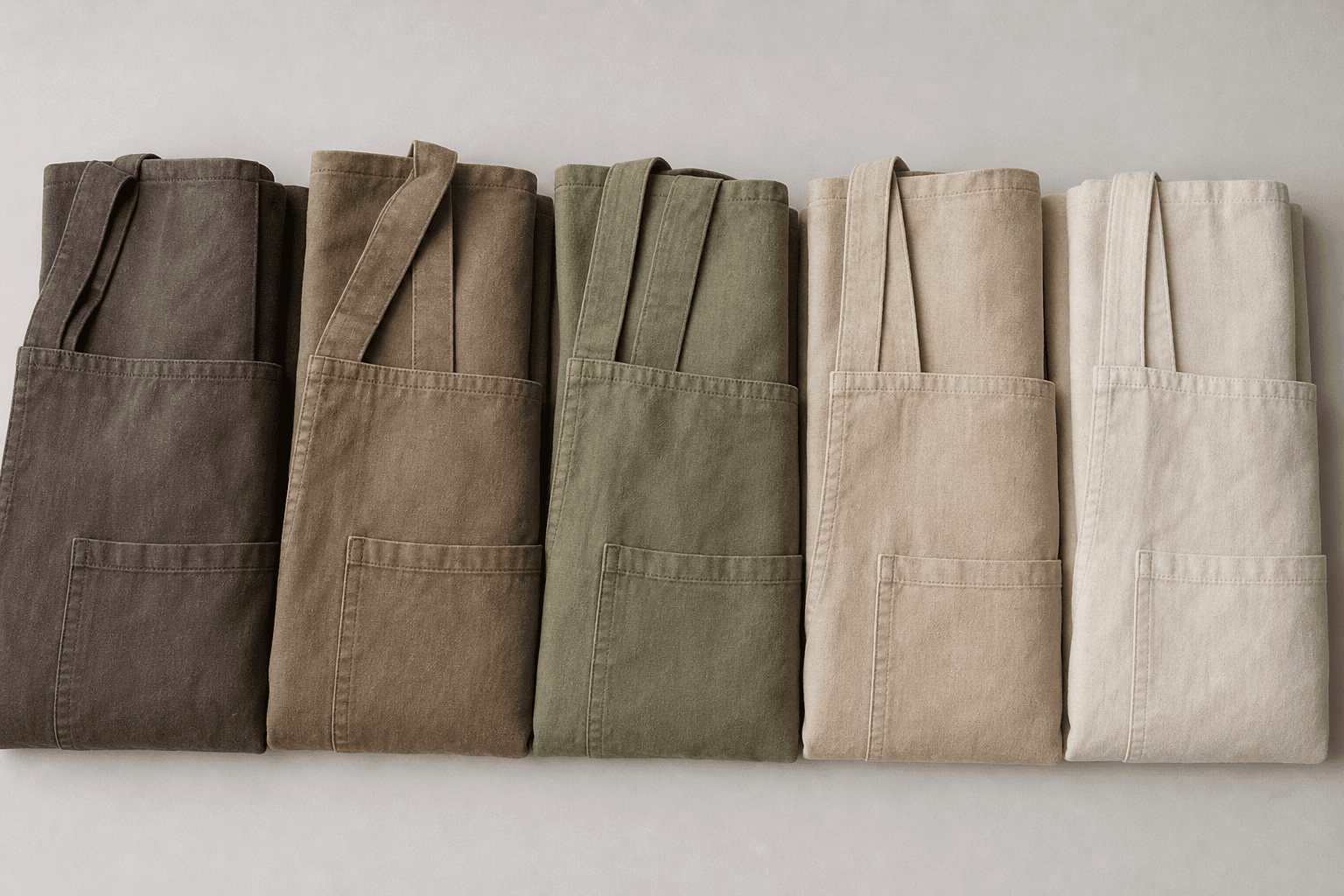
A pre-wash apron can mean several different processes, and buyers should avoid using the term without definition. In factory production, the apron can be made from pre-shrunk fabric, from fabric washed before cutting, or from fully sewn garments washed after sewing. Each route affects cost, measurements, color and production planning in a different way.
Fabric wash before cutting is useful when the buyer wants stable dimensions but a relatively clean, uniform appearance. The fabric is washed, dried and relaxed before marker making and cutting. This reduces shrinkage in the finished apron, but it requires extra fabric handling and may increase fabric consumption by 3-8% because the fabric shrinks before cutting. It also requires careful roll inspection after washing to avoid shade and width variation.
A garment wash apron is washed after sewing. This gives a softer hand feel, slightly worn appearance and better dimensional stability for the consumer. However, garment wash also creates more measurement variation. Seams pucker, pocket edges soften, labels can curl, and metal hardware may mark the fabric if not protected. For a premium cafe apron or retail lifestyle apron, this may be desirable. For a uniform program requiring strict size consistency, it must be controlled carefully.
- Pre-shrunk fabric is suitable when the buyer wants a clean finish and lower shrinkage without a washed garment look.
- Fabric wash before cutting is suitable for 100% cotton aprons where after-wash size stability is important.
- Garment wash is suitable for denim, canvas and retail aprons where soft hand feel and casual appearance are part of the design.
- Enzyme wash is suitable when the buyer wants a smoother surface and reduced stiffness, but it can reduce fabric strength if overprocessed.
- Stone wash or heavy abrasion wash is usually not recommended for low-cost uniform aprons because it increases damage and shade variation.
How we test apron shrinkage before bulk cutting
A responsible factory should not start bulk cutting based only on fabric mill claims. Mill shrinkage reports are useful, but apron production includes cutting direction, seam tension, interlining, pocket attachment, straps, bartacks and sometimes printed logos. These details can change the final result. We normally test both fabric panels and a sewn apron sample before confirming the final size chart.
For normal export apron orders, a practical test is one wash cycle at 40°C, line dry or tumble dry as specified by the buyer, then measure after full relaxation. For food service or industrial laundry programs, the test may require 60°C washing and tumble drying. If the buyer's market uses commercial laundry, home-laundry results are not enough. Commercial drying can increase shrinkage and twist, especially on cotton apron shrink programs.
Measurements should be taken at fixed points. For a bib apron, we measure total length from top center bib to hem, waist width at the waist seam or tie insertion line, bib top width, bottom width, pocket placement, neck strap length and waist tie length. For cross-back aprons, strap length and attachment position are especially important because small shrinkage can change the wearing balance.
- Cut a test sample from actual bulk fabric or approved lab-dip yardage, not from a substitute fabric.
- Measure the apron before wash and record dimensions to 0.1 cm for development, then apply commercial tolerances for bulk.
- Wash according to the buyer's care label plan, such as 40°C machine wash and low tumble dry.
- Relax the sample for at least 4 hours after drying before final measurement.
- Calculate shrinkage separately for length, width, straps and ties because they may move differently.
- Repeat the test after three wash cycles if the apron is positioned as workwear or industrial uniform.
Building the size chart for apron fit after wash
The most common mistake is approving only one size chart. For shrinkage-sensitive programs, the buyer and supplier should agree on two sets of measurements: before-wash production measurements and after-wash target measurements. The before-wash measurements guide cutting and inline inspection. The after-wash measurements protect the fit the end user actually experiences.
For example, if the target finished length after wash is 80 cm and test shrinkage is 4%, the cutting and sewing target may need to be about 83.3 cm before wash. If the target waist width after wash is 72 cm and width shrinkage is 2.5%, the before-wash target may need to be about 73.8 cm. These numbers sound simple, but they must be checked through an actual sewn sample because seams, hems and pockets can restrict or concentrate movement.
Tolerances also need to be realistic. On raw aprons, +/-0.5 cm may be possible for some flat dimensions. On garment wash apron production, +/-1.0 cm or +/-1.5 cm may be more realistic depending on fabric and wash intensity. If the buyer asks for heavy garment wash, soft hand feel, visible puckering and very tight measurement tolerance at the same time, the factory should flag the conflict before bulk order confirmation.
- For basic bib apron body length, a practical bulk tolerance is often +/-1.0 cm after wash.
- For waist width, +/-1.0 cm is usually workable on stable fabrics and +/-1.5 cm may be needed on washed cotton canvas.
- For pocket placement, +/-0.5 cm to +/-1.0 cm is reasonable depending on pocket size and wash process.
- For waist tie length, +/-1.5 cm is common because long narrow parts shrink and twist more easily.
- For cross-back strap length, tolerance should be tighter than waist ties because it affects wearing comfort directly.
Cost, MOQ and lead-time impact of shrinkage control
Shrinkage control is not free, and buyers should budget it into the product from the beginning. A raw cotton bib apron may be quoted at USD 2.40-3.20/pc depending on fabric, size, pocket and order quantity. Adding fabric pre-wash may increase cost by roughly USD 0.10-0.25/pc. Adding garment wash may increase cost by USD 0.20-0.60/pc, depending on wash type, local water treatment cost, drying method and inspection level.
Lead time also changes. For a standard custom apron using stock fabric, sampling may take 5-7 days and bulk production may take 25-35 days after approval. If fabric needs custom dyeing plus shrinkage testing, development can add 7-12 days. If garment wash is required, the factory needs extra time for wash sample approval, bulk washing, drying, re-measurement, thread trimming and final inspection. A realistic bulk lead time for garment washed cotton aprons is often 35-45 days after fabric arrival.
MOQ depends on the process. For simple raw aprons, many Zhejiang apron factories can accept 500-1,000 pcs per color if fabric is available. For custom dyed cotton fabric, MOQ is often 1,000-3,000 meters per color, which may translate to 1,500-5,000 aprons depending on style and fabric width. For garment wash, factories usually prefer at least 1,000 pcs per color and wash recipe because small lots are inefficient and harder to control.
- Basic shrinkage test on one fabric and one apron sample usually adds 2-4 working days during development.
- Fabric pre-wash can add 3-6 working days before cutting, depending on fabric quantity and drying capacity.
- Garment wash sample approval can add 5-8 working days if shade, hand feel and measurements all need confirmation.
- Bulk garment washing can add 4-7 working days to production for a 3,000-10,000 pc order.
- A second wash-test round is recommended when the first result exceeds 4% length shrinkage on a fitted bib or cross-back apron.
Print, embroidery and trims under apron shrinkage conditions
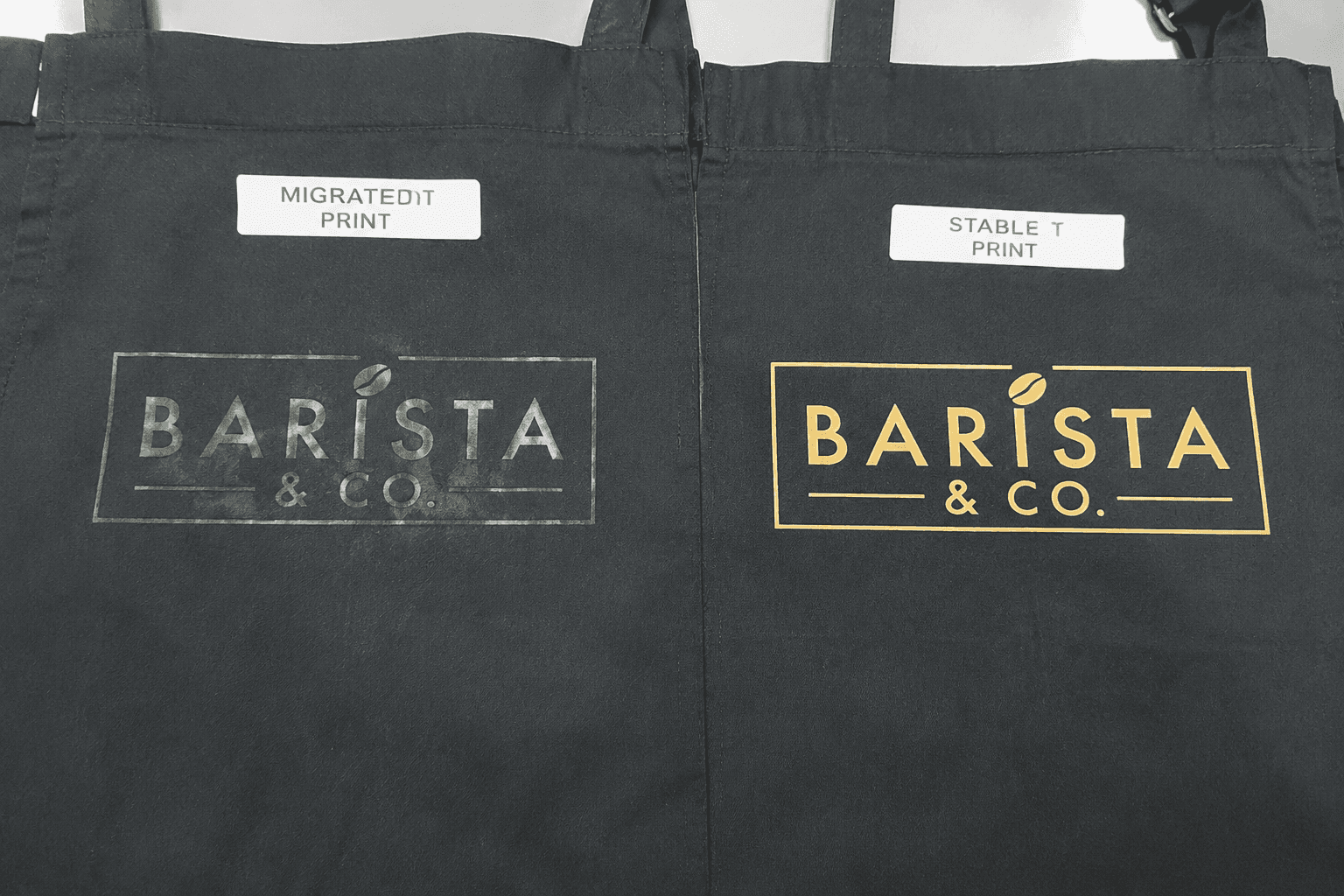
Shrinkage control must include decoration and trims. Screen print, heat transfer, embroidery, woven labels, leather patches and metal hardware all react differently during washing. If the apron body shrinks but a large print area does not move in the same way, the print may ripple or crack. If embroidery is dense, it can restrict local shrinkage and cause puckering around the logo.
For printed aprons, the safest route is usually to pre-shrink the fabric before printing or to print after garment wash if the design and registration allow it. Printing before garment wash can work, but the ink system must be tested for wash resistance, crocking and hand feel. For dark cotton aprons, pigment dye and wash processes can also affect logo brightness.
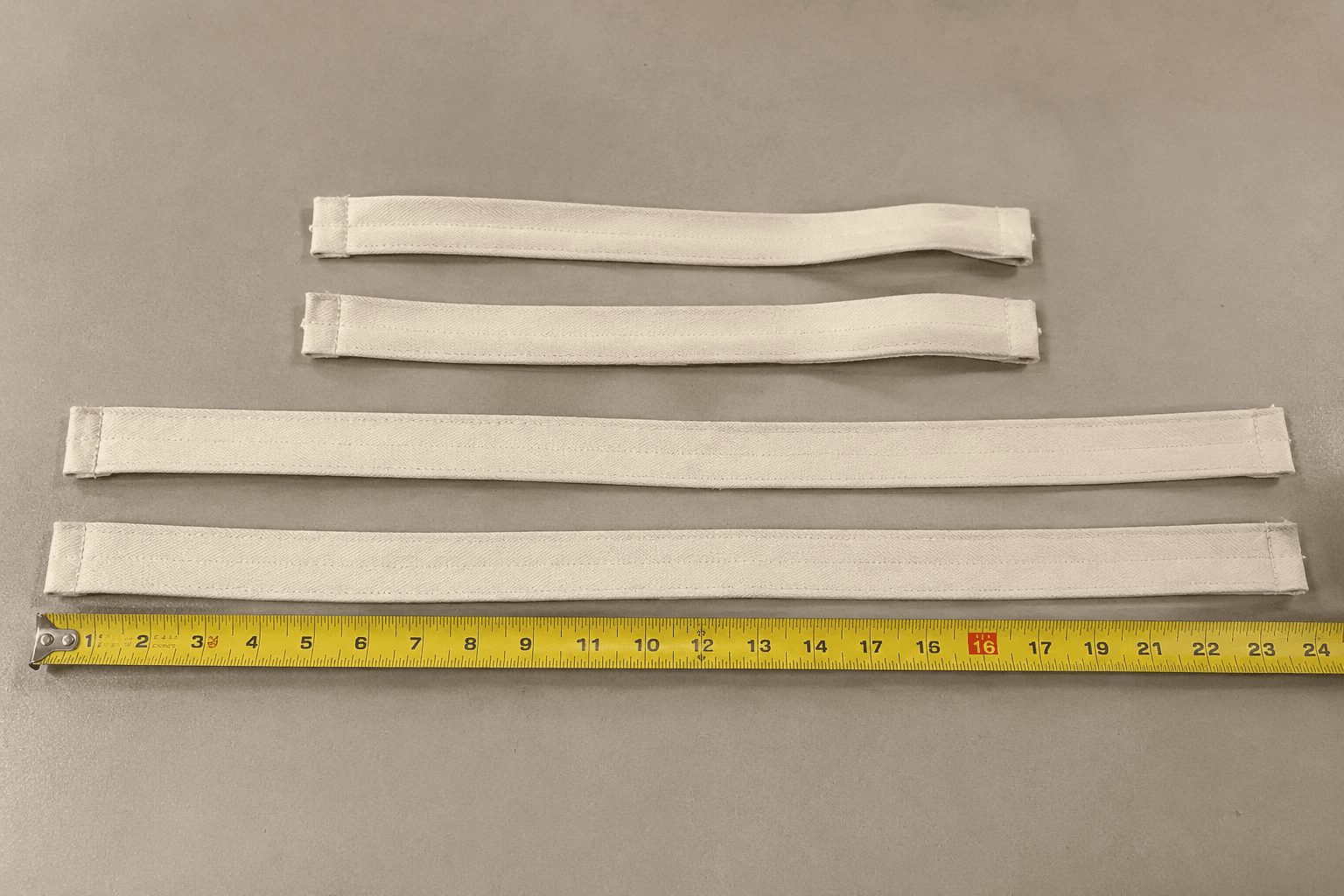
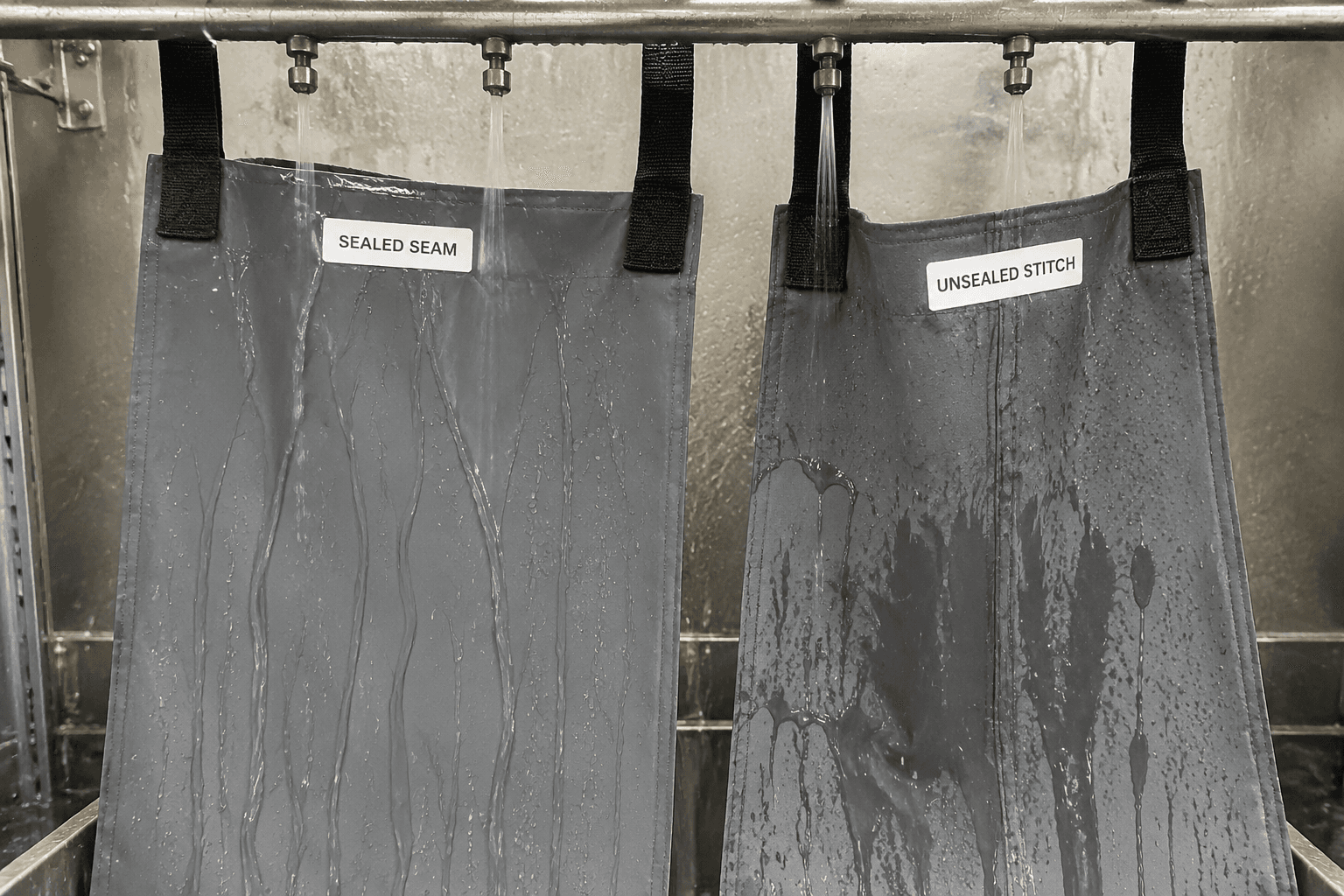
Trim selection is equally important. Cotton webbing straps may shrink more than the apron body if sourced from a different supplier. Polyester straps may shrink less, which can change the balance between body and strap after wash. Metal eyelets, D-rings and sliders should be tested for rust resistance and marking during wet processing. If the buyer requires antique brass or black metal hardware, the coating should be checked after wash, not only in dry condition.
- Large chest prints should be wash tested on the actual fabric before bulk print approval.
- Dense embroidery should be tested for puckering after wash, especially on 200-240 GSM cotton twill.
- Cotton neck straps and waist ties should be shrink tested separately if they use separate webbing.
- Leather patches are risky on garment wash aprons unless the leather is washable and colorfast.
- Metal hardware should be protected during garment wash to reduce abrasion marks on the apron body.
How to write a purchase specification for apron shrinkage
A clear purchase specification prevents arguments after shipment. The buyer should not write only pre-shrunk cotton apron or low shrinkage. These phrases are open to interpretation. A better specification states the fabric composition, weight, wash process, test method, target after-wash measurements and acceptable shrinkage percentage.
For example: 100% cotton twill, 280 GSM, reactive dyed, fabric pre-washed before cutting. Finished apron target after one 40°C machine wash and low tumble dry: length 80 cm +/-1.0 cm, waist width 72 cm +/-1.0 cm. Maximum residual shrinkage after one additional wash: 2% length, 2% width. This gives both buyer and factory a measurable standard.
For programs where the apron will be sold to restaurants, hotels or coffee chains, the buyer should confirm the real laundry environment. If the end user washes at 60°C with tumble drying but the purchase order only tests at 30°C line dry, the approved result will not represent field performance. The factory can manage apron shrinkage, but only against the correct condition.
- State whether the apron is raw, fabric pre-washed, garment washed or enzyme washed.
- Confirm whether measurements are controlled before wash, after wash or both.
- Define the wash test temperature, drying method and number of cycles.
- List critical dimensions including body length, waist width, bib width, strap length, tie length and pocket position.
- Set separate tolerances for raw production inspection and after-wash confirmation.
- Approve shade and hand feel after the same wash process used for shrinkage control.