For bulk custom aprons, sampling is where the buyer’s concept becomes a controllable factory product. A sketch or reference apron can show the direction, but the apron sampling process turns that direction into fabric weight, seam construction, pocket size, strap length, shrinkage allowance, logo placement, packaging, and production cost.
In our Zhejiang apron factory, a normal apron development project moves from apron tech pack review to first apron sample, revision sample, size or color confirmation, and finally the pre-production sample. For a simple waist apron, this may take 7 to 12 working days before production approval. For a cross-back bib apron with enzyme-washed cotton canvas, leather-look trims, embroidery, and retail packaging, the process can easily take 18 to 30 working days.
Professional buyers can reduce sampling time and cost by giving the factory complete inputs early. The most useful information is not only a drawing, but also the target fabric GSM or oz, finished dimensions, tolerance, wash requirement, logo method, target FOB price, order quantity, and intended use environment.
- A complete apron tech pack usually saves 3 to 7 working days during first sample development.
- Fabric selection should be confirmed by GSM, weave, shrinkage, color standard, and end-use, not by fabric name alone.
- A first apron sample checks construction and appearance, while a pre-production sample confirms what bulk production will follow.
- Most apron sampling delays come from unclear pocket dimensions, logo placement, strap length, fabric substitution, or late packaging decisions.
- For custom aprons from China, realistic sampling cost is often USD 30 to USD 120 per style, depending on fabric, trims, and decoration.
- Sampling approval should include tolerances, wash test results, logo quality, packing method, and bulk inspection points.
Why the apron sampling process matters before bulk production
Aprons look simple compared with jackets or trousers, but a bulk apron order still has many variables that affect cost, durability, and buyer acceptance. A 240 GSM cotton twill waist apron with two pockets is a very different product from a 12 oz canvas barista apron with cross-back straps, antique brass rivets, and a washed finish. If these details are not fixed before production, the factory can make an apron that is technically functional but commercially wrong for the buyer’s market.
The apron sampling process protects both sides. The buyer sees the actual hand feel, fit, color, print quality, pocket position, strap comfort, and finishing level before committing to bulk. The factory uses the sample stage to check material availability, sewing method, labor minutes, shrinkage, decoration risk, packing size, and final FOB cost. When a buyer asks for 3,000 to 20,000 custom aprons, a small sampling mistake can become thousands of incorrect pieces.
In practice, we divide apron development into three control points. The first is technical clarification, where we review the apron tech pack and confirm what is missing. The second is physical sample making, where the first apron sample proves the concept. The third is pre-production sample approval, where all production details are locked before fabric cutting.
- Sampling reduces bulk risk by confirming fabric, construction, dimensions, logo, trims, and packing before mass cutting.
- A clear sample avoids repeated price changes after the buyer has already shown the apron to internal teams or retail customers.
- A good pre-production sample gives the production line one physical standard for sewing, QC, pressing, folding, and packing.
Starting point: the apron tech pack and buyer inputs
A strong apron tech pack does not need to be complicated, but it must be specific. For aprons, the most important technical pages are usually the front and back sketches, finished measurement chart, fabric specification, pocket construction, strap system, logo artwork, trim list, stitching requirement, packing method, and tolerance table. If the order includes several apron sizes, such as adult and junior, each size should have separate finished dimensions.
For example, a standard bib apron may measure 70 cm wide at the hem, 84 cm total height, with a 25 cm neck strap drop and 90 cm waist ties. A short waist apron may measure 70 cm wide by 40 cm high, while a bistro apron may measure 100 cm wide by 80 cm high. If these measurements are not defined, the factory may use a local standard that does not fit the buyer’s market. North American hospitality customers often prefer longer waist ties and larger pockets, while some European retail aprons require a cleaner, narrower shape.
The target price is also useful at the tech pack stage. If the buyer’s target is USD 2.20 FOB for 5,000 pieces, the factory should not develop the first sample in 12 oz cotton canvas with metal hardware and heavy embroidery unless the buyer accepts a higher cost. A supplier-side sampling team can suggest alternatives early, such as 220 GSM poly-cotton twill instead of 280 GSM cotton twill, screen print instead of embroidery, or self-fabric ties instead of webbing straps.
- The tech pack should state finished apron width, height, pocket size, strap length, and tolerance, normally plus or minus 0.5 cm to 1.5 cm depending on the point of measure.
- Fabric should be described by composition, weave, GSM or oz, color standard, and required tests such as colorfastness or shrinkage.
- Logo artwork should include file format, size, position from edge or seam, color reference, and decoration method.
- Packaging should be confirmed early when the buyer needs belly bands, hangtags, individual polybags, cartons under 15 kg, or retail-ready folding.
Fabric and trim development for apron samples
Fabric is usually the biggest driver of apron cost and performance. Common apron fabrics include 180 to 240 GSM poly-cotton twill for promotional and light hospitality aprons, 240 to 280 GSM cotton twill for retail and kitchen aprons, 10 oz to 12 oz cotton canvas for barista and workshop aprons, and 180 to 220 GSM polyester for easy-care uniforms. Linen-cotton blends and recycled polyester are also used, but they need closer control on shrinkage, color consistency, and MOQ.
A fabric name alone is not enough. One supplier’s “canvas” may be 260 GSM, while another’s may be 380 GSM. A buyer asking for “heavy cotton apron” may expect 10 oz canvas, but the target FOB price may only allow 240 GSM twill. During apron development, we normally send available fabric swatches first if the fabric is standard. For custom-dyed fabric, the mill may require 300 to 500 meters minimum per color, and lab dip approval usually adds 5 to 8 working days.
Trims must also match the intended use. D-rings, sliders, rivets, snaps, eyelets, webbing, leather patches, and metal buckles can improve appearance but add cost and production time. Metal hardware may add USD 0.08 to USD 0.35 per apron depending on quality and quantity. Genuine leather trims can create washing and customs issues, so many uniform buyers choose PU leather patches or washable imitation leather instead.
- Light promotional apron: 160 to 200 GSM polyester or poly-cotton, low unit cost, suitable for campaigns and events.
- Restaurant service apron: 220 to 260 GSM poly-cotton twill, better durability, stable color, easier industrial washing.
- Retail kitchen apron: 240 to 280 GSM cotton twill or canvas, softer hand feel, suitable for screen print or embroidery.
- Barista or workshop apron: 10 oz to 12 oz canvas or denim, stronger structure, higher sewing labor, higher freight weight.
- Washed fashion apron: cotton canvas or twill with enzyme wash, better vintage hand feel, but larger shrinkage and shade variation.
First apron sample: what the factory is really checking
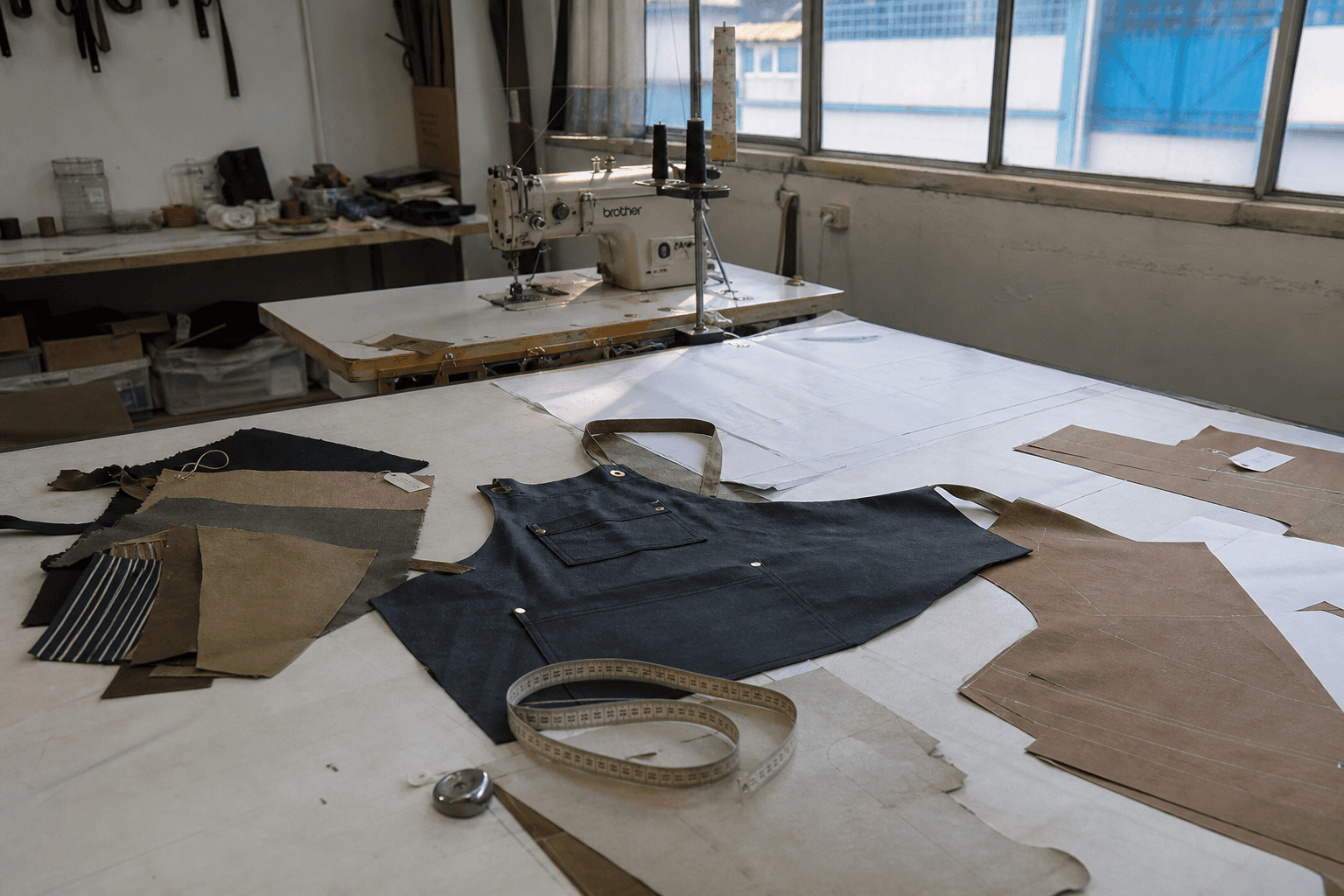
The first apron sample is not only for the buyer’s photo review. Inside the factory, the sample room checks whether the pattern is correct, whether the fabric behaves well during cutting and sewing, whether the seam allowance is enough, and whether the decoration position is practical. If the apron has curved edges, large patch pockets, cross-back straps, contrast stitching, or binding tape, the sample maker will also check sewing difficulty and operation sequence.
A simple first sample can often be made in 3 to 5 working days after all materials are ready. If the sample uses stock fabric and no custom hardware, the timeline is short. If it needs custom dyed fabric, woven labels, special webbing, printed packaging, or embroidery digitizing, the timeline becomes longer. Embroidery sample setup may add 2 to 4 working days. Screen print setup may add 2 to 3 working days after artwork confirmation. Digital print is faster for samples but may not be the same cost structure as bulk rotary or screen printing.
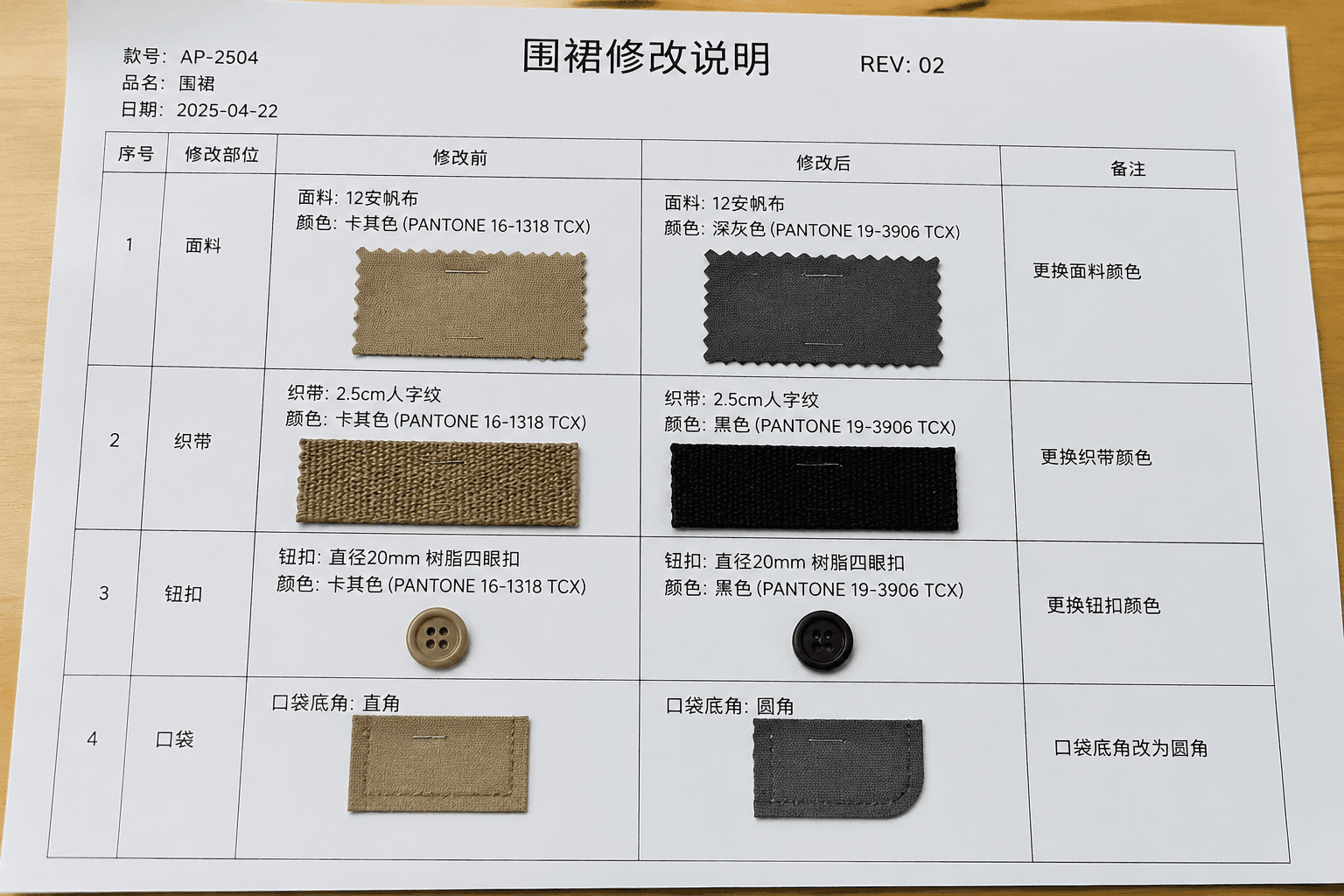
Buyers should review the first sample with a measurement tape and a written comment sheet. Comments such as “make pocket bigger” or “strap too long” are difficult to control. It is better to write “increase center pocket width from 18 cm to 21 cm,” or “reduce neck strap total length by 6 cm.” Clear revision comments allow the sample room to make the second apron sample accurately and allow the merchandiser to update the cost.
- Check finished dimensions flat on table before fitting the apron on a model or mannequin.
- Measure pocket opening, pocket depth, pen slot width, neck strap length, waist tie length, and logo position.
- Review seam type, bartack positions, thread color, edge finishing, and whether pockets pull or twist after pressing.
- Confirm whether the apron sample represents bulk fabric or only a substitute fabric for shape checking.
- Record every change in the revised tech pack so the second sample and quotation follow the same information.
Logo, decoration, and washing risks during apron development
Logo application is one of the most common reasons for repeated apron sampling. Aprons often carry brand identity on the chest, lower pocket, or side tab, so the buyer expects a clean result. The right decoration method depends on fabric weight, order quantity, logo size, color count, wash requirement, and target cost. For example, embroidery works well on 240 GSM twill and canvas, but it can pucker on lightweight 160 GSM fabric if the stitch density is too high.
Screen printing is economical for larger logos and quantities above 500 to 1,000 pieces, especially with one to three colors. Heat transfer can give sharp detail for smaller orders or complex artwork, but buyers should confirm wash durability, hand feel, and heat mark risk on dark fabric. Woven patches and silicone patches give a premium look but add MOQ and lead time. A small woven patch may require 500 to 1,000 pieces MOQ, while custom metal badges may require tooling and 15 to 25 days.
Wash testing is important when the apron is intended for hospitality, kitchen, salon, workshop, or repeated home laundering. Cotton aprons may shrink 3 percent to 7 percent depending on fabric and washing process. Enzyme-washed aprons can have more stable hand feel but more shade variation between batches. If the buyer requires industrial laundry performance, the factory should know this before sampling because thread, label, print, and trim choices may need adjustment.
- Embroidery is durable and premium, but cost increases with stitch count; a 6,000-stitch chest logo may add about USD 0.25 to USD 0.60 per piece.
- Screen print is cost-effective for simple artwork, but each color needs setup and color matching.
- Heat transfer supports fine detail, but buyers should approve wash testing before using it for high-temperature laundry.
- Woven or PU patches improve retail appearance, but they add trim MOQ, positioning control, and extra sewing operations.
- Reactive-dyed cotton and dark polyester should be checked for crocking if the apron will contact white shirts or uniforms.
Cost, MOQ, and timing inside the apron sampling process
Sampling cost is not only fabric and sewing. It includes pattern making, sample room labor, decoration setup, trim sourcing, courier packing, and sometimes fabric dyeing or washing. For a standard bib apron using stock fabric, a sample fee may be USD 30 to USD 60 per style. For a canvas apron with embroidery, metal hardware, PU patch, and custom washing, USD 80 to USD 150 is common. If custom fabric dyeing is needed only for one sample, the real cost can be higher than the factory charges.
MOQ depends on the material and decoration more than the apron itself. A factory may accept 300 pieces for a simple apron in stock black poly-cotton twill, but the MOQ may become 1,000 pieces per color for custom dyed cotton twill. For yarn-dyed stripe fabric, MOQ can be 1,500 to 3,000 meters. For custom woven labels, 1,000 to 5,000 labels is common. Buyers should ask which MOQ belongs to sewing, fabric, trims, logo, and packaging separately. This avoids confusion when one apron style has five colorways.
Timing should be calculated from confirmed information, not from first inquiry date. If a buyer sends an apron tech pack but logo artwork is missing, fabric color is not approved, and pocket dimensions are still open, the sample clock has not truly started. A realistic schedule for custom apron sourcing from China is 1 to 2 days for tech pack review, 2 to 5 days for material confirmation if using stock fabric, 3 to 7 days for first sample making, 3 to 6 days for buyer review and shipping, and another 3 to 7 days for revision sample.
- Stock fabric first sample: usually 3 to 7 working days after complete technical details are confirmed.
- Custom lab dip: usually 5 to 8 working days before fabric color approval.
- Custom woven label or patch sample: usually 7 to 15 working days depending on supplier workload.
- Washed apron sample: usually adds 3 to 6 working days for wash trial, drying, measurement, and shade review.
- Bulk production after pre-production sample approval: often 25 to 45 days, depending on order quantity, fabric status, and decoration.
From revision sample to pre-production sample approval
The revision sample should answer the buyer’s written comments from the first sample. It is not the right time to add a completely new fabric, new pocket layout, new logo method, and new packaging without expecting schedule and price changes. When many changes are introduced together, the sample becomes a new development round rather than a controlled revision. For efficient apron development, we prefer one consolidated comment sheet from the buyer’s sourcing, design, and sales teams.
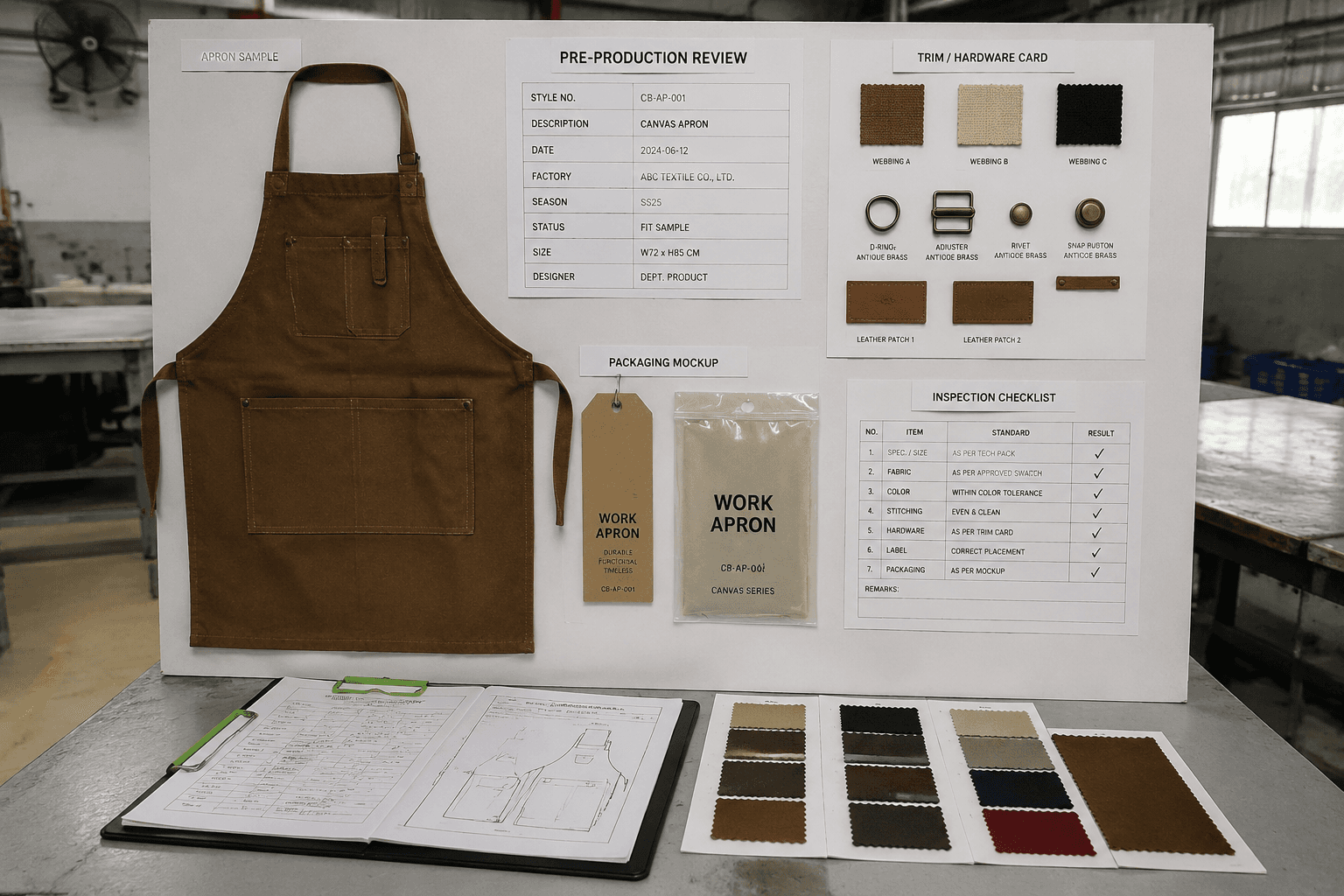
The pre-production sample is the final physical reference for bulk production. It should be made with approved bulk fabric or the closest available bulk fabric, approved trims, approved logo method, correct thread color, correct label placement, correct packing, and final measurements. In many factory workflows, the pre-production sample is signed by merchandising, technical, production, and QC teams before bulk cutting. If the buyer approves only by photo, the factory should still keep one sealed sample for line reference.
A proper pre-production sample reduces disputes during final inspection. The inspection company or buyer QC can compare bulk goods against the approved sample for fabric hand feel, color, pocket position, logo size, stitch quality, and packing. Measurement tolerance should also be stated clearly. For aprons, plus or minus 1 cm is often acceptable for body width and height, while logo placement and pocket alignment may need tighter control, such as plus or minus 0.5 cm to 1 cm.
- The pre-production sample should match approved fabric composition, GSM, color, logo, trims, measurements, and packing.
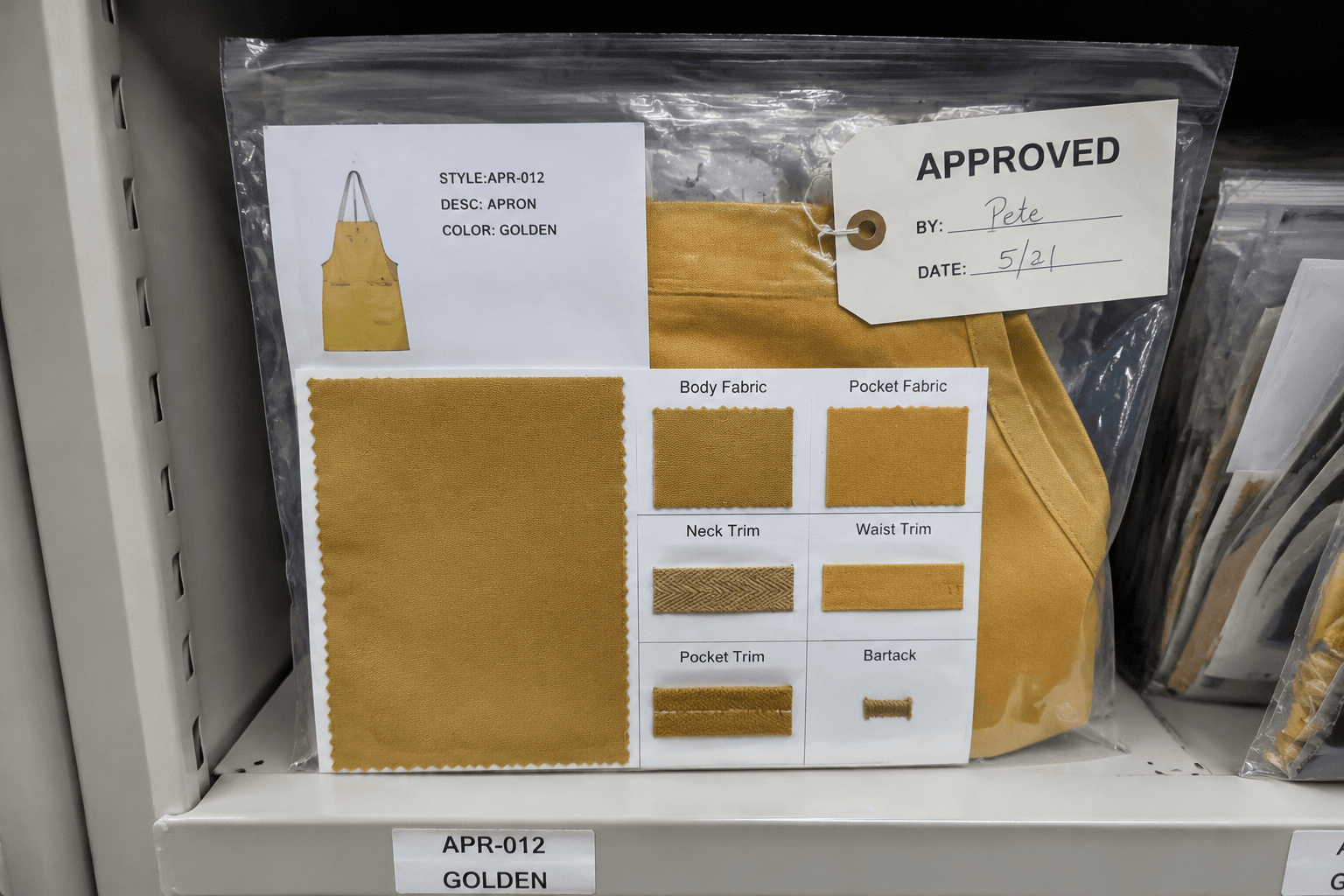
- The buyer should approve the sample with date, version number, and any final exceptions clearly written.
- The factory should keep one approved sample in the sample room and one on the production line during bulk sewing.
- QC should use the approved sample together with the tech pack, not as a replacement for written specifications.
Practical approval checklist for custom apron buyers
Before approving any apron sample for bulk production, the buyer should check the product as a working uniform or retail item, not only as a flat garment. Tie the apron, adjust the neck or cross-back straps, place tools or order pads in the pockets, check whether the waist ties are long enough, and confirm whether the fabric weight feels suitable for the selling price. A heavy 12 oz apron may look premium but feel too hot for kitchen staff working long shifts. A lightweight 180 GSM apron may meet a promotion budget but may not support a large embroidered logo.
The best approvals are specific. Instead of writing “approved except minor changes,” list exactly what is approved and what must be updated in bulk. For example, “Body size approved, pocket to move 1 cm higher, logo size approved, thread color to change to Pantone 426C, individual polybag required.” This gives the factory clear production instructions and protects the buyer if the bulk shipment is inspected later.
A controlled apron sampling process also helps with future reorders. Once the pre-production sample, measurement chart, fabric code, trim code, logo file, and packing specification are fixed, the second order can move faster. Reorder sampling may only need a color confirmation or salesman sample, unless the buyer changes fabric, supplier, wash, decoration, or size.
- Confirm the final apron sample against the latest tech pack version, not an old quotation sheet.
- Measure at least five key points: total height, hem width, bib width, pocket size, and strap length.
- Check logo position from fixed reference points such as top edge, center line, pocket edge, or side seam.
- Review wash result for shrinkage, color bleeding, print cracking, embroidery puckering, and trim damage.
- Approve carton packing, folding size, polybag warning text, barcode position, and carton weight when retail or warehouse handling matters.
- Keep approval records with sample photos, version number, date, comments, and final FOB price.