For bulk apron orders, defects usually become expensive after the goods leave the sewing line. A loose neck strap, unstable dye lot, wrong pocket size or weak bar tack may look minor in one carton, but at 5,000 or 20,000 pieces it can become a chargeback, customer complaint or full rework issue. Practical apron quality control is not only a final inspection; it is a set of checkpoints from fabric approval to carton sealing.
Most China apron factories, including OEM workshops in Zhejiang, work with pre-production samples, inline checking and final AQL inspection. The buyer’s job is to make the pass/fail criteria clear before cutting starts, not after the inspector opens cartons. This article explains what sourcing managers and product developers should check before paying the balance, especially for cotton canvas aprons, polyester-cotton work aprons, denim aprons, bib aprons, waist aprons and promotional aprons.
The goal is simple: use apron QC to verify that the bulk shipment matches the approved sample, purchase order and end-use requirement. A coffee chain apron, a butcher apron, a salon apron and a giveaway apron do not need the same standard, but each one needs measurable requirements.
- Apron quality control should start from fabric and trims, not only from final packed goods.
- AQL inspection apron sampling must match the order quantity and the buyer’s risk level.
- Key apron defect inspection points include size tolerance, stitch strength, pocket position, strap attachment and color consistency.
- Pre-shipment inspection should open real export cartons and verify packing, barcode, polybag, carton mark and assortment.
- Balance payment should be linked to an approved inspection report, not only to production completion photos.
- Clear defect classification prevents arguments about what is critical, major or minor during final QC.
Why apron quality control must begin before final inspection
Many buyers treat apron pre-shipment inspection as the main safety net. It is important, but it comes too late to solve several high-cost problems. If a 10 oz cotton canvas is approved but the bulk fabric arrives at 8.5 oz, the problem is already inside the cutting room. If the tape supplier delivers neck straps with poor dye fastness, the issue may only show after washing. If the embroidery file is not locked before mass production, every piece may carry the wrong logo size.
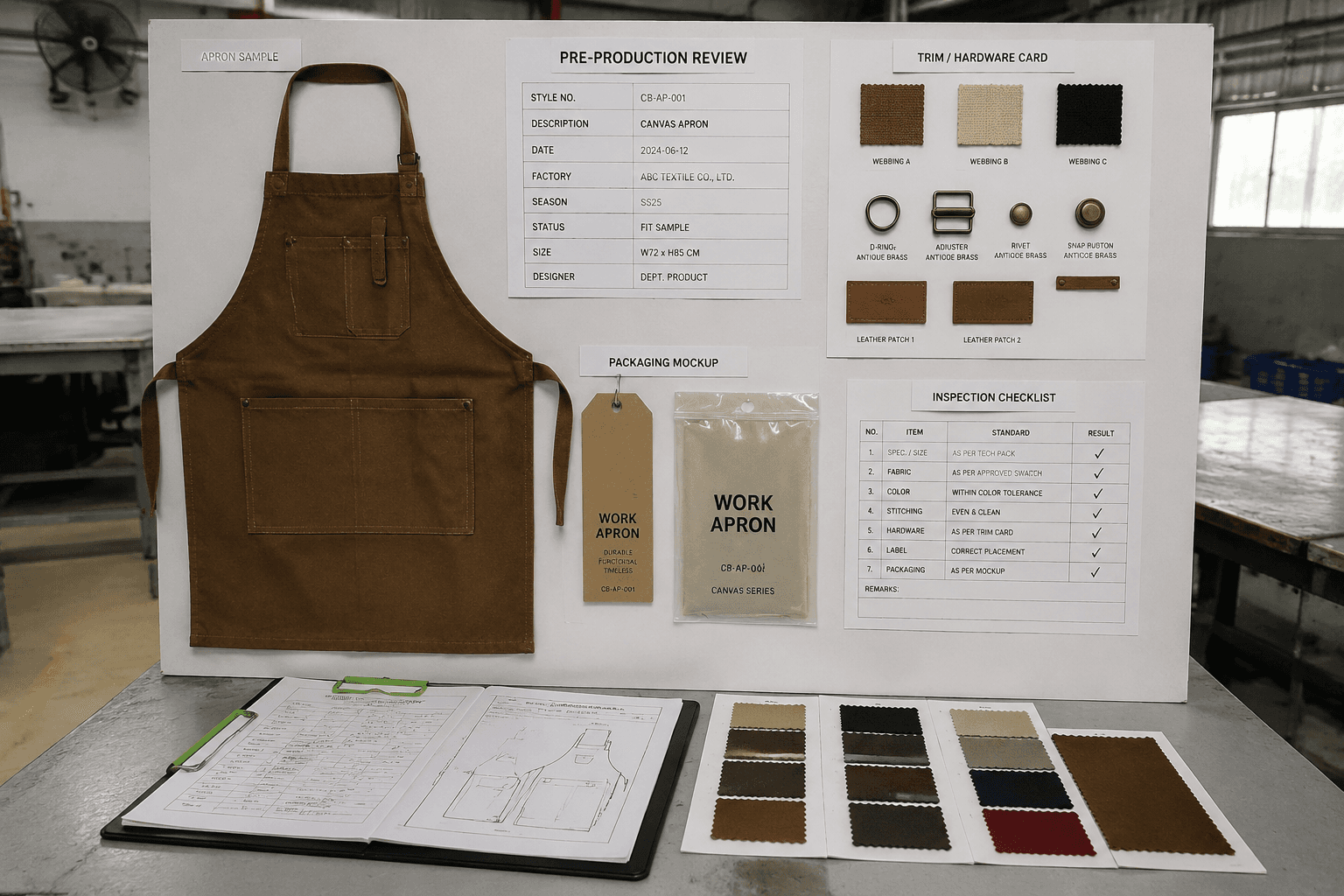
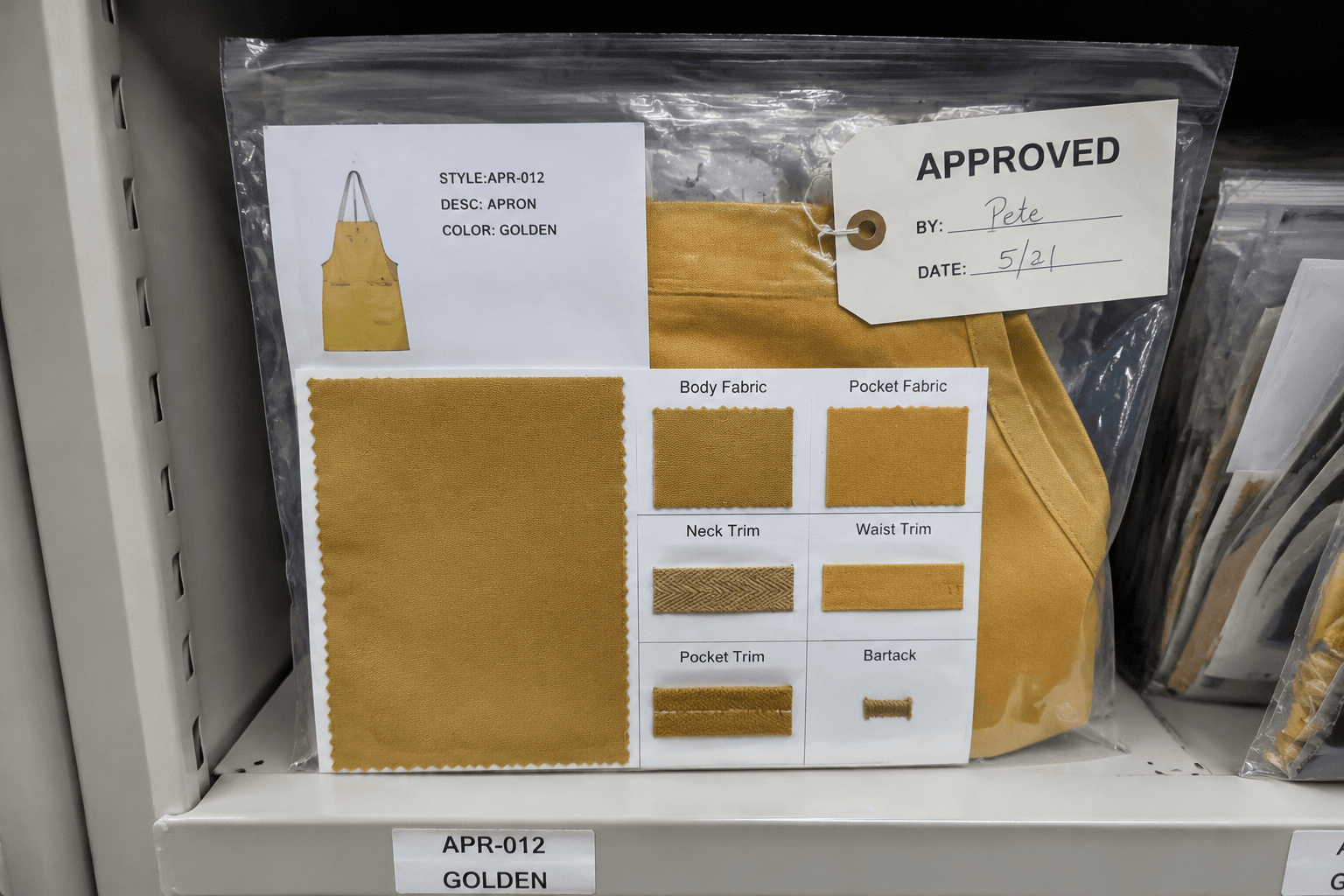
Apron quality control should therefore start with a pre-production file. This file normally includes the approved sample, fabric swatch, GSM or oz specification, color standard, trim card, size chart, sewing details, packaging method and carton information. For a custom apron order, the file should also include logo placement in millimeters, thread color, pocket dimensions and strap length. When the file is complete, the factory QC team, sewing line leader and final inspector are checking against the same standard.
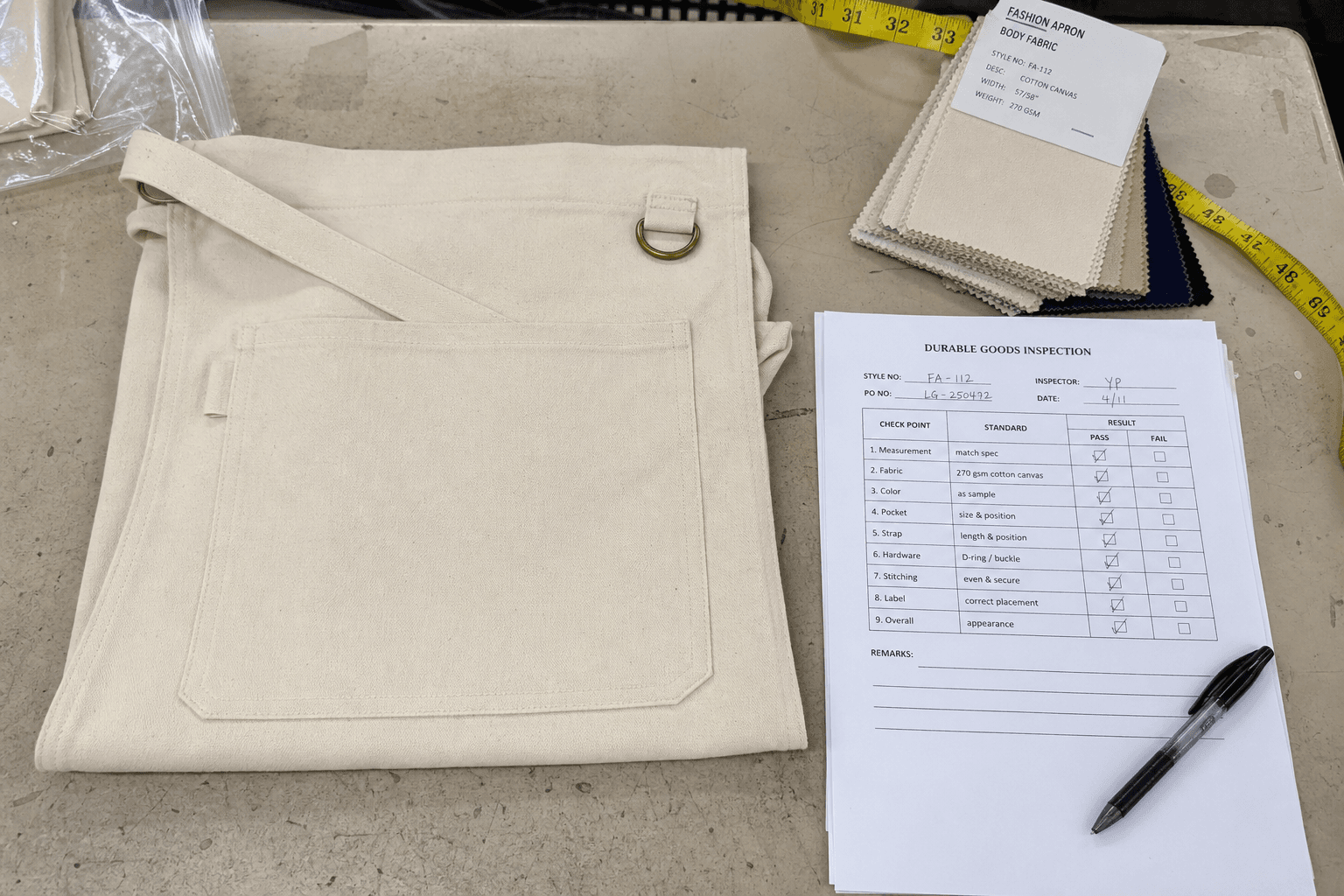
A practical control plan for aprons usually has three stages: incoming material inspection, inline inspection and final AQL inspection. For a standard 3,000-piece bib apron order, incoming fabric and trims may take 1 day, inline inspection may be done when 20-30% of goods are sewn, and final inspection is arranged when 100% of goods are finished and at least 80% are packed. This timing gives the buyer enough evidence before paying the balance.
- Incoming inspection should verify fabric composition, weight, color, shrinkage risk and obvious weaving defects.
- Inline inspection should catch wrong seam allowance, weak stitching, inaccurate pocket setting and logo placement before the full lot is completed.
- Final apron QC should confirm appearance, measurement, workmanship, packing and carton assortment against the purchase order.
- Payment release should be scheduled after corrective action is closed, not before the factory has rechecked repaired goods.
Define the approved standard: sample, fabric, GSM and workmanship
Most apron disputes are not caused by inspection itself; they are caused by unclear standards. A buyer may write “heavy cotton apron” on the purchase order, while one supplier quotes 230 GSM, another quotes 280 GSM and another quotes 10 oz canvas. These are different cost levels and performance levels. Before production, the buyer should define the exact fabric, such as 100% cotton canvas 280 GSM, polyester-cotton twill 200 GSM, 12 oz denim or 65/35 poly-cotton 190 GSM with water-repellent finish.
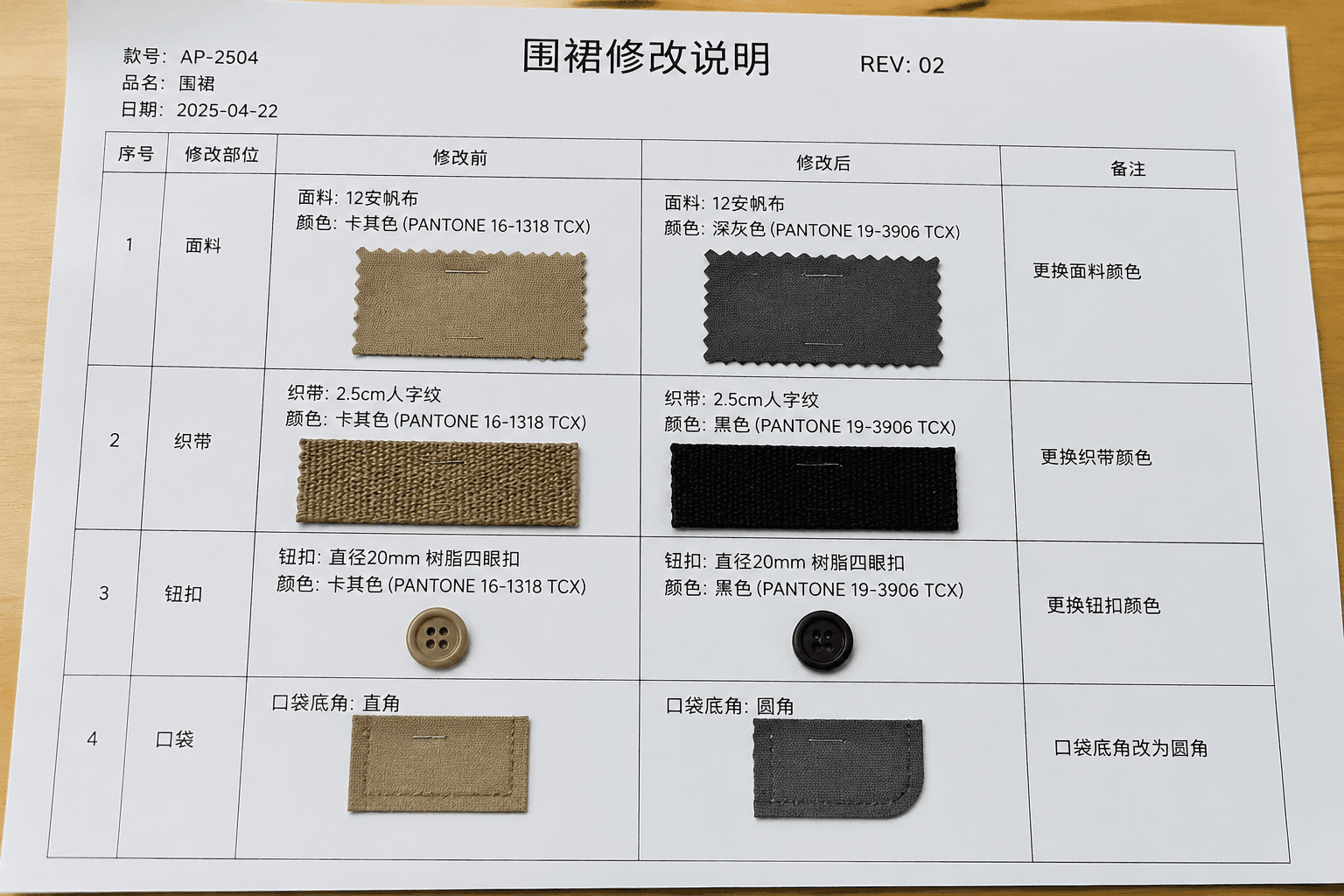
For apron quality control, the approved sample must be tagged and dated. If several sample revisions exist, the factory and buyer should clearly identify which one is the production sample. Small details need written confirmation: whether the neck strap is adjustable with a metal buckle, whether the waist ties are 90 cm or 100 cm each, whether the pocket opening is reinforced with bar tacks, and whether the bottom hem is single-fold or double-fold. A USD 2.20 promotional apron and a USD 6.80 hospitality apron can both pass QC, but they cannot be judged by the same construction expectation.
Color control is also important for apron sourcing because many orders are brand-sensitive. For solid dyed cotton aprons, the factory should check bulk fabric against Pantone, lab dip or approved swatch under a light box. A normal commercial tolerance may be around grade 4 on the gray scale, but premium brand orders may require tighter control. For black, navy, khaki and dark green aprons, buyers should pay extra attention to shade banding between rolls and rubbing fastness on straps, especially if the apron will be used with white shirts.
- Fabric weight should be specified as GSM or oz, for example 240 GSM twill, 280 GSM canvas or 12 oz denim.
- Dimensional tolerance should be written in centimeters, commonly +/-1 cm for pocket position and +/-2 cm for apron body length on standard styles.
- Logo tolerance should include size, color, position and maximum skew, such as within 3 mm for embroidery placement on premium orders.
- Trim standards should include buckle material, eyelet finish, tape width, thread color, zipper quality if used and label position.
- Washing or finishing requirements should state whether pre-shrink, enzyme wash, stone wash, water repellent or oil repellent treatment is required.
AQL inspection apron sampling: how many pieces are checked
AQL means Acceptable Quality Limit. In practical sourcing, AQL inspection apron sampling tells the inspector how many pieces to check and how many defects can be accepted before the lot fails. Most apparel inspections use ANSI/ASQ Z1.4 or ISO 2859-1 sampling tables. The buyer selects an inspection level and AQL limits for critical, major and minor defects. The inspector then randomly selects cartons and pieces from the finished order.
For custom aprons, many buyers use General Inspection Level II with AQL 0 for critical defects, 2.5 for major defects and 4.0 for minor defects. For a 5,000-piece apron order, Level II typically requires a sample size of 200 pieces. At AQL 2.5, the major defect acceptance number is usually 10 and rejection number is 11. At AQL 4.0, the minor defect acceptance number is usually 14 and rejection number is 15. These numbers should be confirmed with the inspection company’s table, but the principle is consistent: a small sample represents the whole lot.
Some buyers request tighter inspection, especially for uniforms, retail packaging or food-service chains. For example, AQL 1.5 for major defects may be used for premium waxed canvas aprons at USD 9.50 per piece, while AQL 4.0 may be acceptable for a low-cost event apron at USD 1.35 per piece. The inspection level should match the order value, customer risk and rework feasibility. If the apron includes metal hardware, children’s use, heat-resistant material or a compliance claim, additional testing may be needed beyond AQL visual inspection.
- Critical defects should normally have AQL 0 because they involve safety, legal risk or unusable product.
- Major defects usually include problems that affect saleability, durability, appearance or function.
- Minor defects usually include small workmanship issues that do not affect normal use but reduce perceived quality.
- General Inspection Level II is common for normal apron pre-shipment inspection.
- Tighter AQL levels increase inspection pressure and may increase rework time by 2-7 days if the lot fails.
Apron defect inspection: what counts as critical, major and minor
Clear defect classification avoids negotiation during inspection. The inspector should not decide alone whether a crooked pocket is acceptable or not. The buyer and factory should agree before production. For aprons, critical defects are uncommon but serious. A broken needle part, sharp metal burr on a buckle, mold contamination, wrong safety warning or restricted chemical issue may be classified as critical. One critical defect can fail the shipment.
Major defects are the main focus of apron defect inspection. These include wrong fabric, wrong color, missing logo, wrong logo position beyond tolerance, open seam, broken stitch, poor bar tack, missing pocket, wrong size, oil stain, hole, fabric tear, severe shade variation, incorrect label or incorrect packing ratio. For a bib apron with adjustable neck strap, a non-functioning buckle is major because it affects wearability. For a waist apron, a waist tie sewn too short may also be major because staff cannot fasten it properly.
Minor defects are small issues visible on close inspection but not likely to affect function. Examples include slight loose thread, minor crease, small yarn slub within agreed tolerance, slight uneven topstitching or small chalk mark that can be removed. However, buyers must be careful: one minor loose thread is acceptable; widespread loose threads on 40% of the sample show weak line control and may indicate a systematic problem.
- Critical defects include sharp metal edges, broken needle contamination, mildew, strong chemical odor or safety non-compliance.
- Major workmanship defects include open seams, skipped stitches, weak bar tacks, broken stitches, twisted straps and missing reinforcement.
- Major appearance defects include visible stains, holes, wrong shade, incorrect logo, printing crack, embroidery puckering and fabric damage.
- Major measurement defects include body length, width, pocket size or strap length outside approved tolerance.
- Minor defects include isolated loose thread, slight uneven seam, small removable mark or minor fabric slub within the accepted standard.
Measurements and fit points specific to aprons
Aprons look simple, but measurement errors are common because several parts are narrow, long or flexible. The most important points are body length, top width, bottom width, waist position, neck strap length, waist tie length, pocket size and pocket placement. On cross-back aprons, the strap crossing point and strap length must be checked carefully because a 5 cm error can change how the apron fits on different body sizes.
A standard adult bib apron may be 70 cm wide by 80 cm long, with 90-100 cm waist ties. A café apron may have a 30 cm by 18 cm divided front pocket, while a tool apron may need deeper 22-25 cm pockets and stronger reinforcement. If the apron is for a European uniform program, the buyer may request graded sizing such as S/M and L/XL. In that case, size marking and carton assortment become important QC points, not just cutting dimensions.
Shrinkage should be considered before final measurement approval. Cotton canvas and denim can shrink after washing, commonly 3-5% if not pre-shrunk. If a buyer sells washable aprons, the specification should state whether measurements are before wash or after wash. For washed denim aprons, the factory should measure after the washing process, because enzyme wash or stone wash can change both dimensions and hand feel. For polyester-cotton aprons, shrinkage is usually lower, often 1-3%, but heat setting and finishing still matter.
- Bib apron body length should commonly be checked from top center edge to bottom hem, not including neck strap.
- Waist apron length should be measured from waistband top edge to bottom hem after the garment is laid flat.
- Pocket placement should be measured from fixed edges, such as side seam and top edge, to avoid inconsistent reference points.
- Strap length should be measured end to end, including or excluding hardware according to the approved measurement method.
- For washed aprons, the tolerance should apply after washing and drying if the order is sold as a washed product.
Logo, printing and embroidery checks before balance payment
Custom aprons often carry a restaurant, brewery, hotel, salon or retail brand logo. This makes decoration QC as important as sewing QC. A blank apron with a small stitch issue can sometimes be repaired; an apron with the wrong logo color on 3,000 pieces may not be commercially usable. Before bulk production, the buyer should approve a strike-off or embroidery sample on the actual production fabric, not only on a loose test cloth.
For screen printing, apron QC should check color, opacity, registration, hand feel, curing and wash resistance. Thick cotton canvas may absorb ink differently from poly-cotton twill. For dark aprons, underbase printing may be required, adding cost and production time. For heat transfer logos, the inspector should check edge adhesion, cracking, bubbling and temperature marks. For embroidery, common defects include thread break, puckering, wrong density, rough backing, color mismatch and distorted small letters.
Logo position should be measured, not estimated by eye. If the approved position is 12 cm below the top edge and centered, the tolerance should be specified, for example +/-5 mm for a premium uniform order or +/-10 mm for a promotional order. On pockets, the logo must be checked after the pocket is sewn, because pocket distortion can make a correctly embroidered panel look crooked on the finished apron.
- Screen print inspection should include color match, registration, edge sharpness, ink coverage, curing and cracking.
- Embroidery inspection should include thread color, logo size, stitch density, backing removal, puckering and trimming.
- Heat transfer inspection should include adhesion, edge lift, scorch marks, bubbling and wash-test result if required.
- Logo placement should be checked with a ruler on multiple pieces, especially across different sewing lines.
- For repeat orders, the current bulk logo should be compared with the last approved shipment sample.
Apron pre-shipment inspection: packing, cartons and export readiness
Apron pre-shipment inspection is not complete if the inspector only checks loose garments. Packing errors can delay receiving, cause warehouse chargebacks or make goods unsellable in retail. The inspector should open randomly selected export cartons, verify the carton mark, count pieces, confirm color and size assortment, and check inner packaging. If the order requires individual polybags with barcode stickers, every element should match the buyer’s packing instruction.
For B2B uniform orders, packaging may be simple: 1 piece per polybag, 50 pieces per carton, carton size around 55 x 35 x 35 cm depending on fabric weight. For heavy 12 oz canvas aprons with hardware, a carton may hold only 25-30 pieces to keep gross weight below 18-20 kg. For retail apron orders, packaging may include hangtag, size sticker, belly band, insert card, hanger or FSC paper band. Each extra packaging component adds a QC point and should be included in the inspection checklist.
Carton condition also matters. Wet cartons, weak tape, wrong shipping marks or over-weight cartons can cause problems during loading and destination handling. If the apron order is shipped by sea, moisture control is important for cotton and denim. The factory may use dry cartons, inner poly liner or desiccant depending on the season and transit route. In Zhejiang, rainy season and humid warehouse conditions can affect cartons if goods are stored too long before vessel departure.
- Carton count should match the packing list and the total order quantity.
- Carton marks should show buyer PO number, item number, color, size, quantity, carton number and gross/net weight if required.
- Inner packing should match the approved method, such as 1 piece per polybag or 10 pieces bundled without individual bags.
- Barcode and retail labels should be scanned or visually checked against the buyer’s data file.
- Carton weight should stay within the buyer’s handling limit, commonly below 20 kg gross weight unless otherwise approved.
Using apron quality control results to decide pay, rework or ship
The final inspection report should give a clear decision: pass, fail or pending. A pass means the sample results are within the agreed AQL limits and the inspector found no blocking issue. A fail means defects exceed the rejection number or a critical issue is found. Pending usually means the goods cannot be fully judged because production is incomplete, packing is insufficient or key information is missing. Buyers should avoid paying the balance against a pending report unless the open issue is minor and documented.
If the shipment fails, the next step should be corrective action, not argument. The factory should sort the full lot, repair what can be repaired, replace unrepairable pieces and provide a reinspection plan. For common apron issues such as loose threads, missed bar tacks, wrong packing ratio or removable stains, rework may take 1-3 days for 3,000 pieces. For logo errors, fabric shade problems or wrong cutting size, rework can take 7-20 days or require remake, depending on material availability. This is why early apron QC is cheaper than final-stage correction.
A reasonable payment workflow is to pay deposit before production, inspect finished goods before shipment, then release balance after an approved inspection report and final packing list. For new suppliers or high-value orders, buyers may appoint a third-party inspector. For stable repeat programs, the buyer may combine factory QC report, production photos and periodic third-party audits. In either case, the inspection standard must be written into the purchase order so that apron quality control is enforceable before the goods leave China.
- Release balance payment when the AQL result passes, cartons are complete and all required documents are ready.
- Request full sorting when the same major defect appears repeatedly in the inspection sample.
- Request reinspection when rework affects a large quantity or changes the packing status.
- Accept shipment with concession only when the defect is minor, quantified and commercially acceptable to the end customer.
- Record every failed inspection reason to improve the next purchase order, sample approval and inline QC checklist.