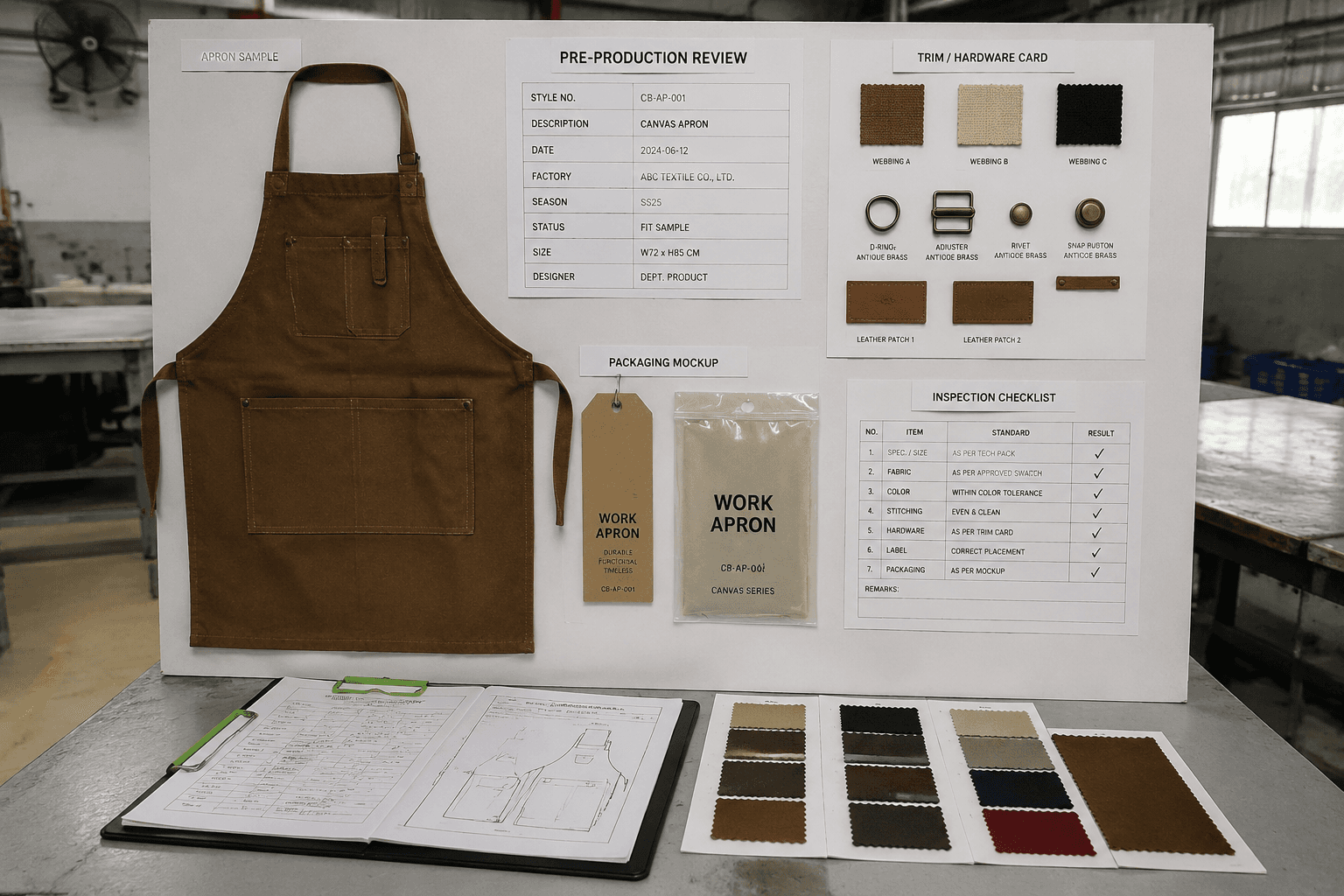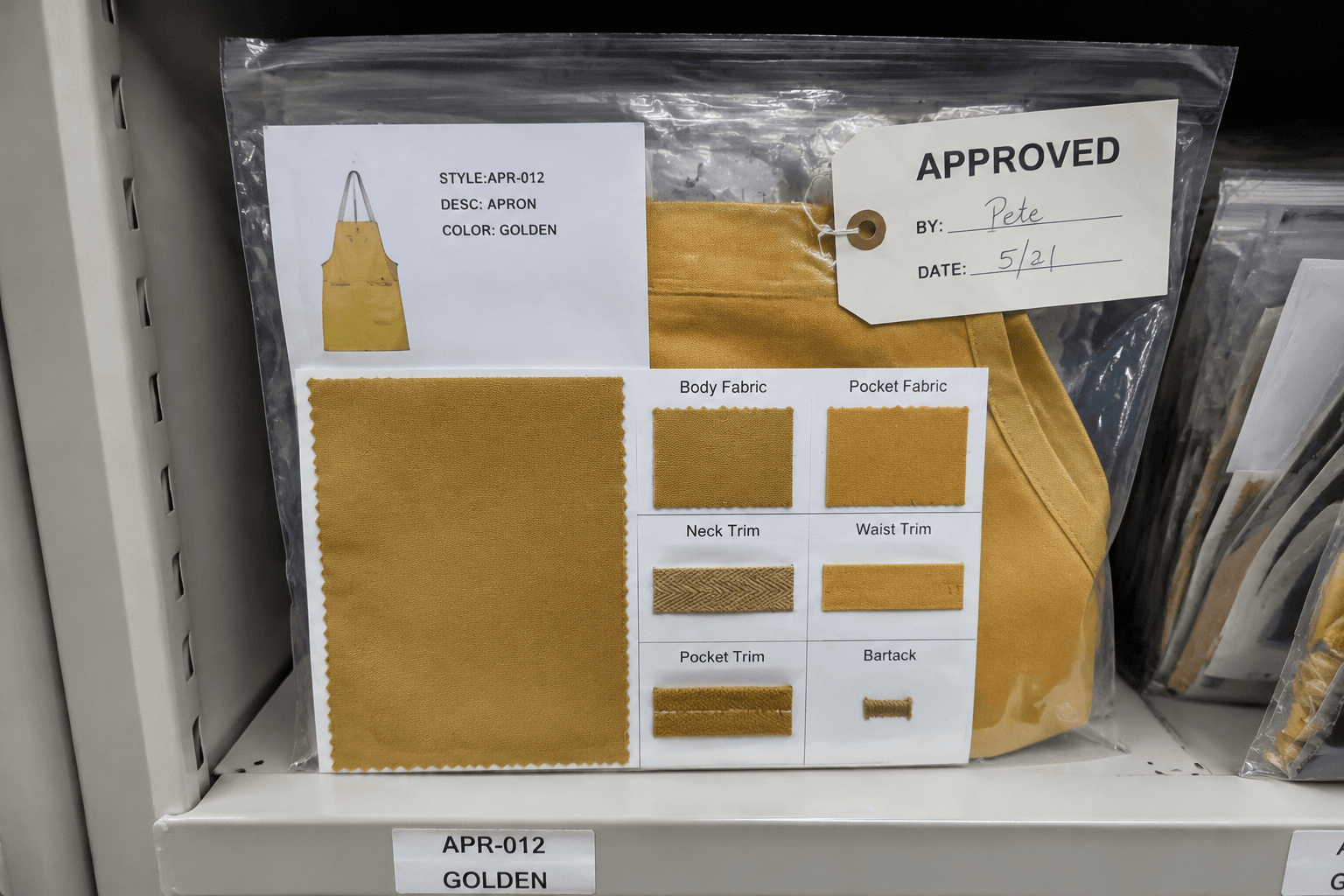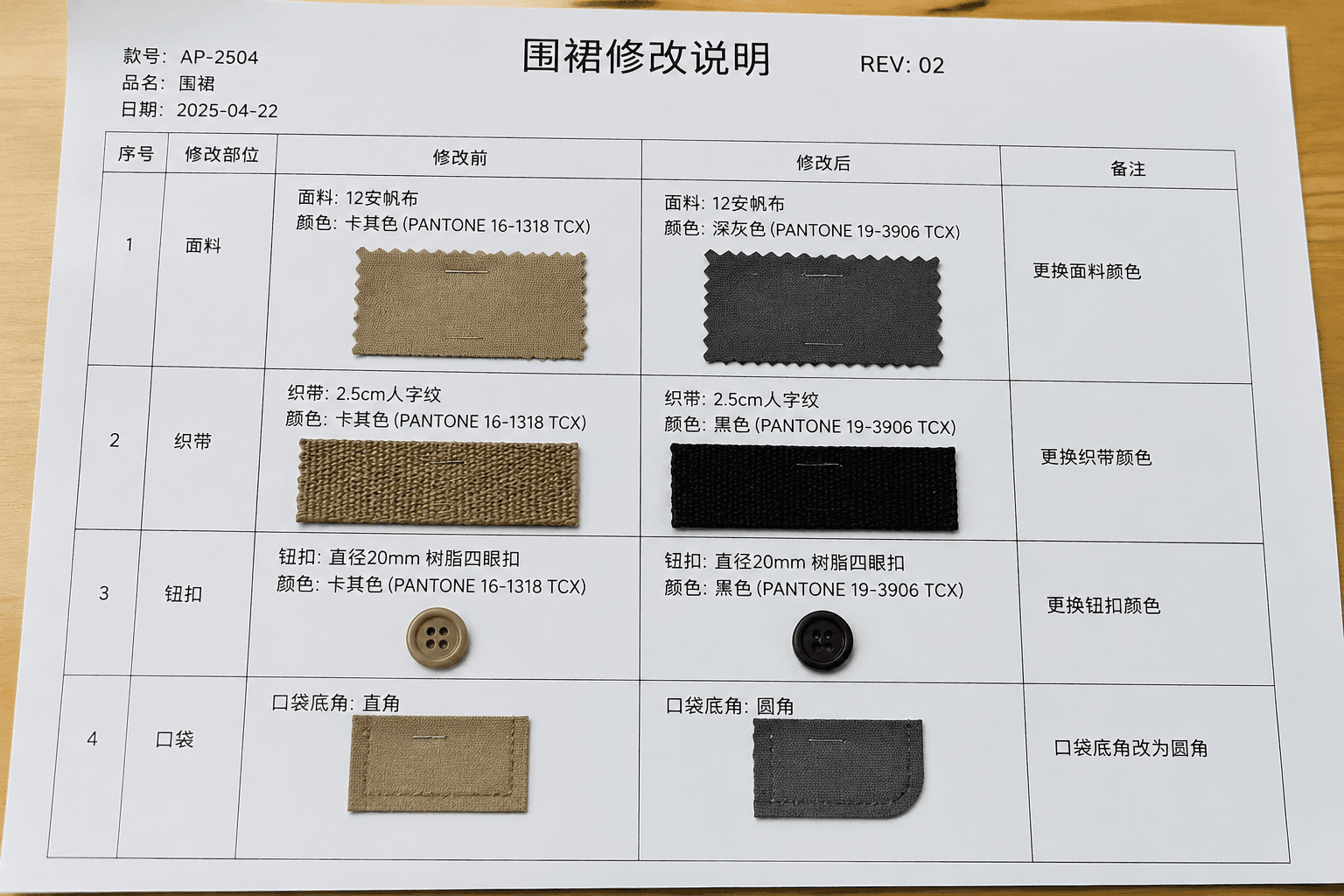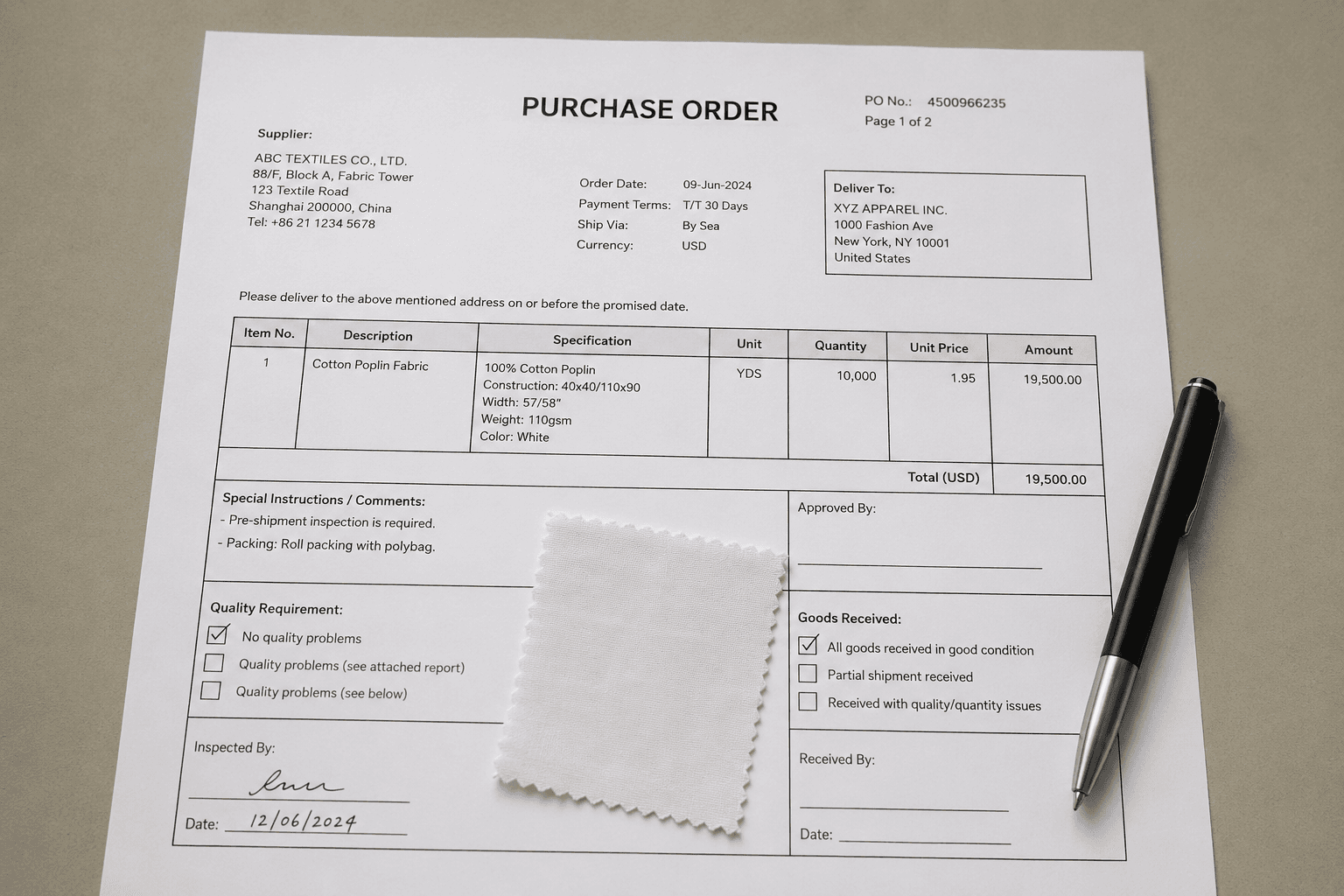
An apron purchase order is not only a buying document. For a custom apron factory, it is the production instruction that connects fabric booking, cutting, printing, sewing, packing, inspection, and shipment. If the terms are vague before deposit, the risk usually appears later as shade variation, wrong pocket placement, carton overweight, missing barcodes, or a shipment that cannot meet the launch date.
For bulk apron sourcing from China, the best time to remove ambiguity is before the supplier buys fabric and trims. After deposit, a factory may already reserve greige fabric, dye lot capacity, webbing, metal hardware, polybags, cartons, and printing screens. Changes are still possible, but they often add 3-10 days and sometimes create scrap cost.
This apron po checklist explains the terms buyers should lock in an apron order agreement before paying deposit. The details below are based on normal OEM apron production in Zhejiang: cotton canvas, poly-cotton twill, denim, chef aprons, bib aprons, waist aprons, cross-back aprons, and promotional aprons ordered in bulk.
- Confirm fabric by construction, GSM or oz, color standard, shrinkage, and testing requirement before deposit.
- Lock the approved sample with measurements, pocket positions, print size, trims, label, and stitching details.
- Define MOQ, tolerance, unit price basis, payment milestones, and who pays for change cost.
- Put packing, carton marks, barcode rules, and Amazon or retailer requirements into the PO, not into separate emails only.
- Reserve enough lead time for fabric dyeing, sampling, bulk production, inspection, and vessel or air booking.
- State inspection method and acceptable quality level so defect disputes are handled by agreed rules.
Why the apron purchase order must be more detailed than a price confirmation
A price confirmation may say “10,000 pcs black bib apron, cotton canvas, logo print, FOB Ningbo.” That is enough for a rough quotation, but not enough for production. A real apron purchase order should tell the factory what fabric to buy, what shrinkage is accepted, where the neck strap ends, how large the pocket is, whether the pocket has a pen slot, which thread color to use, how the logo is placed, and how the cartons are marked.
Aprons look simple, but bulk production has many small decisions. A 10 oz cotton canvas apron and a 280 GSM cotton canvas apron may sound similar to a buyer, yet they can feel different after washing. A 65/35 poly-cotton twill at 210 GSM may be suitable for promotional café uniforms, while a 320 GSM cotton twill may be too heavy for a fast-food chain that needs low freight cost and quick drying. If the apron order terms do not define these points, the factory has to make assumptions.
The most expensive disputes usually come from assumptions made in good faith. The buyer assumes the neck strap is adjustable with antique brass hardware. The factory assumes a fixed cotton tape neck because the target price is USD 1.85/pc. The buyer assumes individual polybags with size stickers. The factory assumes bulk pack because the quote excluded retail packing. A strong apron purchase order prevents this gap before money and time are committed.
- Use the PO as the master document for product, commercial, quality, packing, and shipment terms.
- Attach the approved sample report, tech pack, artwork, size chart, and packing instruction to the same PO record.
- Ask the factory to countersign or stamp the PO before deposit, especially for first orders or retailer programs.
- Keep WeChat or email discussions as backup only; the final locked terms should sit inside the apron order agreement.
Product specification terms to lock in every apron purchase order
The first part of the apron purchase order should identify the exact apron style. “Bib apron” is not enough. A factory needs the apron shape, body dimensions, neckline type, strap system, pocket layout, fabric, color, stitching, logo method, and all trims. For a buyer managing several SKUs, each color and style should have its own line item or SKU table to avoid mixing instructions.
For measurements, use a tolerance that matches apron production reality. For most woven aprons, a body length and width tolerance of +/-1 cm is workable after cutting and sewing. Strap length can often be held within +/-2 cm. Pocket placement should be tighter, normally +/-0.5 cm to +/-1 cm, because uneven pocket position is visible when staff wear the apron side by side. If the apron has a printed logo centered above the pocket, define whether centering is measured from apron body center, pocket center, or neckline center.
Fabric terms should be written in a way that both purchasing and production can verify. Instead of “thick cotton,” write “100% cotton canvas, 10 oz, reactive dyed black, pre-shrunk, target finished weight 330-350 GSM.” Instead of “polyester cotton,” write “65% polyester 35% cotton twill, 210-230 GSM, yarn dyed or piece dyed as specified.” For denim aprons, clarify indigo denim versus black denim, enzyme wash or no wash, and whether color bleeding testing is required.
- Style code, buyer SKU, color name, Pantone or lab dip reference, and order quantity per color.
- Finished measurements, size grading if applicable, and tolerance for body, straps, pockets, and logo position.
- Fabric composition, weave, GSM or oz, dye method, shrinkage target, and required test standards.
- Neck strap type: fixed, adjustable buckle, D-ring, slider, halter, or cross-back.
- Waist tie material and length, such as cotton tape 90 cm each side or polyester herringbone tape 100 cm each side.
- Pocket construction, including pocket size, divisions, rivets, bartacks, pen slot, towel loop, or tool loop.
Sample approval and change control before deposit
For custom aprons, the deposit should be paid only after the buyer and supplier agree which sample is the production standard. The approved sample may be a fit sample, pre-production sample, or sealed sample. The important point is that it carries a clear date, version number, fabric reference, artwork reference, and trim reference. If the factory keeps one sealed sample and the buyer keeps one, both sides can compare bulk goods against the same standard.
A common problem is approving the appearance of one sample while leaving cost-related details open. For example, the sample uses 320 GSM cotton canvas, but the quotation was based on 280 GSM. The sample has metal eyelets, but the PO does not mention them. The sample has double-needle stitching around the pocket, but the supplier planned single-needle for bulk. These differences may be small at 500 pcs, but at 20,000 pcs they change fabric usage, labor minutes, trim cost, and sewing line speed.
Any change after deposit should be documented with impact on unit price, lead time, and sample status. If the buyer changes logo size after screens are made, the extra screen charge may be USD 25-60 per color depending on print method and artwork. If the buyer changes fabric weight after fabric booking, the supplier may need to cancel or use the booked fabric for another customer, which is not always possible. A practical po template apron buyers use should include a change approval line.
- Approved sample version, approval date, and whether it is a photo approval, physical sample approval, or sealed sample.
- Artwork version, print colors, embroidery thread colors, logo size, placement coordinates, and tolerance.
- Trim card approval for buckles, D-rings, buttons, rivets, snaps, labels, tapes, and thread.
- Rule that any post-deposit change requires written approval for cost, timing, and sample revision.
Commercial apron order terms: MOQ, price basis, tolerance, and payment
Commercial terms should be simple, but they must be complete. Apron factories quote based on fabric consumption, trim cost, cutting efficiency, printing or embroidery, sewing minutes, packing, wastage, inland transport, and export handling. A small detail such as 10 cm longer waist ties can increase consumption across thousands of pieces. A retail hangtag and barcode sticker may add USD 0.03-0.08/pc. Heavy canvas can increase carton weight and freight cost even when the FOB unit price looks acceptable.
MOQ should be stated by style, color, and fabric. A factory may accept 500 pcs for a simple promotional apron in stock polyester twill, but require 1,000-2,000 pcs per color for custom-dyed cotton canvas. For yarn-dyed stripe aprons, MOQ can be higher because the fabric mill has its own weaving minimum, sometimes 800-1,500 meters. If several colors are ordered under one PO, clarify whether the MOQ is per color or total order quantity.
Quantity tolerance is also important. For fabric-dyed apron orders, a +/-3% or +/-5% shipment tolerance is common because cutting yield, defects, and fabric length variation affect the final output. Some retailers require exact quantities by SKU, but this may increase sorting pressure and leftover risk. Payment terms should include deposit percentage, balance timing, and documents required. A typical OEM apron order may use 30% deposit and 70% balance before shipment, while repeat customers with credit insurance may negotiate different terms.
- Unit price by SKU, currency, Incoterm, port, and whether price includes labels, packing, testing, and inspection support.
- MOQ per style, per color, per fabric, and per logo version.
- Order quantity tolerance, commonly +/-3% to +/-5% unless exact quantity is required.
- Payment terms, bank charges responsibility, deposit due date, and balance payment trigger.
- Validity period of quotation, especially when cotton, polyester, or exchange rates are moving.
- Extra charge rules for urgent sampling, revised screens, courier samples, testing, or special cartons.
Fabric, color, and testing clauses for apron sourcing
Fabric is usually the largest cost component in an apron. For a simple waist apron it may be 35-45% of total FOB cost; for a heavy cross-back canvas apron it may be 45-60%. The apron purchase order should therefore define the fabric in measurable terms. Buyers should avoid relying only on fabric names such as canvas, twill, denim, duck, or drill, because these names are used differently by different mills.
Color control is another area where small omissions become expensive. A Pantone number alone is not always enough for dyed fabric because fabric composition, weave, and finishing affect the final shade. The correct process is lab dip approval before bulk dyeing, then bulk shade approval when the first dye lot is ready. For repeat apron programs, the buyer should state whether the new bulk must match the previous shipment, the latest lab dip, or a physical standard swatch. If the apron has contrast straps or pockets, define which component is the color priority.
Testing requirements should be included before deposit because tests can affect fabric choice and lead time. Common apron tests include color fastness to washing, rubbing, perspiration, dimensional stability, seam strength, needle detection for certain markets, azo-free dye compliance, formaldehyde, and pH value. Food service brands may ask for durable washing performance at 40°C or 60°C. A test package can cost USD 80-350 depending on lab and standard, and may add 3-7 working days.
- Fabric composition, construction, weight, finishing, hand feel, and whether the fabric is pre-shrunk or washed.
- Lab dip standard, approval process, bulk shade tolerance, and rule for mixed dye lots in one shipment.
- Shrinkage target, such as within 3% after one wash at 40°C for cotton twill aprons.
- Color fastness requirement, especially for black, navy, red, indigo denim, and contrast white logo prints.
- Testing lab, test standard, cost responsibility, sample quantity, and whether failed tests allow rework or remake.
- Care label wording, wash temperature, tumble dry allowance, ironing, and bleaching restrictions.
Branding, trims, and packing terms that affect the final landed result
Branding is not only the logo. For many apron buyers, the label, hangtag, barcode, carton mark, and retail presentation are part of the product. The apron order terms should specify the branding method and its technical limits. Screen printing is cost-efficient for simple logos and medium-to-large runs. Embroidery gives a premium look but can pucker on light fabrics and costs more on dense designs. Heat transfer can work for detailed artwork, but buyers should confirm wash durability and edge feel.
For reference, a one-color screen print on a bib apron may add around USD 0.08-0.18/pc depending on size and quantity, plus screen charge. Embroidery may add USD 0.20-0.80/pc depending on stitch count and thread colors. Woven neck labels may add USD 0.03-0.08/pc when ordered in bulk, while printed satin labels can be lower. Metal hardware such as D-rings, buckles, or rivets affects both appearance and nickel testing requirements.
Packing must be described in operational detail. A PO that says “standard export carton” can still create problems if the buyer needs shelf-ready units, Amazon FBA labels, carton barcodes, or maximum carton weight below 15 kg. Aprons are soft goods, so carton compression and fold lines matter. Heavy canvas aprons packed too tightly may arrive with strong creases. White or light-colored aprons need clean packing tables and may need individual polybags to prevent dirt during handling.
- Logo method, logo size, placement, color standard, artwork file name, and print or embroidery tolerance.
- Main label, care label, size label, country-of-origin label, hangtag, sticker, and barcode requirements.
- Hardware material, finish, coating, nickel-free requirement, and anti-rust expectation.
- Individual polybag, folded size, tissue paper, belly band, hanger, or bulk pack method.
- Carton dimensions, pieces per carton, gross weight limit, carton mark layout, and pallet requirement if any.
- Retailer routing guide, Amazon FBA label placement, carton barcode grade, and mixed-SKU carton rules.
Lead time, inspection, and shipment schedule in the apron po checklist
Lead time should be calculated from confirmed deposit, approved sample, approved lab dip, and complete artwork, not from the first quotation date. For a normal custom apron order using available fabric, sampling may take 5-10 days and bulk production may take 20-30 days after approval. For custom-dyed cotton canvas or denim, fabric production and dyeing may take 15-25 days before cutting. For large orders above 30,000 pcs or multi-color retail programs, 45-60 days is more realistic.
The apron po checklist should include a date plan with responsibility for each step. Buyer approval delays are common. If lab dips are sent on day 7 but approval arrives on day 18, the supplier cannot keep the original ship date without overtime, air freight, or capacity adjustment. A practical schedule includes sample approval date, fabric booking date, bulk fabric ready date, printing start date, sewing start date, inline inspection date, final inspection date, cargo ready date, and ETD.
Inspection terms should be agreed before production. Many buyers use ANSI/ASQ Z1.4, general inspection level II, AQL 2.5 for major defects and 4.0 for minor defects. For aprons, major defects usually include wrong fabric, wrong color, missing logo, broken stitch, open seam, wrong label, visible stain, severe shade variation, incorrect pocket position, or measurement outside tolerance. Minor defects may include loose thread, slight crease, small acceptable shade difference, or minor printing edge imperfection within agreed standard.
Shipment terms should state Incoterm and port clearly. FOB Ningbo or FOB Shanghai is common for Zhejiang apron factories. EXW may look cheaper but shifts export handling and inland coordination to the buyer or forwarder. CIF or DDP can be arranged, but the buyer should compare freight, duty, and risk responsibility carefully. If the goods are for a fixed store launch, keep buffer time: 3-5 days for final inspection and rework, 2-4 days for customs and port delivery, plus vessel schedule uncertainty.
- Lead time start condition: deposit received, sample approved, lab dip approved, and artwork confirmed.
- Milestone dates for fabric, printing, sewing, packing, inspection, cargo ready, ETD, and ETA.
- Inspection standard, AQL level, defect classification, measurement sampling, and re-inspection cost rule.
- Incoterm, loading port, forwarder contact, shipping marks, document requirements, and cargo handover deadline.
- Delay responsibility if approval, payment, fabric, testing, inspection, or vessel booking misses the agreed date.
A practical po template apron buyers can adapt
A useful po template apron sourcing teams use does not need to be complicated, but it must be complete enough for production. The template should combine commercial terms and technical details in one document, with attachments clearly named. If the buyer’s ERP PO is too simple, issue a supplier production confirmation or apron order agreement as an appendix and make it part of the PO.
For repeat programs, keep a master specification for each apron SKU and update only the changing items: quantity, color, delivery date, price, label batch, carton marks, and shipping instruction. This reduces repeated questions and keeps the factory from using an outdated artwork file. For first orders, ask the supplier to review the PO line by line and mark any item they cannot meet before deposit. A serious factory will prefer this conversation early rather than argue after inspection.
The final check before deposit is simple: can a production manager who never joined the sales calls make the apron correctly using only the PO, attachments, and approved sample? If the answer is no, the document is not ready. In apron manufacturing, a clear PO does not slow the order down. It saves days in sampling, prevents avoidable rework, and gives both buyer and factory a fair basis for quality control.
- Buyer details: company name, PO number, order date, billing address, delivery address, and contact person.
- Supplier details: factory name, bank information, export company if different, and production contact.
- Product table: SKU, style name, color, fabric, size, logo version, quantity, unit price, and total price.
- Technical attachments: tech pack, measurement sheet, artwork, label files, packing instruction, and approved sample photos.
- Quality terms: tolerance, testing, inspection standard, defect rules, and approved sample reference.
- Commercial terms: MOQ, quantity tolerance, Incoterm, payment, delivery date, document list, and change control rule.