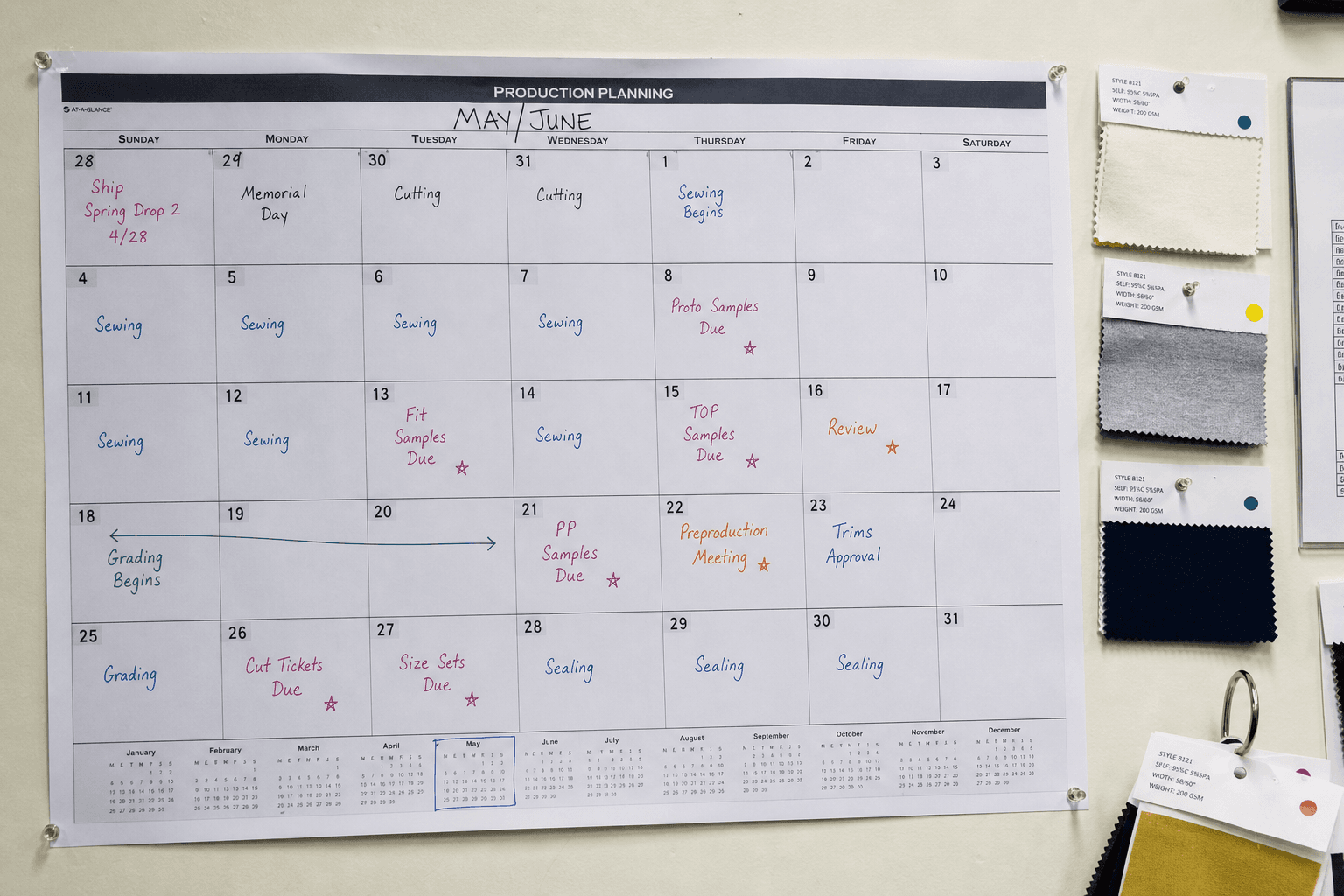
Seasonal apron programs fail most often because the calendar is built backward from the selling date, but not checked against fabric availability, sample approval time, decoration capacity, and export shipping windows. For a custom apron factory, the visible sewing time is only one part of the schedule. Yarn dyeing, fabric weaving, washing, printing, embroidery, packing material confirmation, and final inspection can each add several days, and delays usually compound near peak seasons.
A reliable apron production calendar should show more than a delivery date. It should define the buyer approval points, the supplier booking points, and the latest dates when specifications can still change without affecting shipment. For seasonal apron sourcing, especially holiday retail, back-to-school culinary programs, hospitality openings, outdoor barbecue collections, and promotional campaigns, the calendar is a working control document rather than a simple reminder list.
From a Zhejiang apron manufacturer’s side, the safest planning method is to separate development lead time, material lead time, bulk production lead time, and logistics lead time. This article explains how to build an apron launch timeline with practical day counts, MOQ considerations, and production scheduling apron details that buyers can use before issuing a purchase order.
- A seasonal apron launch should normally start 90-150 days before the in-store or campaign date, depending on fabric, decoration, and shipping mode.
- Standard dyed cotton twill aprons move faster than yarn-dyed stripe, washed canvas, denim, waxed-look, or heavy 10-12 oz fabrics.
- Artwork, lab dip, strike-off, and pre-production sample approvals should be treated as dated milestones, not informal email steps.
- Factory capacity must be booked before all trims are finished if the launch month is May-July or September-November.
- The most stable apron lead time planning uses a change-freeze date for fabric, size grading, pocket structure, and decoration placement.
Why an apron production calendar is different from a garment calendar
Aprons look simple compared with shirts, jackets, or trousers, but bulk apron production has its own timing risks. The product has large visible fabric panels, exposed stitching, long ties, repeated pocket seams, and decoration areas that are often centered on the chest or front waist. A small variation in fabric shrinkage, pocket position, strap length, or logo placement is easy for the end customer to notice. This means the calendar must protect the approval stages before fabric cutting.
For most custom apron orders, the buyer is not only selecting fabric and color. They may also need to approve neck strap construction, tie length, bartack position, eyelet color, grommet size, embroidery thread, screen print ink, woven label, wash care label, carton marks, and polybag warnings. Each approval looks small, but a missing decision can hold the whole order. In a seasonal launch, one undecided trim can consume the buffer that was meant for shipping.
Another difference is that apron orders are often linked to fixed events: a restaurant chain opening, a brewery promotion, a garden center spring campaign, a Christmas gift range, or a school culinary uniform issue. The shipment date is therefore less flexible than a replenishment order. A proper apron production calendar should show the latest ex-factory date, not only the requested arrival date.
- Bib aprons with simple screen print usually need fewer approval steps than cross-back aprons with metal hardware and multiple pockets.
- Heavy canvas or denim aprons require more careful shrinkage control before cutting because panel distortion is visible after washing.
- Promotional apron programs often have strict carton labeling and kitting requirements that should be scheduled before packing starts.
- Hospitality aprons with repeat orders should keep a confirmed technical file so that seasonal reorders can skip unnecessary redevelopment.
Start with the selling date and work back by real day counts
The first working date in an apron launch timeline is not the purchase order date. It is the date when the goods must be usable by the buyer. For retail, that may be the warehouse arrival date plus 7-14 days for allocation. For a restaurant group, it may be the staff training date before opening. For an e-commerce brand, it may be the date when product photography, fulfillment setup, and stock-in confirmation must be finished.
After the usable date is fixed, work backward through logistics, inspection, packing, bulk sewing, cutting, fabric preparation, and sampling. For sea freight from Ningbo or Shanghai to the US West Coast, allow about 18-28 days port-to-port in normal conditions, but 30-40 days door-to-door is more realistic after trucking, customs, and warehouse appointment time. For Europe, door-to-door sea freight is often 38-50 days. Air freight is faster, commonly 5-10 days door-to-door, but the cost can add USD 0.40-1.20 per apron depending on weight and destination.
For a normal 3,000-10,000 piece apron order using available fabric, bulk production may take 25-40 days after all approvals and deposits are complete. If fabric must be custom dyed or woven, add 15-35 days. If the order includes embroidery or screen printing, add 3-10 days depending on logo size, number of colors, and quantity. Therefore, a seasonal apron sourcing plan that starts only 45 days before the launch will usually force air shipment or specification compromises.
- For local stock fabric and simple logo decoration, plan 60-75 days from artwork confirmation to warehouse arrival by sea.
- For custom dyed cotton twill or canvas, plan 90-110 days from lab dip request to warehouse arrival by sea.
- For yarn-dyed stripe, jacquard, denim wash, or special finishing, plan 110-150 days before the required selling date.
- For urgent air shipment programs, confirm carton size and gross weight early because freight cost can change the landed price sharply.
Development stage: sampling, lab dips, and technical approval
The development stage is where many buyers underestimate time. A first sample for a basic bib apron can often be made in 5-7 working days if fabric is available. A cross-back apron with adjustable straps, metal buckles, double pockets, towel loop, and contrast stitching usually needs 7-12 working days. If the fabric color is not from stock, lab dips normally take 5-8 days after receiving Pantone, TCX, or physical swatch reference.
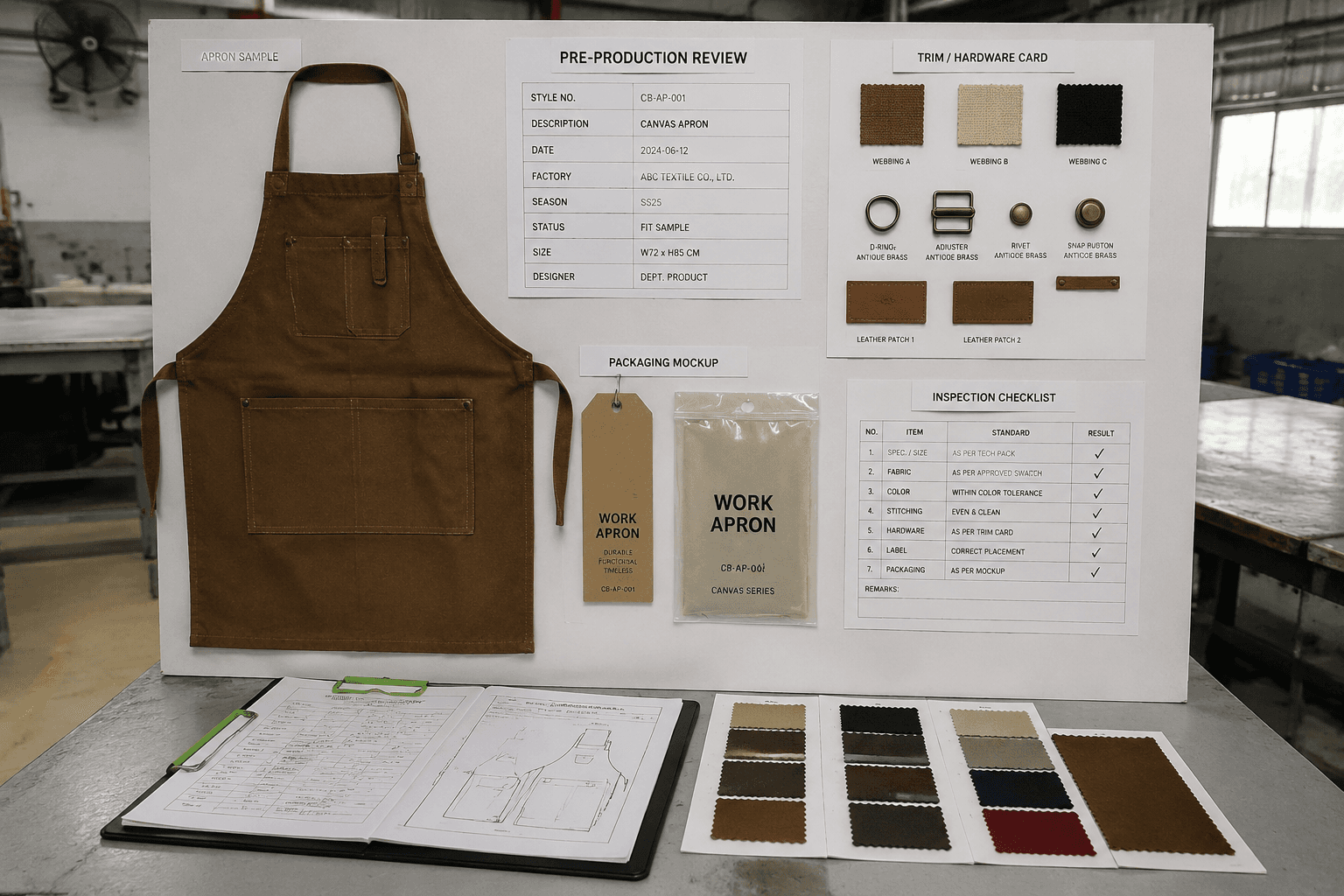
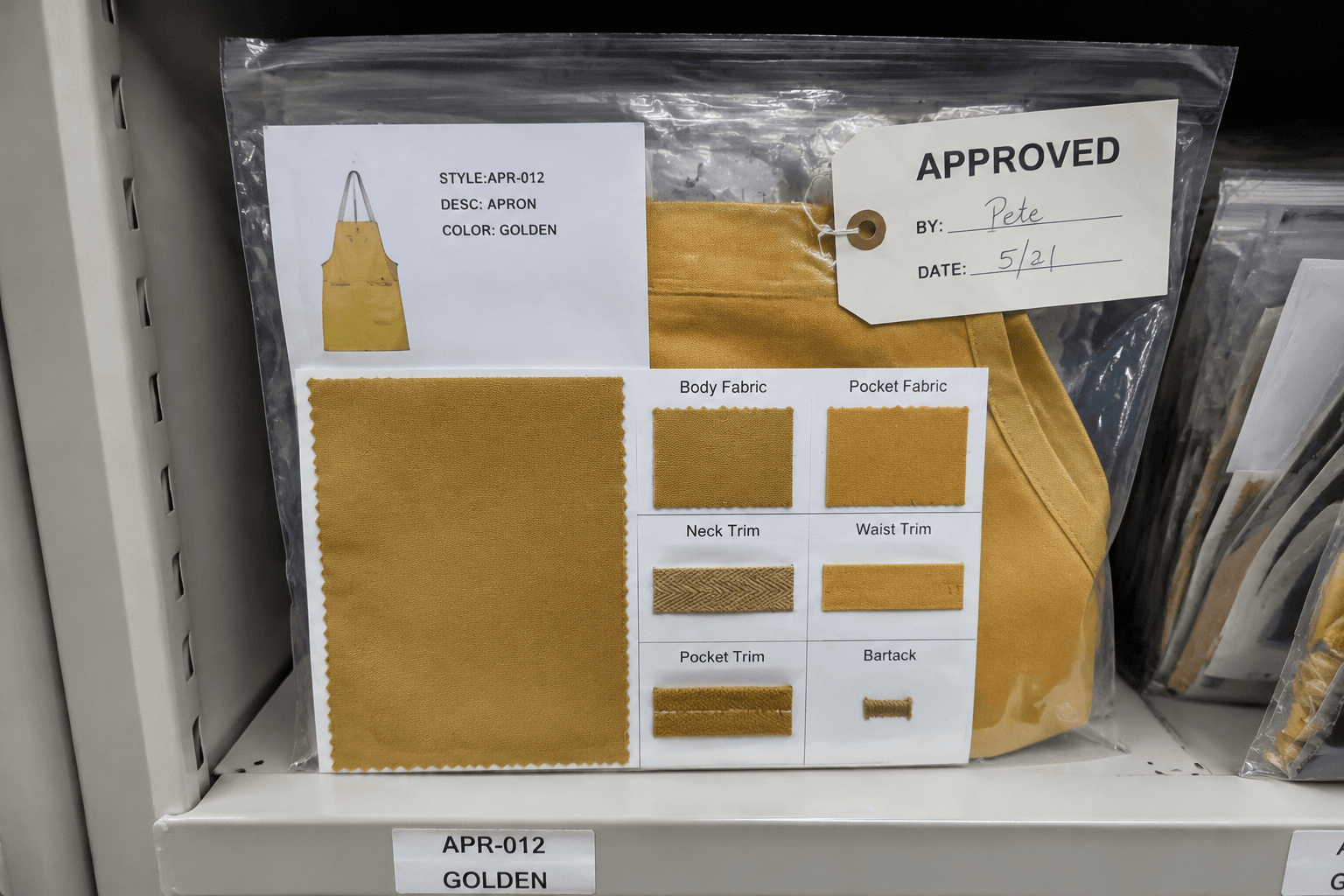
For accurate apron lead time planning, the buyer should separate design sample approval from pre-production sample approval. A design sample proves shape, pocket layout, strap system, and decoration scale. A pre-production sample confirms the exact bulk fabric, bulk trim, stitch color, label placement, shrinkage result, and packing method. Factories can start some material booking after design approval, but cutting should wait for the pre-production sample when the fabric or wash process is new.
A common calendar problem is artwork revision. Embroidery artwork may need digitizing, sample stitch-out, density adjustment, and thread color confirmation. Screen printing may need a strike-off to check ink hand feel, coverage, and curing. Heat transfer may need washing tests, especially on cotton canvas or polyester-cotton twill. A buyer who approves garment shape but leaves logo approval open has not really released production.
- Allow 5-7 working days for a first sample of a standard bib apron using available fabric.
- Allow 7-12 working days for complex aprons with cross-back straps, hardware, multiple pockets, or contrast construction.
- Allow 5-8 days for lab dips and 3-6 days for print or embroidery strike-offs after artwork is confirmed.
- Allow 2-4 days for internal pre-production checking after all materials arrive at the factory.
Fabric and trim timing for seasonal apron sourcing
Fabric choice has the largest effect on an apron production calendar. A 180-220 GSM polyester-cotton twill in black, white, navy, or red may be available quickly from regular mills. A 240-280 GSM cotton twill, 300 GSM canvas, 10 oz denim, or washed cotton-linen blend often requires mill booking. If the buyer needs a custom Pantone color, fabric dyeing and color approval become the critical path.
For aprons, GSM and construction affect not only cost but also cutting yield, sewing speed, and packing weight. A lightweight 180 GSM poly-cotton bib apron may pack 100 pieces per carton with reasonable carton weight. A 320 GSM canvas apron with long ties, double pockets, and metal hardware may need larger cartons and increases sea freight volume. The buyer may see only USD 0.30-0.60 per piece difference in fabric cost, but the landed cost can shift again through carton dimensions and freight.
Trim timing should not be treated as an afterthought. Cotton webbing, herringbone tape, metal eyelets, leather-look patches, woven labels, and branded buckles may have separate MOQs. A factory can keep common black or natural twill tape in stock, but custom dyed tape may require 7-15 days and a MOQ of 1,000-3,000 meters. Branded woven labels often need 7-10 days after artwork approval, with 3,000-5,000 piece MOQ depending on size and weave density.
- 180-220 GSM poly-cotton twill is suitable for value hospitality and promotional aprons where fast production and easy care matter.
- 240-280 GSM cotton twill gives a better retail hand feel but needs stronger shrinkage control and may add dyeing time.
- 280-340 GSM canvas works well for workwear and premium kitchen aprons, but it slows sewing and raises freight weight.
- 8-10 oz denim aprons require attention to washing, shade variation, needle selection, and seam thickness.
- Custom trims should be approved at the same time as fabric because a late label or buckle can stop packing even when aprons are sewn.
Building the apron production calendar around factory capacity
A practical apron production calendar must include factory capacity booking. In Zhejiang, apron factories often handle a mix of export kitchen textiles, uniforms, promotional textile items, and workwear accessories. Capacity becomes tight before major Western retail seasons and before Chinese New Year. Even if the physical sewing time for 5,000 aprons is only 12-18 days on one line, the line may already be assigned to another buyer when the purchase order arrives.
For simple bib aprons, one experienced sewing line can often produce 800-1,500 pieces per day depending on fabric, pocket count, decoration process, and quality standard. Cross-back aprons, heavy canvas aprons, and aprons with binding or multiple bartacks may reduce output to 300-800 pieces per day. These numbers are factory planning figures, not guaranteed daily output, because inspection findings, needle changes, thread color changes, or decoration waiting time can interrupt the flow.
The best way to secure capacity is to release the order in stages. First, confirm the forecast quantity and target shipment window. Second, approve fabric and main construction. Third, issue the purchase order with deposit so the supplier can book fabric and line space. Final artwork or carton marks can sometimes follow shortly afterward, but only if they are not on the critical path. A calendar that waits for every minor item before booking production may look clean on paper but lose the sewing slot.
- For 1,000-3,000 pieces, plan one smaller batch with 15-25 days bulk production after material arrival.
- For 5,000-10,000 pieces, plan 25-40 days including cutting, decoration, sewing, inline inspection, finishing, and packing.
- For 20,000 pieces and above, split by color, style, or delivery wave so inspection and logistics can move without waiting for the final batch.
- For peak months, reserve line capacity 30-45 days before material arrival when the launch date is fixed.
Approval freeze points that protect the apron launch timeline
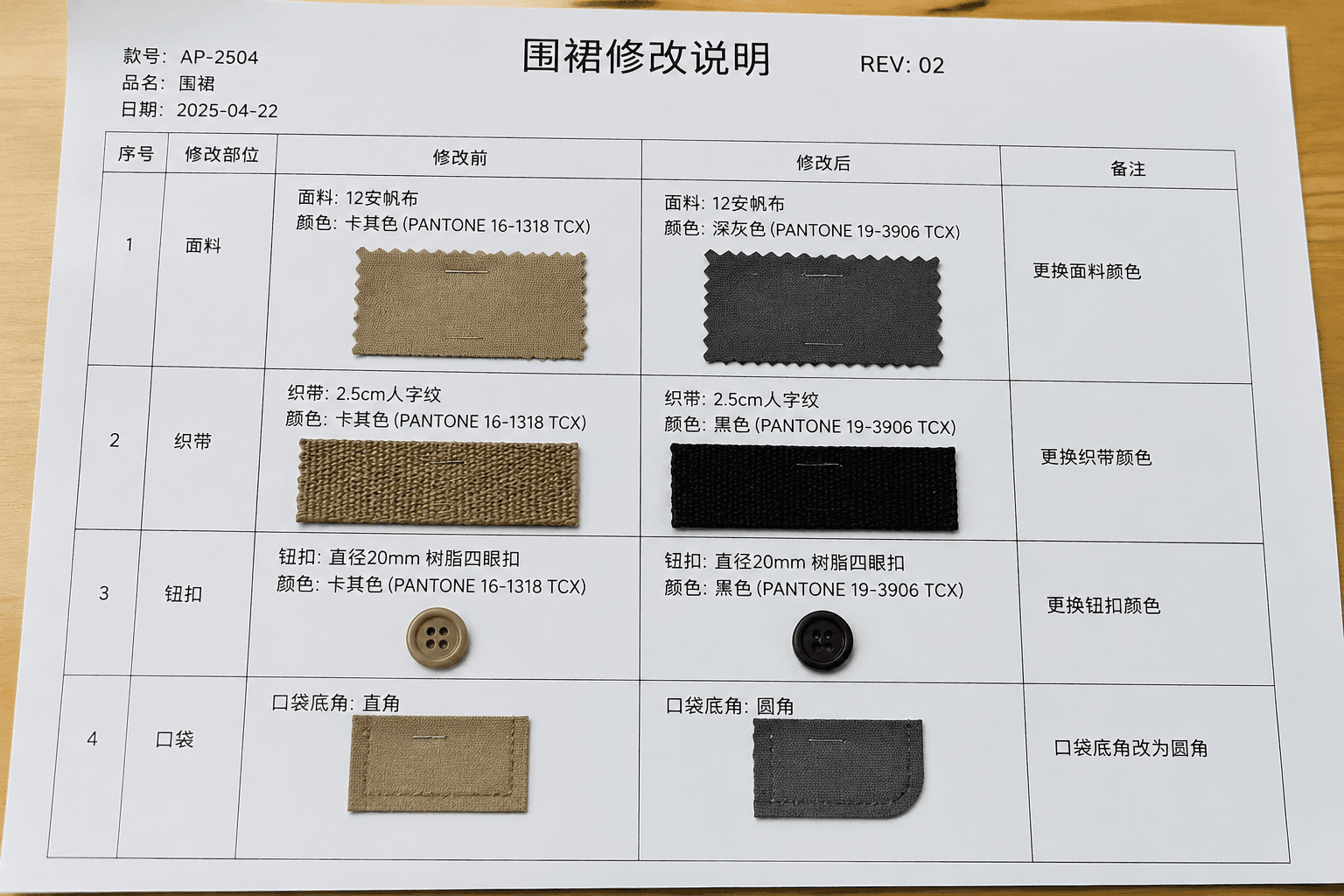
Many delays come from changes made after the factory has already acted on the previous approval. For apron programs, the most sensitive late changes are fabric color, fabric weight, strap construction, pocket layout, print size, embroidery placement, label type, and packing method. These items affect material purchase, cutting markers, sewing operations, or carton volume. A late change to neck strap length may sound minor, but if fabric has been cut, it may require recutting or piecing, which is not acceptable for most branded orders.
A strong apron launch timeline uses freeze points. The design freeze confirms size chart, pocket structure, strap method, and decoration position. The material freeze confirms fabric quality, color, trims, thread, and labels. The production freeze confirms pre-production sample approval, packing, carton marks, and inspection criteria. After each freeze, changes should be treated as cost and schedule events, not normal comments.
For seasonal apron sourcing, buyers should also confirm tolerance standards before bulk production. Common apron tolerances may be plus or minus 1 cm for small pocket dimensions, plus or minus 1.5 cm for body width, and plus or minus 2 cm for long ties, depending on construction. Shrinkage after washing should be tested according to the intended care label. If a retail apron is advertised as machine washable, the buyer should not skip wash testing only to save three days.
- Design freeze should occur before bulk fabric cutting and should include apron body size, pocket size, tie length, and strap system.
- Material freeze should occur before fabric dyeing or purchase and should include GSM, color standard, trim color, and label artwork.
- Decoration freeze should occur before screen making, embroidery digitizing, or heat transfer film production.
- Packing freeze should occur before carton ordering and should include folding method, polybag type, barcode, carton marks, and inner quantity.
Cost and MOQ trade-offs inside production scheduling apron decisions
Production scheduling apron decisions are not only about time. They also affect unit cost and MOQ. A buyer may request four colors, three sizes, and two logo placements for a total order of 2,400 pieces. On paper, the MOQ is acceptable. In production, that becomes 24 small combinations of 100 pieces each, with separate cutting, printing setup, sewing thread control, and packing checks. The factory may need to quote a higher unit price or extend lead time because the line efficiency drops.
As a rough reference, a basic 180-220 GSM poly-cotton bib apron with one front pocket and simple screen print may fall in the USD 1.20-2.20 per piece FOB range at 3,000-10,000 pieces, depending on size and fabric market. A 260 GSM cotton twill apron with adjustable neck strap, two pockets, and embroidery may be closer to USD 2.60-4.20. A heavy 300-340 GSM canvas or denim cross-back apron with hardware and branded trims can reach USD 5.00-9.00 or more. Calendar pressure can increase these costs through overtime, air freight, smaller fabric dye lots, or split shipments.
MOQ also depends on fabric and trim. If the buyer chooses stock black twill, the garment MOQ may be 500-1,000 pieces per style. If the buyer needs custom dyed canvas, the fabric mill may require 800-1,500 meters per color, which may translate to 1,500-3,000 aprons depending on width and consumption. For yarn-dyed stripe fabric, MOQ can be higher because the mill must prepare dyed yarn and loom setup. These realities should be visible in the apron production calendar before the buyer sells a wide seasonal color range.
- Reduce colorways when the total quantity is small, because each color adds fabric, thread, decoration, and inspection complexity.
- Keep pocket and strap construction common across styles if the launch requires multiple colors or logos.
- Use stock fabric colors for urgent seasonal promotions when the delivery date is more important than exact Pantone matching.
- Reserve custom woven labels across multiple seasonal orders to reduce label MOQ pressure and avoid repeated setup time.
A practical seasonal apron calendar example
Consider a buyer planning a spring garden-center apron launch that must arrive at a European warehouse by March 15. The apron is a 260 GSM cotton twill bib apron in two custom colors, with a large front pocket, adjustable metal neck slider, woven brand label, and one-color screen print. The order quantity is 8,000 pieces, split equally between colors. Because the goods ship by sea, the supplier should target ex-factory around late January or the first week of February, allowing around 40-50 days for vessel, customs, and warehouse booking.
Working backward, bulk sewing and packing should finish by January 25-30. Cutting and decoration should begin around January 5-8. Bulk fabric must arrive at the factory by late December. Custom dyeing, shrinkage testing, and fabric inspection may need 20-30 days after color approval, so lab dips should be approved by late November. Samples and strike-offs should therefore begin in early to mid-November. The purchase order and deposit should be placed no later than late November if the buyer wants to avoid compression near Chinese New Year.
This calendar may feel early to a buyer who is still selling autumn products in November, but it reflects the real production chain. If the buyer delays approval until mid-December, the factory may still make the aprons, but the risk shifts: fabric dyeing may conflict with year-end mill capacity, sewing may move close to the holiday shutdown, and sea freight may no longer support the March 15 warehouse date. The remaining choices become air freight, partial shipment, simplified specification, or later launch.
- March 15 warehouse arrival requires a late January or early February ex-factory target for Europe sea shipment.
- Late November purchase order is a practical deadline for custom dyed cotton twill before spring launch pressure.
- Early November sampling gives enough room for fit, pocket, color, and decoration corrections.
- Mid-December approval may still be possible but usually removes the normal buffer for fabric delay or inspection rework.
How buyers and factories should maintain the calendar after order release
An apron production calendar is useful only if both sides maintain it after the order is released. The supplier should update actual dates for fabric booking, fabric arrival, cutting start, decoration start, sewing start, inline inspection, final inspection, and shipment booking. The buyer should return approvals within the agreed response time, usually 24-48 hours for urgent seasonal programs and 2-3 working days for normal orders.
For larger programs, weekly status is not always enough. During the 10-15 days before final inspection, the factory should report packed quantity, remaining sewing quantity, decoration completion, carton readiness, and any quality issue that may affect the AQL result. Buyers should avoid introducing new label, packing, or routing instructions during this window unless absolutely necessary. A late routing change can hold a finished order as effectively as a sewing delay.
The most reliable calendar is built from the supplier’s actual process, not from a general template. Apron lead time planning should reflect fabric weight, decoration method, order quantity, color split, inspection standard, packing complexity, and destination. When these details are confirmed early, seasonal apron sourcing becomes much more predictable. The buyer gets a cleaner launch, and the factory can protect quality without using the final week as a recovery period.
- Update the calendar with actual completion dates, not only planned milestones.
- Track buyer approval time because delayed comments are part of the real lead time.
- Confirm inspection booking at least 7 days before the expected final inspection date.
- Confirm vessel or air booking before packing is fully completed when the launch date is fixed.
- Keep a post-shipment record of actual lead times so the next seasonal program can start with better data.