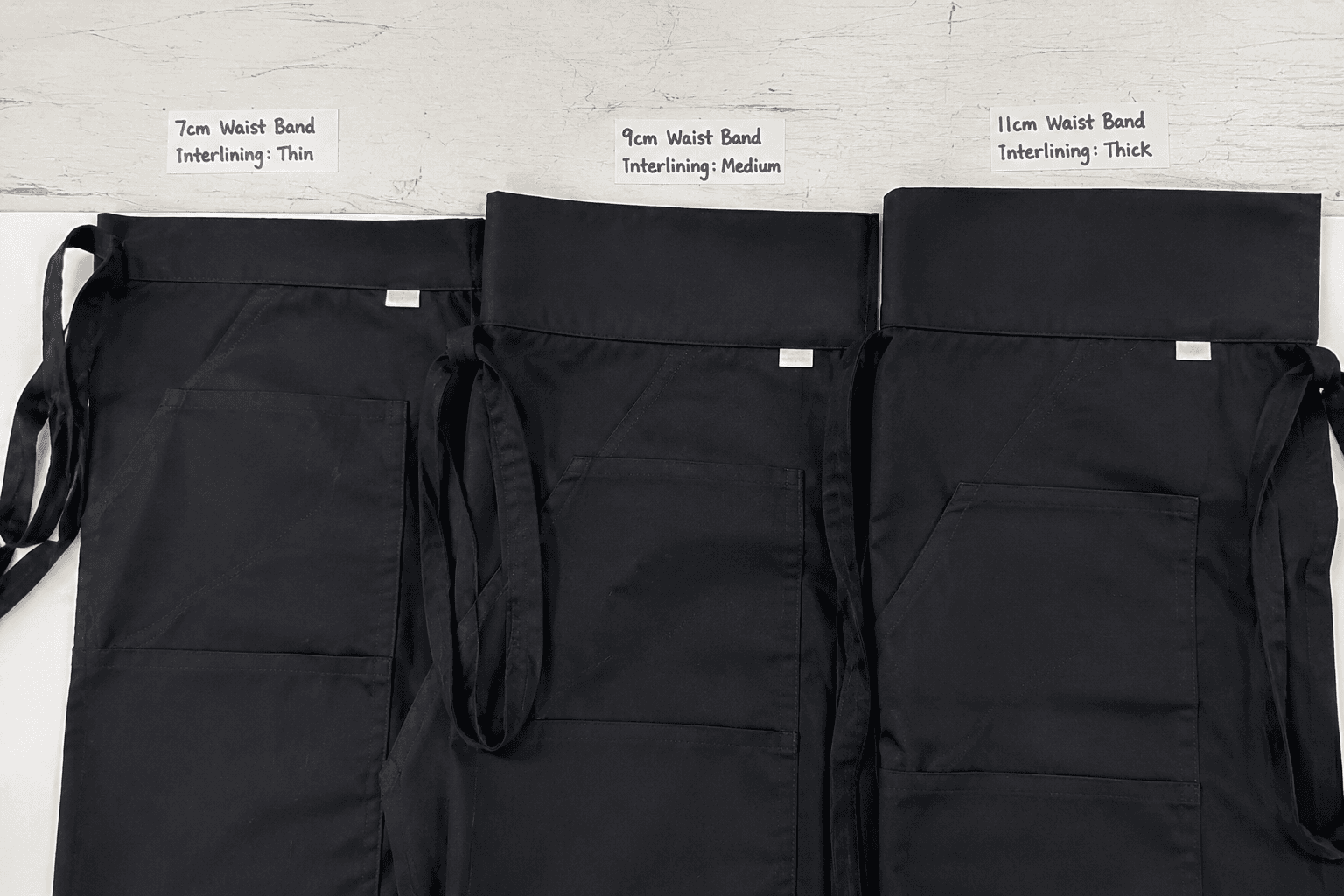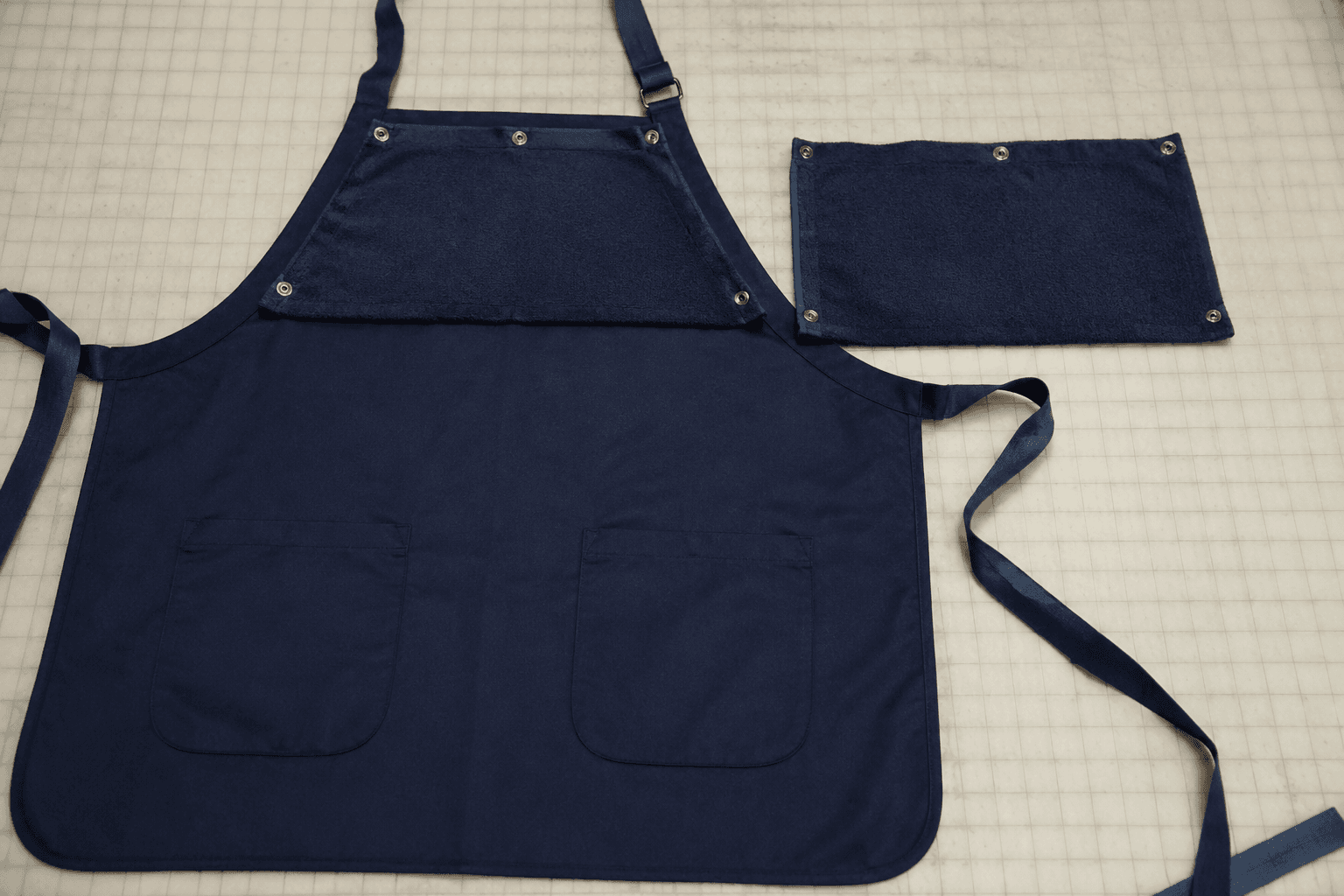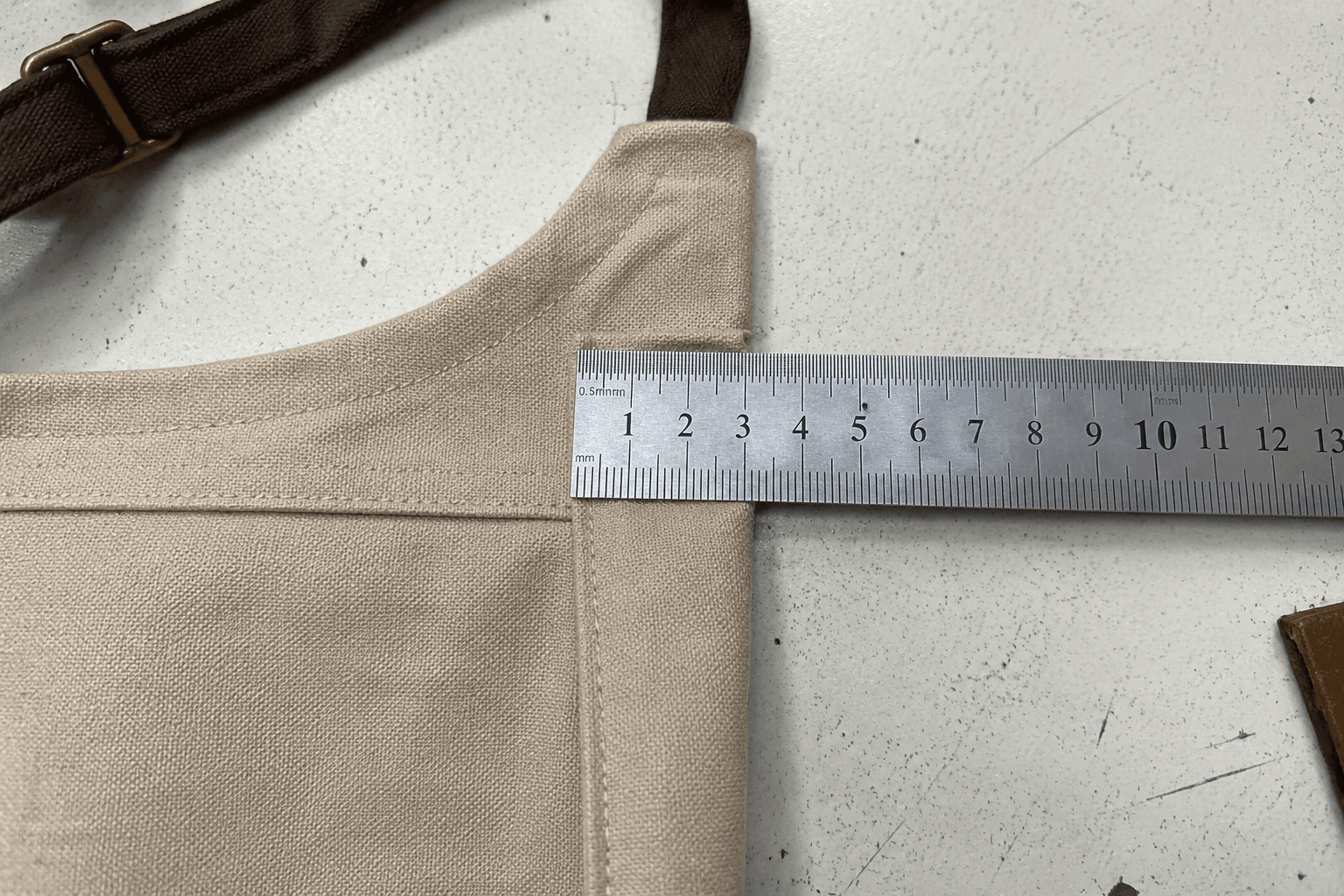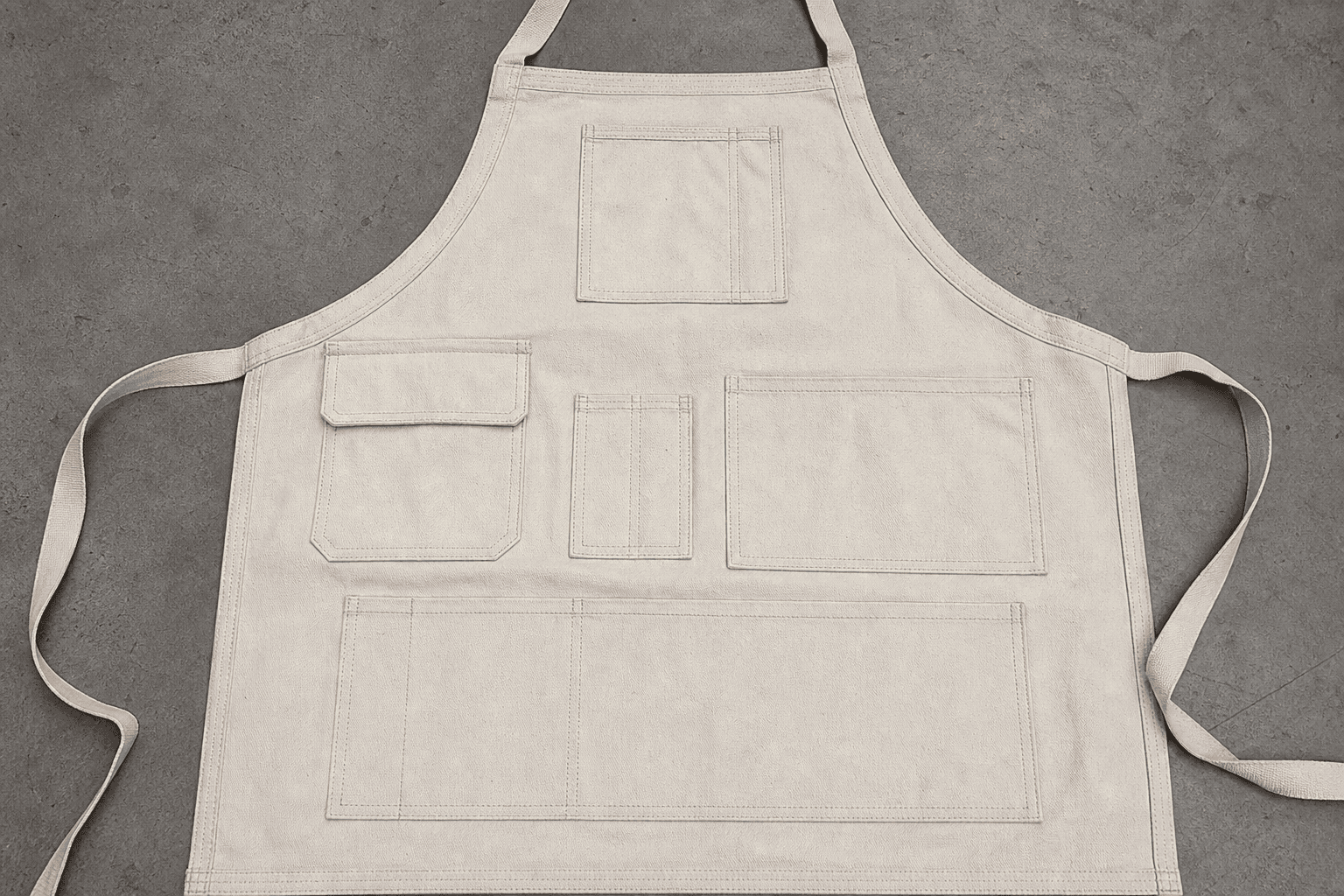
For custom apron programs, the apron pocket configuration is not a small trim decision. Pocket count, pocket layout, opening width, reinforcement method, and stitch placement affect labor time, fabric consumption, defect risk, packing appearance, and the way the final apron performs in a kitchen, cafe, workshop, garden center, salon, or retail floor.
From a factory perspective, apron pockets should be specified with the same discipline as fabric weight, strap construction, and logo method. A buyer who only writes “two front pockets” leaves too much room for interpretation. A production line needs pocket dimensions in centimeters, placement from finished edges, seam allowance, bar-tack positions, and any tool slot, pen slot, towel loop, phone pocket, or hidden pocket requirement.
This guide explains the main apron pocket layouts used in bulk China OEM production, the trade-offs behind each option, and the details buyers should confirm during sample approval. The goal is simple: fewer sample rounds, cleaner apron spec pockets, and fewer disputes when 3,000 or 30,000 pieces arrive at destination.
- Pocket size and placement must be measured from finished apron edges, not estimated from a photo or reference sample.
- Extra pocket divisions increase sewing minutes, especially when bar-tacks, topstitching, and narrow tool slots are required.
- Heavy tools need reinforced pocket openings, otherwise tearing usually appears at upper pocket corners after repeated use.
- Fabric weight changes pocket behavior, because 7 oz twill, 10 oz canvas, denim, and waxed cotton do not fold or drape the same way.
- Sampling should test real contents, including phones, order pads, pens, pruning shears, bottle openers, thermometers, or hand tools.
- A clear apron pocket layout reduces QC arguments, because inspectors can measure against a technical drawing instead of judging by appearance.
Why apron pocket configuration matters in bulk sourcing
A pocket changes the apron more than many buyers expect. A plain bib apron in 240 GSM polyester-cotton twill may be a straightforward line item. Add a divided kangaroo pocket, two angled tool slots, a double-needle top edge, bar-tacks, and a woven label on the pocket face, and the production method changes. The apron now requires additional cutting parts, alignment checking, pocket ironing or folding, more operator handling, and stricter inline inspection.
In factory costing, a simple patch pocket can add approximately US$0.08-0.18 per piece depending on size, fabric, and order volume. A more complex tool pocket apron with multiple compartments can add US$0.25-0.70 per piece, sometimes more if the fabric is heavy canvas or the pocket requires contrast binding. These figures are not universal quotes, but they are realistic enough for early budgeting. On a 10,000 piece order, one unnecessary pocket detail can become a meaningful cost.
Pockets also affect delivery timing. For repeat apron styles with approved patterns, pocket changes may not add much time. For a new custom apron pockets project, expect 3-5 days for pattern adjustment, 5-7 days for first sample making, and 2-4 days for revised samples after comments. In mass production, complex apron pockets can reduce sewing output per line by 15-35% compared with a no-pocket or single-pocket apron.
- A simple single patch pocket is usually suitable for cafe, bakery, promotional, and retail uniforms where the user carries light items.
- A divided center pocket is common for servers, baristas, and counter staff who need order pads, pens, and small accessories.
- A multi-slot tool pocket apron suits workshops, florists, barbers, grill staff, and maker brands, but it needs stronger reinforcement.
- A hidden zipper pocket is useful for cash, keys, or phones, but it raises both material cost and needle-break risk on thick fabrics.
- A decorative pocket layout may improve brand appearance, but it should still be tested with actual workplace contents.
Core apron pocket configuration options buyers usually specify
Most custom apron pockets fall into several repeatable construction families. The first is the patch pocket: a separate fabric panel folded at the edges and stitched onto the apron body. This is the simplest and most flexible option. It works on bib aprons, waist aprons, cross-back aprons, denim aprons, and bistro aprons. For light to medium use, pocket opening width is often 14-20 cm per pocket, with depth around 16-22 cm.
The second option is a kangaroo pocket or large shared front pocket divided by one or more vertical stitch lines. This is common on hospitality aprons because it looks clean and keeps sewing efficient. A buyer may specify a 36 cm wide by 20 cm high pocket, divided into two 18 cm compartments, positioned 42 cm down from the top bib edge. If the vertical division is not bar-tacked at the top, the seam may open under stress when users pull items sideways.
The third option is a tool pocket layout. This can include narrow pen slots, thermometer slots, scissor pockets, metal ruler pockets, towel loops, and double-layer tool panels. The challenge is that narrow pockets must be sewn accurately. A 2.5 cm pen slot can become unusable if seam tolerance is loose, especially after washing shrinkage. For tool pocket apron projects, the sample should be checked with the actual tool set, not only by ruler.
- Patch pocket: lowest complexity, flexible size range, suitable for most standard uniforms.
- Kangaroo divided pocket: clean appearance, efficient sewing, common for cafes and restaurants.
- Chest pocket: useful for pens or thermometers, but placement must avoid logo conflict on the bib.
- Tool slot pocket: functional for narrow items, but requires tight sewing tolerance and bar-tacks.
- Zipper pocket: secure storage, higher cost, more inspection points, less suitable for very low-cost promotions.
- Layered pocket: premium function for workwear, but increases thickness at seams and may affect packing flatness.
Pocket dimensions, placement, and apron pocket layout tolerances
A good apron pocket layout is measured from fixed finished edges. For a bib apron, the top of the main lower pocket is often placed 30-45 cm below the top bib edge, depending on apron length and target user height. On a waist apron, pocket top placement is normally measured from the finished waistband or top edge, usually 8-15 cm down. Side placement should be measured from the center line or finished side edge. Do not rely only on “visually centered” instructions.
For OEM production, acceptable tolerance should be written into the tech pack. Common tolerance for pocket size is plus or minus 0.5 cm for standard woven aprons. Pocket placement tolerance is often plus or minus 0.7 cm to 1.0 cm, depending on layout complexity and fabric behavior. For stripe fabric, yarn-dyed fabric, waxed canvas, or contrast pockets, tolerance needs more discussion because visual misalignment is easier to notice.
Pocket depth must match the intended contents. A server order pad may need 12-14 cm width and 16-18 cm depth. A smartphone pocket should be at least 9-10 cm wide and 15-17 cm deep for common current phone sizes, with more width if the user may use a protective case. A chef thermometer pocket can be 2.5-3.0 cm wide, but it must not be so tight that the item catches on seam bulk.
- Specify pocket width, height, and finished opening width in centimeters, not only by photo reference.
- Mark pocket placement from finished top edge, side edge, center line, or waistband, depending on apron type.
- State whether pocket dimensions are finished measurements or cut-panel measurements before folding.
- Use plus or minus 0.5 cm tolerance for pocket dimensions when possible, and agree wider tolerance only when fabric requires it.
- Confirm whether the logo is printed or embroidered on the pocket panel before attachment or after pocket sewing.
- Check that pocket placement does not interfere with waist ties, cross-back straps, grommets, rivets, or label positions.
Fabric weight and construction effects on apron pockets
The same pocket design behaves differently across fabrics. A 190 GSM polyester fabric can hold a printed promotional pocket, but it may not support heavy contents well. A 240-260 GSM poly-cotton twill is common for restaurant aprons and can handle standard patch pockets. A 10 oz cotton canvas or 12 oz denim gives better structure for tools, but it creates thicker folded edges and requires stronger needle settings. A waxed canvas pocket may look premium but can show stitch marks and folding marks more clearly.
Fabric shrinkage also matters. If the apron body and pocket fabric are the same material and pre-shrunk consistently, distortion risk is lower. If the pocket is contrast fabric, such as denim pocket on cotton twill body, shrinkage mismatch can cause puckering after wash. For bulk programs with industrial laundry exposure, we usually recommend wash testing the approved pre-production sample for 3-5 cycles before final order release.
Pocket grain direction is another detail buyers rarely specify but factories still need to control. If pocket panels are cut off-grain to save fabric, pockets may twist after washing. For low-cost promotional aprons this may be acceptable within a looser standard. For retail or workwear aprons, pocket panels should follow the body grain direction unless the design intentionally uses bias or contrast orientation.
- 190-210 GSM fabric is suitable for light promotional pockets but not heavy tool storage.
- 240-280 GSM twill is a balanced choice for restaurant apron pockets and standard hospitality uniforms.
- 300-340 GSM canvas provides better pocket body but increases folding thickness and sewing time.
- 10-12 oz denim supports durable custom apron pockets but may require rivets or bar-tacks at stress points.
- Waxed cotton can be used for premium apron pockets, but sampling must confirm crease marks and stitch appearance.
- Contrast pocket fabric should be wash-tested for shrinkage, colorfastness, and seam puckering.
Reinforcement choices for tool pocket apron programs
For a tool pocket apron, reinforcement is not optional if the user carries metal or hard plastic items. The most common failure points are the upper pocket corners, vertical division tops, narrow slot openings, and bottom corners where tools push downward. A standard single topstitch may be acceptable for a cafe pen pocket, but it is weak for scissors, pruning tools, grill tools, or barber accessories.
Bar-tacks are the normal solution. A bar-tack at each upper pocket corner adds little material cost but adds sewing operation time. Depending on order size and factory line setup, bar-tacks may add around US$0.02-0.05 per position. For a pocket with four reinforced openings, the cost can rise quickly. Rivets are another option for denim and canvas aprons, especially for workwear styling, but rivets require metal detection management, extra hardware sourcing, and clear color specification such as antique brass, gunmetal, nickel, or matte black.
A double-layer pocket panel is useful when tools are heavy, but it increases fabric usage and drying time after washing. Binding tape around pocket openings can improve durability and appearance, yet it raises sewing difficulty on curved or angled pockets. For most B2B apron spec pockets, the best balance is reinforced upper corners, double-needle top edge, and heavier pocket fabric only where function requires it.
- Use bar-tacks at all pocket opening corners for tool, florist, barber, grill, or workshop aprons.
- Use double-needle stitching on wide pocket top edges when the user frequently pulls items in and out.
- Consider rivets only when the brand accepts metal hardware, extra cost, and possible laundry restrictions.
- Avoid very narrow tool slots in heavy canvas unless the sewing line can maintain consistent width.
- Request pull testing on critical pockets when the apron is intended for tools heavier than 300 g.
- Confirm that reinforcement thread color matches the design intent, because contrast bar-tacks are highly visible.
Cost, MOQ, and lead-time impact of custom apron pockets
Pocket complexity affects price through fabric consumption, sewing minutes, trims, inspection time, and reject risk. A plain bib apron might have an MOQ of 500-1,000 pcs per color in stock fabric. When the buyer adds custom pocket layout, contrast panels, zipper pockets, or special reinforced tool slots, a practical MOQ may move to 1,000-3,000 pcs per color. If the pocket fabric is custom dyed or yarn-dyed, MOQ may depend on fabric mill minimums, often 500-1,000 meters per color.
Lead time also changes. For a normal custom apron using available fabric, sample time is usually 5-10 days and bulk production is often 25-40 days after sample approval and deposit. If the pocket design requires special hardware, branded zipper pulls, rivets, custom woven labels on pocket panels, or garment wash testing, add 7-15 days depending on supplier availability. For peak season before holiday retail deliveries, buyers should add more buffer.
Price discussions should separate the base apron from pocket upgrades. This avoids confusion when comparing supplier quotations. One supplier may quote a low base price but exclude bar-tacks or zipper pockets. Another may include reinforcement and better inspection in the quoted price. For accurate comparison, send the same apron pocket configuration drawing, same fabric GSM, same logo method, same packing method, and same inspection level to all factories.
- A single simple patch pocket may add approximately US$0.08-0.18 per apron in medium-volume orders.
- A divided kangaroo pocket may add approximately US$0.12-0.30 depending on size and stitch details.
- A multi-compartment tool pocket layout may add approximately US$0.25-0.70 or more on heavy fabrics.
- A zipper pocket may add approximately US$0.18-0.45 depending on zipper quality, length, and sewing method.
- Bar-tacks commonly add approximately US$0.02-0.05 per position, depending on quantity and line setup.
- Bulk lead time for pocket-heavy aprons is commonly 30-45 days after approvals, not including fabric delays.
Sampling and QC checks for apron spec pockets
The sample stage should verify function, not only appearance. Buyers should place actual working items into the pockets and wear the apron in the intended posture. A pocket that looks correct on a flat table may sit too low when worn, collapse forward, interfere with walking, or place heavy tools against the thigh. For servers and baristas, check reach comfort. For workshop users, check whether tools fall out when bending. For chefs, check whether thermometer slots are accessible with one hand.
During sample approval, request a measurement chart that includes every pocket. The chart should show finished pocket width, pocket height, distance from top edge, distance from side edge or center line, division line positions, opening width, and reinforcement points. If the sample is approved with handwritten comments, make sure the final tech pack is updated before production. Verbal comments such as “make pocket slightly bigger” are a common source of bulk production disputes.
Inline QC should check pocket alignment early in production, not only at final inspection. Once 2,000 apron bodies are sewn with pockets 2 cm too low, correction becomes expensive and may require re-cutting. For large orders, a pre-production sample should be sealed, and the first 50-100 pieces should be reviewed by the line supervisor and merchandiser before full-speed production.
- Measure pocket dimensions on a flat apron after light smoothing, without stretching the fabric.
- Check vertical division stitching for straightness and equal compartment widths.
- Inspect upper pocket corners for bar-tack position, skipped stitches, loose threads, and fabric tearing.
- Test pocket function with the buyer's intended tools, phone size, order pad, pens, or accessories.
- Confirm logo position after pockets are loaded, because contents can distort printed or embroidered pocket logos.
- Review packed apron appearance, since bulky layered pockets can create uneven folding and carton height variation.
How to write a clear apron pocket configuration in the tech pack
A factory can produce custom apron pockets more accurately when the buyer provides a simple but complete pocket specification. The best format is a flat technical drawing with numbered pockets and a measurement table. Photos are helpful as references, but photos alone are not enough. If a buyer sends a lifestyle image and asks the factory to “copy this pocket,” the result may vary because camera angle, apron size, and model height distort proportion.
For each pocket, specify shape, size, opening direction, seam construction, reinforcement, fabric, thread color, and placement. Also state whether pocket edges are folded, bound, overlocked then folded, or raw-edge style for washed denim. If there is a logo on the pocket, confirm whether it is printed before sewing, embroidered before sewing, or applied after sewing. Printing after pocket attachment can be difficult on thick aprons because the pocket edge creates an uneven surface.
The most reliable apron pocket configuration is the one that matches real use, target price, and factory process. More pockets do not automatically make a better apron. A clean two-pocket layout may serve a restaurant chain better than a complex tool layout. A reinforced multi-slot pocket may be necessary for a barber brand or garden center. The right decision comes from matching function, cost, durability, and production repeatability before the order reaches the cutting table.
- Pocket 1: finished width, finished height, top opening width, and placement from fixed apron edges.
- Pocket divisions: exact stitch line positions and whether each division top requires a bar-tack.
- Pocket fabric: same as body or contrast material, including GSM, color, shrinkage, and grain direction.
- Pocket stitching: single needle, double needle, contrast thread, bartack length, and stitch-per-inch requirement.
- Pocket contents: intended items and approximate weight, especially for tool pocket apron programs.
- Pocket approval standard: measurement tolerance, wash-test requirement, and sealed sample reference.