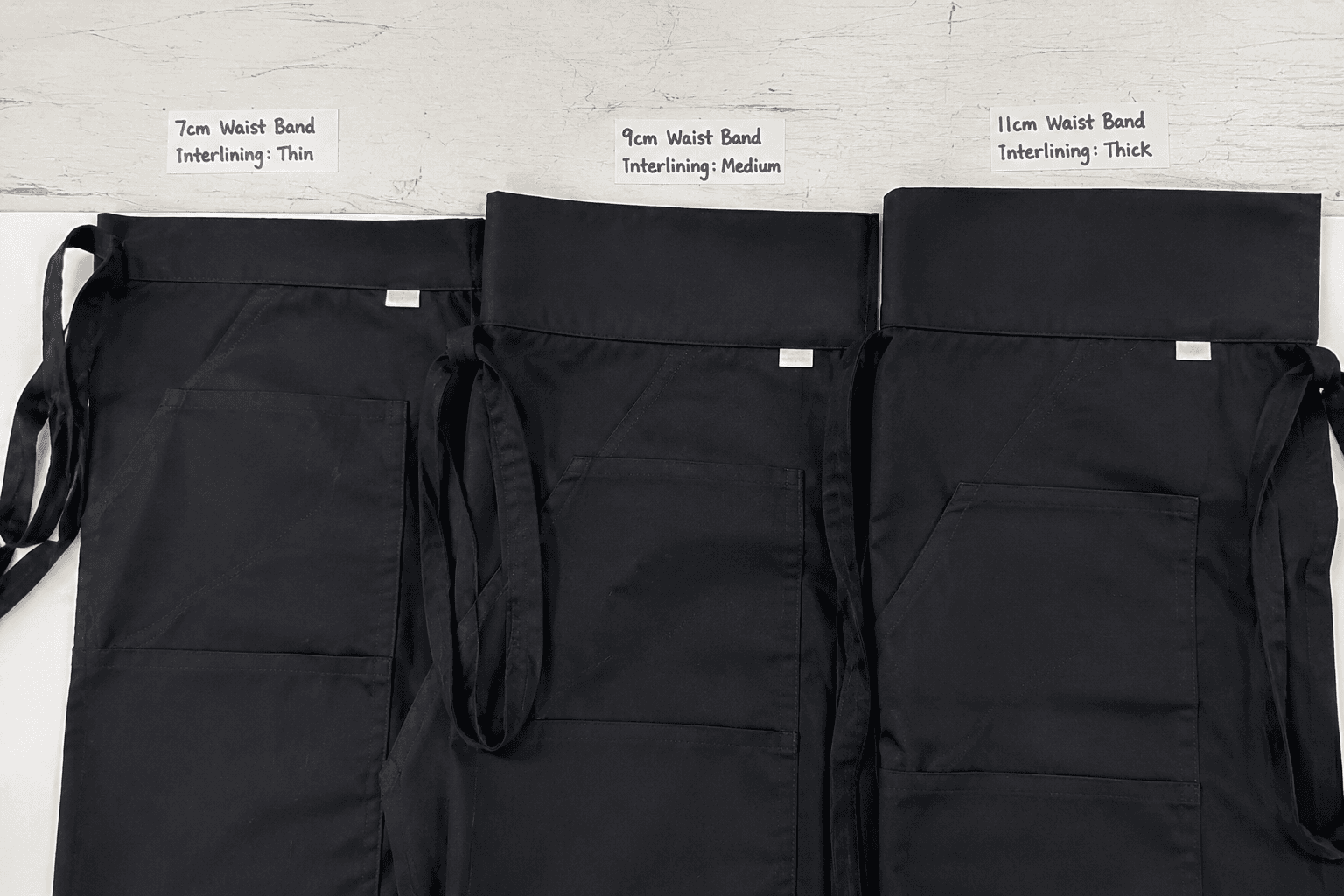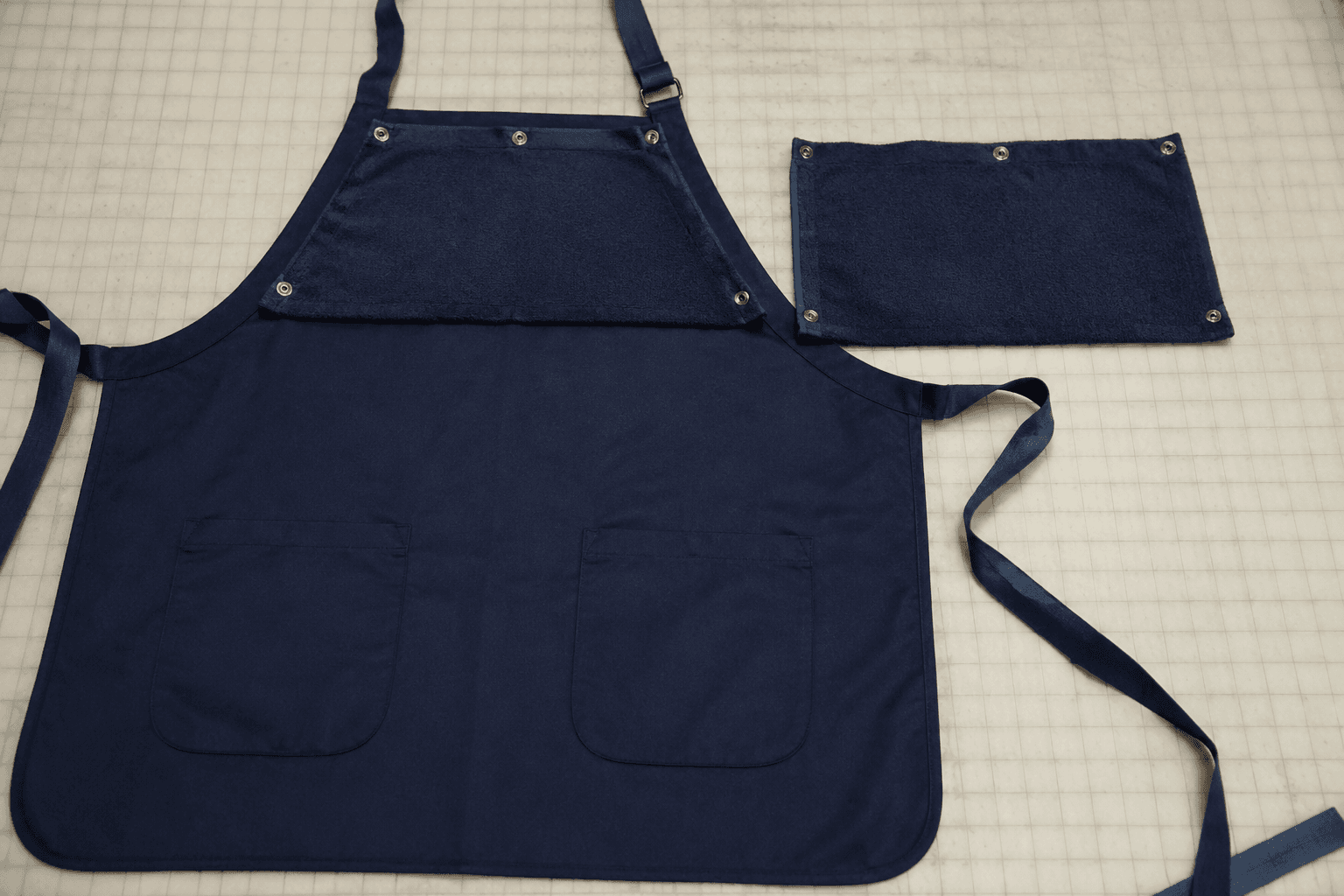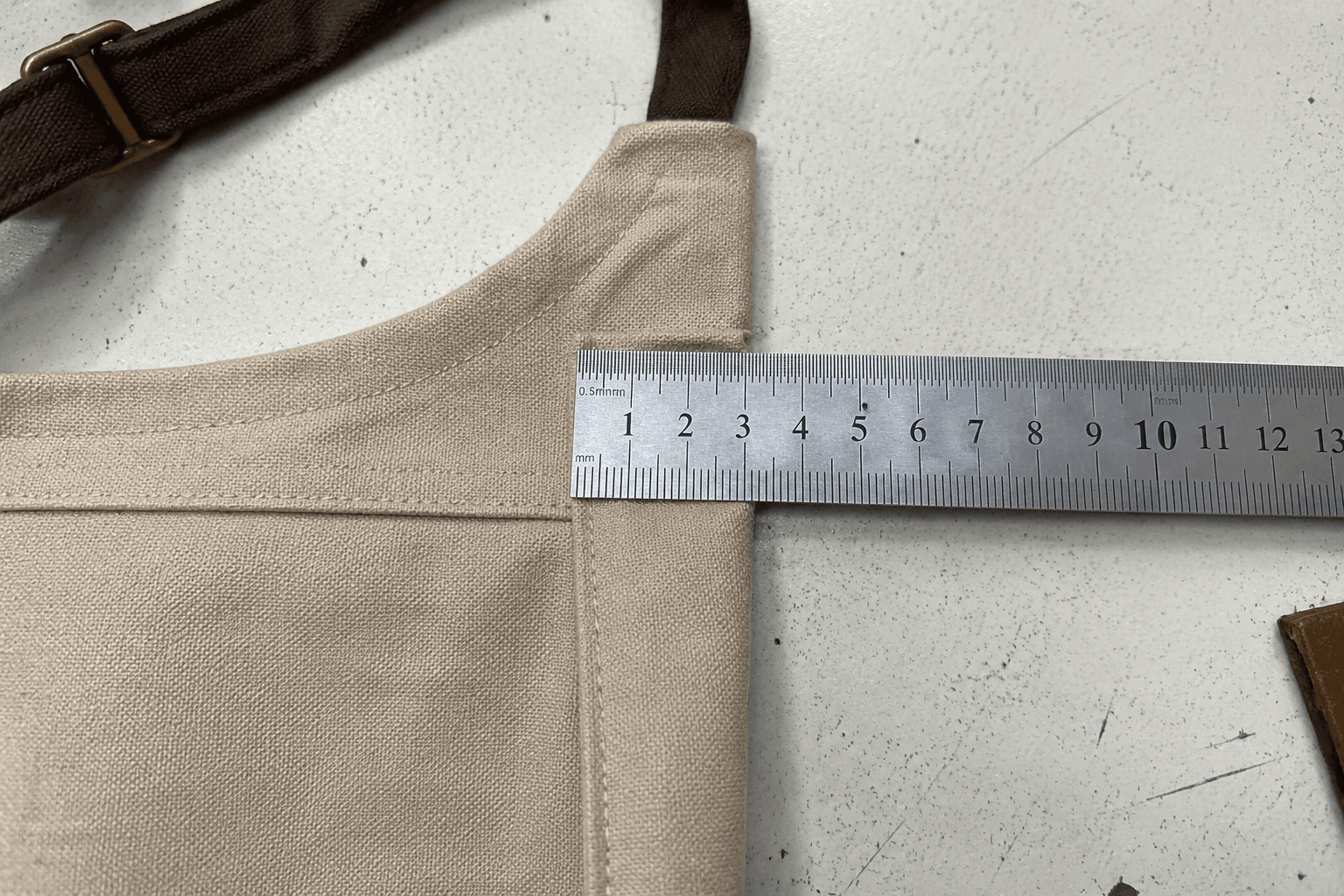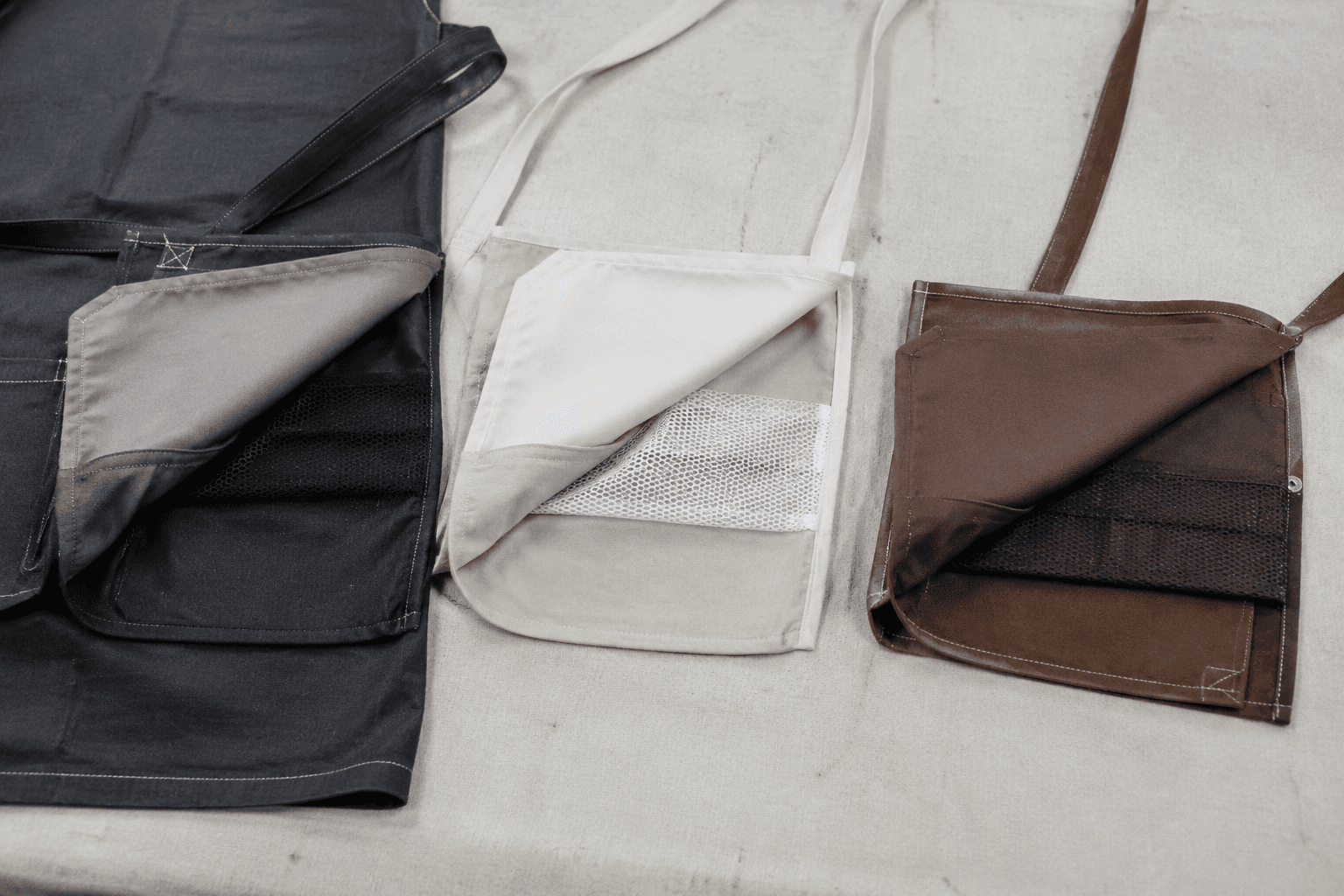
In apron development, buyers usually lock the shell fabric, straps, hardware, and logo first. The pocket construction is often approved later, even though the apron pocket bag material affects shell consumption, marker yield, seam bulk, operator minutes, wash shrinkage, and claim rate. On a working apron, the pocket is a load-bearing component, not a minor trim.
For OEM apron programs from 3,000 to 20,000 pieces, pocket material choice has a visible cost effect. Changing a large divided front pocket from 280 GSM self-fabric twill to a 120 to 140 GSM poly-cotton lining commonly lowers total cost by $0.08 to $0.25 per apron. On 10 oz to 12 oz shells, the same change often cuts pocket assembly time by 20 to 35 seconds per piece because operators handle fewer thick folds and topstitch through fewer heavy layers.
This article compares three common routes for apron pocket bag material in professional apron sourcing: self-fabric, woven lining cloth, and mesh. The focus is strictly on B2B buying decisions for hospitality, salon, workshop, barbecue, cleaning, seafood, harvest, and gardening aprons, with concrete guidance on GSM, MOQ, lead-time days, reinforcement standards, wash risk, and bulk inspection.
- Self-fabric pockets give the best shade and texture match, but they raise shell consumption, seam bulk, and sewing minutes, especially above 270 GSM or 10 oz
- A woven apron pocket bag material in 110 to 160 GSM is usually the best cost-performance option when the apron shell is 240 GSM or heavier
- Mesh pocket constructions work for wet-use or debris-heavy aprons, but they need reinforcement and are not suitable for pointed tools unless built as hybrid pockets
- Most apron pocket failures come from weak corner reinforcement, narrow seam allowance, poor division spacing, or shrinkage mismatch rather than fabric choice alone
- Before PP approval, buyers should confirm pocket GSM, fiber content, seam allowance, bartack method, shrinkage tolerance, and fit test with the real carried items
- Bulk inspection should check pockets inline and at final to AQL 2.5 major and 4.0 minor, with special attention to placement, mouth flatness, stitch security, and corner strength
Why apron pocket decisions change FOB, sewing time, and complaint risk
An apron pocket takes concentrated stress from repeated hand entry and from carried items such as phones, order pads, shears, probes, bottle openers, gloves, and small tools. In many commercial aprons, the first field failure is not the body fabric but the upper pocket corners, pocket mouth edge, or the vertical division seam. That is why the wrong apron pocket bag material can create warranty claims even when the shell fabric passes tensile, tear, and colorfastness testing.
For costing, pocket choice changes four variables at once: shell consumption, sewing minutes, defect risk, and finished appearance. A 240 to 300 GSM cotton canvas or poly-cotton twill pocket holds shape well, but it increases seam stack height and slows attachment. A 120 to 140 GSM woven lining reduces thickness and usually improves line balance, yet if it is too light for the end use, the short-term saving turns into replacement cost later.
The effect is most obvious on bib aprons with one large lower pocket. A pocket around 36 cm wide by 20 cm deep can consume enough fabric to matter when shell cost is $3.80 to $5.20 per meter. On price-sensitive private-label orders, the pocket specification often moves margin more than changing from embroidery to a small screen print. Professional buyers should therefore review pocket material before salesman sample approval, not after the style is already costed.
- Pocket corners and pocket mouths are the most common apron claim points after wash and daily use
- When shell fabric exceeds 270 GSM, pocket seam bulk can reduce line efficiency by about 3% to 8%
- On large utility pockets, changing from self-fabric to lining cloth can save $0.10 to $0.25 per apron before freight
- A low pocket cost is not a real saving if the pocket twists, shrinks differently, or fails in the first wash cycle
Self-fabric apron pocket bag material: best visual match, highest bulk and shell use
Self-fabric means the pocket uses the same cloth as the apron shell. In custom apron manufacturing, that usually means 200 to 350 GSM cotton twill, poly-cotton twill, cotton canvas, or 8 oz to 12 oz utility canvas. For hospitality, premium retail, and garment-washed apron programs where the pocket topstitching is fully visible, self-fabric gives the cleanest appearance because the shade, texture, surface finish, and post-wash behavior match the body exactly.
Performance is also reliable when the shell already has suitable tear and seam strength. On an 8 oz to 10 oz canvas bib apron, a self-fabric lower patch pocket can carry a phone, order pad, pen set, and small POS device without distortion if the pocket mouth is turned 2.5 to 3.0 cm, the top corners are bartacked, and the lower corners are rounded or angle-cut. On barber, grill, and workshop aprons, self-fabric avoids the weak-link problem created when a heavy shell is paired with a much lighter hidden pocket.
The disadvantages are measurable rather than theoretical. Self-fabric increases marker consumption and sewing resistance. On a mid-size bib apron with one divided front pocket, the extra shell use commonly adds $0.14 to $0.28 per piece when shell fabric costs $4.00 to $5.20 per meter. On 10 oz to 12 oz canvas, pocket folding and topstitching usually add 20 to 35 seconds per apron compared with a 120 to 140 GSM lining pocket. With waxed, peached, brushed, or lightly coated shells, hard seam stacks can also create uneven pocket mouths, needle drag, or poor topstitch appearance.
For bulky shells, many factories use a hybrid version: self-fabric on the visible pocket face and lighter woven cloth inside the hidden pocket section. This keeps the front appearance while reducing thickness at the side joins and pocket mouth. For B2B buyers trying to balance premium look with production efficiency, hybrid construction is often more practical than full self-fabric on every pocket layer.
- Typical shell range for self-fabric pockets: 200 to 350 GSM or 8 oz to 12 oz
- Typical FOB increase versus woven lining pocket: $0.08 to $0.22 per apron on standard styles, up to $0.28 on large divided pockets
- Best use cases: hospitality bib aprons, washed aprons, premium retail aprons, and medium-load utility aprons
- Less suitable when shell is waxed, coated, brushed, or above 300 GSM unless the pocket design is simplified
Woven lining cloth as apron pocket bag material: the best commercial balance for most B2B orders
For many programs, woven lining cloth is the most efficient apron pocket bag material. The most reliable choices are stable woven constructions rather than slippery fashion linings. Common apron pocket options include 88/12 or 80/20 poly-cotton plain weave at 110 to 130 GSM, 65/35 poly-cotton twill at 120 to 160 GSM, and cotton twill at 130 to 150 GSM when a softer natural hand is required.
The cost advantage is straightforward. When the apron shell is 260 to 300 GSM twill or 10 oz canvas, replacing a full self-fabric pocket bag with a 120 to 140 GSM woven lining usually saves $0.10 to $0.25 per piece on medium and large pockets. On a 10,000-piece order, that is $1,000 to $2,500 before labor savings are counted. In production, line output often improves by 4% to 7% because operators feed fewer thick layers on divided waist aprons and multi-compartment bib styles.
The main sourcing mistake is going too light. A 90 to 100 GSM plain weave may look fine on a proto sample, but it often distorts at the corners, abrades through under clips, or splits at narrow divisions after repeated use. For most hospitality, salon, and service aprons, 110 to 140 GSM is the practical minimum. For workshop, barbecue, garden, and utility aprons carrying harder items, 130 to 160 GSM twill gives better seam hold and shape retention.
Color and shrinkage compatibility matter as much as GSM. If a dark apron uses white or low-grade grey lining, the pocket can flash visibly when it opens. Better practice is to use stock black, navy, charcoal, or dyed-to-match lining for dark colorways. If shell and pocket use different fiber blends, both should be washed together before bulk cutting. A shrinkage difference of 2% to 3% is enough to create mouth curling, bubbling, or side torque after laundering.
- Recommended woven pocket lining range for most custom aprons: 110 to 160 GSM
- Most economical when shell fabric is above 240 GSM or priced above $3.50 per meter
- Safer minimum for service aprons: 110 to 120 GSM; safer minimum for utility aprons: 130 GSM
- Stock colors such as black, navy, natural, white, and charcoal usually avoid dye MOQ and shorten lead time
Mesh apron pocket bag material: functional for wet-use aprons, limited for sharp or heavy tools
Mesh is a specialist apron pocket bag material, not a universal one, but it solves real problems in the right apron category. Polyester warp-knit mesh, utility open-hole mesh, and denser sandwich mesh are used when the pocket must drain water, release dirt, or dry quickly. Relevant end uses include seafood handling, cleaning, gardening, harvest work, and some outdoor barbecue or utility aprons where users carry gloves, produce, shells, cloths, or wet accessories rather than pointed metal tools.
Typical apron mesh weights range from 120 to 220 GSM. A light 120 to 150 GSM open mesh reduces dead weight and dries fast. A denser 180 to 220 GSM mesh has better stability and less sagging. On a bib apron with two lower pockets, replacing 240 GSM self-fabric pocket bags with 150 GSM polyester mesh can reduce pocket weight by roughly 35% to 45%, which improves comfort and speeds dry-down after washing or splash exposure.
The limitations are clear. Mesh is weaker against puncture, snagging, and edge abrasion. It is a poor choice for scissors, pens, probe thermometers, utility knives, or workshop fasteners unless the mouth and stress points are reinforced with woven tape, binding, or a woven top band. For that reason, many successful professional aprons use hybrid pockets with a woven upper section for bartacks and shape retention, and mesh below for drainage and lighter weight.
Buyers should specify mesh in more detail than just color and GSM. The quotation sheet should state yarn denier, hole size, stretch direction, colorfastness target, and whether seam-hold or snag testing is required. Black utility mesh from two mills can look similar in a swatch but perform very differently once sewn and laundered.
- Typical mesh range for apron pockets: 120 to 220 GSM polyester
- Best use cases: gardening, seafood, cleaning, harvest, and outdoor utility aprons
- Poor fit for pointed tools unless reinforced at the mouth and corners
- Hybrid woven-plus-mesh pockets usually outperform full-mesh pockets on professional aprons
Pocket engineering standards matter more than fabric alone
Pocket durability depends as much on construction as on fabric choice. Many defects described as pocket material failure are actually caused by narrow seam allowance, missing bartacks, poor thread selection, or division stitching placed without reference to the actual object width. Buyers should therefore approve the full pocket specification, not only the apron pocket bag material.
For standard patch pockets, a side and bottom seam allowance of 1.0 to 1.2 cm is a practical baseline. Pocket mouth turn-in is usually 2.5 to 3.0 cm, adjusted for shell thickness and wash requirement. Upper corners should be reinforced with bartacks 0.6 to 1.0 cm long or with box-X stitching on heavier utility styles. On shells above 300 GSM, trimming corner bulk before topstitching helps prevent hard lumps and uneven stitch lines.
Division spacing must reflect the real carried item, not an arbitrary drawing. If a buyer requests a 4 cm channel but the user forces in a 5 cm thermometer, clip, or tool, the vertical division seam becomes the first break point. This is common on barber and grill aprons where multiple narrow compartments are requested for appearance but overloaded in use.
Needle and thread pairing should match the shell and pocket combination. For 8 oz to 10 oz canvas with self-fabric pockets, size 16 to 18 needles with Tex 40 to Tex 60 thread are common. For a 110 to 140 GSM pocket lining, smaller needles reduce drag marks and puckering. If shell and pocket use different blends or finishes, the PP sample should be wash-tested before release. Fixing a shrinkage or torque problem at sample stage is far cheaper than after 5,000 pieces are already cut.
- Use 1.0 to 1.2 cm seam allowance on most apron patch pockets
- Use 2.5 to 3.0 cm pocket mouth turn-in, adjusted for thickness and wash requirement
- Add bartacks or box-X reinforcement for pockets expected to carry more than 300 g regularly
- Check division width using the real item, not only the technical sketch
MOQ, lead-time days, and FOB impact by pocket material option
From a sourcing perspective, buyers need to know whether a pocket material change will create a new MOQ, delay shipment, or push FOB above target. Self-fabric is usually the simplest option. Because the pocket uses the booked shell fabric, there is no separate fabric MOQ beyond the shell requirement. The apron style may still have a practical MOQ of 1,000 to 3,000 pieces per colorway, but the pocket itself does not introduce another mill threshold.
Woven lining adds a second fabric line, but the impact is manageable when stock-supported colors are used. In a typical East China apron supply chain, black, navy, natural, white, and charcoal lining cloth in 110 to 140 GSM can often be sourced in 3 to 7 days. Practical MOQs are usually 300 to 500 meters per color for stock-supported goods. Dyed-to-match lining often needs 800 to 1,500 meters and adds 7 to 12 days for lab dips, approval, dyeing, and finishing.
Mesh is less predictable. Basic black utility mesh may be available ex-stock, but custom colors, recycled-content mesh, and denser sandwich mesh commonly require 1,000 to 2,000 meters and add 10 to 18 days. If recycled-content document support such as GRS transaction paperwork is required, documentation can add another 3 to 5 working days. Mesh is not difficult to buy, but it should be locked earlier than standard woven lining.
In FOB terms, self-fabric pockets are normally the highest baseline when shell cost is moderate to high. A woven lining pocket usually lowers total FOB by $0.08 to $0.25 per apron on standard waist and bib styles. Basic mesh can price close to lining cloth, but structured or certified mesh may equal or exceed self-fabric on smaller orders. Buyers should ask for a full cost sheet that includes sewing minutes, because labor effect is often material on pocket-heavy styles.
- Typical custom apron MOQ: 1,000 to 3,000 pieces per colorway
- Stock woven lining lead time: 3 to 7 days
- Dyed-to-match lining lead time: 7 to 12 extra days
- Custom mesh lead time: 10 to 18 extra days, plus 3 to 5 working days if recycled-content paperwork is required
How B2B buyers should choose apron pocket bag material by end use and inspection standard
The correct pocket choice starts with the apron job, not with habit. A restaurant or cafe bib apron usually needs clean appearance, moderate load capacity, and frequent laundering. In that case, a 200 to 240 GSM shell with a self-fabric pocket face or a 120 to 140 GSM matching woven lining is normally sufficient. A barber or salon apron carries more hard-edge tools, so denser woven pockets with reinforced upper corners are safer than open mesh. Workshop and grill aprons usually need either self-fabric or 130 to 160 GSM twill lining because users carry heavier and harder items.
Garden, harvest, seafood, and cleaning aprons are different. In these categories, drainage, debris release, and drying speed may matter more than formal appearance. Mesh or hybrid mesh pockets can therefore be the better commercial option if the carried items are broad and blunt rather than sharp. The sourcing brief should still state whether the pocket must remain flat on-body or can hang more loosely, because a flexible mesh pocket behaves very differently from a structured woven one.
The most useful buyer brief is specific. Instead of writing only 'strong pocket,' state the carried items, approximate weight, wash method, target shell weight, and required appearance after laundering. For example: two-compartment lower bib pocket, each compartment to hold one phone up to 220 g plus one order pad, shell 8 oz poly-cotton twill, commercial wash once weekly, pocket mouth must remain flat after 20 washes. That level of detail allows the factory to recommend the right apron pocket bag material, reinforcement, and test method before sample development.
Before bulk approval, buyers should confirm pocket composition, GSM or oz, shrinkage tolerance, reinforcement type, finished dimensions, and fit test with real carried items. Inline inspection should verify pocket placement within ±0.5 cm, stitch density consistency, mouth flatness, and completion of all bartacks. Final inspection can follow AQL 2.5 major and 4.0 minor, with open seam, missing reinforcement, severe skew, or major puckering classified according to the buyer manual. If the pocket is a key selling feature, adding a simple pre-production load test usually costs only one extra day and prevents expensive bulk disputes.
- Hospitality aprons: prioritize appearance, moderate load, and wash consistency
- Salon, workshop, and grill aprons: prioritize puncture resistance, seam strength, and reinforced corners
- Garden and wet-use aprons: consider mesh or hybrid pockets only when drainage is a real functional need
- Approve the pocket with a real-item fit test and inspect to AQL 2.5 major, 4.0 minor before shipment