Pocket capacity is often changed too late in apron development, after the silhouette, target FOB and base fabric are already approved. That creates avoidable rework. A buyer may need room for a 78 x 148 x 22 mm POS terminal, a 95 x 150 mm order pad, pruning shears, tasting spoons or a box cutter, but the apron still has to hang cleanly, survive 30-50 commercial wash cycles and fold efficiently for export packing.
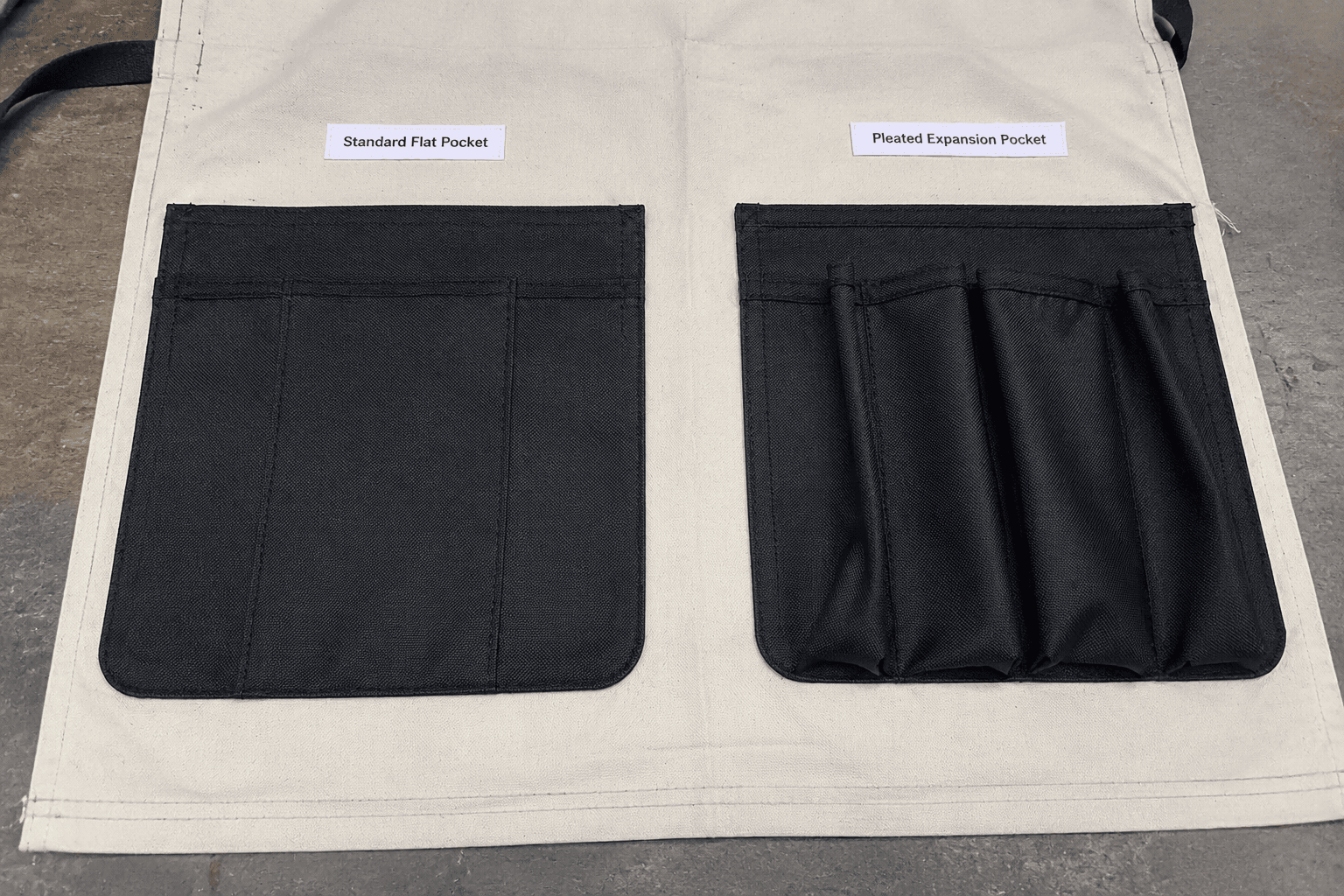
Apron expansion pockets solve that problem only when capacity is engineered instead of guessed. A side pleat, box pleat, hidden inverted fold or bottom bellows can add 15-50 mm of usable depth where volume is needed while keeping the rest of the apron front relatively flat. On a hospitality apron, that may mean one expanded device pocket plus two 30 mm pen slots. On a workshop apron, it may mean several reinforced bellows pockets in 280-320 GSM twill or 10 oz canvas.
For OEM sourcing, the question is not whether a sketch looks bigger. Buyers need to balance pocket volume, fabric memory, seam bulk, shrinkage, bartack points, sewing minutes, AQL limits, carton compression and unit cost. The strongest apron programs lock pocket construction early, test samples with loaded objects and freeze measurements before grading, marker planning and bulk trim booking.
- Define pocket capacity by exact object size and weight. "Bigger pocket" is not a usable sourcing or QC instruction.
- For service aprons, 15-25 mm pleat depth usually covers order pads, pens and compact card readers; 30-45 mm is more appropriate for gardening, workshop and tool aprons.
- The most dependable cloth range for apron expansion pockets is 220-300 GSM twill or 8-10 oz canvas, which balances fold recovery, wash performance and manageable seam bulk.
- A basic engineered pleated pocket typically adds US$0.12-0.28/pc at 1,000-3,000 pcs; a reinforced multi-compartment gusset pocket usually adds US$0.30-0.55/pc.
- Sampling should include fit, loaded function and wash review. Bulk QC should check pleat depth, mouth width, bartack position, seam security and packed-carton creasing under AQL 2.5 unless a tighter plan is specified.
- Freeze pocket structure before grading and marker making. Even a 10-15 mm change in pocket depth can affect fabric yield, sewing sequence, carton shape and final FOB.
Why flat apron pockets fail sooner than engineered apron expansion pockets
Many OEM apron programs still start with flat patch pockets because they are fast to sew, easy to inspect and low in labor cost. On a basic waist apron in 220 GSM 65/35 poly-cotton twill, a flat pocket can work for pens, gloves or a guest-check pad. Problems start when staff carry thicker items such as handheld payment terminals, barcode scanners, wine keys, folded towels, microfiber cloths or pruning shears. A flat compartment then pushes outward, strains the top corners and telegraphs every object through the apron front.
Apron expansion pockets add shaped volume instead of only adding visible width and height. A pocket with 20 mm side pleats on both edges can increase practical internal volume by roughly 40-60% over a flat patch pocket with the same face size, while still pressing mostly flat when empty. For B2B buyers, that is the commercial advantage: more storage without turning a uniform apron into a sagging utility pouch.
In commercial wear, the pocket usually fails before the apron body. A bib apron body may last 40-60 commercial or industrial wash cycles, but the pocket mouth stretches, divider seams break, bottom corners distort or bartacks tear out much earlier if the load does not match the construction. These failures are usually traceable to one of four causes: the item is too thick for the pocket geometry, the fabric is too soft for the expansion depth, the reinforcement is too light, or the pocket is placed where swing stress is too high.
- Cafe waist apron: usually needs 18-25 mm effective depth for an order pad, pens and a compact card reader.
- Bar apron: often needs one reinforced tool pocket plus 1-2 narrow 25-35 mm slots for opener, lighter or wine key.
- Florist or garden apron: commonly needs 30-45 mm expansion for shears, twine, tags and gloves.
- Workshop apron: typically needs bellows or side-gusset pockets with bartacks, double-layer bottoms or riveted stress points.
Set pleat depth, gusset width and opening size before the first apron sample
The most common structures for apron expansion pockets are center box pleats, side pleats, bottom bellows, inverted pleats and full side gussets. Each changes capacity, sewing time and visible bulk in a different way. Buyers should not approve any of them from artwork alone. The tech pack should state finished pocket width and height, pleat or gusset depth, opening width, seam allowance, top-hem depth and reinforcement positions in millimeters.
A center box pleat gives a balanced look and works well on bib and bistro aprons where presentation matters. Side pleats usually perform better for repeated device or tool removal because the face stays flatter while the volume opens laterally. Bottom bellows work when the carried item is thick but not wide. Inverted pleats hide spare volume and are useful for front-of-house aprons that must collapse cleanly when empty. Full gussets give the greatest controlled capacity, but they also add more sewing minutes, more edge handling and more QC points.
Depth needs to be functional, not decorative. A 10 mm pleat rarely adds meaningful carrying capacity. At 15-20 mm, the gain becomes useful for hospitality items such as note pads or compact POS devices. At 25-30 mm, a utility apron pocket can carry folded towels, scanners or small tools more comfortably. Above 35 mm, the pocket starts behaving like a pouch, so seam bulk, fold recovery, body balance and wearer comfort become much more critical.
Opening width is just as important as depth. A well-sized pocket can still fail in use if the mouth narrows after topstitching, washing or pressing. If a device is 78 mm wide, an 80 mm finished opening is usually too tight once seam thickness and shrinkage are considered. For rigid objects, the opening must account for insertion angle, one-handed access and the resistance created by medium- to heavy-weight cloth.
- 10-12 mm pleat depth: mostly visual, with limited functional gain.
- 15-20 mm pleat depth: suitable for hospitality and retail aprons.
- 25-30 mm pleat depth: suitable for mixed service and light utility use.
- 35-50 mm gusset depth: better reserved for workshop, gardening and heavy utility aprons.
- Top hem at 20-25 mm: usually gives better mouth stability than a 10-12 mm turn-over.
Choose apron fabric by pocket load, fold recovery and wash count
Fabric weight determines whether an expansion pocket holds shape or collapses after laundering. In lighter aprons made from 160-190 GSM cotton twill, expansion depth should stay conservative unless the pocket is lined or the mouth is faced, because the folds soften quickly and the bottom edge can sag after 5-10 wash cycles. For most hospitality, salon and retail aprons, 220-260 GSM twill is the safest range. Common options are 65/35 poly-cotton twill for dimensional stability or 100% cotton twill with a sanforized finish where a softer hand is required.
For bar, garden and workshop aprons, 280-320 GSM twill or 8-10 oz canvas usually supports larger apron expansion pockets more reliably. These weights hold 25-40 mm expansion better and resist distortion under loaded use. In 10-12 oz canvas or denim, even larger pocket volume is possible, but the pocket corners, folded seam allowances and topstitch stacks become harder to sew cleanly. Needle size, SPI, seam trimming and operator handling need to be planned before bulk production.
Testing has to follow the pocket design, not just the apron body spec. Cotton-rich fabrics may shrink 3-5% in warp or weft after laundering, narrowing the pocket mouth enough to make a scanner or card terminal difficult to insert. Garment-washed aprons also soften, which changes how the pleat opens under load. Polyester-rich twills keep size more consistently, but pleat press marks can show more clearly on dark colors. In many cases, adding a 90-120 GSM pocket lining or a 120-150 GSM mouth facing is a more efficient fix than upgrading the entire apron body fabric.
Fabric choice also affects seam build-up. A 300 GSM twill pocket with a double-turned top hem, side pleats and a lining can create six to eight fabric layers at key points. That is manageable in a capable apron factory, but only if operator method, folder use and needle-thread combination are aligned with the actual construction.
- 160-190 GSM twill: acceptable for light service aprons, but keep expansion shallow.
- 220-260 GSM twill: the best-balanced range for hospitality, salon and retail programs.
- 280-320 GSM twill: suitable for heavier-duty service, bar and utility aprons.
- 8-10 oz canvas: strong option for structured utility pockets with moderate bulk.
- 10-12 oz canvas or denim: good for rugged aprons, but seam thickness and sewing difficulty rise sharply.
Engineer apron pocket dimensions around real devices, tools and user motion
The fastest way to waste sample rounds is to ask for a large pocket without object data. Buyers should provide width, height, thickness and approximate weight for each main carried item. If a card terminal measures 78 x 148 x 22 mm and weighs 240 g, the pocket cannot be patterned like a notebook sleeve. It needs insertion clearance, controlled side expansion and top-corner reinforcement that can survive one-handed removal through an 8-10 hour shift.
A practical rule is to add 8-12 mm total clearance for thin paper goods and 12-18 mm for rigid devices, depending on fabric weight, expected shrinkage and whether the item is inserted one-handed. In the POS example above, a finished pocket width of 90-95 mm with 15 mm side expansion often performs better than an 85 mm flat slot. For a 95 x 150 mm order pad, 15-20 mm depth is usually enough in 220-240 GSM twill. For pruning shears or tasting spoons, bottom reinforcement and compartment separation matter more than simply widening the opening.
Compartment planning affects user behavior as much as capacity. One oversized bellows pocket becomes a mixed cavity where pens fall sideways and tools hit each other. For servers, a stronger layout is often one expanded main pocket plus two narrow pen or thermometer slots at 25-35 mm finished width. For workshop aprons, several smaller gusseted pockets usually distribute stress more evenly than one large center pouch.
Placement matters too. A heavy pocket mounted low and near the side seam swings while walking and can pull the apron off balance. On waist aprons, the most stable location for a loaded device pocket is often slightly above mid-body and closer to the center front than buyers first expect. On bib aprons, high placement improves access but can interfere with branding or chest drape, so fit review on body is essential.
- Thin note pad or check pad: allow 8-12 mm clearance and modest depth.
- Scanner or POS device: allow 12-18 mm clearance and bartack both top corners.
- Pocket load above 200 g: use double-needle bottom attachment or enclosed bottom seam.
- Pen or thermometer slot: 25-35 mm finished width is common, adjusted for shrinkage.
- Single tool above 500 g: review whether the item should be apron-carried at all.
Keep front-of-house silhouettes clean while adding apron expansion pockets
For hospitality, salon and retail programs, pocket function cannot ruin presentation. The apron has to look clean when worn empty, when folded for stock and when packed into export cartons. Bulk usually comes from three design mistakes: the expansion opens forward instead of sideways, the mouth lacks enough structure, or too much weight is placed far from the apron center line. The result is a swollen-looking front even before the pocket is loaded.
To control appearance, expansion should usually open at the sides or bottom instead of projecting directly outward. Side pleats and inverted pleats generally give a cleaner face than pouch-style bellows on front-of-house aprons. A 20-25 mm top hem or a bound mouth helps reduce elongation during repeated in-and-out use. On waist aprons, slightly raised lower corners or a mild angled bottom edge can reduce thigh sag better than a simple square patch-pocket shape.
Sewing details affect the visual result as much as the pattern. On most hospitality aprons, Tex 40 or Tex 45 thread at 8-10 SPI gives stable attachment without making the fold too rigid. On 10 oz canvas, Tex 60 may be suitable, but heavy thread on a small pleated pocket can create visible ridges and stop the pleat from collapsing flat. Edge pressing temperature also matters, especially on polyester-rich twills where shine or pressure marks can appear on black and navy programs.
Review should never be limited to tabletop approval. Buyers should assess the apron on body, standing and seated, with and without loaded objects. A pocket that looks balanced on a flat table may pull open on a moving wearer or become inaccessible once the apron wraps around the hip.
- Use side pleats or inverted pleats when a clean front view is critical.
- Stabilize pocket mouths with 20-25 mm turn-over hems or binding on medium-weight aprons.
- Place heavier compartments closer to the apron center line to reduce swing during walking.
- Avoid very wide patch pockets on fabrics below 200 GSM because they distort quickly after wash.
- Approve silhouette both empty and loaded before PP sign-off.
Cost, MOQ and lead-time impact of pleated and gusseted apron pockets
In apron sourcing, expansion pockets add cost mainly through labor, not fabric usage. A simple flat patch pocket may take about 35-55 seconds to prepare and attach, depending on size and factory method. A pleated pocket with pressed folds, top hem, edge setting, topstitching and bartacks often requires 80-140 seconds. A lined, divided or full-gusset pocket can exceed 150-190 seconds once turning, shape-setting and inspection are included.
For orders in the 1,000-3,000 piece range, a basic side-pleat or box-pleat pocket usually adds US$0.12-0.28/pc. A reinforced multi-compartment pocket with lining, bottom facing or extra bartacks commonly adds US$0.30-0.55/pc. At lower MOQs of 300-500 pcs, the effective add-on rises because pattern engineering, sample revisions and line setup are spread across fewer units. Buyers targeting a waist-apron FOB under US$3.50/pc need to budget these minutes carefully. On a premium bib apron in canvas at US$6.50-11.00/pc, engineered pocket cost is usually easier to absorb.
Lead time shifts as well. A repeat apron in stock fabric may sample in 5-7 days and ship bulk in 25-30 days after PP approval. A new pocket structure often needs 10-14 days for the first sample, plus 3-5 more days if object fit, wash recovery or access angle requires revision. Bulk sewing may need another 2-4 days because line speed is lower and in-line inspection points increase. If the pocket uses custom rivets, snaps or woven labels, trim booking can add another 5-7 days unless materials are already in house.
Complex pockets also affect packing. Deep gusseted aprons can consume more carton volume or require a different folding method to prevent mouth creasing. That may reduce pieces per carton and slightly change sea-freight cost per unit, which is why pocket approval should happen before final carton dimensions are frozen.
- MOQ 300-500 pcs: workable for pilot uniform programs, but development cost per piece is higher.
- MOQ 1,000-3,000 pcs: usually the most efficient range for custom apron expansion pockets.
- Basic pleated pocket add-on: about US$0.12-0.28/pc.
- Reinforced gusset or multi-compartment pocket add-on: about US$0.30-0.55/pc.
- Typical bulk lead time after PP approval: 25-35 days, with 2-4 extra days for complex pocket programs.
Sampling, AQL and wash testing standards for apron pocket approval
Pocket development should be treated as functional engineering, not as a small styling detail. For a new apron style, buyers should request at least three sample stages: a fit sample to confirm scale and placement, a loaded function sample using the actual device or a calibrated dummy, and a wash sample to check shrinkage, seam security, twist and pleat recovery. If the apron is intended for commercial laundering, even a 5-cycle internal wash review can expose mouth stretch, seam grin and corner torque before PP approval. For heavy-use utility programs, 10-cycle internal review is even safer.
The tech pack should include measurable tolerances. In many apron programs, general pocket width and height can sit at plus or minus 3 mm, while pleat depth, divider width and bartack location should stay within plus or minus 2 mm. If a pocket must fit a dedicated scanner or payment device, the critical opening width may need to tighten to plus or minus 1.5 mm. Without written tolerances, factory QC and third-party inspectors cannot judge fit consistently.
For bulk inspection, AQL 2.5 for major defects and 4.0 for minor defects is common on apron orders, while premium uniform buyers may require AQL 1.5 major. Functional checkpoints should include loaded pull at top corners, seam security at the pocket base, symmetry, mouth width, pleat depth after pressing and the effect of carton compression on folded pockets. Lined or washed canvas pockets can take permanent pressure creases if packed too tightly, so pack-density review should not be skipped.
A practical approval method is to define one or two critical-use objects and make them part of the PP standard. If the approved sample accepts the object smoothly after wash and still lies acceptably flat when empty, QC has a clear pass-fail reference. That is far more reliable than visual comments such as 'pocket looks okay' or 'please make slightly bigger.'
- Sample sequence: fit sample, loaded function sample, wash sample, then PP sample.
- Typical tolerance: plus or minus 3 mm for general pocket dimensions.
- Pleat depth and divider width: usually plus or minus 2 mm maximum.
- Critical device-fit openings: often need plus or minus 1.5 mm control.
- Common inspection plan: AQL 2.5 major and AQL 4.0 minor unless buyer standards are stricter.