For chain restaurants, hotel kitchens, bakeries, workshops, and beauty service brands, adding names or station numbers to aprons looks simple on a tech pack. In factory production, however, an embroidered name apron is a controlled uniform item with more variables than a plain apron: fabric stability, stitch density, thread color, position tolerance, name data accuracy, and packing sequence all affect cost and delivery.
At Linwa Apron Manufacturing in Zhejiang, we usually treat named uniform apron orders as a separate workflow from standard logo embroidery. A logo repeats the same file across the full order. Names, job titles, and apron station number details create many small variations, so the real risk is not only embroidery quality but data control. One wrong spelling on 300 pieces can cost more time than a late fabric roll.
This article explains how buyers can specify embroidered names and station numbering on staff aprons in a way that is practical for OEM production in China. The focus is on bulk custom aprons, not one-piece personalization, with typical order sizes from 300 to 20,000 pieces and common lead times of 25 to 45 days after approval.
- Confirm the name list before fabric cutting, because late name changes can disturb embroidery scheduling and packing sequence.
- Keep name embroidery under 80 mm wide where possible, as long names increase stitch count, cost, and distortion risk.
- Use apron station number rules consistently, such as A01-A50 or BAR-01, so production can check sequence quickly.
- Choose mid-weight stable fabrics, usually 220-320 GSM cotton twill, TC twill, denim, or canvas, for cleaner name embroidery.
- Expect a higher unit cost than standard logo aprons, usually USD 0.20-0.85 per piece extra depending on name length and handling.
- Approve one physical pre-production sample before bulk embroidery, because digital mockups do not show puckering, thread sheen, or real placement.
Why an embroidered name apron is different from a logo apron
A standard custom apron normally has one repeated decoration file: a chest logo, waist logo, woven label, or screen print. The factory prepares one embroidery program, sets up the machine, and repeats the same design across all pieces. An embroidered name apron changes that rhythm. Each name can require a separate text file, size adjustment, thread trim, and operator check. The apron may still look identical to the end user, but in production it is a multi-SKU order.
For a 1,000-piece restaurant apron order with one logo, the embroidery room may run continuously after the first-piece approval. For 1,000 pieces with 120 different names, the machine time is not only stitch time. The operator must load each name file, confirm the placement, check thread color, and avoid mixing sizes or departments. If the order also includes apron numbering by station, the packing team must match the right apron to the right store, counter, room, or employee list.
The main sourcing point is that personalization should be planned as manufacturing data, not as decoration text added near shipment. A buyer should supply the name list, numbering system, apron color breakdown, and packing requirement together with the purchase order. When this information arrives after fabric approval, the order can still be produced, but the risk of delay and manual rework increases.
- A repeated logo is one embroidery file, while 100 staff names may require 100 controlled text entries.
- Name embroidery needs spelling checks at artwork, sample, bulk embroidery, trimming, and packing stages.
- Station numbering affects carton labels and distribution, not only the appearance of the apron.
- A personalized staff apron order usually requires more production documents than a plain apron order.
Fabric choices for named uniform apron embroidery
Fabric stability is the first technical point. Embroidered names are usually small, straight, and easy to judge by eye. If the fabric shifts, puckers, or stretches, the defect is visible immediately. For most staff aprons, we prefer 220-320 GSM woven fabrics when names are embroidered directly on the bib or pocket. Cotton twill at 250-280 GSM gives a soft hand feel and accepts dense stitching well. Polyester-cotton twill at 210-260 GSM is more colorfast and easier to launder for chain food service programs. Canvas at 300-340 GSM is strong but may feel heavy for long shifts.
Denim aprons, especially 8-12 oz cotton or cotton-poly denim, are common for cafes and barbershops. Name embroidery can look clean on denim, but thread color must be selected carefully because indigo washing may create shade variation. If the apron is garment washed after embroidery, thread and backing must be tested. In many OEM orders, we recommend embroidering after fabric pre-shrink or garment wash, not before, unless the buyer accepts a more irregular vintage effect.
For very thin fabrics under 180 GSM, direct name embroidery can cause distortion, especially with all-cap names or dense fonts. In those cases, alternatives include woven name patches, heat-transfer name labels, or placing the embroidery on a pocket layer with suitable backing. Thin waterproof fabrics also need attention. PU-coated polyester may show needle holes, and TPU laminated fabrics can lose waterproof performance around embroidery areas.
- 220-260 GSM TC twill is a practical choice for value restaurant aprons with frequent washing.
- 250-320 GSM cotton twill gives a cleaner premium hand feel but may shrink 3-5 percent if not controlled.
- 8-12 oz denim works well for cafe and workshop aprons, but shade variation must be accepted or controlled.
- 300-340 GSM canvas is durable for tool aprons, though name embroidery can feel stiff if the stitch area is large.
- Coated waterproof fabrics should be tested because embroidery needles create permanent perforations.
Best placement for embroidered name apron programs
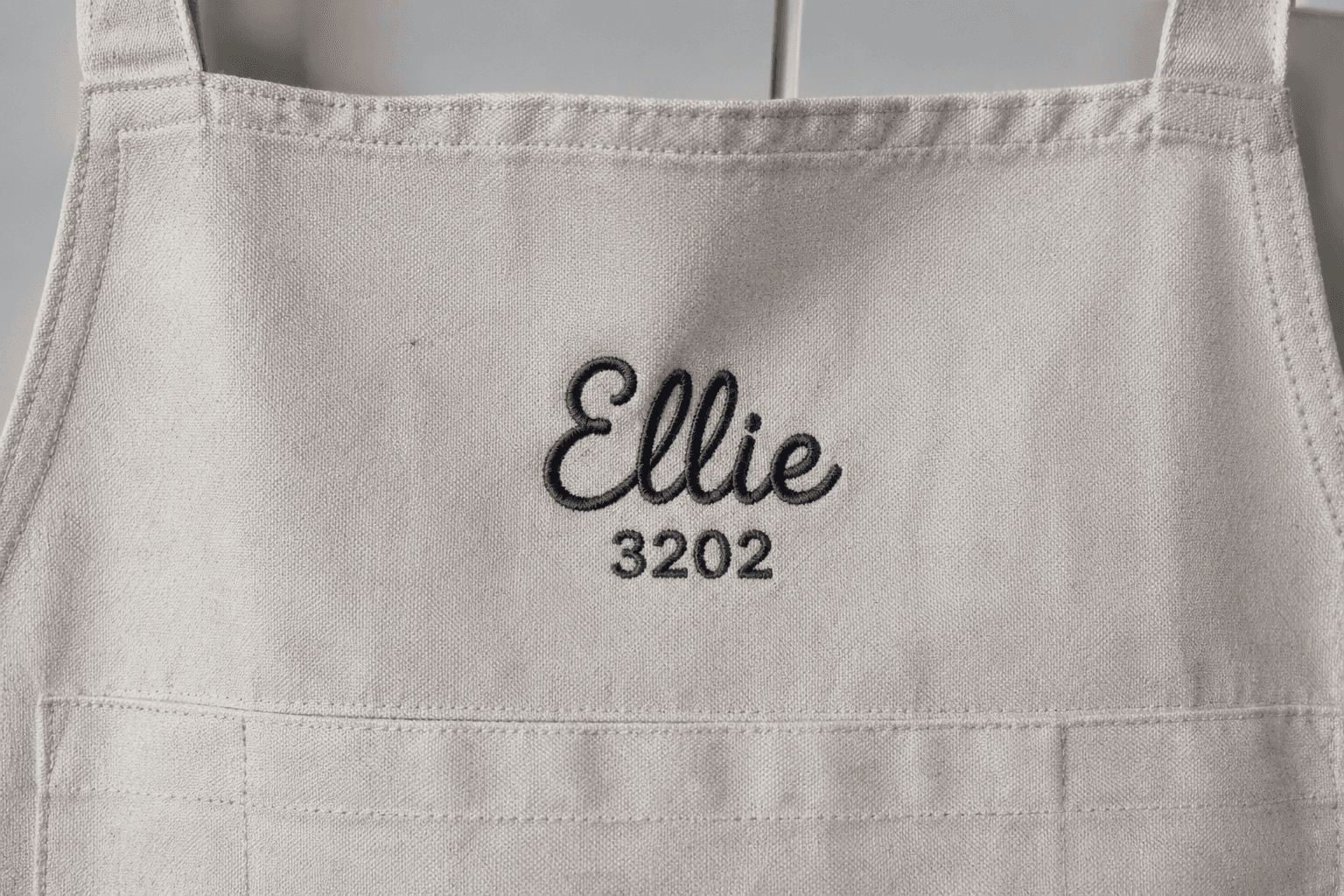
The most common placement for an embroidered name apron is the upper left chest of a bib apron, usually 70-100 mm below the top edge and 50-80 mm from the wearer’s left edge depending on bib width. For hospitality aprons, this position is easy for guests to read and does not interfere with waist ties. For kitchen aprons where the upper bib may be covered by a jacket, the pocket top or right chest may be more useful.
Placement tolerance must be written in the specification. For bulk apron production, a realistic embroidery placement tolerance is usually plus or minus 5 mm for simple bib placements and plus or minus 8 mm when the apron has curved edges, slanted pockets, or multiple size grades. Tighter tolerance is possible on stable patterns, but it can slow production and raise rejection rates. Buyers should define the measuring point clearly: from top edge to text baseline, from pocket edge to name center, or from center front to embroidery center.
Pocket embroidery is popular for server aprons and craft aprons. It looks neat, but the workflow matters. If the name is embroidered on the pocket before the pocket is sewn onto the apron, placement is easier for the embroidery machine, but the sewing team must attach each pocket correctly to avoid mixing names. If embroidery is done after pocket attachment, the hooping area may be limited and the needle can hit seam thickness. For large orders, pre-embroidered pockets are efficient only when the name list and sewing sequence are well controlled.
- Left chest placement is suitable for front-of-house staff and hotel service aprons.
- Pocket placement is useful when the bib area carries a logo or when staff names need to be lower and less prominent.
- Center chest placement works for station numbers but can look too uniform-like for premium hospitality brands.
- Hem or side-tab numbering is discreet, but it is harder to read during staff assignment or laundry sorting.
- Embroidery on straps is usually not recommended because the area is narrow, unstable, and affected by adjustment hardware.
How to specify apron station number systems
An apron station number can identify a workstation, production line, store counter, hotel department, table service section, or employee locker assignment. Unlike a personal name, a number may be reused when staff change. This is useful for high-turnover operations because the buyer does not need to reorder every time an employee leaves. For example, a bakery may order apron numbering from BAKE-01 to BAKE-60, while a hotel breakfast team may use F&B-001 to F&B-120.
The numbering format should be short and consistent. Long codes such as SHANGHAI-STORE-07-BAR-TEAM-003 are difficult to embroider at readable size and may look untidy on the apron. In production, we recommend 3-8 characters for visible station codes. If longer data is needed for warehouse control, use a woven label, QR label, or inner care label instead of front embroidery. For most front-facing staff aprons, A01, B02, BAR-11, K08, or ST-120 is enough.
Buyers should also decide whether numbers are embroidered alone, paired with names, or placed separately from names. A common layout is name on the left chest and apron station number on the right chest. Another option is name above number in two lines, but this increases height and may make long names look crowded. If the apron also carries a brand logo, the layout should avoid three competing visual points on the bib.
- Use leading zeros, such as 001-150, when the full order may later expand above 99 pieces.
- Keep department prefixes short, such as BAR, KIT, SPA, LAB, or F&B.
- Avoid changing between hyphen, space, and slash formats inside the same order.
- Confirm whether station numbers must be packed by store, by department, by numeric order, or by employee list.
- Reserve extra numbers for replacements, usually 3-5 percent of the first order quantity.
Font, thread, and stitch count control for an embroidered name apron
For name embroidery, readability is more important than decorative style. Simple block fonts, clean sans serif fonts, and moderate script fonts work best. Very thin strokes can break visually after washing, while very dense bold fonts can cause puckering. We normally advise a letter height of 8-12 mm for staff names and 12-18 mm for apron numbering that must be read from a distance. For a standard bib apron, a name width of 50-80 mm is usually balanced. Above 100 mm, long names may start to dominate the garment.
Thread choice should be fixed before sampling. 120D/2 polyester embroidery thread is the common choice for commercial aprons because it has good abrasion resistance, colorfastness, and washing performance. Rayon thread has a softer shine but is less common for heavy-duty laundering. For restaurant and hotel supply, polyester thread is normally safer, especially when aprons are washed at 40-60 degrees Celsius. Metallic thread is not recommended for staff name embroidery because it is slower to run and less durable.
Stitch count affects cost. A small single-line name may use 600-1,200 stitches. A two-line name and title may use 1,500-3,000 stitches. A bold station number with satin fill may use 1,000-2,500 stitches depending on size. In China apron factories, simple name embroidery often adds USD 0.20-0.45 per piece when data handling is clean and quantities are above 500 pieces. Complex two-line personalization or mixed names and numbers can add USD 0.45-0.85 per piece. These figures vary with thread color changes, backing, machine loading, and inspection requirements.
- Use 8-12 mm letter height for personal names on bib aprons.
- Use 12-18 mm letter height for apron station number details that supervisors must read quickly.
- Limit standard name width to 80 mm where possible to control stitch time and avoid distortion.
- Use polyester embroidery thread for commercial laundering and repeated wear.
- Avoid thin script fonts for dark denim or textured canvas because small curves can become unclear.
Data preparation and approval workflow for personalized staff apron orders
The most expensive mistake in a personalized staff apron order is usually not a broken stitch. It is wrong data. A buyer may send names in an email thread, a spreadsheet, a PDF, and a chat message, with different spellings in each file. The factory then needs to guess which version is final. For bulk OEM production, the name and number list should be one locked spreadsheet with line number, apron color, size if applicable, name, station number, department, packing group, and quantity.
We recommend freezing the name list before bulk fabric cutting or at least before embroidery file preparation. For normal orders, artwork confirmation takes 2-3 days, physical sample embroidery takes 5-7 days including fabric availability, and bulk embroidery file preparation takes 1-3 days depending on the number of variations. If the buyer changes 20 percent of names after production begins, the factory may need to remake embroidery files, reassign cut panels, and revise packing labels. This can add 3-7 days even when fabric and sewing capacity are available.
A good approval process has three checks. First, approve the font, thread color, size, and placement on a physical sample. Second, approve the final name and apron numbering list in spreadsheet form. Third, approve a production layout sheet showing exact text examples, including the longest name, shortest name, special characters, and number format. Names with accents, apostrophes, hyphens, or non-Latin characters should be tested early. Some embroidery fonts do not support all characters cleanly.
- Send one final spreadsheet instead of separate emails and marked PDFs.
- Include exact capitalization, because JOHN, John, and john require different visual approval.
- Mark duplicate names clearly if two staff members share the same name but need different station numbers.
- Avoid last-minute title changes such as Chef, Bar Lead, or Supervisor after embroidery files are prepared.
- Keep one buyer-side person responsible for final spelling approval.
MOQ, cost, and lead time for named uniform apron production
Minimum order quantity depends on fabric, apron style, and decoration complexity. For a standard stock fabric such as black 240 GSM TC twill or 280 GSM cotton twill, a named uniform apron order can often start from 300 pieces per style, with mixed names accepted. For custom-dyed fabric, yarn-dyed stripe, special denim wash, or custom hardware, the MOQ may be 1,000-3,000 pieces because the fabric mill and trim suppliers set their own minimums. Personalization does not reduce fabric MOQ; it only changes the decoration workflow.
Lead time should be counted from final sample and data approval, not from the first inquiry. A realistic timeline for 500-2,000 embroidered name apron pieces in regular fabric is usually 7-10 days for material preparation if stock fabric is available, 3-5 days for cutting, 4-8 days for embroidery depending on name count, 7-12 days for sewing and finishing, and 2-4 days for inspection and packing. The total is commonly 25-35 days after approval. For 5,000-20,000 pieces or custom-dyed fabric, 35-50 days is more realistic.
Cost structure is also different from plain aprons. The base apron may be USD 2.20-4.80 per piece for common restaurant bib aprons in TC twill or cotton twill, depending on fabric weight, size, pocket construction, tie length, and order quantity. Name embroidery then adds machine time and handling. If each apron has a unique name and number, the factory also needs more inspection time and sorting labor. Buyers comparing quotations should check whether the price includes embroidery setup, backing, trimming, individual polybagging, and packing by name sequence.
- 300 pieces is a practical starting MOQ for standard fabric and simple name embroidery.
- 1,000-3,000 pieces may be required when fabric color, weave, wash, or trims are custom-developed.
- 25-35 days after approval is common for 500-2,000 pieces in stock fabric.
- 35-50 days is more realistic for large orders, garment wash, custom dyeing, or many store allocations.
- USD 0.20-0.85 per piece is a typical added range for name and numbering embroidery, depending on complexity.
Quality inspection, packing, and reorder control
Inspection for an embroidered name apron order must include both garment quality and data accuracy. The normal apron checks still apply: fabric shade, size tolerance, seam strength, pocket position, tie length, thread trimming, metal hardware, and washing label. On top of that, the inspector must verify spelling, number sequence, embroidery position, thread color, backing removal, and puckering. For a personalized order, an AQL check alone may not be enough for name data because one wrong name can make that piece unusable.
For bulk shipments, we recommend 100 percent visual checking of names and station numbers against the approved list, especially when each piece is unique. This does not mean every seam measurement is checked on every apron, but every personalized text should be matched. The packing method should also be written clearly. Some buyers need one polybag per apron with name and number sticker. Others need bulk packing by store, such as Store 015: 30 pieces, numbers BAR-01 to BAR-10, KIT-01 to KIT-12, SRV-01 to SRV-08. If the carton label is wrong, the receiving team may spend hours sorting at destination.
Reorders are easier when the first order has a clean system. Keep the embroidery font name, thread color code, placement measurement, approved artwork file, apron fabric code, and numbering format in the supplier file. For replacement orders, buyers can send only the new names and station numbers using the same template. If the fabric is custom-dyed, reserve tolerance must be understood. A reorder of navy cotton twill six months later may not match the first batch perfectly unless fabric is booked from the same mill lot or the buyer accepts commercial shade tolerance.
- Check every embroidered name and number against the approved spreadsheet before packing.
- Use carton labels that show store, department, size if applicable, and number range.
- Keep extra blank aprons only if the buyer accepts local embroidery later; otherwise reserve numbered replacements in the first order.
- Record thread color with a real supplier code, not only a general color name such as gold or grey.
- For repeat programs, keep 2-3 approved samples at the factory for future comparison.