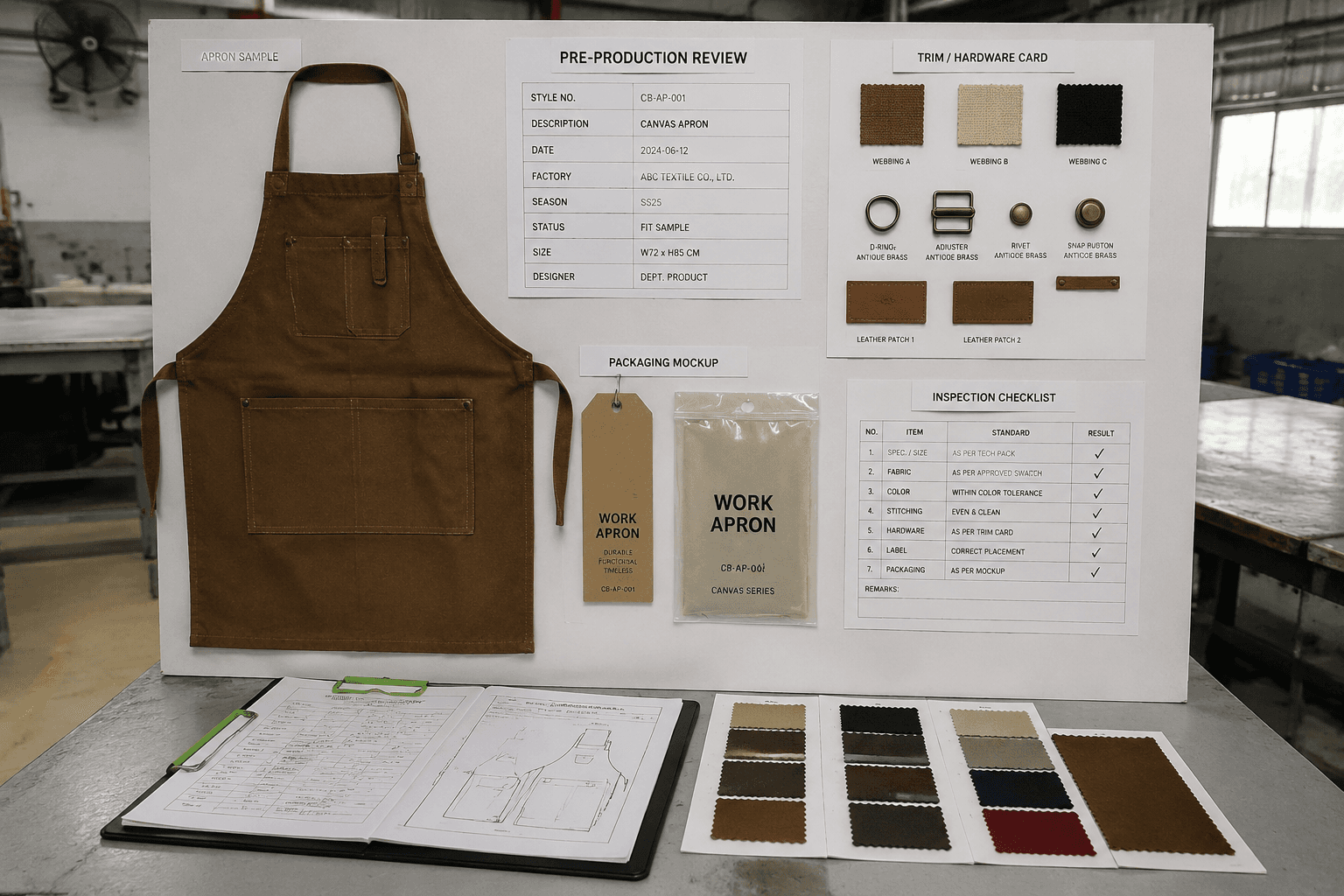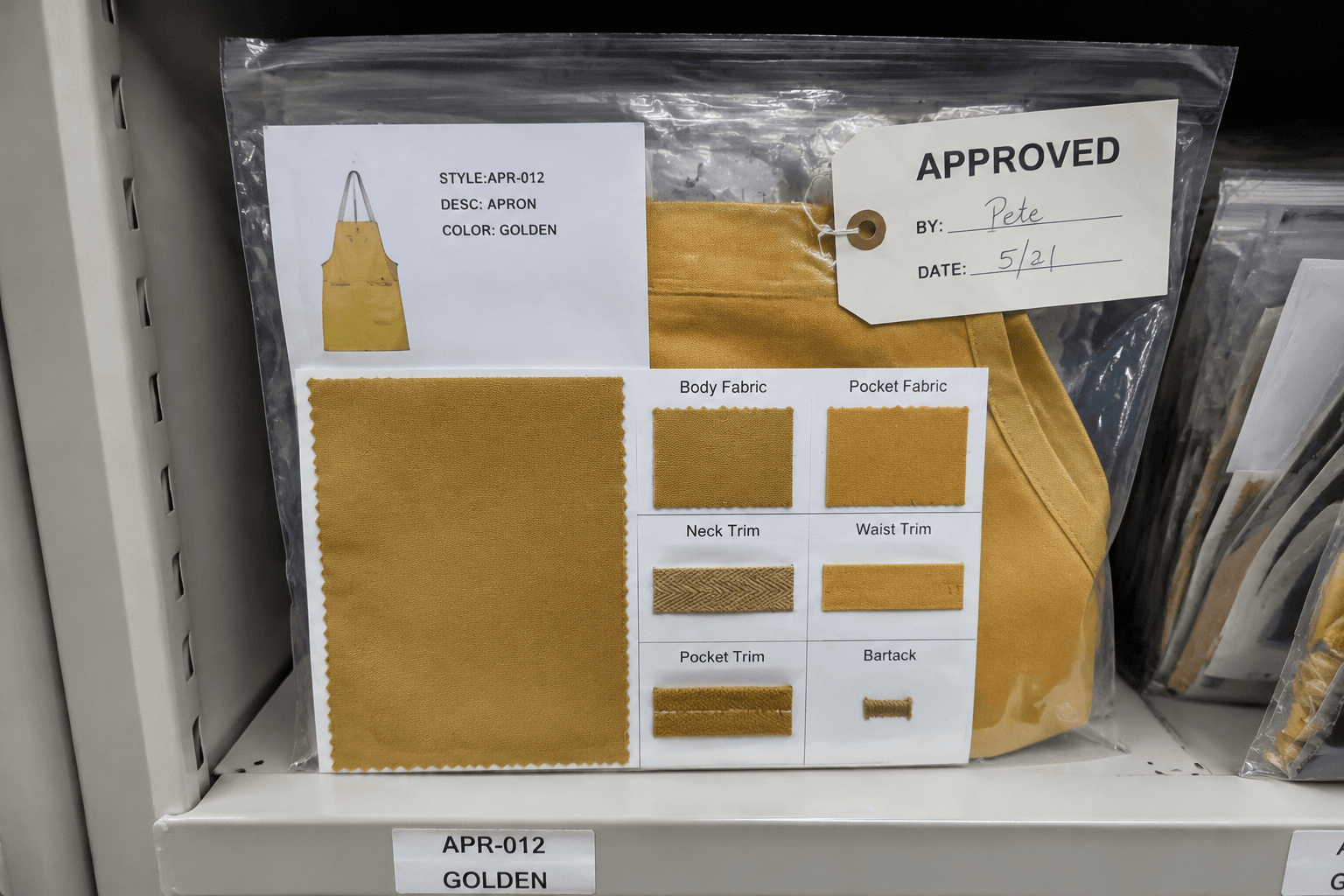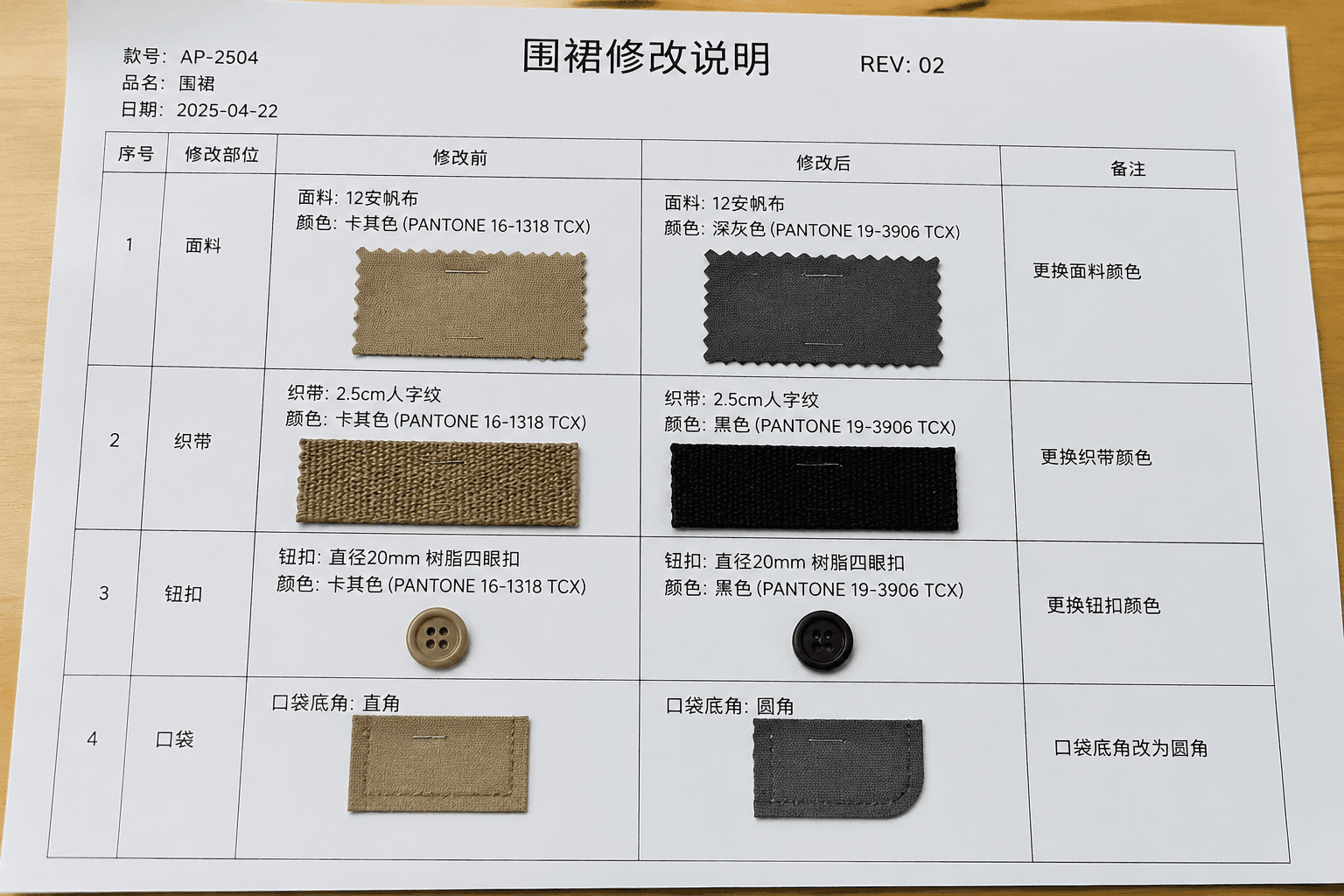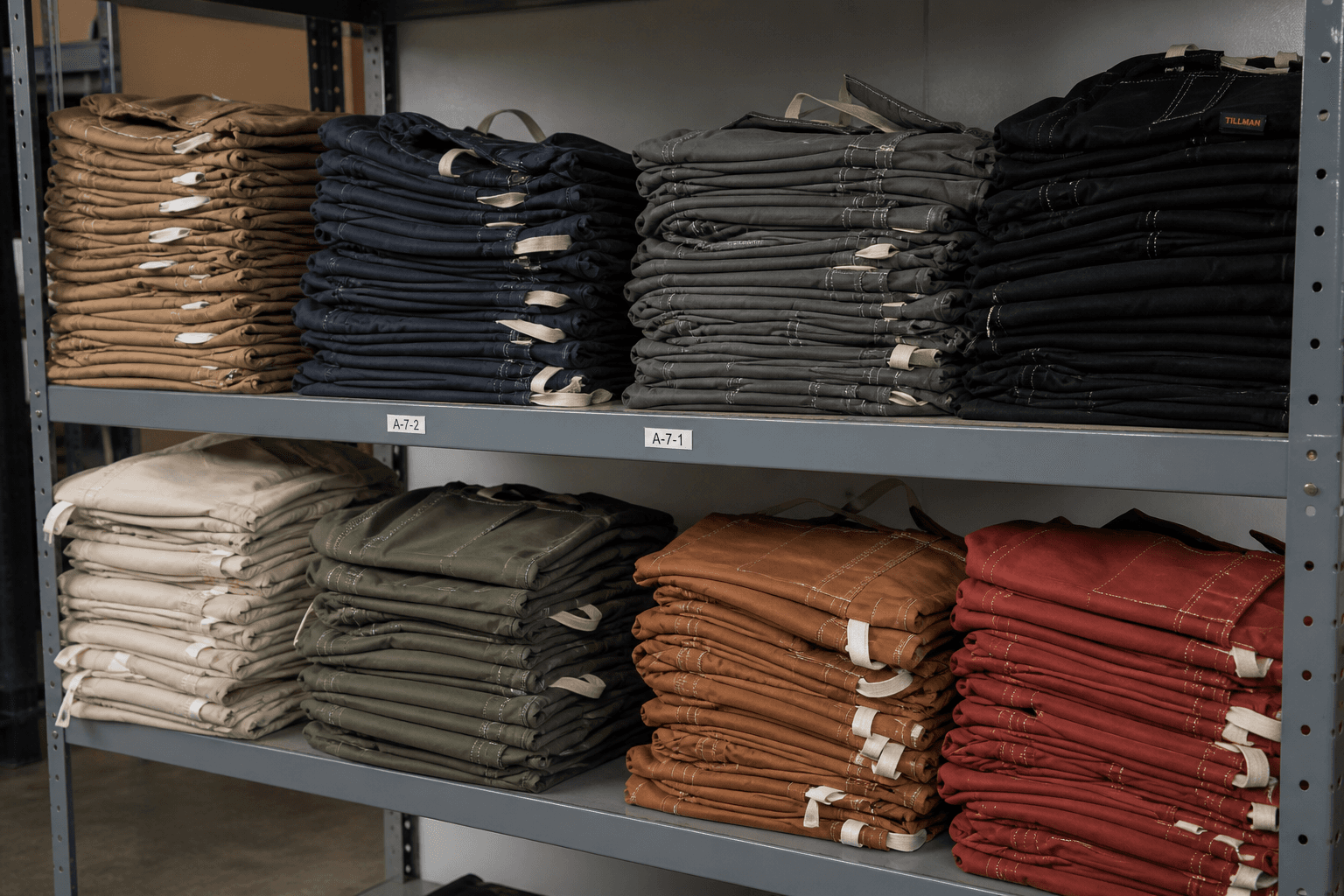
When a buyer asks for a custom apron quote from China, one of the first numbers in the reply is the apron MOQ. For many woven cotton, TC, denim, canvas, and polyester apron programs, factories commonly quote 150 to 300 pieces per style or per color. This range is not arbitrary. It reflects how a sewing factory balances fabric usage, cutting efficiency, decoration setup, trim purchasing, and production line scheduling.
For sourcing managers, the MOQ matters because it affects sampling decisions, SKU planning, launch risk, warehouse cost, and landed price. A 50-piece test order may look safer on paper, but if it carries a high unit cost, unstable color control, or manual handling at every production step, it may not represent the true bulk product. A 300-piece order often gives the factory enough volume to run normal bulk methods and give a more reliable price.
This article explains why the typical minimum order apron quantity falls around 150 to 300 pieces, when a lower quantity is realistic, and what buyers can adjust to reduce cost without weakening the finished apron.
- A standard apron MOQ of 150 to 300 pieces usually reflects fixed setup work rather than factory inflexibility.
- Fabric MOQ, dye-lot control, webbing color, buckle sourcing, and decoration setup can each create a separate minimum.
- A low MOQ apron manufacturer can support smaller trials when the buyer accepts stock fabric, limited colors, and simpler branding.
- The custom apron minimum usually rises when each colorway, size, or artwork version requires separate cutting, printing, or packing.
- The most practical way to lower apron order quantity is to standardize fabric, trims, and packaging across multiple SKUs.
What apron MOQ means in factory quoting
In apron sourcing, MOQ is not only a sales condition. It is the lowest quantity at which the factory can purchase materials, arrange cutting, set up decoration, sew, inspect, and pack the order without losing control of cost. For a simple waist apron in stock 180 GSM TC fabric, the practical MOQ may be 150 pieces. For a bib apron in custom-dyed 12 oz canvas with metal hardware, branded straps, and individual retail packaging, the effective MOQ may be 300, 500, or even 1,000 pieces.
Factories often quote MOQ by style, color, and logo version. If a buyer orders 300 pieces total but splits them into three colors and two logo placements, the factory may treat the order as six small batches of 50 pieces. Each batch needs separate material handling, cutting markers, decoration setup, quality checking, and packing identification. This is why a quote may say 300 pieces per color, or 200 pieces per design, instead of 300 pieces mixed freely.
A clear apron MOQ quote should define the unit of the minimum. Buyers should check whether the minimum applies per style, per color, per fabric, per print design, per embroidery design, or per shipment. Without this detail, the buyer may compare two suppliers incorrectly. One supplier may quote 200 pieces total using stock black fabric and one logo, while another may quote 300 pieces per color for a custom fabric program.
- A style MOQ applies to one apron construction, such as one bib apron pattern with one pocket layout.
- A color MOQ applies when fabric or straps must be purchased, dyed, cut, and controlled by shade.
- A logo MOQ applies when screen printing, heat transfer, embroidery, or woven labels require separate setup.
- A packing MOQ applies when hangtags, barcodes, polybags, carton marks, or retail inserts change by SKU.
Why apron MOQ is commonly 150 to 300 pieces
The 150 to 300 piece range is common because it is large enough for a small but controlled production run. At this level, a factory can usually make a cutting lay with acceptable fabric utilization, keep one sewing team occupied for several hours, and spread setup labor across enough units. Below this range, too much of the unit price comes from preparation rather than sewing time.
Consider a mid-weight bib apron made from 240 GSM cotton twill. If each apron consumes about 0.72 to 0.85 meter including shrinkage allowance and cutting loss, a 300-piece order uses around 216 to 255 meters of fabric. This is normally enough to purchase a stock roll quantity or reserve a dye lot from a fabric supplier. A 50-piece order may need only 40 meters, but the fabric mill or wholesaler may still charge a higher roll price, cutting fee, or color matching fee.
Decoration also pushes the MOQ upward. A screen print frame may cost USD 20 to 45 per color. Embroidery digitizing may cost USD 15 to 50 per logo. Heat-transfer films may require test pressing for temperature, pressure, and wash resistance. These are fixed costs. On 300 pieces, a USD 45 screen cost adds USD 0.15 per apron. On 50 pieces, it adds USD 0.90 per apron before printing labor is counted.
- At 150 pieces, a basic apron can often be cut and sewn as a small production batch.
- At 200 pieces, fabric and trim usage becomes easier to control, especially for black, navy, khaki, and white.
- At 300 pieces, decoration setup, inspection, and export packing are spread over enough units to support a stable quote.
- Below 100 pieces, the order often behaves like extended sampling rather than bulk production.
Fabric is usually the first minimum order apron driver
For aprons, fabric is the largest material cost and one of the strongest MOQ drivers. A lightweight promotional apron may use 150 to 190 GSM polyester or TC fabric. A restaurant bib apron may use 200 to 260 GSM cotton twill. A barista or workshop apron may use 10 oz to 16 oz canvas, denim, or waxed cotton. Each fabric has different roll lengths, dyeing requirements, shrinkage behavior, and supplier minimums.
Stock fabrics allow lower quantities because the material is already available in common colors. Black 240 GSM cotton twill, 11 oz indigo denim, 260 GSM poly-cotton canvas, and 600D polyester can often be sourced from local inventory. In those cases, a factory may accept 150 to 300 pieces if the shade tolerance is reasonable. Custom-dyed fabric is different. Dye houses often prefer 300 to 500 kg per color, which can equal 800 to 2,000 aprons depending on fabric weight and consumption.
Fabric width also affects apron order quantity. A 150 cm wide fabric may cut bib aprons more efficiently than a 145 cm fabric, depending on pocket shape and strap placement. If the order is small, the cutting team has fewer chances to optimize marker efficiency. A 2% to 5% cutting loss difference can be meaningful on heavy canvas where fabric cost may be USD 2.20 to 4.80 per meter.
- Stock 180 to 240 GSM TC or cotton twill can support a lower custom apron minimum, often from 150 pieces.
- Custom dyed cotton, canvas, or denim may require 500 pieces or more per color unless the buyer accepts a surcharge.
- Heavy 12 oz to 16 oz fabrics raise the cost impact of cutting waste, shade variation, and rejected panels.
- Special finishes such as water repellent, oil resistant, enzyme wash, pigment wash, or wax coating usually increase MOQ and lead time.
Trims, hardware, and pocket details affect the custom apron minimum
Aprons look simple, but trim decisions can create separate minimums. Neck straps, waist ties, webbing, metal eyelets, D-rings, buckles, leather patches, woven labels, snaps, and rivets are often purchased from different suppliers. If the buyer wants custom strap color, antique brass hardware, contrast stitching, or a branded leather patch, the factory may need to meet trim supplier minimums before sewing can start.
For example, a stock cotton herringbone tape may be available in black, natural, or khaki with no special MOQ. A custom Pantone dyed webbing may require 1,000 to 3,000 meters. If each apron uses 2.2 meters of webbing for neck and waist ties, 300 aprons consume about 660 meters. That is below many webbing dye minimums, so the factory must either charge for unused material, suggest a stock color, or raise the apron MOQ.
Pocket construction also changes production efficiency. A plain center pocket is fast to attach. A divided tool pocket with pen slot, towel loop, rivets, and reinforced bartacks needs more operations and more line balancing. A 100-piece run with many details may take almost the same preparation time as a 300-piece run, but with fewer units to absorb the cost. This is why a low MOQ apron manufacturer will usually guide buyers toward standard pocket options for trial orders.
- Use stock webbing when the target order is 150 to 300 pieces.
- Avoid custom metal plating for small apron programs unless the buyer can accept 500 to 1,000 pieces.
- Keep one pocket layout across multiple colors to reduce pattern, cutting, and sewing setup time.
- Confirm whether leather, PU, silicone, or woven brand patches have their own MOQ separate from the apron MOQ.
Logo method changes the apron MOQ and unit price
Branding is often the reason buyers source custom aprons, but logo application has real setup costs. The best method depends on fabric type, design size, wash requirement, and order quantity. A one-color screen print on a 240 GSM cotton twill apron can be economical from 150 to 300 pieces. A multi-color print, large chest print, metallic ink, puff print, or discharge print may need higher quantities to justify setup and testing.
Embroidery is flexible for small batches because it does not require a screen for each color, but it is slow and thread consumption increases with logo size. A 7 cm wide chest embroidery may add USD 0.35 to 0.90 per piece on 300 pieces, depending on stitch count. A large 18 cm logo with 18,000 stitches can add USD 1.20 to 2.50 per piece and slow the production schedule. For thick canvas or denim, embroidery testing is important because needle marks and puckering are more visible.
Heat transfer works well for clean logos, small runs, and polyester blends, but wash testing must be honest. Food service and hospitality aprons may be washed frequently at 40 to 60 degrees Celsius. A low-cost transfer that looks fine on day one can crack after 15 to 25 wash cycles if the film and adhesive are not matched to the fabric. For workwear aprons, buyers should ask whether the quoted price includes a wash test, a pull test, or only normal visual inspection.
- Screen print is usually efficient for 150 to 300 pieces when the artwork is one or two colors.
- Embroidery is suitable for premium restaurant, hotel, and retail staff aprons, but stitch count controls cost.
- Heat transfer supports smaller batches, but wash resistance should be checked before bulk approval.
- Woven labels and patches may be better than large decoration when the apron fabric is heavy, textured, or washed.
When a low MOQ apron manufacturer can quote below 150 pieces
A factory can sometimes quote below 150 pieces, but the buyer should understand what changes. Orders of 30, 50, or 100 pieces are usually handled like sample room or small-batch production. The factory may use stock fabric, manual cutting, available trims, and flexible packing. Unit cost will be higher because procurement, pattern checking, logo setup, inspection, and export documentation do not reduce in the same proportion as quantity.
A practical low MOQ program may use a standard apron block, such as a 70 x 85 cm bib apron, 240 GSM black cotton twill, stock black neck strap, two waist ties, and one front pocket. With one-color print or small embroidery, this can sometimes be produced at 50 to 100 pieces. The price might be USD 4.20 to 6.80 per piece depending on fabric, logo, and packing. The same apron at 300 pieces may be USD 2.90 to 4.30 per piece because cutting, decoration, and handling are more efficient.
Small orders also carry lead-time trade-offs. A factory may not put a 50-piece order into the main sewing line during peak months. It may wait for a sample team opening or combine the cutting with another similar fabric order. For urgent trial launches, buyers should discuss the delivery date in calendar days, not only production days. A 12-day production promise may still become 22 to 30 days door-to-door after material purchase, logo approval, packing, customs, and international shipping.
- Below 150 pieces is realistic when the apron uses stock fabric, stock trims, one logo, and standard packing.
- The buyer should expect a higher USD per piece because setup costs are divided by fewer aprons.
- Low quantity orders are less suitable for custom dyeing, complex washing, special hardware, or many SKU splits.
- A 50-piece trial should be used to check market response, not to benchmark the final 500-piece bulk cost.
How SKU splitting raises the real apron order quantity
Many buyers plan an apron program by total quantity, but factories quote by production batch. A brand may say it needs 300 pieces total, but the breakdown is 50 black bib aprons, 50 khaki bib aprons, 50 denim aprons, 50 waist aprons, 50 cross-back aprons, and 50 kids aprons. To the buyer, this is one 300-piece order. To the factory, it is six different small orders with separate fabric, patterns, cutting, sewing, inspection, and packing.
SKU splitting is especially important for e-commerce brands, restaurant groups with different departments, and promotional distributors serving multiple end clients. Every change in size, color, logo, pocket, strap, or packaging can reduce efficiency. If cartons require separate barcode labels and packing lists, warehouse labor also increases. This does not mean SKU variety is impossible, but it should be planned deliberately.
One useful approach is to separate commercial variety from production variety. For example, a buyer may keep one apron body and one fabric across the program, then vary only the logo label or hangtag by end customer. Another approach is to group colors by fabric availability: 300 pieces in black and 300 in khaki for the first order, then add olive and burgundy after sales data confirms demand. This keeps the custom apron minimum aligned with real production economics.
- Combine small color runs into fewer launch colors when the fabric must be purchased or dyed separately.
- Use one apron pattern across multiple end users when only branding needs to change.
- Keep packaging common across the order unless retail channel rules require separate barcodes or inserts.
- Ask the factory to quote the same total quantity with two SKU breakdowns to see the cost impact clearly.
Practical ways to negotiate apron MOQ without damaging quality
MOQ negotiation works best when both sides reduce fixed costs, not when the buyer only asks for an exception. A factory may accept 150 pieces instead of 300 if the buyer uses stock fabric, limits the order to one color, approves standard strap materials, and accepts normal carton packing. This gives the factory a manageable small batch without forcing unusual procurement.
Buyers can also negotiate by committing to a repeat plan. For example, the first order may be 150 pieces for market testing, followed by 300 to 500 pieces within 60 to 90 days if sell-through is positive. Some factories will support this when the buyer pays sample fees, approves materials quickly, and keeps the specification stable. The factory may reserve the pattern and decoration settings, but it will usually not reserve fabric or trims without a deposit.
The most useful RFQ includes a target apron order quantity, acceptable alternatives, and non-negotiable points. A buyer might say: 200 pieces, black 240 GSM cotton twill preferred, stock fabric acceptable, one chest embroidery, individual polybag required, retail hangtag optional, target FOB Ningbo USD 3.80 to 4.50 per piece. This is much easier to quote than a broad request for the lowest MOQ and best price.
- Share the exact quantity by style, color, size, and logo before asking for the final apron MOQ.
- Allow stock fabric colors when the order is below 300 pieces per color.
- Standardize trims and pocket construction across all small launch quantities.
- Ask for separate pricing at 150, 300, 500, and 1,000 pieces to understand the cost curve.
- Confirm whether sample cost can be refunded after bulk order, but do not assume this applies to logo screens or custom materials.
What buyers should confirm before accepting an apron MOQ quote
Before accepting a quote, buyers should check what is included in the MOQ and unit price. A low number can be attractive, but it may exclude shrinkage testing, colorfastness checking, logo setup, inner packing, carton labeling, or pre-shipment inspection. For aprons used in restaurants, cafes, workshops, salons, hotels, or promotional retail, these details affect the product more than a small difference in MOQ.
Lead time should also be tied to the approved specification. For a 300-piece stock fabric apron order, a normal timeline may be 3 to 5 days for material confirmation, 5 to 7 days for pre-production sample with logo, 12 to 18 days for bulk production, and 3 to 5 days for final inspection and packing. In total, 23 to 35 days before international transport is realistic. Custom dyed fabric, washed denim, waxed canvas, or imported trims can add 10 to 25 days.
The best apron MOQ decision is not always the lowest quantity. For a new buyer, 150 pieces may be enough to test fit, fabric hand feel, logo durability, and staff feedback. For a brand with confirmed demand, 300 to 500 pieces usually gives better cost control and more stable production. The right custom apron minimum should match the buyer's launch risk, SKU plan, and quality requirement, while giving the factory enough volume to produce the apron under normal bulk conditions.
- Confirm whether MOQ is per style, per color, per logo, or total order.
- Check whether the quoted price includes logo setup, pre-production sample, hangtags, polybags, carton marks, and inspection.
- Ask what fabric GSM, composition, shrinkage allowance, and color tolerance are used in the quote.
- Confirm expected production days after sample approval, not only the earliest shipment estimate.
- Request a price ladder so the purchasing team can compare 150, 300, 500, and 1,000 piece scenarios.