Many apron programs are costed around fabric, pockets, straps and logo application first, with the hem left for later sample discussion. That sequence creates avoidable re-costing because apron hem construction changes seam allowance, marker efficiency, pressing method, SMV, inline repair rates and final appearance. On a custom bib apron or waist apron, a hem revision made after proto approval can force a new marker, a new labor booking and, with binding, a new trim approval cycle.
For professional buyers, hem selection is not a styling footnote. A 1.0 cm to 1.2 cm double-turn hem is usually the lowest-risk option on 220 to 340 GSM twill, canvas and lightweight denim used in hospitality and workwear aprons. A 0.5 cm to 0.8 cm narrow hem can reduce cloth take-up on 140 to 210 GSM promotional or light-service aprons, but it often loses that saving in slower sewing on curves or unstable fabrics. A bound edge can control scooped bib shapes, coated fabrics and contrast-edge retail programs, yet it adds trim MOQ, shade-control work and longer lead-time exposure.
The right choice is the one that matches the apron’s use cycle, wash conditions, target FOB, order quantity and delivery window. The sections below compare the three main edge finishes with realistic numbers buyers can use during RFQ review, sample approval, PP meetings and bulk negotiation.
- Double-turn hems are usually the safest commercial option for 220 to 340 GSM apron fabrics because they avoid trim dependency, hold shape well and perform reliably in repeated washing.
- Narrow hems can save about 1.5% to 3.0% in fabric yield, but on curved apron bodies or unstable fabrics they commonly add $0.03 to $0.10 per piece in labor and increase puckering risk.
- Bound edges usually add $0.10 to $0.35 per apron including tape and labor, but they can be the better technical choice on deep bib curves, coated shells and contrast-edge apron programs.
- Changing apron hem construction after sample approval typically adds 2 to 5 days for re-costing and marker revision; when custom binding is involved, the delay is more often 7 to 12 days.
- For hem-sensitive apron orders, many buyers inspect at AQL 2.5 major and 4.0 minor, with specific checks for skipped stitches, exposed raw edges, twisting, uneven width, corner distortion and binding shade mismatch.
How apron hem construction changes FOB on bulk apron orders
Hem selection moves four cost lines at once: shell fabric consumption, trim consumption, sewing minutes and defect handling. On a standard 70 x 85 cm bib apron in 245 to 300 GSM poly-cotton twill, moving from a 0.7 cm finished narrow hem to a 1.2 cm double-turn hem typically adds enough seam allowance to increase usage by about 0.025 to 0.055 meters per piece, depending on bib curve depth and corner radius. If the shell fabric lands at $2.20 to $3.60 per meter, the material effect alone is usually $0.06 to $0.18 per apron.
Labor can overturn that apparent material saving. On straight, stable edges, a double-turn hem is predictable once folders and guides are set. A narrow hem may look cheaper in a paper costing, yet on rounded lower corners, scooped bib edges or washed linen blends, the operator has less control margin and output drops. In many apron factories, a basic perimeter double-turn runs about 1.8 to 2.3 SMV, a narrow hem 1.7 to 2.8 SMV, and a bound edge 2.6 to 4.1 SMV depending on tape type, curve depth and whether the binding is pre-folded or cut in-house.
Defect cost is where buyers often under-budget. Uneven hem width, roping, raw-edge exposure, corner puckering and seam twisting add repair minutes and finishing delay. On an order of 12,000 aprons, even a 1.5% rise in hem-related repairs can consume most of one finishing shift if the line is already loaded tightly. Serious sourcing decisions therefore compare delivered FOB, not just seam allowance or trim price in isolation.
- Typical FOB gap between hem options on a basic apron: $0.04 to $0.18 per piece.
- Common time loss after a late hem revision: 2 to 5 days for re-costing, marker update and PP confirmation.
- Frequent defect categories: uneven width, skipped stitches, raw-edge show, twisting and corner puckering.
- On orders above 10,000 pieces, a 0.2 SMV change is usually commercially meaningful.
Double-turn apron hem construction on 220 to 340 GSM workwear aprons
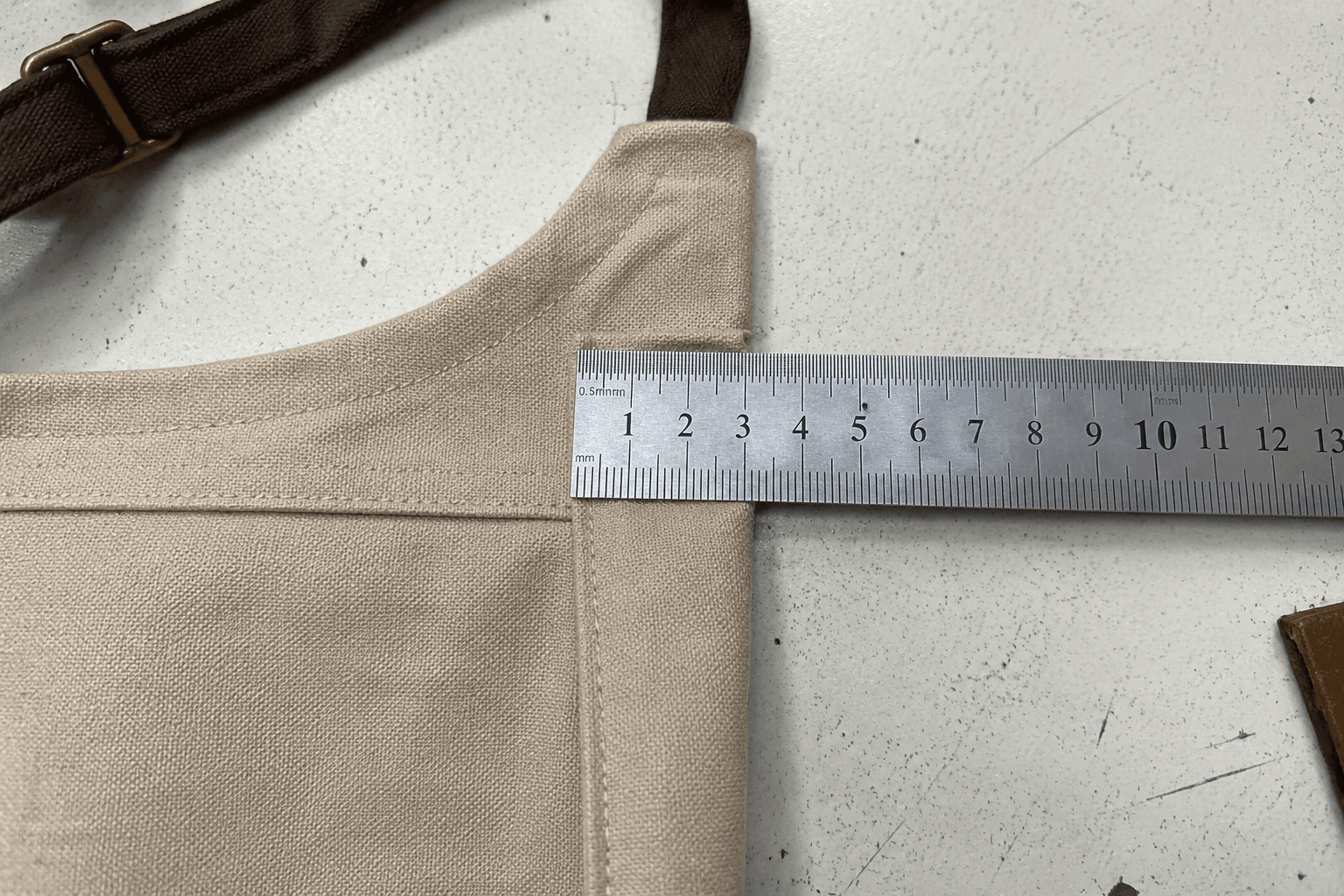
A double-turn hem encloses the raw edge by folding the shell fabric twice. On aprons, the most common finished widths are 1.0 cm, 1.2 cm and 1.5 cm, so the pattern must carry enough allowance for both folds plus corner control. This construction is standard on bib aprons, bistro aprons and cross-back utility aprons made in 8 oz to 12 oz cotton twill, poly-cotton twill, canvas and lightweight denim because these fabrics crease well and feed consistently through a single-needle setup.
Its main B2B advantage is reliability without extra trim sourcing. For restaurant and café aprons washed two to four times per week, a 1.0 cm to 1.2 cm double-turn hem sewn at 8 to 10 SPI usually performs well if the shell is sanforized and residual shrinkage is controlled below about 3% warp and 3% weft. There is no binding lot to approve, no added trim MOQ and less risk of edge shade variation after washing. For buyers managing replacement cycles and claim rates, that stability often outweighs a small material premium.
The trade-off is cloth usage and local bulk. On fabrics above 320 GSM, especially stiff 11 oz to 12 oz canvas, a 1.5 cm double-turn can create excessive thickness at apron corners, pocket overlaps and tie attachment zones. A practical factory response is to reduce the finished width to 1.0 cm, trim internal corners or combine constructions, such as double-turn on side and bottom edges with binding or facing on a curved bib opening. In apron sourcing, that mixed approach is often more efficient than forcing one finish across every edge.
- Best shell range: 220 to 340 GSM, roughly 8 oz to 12 oz.
- Typical cost premium versus a simple narrow hem: $0.02 to $0.08 per piece.
- Trim MOQ impact: usually none because only self-fabric is used.
- Best fit: hospitality, kitchen and retail workwear aprons with regular laundering.
Narrow hem apron hem construction: lower fabric use, higher sewing sensitivity
A narrow hem usually finishes at 0.5 cm to 0.8 cm and is chosen when the apron needs a lighter edge, softer drape or less seam allowance. It is common on 140 to 210 GSM cotton, polyester and linen-blend fabrics used for waist aprons, promotional bib aprons and event-driven programs with mostly straight edges. On simple apron shapes in stable fabric, it can reduce cloth take-up and keep the perimeter less bulky than a wider self-fabric fold.
The risk starts when buyers treat lower consumption as automatic cost saving. Narrow hems are less forgiving on fabrics that fray, grow, skew or resist a clean fold. Linen-cotton blends, washed chambray, open-weave recycled blends and slub-textured shells usually need slower handling and more pressing control. On curved apron perimeters, operators often have to ease the edge continuously to avoid tunneling and edge roll, which can cut output by 10% to 20% compared with a 1.0 cm double-turn on stable twill.
That efficiency loss compounds quickly in bulk. If a line is planned for 7,500 aprons per day but loses 12% output because a narrow hem is used on a curved bib-and-body style, the order may need two to four extra sewing days or additional operators. The cloth saving then disappears into labor and overhead. Narrow hems work best when three conditions are present together: the apron perimeter is mostly straight, the shell has low fray tendency and the product is intended for light-duty use or infrequent washing rather than a commercial laundry cycle.
- Typical fabric saving versus a wider double-turn hem: 1.5% to 3.0%.
- Typical finished width: 0.5 cm to 0.8 cm.
- Typical added labor on unstable shells or curves: $0.03 to $0.10 per piece.
- Best fit: promotional, seasonal and light-service aprons in stable 140 to 210 GSM fabrics.
Bound-edge apron hem construction for curved bibs, coated shells and contrast programs
A bound edge encloses the raw apron edge with a separate tape or strip instead of folding the body fabric twice. Common apron options include poly-cotton binding, cotton herringbone tape, bias-cut shell fabric and custom-dyed woven tape. This method becomes useful when the apron body has a deep bib curve, asymmetrical opening, coated finish or shell fabric that marks, stretches or frays under repeated folding.
Its value is process control as much as visual effect. On a scooped bib opening or rounded café-apron corner, binding can hold the shape more cleanly than a narrow hem and avoid the bulk of a wide double-turn fold. It is also functional for contrast-edge retail programs, but the sourcing decision should still start with performance. On technically difficult apron shapes, bound edges can reduce distortion and raw-edge risk when self-fabric folding is inconsistent in bulk.
The cost burden needs to be quoted early. Stock binding often adds $0.06 to $0.15 per piece in material and handling, while custom cotton binding, self-fabric bias binding or color-matched tape commonly pushes the total premium to $0.18 to $0.35 per apron once labor is included. MOQ is the next checkpoint: stock tape may be workable from 500 to 1,000 meters, but custom-dyed binding often requires 3,000 to 5,000 meters per color, which is too high for many 600-piece pilot orders. Lead time is also longer because color approval, shrinkage matching and trim testing can add 5 to 10 days, and 7 to 12 days is common in peak production months.
- Typical added cost including tape and labor: $0.10 to $0.35 per piece.
- Typical custom binding MOQ: 3,000 to 5,000 meters per color.
- Typical lead-time extension for trim approval and booking: 5 to 10 days, sometimes 12 days in peak season.
- Best use: curved apron bodies, coated fabrics, low-stability shells and contrast-edge retail programs.
Match apron hem construction to wash cycles, GSM and stress points
Buyers often ask which hem is strongest, but apron durability is not determined by edge finish alone. Real performance comes from the interaction between hem type, shell GSM, laundering conditions and stress concentration. On most aprons, the highest failure risk sits at lower corners, side openings, pocket edges and tie or strap attachment points rather than along long straight runs. A heavy-looking hem still fails early if the shell is too light or those stress points are not reinforced properly.
For example, a 270 GSM poly-cotton twill bib apron with a 1.0 cm double-turn hem will usually outlast a 180 GSM linen-blend apron with a decorative bound edge in hot-wash hospitality use because the base fabric is denser and dimensionally more stable. By contrast, a 190 GSM promotional apron with a narrow hem may be fully acceptable when it is worn occasionally and washed infrequently. The correct sourcing question is not which hem is universally best, but which hem is sufficient for the apron’s actual wash profile and replacement cycle.
Stitch density and reinforcement details often matter more than adding fold width. Many medium-weight apron fabrics sew cleanly at 8 to 10 SPI, while heavier canvas may run better at 7 to 9 SPI to avoid stiffness, needle heating and seam grin. Bartacks or reinforced backtacks at tie joins, pocket corners and hem start-finish points frequently reduce claims more effectively than upgrading the entire perimeter from narrow hem to double-turn. For B2B buyers, durability decisions should combine GSM, seam construction and end use rather than treating the hem in isolation.
- Daily hospitality baseline: 220 to 300 GSM twill with 1.0 to 1.5 cm double-turn hems.
- Occasional-use baseline: narrow hems can be acceptable below 210 GSM on stable shells.
- Heavy canvas above 320 GSM needs bulk review at corners, pocket joins and tie attachments.
- QC should prioritize stress points before long straight hem runs.
PP sample, tech pack and AQL controls before freezing apron hem construction
The safest moment to lock apron hem construction is during tech-pack costing and again at PP sample approval. Buyers should specify the edge type by location, finished width, corner geometry and visual tolerance. A workable apron tech pack should not say only hem all around. It should state details such as side and bottom edges 1.0 cm double-turn, bib curve bound with 30 mm tape folded to finish, bottom corners rounded to a 20 mm radius, SPI target 9 and no raw-edge exposure after one home-laundry test or one agreed commercial wash simulation.
This level of detail protects both cost and delivery. If the factory quotes one hem method but samples another, the SMV, marker and trim assumptions are no longer valid. On orders of 500 to 2,000 aprons, a bound edge may still be practical when styling requires it. On orders above 20,000 pieces, even a 0.2-minute SMV increase can affect line loading, finishing capacity and ship date. That is why experienced buyers request separate costing for double-turn, narrow hem and bound edge options during RFQ review instead of waiting for the sample room to decide.
A disciplined approval flow also reduces claim disputes. Confirm end use first, then shell stability, then hem method, then wash test, then PP approval, then bulk freeze. For standard apron programs, many importers inspect at AQL 2.5 major and 4.0 minor, with tighter visual checks on contrast binding, front-facing edges and curved bib openings. Once the PP sample is signed off, the hem specification should stay frozen before marker making, bulk cutting and trim booking begin.
- State hem type and finished width by apron location in the tech pack.
- Request separate costing for all three hem options when the FOB target is tight.
- Check that trim MOQ matches planned order volume before approving bound edges.
- Use a washed PP sample for aprons intended for repeated laundering.
- Freeze the approved hem spec before marker making, bulk cutting and trim booking.