For custom apron sourcing, fabric usually receives the first discussion: 10 oz canvas, 12 oz denim, 280 GSM twill, waxed cotton, recycled polyester blends. Hardware is often confirmed later, but the apron hardware finish can change how the final product is judged by the buyer, the store team and the end user. A brass apron buckle on a dark denim bib creates a very different commercial impression from matte black apron hardware on a polyester utility apron, even when the pattern and fabric are identical.
In factory production, apron metal trim is not only decorative. Buckles, D-rings, snap hooks, eyelets, jeans buttons and rivets must pass pull strength, wash testing, color consistency checks and metal detection requirements where applicable. The finish also affects lead time because not every surface treatment is stocked in every size. For a 3,000 piece order, using a standard nickel 25 mm slide may be straightforward. For a 20,000 piece program with antique copper rivet heads, matching buckles and branded snap hooks, the hardware schedule can become a separate production path.
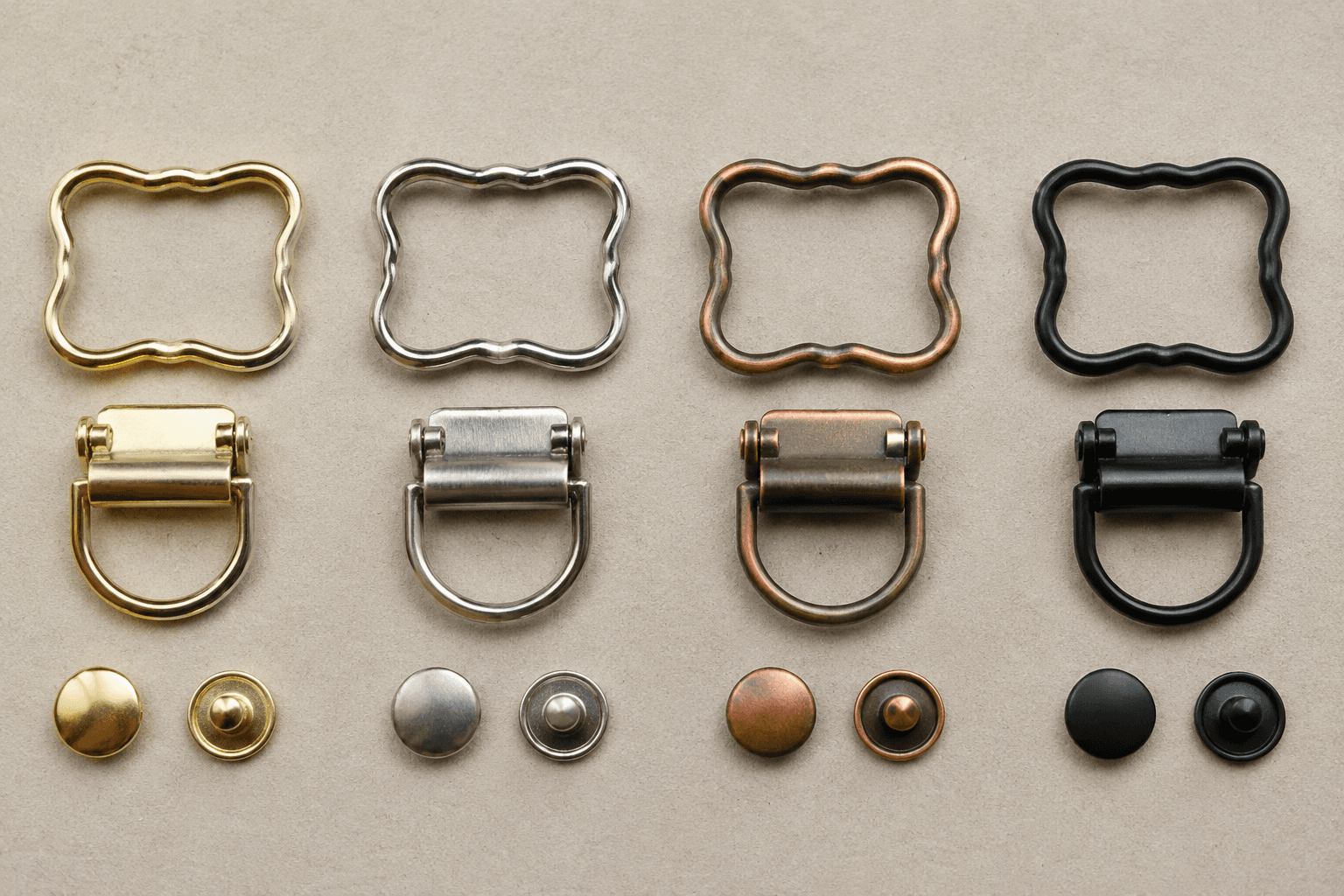
This article explains the practical sourcing differences between brass, nickel, antique copper and matte black finishes for apron hardware. The focus is on bulk apron orders from China: what is usually available, what can fail in testing, where costs move, and what buyers should lock before sample approval.
- Hardware finish should be confirmed before SMS approval because late changes can affect lab dips, trim cards, photos and wash-test results.
- Nickel is usually the lowest-risk commercial finish for consistency, availability and repeat order matching.
- Brass and antique copper finishes need closer shade control because warm tones can vary between plating lots and suppliers.
- Matte black apron hardware looks clean and modern but requires abrasion and wash testing to avoid edge rub-off.
- Apron metal trim cost is small per piece but can create real delays when custom plating, logo engraving or non-standard sizes are required.
- Food service and hospitality aprons need practical corrosion checks because sweat, detergent, steam and acidic kitchen environments expose weak finishes quickly.
Why apron hardware finish matters in bulk sourcing
An apron is handled more aggressively than many casual garments. The neck strap is adjusted repeatedly, waist straps are tied under tension, pockets carry tools, and the bib area is exposed to washing, oil, steam, coffee, flour, dye or cleaning chemicals depending on the end market. This means the apron hardware finish must be evaluated as a working component, not only as a color detail on a style sheet.
For a typical workwear or hospitality apron, the hardware set may include a 25 mm or 32 mm neck strap slider, one or two D-rings, pocket rivets, eyelets, snap hooks or detachable towel loops. On a basic 280 GSM polyester-cotton apron, hardware may add only USD 0.08-0.25 per piece. On a premium 12 oz canvas apron with branded metal buttons, antique rivets and a heavy brass buckle, the hardware package may add USD 0.35-0.90 per piece before packing. The value looks small compared with fabric, but a failed finish can delay the whole shipment.
From the factory side, the main risks are shade mismatch, plating thickness variation, surface scratches during sewing, corrosion after washing, and buyer rejection because the production lot does not match the approved sample. These problems are easier to prevent when the finish is included in the first trim card, not treated as a late merchandising decision.
- A standard 25 mm metal slide is normally easier to source than a 38 mm or 50 mm heavy-duty slide in the same finish.
- Nickel and gunmetal-style finishes are commonly available from stock, while antique copper and matte black may require plating to order.
- Logo-engraved buckles or rivets usually need 10-18 days for mold, engraving setup or strike-off approval before bulk trim production.
- A trim color approved under showroom lighting may look warmer, cooler or glossier after sewing against dark indigo denim or black canvas.
- Packed aprons with exposed metal trim need tissue, polybag direction or divider control when the finish scratches easily.
Common apron metal trim components and normal specifications
Before choosing a finish, buyers should define the hardware type, size and function. The same finish behaves differently on a flat rivet head, a curved buckle, a spring hook and a thin eyelet flange. Large curved parts show plating waves and scratches more clearly. Small rivets are easier to control visually but may loosen if the cap and nail length are not matched to the fabric thickness.
For aprons, fabric thickness strongly affects hardware selection. A 180-220 GSM promotional apron usually does not need heavy metal parts; plastic adjusters or light nickel D-rings may be enough. A 280-320 GSM twill apron can take standard metal sliders and rivets. A 10-12 oz cotton canvas or denim apron may need longer rivet posts, stronger washers and thicker buckles to avoid pull-out during use. Waxed canvas also needs care because oil and wax can transfer to the metal surface during sewing and packing.
In bulk production, we normally check hardware by actual fabric layers. For example, a waist pocket rivet may pass on two layers of 10 oz canvas but fail on four layers plus pocket reinforcement. A neck strap buckle may look correct at 25 mm, but if the tape shrinks from 25 mm to 24 mm after washing, the strap may slip. These are engineering details, but they affect returns and buyer complaints.
- Neck strap sliders are commonly 25 mm, 32 mm or 38 mm, with 25 mm used most often for hospitality and cafe aprons.
- D-rings are often 25 mm or 32 mm, with wire thickness around 2.5-4.0 mm depending on apron weight.
- Pocket rivet cap diameters are commonly 7 mm, 9 mm or 10 mm, with longer nails required for heavy canvas and multiple fabric layers.
- Eyelets for towel loops or tie exits should be tested for flange cracking after setting, especially on coated or waxed fabrics.
- Snap hooks for detachable straps or towel loops should be checked for spring strength and opening width, not only finish color.
Brass apron buckle: warm premium appearance with sourcing controls
A brass apron buckle is often selected for denim, canvas, waxed cotton and leather-detail aprons. It gives a traditional workwear look and pairs well with natural cotton tapes, brown leather patches, olive canvas, indigo denim and black twill. For brand buyers building a premium cafe, barber, florist or workshop apron line, brass is one of the most recognizable finishes.
There are two common sourcing paths. One is solid brass hardware, which has better material integrity and a natural warm tone but is more expensive. The other is zinc alloy or iron hardware with brass plating, which is more economical and widely used. For most apron programs, plated brass is acceptable if the finish passes wash and abrasion testing. Solid brass may be justified when the buyer wants long service life, visible aging or a more authentic workwear story, but the cost can be two to four times higher for larger buckles.
The buyer should understand that brass tones are not all the same. Some are yellow and bright, some are brushed and muted, and some are closer to old gold. If an apron program includes a brass buckle, brass rivets and brass snap hooks from different component factories, exact matching is not automatic. The safest method is to approve a full trim card made from the same bulk suppliers planned for production.
- A standard plated brass 25 mm slider may add about USD 0.04-0.08 per piece compared with basic nickel, depending on order volume.
- A heavy solid brass buckle can cost USD 0.25-0.80 each, and branded or cast styles can exceed that range.
- MOQ for stock plated brass parts can be as low as 1,000-3,000 pieces, while custom brass color or logo parts may require 5,000-10,000 pieces.
- Lead time for stock brass-tone parts may be 3-7 days, while custom plating or logo hardware often needs 12-25 days.
- Brass-tone hardware should be checked after enzyme wash, stone wash or heavy garment wash because abrasion can expose the base metal on corners.
Nickel finish: the practical default for repeat apron programs
Nickel is the most practical finish for many apron orders because it is widely available, consistent and easy to match across buckles, rings, rivets and eyelets. It works with black, navy, white, gray, khaki and many printed fabrics. For uniform suppliers, restaurant groups and distributor catalogues, nickel often gives the best balance between appearance, cost and replenishment reliability.
From a production viewpoint, nickel hardware has several advantages. Many trim suppliers keep standard sizes in stock. Surface color is easier to control than antique finishes. Scratches are less visible than on matte black. When a buyer reorders after six months, the chance of matching the previous shipment is usually better than with warm metallic finishes. This matters for programs where stores or franchise locations may receive aprons from different production batches.
Nickel also has compliance considerations. Some markets are sensitive to nickel release standards for skin-contact products. Apron hardware does not usually sit against skin in the same way as jewelry, but neck rings, buckles and snaps can contact the wearer, especially when the apron is worn over a T-shirt. If the buyer sells into the EU or requests REACH-related documentation, the hardware supplier must provide relevant declarations or test reports. This should be requested before bulk trim purchase, not after shipment booking.
- Use nickel when the buyer prioritizes consistent replenishment, fast trim sourcing and moderate cost.
- Confirm whether the required appearance is bright nickel, dull nickel, brushed nickel or satin nickel because these are not the same visual standard.
- Ask for nickel release or heavy metal documentation when the apron is sold into regulated retail channels.
- Avoid mixing nickel from multiple suppliers in one order unless the buyer accepts minor shade and gloss variation.
- For industrial laundry aprons, test nickel hardware after at least 5 wash cycles at the buyer's required temperature and detergent condition.
Antique copper rivet and aged finishes for heritage apron styles
An antique copper rivet is common on denim aprons, roaster aprons, maker aprons and styles influenced by jeanswear. Antique copper gives visible contrast on indigo, black, forest green and brown canvas. It can make a simple pocket construction look more substantial, especially when used at pocket stress points and paired with copper-tone buckles or D-rings.
The challenge is control. Antique copper is usually created by plating and then adding an oxidized or rubbed effect. This means two batches can look different even when the supplier uses the same process. One lot may be redder, another darker brown, another more orange. On small rivets this may be acceptable, but on a large neck buckle the variation becomes obvious. Buyers should define the target shade with a physical reference, not only a Pantone number or product photo.
Antique finishes also need realistic expectations. The aged effect is meant to be irregular, so a completely uniform surface may not be possible. However, there is a difference between intentional antique character and poor plating. Black stains, green oxidation, rough burrs and peeling edges should not be accepted. In our factory inspection, antique copper hardware is checked under daylight-equivalent lighting, then rubbed with a dry white cloth to see whether loose surface color transfers before sewing.
- Antique copper is suitable for 10 oz, 12 oz and 14 oz denim or canvas aprons where the customer expects a heritage workwear look.
- It is less suitable for clean medical, laboratory, spa or minimal uniform programs that require a crisp and neutral appearance.
- Buyer approval should include separate sign-off for rivets, buckles, eyelets and hooks because antique effect varies by component shape.
- For garment-washed aprons, test finished aprons after the full wash process because copper-tone edges may brighten or expose base metal.
- When using leather patches or leather straps, check whether copper finish stains the leather surface during packing or humid storage.
Matte black apron hardware for modern uniforms and its failure points
Matte black apron hardware is widely used for modern restaurant, bar, retail and beauty-service uniforms. It works well with black canvas, charcoal twill, olive fabric, beige cotton and minimalist branding. It also helps hide metal trim in tonal designs where the buyer does not want shiny hardware drawing attention away from the apron silhouette.
The main risk is abrasion. Matte black finishes are usually plating, electrophoresis, spray coating or another surface treatment over a base metal. When the part rubs against a sewing machine guide, metal presser foot, packing table, buckle edge or another hardware piece in the carton, the black coating can show silver or gray underneath. This is especially visible on corners, wire rings and moving parts. For this reason, matte black is not only a color choice; it requires handling control.
For bulk apron programs, the factory should test matte black hardware before confirming production. A simple dry rub test can identify weak coating, but it is not enough. We prefer to check buckle adjustment abrasion, 3-5 home wash cycles for normal aprons, and up to 10 industrial wash cycles for rental or laundry programs if the buyer requires that service condition. If the apron is packed with metal parts touching each other, we may add tissue wrapping or change folding direction, which can add packing labor and carton volume.
- Matte black hardware is strongest commercially when used on fashion-forward hospitality aprons, salon aprons and retail uniforms.
- It should be avoided for harsh industrial laundry programs unless the buyer accepts visible wear over time or approves a proven finish.
- The factory should inspect black buckles and rings for exposed edges before sewing because defects become harder to replace after attachment.
- Bulk packing should prevent black rivet heads, hooks and buckles from rubbing directly against each other during inland and sea transport.
- Allow 2-5 extra days for replacement or sorting if matte black trim arrives with surface scratches from the plating supplier.
How apron hardware finish affects cost, MOQ and lead time
The cost of an apron hardware finish depends on base material, component size, plating method, order quantity and whether the part is stock or custom. For a 5,000 piece apron order using one neck slider and two rivets, changing from stock nickel to stock brass-tone may increase cost only USD 0.05-0.12 per apron. Changing to custom matte black hardware with branded rivets, a special snap hook and individual wrapping may increase cost by USD 0.25-0.70 per apron.
MOQ is also important. If a buyer orders 1,200 aprons but wants a special antique copper finish across four different hardware items, each hardware item may have its own MOQ. The factory may need to buy 5,000 sliders, 10,000 rivets, 5,000 D-rings and 5,000 hooks even though the apron order uses fewer. The unused balance must be charged, stored for repeat orders or avoided by selecting a standard finish. This is why early trim discussion can save real money on small and mid-sized custom programs.
Lead time is often underestimated. Fabric booking may take 10-18 days for custom dye or 3-7 days for stock fabric. Sewing may take 12-20 days depending on quantity and line loading. Hardware may seem minor, but custom plating can take 7-15 days after approval, and branded mold work can take another 7-12 days. If hardware approval is delayed, the sewing line may wait even when fabric is ready.
- Stock nickel hardware for common sizes can often be ready in 2-5 days from local trim markets.
- Stock brass-tone or antique copper hardware usually needs 3-10 days, depending on size and quantity.
- Custom matte black plating commonly needs 7-15 days after sample approval, with longer timing before holidays.
- Logo rivet or buckle development may require 10-18 days for mold, sample and buyer confirmation.
- For orders above 10,000 pieces, reserve an extra 3-5 days for incoming hardware inspection, sorting and replacement if the finish is sensitive.
- For repeat programs, keep approved trim codes, supplier names, finish photos and physical counter samples to reduce second-order approval time.
Approval and testing checklist for apron metal trim
For serious apron sourcing, the finish should be approved through a physical process: trim card, proto sample, sales sample or SMS, then pre-production sample. Photos are useful for communication but not enough for metallic surfaces. Gloss level, warm-cool tone and antique effect are difficult to judge on screen. A buyer should keep one approved counter sample, and the factory should keep the same reference in the production office and QC room.
Testing should match the apron use case. A promotional apron for one event may only need basic appearance checking and pull testing. A restaurant uniform apron should pass repeated washing and sweat exposure. A rental laundry apron may need more severe wash tests, stronger rivet setting and corrosion checks. If the buyer requires SGS, Intertek, BV or other third-party testing, the finish and metal components must be submitted as part of the complete apron, not reviewed separately after bulk sewing.
The final inspection should include both function and appearance. QC should check that buckles slide but do not slip, rivets are centered and tight, eyelets are not cracked, hooks open and close smoothly, and visible hardware matches the approved finish. For a 3,000 piece order, AQL 2.5 for major defects and AQL 4.0 for minor defects is a common apparel inspection reference, but the buyer can define stricter rules for premium retail programs. Finish peeling, rust, broken springs and loose rivets should be treated as major defects because they affect use and brand perception.
- Approve one complete trim card showing every metal item, including spare buttons or detachable accessories.
- Test hardware on the actual bulk fabric thickness, including reinforced pocket corners and strap layers.
- Run wash testing before bulk production when the apron is garment-washed, industrial-laundered or sold as a durable workwear item.
- Check corrosion risk with sweat, detergent, steam or acidic food-service exposure when relevant to the end user.
- Define whether small antique variation is acceptable, and set rejection limits for peeling, rust, sharp burrs and exposed base metal.
- Keep physical approved samples in both buyer and factory records for repeat orders and claim handling.