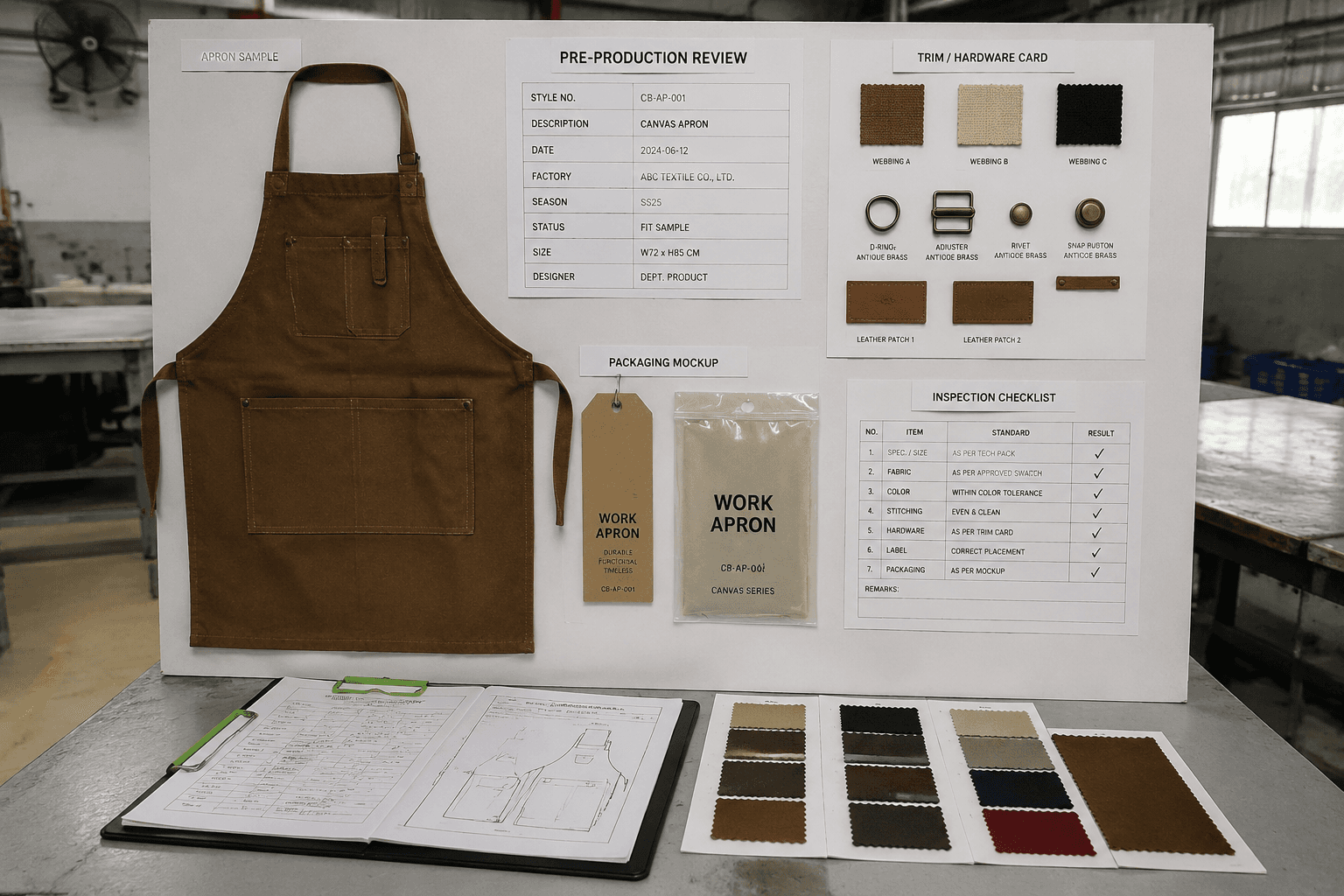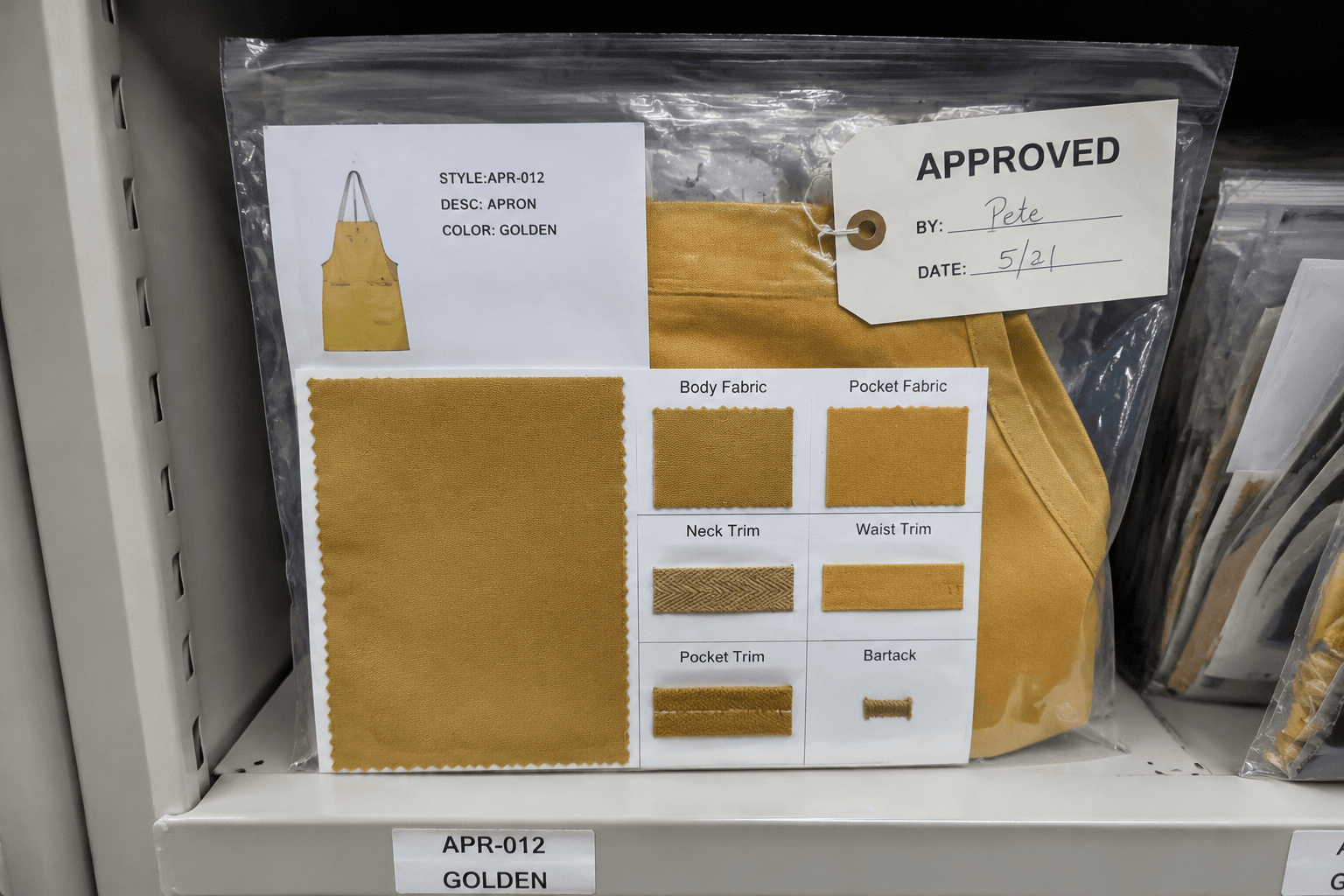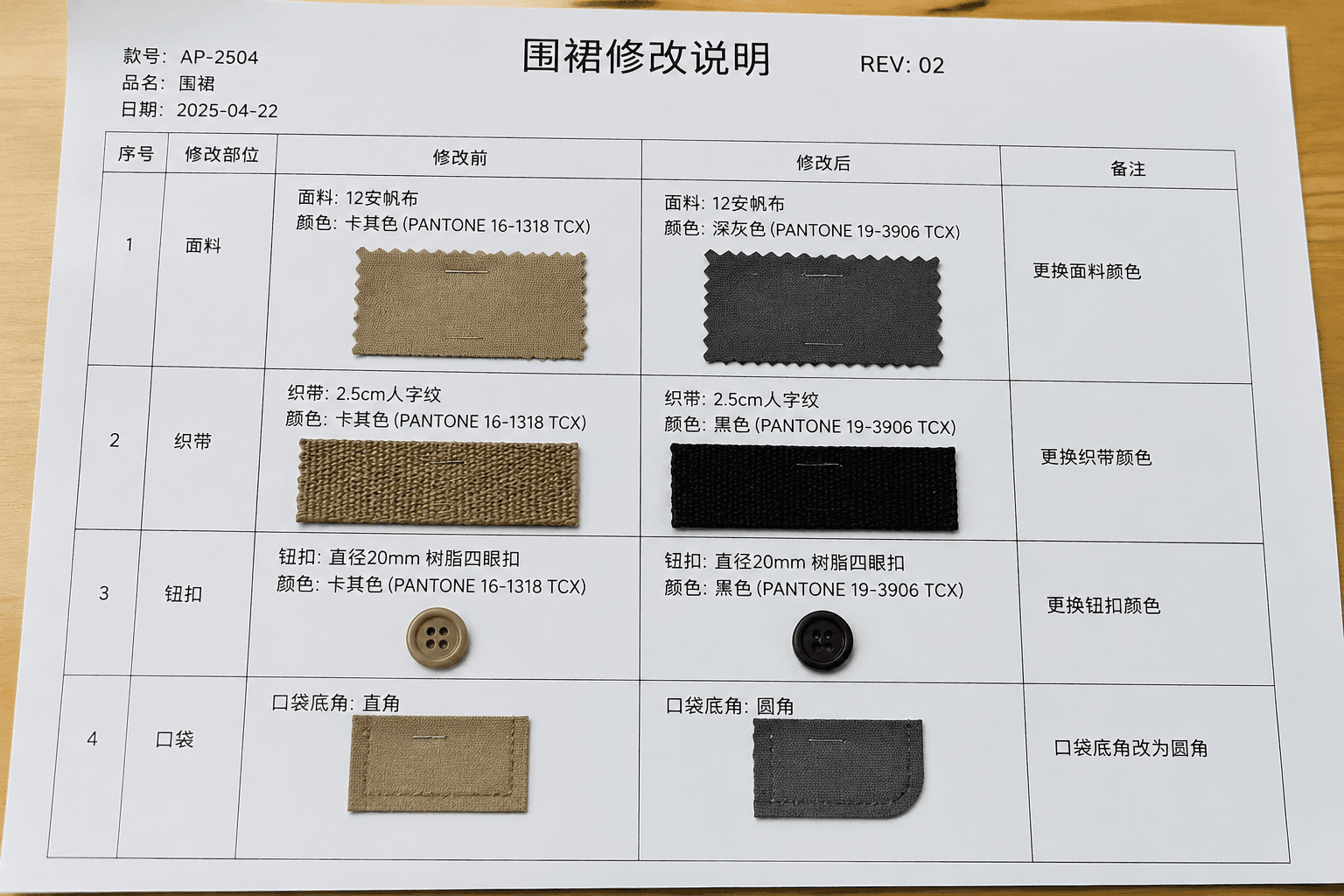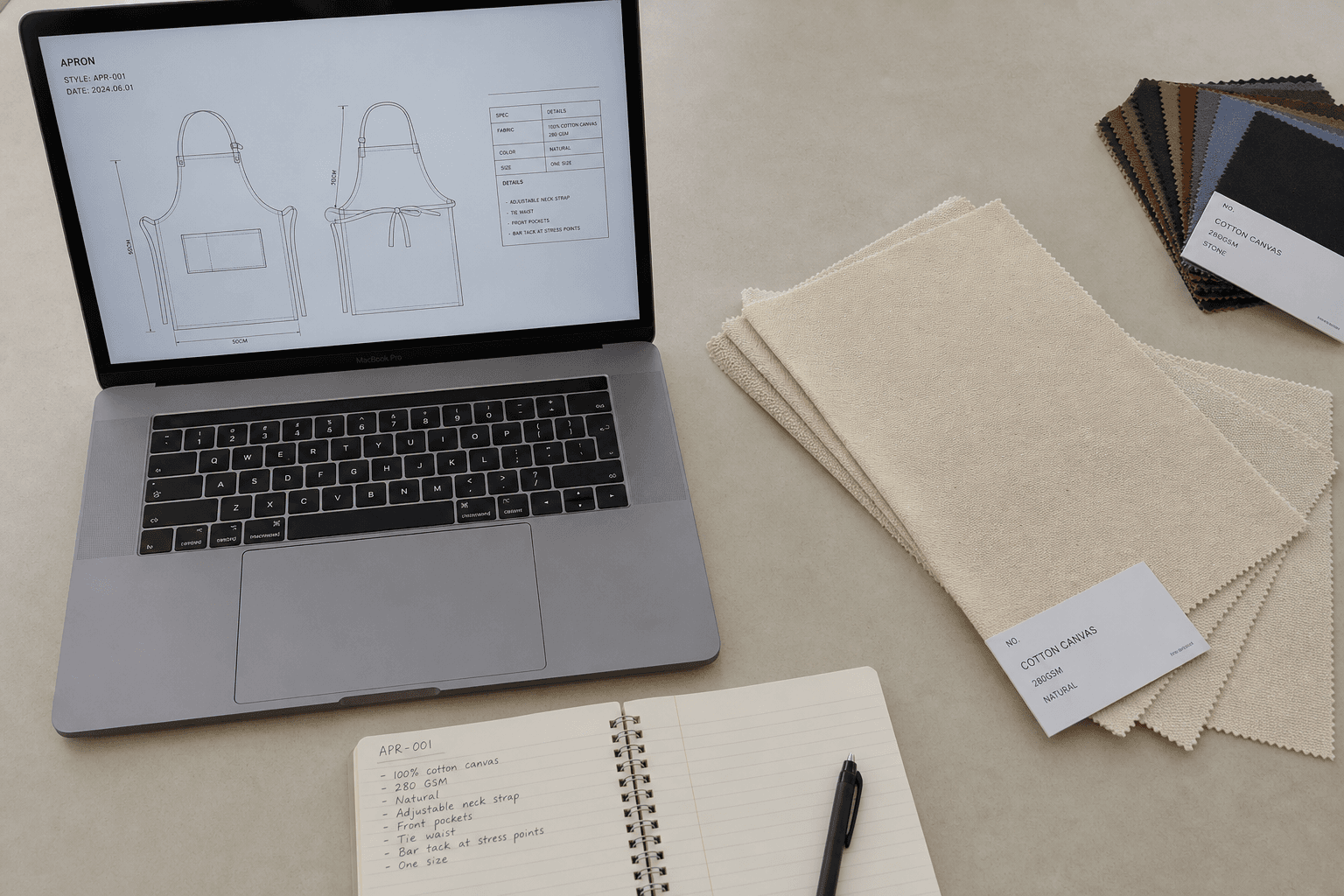
In bulk apron sourcing, most problems do not come from bad intentions. They come from incomplete messages, mixed reference samples, unclear drawings, and approval steps that are not written down. For a factory, the difference between a smooth 3,000-piece PO and a delayed one is often decided before the first fabric is cut.
Apron factory communication needs more detail than a casual product description. A buyer may say “heavy cotton canvas bib apron with leather straps,” but the factory still has to decide GSM, shrinkage control, strap thickness, buckle finish, pocket placement, bartack positions, packaging method, carton quantity and AQL standard. Each missing point becomes a factory assumption, and factory assumptions are where cost, schedule and quality disputes begin.
This article explains how sourcing managers, product developers and brand buyers can reduce supplier miscommunication when ordering custom aprons from China. The focus is practical: what to include in an apron order brief, what to confirm before sampling, and how to keep quotation, production and inspection aligned.
- Define measurable apron specifications instead of relying on product adjectives such as heavy, premium, soft or standard.
- Separate confirmed requirements from open questions so the factory knows which points need pricing and which need development advice.
- Use one controlled tech pack because mixed emails, chat screenshots and old samples create avoidable sampling errors.
- Confirm tolerances and inspection points early, especially for apron length, strap position, pocket size, logo placement and shade variation.
- Lock packaging and carton details before bulk because they affect labor cost, CBM, barcode accuracy and delivery timing.
Why apron factory communication fails before sampling
In apron sourcing, the first sample often reveals the real quality of the brief. A buyer may provide a photo, a logo file and a target price, then expect the factory to infer the rest. That can work for a repeat SKU, but it is risky for custom aprons because many visible and invisible choices affect cost. A 280 GSM cotton twill apron and a 420 GSM cotton canvas apron may look similar in a small image, but fabric consumption, sewing behavior, shrinkage and freight weight are different.
The most common supplier miscommunication happens when one side uses trade language and the other side uses retail language. “Chef apron,” “barista apron,” “utility apron,” and “gardening apron” are useful category labels, but they are not specifications. A factory needs panel dimensions, pocket function, reinforcement method, strap design, logo process, fabric standard, color reference and packing rules. Without those, two suppliers can quote the same request with a 20-40% price gap because they are not quoting the same product.
Another reason apron factory communication breaks down is that buyers sometimes send several reference points without ranking them. One message may include an old apron sample, a competitor photo, a Pantone color, a requested fabric weight, and a comment such as “keep cost low.” If those references conflict, the sampling room has to choose. For example, the old sample may use 10 oz canvas, the photo may show 12 oz denim, and the target price may only support 7 oz poly-cotton. A good supplier will ask questions, but the cleaner approach is to identify which references are binding and which are only inspiration.
- State whether the reference sample is for size, fabric handfeel, construction, color or general style.
- Mark any point that must not change, such as logo size, neck strap type, pocket count or finished apron length.
- Give the factory permission to suggest cost-saving alternatives only in defined areas, such as fabric blend or packing method.
Build an apron order brief that a production team can actually use
A practical apron order brief should read like a working production document, not like a sales concept. The merchandiser, pattern maker, sample sewer, fabric buyer, printing department, QC inspector and packing line may all use different parts of the same information. If the brief is vague, each department may fill gaps differently. This is how a sample can be correct in fabric but wrong in pocket placement, or correct in logo size but wrong in washing label content.
For a first enquiry, the brief does not need to be perfect, but it should contain enough detail for a realistic quotation. At Linwa, for a custom bib apron, we would normally need fabric composition and weight, finished size, strap type, pocket layout, logo method, order quantity per color, packing requirement, destination market and required delivery window. If these points are missing, the first price is only a rough estimate. For example, the difference between single polybag packing and folded belly-band packing can add USD 0.05-0.18 per piece depending on labor, paper grade and barcode control.
The brief should also separate “must follow” from “factory can advise.” This helps avoid unnecessary sampling rounds. If the buyer must hit USD 3.20/pc FOB Ningbo for 5,000 pcs, the factory can recommend 260 GSM poly-cotton instead of 320 GSM cotton canvas, or a printed twill tape neck strap instead of metal hardware. If the buyer requires 340 GSM organic cotton with GOTS documentation and individual retail packaging, the cost target needs to be adjusted before sampling.
- Include finished apron dimensions in cm or inches, including width, body length, neck strap length, waist tie length and pocket size.
- Specify fabric by composition, weave and weight, such as 100% cotton twill 260 GSM, 65/35 poly-cotton twill 220 GSM, or cotton canvas 12 oz.
- List logo method with size and position, such as screen print 90 x 45 mm at center chest, embroidery 70 mm wide above pocket, or woven label at lower right edge.
- Confirm quantity by color and size, because 2,000 pcs total across 8 colors is not the same sourcing condition as 2,000 pcs in one color.
- State packing and shipping assumptions, including individual polybag, master polybag, hangtag, carton mark, carton quantity and whether Amazon FBA labels are required.
Tech pack clarity for apron fabric, GSM and shrinkage
Fabric is where many apron costing errors start. Buyers often request “canvas,” “denim,” “linen look,” or “waterproof fabric” without defining weight, composition or finishing. For aprons, fabric selection is not only a handfeel decision. It affects sewing needle choice, seam puckering, washing shrinkage, colorfastness, logo adhesion, production speed and carton weight.
Tech pack clarity should include both fabric target and acceptable alternative. For example, if the desired cloth is 100% cotton canvas 10 oz, the buyer can state whether 280-300 GSM cotton twill is acceptable for cost reduction, or whether the canvas look is mandatory. For hospitality aprons, 220-260 GSM poly-cotton twill is common because it handles repeated washing better than many low-cost cotton fabrics and dries faster. For premium retail or cafe uniforms, 320-420 GSM cotton canvas or denim may give the heavier feel buyers want, but it increases sewing time, shrinkage risk and freight cost.
Shrinkage deserves explicit discussion. A 100% cotton apron may shrink 3-5% after washing if the fabric is not preshrunk or sanforized. If the finished length is 86 cm and the apron shrinks 4%, the customer sees almost 3.5 cm loss after laundering. That is not a small difference for uniform fit. The factory can pre-test fabric shrinkage, but the buyer should state whether measurements are required before wash, after wash, or both. For workwear-style aprons, we often recommend allowing size tolerance of +/-1 cm for small panels and +/-2 cm for full body length, then defining separate shrinkage expectations after one domestic wash or industrial wash cycle.
- Use Pantone TCX/TPG, fabric swatch or lab dip approval for color, not only screen images.
- Define whether GSM tolerance is acceptable, such as 260 GSM +/-5%, or whether a narrow fabric weight is required.
- Confirm wash testing requirements before bulk cutting if the apron is marketed as washable uniform wear.
- Ask for fabric roll width and consumption if the target price is tight, because narrow fabric can raise cutting waste.
- Clarify whether water-repellent, stain-release or waxed finishing is required, since these finishes change MOQ and lead time.
Apron factory communication around construction details
Apron construction looks simple until production quantities make small details expensive. One extra pocket seam, bartack or metal rivet may not matter on a sample, but on 10,000 pcs it can add hours of sewing time. A bib apron with cross-back straps also needs more fitting confirmation than a basic neck-strap apron because strap length, buckle position and body width affect comfort across different staff sizes.
The buyer should not assume that “same as photo” is enough for construction. Photos often hide the back side, inner seam finish, strap attachment and pocket depth. If the pocket must hold a tablet, POS device, wine opener, notebook or gardening tool, the dimensions and reinforcement method should be stated. A 15 cm deep decorative pocket is different from a 20 cm functional pocket with bartacks at stress points. For restaurant uniforms, bartacks at pocket corners and waist-tie attachment points are usually worth the small cost, often USD 0.02-0.06/pc depending on the design and labor rate.
Hardware is another area where sourcing communication needs precision. “Brass buckle” may mean solid brass, brass-plated iron, antique brass finish zinc alloy or plastic buckle with metallic coating. These have different costs and different corrosion performance after washing. Leather also needs definition. Genuine leather, split leather, PU leather and washable synthetic leather behave differently, especially for aprons that will be laundered frequently. If the apron is for cafes where straps are removed before washing, leather may be acceptable. If the apron is for industrial laundry, detachable or non-leather straps should be considered.
- Confirm seam type, such as single needle fold hem, double needle topstitch, overlock plus turnback, or bound edge.
- Mark bartack positions on the drawing for pocket corners, strap joints, waist ties and tool loops.
- Specify hardware material, finish, size and whether it must pass nickel, rust or wash testing.
- Define strap construction, including fixed neck strap, adjustable metal slider, cross-back, detachable hook, D-ring or waist-tie wrap.
- Show pocket function and dimensions, not only pocket count.
Managing artwork, labels and brand approvals
Logo execution is a frequent source of supplier miscommunication because artwork teams and factories think in different units. A brand file may be created for web or packaging, while the apron factory needs production-ready artwork with size, color count, placement and process. Screen printing, heat transfer, embroidery, woven patches and leather patches all have different setup costs and MOQ rules. A fine-line logo that looks sharp on paper may fill in during embroidery on 260 GSM twill, while a large plastisol print may feel too heavy on a kitchen apron.
For a clean approval process, the buyer should approve one artwork sheet before the pre-production sample. It should include logo dimensions, Pantone colors, placement from fixed measurement points and any tolerance. For example, “center chest print, 80 mm wide, top edge 210 mm below top neckline, placement tolerance +/-5 mm.” This is clearer than “logo on upper front.” If the apron has a pocket, placement should be measured from the pocket top edge or apron center line, not guessed from a photo.
Care labels, brand labels, hangtags and cartons also need early confirmation. Many buyers leave label details until late, but the factory may need them before bulk sewing. A woven neck label may require 7-12 days for production after artwork approval. A printed care label may be faster, but content must match destination regulations. For the US, fiber content, country of origin and care instructions must be accurate. For EU and UK orders, buyers may also require language versions, importer details or sustainability claims that need documentation. If label files arrive after the fabric is cut, the sewing line may wait or the factory may need to rework completed pieces.
- Send vector artwork for logos when possible, such as AI, PDF, EPS or SVG, plus a flattened JPG for visual checking.
- Define logo process and maximum color count before quotation, because embroidery, screen print and heat transfer price differently.
- Approve strike-off or embroidery swatch before bulk for new logos, especially when color matching is strict.
- Provide care label wording, brand label placement and hangtag barcode files before the pre-production sample.
- Check carton marks and shipping labels before packing starts, not after goods are sealed.
Use approval checkpoints to reduce supplier miscommunication
The safest apron development process uses several clear approval checkpoints: quotation confirmation, material confirmation, first sample, revised sample if needed, pre-production sample, bulk in-line check and final inspection. Not every order needs all stages, but skipping approvals without understanding the risk can create expensive rework. For a reorder of a stable SKU, one pre-production sample may be enough. For a new cross-back apron with custom dyed fabric and embroidery, a more careful process is justified.
Lead times should be discussed in days, not general phrases. For a normal custom apron order from China, sample lead time is often 5-10 days if fabric is available, or 12-20 days if fabric needs dyeing or special finishing. Bulk production may take 25-40 days after pre-production sample approval and deposit, depending on quantity, fabric sourcing and printing. Custom woven labels can add 7-12 days. Lab dips can add 3-7 days per round. These numbers are not fixed, but they help both sides understand schedule pressure.
Buyers should also define what approval means. If a buyer approves a sample with comments, the factory needs to know whether the comments require another sample or can be corrected directly in bulk. For example, changing waist-tie length from 90 cm to 100 cm is usually manageable without a new sample if written clearly. Changing fabric from 260 GSM twill to 340 GSM canvas is a different product and should be re-sampled. Good apron factory communication makes this distinction before the clock is running.
- Use one approval log showing date, sample version, approved points, rejected points and open points.
- Confirm whether approval is based on physical sample, photos, measurement sheet, fabric swatch or all of these.
- Avoid approving a sample in chat only; summarize approval decisions in one email or shared document.
- Set a deadline for buyer comments after sample receipt, such as 3 working days, so production planning is realistic.
- Ask the factory to confirm the production-ready specification after all sample comments are closed.
Pricing conversations should show what is included
A low apron price is not useful unless both sides know what is included. FOB price can include different assumptions: fabric grade, GSM tolerance, logo process, packing, testing, inspection support, label type, carton strength and documentation. If a buyer compares three quotations without aligning these inputs, the cheapest price may simply have fewer requirements inside it.
For example, a 5,000-piece bib apron in 260 GSM poly-cotton twill with one-color screen print and simple bulk packing may price around USD 2.20-3.10/pc FOB depending on design, order timing and fabric market. The same apron in 12 oz cotton canvas with metal hardware, cross-back straps, woven label, hangtag and individual polybag may move to USD 4.50-7.50/pc or more. Organic cotton, recycled polyester certification, special wash, waxed finishing or retail packaging can raise both MOQ and unit price.
MOQ should also be broken down. A factory MOQ of 500 pcs may apply to sewing, but fabric dyeing MOQ may be 1,000-1,500 meters per color. Screen print MOQ may be lower than embroidery, while custom metal hardware may require 2,000-5,000 sets. If the order is 800 pcs across four colors, the apron factory may need stock fabric or a surcharge. Sourcing communication should ask where the MOQ comes from instead of treating it as a single number.
- Ask the supplier to quote with fabric composition, GSM, logo method, packing method and Incoterm written beside the price.
- Request separate costs for optional upgrades, such as heavier fabric, extra pocket, bartacks, individual polybag or hangtag.
- Confirm whether testing, inspection, sample freight, mold fee, screen fee or label setup fee is included or charged separately.
- Compare suppliers using the same apron order brief; otherwise price differences may reflect different assumptions.
- Discuss MOQ by fabric color, logo version, label version and packing version, not only by total order quantity.
Make apron factory communication disciplined during bulk production
Once bulk production starts, communication should become more controlled, not more casual. The factory should not receive new design instructions through scattered messages from different buyer-side team members. If product development, merchandising, compliance and logistics all send separate requests, the factory may implement one change and miss another. A single responsible contact or approval document reduces this risk.
During bulk, buyers should ask for evidence at the right moments. Fabric inspection photos before cutting, logo strike-off photos before full printing, in-line sewing photos, measurement records and packing photos are useful. However, excessive photo requests after every small operation can slow the merchandiser without improving control. The best approach is to define the critical checkpoints in advance. For aprons, these usually include fabric shade, cutting direction, pocket placement, strap length, logo position, label content and carton marking.
Final inspection should use the same specification that was approved for production. The AQL level, defect classification and measurement tolerance should be agreed before inspection booking. Common major defects for aprons include wrong logo placement, broken stitches at stress points, visible stains, wrong label, incorrect carton quantity and significant shade mismatch within the same order. Minor defects may include loose threads, small chalk marks that can be removed, or slight measurement variance within tolerance. If these rules are written only after the goods are packed, disputes become harder to solve and shipping dates become vulnerable.
- Freeze the production specification after pre-production approval and record any later change with cost and lead-time impact.
- Ask for in-line inspection photos when 10-20% of goods are sewn, so corrections are still possible.
- Confirm final carton quantity, gross weight, net weight and CBM before vessel or air booking.
- Use agreed AQL and defect definitions for final inspection, such as AQL 2.5 for major defects and 4.0 for minor defects where suitable.
- Keep one communication thread for production decisions, with attachments named by SKU, version and date.