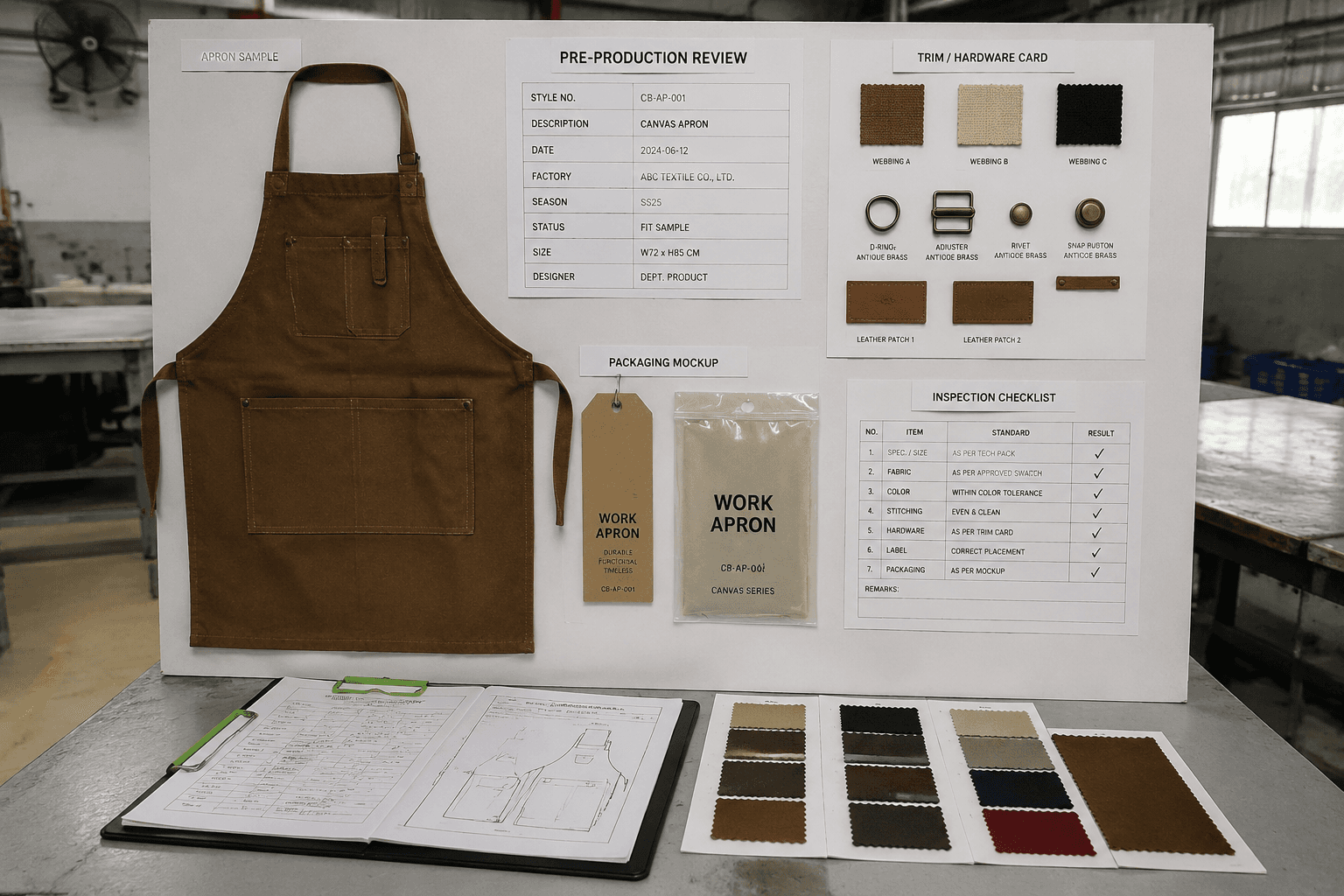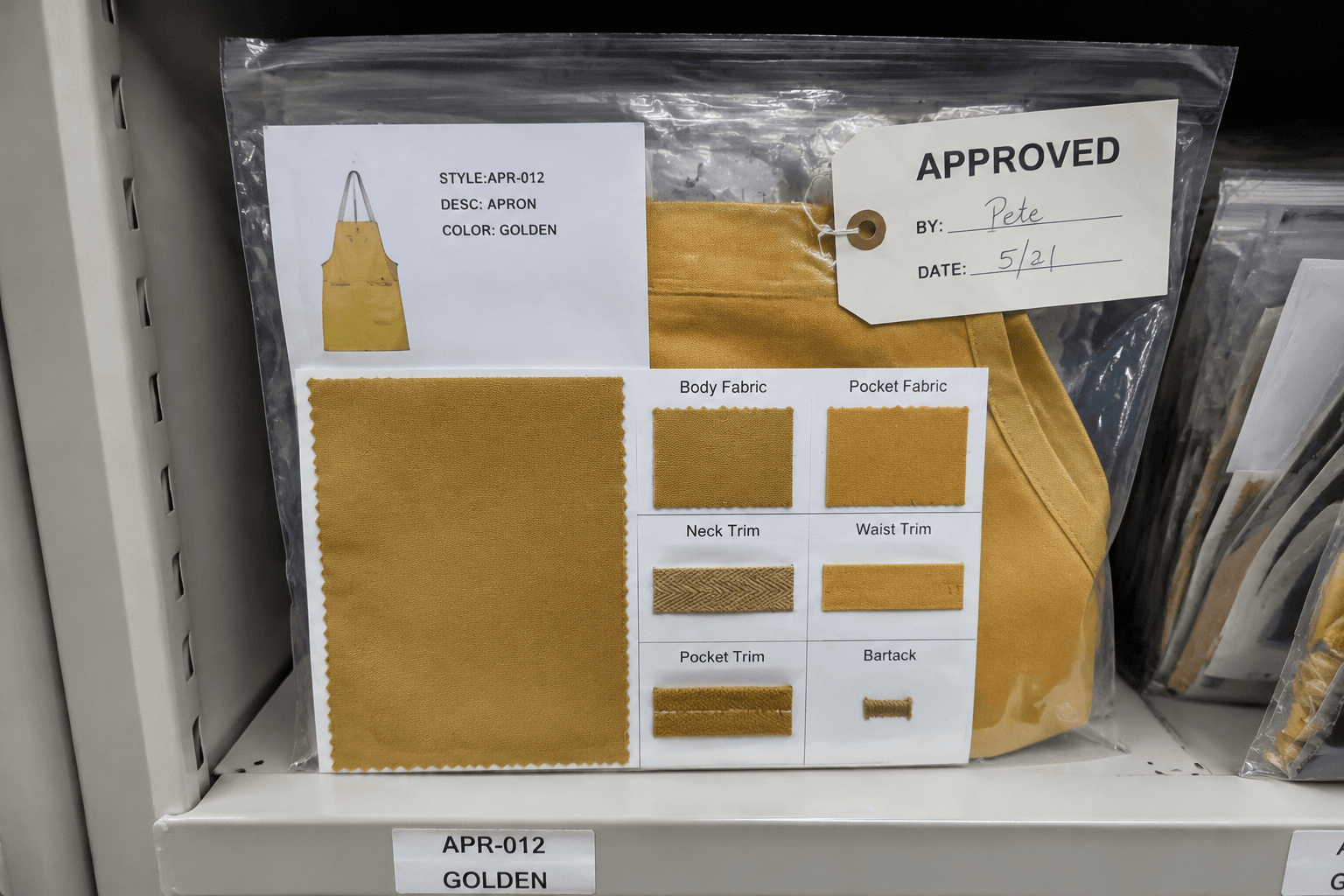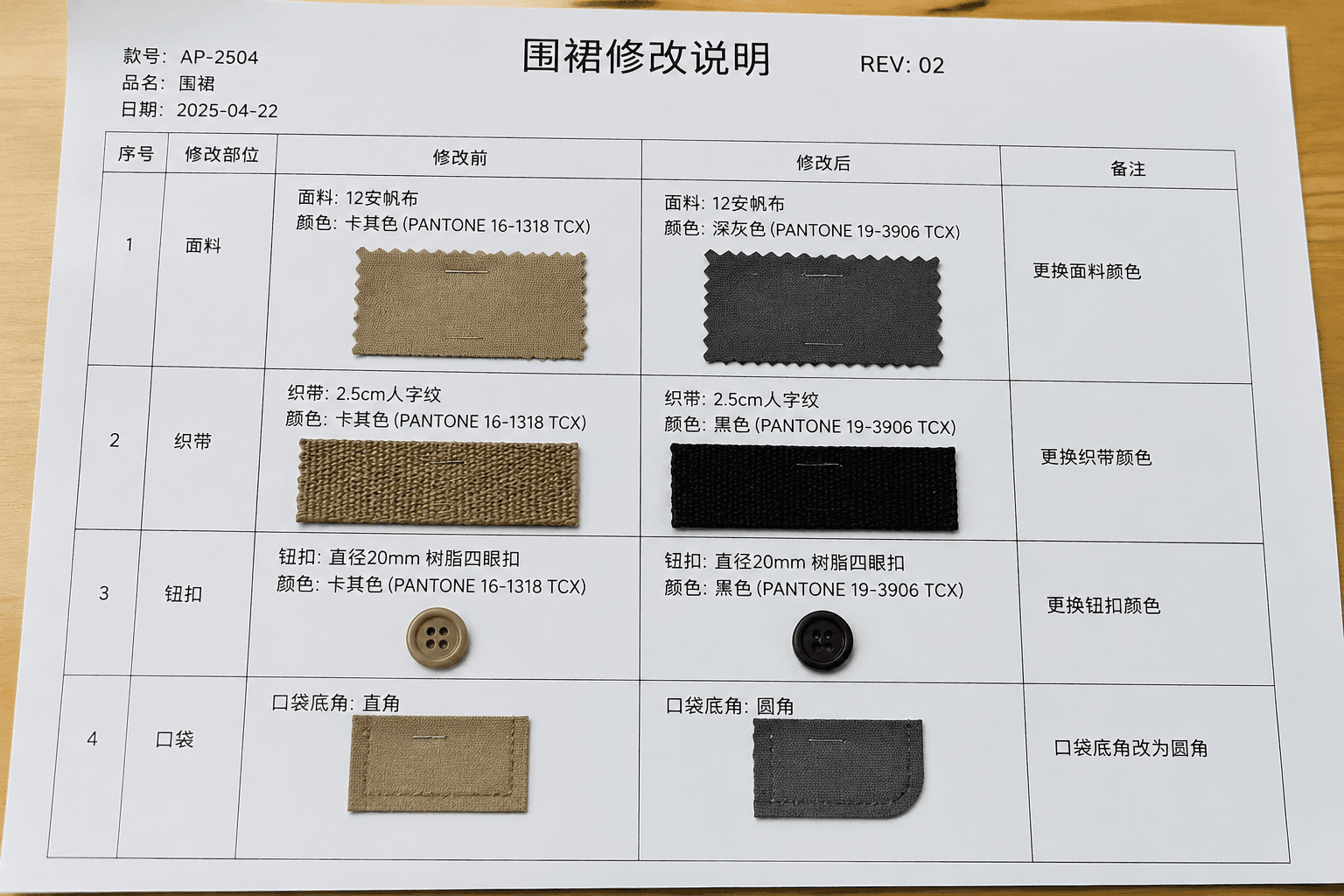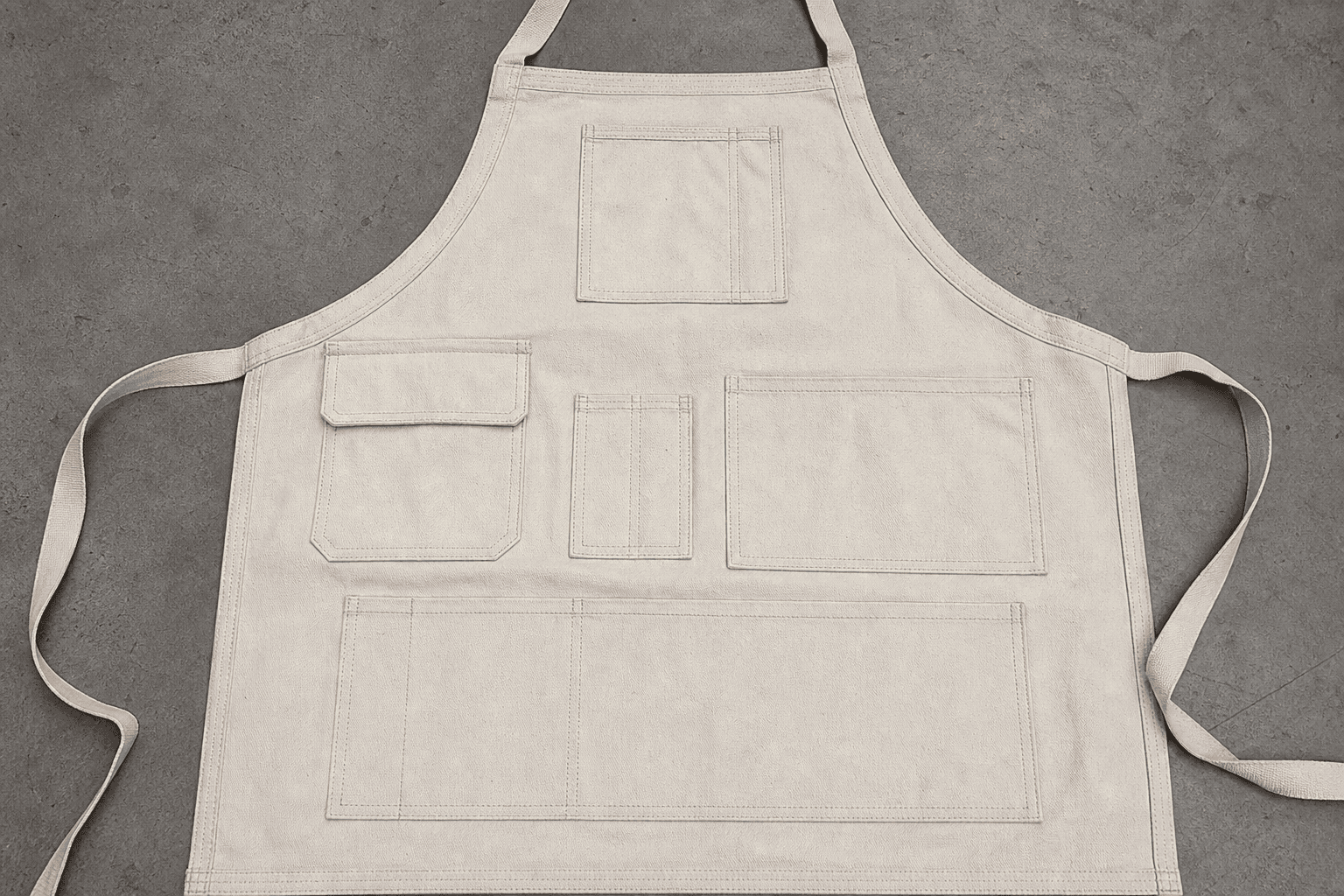
In custom apron manufacturing, approved lab dips, handloom swatches and PP samples do not confirm bulk consistency. That decision is made when each incoming roll is opened on the inspection machine and checked for shade variation, side-to-center drift, usable width, actual yardage, bow, skew and visible defects. For B2B buyers, apron roll inspection is the control point that determines whether fabric is released to cutting, restricted to limited use, or held for mill replacement.
This matters because aprons expose fabric problems faster than many cut-and-sew items. Bib aprons, waist aprons and cross-back aprons usually feature broad uninterrupted panels, large patch pockets and long self-fabric ties. A mild shade shift that may disappear on a multi-panel jacket becomes obvious on a black 10 oz cotton canvas bib front, a navy 245 GSM poly-cotton twill waist apron or an olive 12 oz washed denim cross-back style. Even a reduction from nominal 58 inch width to 56 inch clean usable width can lower marker efficiency enough to add roughly $0.08 to $0.18 per apron on a 5,000 to 12,000 piece order.
At factory level, roll inspection is not clerical work. It is a production release system covering shade-band separation, apron-specific defect grading, width verification, length reconciliation and roll-by-roll cut allocation. When the process is disciplined, buyers get more stable color appearance, fewer recuts, better claim traceability and more realistic ex-factory dates. When it is rushed, the cost usually reappears later as sewn rejects, carton shade complaints, reserve-fabric shortages or air-freight corrections.
- Run apron roll inspection before spreading; once cutting starts, shade and defect losses become materially more expensive to recover.
- Keep bib fronts, body panels, pockets and self-fabric straps within one verified shade band; do not mix bands on visible apron parts.
- Use the 4-point system together with apron-specific no-cut rules, because a roll can pass on points and still fail commercially on a bib-front defect.
- Measure actual roll length and usable width roll by roll; nominal mill specs do not protect marker efficiency or cutting balance.
- Link roll number, shade code, defect map and bundle allocation so any claim can be traced back to a specific fabric group after shipment.
Why apron roll inspection must be completed before cutting approval
For apron sourcing, the lowest-cost time to find a fabric problem is before marker release and spreading approval. If a roll fails for shade variation, short measure, severe bow or a visible defect during incoming inspection, the factory can isolate it, recalculate consumption, request replacement cloth or file a mill claim before labor is committed. If the same issue is discovered after cutting, the loss already includes spreading labor, cutting labor, marker paper, partial trims, line balancing time and often 1 to 3 lost production days.
Aprons appear simple, but they are visually unforgiving. A woven shirt can sometimes hide a minor slub inside a placket or under a collar stand. A bib apron usually cannot hide a barre line across the chest, an oil mark on the pocket face or a missing-end line through the center body. In hospitality programs, defects are easy to spot when 30 or 40 aprons hang together under restaurant lighting or when receiving teams compare cartons side by side.
A practical incoming control plan for aprons checks six points on every relevant roll: shade continuity, actual length, clean usable width, defect points, bow/skew and hand-feel consistency. For stable repeat fabric from a proven mill, some factories begin at 10% to 20% roll sampling and move to full inspection if any roll fails. For first orders, dark shades, washed fabrics, yarn-dyed stripes or any program with previous claims, 100% inspection is the safer commercial standard.
The inspection cost is small compared with remake risk. On an 8,000-piece bib apron order using around 9,800 to 10,300 yards of 245 to 300 GSM fabric, two inspectors on one machine can usually complete full checking in 2 working days of 10 hours each. In most factories, that cost is far lower than remaking even 250 defective aprons or paying expedited freight to recover a delayed shipment.
- A 5,000-piece bib apron order often uses 70 to 90 rolls, depending on average roll length and marker yield.
- Two trained inspectors can typically check 4,000 to 5,000 yards per 10-hour day on medium-weight apron twill or canvas.
- For dark solids, first orders or prior-claim programs, 100% roll inspection is usually cheaper than post-cut recovery.
Apron roll inspection for shade bands, side-to-center drift and lot separation
Shade sorting is usually the first make-or-break output of apron roll inspection. A roll may match the approved lab dip in isolation and still vary from the rest of the lot, from the roll head to the tail, or from side to center. On aprons with wide one-piece panels, side-to-center drift is especially risky because the left and right sides of a bib front can read as two different colors under D65 or TL84 lighting.
Most apron factories group rolls into shade bands such as A, B and C, or into narrower groups such as A1, A2 and B1 when the program is claim-sensitive. Tighter grouping is normally justified for black, navy, charcoal, burgundy and bottle green reactive-dyed canvas or twill in the 240 to 320 GSM range, because pressing and final finishing can make slight differences more visible. The standard should be visual consistency on finished aprons laid side by side, not merely rolled fabric that looks acceptable in isolation.
The practical rule is straightforward: all visible self-fabric parts on one apron should come from one verified shade band. That usually includes body, bib, pocket, neck strap and waist ties. If the lot contains more than one acceptable band, the cleaner commercial decision is to split production by PO line, delivery batch or carton range rather than mix bands inside one run. This reduces appearance disputes and makes post-shipment tracing credible.
End-to-end drift also needs a defined action. If the tail 8 to 12 yards of a 60-yard roll reads darker, lighter or flatter than the first section, that portion should not be mixed freely into body panels. Depending on style, it may be reassigned to matching strap sets or hidden reinforcements with buyer approval. If the style has no concealed self-fabric parts, isolation is safer than forcing usage to protect nominal yield.
- Common allocation rule: one shade band per apron, and preferably one shade band per carton on dark-color programs.
- Black and navy 245 to 300 GSM twills usually need tighter shade grouping than natural cotton or bleached canvas.
- If side-to-center variation appears across full-width bib panels, downgrade the roll or reserve it for non-visible components only.
Defect grading in apron roll inspection: 4-point limits plus apron no-cut zones
The 4-point system is a useful base tool, but professional apron buying should not rely on point totals alone. A roll can pass at 18 to 22 points per 100 square yards and still be commercially unusable if one hole, oil streak, dye bar or strong slub falls in the center of a bib front. Effective apron roll inspection combines total points with defect type, size and location against the actual apron pattern.
Inspectors should mark each defect on the roll and record its distance from the roll start. Common apron-fabric faults include missing ends, broken picks, knots, slubs, oil marks, reed marks, barre, shading bars, color contamination, coating scratches and selvage damage that reduces usable width. On solids, the highest-sensitivity zones are the bib center, center body and front pocket face. On striped, checked or printed aprons, bow, skew and motif registration become even more important because misalignment is immediately visible in wear.
A practical OEM standard often combines a point limit with zero-tolerance visible-zone rules. Many better-grade apron programs accept up to 20 points per 100 square yards, sometimes 24 points with buyer approval, while also requiring zero tolerance for holes, oil marks, severe shade bars and major slubs in visible panels. Retail private-label chefwear may tighten the limit to 18 points. Basic promotional aprons may allow a slightly looser total if visible zones remain clean and shipment use is less appearance-critical.
Defect position changes the commercial decision. A minor imperfection may be acceptable inside a hem turn, under a bartack reinforcement or beneath a concealed neck-loop support. The same defect in the bib center is not acceptable even when the roll remains under the numeric limit. For that reason, generic pass/fail reports are weak controls for aprons. The inspection record must guide cut planning, not simply close a QA form.
- Typical better-grade control: 20 points per 100 square yards, subject to buyer standard and fabric type.
- Visible bib and center-front areas should carry zero tolerance for holes, oil marks and major shade bars.
- Striped or printed aprons require added checks for repeat stability, motif placement and skew before cutting release.
Usable width, short measure and the real fabric cost per apron
Quoted fabric price per yard is only a starting number. For apron sourcing, the more useful calculation is fabric cost per shippable piece after width loss, defect cut-outs and shade segregation are included. Two mills may both quote 10 oz cotton canvas at $2.30 to $2.55 per yard, yet the lot with weaker width stability or more visible defects often delivers the higher true FOB cost.
Take a bib apron booked at 0.92 yard consumption. If incoming inspection shows repeated width narrowing, several visible defect cut-outs and some tail-end shade loss, actual usage may rise to 0.97 or 0.99 yard. On a 10,000-piece order, that means 500 to 700 extra yards. At $2.42 per yard, the added fabric cost is about $1,210 to $1,694, or roughly $0.12 to $0.17 per apron before extra labor, reserve-roll handling or delay charges are counted.
Usable width is often the main driver. A nominal 58-inch roll that delivers only 56-inch clean width after excluding damaged selvage, edge contamination or bow can force ties and pockets into a less efficient layout. Marker length increases, spreading slows and balance quantities become harder to control. On compact MOQ programs of 1,000 to 2,000 pieces per color, that margin loss can erase the apparent benefit of a slightly cheaper opening quote.
Short measure adds another hidden cost. If the packing list shows 60-yard average rolls but actual receipt averages 57.5 to 58.0 yards, lay planning becomes unreliable. The cutting room opens reserve rolls earlier, stops more often to reset plies and can generate remnants too short for efficient reuse. On multi-style apron orders, these interruptions commonly add 1 to 2 cutting days even when total missing yardage looks modest on paper.
Lead time risk follows the same logic. If 100% inspection finds unstable width, heavy shade separation or concentrated major defects, the factory may need 2 to 4 extra days to re-plan cutting. Replacement rolls from local greige or stock-supported programs may arrive in 3 to 7 days; imported custom-dyed replacements more often take 12 to 21 days. For launch-driven orders, stable rolls are frequently worth more than the lowest initial price.
- A 2% to 3% drop in marker efficiency commonly adds about $0.06 to $0.15 per apron, depending on style and fabric weight.
- A 58-inch nominal width reduced to 56-inch usable width can materially change marker length for bib aprons with long self-fabric ties.
- Short-measured rolls often add 1 to 2 days to cutting on mixed-style apron programs.
Cut allocation after apron roll inspection: assigning rolls to bibs, pockets and ties
Once each roll is graded, the inspection result must be converted into a disciplined cut plan. This is where many factories lose control. A complete report has limited value if cutting later mixes body panels from one shade band with pockets or straps from another because leftover fabric is pulled without review. For aprons, cut allocation is the step that converts inspection data into shipment consistency.
For bib aprons, strict allocation is usually the safest rule. Body panels, chest pockets, neck straps and waist ties should remain within the same verified shade band, and in tighter programs within the same grouped roll set. For waist aprons, there is sometimes slightly more flexibility because the visible panel is smaller, but any self-fabric part visible in wear still needs close visual matching.
Roll-end drift and localized fault clusters should affect allocation immediately. If one section of a roll shows darker tail shade, bowing or a mapped defect concentration, that section can be reserved for hidden reinforcements or internal support parts only if the pattern allows it and the buyer has approved that use. If the style has no concealed self-fabric areas, isolating the section is safer than pushing it into visible pieces for yield.
The most useful factory control is a roll allocation sheet linking roll number, shade code, actual measured length, defect zones, marker identity and bundle numbers. On apron orders above 3,000 pieces per color, that level of traceability is standard risk management. If a customer later reports mixed shade in cartons 201 to 320, the factory can trace the problem to a defined roll group within hours rather than reopen the full shipment investigation.
- Allocate all visible self-fabric parts from one verified shade band for each apron.
- Use tail sections with drift or mapped faults only for hidden reinforcement parts, and only if the approved pattern allows it.
- Link roll numbers to bundle numbers so shade or defect claims can be traced quickly after shipment.
Buyer standards to confirm before bulk apron fabric arrives at the factory
Many apron claims start with vague standards, not extreme fabric failure. The buyer expects one quality level, the mill interprets another, and the factory is left balancing shipment dates against rejection risk. The practical solution is to lock the inspection standard before weaving, dyeing or finishing is complete and keep that standard inside the PO file, tech pack or quality appendix.
At minimum, buyer and factory should agree the inspection method, 4-point limit, minimum usable width, maximum bow and skew, shade-band handling, allowed end-to-end variation and the remedy if bulk falls outside standard. For dark canvas and twill aprons, it is sensible to define whether pre-cut shade review photos or live video under standard lighting are required. If the apron will be garment washed, enzyme washed or stone washed, that finishing route should be considered early because washing can either soften mild variation or exaggerate panel mismatch.
Commercial terms should reflect order structure. A 1,500-piece MOQ per color in stock-supported 240 GSM poly-cotton twill gives the factory more flexibility than a 300-piece custom-color order in 12 oz piece-dyed canvas. Lead time should reflect that reality. A standard reorder in approved fabric may run 25 to 35 days from deposit and trim approval, while a first custom order with strict shade control and possible roll replacement may require 35 to 50 days.
Acceptance language should also match market tier. A basic promotional apron at $2.40 to $3.20 FOB may carry broader tolerance than a branded chef apron at $6.20 to $9.80 FOB for hospitality chains or retail private label. Final garment inspection should then follow the agreed AQL level, often AQL 2.5 for major defects and AQL 4.0 for minor defects on standard uniform programs, with tighter standards if the customer requires them. When those rules are written clearly, incoming fabric decisions become faster and claim discussions become more factual.
- Write minimum usable width into the PO instead of relying only on nominal width such as 57/58 inch.
- Define claim handling for excess shade bands, visible major defects and short-measured rolls before bulk booking.
- Match AQL and fabric tolerance levels to the order tier: promotional, uniform, private label or premium hospitality.
A B2B checklist for apron roll inspection and shipment risk control
Buyers do not need longer generic reports. They need a short operating checklist that forces the mill, factory and sourcing team to review the variables that actually change apron appearance, cost and shipment timing. A useful apron roll inspection checklist should simplify cutting decisions under production pressure, not create paperwork that sits outside the cutting room.
Start with roll-by-roll records for shade band, actual measured length, clean usable width, defect mapping and any bow or skew notes. Confirm whether the factory is inspecting 10%, 20% or 100% of rolls and what trigger moves the order to full inspection. For first orders, dark colors, washed fabrics and repeat styles with claim history, 100% checking should normally be written into the factory instruction and completed before marker approval.
Next, review how inspection results are translated into allocation. The file should show which rolls feed which markers, whether body, pocket and strap panels are locked to one shade band, and how tail sections with drift are handled. On hospitality, private-label or multi-SKU apron programs, the inspection sheet, allocation sheet and final bundle traceability should sit in one order file so any claim can be investigated quickly and with evidence.
Finally, connect inspection findings to shipment decisions. If a fabric lot shows unstable width, repeated visible defects or more than two acceptable shade bands, the buyer should decide immediately whether to accept split delivery, wait for replacement fabric or downgrade the program. Fast decisions at this stage protect the ex-factory date. Delayed decisions usually move the cost downstream into rushed sewing, recuts, carton sorting or premium freight.
When this discipline is maintained, apron production becomes more predictable. Shade consistency improves, actual consumption stays closer to booking and supplier discussions shift from opinion to measurable data. That is the practical value of apron roll inspection for professional B2B buyers: fewer surprises before cutting and fewer claims after delivery.
- Request roll-by-roll records for shade, actual length, usable width, bow/skew and visible defect locations.
- Require 100% inspection for first orders, dark colors, washed fabrics or any repeat apron with prior claims.
- Verify that body panels, pockets and ties follow one shade allocation rule before cutting approval.
- Keep inspection, allocation and lot traceability records together for every apron PO.