Most apron defects are not caused by one careless sewing operator. They usually come from unclear specifications, fabric variation, weak trim control, rushed inline inspection or tolerance language that is too broad for factory execution. For a custom apron order of 3,000 to 50,000 pieces, a buyer should not rely on terms like “good stitching” or “acceptable shade.” Those words are difficult to inspect consistently on the cutting table, sewing line and final AQL table.
A practical apron quality tolerance document should convert design intent into measurable limits. For example, a 260 GSM cotton twill bib apron may allow ±5% fabric weight, ±1 cm finished width, no open seam longer than 3 mm, and color difference within Grey Scale grade 4 under D65 light. A PU leather strap apron, a 10 oz denim cross-back apron and a 190 GSM polyester waist apron each need different tolerances because the fabric behavior, shrinkage, needle marks and seam stress are different.
This article explains common apron defects from the supplier side and shows how to write apron inspection criteria that a Zhejiang OEM factory, third-party QC team and brand buyer can all follow. The goal is not to reject more goods. The goal is to prevent avoidable disputes by defining apron qc standards before bulk cutting begins.
- Apron defects should be classified as critical, major or minor before inspection so the factory knows which issues require repair, replacement or concession.
- Fabric tolerances must include GSM, shrinkage, shade, handfeel and visible weaving faults, not only the fabric name on the purchase order.
- Stitching defect apron standards need measurable limits for skipped stitches, open seams, seam allowance, bartack placement and thread trimming.
- Finished apron dimensions should use different tolerances for body panels, straps, pockets and neck loops because each part has different sewing and handling variation.
- Packing and labeling defects should be included in apron inspection criteria because wrong carton mix, missing barcode or wet polybag can create the same commercial loss as a sewing defect.
- Pre-production samples and inline inspection reduce final rejection risk, especially for orders above 5,000 pieces or styles using dyed canvas, denim, coated fabric or metal hardware.
Why apron defects start with unclear specifications
In apron sourcing, many quality problems are decided before the first fabric roll is cut. A tech pack may show a front view, a logo position and a fabric reference, but still miss the inspection limits needed for bulk production. If the buyer writes “heavy cotton canvas,” the factory must decide whether that means 280 GSM, 320 GSM or 12 oz. If the buyer writes “black straps,” the factory must decide whether webbing, self-fabric or polyester tape is acceptable. Each decision affects cost, lead time and defect risk.
For a standard bib apron order, common variables include fabric weight, weave density, garment wash, pocket size, neck strap construction, waist tie length, thread color, bartack position, label placement and packing method. A small change in any item can create a visible issue. For example, a 2 cm shorter waist tie may be acceptable for a promotional apron but unacceptable for a chef apron sold to restaurants. A pocket tilted by 4 mm may be minor on a dark denim apron but obvious on a striped yarn-dyed apron.
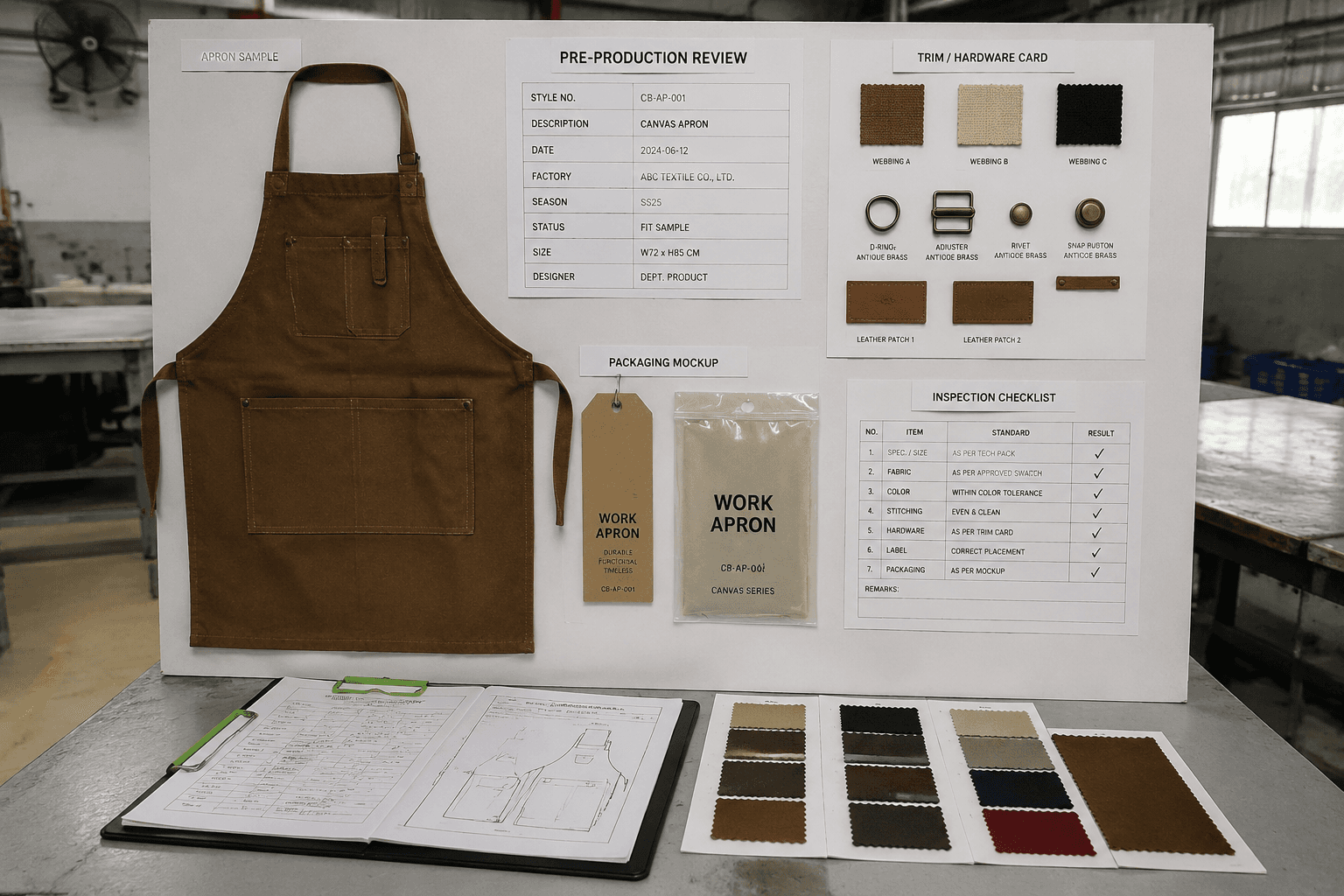
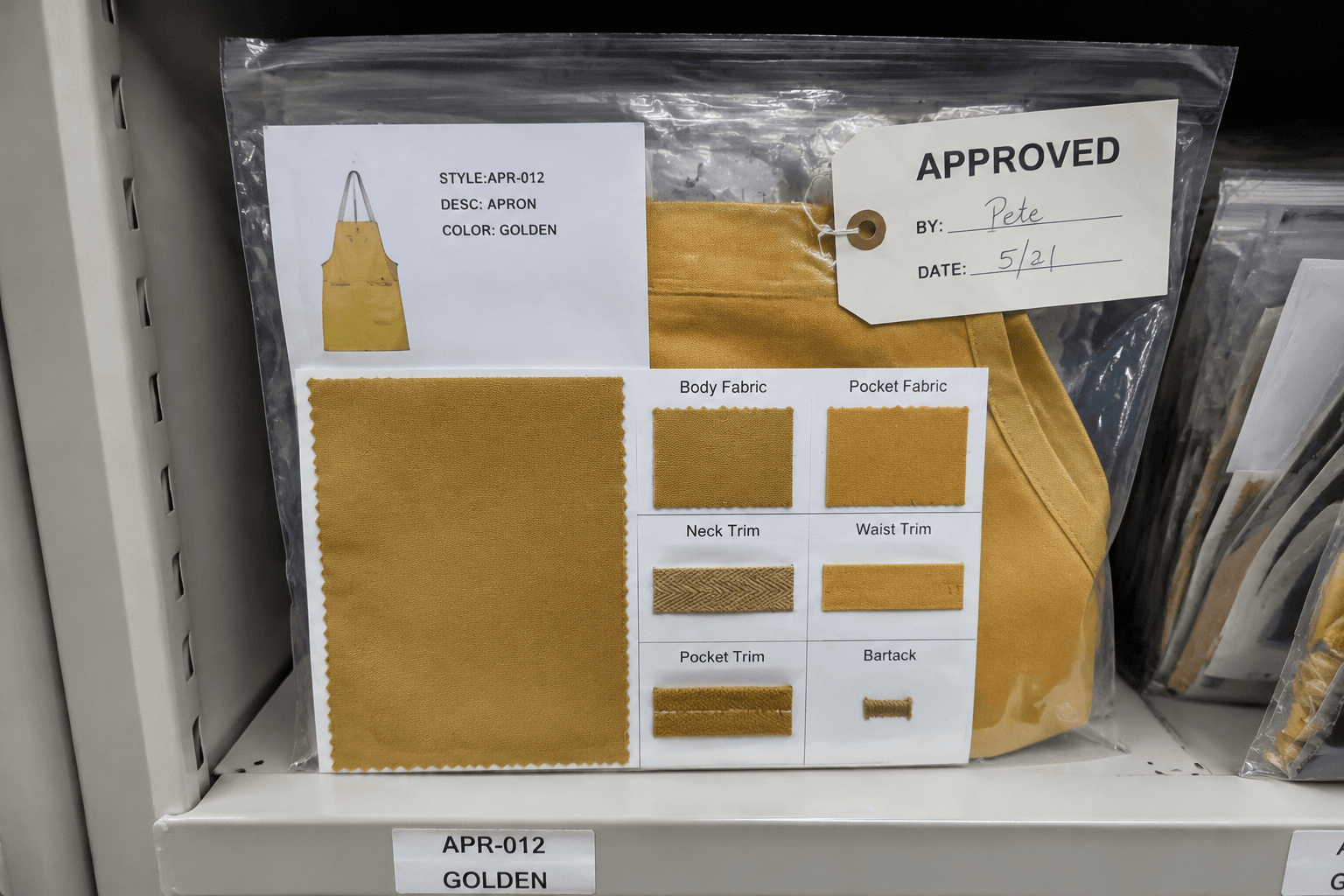
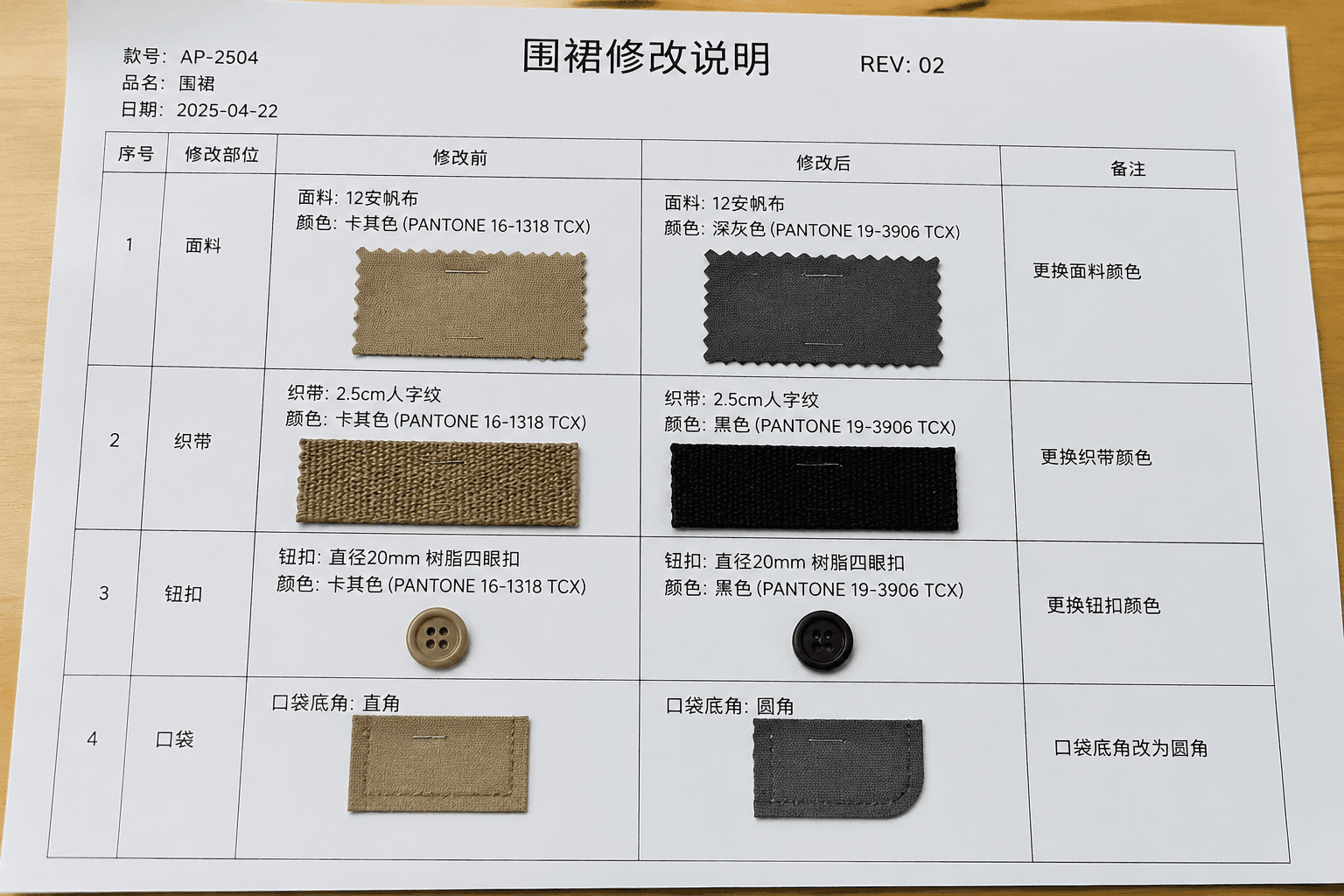
Good apron qc standards start with a controlled spec sheet. The factory should confirm sample reference, approved fabric swatch, approved trims, finished measurements, logo artwork, packing method and AQL level before placing bulk material orders. For China OEM apron production, this confirmation usually takes 3 to 7 days after sample approval. It is a small step compared with the cost of repairing 10,000 pieces after final inspection.
- A complete apron spec should state fabric composition, GSM or oz weight, weave type, color code and finishing process.
- Finished measurements should show tolerance for body length, body width, pocket opening, strap length, strap width and logo position.
- The approved sample should be sealed with date, buyer name, style number and any signed deviation from the original tech pack.
- Inspection should reference a written defect classification list, not only the visual opinion of one inspector.
Common apron defects in fabric, shade and shrinkage
Fabric issues are among the most expensive apron defects because they often cannot be repaired after sewing. Cotton canvas, twill, denim, polyester-cotton and coated fabrics all have different risk points. Cotton and linen blends may show slubs, nep, color variation and shrinkage. Polyester fabrics may show heat marks, poor absorbency or shiny press marks. Denim aprons may show shade banding between lots. Waxed canvas or PU-coated aprons may show crease marks and coating scratches during cutting and packing.
For fabric weight, a realistic apron quality tolerance is usually ±5% against approved standard for woven cotton and polyester-cotton fabrics. If the approved fabric is 260 GSM, bulk rolls between about 247 GSM and 273 GSM may be acceptable if handfeel and strength remain consistent. For heavier canvas above 340 GSM, some buyers specify ±3% because the product positioning depends on a firm handfeel. For promotional aprons under 180 GSM, ±8% may be commercially acceptable if the target price is tight.
Shrinkage should be tested before bulk cutting, especially for cotton, denim and washed aprons. A common tolerance after one domestic wash at 40°C is within 3% lengthwise and 3% widthwise for pre-shrunk cotton twill, and within 5% for unwashed cotton canvas if the buyer accepts natural shrinkage. If the apron will be sold as a hospitality uniform, we recommend setting shrinkage tighter because repeated washing affects fit, pocket position and strap usability.
- Major fabric defects include holes, broken yarns, stains larger than 3 mm, oil marks, heavy slubs on the front panel and obvious shade panels within one apron.
- Minor fabric defects may include small slubs under 2 mm, slight shade variation within approved Grey Scale grade 4, or inconspicuous crease marks outside the logo area.
- Critical fabric defects include mold, chemical odor, color bleeding above agreed test limits, needle contamination or any sharp foreign object packed with the garment.
- Shade tolerance should state the light source, usually D65, and the minimum Grey Scale grade, commonly grade 4 for solid color aprons and grade 3-4 for washed denim.
Stitching defect apron standards for seams, bartacks and thread
A stitching defect apron issue can look small on one piece but become a serious claim when repeated across a shipment. Aprons carry stress at the neck loop, waist ties, pocket corners and side seams. A weak bartack or skipped stitch may pass a quick visual check but fail after several washes or during restaurant use. This is why stitching tolerances should cover both appearance and strength.
For most woven aprons, stitch density is commonly 8 to 10 stitches per inch for medium-weight cotton twill and 7 to 9 stitches per inch for heavy canvas or denim. Lightweight polyester promotional aprons may use 9 to 11 stitches per inch. Too few stitches reduce strength and look loose. Too many stitches can perforate coated fabric, damage PU leather straps or cause puckering on thin fabric. The tolerance should state acceptable stitch density, seam allowance and any reinforced points.
Open seams are normally major defects when they expose a raw edge, weaken a functional area or exceed 3 mm on a visible seam. Skipped stitches longer than 5 mm should be major on structural seams such as neck strap attachment, waist tie attachment and pocket corners. Loose thread ends under 10 mm may be minor if they can be trimmed without affecting seam strength. Thread shade should match the approved sample unless contrast stitching is part of the design.
- Neck strap and waist tie bartacks should be centered within ±3 mm of the approved position and must fully catch the strap or folded fabric.
- Pocket corner reinforcement should be present on both top corners when specified; missing bartack is usually a major defect.
- Seam allowance can be set at 8 mm ±2 mm for many aprons, but heavy canvas and binding seams may require a wider allowance.
- Needle holes on PU, leatherette or coated fabric should be treated as major if visible on the front panel because they cannot be steamed out.
- Thread tails longer than 10 mm on visible areas can be classified as minor, while loose thread trapped in seams may be major if it affects appearance or durability.
Measurement tolerances for apron body, pockets and straps
Measurement defects are common because aprons have long, flexible parts. A body panel can stretch slightly during sewing. Bias-cut or cross-back straps can grow during handling. Pockets may shift if the operator follows a chalk mark that moved during pressing. To avoid disagreement, the buyer should specify finished measurement points and tolerances for each part, not only overall length and width.
For a standard adult bib apron, practical finished tolerance is often ±1.0 cm for body length and width, ±0.5 cm for pocket dimensions, ±1.0 cm for waist ties, and ±0.5 cm for strap width. For premium retail aprons, buyers may request ±0.5 cm on body measurements, but this can increase sewing time and rejection rate, especially on washed garments. For low-cost promotional waist aprons, ±1.5 cm may be acceptable if the visual balance is not affected.
Measurement should be taken after pressing and before packing, with the apron laid flat without stretching. Washed aprons need measurement after final wash and tumble or line drying, depending on the approved sample. If the buyer requires garment wash, the tolerance should include expected post-wash variation. A washed denim apron can move more than a polyester apron even when cut from the same paper pattern.
- Bib apron body length can usually be controlled within ±1.0 cm for non-washed woven fabric and ±1.5 cm for washed denim or canvas.
- Pocket opening width should often be controlled within ±0.5 cm because uneven pocket size is easy to see on the front panel.
- Logo placement should normally be within ±0.5 cm to ±1.0 cm from approved position, depending on print method and fabric movement.
- Cross-back strap length should be checked as a pair; left and right strap difference above 1.0 cm may affect fit.
- Waist tie length tolerance should consider knotting function, with shorter-than-approved ties treated more strictly than slightly longer ties.
Print, embroidery, labels and hardware defects
Brand elements on aprons are highly visible, so print and embroidery tolerances should be stricter than general sewing tolerances. A small oil spot near a hem may be minor, but a 3 mm logo shift on a centered chest print can be a major defect for a retail apron. Common logo defects include off-position printing, ink bleeding, poor opacity, scorch marks from heat transfer, embroidery puckering, wrong thread color and loose backing.
Screen printing on cotton apron fabric usually needs a printed strike-off before bulk production. For simple one-color logos, a position tolerance of ±5 mm is common. For multi-color registration, the tolerance may be ±1 mm to ±2 mm between colors, depending on artwork detail. Heat transfer logos should pass peel and wash tests agreed in advance. Embroidery should be checked for stitch density, backing removal, thread trimming and puckering, especially on lightweight 160 to 200 GSM fabrics.
Hardware and trims also create apron defects. Metal eyelets can rust if plating is weak. Snap buttons may crack coated fabric if the hole is too small. Plastic buckles may fail a pull test if the grade is too light for a heavy chef apron. For leather or PU straps, color transfer and edge cracking should be checked before bulk assembly. Trim approval is not only visual; it should include function and durability.
- Print position tolerance should be stated from fixed points, such as center front and top edge of bib, rather than from a moving pocket edge.
- Embroidery puckering is major when it distorts the front panel after pressing or remains visible from 60 cm viewing distance.
- Label defects include wrong care label, wrong country of origin, reversed brand label, missing size label and barcode mismatch.
- Metal hardware should be free from rust, sharp edges and plating peel; any sharp edge touching the wearer should be critical.
- Heat transfer logos should be tested after at least one wash cycle when the apron is intended for uniforms or retail resale.
How to write apron quality tolerance by defect level
A useful apron quality tolerance document separates defects into critical, major and minor categories. This structure helps the factory decide what must be stopped immediately, what must be repaired, and what can be accepted within AQL limits. Without this classification, final inspection becomes a negotiation instead of a controlled process.
Critical defects are safety, legal or contamination issues. For aprons, this includes sharp metal fragments, mold, strong chemical odor, needle pieces, wrong fiber content label, flammable trim when a flame-resistant specification is required, or packaging that violates the buyer’s compliance rules. Critical defects should normally have an acceptance number of zero.
Major defects affect saleability, function or brand appearance. Examples include wrong fabric, incorrect color outside tolerance, open seams, missing pocket, wrong logo, severe stains, broken strap, poor bartack, incorrect carton assortment or measurement outside agreed tolerance. Minor defects are small workmanship issues that do not affect function or first visual impression, such as a short loose thread, slight uneven topstitching in a hidden area, or a small crease mark that can be pressed out.
- For critical defects, use AQL 0.0 or zero acceptance because the commercial and safety risk is too high.
- For major defects, many apron buyers use AQL 2.5, especially for retail, hospitality and uniform programs.
- For minor defects, AQL 4.0 is common when the goods are not luxury level and small appearance issues are commercially acceptable.
- For premium retail aprons above $8.00 to $15.00 FOB per piece, buyers may tighten major AQL to 1.5 and define more visual issues as major.
- For promotional aprons below $1.50 to $2.50 FOB per piece, tolerance is often wider, but safety, label accuracy and carton accuracy should not be relaxed.
Apron inspection criteria during pre-production, inline and final QC
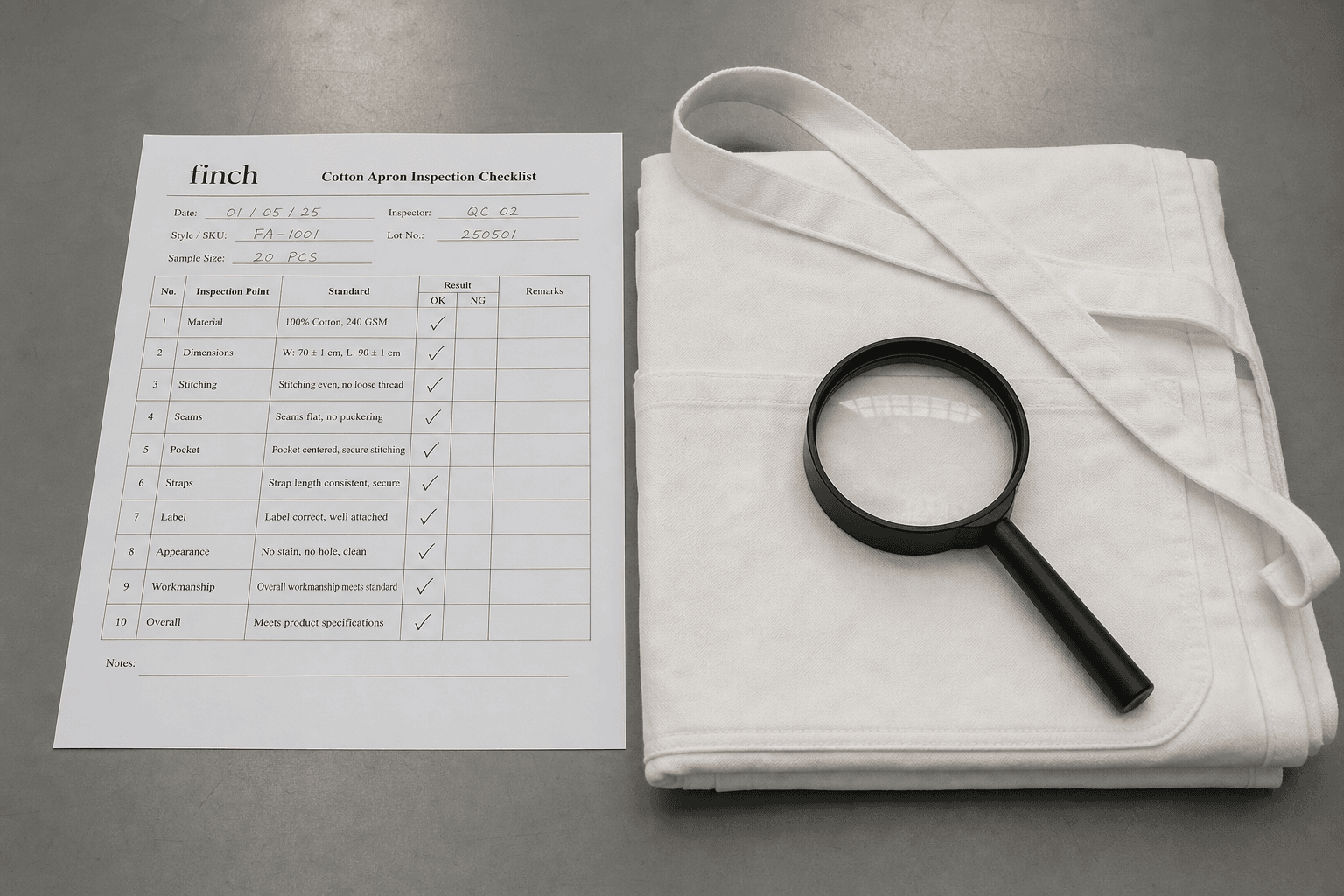
Apron inspection criteria should be applied at several stages, not only at final inspection. Pre-production checks confirm fabric, trims, pattern, logo and packing. Inline inspection catches repeated sewing and measurement problems while repair is still possible. Final inspection verifies shipment quality against agreed AQL before goods leave the factory. This staged control is especially important for bulk custom apron orders where the buyer has a fixed delivery window.
A typical production schedule for 5,000 to 10,000 custom woven aprons may be 5 to 7 days for material preparation after deposit and approvals, 3 to 5 days for cutting, 7 to 12 days for sewing, 2 to 4 days for logo or finishing if not done before sewing, and 2 to 3 days for final inspection and packing. Complex cross-back aprons, garment-washed canvas, embroidery, leather straps or multiple colorways can add 5 to 15 days. If the first inspection happens only on day 25, there is little room to correct systemic apron defects without delaying shipment.
From the factory side, the most valuable inspection is often the first 50 to 100 pieces off the line. At that stage, supervisors can check seam construction, pocket position, strap length, logo alignment and pressing method against the sealed sample. If the buyer or third-party inspector waits until 80% of the order is packed, repairs become slower and more expensive. Re-opening cartons, removing polybags and re-pressing aprons can add $0.05 to $0.25 per piece depending on packing complexity.
- Pre-production inspection should check bulk fabric roll shade, GSM, shrinkage, trim approval, cutting marker and pilot sample.
- Inline inspection should start when 10% to 20% of production is completed and should focus on repeated defects by operation.
- Final inspection is usually performed when 80% to 100% of goods are packed, with carton selection taken randomly across production lots.
- Measurement inspection should include at least several pieces per size, color and sewing line when multiple lines are used.
- Defect photos should include ruler, style number, carton number and clear defect classification so corrective action can be traced.
Practical tolerance clauses to put in an apron purchase order
A purchase order should not carry every technical detail, but it should reference the approved tech pack, sealed sample and inspection standard. For repeat apron programs, the best practice is to keep a master quality standard and attach style-specific tolerances for each order. This prevents the supplier, buyer and QC company from using different documents during production.
The tolerance language should be direct and inspectable. Instead of writing “no bad sewing,” write “no open seam over 3 mm on visible or stress-bearing seams; skipped stitches over 5 mm on neck strap, waist tie or pocket corner are major defects.” Instead of writing “correct size,” write “finished body length 86 cm ±1 cm, body width 70 cm ±1 cm, pocket opening 28 cm ±0.5 cm, waist tie length 95 cm ±1 cm each side.” The inspector can measure these limits; the sewing line can also understand them.
Cost and tolerance must be aligned. If a buyer asks for ±0.3 cm pocket tolerance, perfectly matched yarn-dyed stripes, Grey Scale grade 4-5 shade consistency and AQL 1.0 on a low-quantity apron order, the factory must allow more time for fabric selection, cutting control and QC. That may increase FOB cost by $0.10 to $0.50 per piece depending on style. Clear tolerance writing helps both sides decide where strict control is worth the cost and where normal manufacturing variation is acceptable.
- Fabric clause: “Bulk fabric weight shall be 260 GSM ±5%, shade shall match approved swatch within Grey Scale grade 4 under D65 light, and shrinkage after one 40°C wash shall not exceed 3% lengthwise or widthwise.”
- Stitching clause: “Stitch density shall be 8 to 10 SPI on main seams; open seams over 3 mm, missing bartacks and skipped stitches over 5 mm on stress points are major defects.”
- Measurement clause: “Finished measurements shall follow approved spec with body tolerance ±1.0 cm, pocket tolerance ±0.5 cm, strap width tolerance ±0.3 cm and logo placement tolerance ±0.7 cm.”
- Packing clause: “Each apron shall be folded as approved, packed one piece per recyclable polybag with suffocation warning where required, and cartons shall match buyer assortment with zero barcode mix.”
- Inspection clause: “Final inspection shall follow ANSI/ASQ Z1.4 general inspection level II, AQL critical 0.0, major 2.5, minor 4.0, unless otherwise agreed in writing before production.”