Most apron fit problems are created at the pattern stage, then discovered too late during wear testing or PP review. On a bib apron, the upper chest may stand away from the body, curl at the top edge or collapse toward center front once the apron is worn over a T-shirt, polo or light chef jacket. Apron dart construction can correct side gapping and improve how the bib carries a logo, but it also adds pattern, sewing, pressing and inspection work that must be specified before bulk production.
For B2B buyers, a dart is not a styling detail. On a 240-280 GSM polyester-cotton twill bib, a 0.8-1.2 cm intake per side can noticeably improve chest contact and logo presentation. On 10-12 oz denim, 300-320 GSM canvas or waxed cotton, the same dart may create bulky points, shine marks or inconsistent pressing if the factory line is not set up for it. Even a modest 10-second increase per apron adds about 27.8 labor hours on a 10,000-piece run before final QC and repacking.
This article focuses on apron sourcing decisions for professional buyers: when darted bibs are worth specifying, which dart options are practical in bulk sewing, what GSM and oz ranges are manageable, and how MOQ, lead time, FOB cost and AQL should be adjusted when shaping is added to an apron program.
- Apron dart construction works best on adult bib aprons with upper bib widths around 24-28 cm and fabrics in the 220-280 GSM range, where shaping improves chest fit without excessive bulk.
- A pair of side darts usually adds US$0.04-US$0.12/pc on 220-260 GSM twill and about US$0.12-US$0.25/pc on heavier canvas or denim, depending on topstitching and pressing requirements.
- Dart dimensions must be approved before logo and pocket placement are locked, because dart intake reduces usable bib width and can visually shift centered branding.
- Bulk QC for darted aprons should measure dart length, intake, point location and finished upper bib width, not only total apron length and waist width.
- AQL 2.5 major and AQL 4.0 minor is a workable baseline for most uniform apron programs using shaped bib construction.
- New darted apron styles usually need 10-15 days for SMS development and 30-40 days for bulk production after PP approval when shell fabric and trims are ready.
1. What apron dart construction changes in a bib apron
A dart is a controlled fold stitched into the bib to remove width and convert a flat panel into a slight three-dimensional shape. In apron production, the most common version is a side chest dart that starts near the side edge and points inward toward the center chest. Its purpose is functional: reduce side gapping, keep the bib flatter during wear, and improve the way a chest logo, patch or pocket sits on the body.
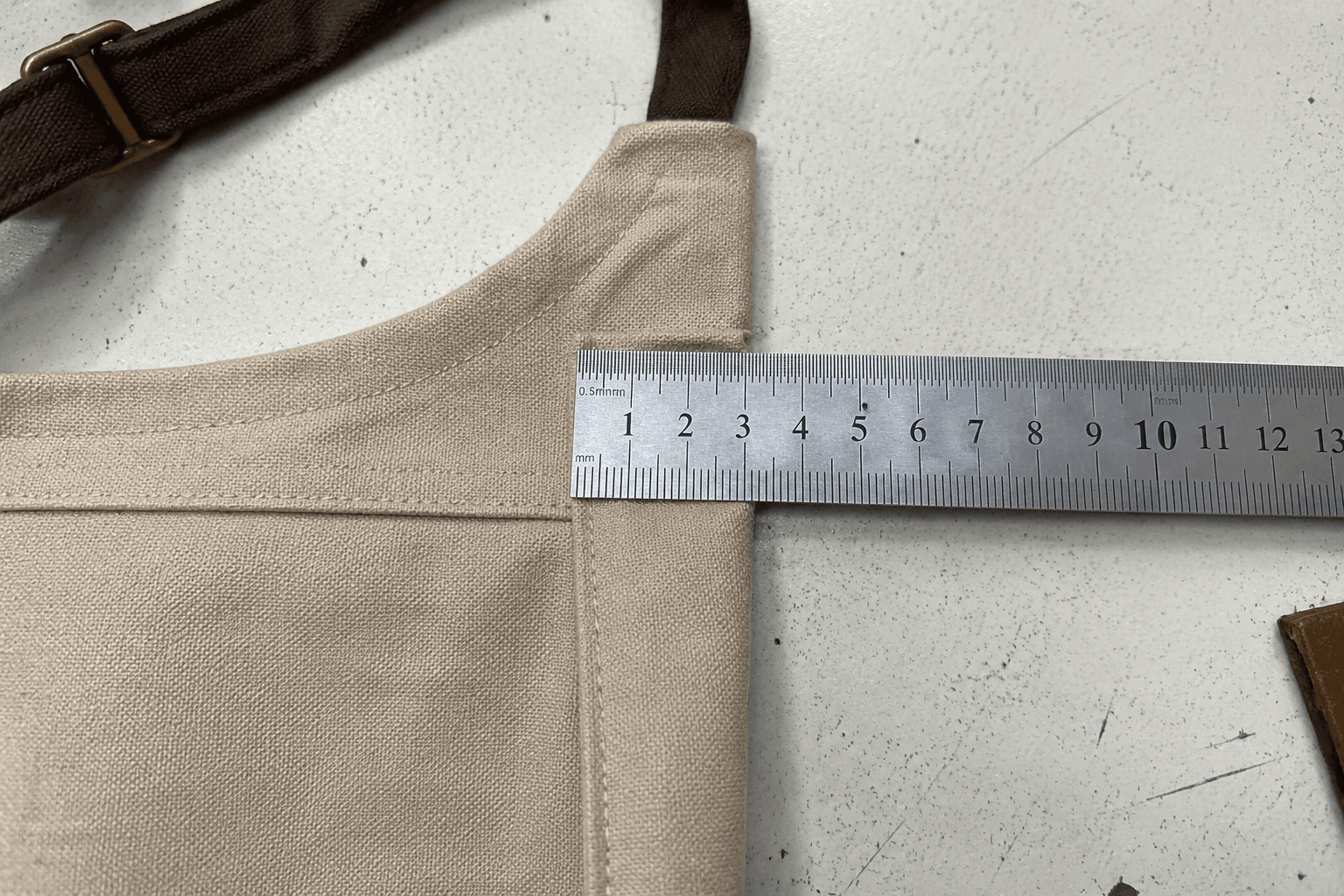
This matters most on adult bib aprons with a finished upper bib width of about 24-28 cm. In a flat pattern, that width gives coverage and simple cutting efficiency, but on medium-to-stiff fabrics it can also create extra volume at the side chest. A pair of 1.0 cm darts removes roughly 2.0 cm of width at the dart line. If that width change is not reflected in the final approved measurement spec, the apron can pass cutting and sewing but still fail fit review.
The effect goes beyond fit. Once apron dart construction is introduced, the factory must control left-right symmetry, pressing direction, top bib width after sewing, and the visual balance of chest branding. A centered embroidery that looked correct on a flat sample can appear too high or too close to the shaping seam on the worn garment if the dart was added later.
For that reason, buyers should treat the dart as a measurement-bearing construction feature, not a minor visual tweak. It should be approved before pocket templates, embroidery films, heat-transfer artwork positions, folding boards and packing dimensions are finalized.
- Typical adult side dart length: 8-13 cm.
- Typical dart intake: 0.8-1.5 cm per side on hospitality bib aprons.
- Common upper bib width affected: 24-28 cm finished.
- Recommended logo clearance from dart seam: at least 3 cm; 4-5 cm is safer.
- Typical added operation time: 8-18 seconds per apron depending on fabric and pressing method.
2. When apron dart construction is the right sourcing choice
Darts are worth specifying when the buyer needs a cleaner bib line without obviously narrowing the apron. This is common in barista, cafe, bakery, hotel, salon and front-of-house retail programs where a neat chest fit supports brand presentation. A mild dart can make a one-size apron look more controlled on different wearers while preserving broad waist coverage and standard strap lengths.
They are less useful when the apron is built for price-first promotions, when the fabric is very soft and already drapes close to the body, or when two-size grading would solve the issue with less sewing risk. A 170-190 GSM polycotton plain weave usually does not need shaping unless the bib is unusually wide. A 300-320 GSM canvas work apron may need shaping, but buyers should also compare a narrower bib, curved side edge or separate size options before choosing darts.
The key is to diagnose the real failure mode. Side chest gapping can justify a dart. Neck strain usually points to poor strap angle, strap placement or bib height. Center-front collapse may be caused by a bib that is too tall for the fabric weight, by a heavy chest pocket, or by fabric that is too soft. Top-edge curling can be caused by binding tension or fabric memory rather than excess width. Adding a dart to the wrong problem increases cost without fixing wear performance.
Order volume also matters. On annual programs above about 20,000-50,000 aprons, two sizes may deliver better consistency and easier replenishment than one-size shaping. On smaller custom runs of 500-3,000 pcs, one size with mild side darts is often easier for the buyer to launch because it avoids splitting inventory and keeps trim usage simpler.
- Use darts when the fit defect is side gapping across the upper chest.
- Compare strap-angle correction first when users report neck pressure.
- Compare a 1-2 cm narrower upper bib when chest coverage can be slightly reduced.
- Consider two sizes for repeat programs above 20,000 pcs/year.
- Avoid darts on low-cost apron briefs targeting below about US$2.20/pc FOB unless fit is a priority.
3. Apron dart construction options that are practical in bulk sewing
The safest choice for OEM production is the side chest dart. It improves fit while keeping the neckline, center front and neck strap position relatively stable. On most adult bibs, the dart starts around 12-18 cm below the top bib edge and runs 8-13 cm in length, though exact placement depends on bib height, finished width and whether the apron is worn over light or bulky garments.
A lower bib dart can be used on tall bib aprons, especially styles with a waistband seam or a skirt panel. It removes volume below the chest and can help the apron lie flatter when the wearer bends. In practice, this is more common on premium retail-driven aprons than on high-volume hospitality uniforms, because the seam is visible and requires clean pressing to look intentional.
Neckline darts are usually a poor fit for standard B2B apron programs. They interfere with neck strap attachment, facings and bias binding, and they concentrate thickness at the most visible edge of the bib. Unless the product is a higher-priced fashion apron with a more complex make, buyers usually gain better bulk consistency from side shaping or a revised strap angle.
A curved side bib edge is often the lowest-risk alternative to apron dart construction. It removes a small amount of width without adding a visible shaping seam, and it is easier to sew and inspect. A princess-style panel seam provides stronger shaping than a dart, but it adds cut pieces, seam matching and more sewing minutes, so it usually suits retail aprons better than uniform orders.
- Side chest dart: best balance of fit gain, cost and repeatability.
- Curved bib side edge: lower-risk option for mild shaping.
- Lower bib dart: suitable only when visual seam lines are acceptable.
- Neckline dart: avoid on most bulk apron programs using binding or fixed neck straps.
- Panel seam shaping: stronger fit control, but higher pattern and sewing cost.
4. Fabric weight, pressing method and wash behavior for darted aprons
Fabric weight is the main technical limit for darted bibs. In most factories, 220-260 GSM polyester-cotton twill is the most stable range for side darts because it holds shape, is not too bulky at the point, and presses cleanly at line speed. This range suits many restaurant, service and cafe apron programs that need a smarter chest line without heavy workwear stiffness.
At 260-320 GSM cotton canvas, the dart remains workable but becomes more sensitive to operator technique. Abrupt backstitching can create dimples, and a thick fold can print through on dark shades. On 10-12 oz denim, the risk rises again, especially if the dart must be topstitched or washed after sewing. In those cases, a buyer should require a PP sample in final fabric and final wash, not just a substitute sampling cloth.
Waxed cotton, PU-coated fabrics and heavily finished canvases are more restrictive. Needle marks are visible, heat tolerance is lower, and reshaping during pressing is limited. For these materials, buyers should keep dart intake small, often around 0.6-0.8 cm, or replace the dart with a curved edge or panel adjustment. Otherwise the shaping line can look forced and inconsistent from unit to unit.
Wash performance must also be checked. On cotton-rich aprons with 3-5 percent shrinkage, the dart can twist if the fabric was not relaxed before cutting or if shrinkage differs in warp and weft. On garment-washed apron programs, testing should confirm both overall shrinkage and post-wash dart appearance. Polyester-rich blends below about 2 percent shrinkage are more stable, but dark shades can still show shine if pressing temperature is too high.
- 160-200 GSM plain weave: often too soft to justify dart cost.
- 220-260 GSM TC twill: safest bulk range for side darts.
- 260-320 GSM canvas: workable, but needs strict PP approval for point quality.
- 10-12 oz denim: possible, but slower sewing and more pressing are normal.
- Waxed or coated apron fabrics: use minimal shaping or avoid darts entirely.
5. Cost, MOQ and lead-time impact of shaped bib aprons
A darted bib always needs to be costed as a real operation, even when the pattern change looks small. On a standard 220-260 GSM twill apron at 1,000 pcs or more, a pair of simple side darts usually adds about US$0.04-US$0.12/pc FOB. On 300 GSM canvas, 10 oz denim or any style requiring visible topstitching and extra pressing, the increase is more often US$0.12-US$0.25/pc. That increase covers pattern adjustment, marking, sewing time, pressing and added QC checkpoints.
The labor effect becomes more visible on volume. If shaping adds 10 seconds per apron, a 5,000-piece order adds about 13.9 production hours. At 15 seconds, a 20,000-piece run adds about 83.3 hours before recheck and packing. Buyers planning national rollouts should therefore treat darts as a line-capacity decision, not only a fit decision.
MOQ is usually driven by fabric and color, not by the dart alone. With stock twill and one standard size, many OEM apron suppliers can accept 300-500 pcs per color. With custom-dyed shell fabric, practical fabric MOQ is often 800-1,500 meters per color, which can equal roughly 1,000-2,500 finished aprons depending on apron length, width and pocket consumption. If two sizes are introduced to reduce the need for darts, MOQ pressure usually increases because size splitting reduces marker efficiency and per-size cut quantity.
Lead time should include a proper sample path. A basic flat bib apron in stock fabric may be sampled in 7-10 days and produced in 25-35 days after approval. A new darted bib usually needs 10-15 days for SMS or fit samples because the pattern must be adjusted and reviewed on body. Bulk production commonly runs 30-40 days after PP approval when fabric is ready, with longer timing if washing, embroidery or multiple colorways are involved.
- Simple side dart on twill: +US$0.04-US$0.12/pc.
- Heavy canvas or denim dart: +US$0.12-US$0.25/pc.
- Stock fabric MOQ: often 300-500 pcs per color.
- Custom-dyed fabric MOQ: commonly 800-1,500 meters per color.
- SMS development: usually 10-15 days for a new darted style.
- Bulk production: commonly 30-40 days after PP approval, excluding fabric delays.
6. QC checkpoints and AQL for apron dart construction
Inspection for darted aprons must be measurement-based. The QC team should record dart length, intake, start point from the top bib edge, point position from center front, and finished upper bib width after sewing and pressing. A dart can look visually acceptable on the table while still reducing bib width enough to alter fit or shift a centered logo by several millimeters.
For medium-weight fabrics, practical tolerances are usually +/-0.3 cm on dart length and +/-0.2 cm on intake. Finished upper bib width is commonly controlled to +/-0.5 cm for uniform programs unless the buyer requires tighter retail standards. On heavier canvas, a small visual dimple at the point may be acceptable if the PP sample allows it, but severe puckering, twist or asymmetry should be rejected as workmanship defects.
AQL should be written into the PO or inspection protocol. For most professional apron programs, AQL 2.5 for major defects and AQL 4.0 for minor defects is a realistic baseline. Major defects include wrong dart placement outside tolerance, strong puckering, twisted hanging, visibly uneven left-right shaping, severe shine marks or branding distortion caused by the dart. Minor defects include loose thread ends, light pressing variation or slight but non-critical asymmetry within approved tolerance.
Flat measurement alone is not enough. Inspectors should hang the apron or place it on a torso form to check whether the bib twists, whether the top edge rolls, and whether the logo remains visually centered after shaping. This is especially important for aprons with chest embroidery, woven labels or heat-transfer logos, because shaping defects are more obvious around a centered brand mark.
Line control should include a sealed PP sample, a signed measurement sheet and first-output checks at the start of each line, after pressing setting changes and after thread or needle changes. For repeat orders, the factory should archive the actual pattern with dart specs, not only sample photos, so a 500-piece reorder matches the approved 10,000-piece production.
- Measure dart start point from top bib edge and center front.
- Check left-right symmetry by point location, not by eye only.
- Measure finished upper bib width after pressing.
- Inspect for puckering, dimples, skipped stitches, shine marks and hanging twist.
- Verify logo and pocket position on the shaped apron, not on a flat pre-sewn panel.
- Use AQL 2.5 major and AQL 4.0 minor unless tighter standards are agreed.
7. How B2B buyers should brief a factory on darted apron development
The most effective brief starts with the fit problem and the intended use. Instead of asking for a shaped bib in general terms, the buyer should specify whether the goal is to reduce side chest gapping, keep a chest logo flatter, improve appearance on front-of-house staff or make one size fit a wider group. That gives the factory a clear reason to compare side darts with narrower bib widths, curved edges, strap-angle changes or size grading.
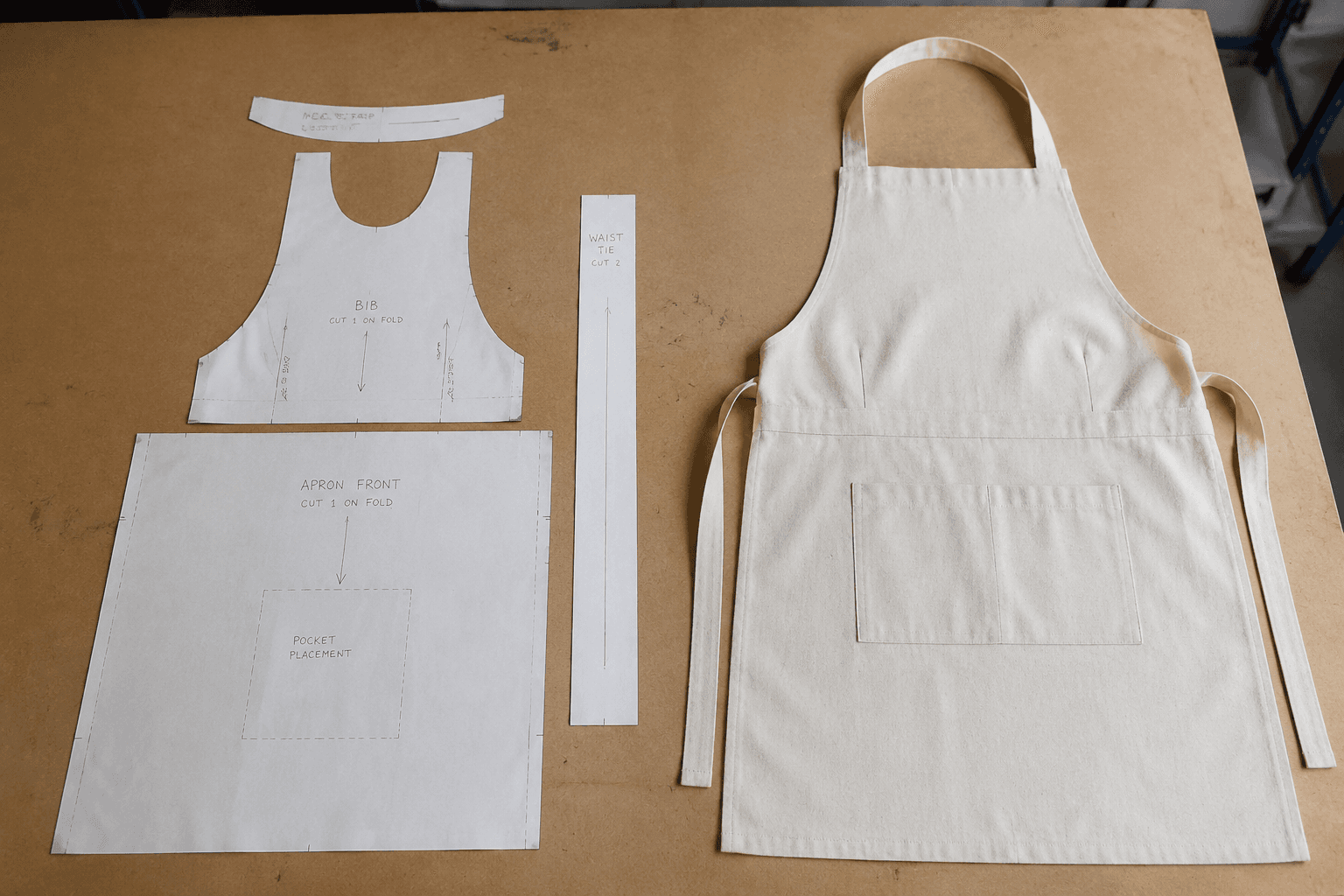
The tech pack should include finished measurements that matter to the dart decision: total length, bib height, upper bib width, waist width, pocket size, neck strap width, tie length and the exact location of artwork. Fabric details should include content, GSM or oz weight, wash requirement, shrinkage target and whether pressing shine on dark colors is acceptable. Without that information, a factory may choose a dart intake that looks good on the sample table but creates issues in bulk.
Pocket and logo placement should be finalized only after the shaped pattern is approved. A chest pocket measuring 12-14 cm wide by 13-15 cm high may need to move lower once side darts reduce usable width at the top bib. Embroidery, woven patches and heat transfers should generally stay at least 2.5-3.0 cm from the dart seam, with more space preferred around the dart point. If the buyer wants a large centered logo on a narrow bib, that should be tested before PP approval.
For a new style, the development path should be controlled: reference sample or sketch, factory pattern proposal, SMS fit sample, buyer comments, revised sample if needed, then PP sample in final fabric and trims. For repeat orders, approved data should include dart length, intake, start point, point position, pressing direction and final upper bib width. That is the information that keeps a 1,000-piece reorder consistent with a 30,000-piece roll-out.
- Provide target finished measurements for bib width, bib height, total length and waist span.
- State fabric content, GSM or oz weight, wash process and shrinkage requirement.
- Confirm one size or multi-size strategy before pattern approval.
- Place pocket, label and logo positions on the shaped pattern, not the flat pattern only.
- Define dart tolerance, AQL and inspection method before bulk cutting.
- Approve the PP sample in final fabric because substitute cloth can hide bulk and pressing risks.