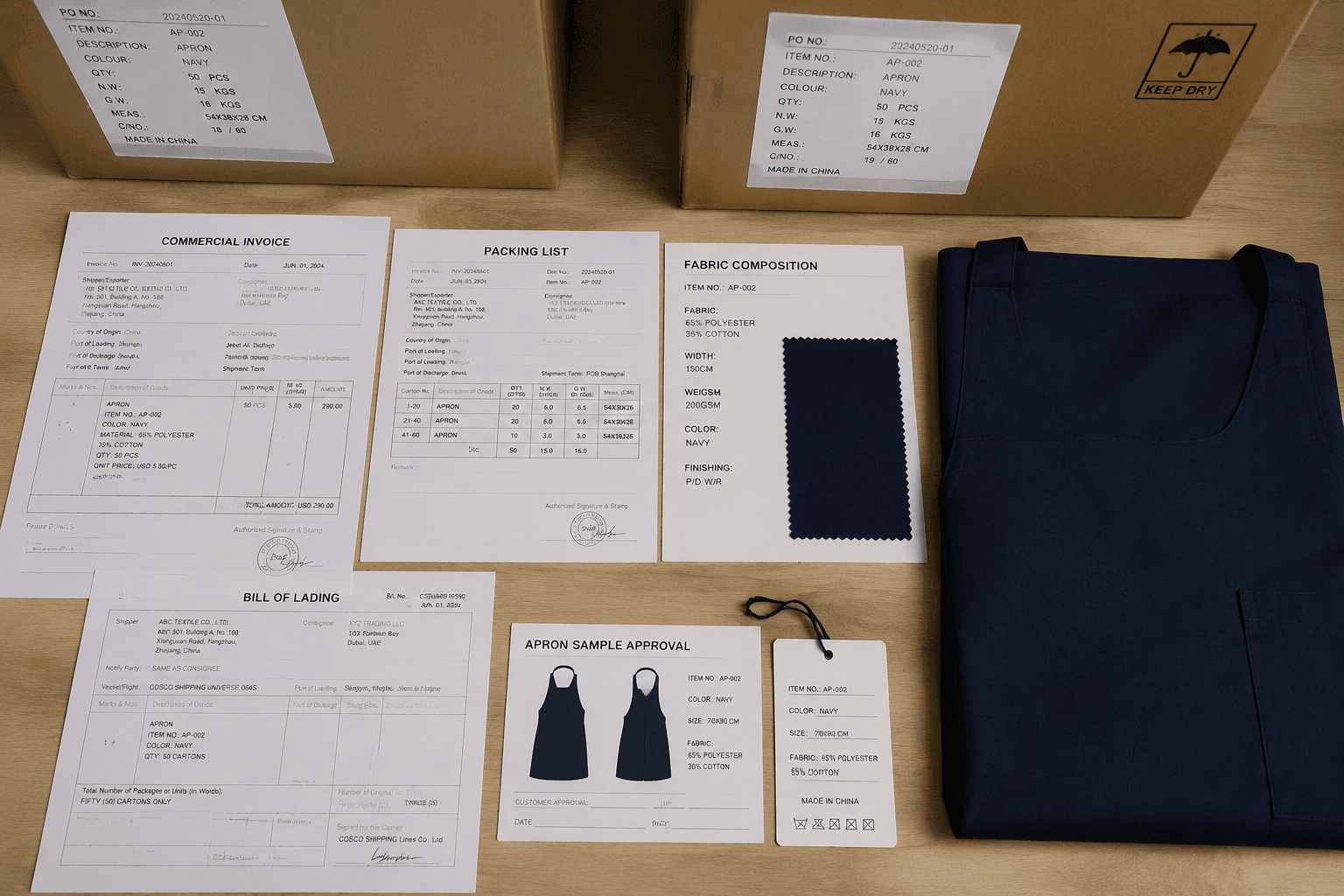
In apron sourcing, customs delays usually start with small mismatches across the shipment file. A commercial invoice may state 100% cotton canvas bib apron, 280 GSM, while the packing list shows 65% polyester 35% cotton twill waist apron, 190 GSM. The carton marks may reference 412 cartons, while the booking was filed at 404 cartons. On an 8,400-piece order, that gap can hold clearance for 2 to 7 working days and add $35 to $120 per amended document before storage, exam handling or missed delivery costs are counted.
That is why apron customs documentation needs the same control as costing, PP sample approval and final inspection. Once goods are packed, brokers and destination compliance teams work from the invoice, packing list, bill of lading data and carton marks. They do not clear shipments from the tech pack or the email thread that approved the fabric. If the customs file is vague or inconsistent, the shipment can be questioned for quantity, valuation, composition or product classification even when the aprons themselves were sewn correctly.
For professional buyers sourcing custom aprons from China, the practical standard is simple: describe the apron as it was actually produced and packed. State product form, shell composition, fabric type, GSM or oz weight, key trim and line value. Separate materially different styles instead of averaging them into one broad declaration. Review the final document set 3 to 5 days before ETD, after carton data is stable and before vessel cutoff pressure makes corrections expensive.
- apron customs documentation should match the shipped aprons by product type, shell composition, fabric weight, trim, quantity, carton count and declared value
- commercial invoice lines should include apron type, shell material, fabric type, GSM or oz weight, key construction detail, unit price, total value, currency and Incoterm
- packing lists should be built from final packed data, including carton count, units per carton, carton dimensions, net weight and gross weight
- material descriptions such as 100% cotton canvas, 280 GSM or 65% polyester 35% cotton twill, 190 GSM are stronger than broad terms such as hospitality apron
- mixed apron programs should be split into separate lines when composition, coating, hardware content, product form or unit price changes materially
- a document review 3 to 5 days before ETD prevents most correction requests and reduces amendment, storage and delivery-delay risk
Why apron customs documentation fails after a clean final inspection
Most document failures on apron shipments are cumulative, not dramatic. A factory may cut and sew the correct goods, pass final inspection at AQL 2.5 major and AQL 4.0 minor, and still create customs problems because the shipment records do not agree. A buyer may place one PO for 12,000 pieces, but the packed order contains 6,000 adult bib aprons in 100% cotton canvas at 280 GSM, 4,000 waist aprons in 65% polyester 35% cotton twill at 190 GSM, and 2,000 cross-back aprons in 12 oz waxed cotton canvas with PU neck tabs and metal rivets. If the paperwork collapses all three into one line called kitchen aprons, it no longer describes the cargo in a useful commercial way.
The risk rises when internal sales language replaces physical product language. Terms such as premium apron, chef apron or promotional textile item may work inside a sourcing team, but they do not help a broker reconcile invoice, packing list and carton contents. Customs-facing descriptions should identify product form, shell composition, fabric type, fabric weight and any trim or finish that changes the apron’s identity, value or handling.
Timing is the second failure point. Factories sometimes draft shipping data before final packing is locked. A load estimated at 396 cartons can finish at 403 cartons after ratio packing, rework replacement or an approved 1% to 2% overrun. If the booking shows one carton count, the invoice another and the packing list a third, destination review slows immediately. In a low-risk lane, that may cost 1 to 2 working days. During peak season or stricter customs review, it can become 5 to 10 working days plus exam handling, storage and brokerage correction fees.
- avoid broad descriptions such as aprons or textile goods on mixed-style apron orders
- use final carton counts from the packed goods report, not estimates prepared 7 to 10 days earlier
- lock fabric declarations before documents are issued, for example 100% cotton canvas, 280 GSM or 65% polyester 35% cotton twill, 190 GSM
- treat bib aprons, waist aprons, waxed styles and PU-trim styles as separate commercial descriptions when they differ materially
Commercial invoice rules for apron customs documentation
A commercial invoice line for aprons should be specific, short and defensible. For most B2B shipments, the best structure is product type, shell composition, fabric type, fabric weight, notable construction detail, quantity, unit price and line value. A clean line reads: Adult bib apron, 100% cotton canvas, 280 GSM, with front pocket and adjustable neck strap. It is clear enough for customs processing and compact enough for standard invoice formatting.
Line separation matters as much as wording. If one shipment contains 5,000 cotton canvas bib aprons at $2.45 per piece and 3,000 polycotton waist aprons at $1.18 per piece, they should not sit on one averaged line. The product forms differ, the shell compositions differ and the values differ enough to invite valuation questions. The same rule applies when a shipment includes washed denim aprons at 8 oz, waxed canvas aprons at 12 oz, or aprons with detachable webbing straps and antique brass buckles. Once non-textile content or finishing changes the product materially, the invoice should show that change directly.
Value control is also important. If the order is FOB Shanghai, 8,000 pieces, with a total invoice value of $15,980, the final commercial invoice should reconcile exactly to the approved shipment basis unless there is a documented adjustment. Spare straps, photo samples or free replacement aprons should not appear physically in the shipment without a declared treatment. Some importers use a nominal value such as $0.10 per sample piece; others require a separate no-charge line tied to the PO. The key is consistency across the invoice, packing list and importer instructions.
- identify the apron precisely: adult bib apron, waist apron, cross-back work apron or cobbler apron
- state shell composition in a standard format such as 100% cotton or 65% polyester 35% cotton
- include fabric type and weight where relevant, such as canvas, 280 GSM, twill, 190 GSM or denim, 8 oz
- separate coated, waxed, PU-trim or hardware-heavy apron styles into their own invoice lines
- keep currency, Incoterm, payment term and quantity aligned with the PO, booking file and final packing report
Packing list controls: cartons, weights and apron style visibility
The packing list shows whether the shipment file reflects packed reality. Warehouses, brokers and destination receiving teams use it to reconcile the load, and customs may use it to test whether the invoice is credible. On apron shipments, errors in units per carton, carton dimensions or gross weight often trigger unnecessary review because textile packs are expected to follow stable ratios.
A usable apron packing list should show style code, apron type, color if required by the importer, units per carton, total carton count, total units, carton dimensions, net weight and gross weight. If style A packs 25 pieces per carton because it uses 12 oz waxed canvas and metal hardware, while style B packs 50 pieces per carton because it uses 190 GSM polycotton twill, that difference needs to be visible. If it is hidden, freight weight may look inconsistent with the declared quantity and the broker may assume cargo or valuation data is wrong.
Professional buyers should review the packing list when the final packing report is stable, usually 3 to 5 days before ETD. At that point, the supplier should know whether the order ships complete, short or with an approved 1% to 3% overrun. Corrections made after filing look minor but can be costly in schedule terms. A local amendment may cost $35 to $80, while a destination correction can add 1 to 3 working days and expose the cargo to storage, exam handling or missed delivery appointments.
Mixed-style loads need extra discipline. If one container holds 420 cartons across four apron styles, the packing list should not hide that detail inside one summary line. The buyer’s receiving team needs to know where each style sits, and the broker needs style-level quantity visibility if the invoice is split by line. On orders of 10,000 to 20,000 pieces, style-level packing visibility also helps reconcile landed cost and shortage claims after arrival.
- carton count must match the final loaded shipment exactly, including approved overrun or replacement cartons
- net and gross weight should come from actual packed measurements, not costing formulas or pre-production estimates
- carton marks should match consignee name, PO reference, style code and carton sequence shown on the invoice and packing list
- mixed cartons should be used only when the buyer can receive, trace and book them by style and color
- if one booking covers split factory loads or split sailings, the packing list should separate each load clearly
Material descriptions in apron customs documentation: GSM, oz and trim detail
Material wording is where many apron files become too vague. Development teams often use shorthand such as 10 oz canvas, washed denim or recycled twill. Customs-facing documents need a standardized commercial description. If the shell fabric is 10 oz cotton canvas, the document team may state 100% cotton canvas, approximately 339 GSM, if that matches the importer’s filing practice. The goal is not longer wording; it is less ambiguity.
For most apron shipments, the minimum useful material description includes shell composition and fabric type. In practice, that means wording such as 100% cotton canvas, 65% polyester 35% cotton twill, 100% cotton denim or recycled polyester cotton woven fabric. If the apron includes a finish or trim that materially affects identity, cost or handling, declare it. Examples include waxed surface, water-repellent coating, PU leather neck strap, PVC patch, brass eyelets, detachable webbing straps or metal clips. These details explain why two apron styles that look similar in photos may carry different values, carton weights or classifications.
Marketing language should be removed from shipping documents. Terms such as artisan, chef-grade, premium or eco add no verifiable product detail. If sustainability content matters commercially, express it factually, for example 80% recycled cotton 20% recycled polyester. If the buyer’s program is supported by recycled content certificates or test reports, the composition shown on the invoice and packing list should align with those records.
Trim description should stay proportional. A standard cotton neck strap with a plastic slider does not need a long accessories paragraph if it does not affect the product’s identity materially. But wax coating, PU trim, detachable leather straps, large metal buckle sets or visible PVC branding patches should not be hidden. On apron orders priced from roughly $1.10 to $4.80 per piece, those details often explain why one style is materially higher in value than another.
- translate internal fabric shorthand into standard commercial terms before documents are drafted
- use one composition format consistently across PO, invoice, packing list and booking data
- declare coatings, wax finishes, PU trim and notable hardware when they affect product identity or value
- replace non-verifiable wording with measurable details such as GSM, oz weight or composition percentage
When one apron PO needs multiple customs lines
Many buyers try to keep documents simple by compressing one apron program into one or two lines. That works only when the shipped goods are genuinely similar in form, composition and value. Once those factors move apart, line splitting is usually safer. A 300 GSM cotton canvas cross-back apron with antique brass hardware is not the same customs-facing description as a 180 GSM polycotton waist apron, even if both styles were ordered for the same restaurant group under one PO.
There are four common triggers for splitting apron lines. First is product form: bib aprons, waist aprons and cobbler aprons should not automatically share one declaration. Second is shell composition: cotton canvas, polycotton twill, denim and recycled blends should be separated. Third is treatment or accessory content: washed, printed, waxed, PU-trim or hardware-heavy styles need clearer visibility. Fourth is value difference. If one style costs $1.05 per piece and another costs $3.90 per piece, a weighted average weakens valuation logic and makes landed-cost reconciliation harder for the importer.
This is also a timing issue. If document splitting is requested too late, the supplier has to rebuild invoice totals, style summaries, carton references and sometimes carton marks. On a typical custom apron order of 5,000 to 15,000 pieces with a 25 to 35 day production cycle, buyers should approve final invoice line structure at least 7 days before ETD. That leaves time to align shipping documents, booking data and carton labels before vessel cutoff.
A useful test is direct: if a broker would reasonably ask why two apron styles have different values, weights or pack ratios, they probably deserve separate document lines. The minor administrative work of adding one or two lines is usually cheaper than a post-filing amendment or customs query.
- split by product type when bib aprons, waist aprons and cobbler aprons ship together
- split by composition when cotton, polycotton, denim, waxed canvas or recycled blends are mixed
- split by treatment when printed, washed, waxed or PU-trim apron styles appear in one shipment
- split by value when unit-price differences are large enough to distort a single averaged declaration
Pre-shipment review of apron customs documentation before ETD
The most reliable way to avoid document-related delays is to treat shipping paperwork as part of production control, not post-production admin. For apron orders, a practical review has three checkpoints. First, freeze shipment scope: style codes, final quantities, consignee data, shell composition, fabric weight and destination instructions. Second, compare draft invoice and packing list against the final production and packing summary. Third, confirm that carton marks, booking data and all commercial documents use the same references. For a shipment under 500 cartons, this review usually takes 60 to 120 minutes and prevents most avoidable mismatches.
Timing should follow the manufacturing calendar. A common custom apron program runs 5 to 7 days for fabric or artwork approval, 20 to 30 days for bulk sewing, 2 to 4 days for final inspection and packing, and 2 to 3 days for final document issue before ETD. If review is left until after filing, even minor corrections become expensive in schedule terms. On a shipment valued at $18,000 to $42,000, the direct amendment fee may be limited, but the real loss comes from delayed delivery appointments, production launch slippage or missed retail rollout dates.
Responsibility should be explicit. The supplier owns factual accuracy for what was made and packed: style, quantity, carton count, weight, composition and trim. The buyer owns importer-specific wording, consignee data, tax registration details and broker preferences. When both sides assume the other has checked everything, small errors survive into the final file. For B2B apron sourcing, that is avoidable risk in a controllable process.
Buyers managing repeat programs should maintain a document template library by apron type. If a supplier ships the same 240 GSM polycotton bib apron every quarter, the invoice wording, packing list format and carton marks should not be reinvented each time. Standard templates reduce drafting errors, speed approval and make exceptions easier to spot when a composition, trim or carton ratio changes.
- freeze final style, quantity, composition, value basis and consignee data before the document set is issued
- review commercial invoice, packing list and carton marks together rather than as separate approvals
- complete buyer approval 3 to 5 days before ETD whenever possible
- keep the final approved packing report as the source file for invoice quantities, carton counts and shipment weights
- use standard document templates for repeat apron programs, then flag only the fields that changed