For bulk apron orders, carton packing is a sourcing control point, not a warehouse afterthought. It affects FOB cost, freight cube, manual-handling weight, receiving speed, and claim exposure for importers, hospitality distributors, uniform suppliers, private-label brands, and retail DCs. In practical terms, apron carton packing changes landed cost because carton dimensions, fold method, polybag thickness, and packed weight determine how efficiently aprons move through export handling, ocean transit, and destination warehousing.
On most custom apron programs, packing decisions shift delivered cost by roughly 2-5%. A carton that is only 2 cm too large on length and width can add 1.5-2.5 cbm across a 10,000-15,000 piece shipment. A carton packed too tightly may reduce measured cube but increase print offset, bent neck sliders, strap creasing, or receiving delays when cartons arrive distorted and count accuracy drops. Bib aprons, waist aprons, cross-back aprons, denim aprons, and 10-14 oz canvas work aprons need different fold and count standards even when finished body measurements look close on the tech pack.
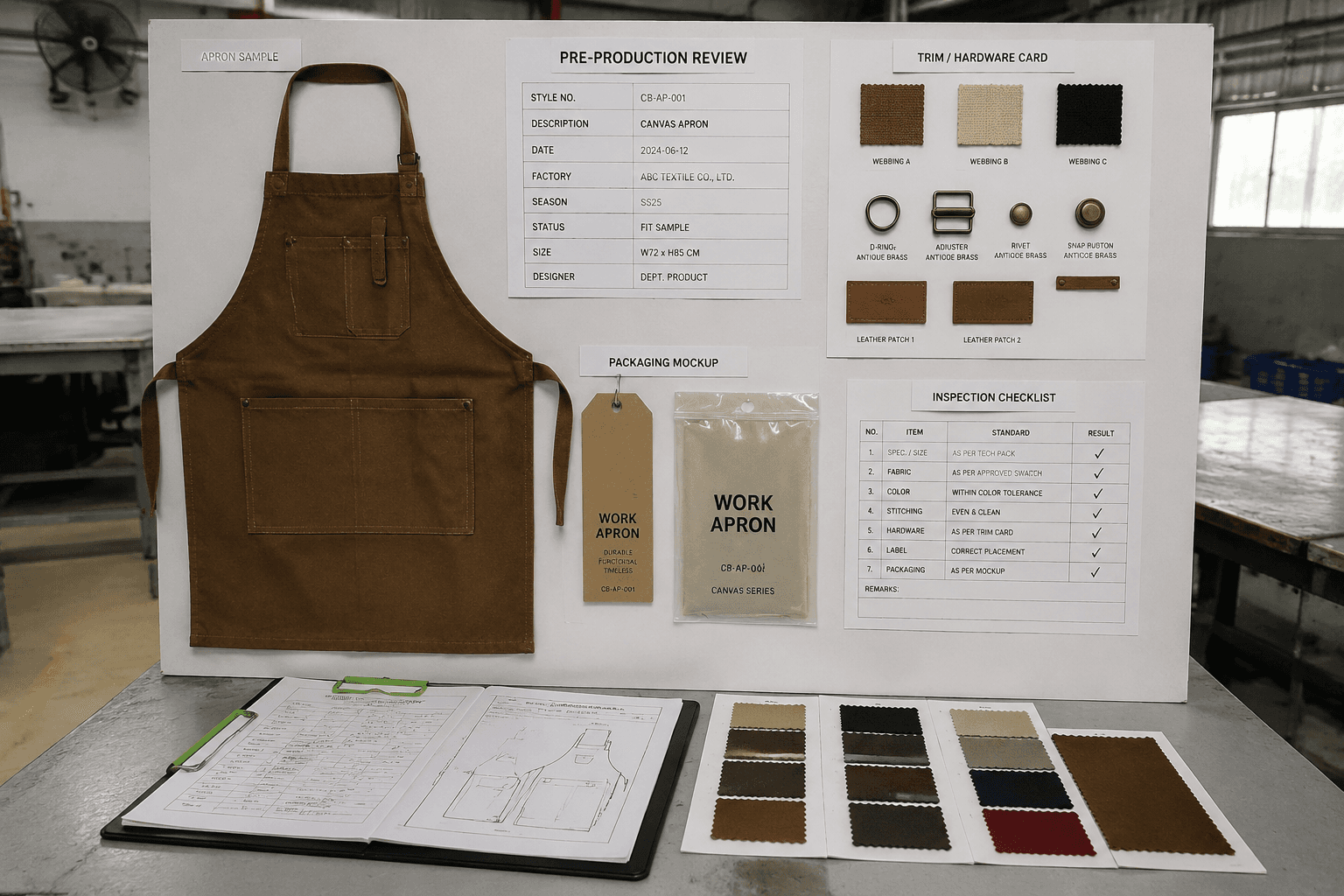
The right time to lock packing is after PP sample approval and before bulk sewing reaches full output. At that stage, the factory can verify actual folded size, fabric weight in 190-400 GSM or 7-14 oz ranges, buckle and rivet bulk, polybag gauge, barcode position, carton marks, and destination weight limits. Finalizing these points early lets the supplier order the correct cartons, avoid repacking, and keep standard custom-apron lead time within about 30-45 days from approval to ex-factory.
- Keep most export cartons for aprons within 12-18 kg gross weight; many buyers target 14-16 kg, and anything above 20 kg should trigger a formal packing review.
- Set units per carton from trial-packed decorated goods, not from flat garment measurements or undecorated fit samples.
- A 190-220 GSM promotional apron may pack at 60-100 pcs per carton, a 230-270 GSM bib apron at 36-60 pcs, and a 10-14 oz canvas apron at 12-24 pcs.
- Approve cube reduction only after a 24-48 hour compression trial confirms recovery of prints, embroidery, straps, and hardware.
- Audit packed cartons at AQL 2.5 major / 4.0 minor for count accuracy, assortment, carton marks, sealing, barcode position, and gross weight.
- Freight damage control depends more on board grade, sealing pattern, moisture control, and pallet discipline than on specifying a thicker carton without testing.
Why apron carton packing has a direct impact on landed cost
Aprons do not pack like basic T-shirts or scrub tops. Many styles concentrate thickness in a few points: neck adjusters, D-rings, snaps, rivets, towel loops, pocket corners, leather patches, or long waist ties. If folds are inconsistent or cartons are overfilled, those pressure points mark adjacent pieces, distort carton shape, and slow receiving at destination. That is why a generic apparel export carton often performs poorly on apron programs, especially for bib aprons with pockets and hardware.
The direct cost of packing materials is usually modest, but the freight effect is larger than many buyers expect. On standard OEM apron orders, polybag, carton share, carton label, tape, desiccant, and packing labor typically add about $0.11-$0.26 per piece for basic poly-cotton styles. Heavier canvas or washed denim aprons with lower carton counts often land at $0.19-$0.43 per piece. By comparison, an extra 0.006-0.010 cbm per carton across 300-400 cartons can erase any saving gained from cheaper board or a larger stock carton.
Bad packing specifications also create schedule risk. If the supplier buys cartons before fold method and final count are confirmed, late repacking can add 1-3 days to ex-factory timing. On a 35-day production plan followed by a 28-35 day sea transit, that delay can push arrival past a promotion start, distributor replenishment date, or hotel opening window. Good apron carton packing aligns costing, production, and logistics instead of forcing corrections at the end of bulk.
- Typical direct packing cost: $0.11-$0.26 per piece for standard aprons; $0.19-$0.43 for heavier workwear aprons.
- Typical MOQ: 500-1,000 pcs per color for basic twill aprons; 1,500-3,000 pcs for washed canvas, special dye, or complex trim programs.
- Typical bulk lead time after approvals: 30-45 days, with carton procurement needing sign-off in the first week.
- Typical delay from late repacking: 1-3 ex-factory days, and longer if printed cartons must be remade.
How to calculate units per carton without creating overweight apron cartons
Start with real packed goods, not finished garment dimensions. A waist apron in 190-210 GSM twill may bag to about 1.0-1.3 cm thick. A 245-270 GSM bib apron with pocket and plastic buckle often packs at 1.6-2.1 cm. A 10-12 oz canvas apron with metal hardware may reach 2.8-3.5 cm, while a 14 oz washed canvas apron can exceed 3.8 cm depending on strap construction and inserts. Those differences are large enough that a count formula taken from another style is usually wrong.
Use inner carton dimensions in centimeters because usable space is smaller than quoted outer size. On many 5-ply cartons, board thickness reduces the interior by about 1.0-1.5 cm per side. Then measure 10-20 actual packed aprons after decoration, final pressing, thread trimming, and polybagging. If one packed bib apron measures 30 x 25 x 2.0 cm, unit volume is 1,500 cubic cm. If the carton interior is 58 x 38 x 32 cm, total internal volume is 70,528 cubic cm. Theoretical fit is 47 units, but commercial fit should be lower because folding varies and cartons should not be packed to mathematical maximum. In practice, reserving 5-10% empty volume usually brings the approved count down to 42-45 pieces.
Weight is the control that prevents overpacking. A 250 GSM poly-cotton bib apron may weigh 0.34-0.38 kg packed. At 44 pieces, net weight is around 15.0-16.7 kg. After carton, tape, labels, and polybags, gross weight often lands at 15.8-17.5 kg, which is acceptable for many importers. A 12 oz canvas apron packed at 0.60-0.72 kg cannot use the same count. Even 30 pieces may exceed 20 kg gross, so the realistic range is often 18-24 pieces per carton even when some cube remains unused.
Decoration and bundled accessories also change the answer. Flat screen print usually packs more efficiently than embroidery, chenille patch, raised heat transfer, or a bundled mitt or towel. For that reason, the packing count must be approved from the final decorated sell-set, not from an early fit sample.
- 190-220 GSM promotional apron: usually 60-100 pcs per carton at 9-15 kg gross.
- 230-270 GSM bib apron: usually 36-60 pcs per carton at 13-18 kg gross.
- 300-400 GSM or 10-14 oz canvas apron: usually 12-24 pcs per carton at 10-19 kg gross.
- Accessory pack with towel or mitt: calculate from the full sell-set dimensions, not apron body only.
- Reserve 5-10% empty volume to absorb fold variation and prevent carton bulge.
Apron carton packing specs: carton dimensions, fold standards, and gross-weight limits
The correct carton starts from the approved folded footprint of the apron, not from whatever stock box is available in the factory. Standard adult bib aprons often fold to about 28-32 cm long and 24-27 cm wide after ties are controlled, but a cross-back apron or a canvas style with oversized patch pockets can differ materially. Once folded size is fixed, the supplier can determine stack pattern, layer count, and stable inner carton dimensions.
For a midweight bib apron folded to 30 x 25 cm, inner cartons around 58 x 38 x 32 cm or 60 x 40 x 30 cm often work well because they allow two stable stacks per layer without excessive side pressure. Reduce width by only 2 cm and stacks may sit unevenly, creating bulging sidewalls, count variation, and gross-weight inconsistency. Small dimension errors become large handling problems when repeated across 250 or 400 cartons.
Buyers should specify both inner and outer dimensions on the packing sheet. This matters when the importer has carton-size ceilings, pallet footprint rules, or e-commerce DC receiving limits such as 18 kg maximum gross weight or a longest-side limit of 60 cm. It also matters when comparing suppliers, because two factories can quote the same outer carton size while delivering different usable capacity due to different board grade and flute construction.
Fold consistency is not a cosmetic detail; it is a quality requirement. If one line rolls waist ties into the center while another folds them flat under the body panel, carton thickness changes enough to alter count, gross weight, and barcode orientation. A style-level SOP with measured folded dimensions, folding photos, bagging sequence, and target gross weight is the simplest way to keep repeat purchase orders stable.
- Approve one fold method per SKU before the factory purchases bulk cartons.
- Record both inner and outer carton dimensions in the PO packing appendix.
- Set folded-size tolerance, for example ±1 cm on length and width after bagging.
- Use the PP packed sample as the fold reference, not a showroom sample.
- Set target gross weight and review any carton above 18 kg before shipment.
Apron carton packing for cube optimization by FCL, LCL, and airfreight mode
Apron carton packing should be optimized differently for FCL, LCL, and airfreight. In FCL, the main goal is high container utilization with stable carton stacking. In LCL, lowering chargeable cbm matters, but mixed-cargo pressure means board strength and count discipline become more important. In airfreight, volumetric weight often dominates total cost, so a carton acceptable for sea freight may still be too large to ship economically by air.
Consider a 15,000-piece order of 250 GSM bib aprons. At 50 pieces per carton and 0.066 cbm each, total volume is 19.8 cbm across 300 cartons. If a revised fold and slightly tighter but still safe carton reduce each carton to 0.060 cbm, total volume falls to 18.0 cbm. A 1.8 cbm saving is commercially significant on LCL pricing and can also create room for chef hats, tunics, or a second apron style on the same shipment. On many lanes, that saving is worth more than the few cents per piece a buyer might save by using a lighter board or a stock carton.
Compression has limits. Plain twill aprons usually recover from moderate pressure, but embroidered hospitality aprons can abrade, raised heat transfers can block, and washed canvas can retain deep fold memory. Buyers should ask the factory to pack one full trial carton, hold it under normal stacking pressure for 24-48 hours, then inspect top, middle, and bottom layers for print recovery, buckle marking, crease depth, and carton shape before approving the final count.
For repeat programs, standardizing carton footprints across core apron SKUs often creates more value than fully minimizing each style. A common footprint simplifies pallet building, warehouse slotting, mixed-SKU loading, and distributor receiving, even when the count per carton differs between a lightweight 200 GSM promotional apron and a 12 oz canvas work apron.
- FCL priority: stable stacking, good container fill, and low carton deformation during loading.
- LCL priority: lower cbm with enough board strength for mixed cargo and repeated handling.
- Airfreight priority: compare volumetric weight against actual gross weight before approval.
- Compression trial: hold one packed carton for 24-48 hours and inspect each layer.
- Repeat-order strategy: standardize carton footprints across core apron styles where practical.
Freight damage control: board grade, sealing pattern, moisture, pallet rules, and AQL
Most freight damage on aprons is routine rather than catastrophic. Cartons soften in humidity, bottom flaps open from weak sealing, corners crush when cartons overhang pallets, or buckles and rivets mark the fabric after 30-45 transit days. Because apron cartons usually sit in the medium-weight range, they need enough compression strength to survive export handling without adding unnecessary dead weight or cost.
For many standard apron orders, a 5-ply export carton is sufficient when gross weight stays near 12-16 kg and the route is moderate risk. When cartons move toward 18-22 kg gross, or when the route includes long inland trucking after destination arrival, buyers should either reduce units per carton or upgrade board specification after reviewing stacking height, humidity exposure, and total transit time. A 30-day ocean leg plus 7-10 days of drayage and warehouse handling creates a different risk profile from a 12-15 day regional sea move.
Sealing method matters as much as board selection. H-taping on top and bottom is a practical baseline for apron exports. Heavy cartons sealed with only one tape strip often fail at the manufacturer joint or bottom flap. On higher-risk lanes, wider tape, edge protection, or controlled strapping may help, but straps should not crush carton edges or block barcode panels. If pallets are required, carton overhang should be prohibited because unsupported corners are where edge-crush failure usually begins.
Inspection should cover the shipping unit, not only the garment. A useful standard is AQL 2.5 major / 4.0 minor on count accuracy, assortment, shipping marks, barcode readability, sealing integrity, gross weight, and visible carton damage. That gives the buyer a measurable control over the actual export pack instead of relying on a vague note such as 'standard export packing'.
- Working gross-weight target: 12-18 kg for most apron programs; review anything above 20 kg.
- Baseline sealing: H-tape top and bottom with consistent overlap and tape width.
- Transit-risk factors: humidity, inland trucking days, pallet stacking height, and mixed-cargo exposure.
- Inspection scope: count, marks, barcode, sealing, carton condition, and gross weight.
- Pallet rule: no carton overhang for export pallets or destination DC handling.
Common apron packing mistakes and a buyer checklist before bulk shipment
One frequent mistake is approving cartons from an undecorated sample. Once embroidery, neck buckles, hangtags, care inserts, belly bands, or bundled accessories are added, packed thickness changes and rubbing risk rises. If cartons were already purchased from that early estimate, the factory may be forced into undercount cartons, overweight cartons, or costly repacking.
Another mistake is treating maximum units per carton as the main KPI. A sourcing team may lower quoted freight by a few cents per piece but create 21-24 kg cartons that receivers dislike and carriers handle poorly. For most apron programs, a repeatable carton at 14-18 kg gross with stable dimensions is commercially better than an aggressively packed carton that causes claims, relabeling, or slow unloading.
Mixed packing is another avoidable source of cost. To solve production balances, some suppliers mix too many colors or sizes in one carton. Unless the PO clearly requires ratio packs, solid packs are usually more efficient for aprons because they reduce receiving errors, speed counting, and simplify replenishment for distributors and hospitality stockists. If mixed cartons are unavoidable, the outer mark should show style, color, size ratio, carton number, and exact quantity clearly.
Moisture control is often underestimated on cotton and cotton-rich aprons. Goods packed too soon after pressing can trap residual moisture, soften carton board, and raise mildew risk during a 25-40 day transit. A short conditioning period in a dry packing area is cheaper than a destination claim. Before the factory buys all bulk cartons, the buyer should approve one packed sample, one trial carton, and one final carton spec sheet with dimensions, count, gross weight, marks, and pallet rules fixed in writing.
- Do not approve cartons from undecorated samples when bulk goods include logos, hardware, or inserts.
- Do not chase maximum count if gross weight rises above destination handling norms.
- Prefer solid packs unless the customer has a defined ratio-pack requirement.
- Allow conditioning time before sealing cartons in humid seasons or after pressing.
- Record actual trial-pack dimensions, count, and gross weight before bulk carton purchase.