For B2B apron buyers, apron care label symbols are not a design detail; they are part of the technical file and the costed BOM. They affect claim rates, replacement frequency, wash performance, and whether the apron shipped to stores or staff matches the approved spec. A 200 GSM 65/35 poly-cotton bib apron in a retail polybag may use a compact side-seam label, while a 260 GSM cotton canvas apron for a cafe chain may need a larger permanent label that remains legible through 50 laundering cycles.
The channel changes the job of the label. Retail apron packs are built around shelf compliance, multilingual efficiency, and home-laundry readability, usually at 30-40 degrees C. Bulk uniform programs need labels that survive repeated laundering, support replenishment, and reflect the actual operating environment, whether that means 40 degrees C store wash, 60 degrees C hospitality wash, or mixed laundering across franchise sites. The symbol set itself cannot be simplified for convenience if the apron fails those conditions in testing.
From a sourcing perspective, the useful question is not whether care text can be rewritten. It is which parts of apron labeling can be reformatted by sales channel and which parts must remain fixed because they are tied to fiber content, shrinkage, colorfastness, coatings, prints, trims, and destination-market rules. That is where most avoidable relabeling cost, approval delay, and post-delivery claims begin. In a 10,000- to 20,000-piece apron program, one wrong symbol decision can easily add 5-10 days and $0.10-$0.35 per piece in rework once seam opening, relabeling, inspection, and repacking are counted.
- Apron care label symbols can be presented differently for retail packs and bulk uniform programs, but the underlying wash instruction must match test data and the actual apron BOM.
- Retail apron programs usually optimize for compact layout and low trim cost; uniform programs optimize for label durability, traceability, and legibility after 30-75 wash cycles.
- Apron label choices should be based on fabric weight, fiber blend, coating, print method, hardware, and trim sensitivity, not on shell fabric alone.
- Typical apron label cost remains low relative to risk: printed satin labels commonly add $0.03-$0.06 per piece, woven plus care-tab systems $0.07-$0.12, and durable heat-transfer systems $0.08-$0.18.
- Custom apron label MOQ usually starts at 2,000-3,000 pieces per artwork. Basic approval often takes 3-5 working days, while multilingual or multi-market programs usually need 7-14 days.
- If apron labeling changes after sewing, rework commonly adds 5-10 days and $0.10-$0.35 per piece once seam opening, relabeling, inspection, and repacking are included.
Apron care label symbols: what changes by channel and what must stay fixed
Retail and uniform programs often use the same apron body, but they do not use it the same way. In retail, the sewn label supports shelf compliance and basic consumer care guidance, while some explanatory text can move to a hangtag, belly band, or insert. In a uniform program, the apron is separated from outer packaging as soon as it is issued, so the permanent label has to carry more of the information burden on its own.
That changes three practical things: label size, label durability, and data density. A retail apron packed for supermarket or e-commerce sale may use a 25 x 60 mm printed satin label because pack copy handles some of the explanation. A uniform apron supplied to a hotel, cafe group, or bakery chain often needs a larger format such as 30 x 70 mm or a woven brand label plus printed care tab, because the label may also need size, SKU, wearer group, or contract code.
What does not change is the technical truth behind the care instruction. If a 265 GSM cotton canvas bib apron tests at 4.2% warp shrinkage and 3.6% weft shrinkage after 60 degrees C washing, the label cannot suggest an easier-care result just to support a cleaner presentation. If a PU-coated waterproof apron distorts or peels in tumble drying, the drying symbol must prohibit that use in both the retail version and the bulk uniform version.
For sourcing teams, the label decision should follow test data and channel need, not visual preference. A retail buyer may want a softer, shorter label to improve hang feel. A uniform buyer may want a more durable label stitched into the neck facing or side seam to survive daily laundry. Both are acceptable only if the approved symbol set stays consistent with the finished apron performance.
- Retail labels prioritize compact layout, shelf readability, and low trim cost.
- Uniform labels prioritize long-term legibility, replacement control, and alignment with the actual laundry process.
- Packaging can redistribute care information, but it cannot justify a different symbol set from the tested apron.
- For orders above 10,000 pieces, buyers should confirm actual wash temperature, bleach use, and drying method before label release.
Which apron care label symbols cannot change once fabric, print, and trims are approved
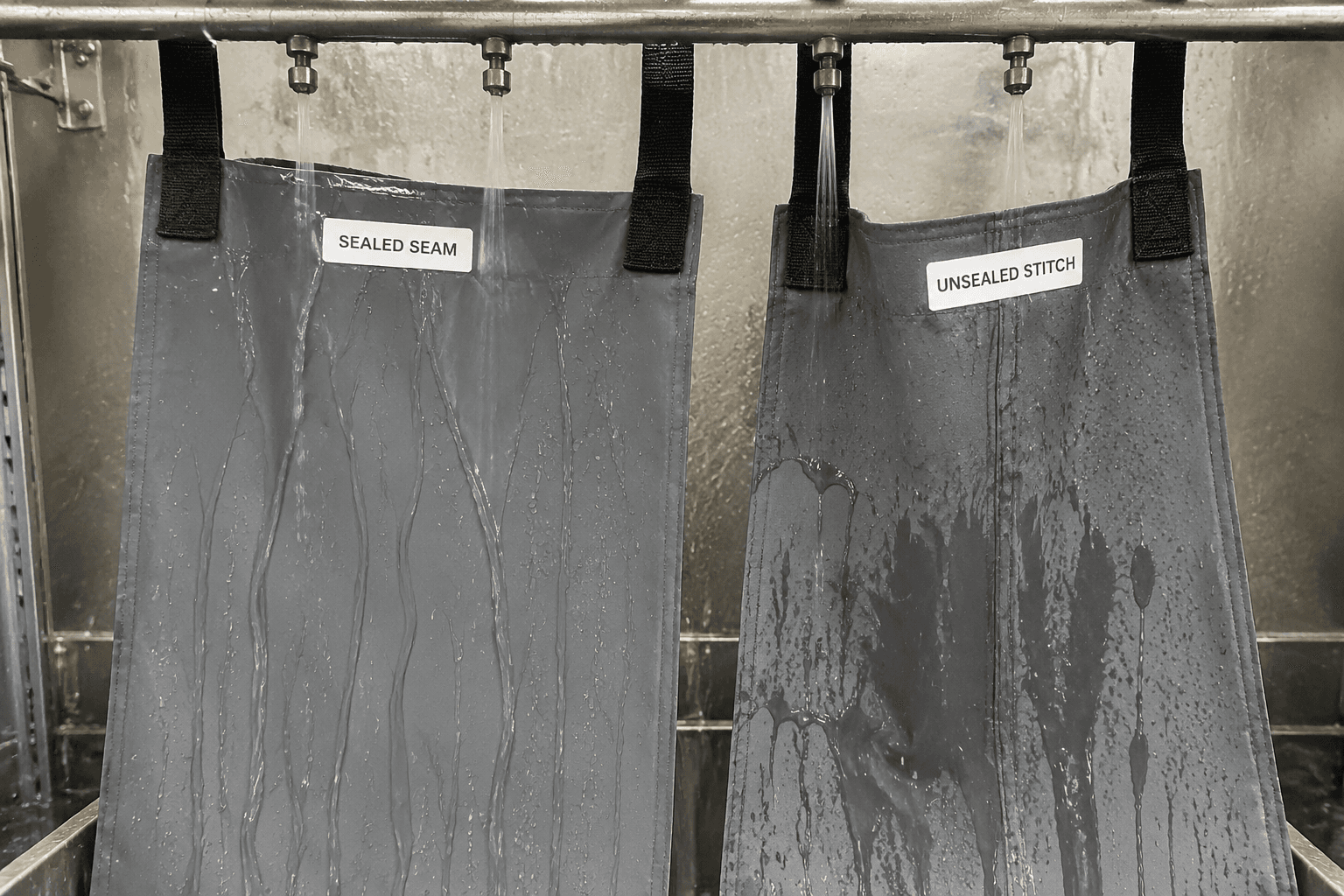
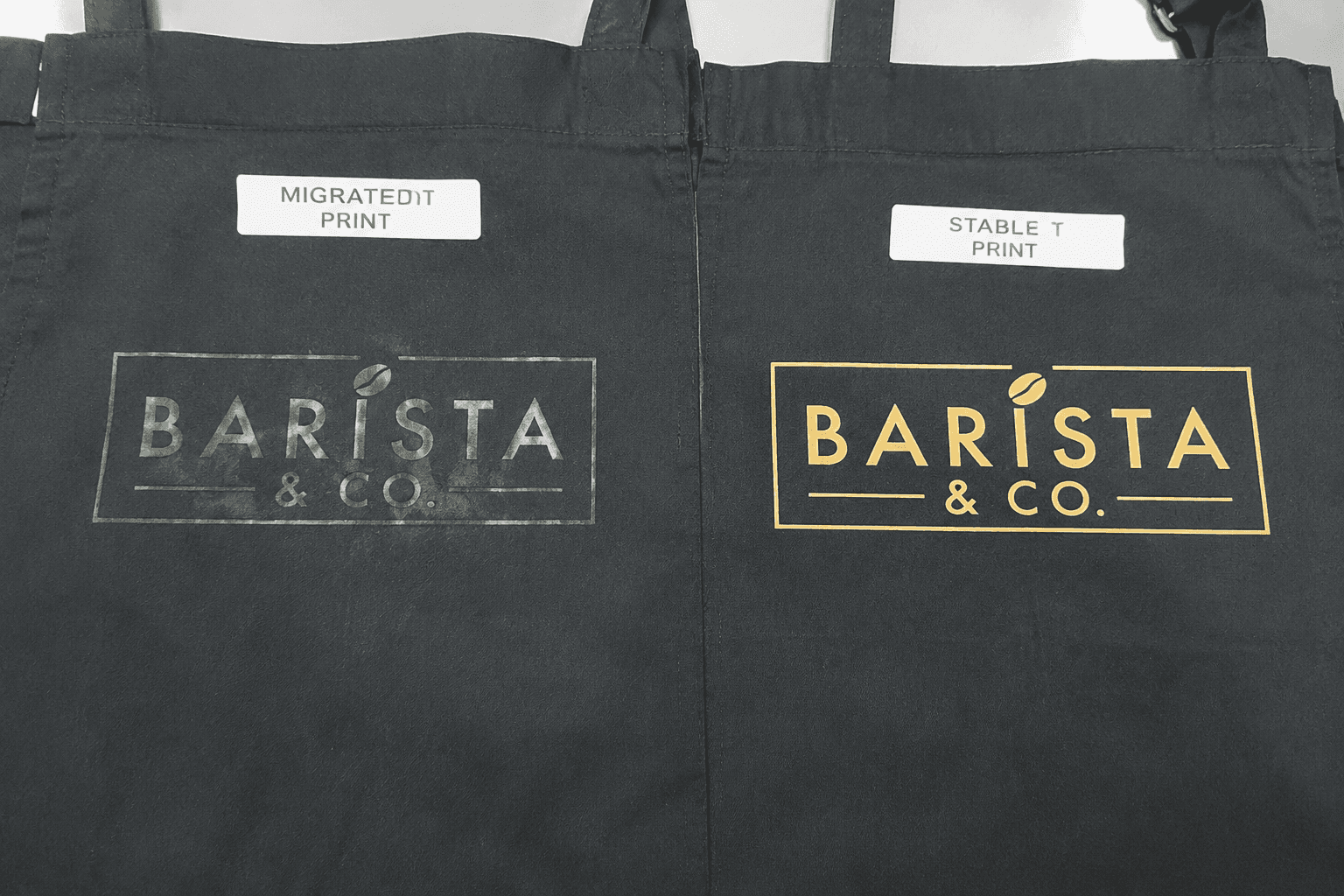
Buyers can change label fold, label position, language order, and whether explanatory wording sits on the pack or on the garment. They cannot freely change the meaning of apron care label symbols once the apron BOM is fixed. In apron production, the limiting factor is often not the shell fabric alone. It may be a screen print, embroidery backing, faux leather patch, metal buckle coating, webbing strap, or water-repellent finish.
A 200 GSM 65/35 poly-cotton twill apron may tolerate repeated 40 degrees C washing with moderate ironing, but the same body fabric can require a stricter symbol set once a low-grade heat transfer or leather-look neck strap is added. An 8 oz cotton twill waist apron may perform well in wash testing, yet a decorative print can still block chlorine bleach or high ironing. A 10 oz waxed canvas apron often needs reduced laundering guidance or spot-clean language because the finish, not the cotton base, becomes the controlling component.
For sourcing teams, the care panel should be treated as a performance statement backed by test results. If the apron cannot tolerate bleach, hot tumble drying, or heavy ironing, the label must say so directly. Styling the label differently for retail or uniform use is acceptable. Rewriting the care logic to look more attractive is not defensible in a serious B2B buying program.
The most common approval mistake is assuming the base fabric decides the instruction. In reality, the weakest component controls the symbol set. A simple cotton apron can still require a lower-heat wash because of a dyed PU patch, and a heavy canvas apron can still be unsuitable for aggressive dry heat because of bonded trims. That is why apron approvals should include the full construction, not just the shell fabric line on the quote.
- Fiber content cannot be shortened or altered to save space on an apron label.
- Prints, coatings, patches, strap materials, and hardware can override the normal care profile of the base fabric.
- If shrinkage or colorfastness misses buyer tolerance, the label should follow the safer wash route.
- One approved symbol set should align with lab results, wear trials, and bulk production performance.
Retail apron packs: how to balance readable apron care label symbols, multilingual layout, and cost per piece
Retail apron sourcing is usually driven by presentation, unit cost, and country-specific compliance. For a home-kitchen bib apron or gifting waist apron, the sewn label often carries mandatory information while the hangtag or insert explains use in plain language. This lets the factory keep the sewn component smaller and softer, which matters on aprons worn directly at the neck or side seam.
Cost planning is straightforward when label content is frozen early. On a 3,000-5,000 piece apron order, a printed satin care label commonly costs $0.03-$0.06 per piece depending on folded size, number of print colors, and whether one or both sides are printed. A woven brand label plus separate printed care tab usually lands around $0.07-$0.12 per piece. When the retailer requests five-language content, the label often expands by 15-30 mm, which raises both trim cost and sewing seconds. The increase is manageable, but it should be included in the pre-costing sheet, not discovered after packaging approval.
Retail claims usually come from inconsistency, not from label cost. An apron can look rugged because it uses 240 GSM canvas, contrast binding, and utility pockets, yet still require no bleach, low iron, and no tumble drying because of trim sensitivity. When the sewn label, hangtag, and insert card describe different care logic, retailer chargebacks and consumer returns increase quickly. The cleanest route is one approved care instruction carried consistently through all retail pack components.
For retailers, the best balance is usually a simple sewn label plus pack-level support copy. If the apron is sold through e-commerce, the care symbols should also match the online product page and carton master data. That reduces disputes from consumer photos, returns, and marketplace complaints when the delivered apron is laundered according to the wrong instruction.
- Custom apron label MOQ for retail programs typically starts at 2,000-3,000 pieces per artwork.
- Simple single-market artwork is often approved in 3-5 working days.
- Multilingual layouts commonly add 2-4 working days for revision and compliance checking.
- Printed satin remains the most common low-cost retail label for aprons sold in close-to-body packaging.
Bulk uniform programs: durable apron care label symbols, wash-cycle targets, and traceability
Uniform programs place more stress on permanent labels because the apron stays in use long after packaging is discarded. In hospitality, bakery, cafe, and food-processing accounts, the label often needs to remain readable through at least 30-50 washes, and some buyers target 75 cycles for higher-turnover bib aprons. The label may also need to support reordering by size, style code, or contract ID, especially when replenishment is managed centrally rather than through a store-level buyer.
That requirement changes the trim decision. A basic printed satin label may be enough for light-duty, home-laundered programs, but once the account washes at 60 degrees C, uses oxygen bleach, or tumble dries regularly, many buyers move to a higher-grade printed label, woven-plus-tab construction, or tested heat-transfer system. The cost difference is usually modest, often $0.05-$0.12 per piece above the lowest-cost retail-style option. On a 15,000-piece apron order, that extra trim spend is usually cheaper than one relabeling event after rollout.
The largest sourcing risk is assuming the laundry practice matches the bid document. Many apron programs are mixed in real use. One site may home-wash at 40 degrees C, another may run store laundry at 60 degrees C, and a third may use a local contractor with stronger chemicals and hotter drying. Before PPS approval, buyers should request the actual wash profile: temperature, detergent type, bleach use, drying method, pressing temperature, and expected number of cycles before apron replacement.
If the buyer manages franchises or multi-site foodservice accounts, the permanent label should also support internal audit. A contract code, style number, or size code on the label can reduce replenishment errors and help identify which apron version failed in laundering. That traceability is more useful than decorative branding once dozens of branches are involved.
- A practical minimum target for uniform apron labels is legibility after 30-50 wash cycles.
- Programs above 5,000 pieces often benefit from adding size code or internal SKU data to the permanent label.
- Higher-durability label systems should be tested on the finished apron at the real seam location.
- Mixed laundry environments are common in franchise hospitality and multi-site foodservice programs.
How apron GSM, coatings, and trims determine the valid apron care label symbols
The valid care instruction for an apron is usually set by the weakest component in the finished assembly. Fabric weight matters, but it is only one variable. A 190 GSM 65/35 poly-cotton bib apron for quick-service staff behaves differently from a 240 GSM cotton twill waist apron, and both may behave differently again once screen print, embroidery, PU coating, or decorative patches are added.
A practical buying method is to classify aprons into care families before labels are ordered. Group A might be 180-220 GSM poly-cotton aprons with stable shrinkage, low wrinkling, and routine 40 degrees C laundering. Group B might be 220-280 GSM cotton twill or canvas aprons that need closer review of shrinkage, colorfastness, and ironing limits. Group C might cover PU- or PVC-coated waterproof aprons where tumble drying and high-heat ironing are normally excluded. Group D might include retail gift aprons with decorative print, contrast binding, or trim details that require gentler home-laundry instructions.
This family approach makes apron care label symbols easier to manage across a mixed product line. It also reduces MOQ fragmentation. Instead of creating five or six separate label artworks for closely related aprons, a buyer may be able to consolidate to two or three symbol sets if the fabric-and-trim risk profile is honestly grouped. That usually improves price, shortens approval time, and still keeps the care instruction technically credible.
The practical advantage is fewer late changes. If one apron style in the range carries a PU pocket or a bonded logo patch, it should be separated early into its own care family instead of being forced into the same symbol set as a simpler apron. That avoids bulk disputes, protects testing integrity, and keeps factory sewing stable once production starts.
- 180-220 GSM poly-cotton is common for easy-care uniform aprons with controlled shrinkage.
- 220-280 GSM cotton twill or canvas often needs stricter review of shrinkage and ironing tolerance.
- PU- or PVC-coated aprons typically restrict tumble drying, strong heat, and some finishing processes.
- Leather, imitation leather, decorative transfers, and painted metal hardware often become the limiting care component.
- Before standardizing one symbol set across all colors, buyers should check dark-shade crocking and first-wash color migration.
When to lock apron care label symbols: MOQ, lead times, AQL, and rework cost
Apron care labels are low-cost trims with disproportionate schedule risk. In most custom programs, MOQ starts at 2,000-3,000 pieces per artwork, with better cost efficiency once volume reaches 5,000 pieces or more. Printed labels can often be produced in 3-7 days after artwork sign-off, while woven labels usually need 5-10 days. When the apron program includes testing, multiple destination markets, or several language blocks, a realistic approval cycle is 7-14 days because the delay usually sits in revision and compliance review rather than in the label factory itself.
The right time to freeze care content is before bulk cutting, ideally during PPS or size-set approval. At that stage, the buyer can still align fabric test data, packaging copy, and permanent label content without disrupting sewing flow. After production starts, even a cheap label correction becomes expensive because it triggers unpacking, seam opening, replacement sewing, reinspection, metal detection if required, and repacking.
On a 20,000-piece apron order, the replacement label itself may cost only $0.06-$0.18 per piece, but the full rework impact often reaches $0.10-$0.35 per piece and adds 5-10 days to ex-factory readiness. Inspection planning should reflect that risk. Many buyers use AQL 2.5 for major apron label defects such as wrong care symbols, wrong fiber content, wrong language version, or unreadable print, and AQL 4.0 for minor issues such as fold variance or small print alignment deviation. That is a sensible baseline unless the retailer or uniform account specifies tighter limits.
For large apron rollouts, final approval should be tied to finished-goods inspection, not to artwork alone. A symbol set that looked correct on screen can still fail once printed on the actual label stock, sewn into the seam, and exposed to the garment color and fold direction. That is why pre-production sampling should include the finished apron, not just a loose label proof.
- Lock destination market, language set, and care logic before final packaging artwork is released.
- Approve permanent label content during PPS or size-set stage, not after finished-goods inspection.
- Use AQL 2.5 for major apron label defects and AQL 4.0 for minor label appearance defects unless the spec says otherwise.
- For wash-critical programs, request a finished-apron wash verification before bulk label release.
- On orders above 10,000 pieces, late label correction can also affect vessel booking and carton-marking approval.
Buyer control checklist for apron care label symbols before PO release
Strong apron programs treat labeling as part of technical development, not as a last-step packaging detail. That matters most when one apron style is adapted across channels. The retail version may work with a soft satin side-seam label and supporting pack copy, while the uniform version of the same body may need a more durable label, longer wash-life legibility, and internal identification. The label format can change by channel. The approved care logic should not.
A disciplined workflow is simple and repeatable. Confirm fiber content, finished GSM, coating, print method, hardware, and trim set. Confirm the real laundry environment rather than the assumed one. Group aprons into care families, align test results to one approved symbol set per family, and then carry that same logic through the permanent label, hangtag, insert, and outer carton spec. That sequence prevents most late disputes about whether the delivered apron care label symbols still match the bulk apron.
For B2B sourcing teams, the goal is accuracy with low execution friction. Buyers do not need longer labels than necessary. They need apron labels that are durable enough for the channel, cheap enough to scale, and specific enough to survive compliance review and repeated use. Retail packs and uniform programs can look different in format, but the care instruction still has to match the apron that leaves the factory.
Before issuing the final PO, a sourcing team should also confirm the label cost is already built into the apron target price. If the quote shows a 0.06 USD label on paper but the actual approved construction needs a 0.12 USD woven-plus-tab, the mismatch will appear later as margin pressure, rushed substitutions, or shipment delay. The cheapest time to fix the spec is before cutting, not during final inspection.
- Check fiber content, finished GSM, coating, print, and trims before assigning care symbols.
- Confirm wash temperature, bleach use, drying method, ironing limit, and target wash-cycle life.
- Review sewn label, hangtag, insert card, and carton markings as one information set.
- Match label MOQ, cost per piece, and lead time to the program quantity and ship date.
- Freeze label approval before bulk cutting and before final packaging booking.