In custom apron sourcing, bartacks are a small sewing operation with outsized claim risk. Poor reinforcement placement leads to torn pocket openings, failed strap joins, seam-edge tearing, wash puckering, visible needle damage, and rejects at final inspection. For OEM buyers reviewing proto, fit, and PP samples, apron bartack reinforcement is one of the fastest indicators of whether a factory has engineered the apron for daily professional use or merely copied a rugged workwear appearance.
The sourcing question is not whether an apron needs bartacks, but which stress points justify them, what stitch build fits the fabric, and how the reinforcement interacts with 180-240 GSM twill, 260-320 GSM canvas, 8-12 oz denim, or PU-coated materials. On most professional aprons, the priority zones are upper strap joins, waist tie anchors, pocket opening corners, divider tops, towel-loop ends, and split-front stop points. Each zone fails under a different load path, so reinforcement should follow actual wear mechanics, not visual symmetry.
Overbuilding is a recurring commercial mistake. On 180-200 GSM cotton twill, an overly dense bartack can distort the panel after one industrial wash at 40-60°C. On waxed or PU-coated canvas, it can leave a perforation line, gloss change, or surface marking. In production, every unnecessary bartack usually adds 2.5-4.0 seconds of handling time, increases misalignment risk, and commonly adds $0.03-$0.10 per apron in FOB cost. A durable apron program balances reinforcement, seam construction, fabric weight, target selling price, and line capacity instead of treating extra bartacks as free insurance.
- Apron bartack reinforcement should be limited to verified load-transfer points such as strap entries, tie anchors, pocket openings, divider tops, towel-loop ends, and split-front stops.
- A basic bib apron usually needs 4-6 bartacks; a utility, bar, workshop, or florist apron with divided pockets and hardware usually needs 8-12, not an automatic 12-14.
- Pocket top corners and divider tops fail earlier than lower pocket corners on most hospitality aprons, so they deserve first priority in development, wash review, and QC.
- On 180-200 GSM twill, dense bartacks often cause puckering after wash; on 10-12 oz coated canvas, they can create visible hole lines, abrasion, or surface cracking.
- Each unnecessary bartack adds machine time, capacity pressure, reject risk, and avoidable cost across 5,000-50,000 piece bulk orders.
- PP approval should lock exact bartack position, length, orientation, density, thread appearance, and tolerance, then verify the result with repeated tug testing and at least one post-wash review.
Load map first: why apron bartack reinforcement should follow force, not symmetry
Many apron tech packs still place bartacks at every pocket corner and strap attachment without documenting end use, carried tools, laundering method, or shift length. That approach creates visual consistency but weak engineering. Aprons are utility garments for kitchens, cafés, bars, bakeries, salons, florists, retail counters, and workshops, so reinforcement should start with load mapping: where force enters the apron, how often that force repeats during a shift, and whether the surrounding seam and panel can absorb it without distortion.
On a standard bib apron, the main force path usually runs from the neck loop or cross-back straps into the upper bib, from the waist ties into the side body, and from the wearer’s hand into the top corners of a lower patch pocket. These loads are not equal. A neck-strap join on a 280 GSM cotton canvas apron worn for a 9-12 hour shift may see repeated downward pull equivalent to roughly 2-3 kg once pocket contents, bending, and body movement are considered. A chest pocket corner holding pens or an order pad may carry less than 0.2-0.4 kg. Effective apron bartack reinforcement separates high-frequency load from low-frequency load so the factory reinforces the points that actually fail first.
This matters commercially as much as technically. On a 10,000-piece order, adding four unnecessary bartacks at 3 seconds each adds about 33 labor hours before rework, thread breaks, and alignment checks are counted. In most sewing lines, the larger cost comes from rejects: skewed bars, seam crowding, distorted pocket openings, and wash puckering all increase exposure at AQL 2.5 major and AQL 4.0 minor. In practical OEM apron programs, six correctly engineered bartacks usually outperform twelve decorative ones.
- Define end use before approving reinforcement: kitchen, café floor, bar, bakery, salon, florist, retail, or workshop.
- Rank each stress point by load frequency, expected carried weight, and failure consequence.
- Delete symmetry-only bartacks during costing review if they do not serve a real load path.
- Ask the factory to mark the reinforcement map directly on the physical sample, not only in the sketch or CAD.
Stress-point zoning for aprons: upper joins, pocket entries, and lower stop areas
A practical apron review divides reinforcement into three zones. The upper zone carries suspended garment weight through neck loops, cross-back straps, shoulder supports, or hardware tabs. The middle zone absorbs hand entry, body twisting, towel pulling, and repeated pocket loading. The lower zone handles split-front opening stress, side opening strain, and tie-anchor force on waist and bistro styles. This zoning helps buyers compare sample revisions faster and prevents one reinforcement method from being copied across unrelated apron constructions.
In the upper zone, the most common risk points are neck-loop insertion, cross-back strap entry, D-ring or slider tabs, and any loop carrying metal hardware. In the middle zone, the highest-value checks are top pocket corners, center divider tops, chest pocket openings, and towel-loop ends. In the lower zone, the top stop of a split front, side opening edges, and waist tie joins need review depending on style. A server waist apron carrying a handheld POS, guest check pad, and bottle opener stresses tie anchors very differently from a bakery bib apron with only light front-pocket use.
Style details change the answer quickly. A lower three-section pocket on 230 GSM poly-cotton twill may need two bartacks at the outer top corners and one at the center divider top. A shallow chest welt pocket already locked into the top seam and side seams may need no visible bartack at all. A 12 oz cross-back canvas apron may require a box stitch plus a short locking bartack at strap entry, while a 190 GSM promotional bib apron often performs better with a clean seam and no visible bartack because the cloth cannot absorb dense reinforcement without puckering.
- Upper zone priorities: strap entries, neck-loop joins, hardware tabs, and slider loops.
- Middle zone priorities: pocket top corners, divider tops, chest openings, and towel-loop ends.
- Lower zone priorities: split-front top stops, side openings, and waist tie joins.
- Review every added pocket, loop, or hardware trim as a new load path, not a minor styling change.
Pocket engineering: where apron bartack reinforcement extends service life and where it wastes cost
Pocket reinforcement is where buyers most often confuse durability with visual signaling. Many workwear-inspired apron samples arrive with bartacks on all four pocket corners because the detail looks strong on the showroom table. In real service, the upper corners of a hand-entry patch pocket usually carry most of the opening load, while the lower corners mainly support the pocket bag and often do not fail first. On hospitality aprons used in restaurants, cafés, bakeries, coffee chains, and retail counters, bartacking all four corners often adds stiffness and visual clutter without adding measurable service life.
Fabric weight changes what is safe. On 180-200 GSM cotton twill, a 10-12 mm bartack sewn too densely can harden the corner and cause edge curling after laundering, especially when the pocket topstitch sits close to the edge. On 210-240 GSM twill, the same corner may remain stable if thread tension, stitch density, and presser pressure are controlled. On 10-12 oz waxed canvas or PU-coated fabric, the main risk shifts to visible needle marking, abrasion lines, and top-surface cracking. In those apron constructions, a shorter bartack, compact triangle reinforcement, or narrow box stitch often outperforms a dense conventional bar.
Divider tops deserve more scrutiny than many buying teams give them. A three-section lower patch pocket creates multiple top-edge load points, but they do not require equal treatment. For many café and restaurant apron programs, two outer top-corner bartacks plus one divider-top bartack are sufficient. For workshop, florist, or barber aprons carrying shears, pliers, pruning tools, or spray bottles, heavier reinforcement may be justified, but that decision should come from a loaded sample test with actual tool weight rather than assumption. If a divider top fails after 30-50 repeated insertions, that point needs redesign even if the lower corners still look clean.
- Prioritize pocket top corners and divider tops before approving lower-corner bartacks.
- Keep bartacks shorter and less dense on 180-200 GSM twill to reduce wash distortion.
- Inspect coated or waxed apron fabrics under strong light for hole lines, gloss change, and surface damage.
- Test divided pockets with realistic devices or tools, not empty sample handling alone.
Strap joins and tie anchors: the highest-risk areas for apron bartack reinforcement
Upper-body joins are among the highest-risk zones in apron production because they carry suspended weight and absorb repeated dressing cycles. In a neck-loop bib apron, the same join is pulled forward and down throughout the shift. In a cross-back apron, wearer comfort improves, but the strap often enters the body at an angle that creates diagonal stress, panel tunneling, or seam twist. If that join is not stabilized correctly, even a strong bartack can become the point that cuts into the cloth instead of protecting it.
The better sourcing approach is to treat the join as a system rather than a single reinforcement mark. Buyers should check strap width, strap material, fold method, insertion depth, seam allowance, body-panel layering, and whether there is an internal reinforcement patch. A 25 mm herringbone tape inserted 18 mm into a single-layer 190 GSM bib requires a different build from a 32 mm self-fabric canvas strap inserted 22-25 mm into a doubled 300 GSM panel. In many apron styles, a box stitch or box-X spreads load more effectively than a long bartack, with the bartack used only as a short lock at the top or bottom of the join.
Tie anchors require the same discipline. Waist ties on server and bistro aprons may be pulled tight and untied 30-50 times per week. If the tie is set into a narrow seam allowance and held only by one dense bartack, the seam edge can fail before the bartack itself. During PP review, a practical internal test is to apply 50-80 repeated hand tugs to each tie anchor, then wash the apron once and inspect for seam grin, edge tearing, and distortion. It is not a laboratory tensile test, but it is a fast and reliable commercial filter before bulk cutting begins.
- Check strap insertion depth before deciding bartack length, width, or density.
- Use box or box-X reinforcement for wider straps, then add a short bartack only if testing shows it is necessary.
- Keep dense bartacks away from narrow turned edges on lighter bib panels and fine twills.
- Run repeated tug tests on waist tie anchors before releasing the PP sample to bulk.
Fabric, thread, and machine settings that control apron bartack reinforcement quality
Bartacks cannot be specified independently from the apron material. Fabric weight is the first control because it determines how much stitch density the panel can absorb. On 7-8 oz twill, an aggressive bartack can overpower the cloth and create a raised, rigid corner. On 9-10 oz twill or canvas, the same reinforcement may lie flat and extend useful life at a true stress point. Recycled poly-cotton blends add another variable: the panel may recover visually after loading while the seam area still shows slippage because the surrounding stitch density is too open.
Thread and needle choice are equally important. Many apron factories sew general construction with core-spun polyester in Tex 40 or Tex 60, then move slightly heavier for visible reinforcement. If the bartack thread is too heavy for the base fabric, the result is a hard bar that abrades the corner and prints through the panel. If the needle is oversized, especially on tightly woven twill, denim, coated canvas, or wax-finish fabrics, the bartack can create a perforation line that later becomes the tear path. A reinforcement that looks strong at final pressing can therefore shorten actual apron life in service.
Machine control is where sample quality is either repeated or lost in bulk. On aprons, bartack length commonly falls in the 8-14 mm range, but the right setting depends on seam location, fabric GSM, fold thickness, and appearance requirements. Density, upper and bobbin tension, presser-foot pressure, and feed stability determine whether the bartack lies flat and whether left and right pockets match within tolerance. During pilot sewing, the strongest practice is to compare at least two settings side by side on unwashed and washed panels, then lock the approved build into the tech pack and PP comments.
- Match bartack density to fabric weight instead of using one default machine program across all aprons.
- Keep bartack length within a practical 8-14 mm range unless testing proves another setting.
- Review washed panels because many distortion issues appear after laundering, not at sewing exit.
- Control needle size carefully on coated, waxed, denim, and tight-weave apron fabrics.
Cost, MOQ, and lead-time impact of overbuilt bartacks in apron sourcing
Overbuilding usually comes from caution rather than poor factory intent. Buyers want fewer claims, so extra bartacks can feel like inexpensive insurance. In apron sourcing, however, excess reinforcement often adds cost and risk faster than it adds durability. It slows handling at the bartack station, increases chances of skewed placement, creates more seam crowding, and makes finished aprons harder to press flat and fold cleanly. On minimalist hospitality styles, it also weakens the front-panel appearance by adding unnecessary visual clutter.
As a practical benchmark, a basic bib apron with one lower patch pocket and standard waist ties usually performs well with 4-6 bartacks. A utility, bar, florist, or workshop apron with divided pockets, towel loop, hardware tabs, and a split front often falls in the 8-12 range. Once a sample exceeds that count, the buyer should ask what failure mode each extra bartack is meant to prevent. If a chest pocket is already secured in a top seam and two side seams, two more visible bartacks may add handling time with little measurable gain.
The financial effect is small per piece but significant in volume. In China OEM production, unnecessary reinforcement commonly adds about $0.03-$0.10 per piece on standard twill aprons and up to $0.12-$0.15 on heavier canvas styles with difficult handling. MOQ is normally driven by fabric and color rather than bartack count, but realistic factory MOQs are often 300-500 pieces per color for simple 180-240 GSM twill aprons and 500-1,000 pieces per color for 10-12 oz canvas styles with custom trims or hardware. Standard lead time is typically 25-35 days after PP approval, and on orders of 20,000-50,000 pieces, limited bartack-machine capacity can extend production by 2-4 days if the style is reinforcement-heavy.
- Basic bib apron benchmark: 4-6 bartacks.
- Utility, bar, florist, or workshop apron benchmark: 8-12 bartacks.
- Typical added FOB from excessive reinforcement: $0.03-$0.10 per piece on standard twill styles.
- Common OEM MOQ: 300-500 pieces per color for simple twill aprons; 500-1,000 for heavier canvas styles.
- Typical lead time: 25-35 days after PP approval, with 2-4 extra days possible on bartack-heavy orders.
PP approval checklist: how to lock apron bartack reinforcement before bulk cutting
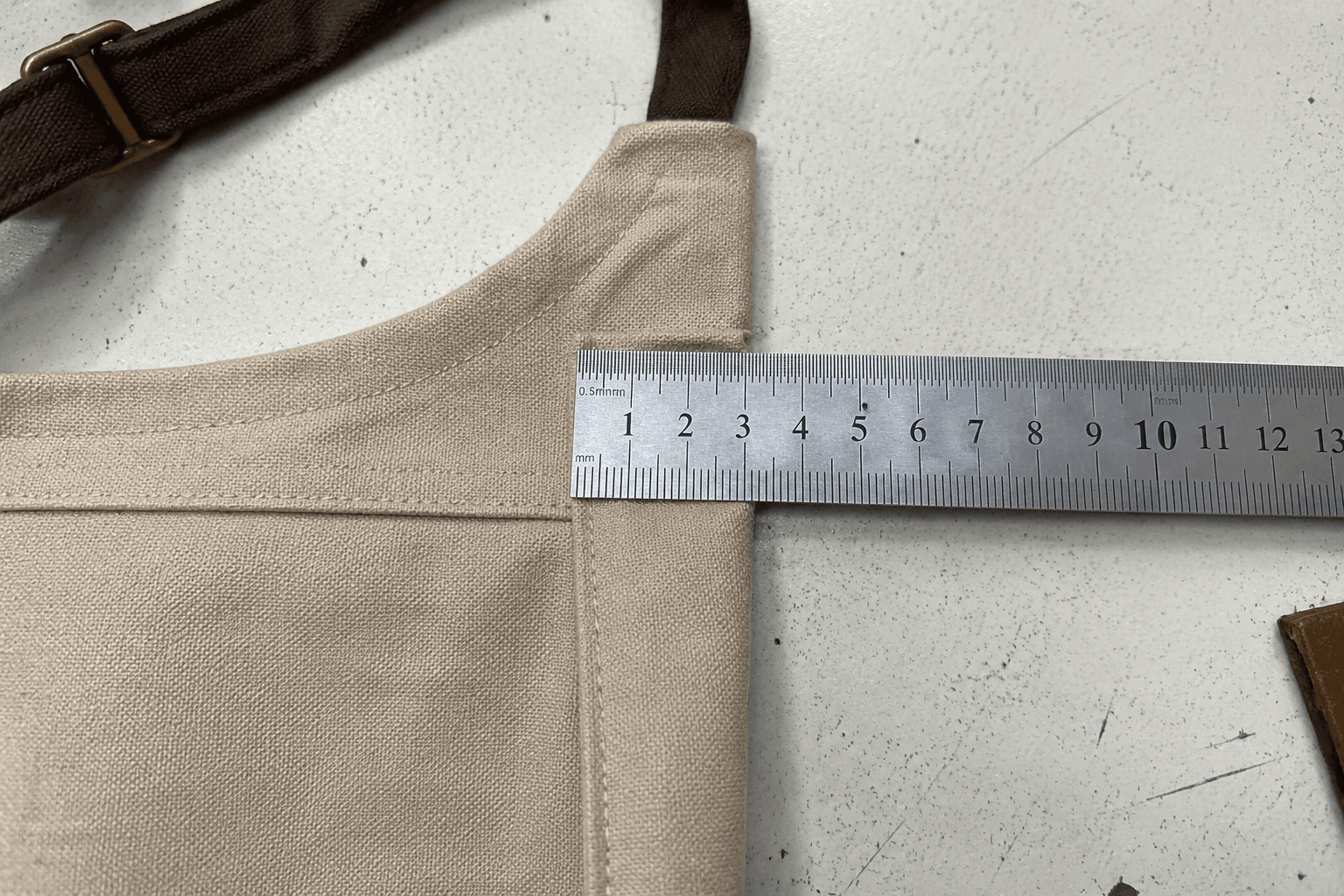
The most effective way to control reinforcement quality is to fix it during development rather than discover defects during inline or final inspection. Buyers should lock the exact position, length, orientation, density, thread appearance, and acceptable tolerance of every bartack on the approved sample. On aprons, a placement shift of even 3-5 mm can tighten a pocket opening, crowd a seam allowance, make left and right sides visibly uneven, or place the bartack too close to a folded edge where tearing begins after wash and wear.
It is equally important to define what the factory cannot change without written approval. Operators may lengthen a bartack on heavier fabric, add one where a pocket corner looks weak, or substitute a different thread shade because a machine is already set up that way. Those adjustments create bulk inconsistency. The tech pack or PP comments should therefore include a reinforcement map showing mandatory bartacks, optional bartacks, forbidden zones, approved visual appearance, and placement tolerance for each point. For visible reinforcement on black twill, dark denim, olive canvas, or natural cotton canvas, thread shade should be checked under standard light to prevent front-panel mismatch.
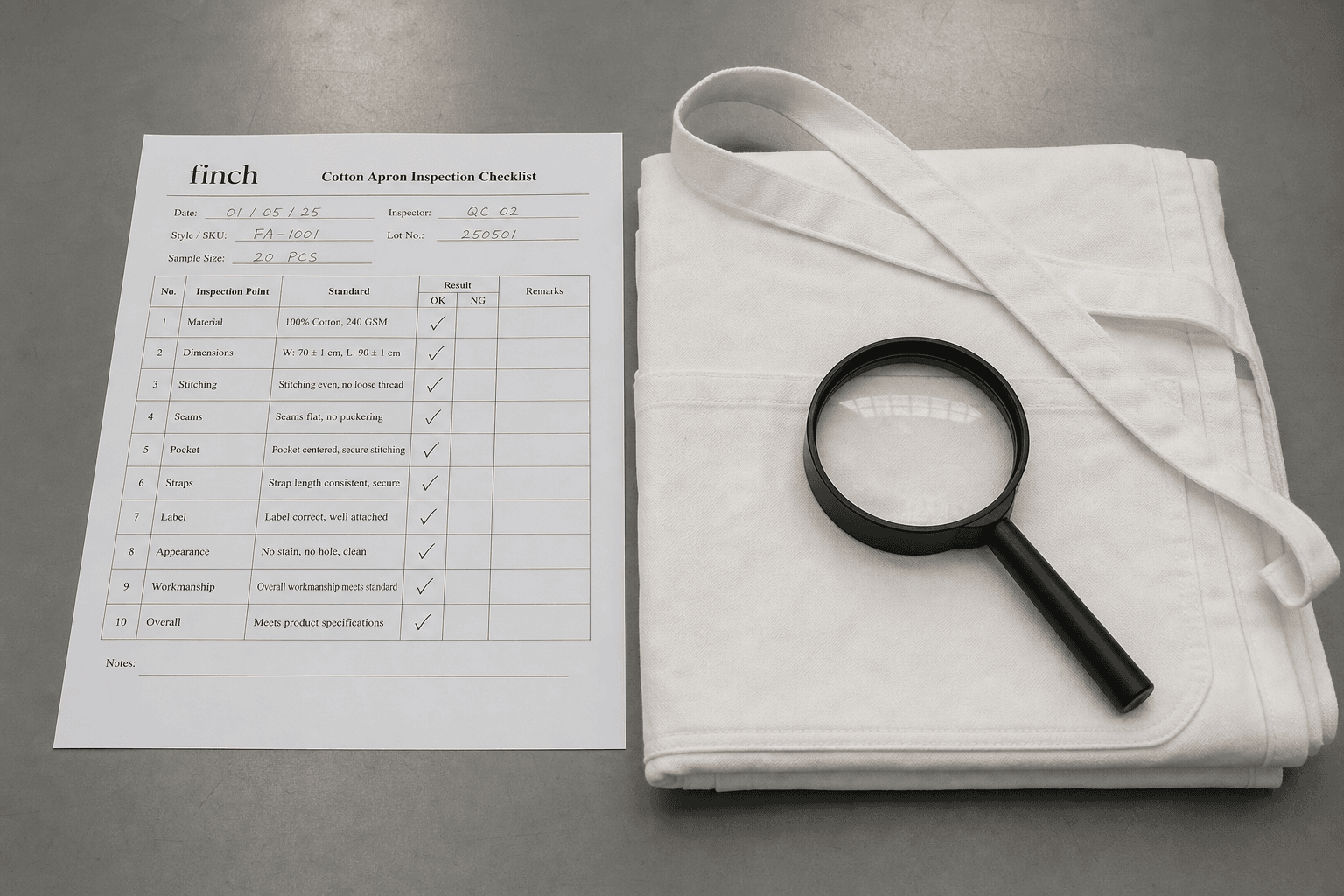
Wear simulation should be part of every PP routine. Load pockets with realistic contents such as order pads, thermometers, handheld terminals, wine keys, shears, or small tools; tie and untie the waist straps 30-50 cycles; pull the neck loop or shoulder supports 50-80 times; then wash the sample once and inspect every reinforced zone again. Record corner curling, seam grin, stitch cracking, fabric abrasion, skipped stitches, and any visible hole line. For apron shipments judged under standard AQL levels, this simple process catches many bartack-related failures before bulk cutting. The best apron is not the one with the most reinforcement; it is the one that stays flat, comfortable, and structurally sound through repeated professional use.
- Approve each bartack with a measurable tolerance, typically ±3 mm on visible pockets and ±5 mm on hidden strap joins.
- Record length, orientation, density, and visible thread color for every reinforcement point.
- Mark mandatory, optional, and forbidden reinforcement zones in the tech pack and PP comments.
- Simulate use with loaded pockets, repeated tie cycles, repeated strap pulls, and one wash before bulk release.