In bulk apron sourcing, apron accessories are not decorative extras. They change how a garment performs on the line, in the kitchen, on the floor or at a retail counter, and they also change how the factory builds, inspects and prices the apron. A towel loop, bottle opener or pen slot looks small on a spec sheet, but each one adds sewing steps, reinforcement requirements and a different risk profile.
For buyers ordering custom aprons from China, the real question is not whether these functional apron features are useful. The question is whether the feature fits the use case, the fabric weight and the target price. A $2.40 apron and a $6.20 apron can both carry accessory details, but the construction method, metal parts, wash durability and packaging method will not be the same.
This article breaks down the most common accessory options we build into aprons for hospitality, bar, retail and workshop programs. The focus is practical: what each accessory does, where it fails, what it adds to MOQ and lead time, and how to write a cleaner tech pack so the factory can quote accurately the first time.
- A towel loop is usually the lowest-risk accessory, but its usefulness depends on placement, tape width and bartack strength, not just the loop itself.
- A bottle opener adds real utility for bar and service aprons, but metal sourcing, plating and attachment testing must be specified before pricing is reliable.
- Pen slots work best on midweight aprons with stable fabrics such as 10-12 oz canvas or 240-320 GSM poly-cotton, because very light fabrics sag or tear at the pocket edge.
- Every accessory adds labor, usually 15-60 seconds per piece, which matters when the order volume moves from 1,000 to 20,000 pieces.
- Wash durability should be tested early, especially for metal hardware and reinforced stitching, because a feature that survives sample approval can still fail after 20-30 industrial washes.
- Clear placement drawings reduce factory variation, since apron accessories can shift visually by 1-2 cm and still technically pass if the spec is vague.
Why apron accessories matter in bulk production
In a custom apron program, accessories are part of the product definition, not an afterthought. A towel loop, for example, changes the back or side seam construction. A bottle opener may require metal sourcing and a rivet or snap system. A pen slot may require reinforcement so the pocket opening does not stretch out after repeated use. Each of these changes the production route and the quality checkpoints.
The sourcing impact is usually more visible than buyers expect. On a standard 300 GSM cotton canvas apron with no accessories, a factory may quote a basic sewing cost. Add one towel loop and a front pocket, and the labor time can rise by 6-12 percent. Add a metal bottle opener, and the accessory cost itself may add $0.18-$0.55 per piece depending on metal finish, engraving and attachment method. Add a triple pen slot, and cutting plus stitching time rises again because the factory must align multiple narrow compartments and keep seam allowances consistent.
The practical point is that apron accessories should be selected based on use case and expected abuse. Restaurant aprons face frequent laundering and repeated hand motions. Bar aprons need quick access to tools. Retail and service aprons often need clean branding and simple storage. Workshop aprons need durability first, appearance second. One accessory can be correct for one category and inefficient for another.
- Towel loop: usually lowest cost, simplest to integrate, and easiest to justify in service environments.
- Bottle opener: high perceived value for bar programs, but requires hardware control and extra durability checks.
- Pen slot: useful where staff write orders or mark stock, but it must be reinforced to avoid seam failure.
- Combined accessory sets: improve functionality, but they also increase rejection risk if placement tolerances are not defined.
Apron towel loop: small detail, real utility
An apron towel loop is one of the most requested functional details for hospitality aprons. It is usually placed on the hip or side seam so a folded towel can hang without interfering with the front of the apron. In restaurants, bars and catering operations, that placement keeps the towel accessible and helps the wearer avoid stuffing it into a pocket, which can look untidy and wear out the pocket faster.
From a factory perspective, the simplest towel loop is a folded self-fabric tab or polyester webbing loop stitched into the side seam and secured with a bartack. Webbing widths of 15 mm or 20 mm are common. For canvas aprons above 260 GSM, a 20 mm polyester webbing loop is usually stable. On lighter twill aprons around 180-220 GSM, a self-fabric loop may match the garment better visually, but it needs careful reinforcement because the base fabric can distort under load.
The loop is small, but buyers should still specify load and wash expectations. If the towel can be damp or heavy, the attachment point should be tested for at least 3-5 kg pull resistance in sampling. For commercial laundering, a loop that passes initial fit review can still twist or fray after 15-20 wash cycles if the stitch density is too low or the bartack is too short.
- Typical added cost: about $0.03-$0.12 per piece for self-fabric loops, or $0.05-$0.18 per piece for webbing loops, depending on volume and color matching.
- Recommended materials: 15-20 mm polyester webbing, cotton twill tape, or self-fabric loops on heavier body cloth.
- Placement rule: side seam or upper hip area is usually cleaner than center-back placement, which can interfere with chair backs and branding.
- Spec detail to add: loop finished length, bartack length, stitch density, and whether the towel opening must fit a folded bar towel or a larger kitchen towel.
Apron bottle opener options for bar and service programs
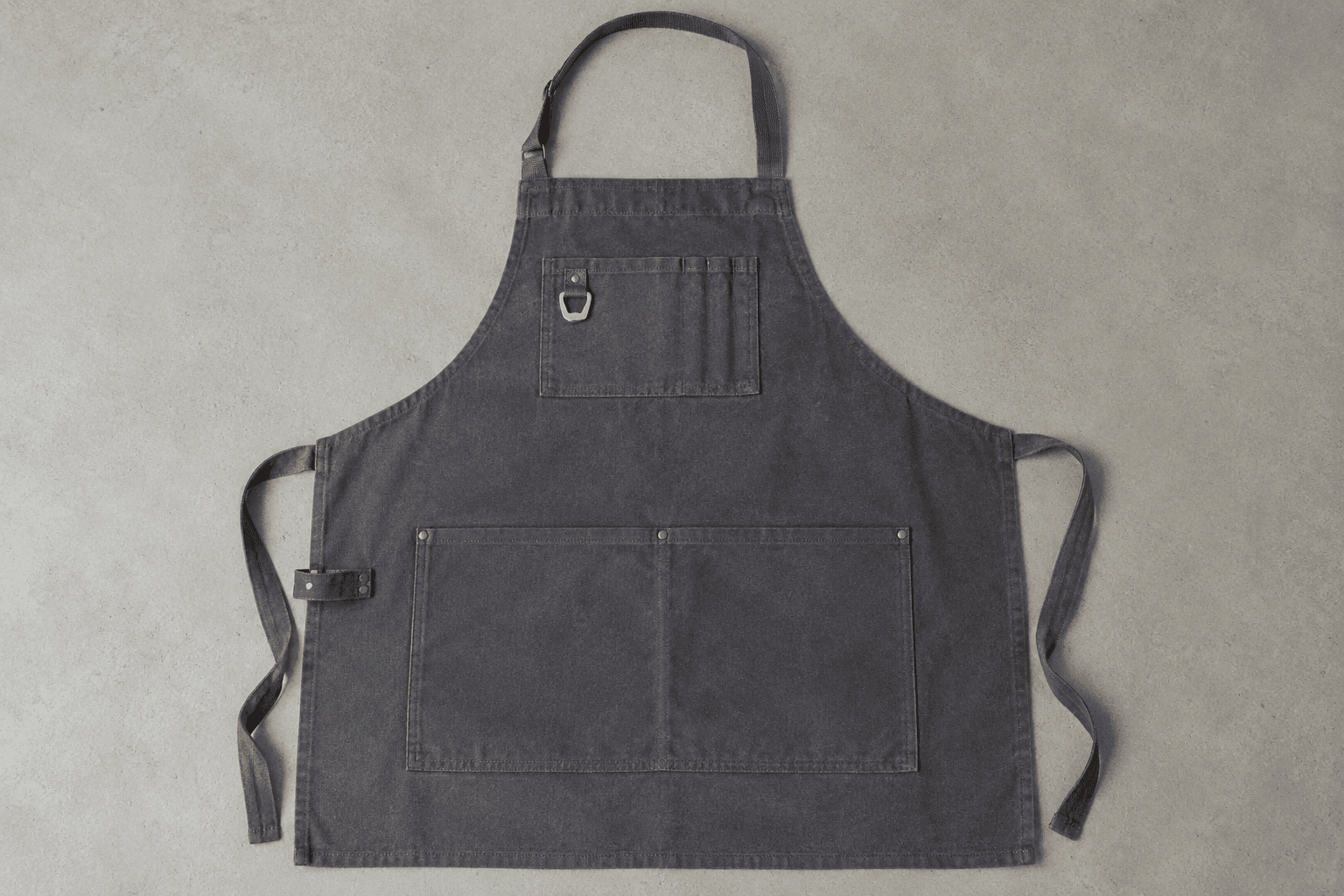
The apron bottle opener is the accessory buyers often request when they want a visible utility feature for bar aprons, pub uniforms or promotional hospitality programs. It is useful because it creates a simple operational shortcut, but from a sourcing point of view it is the most hardware-sensitive option in this category. Once a metal part is added, you need to control shape, plating, attachment strength and corrosion performance.
A common format is a small zinc alloy or stainless opener attached near the lower pocket edge or waistband with rivets. Stainless is more durable and cleaner for wash resistance, but it usually costs more. Zinc alloy can be lower cost and easier to mold in custom shapes, but plating quality matters. A poorly plated opener can rust or discolor after repeated washing, especially in humid markets or in detergent-heavy laundry systems.
Buyers should also watch the ergonomics. If the opener sits too low, it can press into the thigh or catch on chairs. If it is too close to a pocket opening, it can interfere with hand movement. In bulk production, a factory can reproduce a metal part accurately, but it still needs a placement diagram and a wear test. For programs above 5,000 pieces, we usually recommend sample testing with 10-20 wear trials and at least 10 open-close cycles per test unit before approval.
- Typical cost impact: about $0.18-$0.55 per piece for standard hardware, higher for custom-shaped or engraved openers.
- Attachment methods: rivet, screw-back, stitched pocket insert, or hidden reinforcement patch under the front panel.
- Best use cases: bar aprons, beverage service, promotional hospitality aprons, and retail uniforms with a beverage theme.
- Main risks: rust, plating loss, loose rivets, and placement that affects wearer comfort.
Apron pen slot design and pocket balance
An apron pen slot sounds simple, but it affects pocket balance more than most buyers expect. A pen slot is usually a narrow divider stitched into a chest or waist pocket to hold one or two pens, a thermometer, a marker or small tools. In food service and front-of-house work, that small division helps staff find items quickly and prevents the pocket from becoming a loose catch-all.
The problem is stability. If the apron fabric is too light, the narrow slot stretches after repeated insertion and removal. If the pocket opening is too shallow, the pen falls out during movement. If the divider stitching is too close to the edge, the slot collapses after laundering. For reliable bulk production, pen slots work best on aprons around 240-320 GSM cotton canvas, 280-340 GSM denim, or 10-12 oz blends with enough body to support pocket structure.
Buyers should think in terms of user behavior. A chef or server may insert and remove a pen dozens of times per shift. A single pen slot may be enough for a coffee shop apron, but a retail floor program may need two narrow slots plus a larger pocket section. The right construction is not just visual; it is functional and linked to the exact items the wearer carries.
- Suggested slot width: 12-16 mm for standard pens, 18-22 mm for thicker markers or thermometer pens.
- Recommended pocket reinforcement: bar tack at divider ends or a hidden twill tape insert at the top edge.
- Typical added labor: around 15-35 seconds per apron, depending on number of dividers and pocket layers.
- Placement advice: chest pockets suit quick access; waist pockets are better when the apron must stay visually clean.
How to spec apron accessories in a tech pack
Most sourcing problems come from vague instructions rather than bad manufacturing. If the tech pack only says add towel loop, every factory will interpret that differently. One may use self-fabric. Another may use polyester tape. One may stitch it into the side seam. Another may topstitch it onto the apron face. The result can be functionally acceptable but inconsistent with the buyer's brand standard.
A good spec should define the accessory type, exact location, dimensions, attachment method and acceptable tolerance. For example, a towel loop should indicate finished loop length, tape width, stitch count or bartack size, and whether the loop must support a wet 250-gram towel without deformation. A bottle opener spec should define base metal, finish, logo method, thickness and attachment hardware. A pen slot spec should define slot width, pocket depth, divider count and whether the pocket bottom is closed or open.
In China OEM production, precise accessory specs also help with quoting. Factories can estimate labor and material cost more accurately when they know whether the garment has one or three accessories, whether the hardware is standard or custom, and whether the packing requires inserted cards or polybag instructions. That usually shortens quotation revision cycles and reduces sample round-trips.
- Include a flat sketch with front and back views, plus close-up detail drawings for each accessory.
- State the fabric GSM or oz weight because the same accessory behaves differently on 180 GSM twill and 12 oz canvas.
- Define whether the accessory must survive industrial wash, home wash, or dry wipe only.
- Add a reference sample photo if the accessory has a specific visual style, because text alone is often interpreted too broadly.
Cost, MOQ and lead time impact of apron accessories
Accessory selection changes commercial terms. On a standard apron order, the base garment may have a simple MOQ of 500-1,000 pieces per color, but a custom accessory can raise the practical MOQ if the hardware requires a separate production run. For example, a custom bottle opener shape may require its own die or mold, which can push the first-order MOQ to 3,000-5,000 pieces or add a tooling charge of $120-$450 depending on complexity.
Lead time also changes. A plain apron program might be completed in 25-35 days after sample approval. Add standard towel loops, and the schedule may remain similar if materials are in stock. Add custom metal openers or special woven loops, and the timeline can move to 35-50 days, especially if plating, testing or custom color matching is involved. Accessories are rarely the only schedule risk, but they are often the reason a factory has to wait on a subcontracted process.
From a cost model perspective, buyers should think in three layers: material cost, sewing labor, and risk cost. Material cost is obvious. Labor cost is the hidden part, especially on small runs. Risk cost is the cost of inspection failure, rework, or customer complaints after delivery. In our experience, a well-specified accessory can add value at a modest cost, but a poorly defined one can add $0.10 and create a much larger hidden cost downstream.
- Simple towel loop: low material cost, low MOQ impact, usually the easiest accessory to keep within a standard apron budget.
- Metal opener: moderate cost, possible tooling cost, and more inspection time for finish and attachment strength.
- Multi-slot pen pocket: moderate sewing cost, especially if the apron uses heavyweight fabric or lining.
- Mixed accessory programs: best reserved for repeat orders, because first-time development absorbs more sample and approval time.
Choosing the right accessory mix for each apron category
The best apron accessories are the ones that support the job without making the garment harder to wear, wash or brand. For café and casual service aprons, a towel loop and one pen slot are often enough. For bartending aprons, a towel loop plus an apron bottle opener can be justified if the user really needs the opener on body. For chef aprons, pocket structure and reinforced pen storage usually matter more than metal features. For retail and promotional aprons, a clean towel loop may be enough if the buyer wants utility without visual clutter.
Buyers should also align accessories with fabric selection. A lightweight apron around 180-220 GSM works well for simple service wear, but it is not ideal for heavy hardware. A 10-12 oz canvas apron can support more features because it carries structure better and looks more premium. If the brand wants a soft drape, then accessories should stay minimal. If the brand wants a rugged workwear look, the accessory set can be more visible and more heavily reinforced.
In practical sourcing terms, the right question is not which accessory looks best in a catalog. It is which accessory survives the actual shift pattern, wash cycle and cost target. That is the standard a good factory uses when it builds and prices functional apron features for bulk buyers.
- Cafes and bakeries: towel loop plus one pen slot is usually enough.
- Bars and pubs: towel loop plus bottle opener can be justified if the opener is actually used during service.
- Chefs and kitchen teams: reinforced pocketing and pen storage are usually more important than decorative metal parts.
- Retail and promo programs: keep the accessory count low unless the brand story depends on visible utility.