AQL — Acceptable Quality Limit — is the statistical standard that lets you judge a 3,000-piece apron order by inspecting a sample of around 125 pieces instead of all of them. Understanding it turns “the quality felt fine” into a defensible accept-or-reject decision.
This guide explains how AQL works for aprons specifically: which sampling level to ask for, how defects are classified, and how to structure a pre-shipment inspection so the result is a number you can act on, not an opinion.
- AQL lets you judge a full lot from a ~125-piece random sample with a clear accept/reject number
- Standard apron inspection is AQL 2.5 major / 4.0 minor / 0 critical — lower is stricter
- Agree the defect classification in writing against your golden sample before inspection day
- A pre-shipment inspection also verifies quantity, measurements and packaging — not just defects
- Tie balance payment to a passed third-party inspection in your purchase order
How AQL sampling actually works
AQL uses two inputs: your lot size and an inspection level (usually General Level II). Those produce a sample size and an accept/reject number. The inspector pulls that many pieces at random, counts defects, and the lot passes only if defects stay at or below the accept number.
For a typical apron lot of 1,201-3,200 pieces at General Level II, the sample size is 125 pieces. The accept/reject numbers depend on the AQL level you set for each defect class.
The standard AQL levels: 2.5 and 4.0
Apron orders are normally inspected at 2.5 for major defects and 4.0 for minor defects, with critical defects set at 0 (zero tolerance). A lower number is stricter. You can tighten to 1.5/2.5 for premium retail programs.
- Critical (AQL 0): a defect that makes the apron unsafe or unsellable — accept 0
- Major (AQL 2.5): a defect a buyer would likely reject — e.g. broken stitching, wrong size, logo error
- Minor (AQL 4.0): a small flaw unlikely to cause a return — e.g. a loose thread, faint mark
- At 125-piece sample / AQL 2.5: accept ≤7 majors, reject at 8
- At 125-piece sample / AQL 4.0: accept ≤10 minors, reject at 11
What counts as a major defect on an apron
Defect classification should be agreed in writing before inspection, using your approved PP sample as the standard. For aprons, the common majors cluster around stitching, measurements, branding and hardware.
- Broken, skipped or open seams; failed bar-tacks at stress points
- Measurements outside tolerance (bib width, length, strap length)
- Logo errors — wrong placement, wrong color, misregistered print, distorted embroidery
- Wrong or missing labels (care, size, country-of-origin)
- Hardware that fails to function — a buckle that slips, a rivet that pulls
- Color outside the approved lab-dip tolerance; visible shading across panels
What inspectors check beyond defects
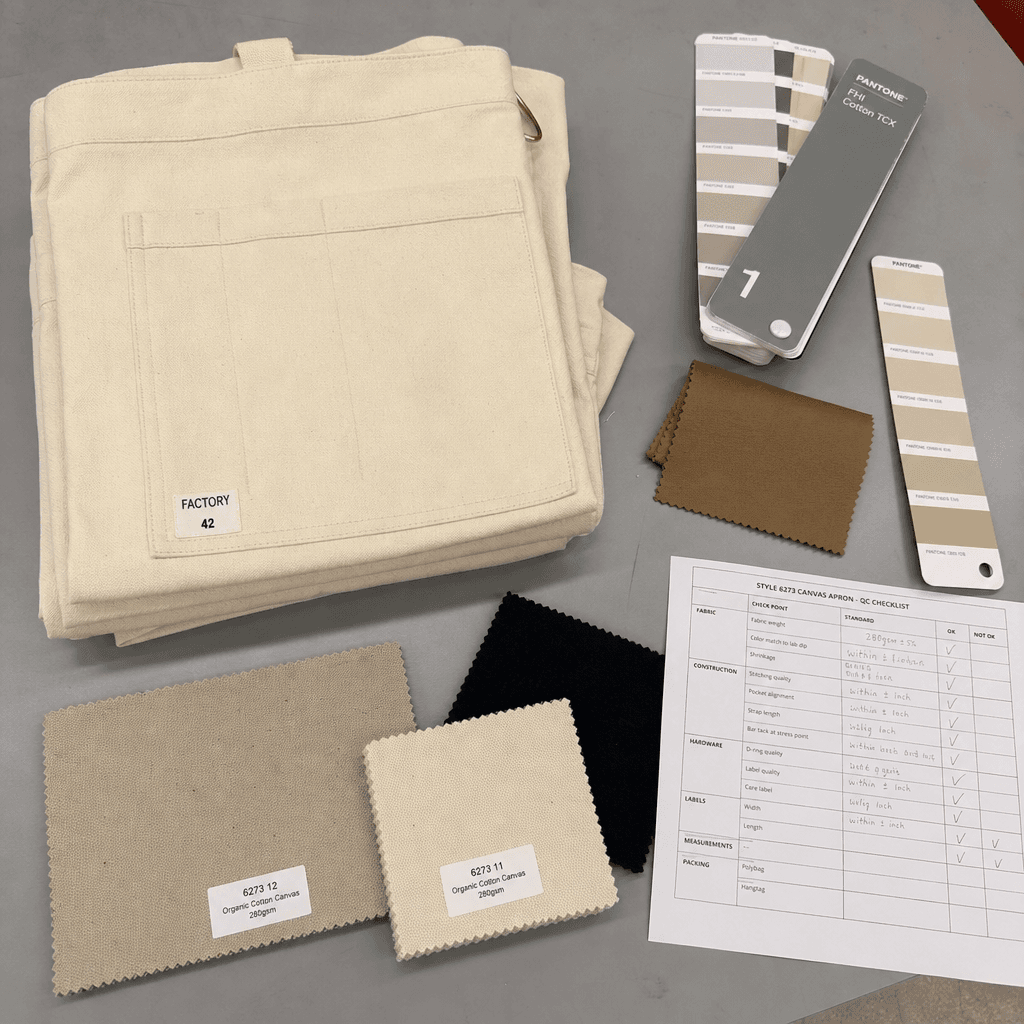
A good pre-shipment inspection (PSI) is more than a defect count. It also verifies quantity, workmanship against the golden sample, and that the goods are actually packed and ready to ship.
- Quantity and SKU/color/size breakdown vs the PO
- Measurement check against the spec on a set number of pieces
- On-site function tests — a wash/rub test, strap pull, hardware cycle
- Carton and packaging check — labeling, drop test, packing method
- Barcode/label scan if retail-bound
When to inspect: PSI vs during-production
A pre-shipment inspection happens when 100% of the goods are produced and at least 80% are packed — it is your last gate before balance payment. For large or high-risk orders, add a during-production (DUPRO) inspection at ~20-50% output so problems are caught while the line is still running and fixable.
How to commission an inspection
You can use a third-party agency (SGS, Bureau Veritas, QIMA, or a smaller regional firm) or the factory's own QC — but third-party is independent and worth the ~$300 day rate on any order of consequence. Book it 3-5 days out and give the inspector your golden sample, spec sheet and agreed defect classification.
- Send the inspector your approved PP/golden sample and tech pack
- State your AQL levels (e.g. 2.5 major / 4.0 minor / 0 critical) in the booking
- Define the defect classification list up front to avoid on-site disputes
- Make balance payment contingent on a passed inspection in your PO terms