For bulk apron sourcing, the woodworking category is more technical than a standard kitchen or café apron. A woodworking apron is expected to resist chips, dust, light abrasion, glue spots, hardware contact and daily tool loading, while still allowing the wearer to bend, sit, plane, saw and move around a bench. The right specification depends on the end user: hobby woodworkers, carpenters, cabinet shops, maker brands and retail tool channels all ask for slightly different protection levels.
From a factory perspective, the biggest decisions are material, reinforcement, pocket layout, strap structure and packaging. A leather woodworking apron gives better abrasion resistance and a premium hand feel, but it also raises weight, inspection requirements and freight cost. A canvas shop apron is easier to wash, easier to print and more stable for bulk color matching, but needs careful GSM and reinforcement planning if the buyer expects heavy tool use.
This guide explains the sourcing trade-offs we see when producing custom woodworking aprons in Zhejiang for overseas brands. The focus is not on a single best apron, but on matching fabric, leather, trims, stitching and MOQ to the actual sales channel, target price and required protection.
- A 10-16 oz canvas woodworking apron is usually the most cost-efficient option for retail and workshop use.
- A leather woodworking apron improves chip and abrasion protection but can add 300-800 g per piece depending on thickness and coverage.
- Pocket reinforcement, rivets and bar-tacks matter more than adding extra pockets that workers will not use.
- For OEM production, realistic MOQ is often 300-500 pcs per color for canvas and 100-300 pcs for leather or leather-hybrid styles.
- Bulk lead time is commonly 25-45 days after material approval, with longer timing for custom-dyed canvas or full-grain leather selection.
- A carpenter apron should be tested with actual tools, not only reviewed from a flat technical drawing.
What a woodworking apron must protect against
A woodworking apron is not designed for fire, welding sparks or chemical splash unless it is separately specified for those risks. Its normal job is to protect against wood chips, sawdust, splinters, glue transfer, light tool impact and abrasion from the bench. Buyers sometimes describe this as "heavy duty," but the factory needs a more precise description: chip shedding, pocket load, bib coverage, leg coverage, strap comfort and wash or care expectations.
For most woodworking users, protection is concentrated in three zones. The chest needs a bib that blocks dust and provides a safe place for pencils, rulers or small gauges. The waist and lower front need stronger coverage because this area contacts bench edges, clamps and rough boards. The pocket zone needs reinforcement because hand tools create repeated point stress, especially from chisels, awls, knives, screwdrivers and marking gauges.
The design should also avoid creating hazards. Long loose straps can catch on equipment. Oversized lower pockets may collect chips. Thin neck straps can create pressure when the apron is loaded with tools. A good shop apron should protect the user while staying close to the body and keeping tools predictable.
- For light hobby use, specify 8-10 oz canvas, simple tool pockets and adjustable cotton or polyester straps.
- For daily shop use, specify 12-16 oz canvas, reinforced lower panels and bar-tacked pocket stress points.
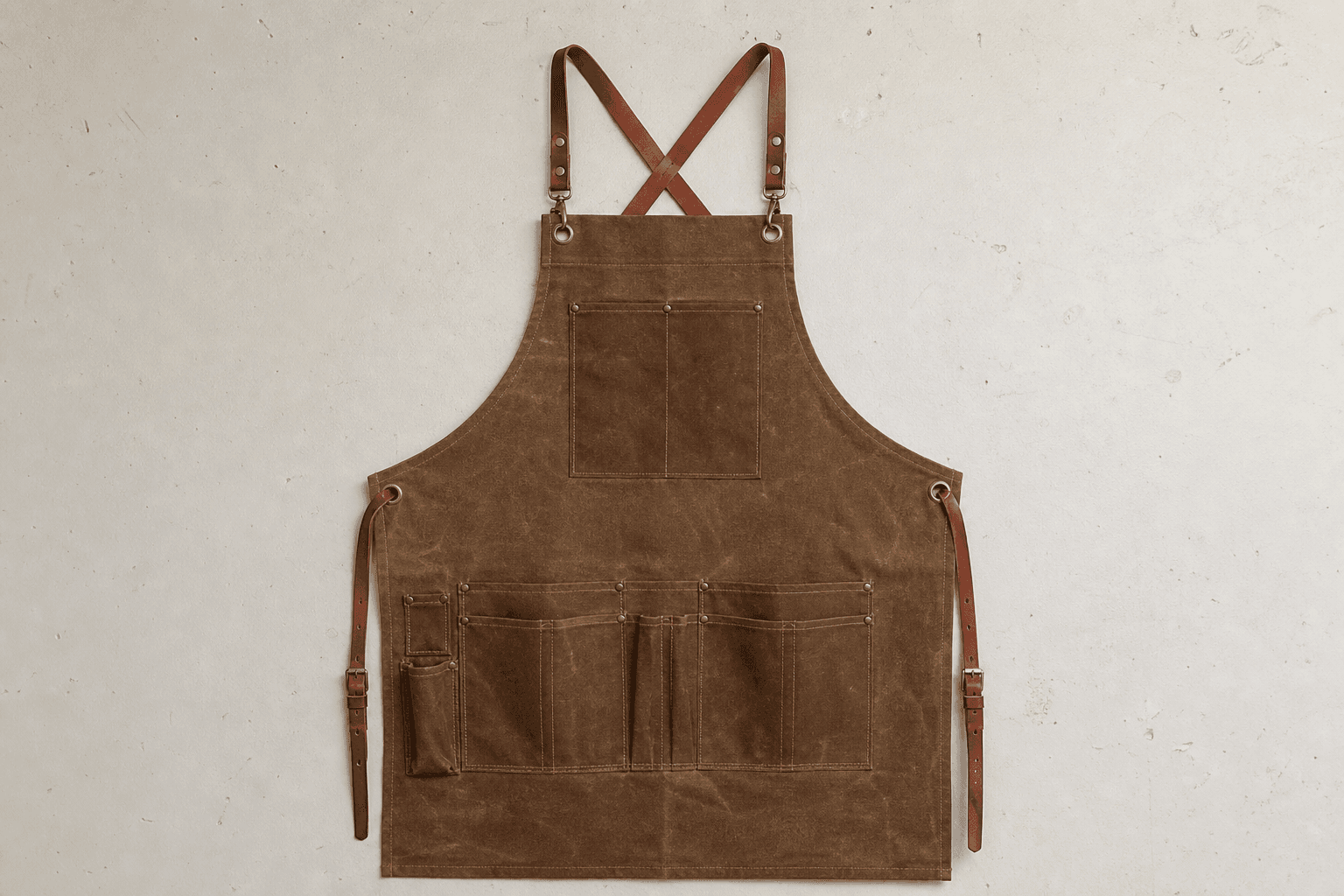
- For premium tool brands, specify split leather, waxed canvas or hybrid leather-canvas construction with branded hardware.
- For carpenter apron programs, confirm whether the user carries hand tools, fasteners, tape measure, pencil, phone or small power-tool accessories.
Woodworking apron material choices: leather, canvas and hybrids
Material selection controls price, weight, care label, branding method and production stability. Canvas is the most common base for a custom woodworking apron because it is available in predictable weights, accepts embroidery and screen printing, and can be cut efficiently. In China OEM production, 10 oz, 12 oz, 14 oz and 16 oz cotton canvas are common options. A 12 oz canvas apron can suit most retail workshop products, while 16 oz gives a stronger hand feel but becomes heavier after adding pockets, straps and hardware.
Leather is different. A leather woodworking apron may use split leather, cowhide, full-grain leather or leather panels combined with canvas. Thickness is often specified in millimeters rather than GSM. For apron use, 1.2-1.6 mm leather is common for flexible protection, while 1.8-2.2 mm gives more robust coverage but increases stiffness and fatigue. Full leather styles are usually more expensive to cut and inspect because natural defects, color variation and hide utilization affect yield.
Hybrid construction is often the most practical middle path. A canvas body with leather pocket patches, leather tool loops or a leather lower panel can improve abrasion resistance without pushing the landed cost too high. It also gives a premium visual signal for tool brands while keeping the upper body lighter. For buyers targeting retail price points around USD 29-69, hybrid designs often produce a better cost-to-perception ratio than full leather.
- Plain cotton canvas is economical and printable, but darker colors may show dust more clearly.
- Waxed canvas improves water and dust shedding, but it changes hand feel, print method and carton handling.
- Split leather gives good abrasion protection at lower cost than full-grain leather, but color consistency must be controlled by batch.
- Full-grain leather looks premium, but cutting loss and natural marks must be accepted in the quality standard.
- Canvas-leather hybrids reduce weight and help keep FOB cost closer to mainstream shop apron programs.
Canvas GSM, ounce weight and real factory cost impact
Buyers often ask for GSM, while many apron suppliers discuss canvas by ounce weight. Both can be used, but the factory and buyer should agree on one test method. As a rough reference, 10 oz canvas is approximately 340 gsm, 12 oz is around 407 gsm, 14 oz is around 475 gsm and 16 oz is around 542 gsm. These numbers vary by weave, finishing and moisture content, so tolerance should be written into the specification, for example plus or minus 5 percent.
The jump from 10 oz to 16 oz is not only a fabric cost change. Heavier fabric slows sewing speed, requires stronger needles, affects seam thickness and may need upgraded binding or hardware. If the apron has double-layer lower pockets, 16 oz canvas can become bulky at corners. This can increase defect risk if the sewing line is not set up for heavy canvas. For a large order, a slightly lighter fabric with correct reinforcement may perform better than a heavier fabric with difficult seam construction.
For many custom woodworking apron projects, we suggest starting development at 12 oz or 14 oz canvas. This weight range feels strong enough for tool and workshop positioning, keeps the apron wearable, and allows stable production at 500-3000 pcs per color. If the brand wants a premium heavy shop apron, 16 oz or waxed 14 oz can work, but sample testing should include strap comfort, pocket sag and folded carton thickness.
- 8 oz canvas is suitable for light promotional use but normally too soft for a serious tool apron.
- 10 oz canvas can work for hobby woodworking and lower retail price points.
- 12 oz canvas is a balanced option for most OEM woodworking apron programs.
- 14 oz canvas gives a stronger retail hand feel with manageable sewing difficulty.
- 16 oz canvas is heavy duty, but it needs careful pocket and binding design to avoid bulk.
Pocket layout for a carpenter apron or shop apron
Pocket layout is where many apron designs become either practical or decorative. A carpenter apron may need a tape measure clip, pencil slots, ruler pocket, lower utility pockets and a loop for a small hammer or marking tool. A fine woodworking shop apron may need fewer heavy pockets because the user works at a bench and does not want tools swinging while planing or sanding. For this reason, the same pocket drawing should not be used for every woodworking market.
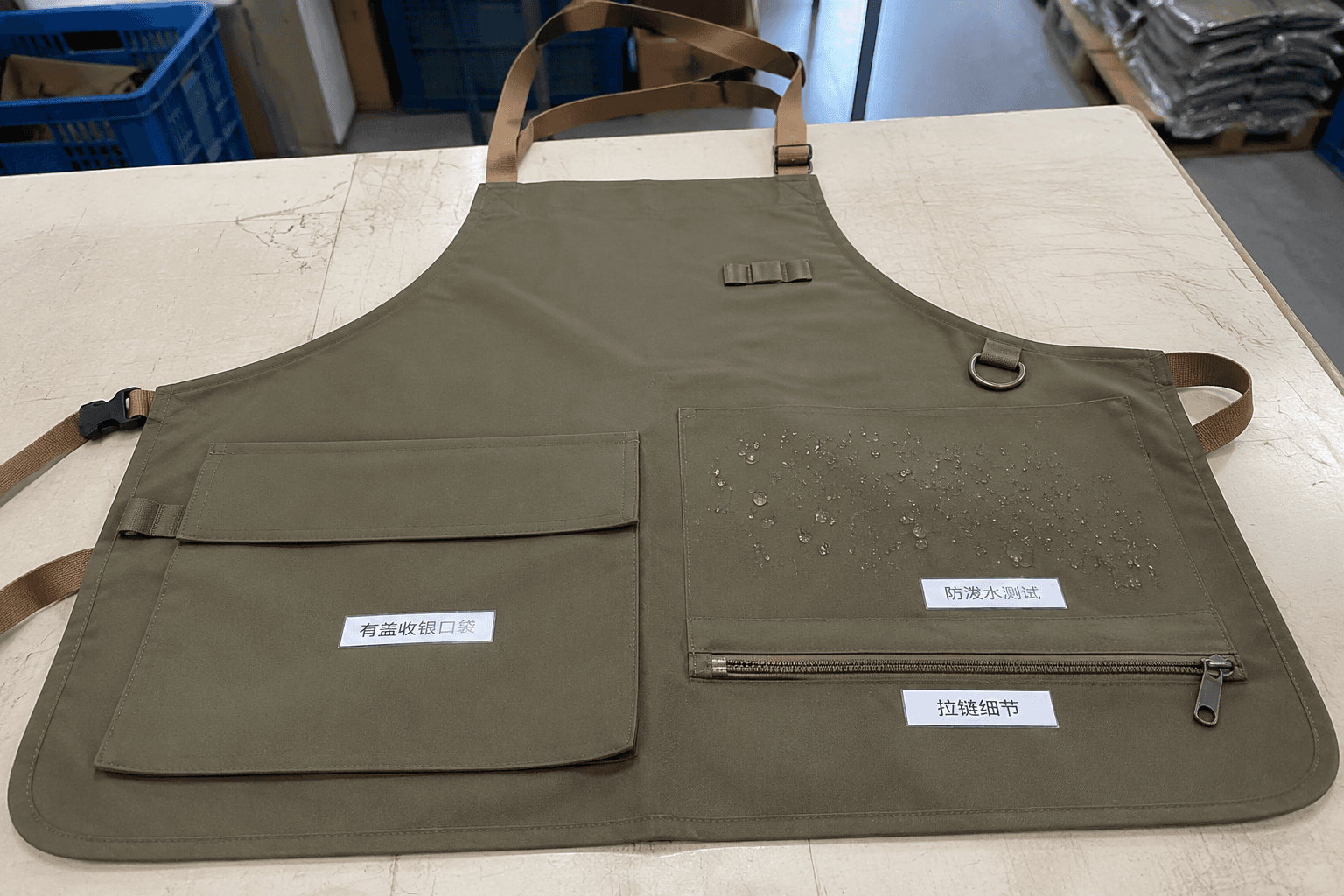
The best approach is to define pocket load by item. For example, one pencil slot at 15-18 mm width, one ruler slot at 35-45 mm, one phone pocket at 90-100 mm, two lower utility pockets at 130-160 mm wide, and optional leather loops for tools. If the buyer wants to market the apron as a tool apron, stress points should use bar-tacks or rivets. Decorative rivets alone are not enough; the rivet position must catch the correct fabric layers and avoid cracking leather patches.
Pocket depth also affects safety and cleaning. Very deep pockets hold more tools but collect more chips. Shallow pockets release chips more easily but may drop small items. A practical lower pocket depth is often 150-190 mm, depending on the apron length. For woodworking, slightly angled pocket openings can improve access, but they also increase cutting and sewing complexity. Each pocket line should be checked on a worn sample, not only measured on a flat table.
- Use bar-tacks at pocket corners, strap joints and tool-loop stress points.
- Use rivets when the visual style needs hardware, but verify the rivet washer and backside finish.
- Keep chest pockets slim so they do not interfere when the wearer bends over a workbench.
- Avoid too many lower pockets if the target user works near rotating tools or moving machinery.
- Confirm whether the buyer wants a retail tool apron appearance or a cleaner workshop uniform appearance.
Straps, fit range and comfort under tool load
A woodworking apron can fail in the market even if the fabric is strong, because strap comfort is often what the user feels first. A simple neck strap is low cost, but it puts tool weight on the neck. This may be acceptable for a light shop apron under 450 g, but becomes uncomfortable when canvas weight, leather patches and loaded tools push the worn weight higher. Cross-back straps distribute weight better and are now common for mid-range and premium woodworking aprons.
For bulk production, strap material should be specified as carefully as shell fabric. Cotton webbing has a natural look but can shrink and wrinkle after washing. Polyester webbing is stable, strong and economical, but may look less premium unless the weave and color are chosen well. Leather straps increase perceived value, especially on a leather woodworking apron, but they add cost and require hole punching, buckle setting and edge inspection.
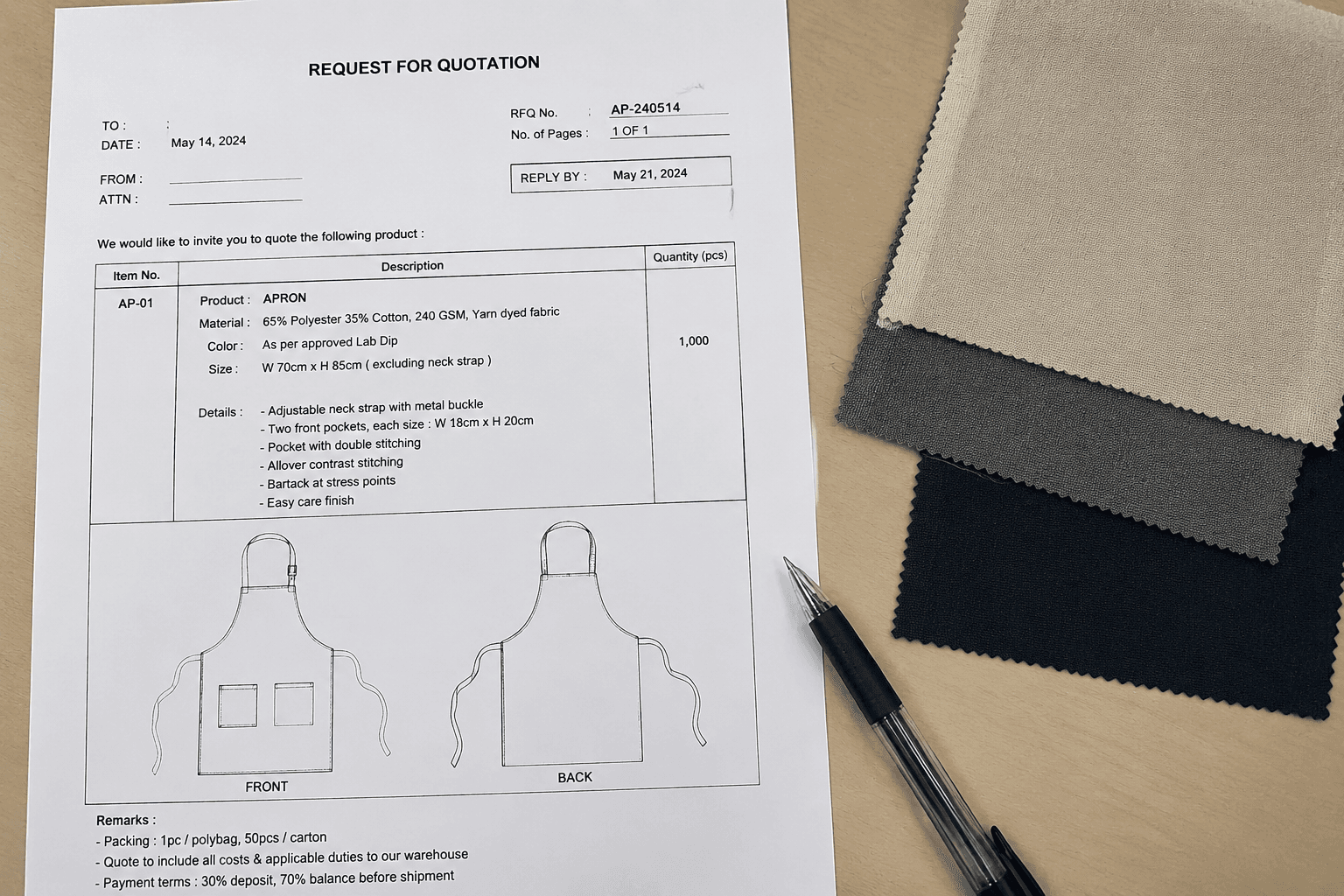
Fit range should match the selling market. For North American and European retail, adjustable length should cover roughly 160-195 cm body height and a wide waist range. A common apron body size is 70-75 cm wide by 80-90 cm long, but carpenter apron styles may be shorter for mobility. For larger professional users, adding longer straps costs little compared with receiving fit complaints after delivery. If the apron is sold as unisex, the neck and waist adjustment should be tested on smaller and larger wearers.
- Neck strap styles are lower cost and simpler to pack, but less comfortable under heavy tool load.
- Cross-back straps improve comfort and suit premium shop apron positioning.
- Quick-release buckles speed up wearing, but metal hardware raises cost and carton weight.
- Leather straps should be checked for edge finish, hole strength and color transfer risk.
- For OEM orders, request a worn-fit photo set during sampling, including front, side and back views.
Branding, color and surface finishing for custom apron orders
Branding method depends heavily on material. Cotton canvas accepts screen print, embroidery, woven labels, leather patches and heat-transfer labels. Screen print is cost-effective for simple logos, usually adding about USD 0.15-0.50 per piece depending on size and colors. Embroidery gives a durable premium result but can pucker on lighter canvas and becomes expensive for large filled logos. Woven labels are stable, clean and useful when the buyer wants one apron body to serve multiple brand lines.
Leather branding requires different planning. Debossing, embossing, laser marking and metal logo plates are common. Debossing works best when leather has enough body and a smooth enough surface. Laser marking can look sharp, but the burn color varies by leather type and finish. For a leather woodworking apron, the brand should approve actual production leather before approving the logo effect, because a logo sample on one hide may not match another batch.
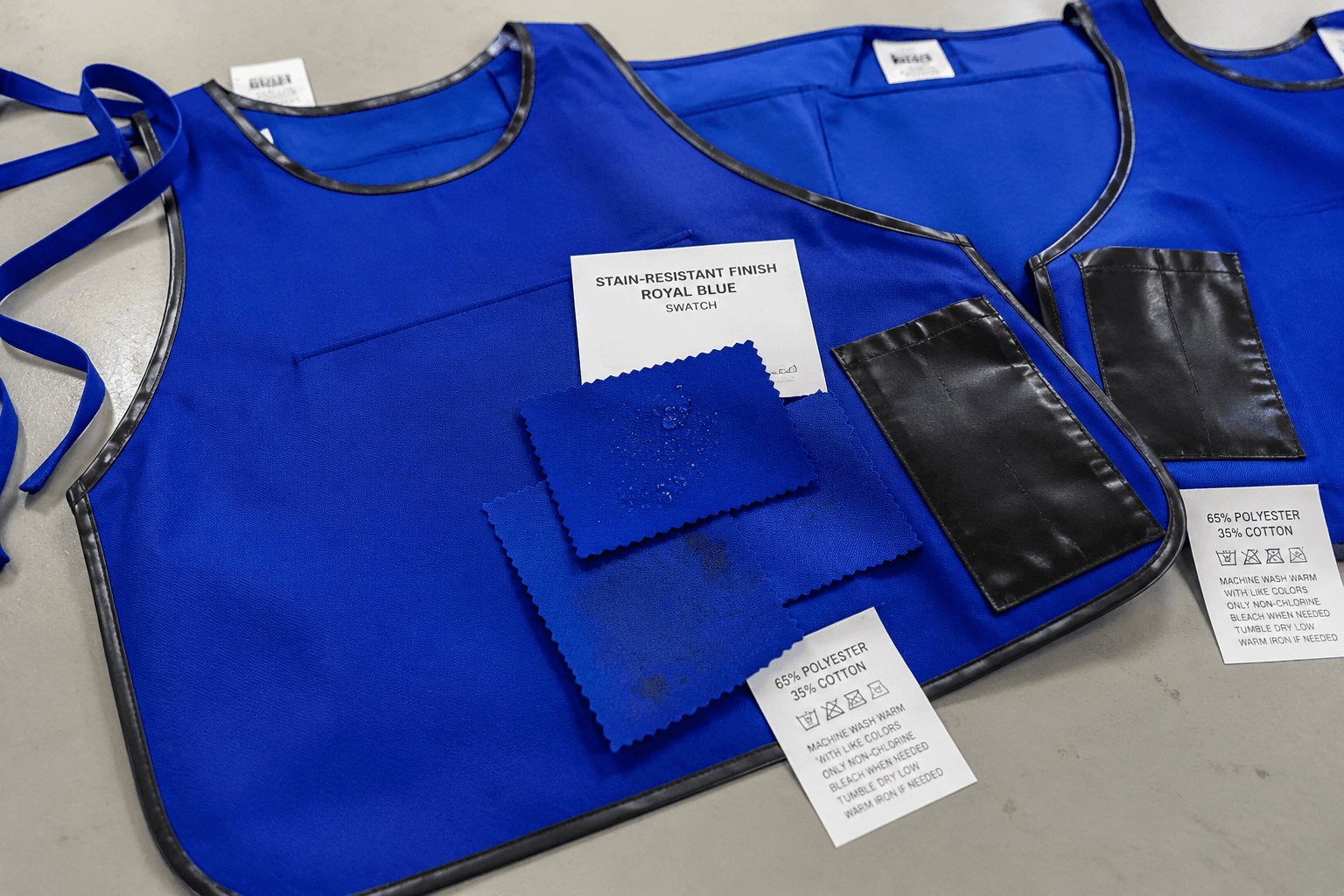
Color is also a sourcing issue. Black, charcoal, navy, khaki, olive and brown are common for woodworking aprons because they hide dust and wear reasonably well. However, very dark colors can show pale sawdust, while very light colors show glue and oil marks. Custom-dyed canvas normally needs higher MOQ, often 500-1000 m per color depending on the mill. For smaller orders, stock canvas colors help keep lead time shorter and reduce shade risk.
- Screen print is suitable for bold logos on cotton canvas and lower to mid-price programs.
- Embroidery is durable but should be tested on the selected GSM to control puckering.
- Leather patches give a premium signal and can be shared across multiple apron colors.
- Debossing works well on suitable leather, but pressure and depth must be approved by sample.
- Stock color canvas can reduce development time by 7-15 days compared with custom dyeing.
MOQ, sampling and lead time for a woodworking apron program
MOQ depends on material availability, color, trims and branding. For standard canvas woodworking apron orders, a practical MOQ is often 300-500 pcs per color when using stock fabric and common webbing. If the buyer requires custom-dyed canvas, custom buckles, special leather patches or individual retail packaging, the economical MOQ may move to 800-1500 pcs. For leather woodworking apron styles, MOQ can sometimes start at 100-300 pcs, but the unit price will be higher because cutting and inspection are more manual.
Sampling usually takes 5-10 days for a simple canvas apron after artwork and measurements are confirmed. More complex tool apron styles with leather panels, rivets, cross-back straps or custom packaging may take 10-18 days. If the project includes lab testing for azo, formaldehyde, colorfastness or nickel release on metal trims, add another 5-10 working days depending on the testing lab and report type.
Bulk lead time after sample approval is commonly 25-35 days for stock canvas orders and 35-45 days for custom fabric or mixed-material styles. Full leather orders may need additional time for hide selection and shade sorting. Buyers should also allow time for pre-production sample approval, inline inspection and final inspection. When a shipment is tied to retail launch dates, we prefer to freeze fabric, trims and logo method before price confirmation, not after the purchase order is issued.
Typical FOB price ranges vary widely by construction. A basic 10-12 oz canvas shop apron may be around USD 3.50-6.50 per piece at higher volume. A reinforced 12-16 oz canvas tool apron with cross-back straps, rivets and branding may sit around USD 6.80-12.50. A hybrid canvas and leather carpenter apron may range from USD 9.50-18.00. A full leather woodworking apron can range from USD 18.00-45.00 or more depending on leather grade, thickness, coverage and hardware.
- For fast sourcing, choose stock canvas, existing webbing colors and standard metal or plastic adjusters.
- For premium retail, budget more time for leather approval, hardware matching and packaging trials.
- For price-sensitive programs, reduce complexity before reducing fabric weight too far.
- For launch orders, confirm whether the first shipment is by sea, air or split shipment because apron weight affects freight strongly.
- For repeat orders, keep approved fabric swatches, logo samples and trim cards as the factory reference standard.
Quality control points before shipping woodworking aprons
Inspection for a woodworking apron should focus on functional stress points, not only appearance. The QC team should check pocket size, pocket symmetry, bartack position, rivet setting, strap length, buckle function, logo placement, fabric defects and measurement tolerance. For heavy aprons, the inspector should also hang-load key pockets or manually pull tool loops to confirm reinforcement. A pocket that looks straight but tears after two weeks of use is a design and QC failure.
Measurement tolerance should be realistic. For apron body width and length, plus or minus 1 cm is common for canvas styles. Pocket placement may need tighter control, around plus or minus 0.5 cm, especially if multiple pockets align visually. Leather styles require a separate standard for acceptable natural marks, color variation and grain differences. Without this standard, final inspection can become subjective and slow.
Packaging also affects delivered quality. Waxed canvas and leather can mark if pressed tightly against rough hardware. Metal rivets may imprint nearby fabric during compression. Individual polybags protect the apron but may not suit all sustainability policies. Paper belly bands, recycled polybags, kraft cartons and hangtags are all possible, but the packing method must protect the apron during 30-45 days of sea freight and warehouse handling.
- Check every strap joint with visual inspection plus manual pull during inline QC.
- Confirm rivets are fully set, smooth on the backside and positioned through reinforced layers.
- Inspect leather panels under consistent light because shade variation is easier to miss on a busy sewing floor.
- Verify barcode, care label, country-of-origin label and warning text before final packing.
- Use a retained golden sample for final inspection so subjective issues are judged consistently.