Sourcing uniform rental company aprons is not the same as buying aprons for restaurants, retail, or one-site kitchens. Rental stock is shared by multiple wearers, washed with mixed garments, exposed to alkali, bleach or oxygen chemistry, extracted at high G-force, then dried or tunnel finished for speed. In that environment, the center panel is rarely the first point of failure. More often the problem is a waist tie tearing out after 20 to 30 washes, a bib corner seam opening, a pocket top splitting, or a side hem twisting enough that the apron hangs crooked and is pulled from route stock.
Because of that, a rental apron program should begin with a service-life target and laundry profile, not with color, trim, or logo position. Buyers need to define expected wash cycles, typical wash temperature, bleaching method, drying or finishing process, soil load, and whether aprons are washed with heavier garments such as jackets or work shirts. For many foodservice and facility-service routes, that leads to woven 65/35 or 80/20 poly-cotton twill in the 235 to 270 GSM range, finished width 58/60 inches, shrinkage held below 3%, and written reinforcement at ties, pockets, and bib seams.
This article stays strictly on aprons and apron sourcing for professional B2B buyers. It focuses on the fabric weights that survive pooled laundering, the construction details that determine whether an apron reaches 40 to 60 industrial cycles, the approval and test sequence that should happen before bulk release, and the commercial effect of MOQ, lead time, AQL, and replacement cost. The objective is practical: source uniform rental company aprons that keep shape, shade, and seam integrity at the lowest realistic cost per wear.
- 65/35 or 80/20 woven poly-cotton twill at 235 to 270 GSM is the standard starting point for pooled-laundry apron programs; fabrics under 200 GSM usually retire too early
- The highest claim areas are waist tie insertions, bib corners, pocket top corners, side hems, and neck joins, so reinforcement details matter more than generic heavy-duty wording
- Custom rental apron MOQ is commonly 800 to 1,500 pcs per color and style; stock-fabric runs often start around 500 to 800 pcs
- Bulk production lead time is typically 25 to 45 days after lab dip or shade approval, PPS approval, and deposit; custom dyeing or mill finishing can add 7 to 15 days
- Typical FOB pricing for rental bib aprons is about $2.20 to $4.80 per piece; heavier twill, embroidery, or extra reinforcement can push cost to $5.20 to $6.20
- An upgrade that adds $0.20 to $0.60 per piece can reduce annual replacement spend if it extends life from 25 cycles to 45 cycles
- Inspection should be booked at AQL 2.5 major / 4.0 minor with wash-test pass/fail criteria written into the order file
Why uniform rental company aprons fail early in pooled laundering
Pooled laundering is tougher on aprons than in-house washing because chemical, thermal, and mechanical stress arrive together in every cycle. A rental apron may be worn by several users in a week, sorted with heavier garments, washed at 60 to 75 degrees C, exposed to high-pH detergents, bleach or oxygen chemistry, extracted at 200 to 350 G, then tunnel finished or tumble dried. An apron that looks acceptable at final inspection can become unserviceable after 20 to 30 industrial washes if the construction was built to light-duty standards.
The failure pattern is consistent. The body fabric often survives longer than the apron itself. Retirement usually comes from a detached waist tie, seam grin at the bib corner, pocket blowout, excessive skew, or a rope-like side hem after repeated extraction and pressing. These are construction and specification failures, not style issues. Buyers who compare only GSM and logo cost often miss the real driver of route economics: how many usable wash cycles the apron delivers before it looks distorted or no longer feels secure to wear.
That is why the buying specification must describe the actual laundry environment in measurable terms. If the route uses chlorine bleach, degreasers, reclaim systems, or tunnel finishing, the apron must be engineered for that setting from the start. Otherwise the FOB price may look attractive, but the replacement rate and service disruption will erase that saving within one route season.
- Typical early retirement triggers are tie pull-out, bib seam opening, pocket corner tear-out, side-hem twist, seam puckering, and shrinkage above 3%
- Decorative trims such as eyelets, contrast facings, painted snaps, detachable straps, or metal hardware usually raise claim rates in pooled laundry
- For shipment control, many buyers set AQL 2.5 for major defects and 4.0 for minor defects on measurement, seam quality, shade, and appearance
Fabric specs for uniform rental company aprons: the workable range is 235 to 270 GSM
For most rental bib and waist aprons, woven poly-cotton twill or drill remains the most reliable base fabric. A 65/35 poly-cotton twill at 235 to 245 GSM, about 6.9 to 7.2 oz per square yard, is a common starting point for standard foodservice routes. Where buyers need more body, better abrasion resistance, or a cleaner pressed appearance after repeated industrial washing, they typically move up to 245 to 270 GSM, about 7.2 to 8.0 oz. Heavy-use utility, meat prep, or butcher-counter programs may justify 270 to 300 GSM, roughly 8.0 to 8.8 oz, but that adds cost, increases drying time, and can reduce wearer comfort if the cut is not adjusted.
Blend ratio matters because rental laundering punishes unstable cloth. Polyester improves dimensional stability, color retention, and drying speed. Cotton improves hand feel and absorbency. In most pooled-laundry routes, 65/35 or 80/20 performs better than 100% cotton, which is more prone to shade loss, uneven shrinkage, and edge distortion unless heavily compacted and carefully route-tested. If a buyer is considering cotton-rich fabric, the proof should come from wash data after 25 and 50 cycles, not from sales language.
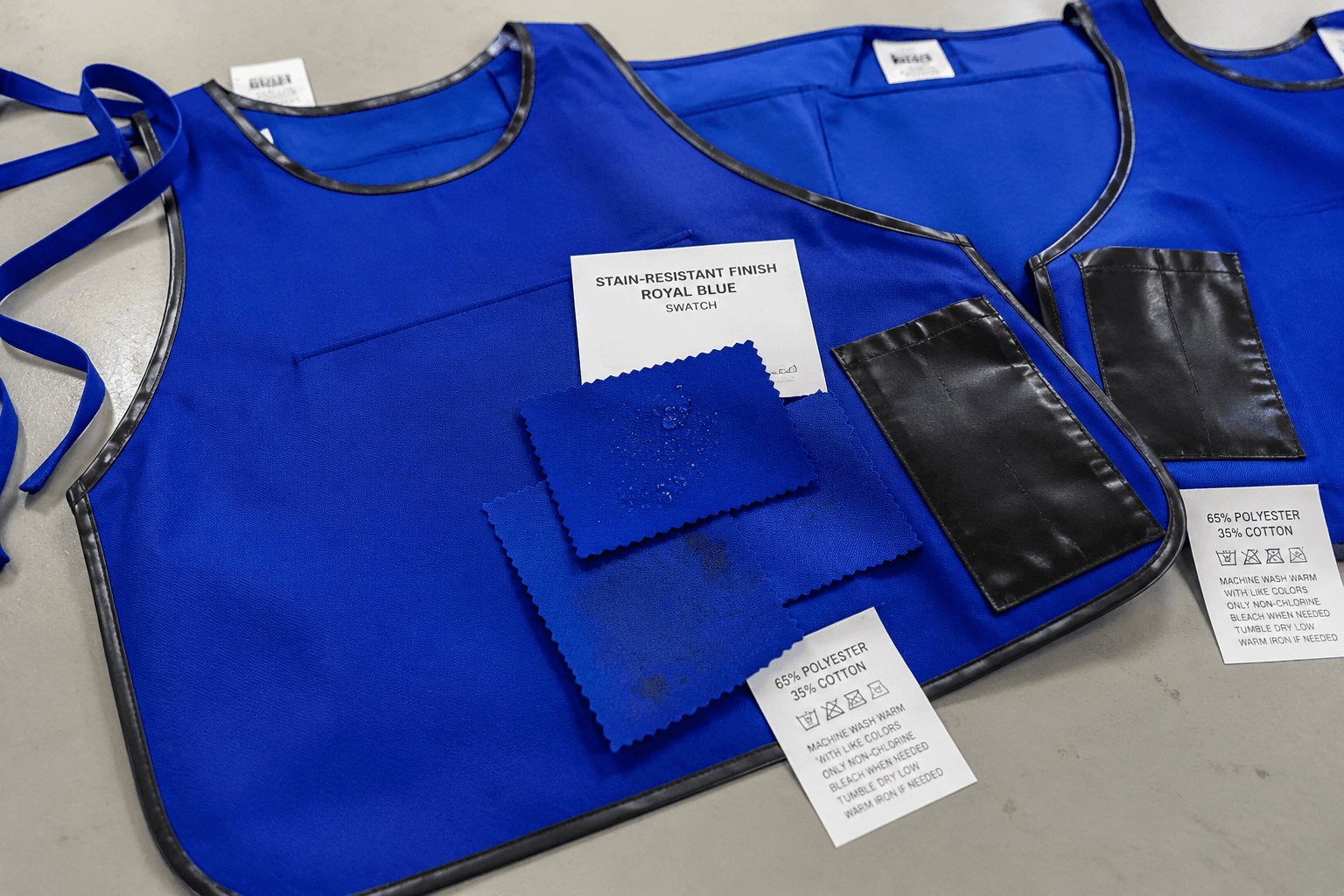
Color selection also needs more discipline than many RFQs show. Black, navy, charcoal, and bottle green remain common because they hide staining and visual wear between collections. Even these shades should be approved only after industrial wash evaluation. A black apron that fades to flat charcoal after 15 to 20 cycles creates a route appearance problem even if the seams still hold. Stain-release or soil-release finishes can help in some foodservice programs, but the benefit should be measured after repeated industrial chemistry because some finishes drop off sharply after 15 to 25 washes.
- Recommended base spec: 65/35 or 80/20 woven poly-cotton twill, 235 to 270 GSM, 58/60 inch width
- Use fabric below 200 GSM only for mild routes or short-life programs targeting 20 to 25 washes
- Set dimensional targets at 2% to 3% shrinkage maximum and skew within 3% after the agreed industrial wash test
- Typical FOB pricing in this range is $2.20 to $4.80 per piece for custom rental bib aprons, depending on quantity, branding, and fabric source
Construction details that let rental aprons reach 40 to 60 wash cycles
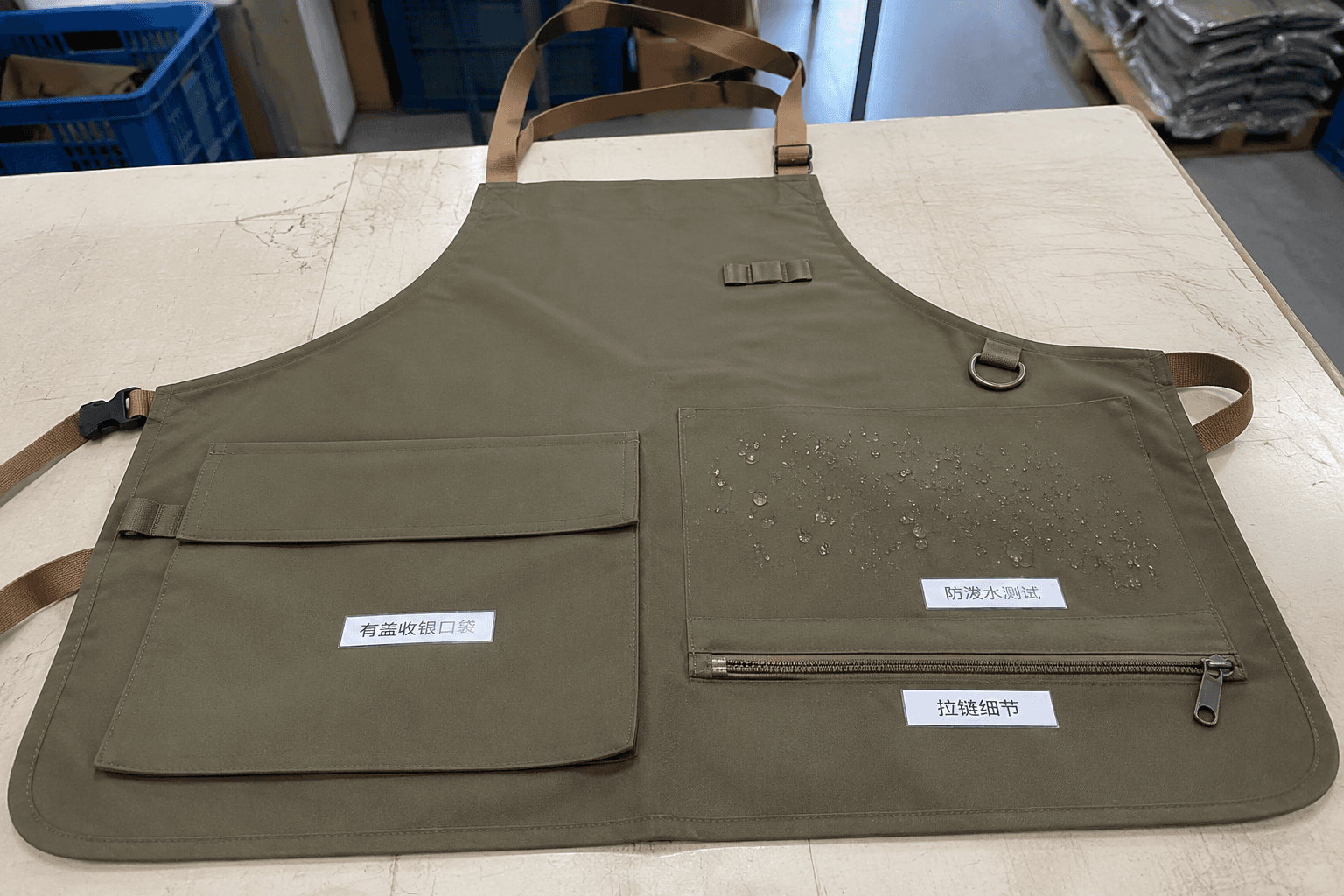
Construction language must be specific. Terms such as reinforced, durable, and industrial grade do not protect the buyer unless the seam type, stitch density, tie insertion, and reinforcement method are written into the spec. On rental aprons, the predictable weak zones are neck joins, bib corners, waist tie insertions, pocket mouths, side seams, and hem corners. If those points are underbuilt, a heavier fabric alone will not prevent early failure.
Stable rental aprons usually use lockstitch seams at 8 to 10 stitches per inch on principal operations, with balanced thread tension to avoid seam grin after repeated washing. Waist ties generally perform better when inserted 2.5 to 4.0 cm into the body seam, then secured with bartacks or a box-X depending on tie width and expected strain. Pocket top corners should be reinforced on both sides. On high-use bib aprons, a standard patch pocket without corner reinforcement often begins to fail after 25 to 35 washes, especially when wearers clip towels, order pads, or small tools onto the opening.
Thread and tie materials should be treated as performance inputs, not low-value trims. Spun polyester or core-spun polyester thread generally withstands heat and chemistry better than cotton thread. Self-fabric ties keep color match clean, but they need enough folded density to resist curling, edge abrasion, and rope formation. In heavier-use routes, denser self-fabric ties or webbing-reinforced ties often justify the extra cost because tie failure is one of the fastest ways to remove an apron from service.
- Use 8 to 10 SPI on major seams and verify stitch consistency during inline and final inspection
- Insert ties by 2.5 to 4.0 cm into seam allowances and reinforce with bartack or box-X stitching
- Control finished hem depth to about 1.0 to 2.5 cm so hems stay flatter after repeated extraction and pressing
- Specify thread as spun polyester or core-spun polyester rather than generic sewing thread
- Avoid ornamental eyelets, rivets, painted hardware, and detachable parts unless the laundry operator has approved them for industrial processing
Testing protocol before bulk release of uniform rental company aprons
Visual approval is not enough for a rental apron order. A garment can pass pre-shipment inspection and still fail in service because the approved sample never faced the actual route chemistry and handling. The stronger process is staged approval: confirm fabric composition, GSM, width, and shade first; approve a pre-production sample; then run industrial wash testing against the intended route conditions before bulk release.
For most programs, useful checkpoints are 10, 25, and 50 washes, with 60 cycles added for demanding routes. Buyers should measure length and width change, seam opening at stress points, side-hem torque, pocket distortion, tie pull performance, logo durability, and shade shift. Route trials matter because they capture mechanical abuse that laboratory washing may miss, including mixed-garment entanglement, transport handling, and over-drying. On orders of 3,000 to 5,000 pieces, skipping pilot validation is usually more expensive than the test itself.
Pass-fail criteria should be written into the order file and approved sample record. A practical standard might allow body shrinkage up to 3%, skew up to 3%, no seam opening above 3 mm at bib corners or tie joins, and color change no worse than grade 4 after 25 cycles or grade 3 to 4 after 50 cycles depending on shade depth. Once those limits are documented, disputes become factual rather than subjective.
- Review garments after 10, 25, 50, and when required 60 industrial wash cycles
- Check shrinkage, skew, seam slippage, seam puckering, colorfastness, tie pull strength, pocket deformation, and logo durability
- Run a pilot route trial with 50 to 100 aprons before approving a large production lot
- Do not release bulk production until PPS approval, wash-test signoff, and measurement tolerance confirmation are complete
MOQ, lead time, and cost-per-cycle math for rental apron sourcing
Commercial terms shift quickly when buyers add heavier fabric, custom-dyed shades, special branding, stain-release finishing, or revised pocket construction. The most efficient sourcing result usually comes from choosing a proven rental fabric platform and adding only the features that improve wash life or route appearance. Every non-standard detail should justify itself in lower replacements or better route presentation.
For stock black, navy, or charcoal fabrics around 235 to 245 GSM, MOQ often begins at 500 to 800 pieces per style, with production in roughly 20 to 30 days after approvals. When the program moves to custom PMS matching, 260 to 270 GSM cloth, embroidery, woven labels, or non-standard measurements, MOQ commonly rises to 800 to 1,500 pieces per color and style, and production lead time usually extends to 25 to 45 days. If greige weaving, custom finishing, or mill-developed treatment is required, the total timeline can exceed 50 days depending on fabric mill capacity and season.
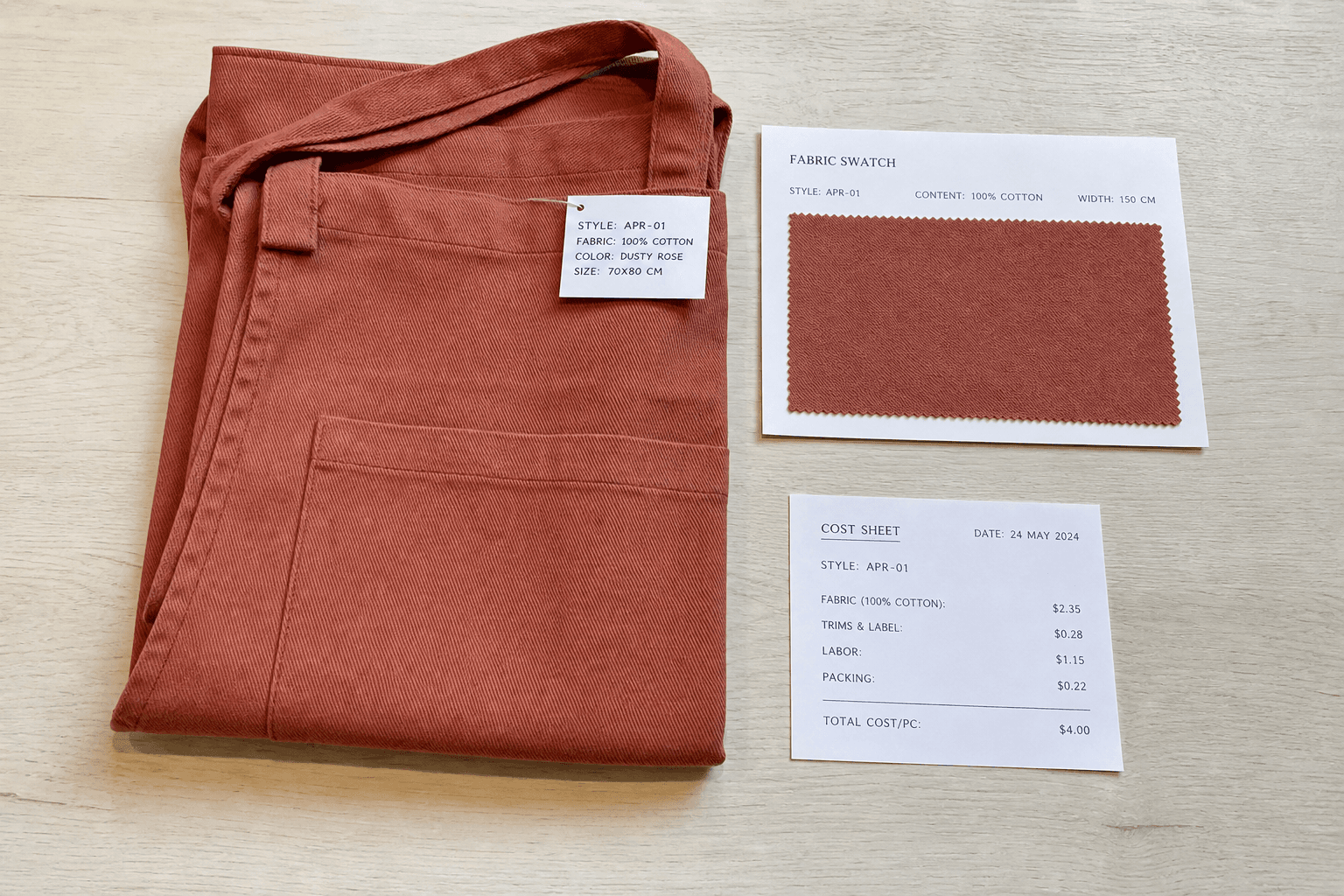
Price should be evaluated against service life, not the lowest unit quote. An apron at $2.60 FOB that survives 25 industrial cycles costs about $0.104 per cycle before handling and replacement labor. A $3.15 apron that survives 45 cycles costs about $0.070 per cycle. Add in fewer route complaints, fewer emergency replacements, and steadier shade continuity, and the more durable apron often produces the lower annual operating cost despite the higher opening price.
- Typical custom MOQ: 800 to 1,500 pcs per color/style; stock-fabric programs may start at 500 to 800 pcs
- Typical bulk lead time: 25 to 45 days after shade approval, PPS signoff, and deposit
- Sample development commonly requires 7 to 14 days; industrial wash validation can add 7 to 21 days
- Reinforcement upgrades usually add $0.20 to $0.60 per piece; embroidery, custom dyeing, or specialty finishing can add $0.30 to $1.20
How to write an apron RFQ that produces comparable quotes and fewer replacements
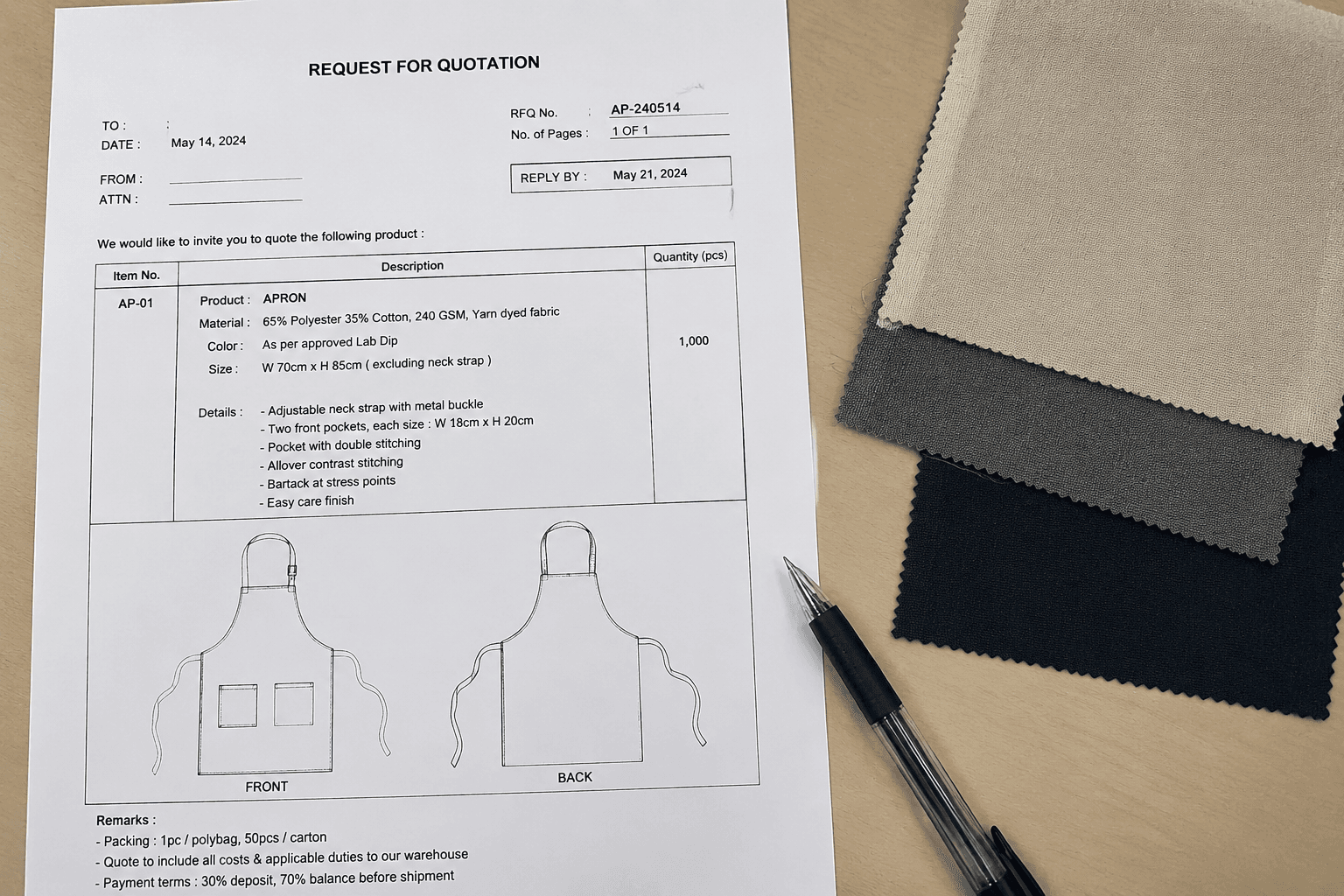
A weak RFQ produces weak quotations. If the brief says only rental apron or heavy-duty apron, each factory will price a different fabric, tie build, seam allowance, pocket attachment, and wash assumption. The quoted numbers may look close, but the products are not comparable. A useful RFQ gives the supplier enough detail to quote the same apron platform and enough context to challenge any feature that is likely to fail in pooled laundering.
At minimum, the buyer should state apron style, finished dimensions, fabric blend, weave, GSM, target shade, pocket layout, tie length and width, reinforcement points, logo method, service-life target, and intended laundry profile. The RFQ should also clarify whether stock shades are acceptable or whether custom dyeing is required, because that decision changes MOQ, lead time, and approval timing. If the order replaces an existing apron, prior failure data should be attached so the factory can address known weak zones such as tie joins, pocket tops, or side hems.
Clear RFQ documentation improves supplier feedback and reduces avoidable revisions. A competent apron factory should be able to say where 220 GSM is too light, where 245 GSM is sufficient, where bartacks are mandatory, and where decorative trim should be removed because it will not survive route laundry. That keeps apron sourcing focused on service life, replenishment stability, and replacement cost instead of the cheapest opening quote.
- State the target life directly, such as 40, 50, or 60 industrial wash cycles
- Specify fabric by blend, weave, GSM, width, and color standard, not by generic poly-cotton wording
- Request inspection terms such as AQL 2.5 major / 4.0 minor plus wash-performance pass criteria
- Share prior failure points, especially tie insertions, bib corners, pocket tops, side hems, and shade loss after wash
- Ask the supplier to quote any durability upgrade separately so the buyer can compare added cost versus added wash cycles