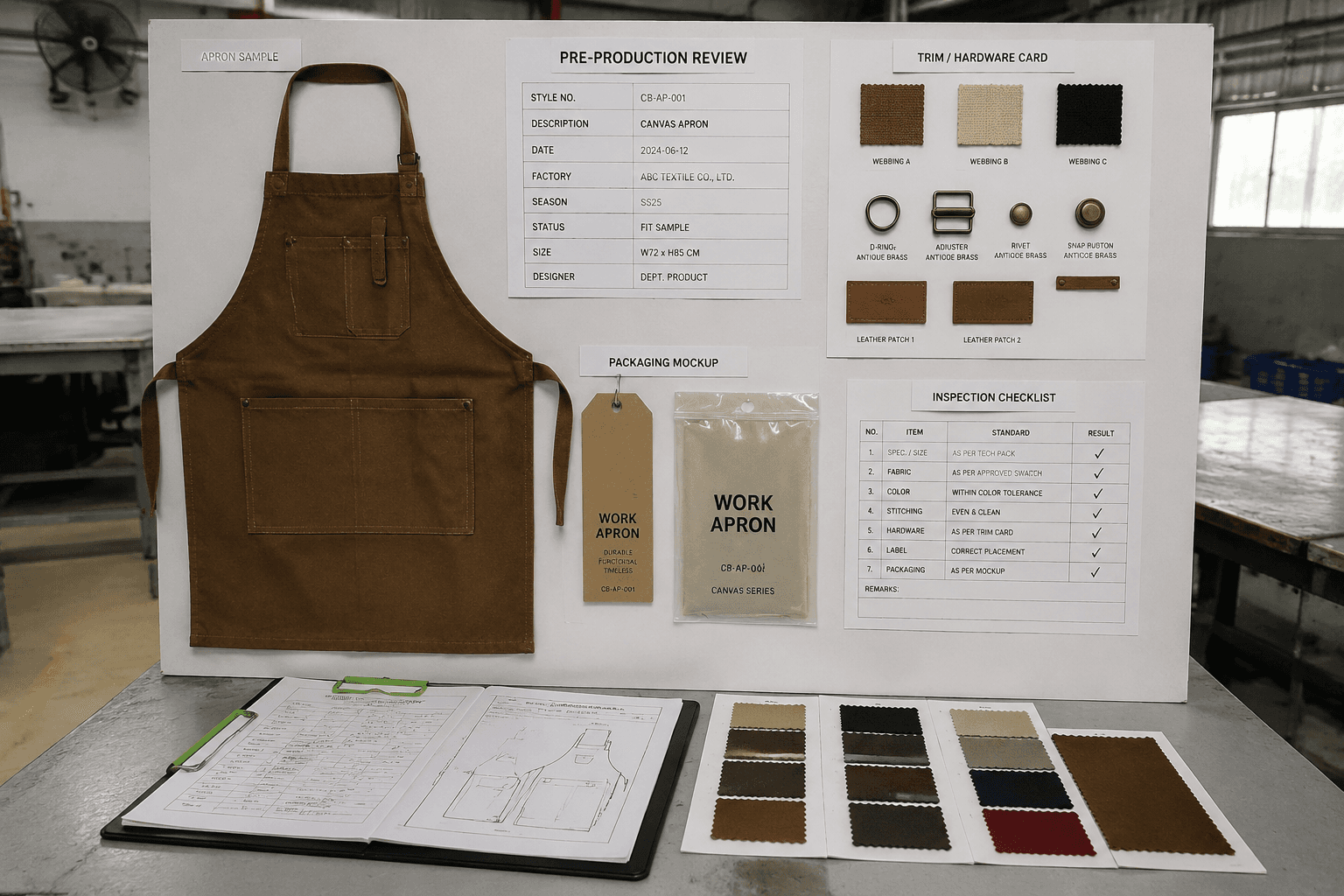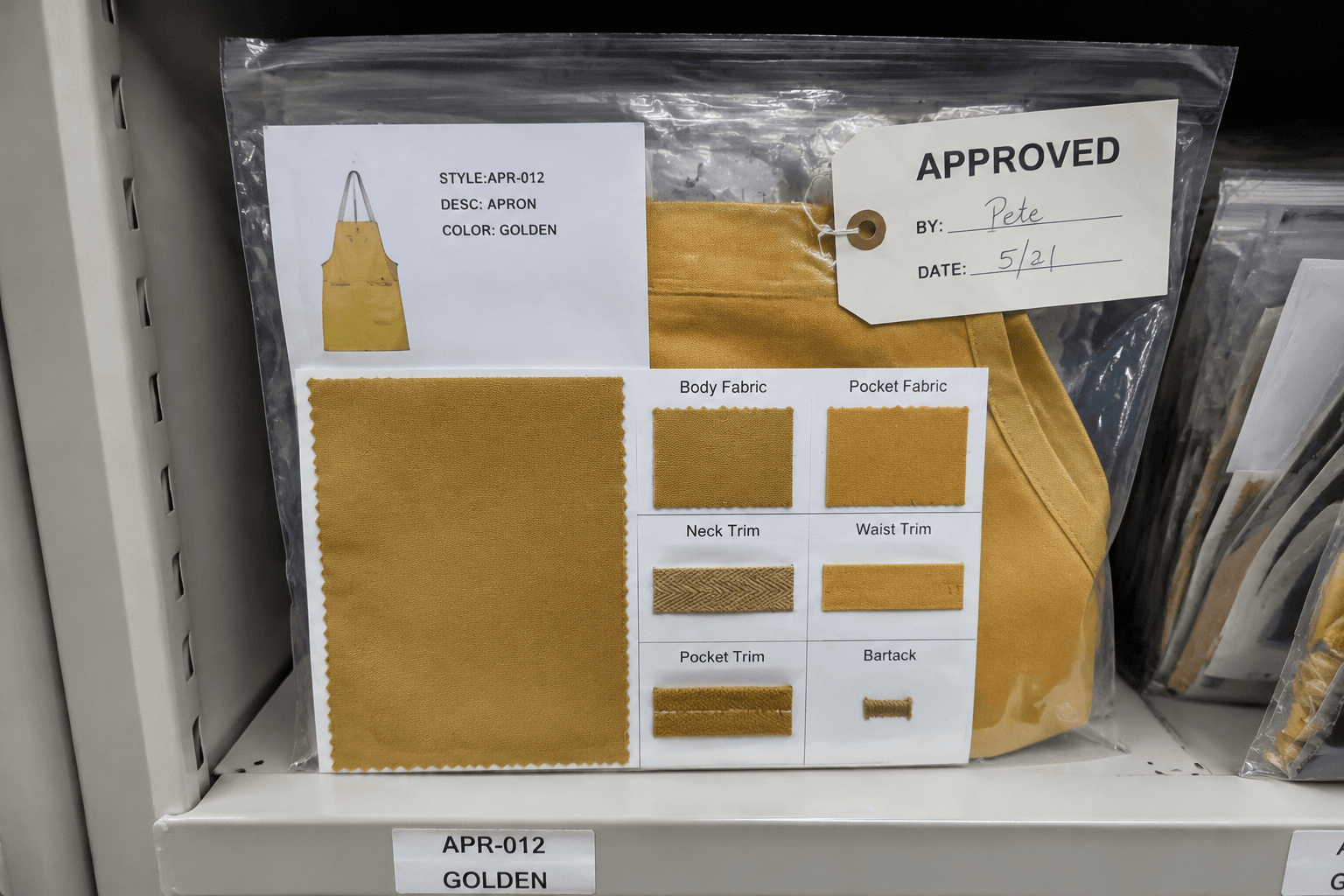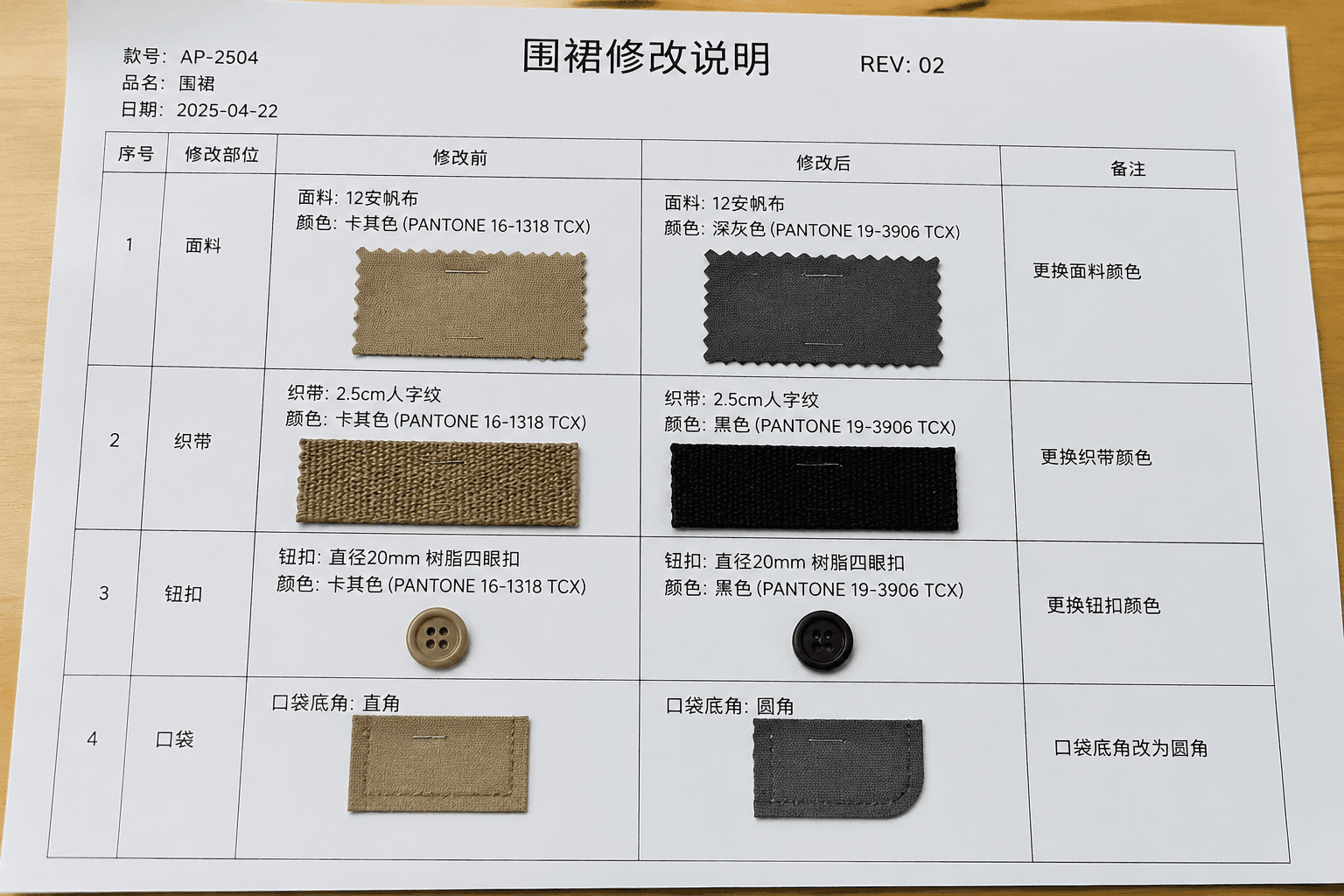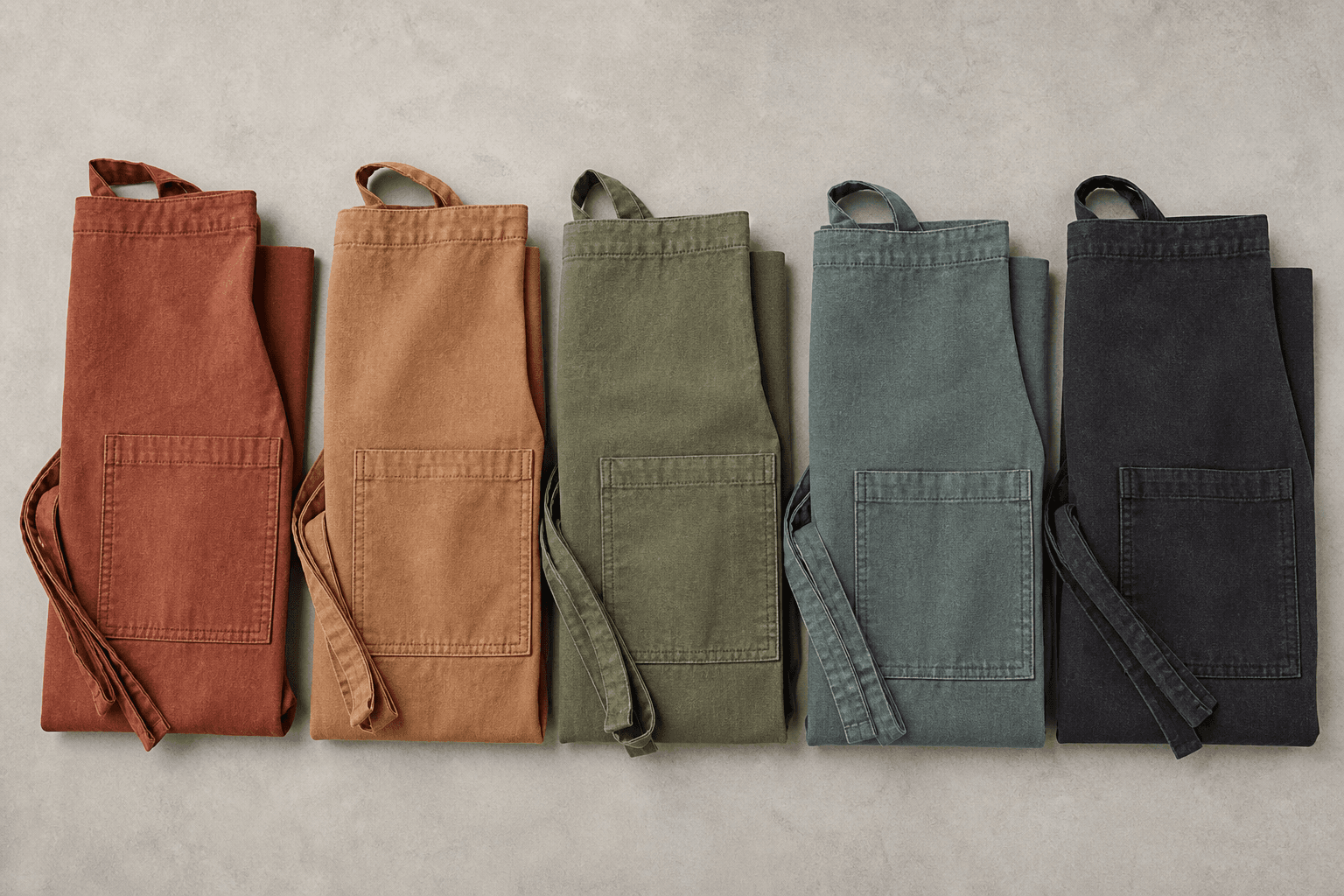
When a buying team receives three quotes for the same apron program, the spread is often wider than the style appears to justify. A bib apron in 260 GSM cotton twill may be quoted at $3.08, $3.42 and $3.86 per piece at 3,000 units ex-factory, even when the tech pack looks aligned. In practice, the gap usually comes from different assumptions on usable fabric width, shrinkage, pocket construction, tie length, sewing minutes, hardware grade, packaging method and defect allowance. A disciplined should cost analysis custom aprons process gives buyers a factual baseline before the first negotiation round.
For professional apron sourcing teams, should-costing is not a way to force every factory to match the cheapest quote. It is a method for separating a commercially credible apron price from a quote that is either underbuilt or overloaded. In apron buying, small specification changes move cost quickly: shifting from 245 GSM twill to 310 GSM canvas, adding antique-brass adjusters, dividing one lower pocket into three sections, or changing from bulk packing to individually folded printed polybags can add $0.07 to $0.46 per piece.
The strongest negotiations happen when buyer and factory discuss the same cost drivers in the same units. That means finished GSM, usable width, fabric yield, sewing minutes, trim MOQ, decoration setup, packing method, AQL level and production lead time in days. Once those assumptions are aligned, quote benchmarking becomes reliable and repeat apron programs are easier to control across suppliers, seasons and order volumes.
- Fabric usually represents 48% to 63% of apron ex-factory cost, so buyers should test GSM, usable width, yield and shrinkage before pushing for savings on minor trims.
- A quote that lands 8% to 12% below should-cost often signals lighter fabric, shorter ties, fewer bartacks, lower-grade hardware or a thin defect reserve rather than true efficiency.
- Labor cost in apron pricing is driven more by sewing minutes and handling complexity than by headline wage rate, especially on bib aprons with neck adjusters, divided pockets and heavier seams.
- Trims, decoration and packaging can add $0.12 to $0.88 per piece when the apron uses custom hardware, embroidery, branded labels and retail-ready packing.
- A workable cost sheet must separate recurring unit cost from MOQ surcharge and one-time charges such as sample making, embroidery digitizing, screen setup and hardware tooling.
- Quote comparisons are valid only when fabric, size, pocket count, decoration method, packing standard, AQL level and Incoterm are identical.
Why <strong>should cost analysis custom aprons</strong> should start before the first price discussion
Many apron negotiations begin too early. The buyer asks for a better number before confirming what the factory actually priced, then the unit price changes again after sample approval because the approved apron uses heavier fabric, longer waist ties, extra bartacks or upgraded packing. Early should-cost work reduces that cycle and prevents repeated quote revisions.
For custom aprons, most ex-factory prices can be separated into six blocks: fabric, cut-and-sew labor, trims and labels, decoration, packaging, and factory overhead plus margin. On a standard bib apron in 245 to 280 GSM twill at 3,000 pieces, fabric often lands at $1.24 to $1.86 per piece, labor at $0.64 to $0.96, trims at $0.10 to $0.30, decoration at $0.00 to $0.28, and packing at $0.05 to $0.15. That usually places a realistic ex-factory range between $2.85 and $4.05, depending on complexity and material choices.
The point of should cost analysis custom aprons is not to predict the factory number to the cent. It is to define a credible range and identify which assumptions need explanation. If a buyer model indicates $3.20 to $3.42 and a supplier quotes $3.94, the discussion should move directly to fabric grade, sewing minutes, decoration method or margin loading. If another supplier quotes $2.88, that is also a signal to verify fabric weight, reinforcement points, tie length and defect allowance before treating the number as a real advantage.
- Build the cost model before final negotiation, not after PP sample approval.
- Lock assumptions on GSM, usable width, finished size, pocket count, tie length and decoration.
- Flag any quote more than 10% below model cost until construction and quality assumptions are verified.
- Update the worksheet after each sample round that changes sewing content, trims or packing.
Build the fabric line first in <strong>should cost analysis custom aprons</strong>: GSM, width, yield and finish
Fabric is usually the largest cost line in any apron program, so it deserves the deepest scrutiny. Buyers often compare a 245 GSM twill apron with a 310 GSM canvas apron as if the difference is minor. On aprons, it is not. Heavier body fabric also affects pocket panels, self-fabric ties, pressing and sewing handling time. A 50 to 65 GSM increase can change both fabric purchase price and unit consumption enough to make a low quote meaningless.
A practical apron worksheet should record composition, finished GSM, usable width, shrinkage allowance, marker efficiency, cutting loss and purchase unit. For a bib apron around 70 x 85 cm with one chest pocket and one divided lower pocket, consumption commonly ranges from 0.82 to 1.04 meters, depending on pattern layout, pocket depth and whether the ties are self-fabric or webbing. At 150 cm usable width, 245 GSM cotton twill may contribute roughly $1.34 to $1.62 per piece at 3,000 units. A 65/35 polycotton twill of similar weight may reduce that by $0.12 to $0.28 per piece. A 300 to 310 GSM cotton canvas with enzyme wash can add $0.36 to $0.60 per piece versus unwashed twill.
Buyers also need to check how the factory prices loss. Some suppliers build 3% to 5% reserve into the fabric line for shade variation, end loss and cutting defects, while others push that reserve into overhead. That difference distorts quote comparisons unless it is stated clearly. Fabric lead time matters as well. Stock greige with standard reactive dyeing may be ready in 12 to 18 days, while custom color approval, peaching, water-repellent coating or garment wash can stretch fabric readiness to 26 to 40 days before cutting starts.
This is where buyers should challenge vague phrases such as 'standard apron fabric' or 'heavy cotton.' A B2B cost discussion needs exact numbers: 245 GSM twill or 310 GSM canvas, 150 cm usable width or 142 cm usable width, 3% shrinkage or 5% shrinkage. Without those details, fabric benchmarking is not reliable.
- Typical bib apron consumption is 0.82 to 1.04 meters per piece including pockets, ties and cutting loss.
- Marker efficiency below 80% often indicates narrow usable width, poor nesting or an inefficient pattern set.
- Washed, coated or yarn-dyed apron fabrics often add 10 to 20 days to material lead time.
- Always verify whether shrinkage allowance is based on greige width or finished usable width.
Measure apron labor by sewing minutes, handling steps and machine changes
Labor is the second major cost driver, but many buyers analyze it too loosely. Asking for a local wage rate does not explain apron pricing. What matters is the actual operation content: seam count, pocket attachments, bartacks, hardware insertion, pressing, thread trimming, inline inspection and rework exposure. A simple waist apron with one patch pocket and self-fabric ties may run 6 to 8 sewing minutes. A bib apron with divided pockets, adjustable neck strap, metal hardware and decorative topstitching can reach 13 to 19 minutes. Heavy canvas with multiple cross seams can push beyond 20 minutes.
Factories typically convert time to cost through SAM or SMV, line efficiency and a burdened hourly sewing rate. If the burdened rate is $5.80 to $7.20 per hour, then 10 minutes of direct sewing content equals about $0.97 to $1.20 before cutting, finishing, final inspection and packing. In a realistic apron worksheet, the full labor block for a basic bib style often sits at $0.62 to $0.92. A more complex canvas barista apron with hardware, contrast panels and embroidery can land at $1.08 to $1.46.
The negotiation question should therefore be operational, not generic. Instead of asking the supplier to reduce labor by 5%, ask which operations are consuming the minutes. Removing one pocket divider, shortening each tie by 8 to 10 cm, standardizing bartack positions, or switching from double-turn edge finishing to overlock plus single-turn hem can remove 0.4 to 1.5 minutes per piece. On a 5,000-piece order, that is usually a more credible saving than demanding a flat unit-price concession with no construction change.
Buyers should also ask whether the labor number assumes normal line efficiency or a short-run penalty. An order of 600 pieces across four colorways may carry noticeably weaker efficiency than a 3,000-piece single-color run, even when the apron specification is identical.
- Basic waist aprons often sew in 6 to 8 minutes; standard bib aprons usually require 13 to 19 minutes.
- Heavy fabrics, hardware and decorative topstitching can add $0.12 to $0.42 per piece in labor.
- Orders below 1,000 pieces usually carry weaker efficiency because setup time is spread across fewer units.
- Ask suppliers to separate cutting, sewing, finishing and inspection minutes when discussing cost.
Trim, decoration and packing costs: where $0.10 becomes $0.88 per apron
Trim cost is where many apron programs drift away from the original quote. Each line looks small on its own, but together they can materially change the margin. A woven main label may cost $0.02 to $0.04, a care label $0.01 to $0.03, a D-ring or buckle $0.03 to $0.08, an eyelet $0.01 to $0.03, and a logo patch $0.05 to $0.18. Add embroidery, hangtags, barcode stickers, printed polybags, carton assorting and insert cards, and the trim-plus-packing total can move from a basic $0.10 to $0.18 up to $0.50 to $0.88 per piece.
Risk increases when trims are nominated or customized. Standard self-fabric straps can be cut in-house with little external dependency. Custom plated buckles, logo snaps, leather-look patches or branded woven tapes may require 15 to 25 days for trim readiness, incoming inspection and spare planning. If a supplier first quotes with standard local hardware and later switches to approved custom trims, the price increase usually appears after sampling rather than at quotation stage.
This is also one of the fastest areas for sensible savings. Moving from metal to acetal hardware, reducing paper inserts, combining brand and care information into one label, or changing from individual retail folding to flat bulk packing can reduce cost by $0.08 to $0.31 per piece without changing the core function of the apron. For many B2B buyers, these adjustments are easier to approve than reducing fabric weight or removing reinforcement.
Decoration needs the same discipline. A small one-position screen print may add $0.04 to $0.09 per piece after setup, while a 6,000-stitch embroidery logo may add $0.12 to $0.26. Buyers should keep these lines separate so repeat orders are not benchmarked against first-order setup charges.
- Basic trims on simple aprons usually total $0.08 to $0.20 per piece.
- Custom hardware, embroidery and retail-style packing can push non-fabric add-on cost to $0.50 to $0.88 per piece.
- Confirm trim MOQ, spare ratio and replacement lead time before approving the quote.
- Check whether the price includes individual polybagging, warning print, carton marks and size stickers.
Compare apron quotes on a true like-for-like basis
A strong quote comparison does not require every factory to reveal the same internal costing template. It requires the buyer to standardize the commercial assumptions before reviewing price. At minimum, the buyer should lock fabric specification, finished dimensions, pocket construction, trim specification, decoration method, packing standard, inspection requirement and Incoterm. Without that discipline, quote benchmarking becomes a comparison of different aprons rather than different suppliers.
Consider three 5,000-piece bib apron quotes at $3.12, $3.46 and $3.79. The cheapest quote may be based on 220 GSM polycotton rather than 260 GSM cotton twill, one undivided lower pocket instead of two sections, no neck-adjuster hardware, and flat bulk carton packing with no individual fold. Once those assumptions are corrected, the same supplier may re-quote at $3.38 to $3.44. The original advantage was not manufacturing efficiency; it was a lighter build and lower finishing standard.
Buyers should also separate recurring unit cost from first-order charges. Pattern development, fit samples, embroidery digitizing, screen setup, wash testing and hardware tooling should not be blended into repeat-order piece price. On a 1,000-piece pilot order, those charges can distort the apparent unit cost by $0.12 to $0.38 per piece. Separating them keeps negotiation focused on the true recurring cost of the apron.
A practical rule is to compare quotations at the same volume points. A supplier that looks expensive at 1,000 pieces may become competitive at 5,000 pieces if fabric purchasing and line efficiency improve. Without matching quantity breaks, buyers often draw the wrong conclusion from otherwise sound quotations.
- Benchmark the same apron at 1,000, 3,000 and 5,000 pieces to see the real volume curve.
- Keep ex-factory unit price separate from one-time development charges and freight.
- Confirm whether the quote includes inline inspection, final inspection and metal detection if required.
- Once assumptions are aligned, a reasonable comparison band is often ±5% to ±8%.
MOQ, lead time, AQL and order split: the commercial terms that change real apron cost
A realistic apron should-cost model must go beyond fabric and labor because MOQ, lead time and quality standards affect the sourcing result just as directly. A factory may accept a 500-piece order, but the unit price usually rises because the fabric mill wants a 1,000-meter minimum, print or embroidery setup is spread across fewer units, and line efficiency falls on short runs. What looks like useful MOQ flexibility can therefore add $0.18 to $0.52 per piece.
Lead time creates similar pressure. A stock-color apron using standard local trims may ship 20 to 30 days after PP sample approval and deposit. A program with custom-dyed fabric, washed finish or nominated hardware more often needs 35 to 50 days. If the style combines embroidery, screen print and custom retail packaging, 45 to 60 days is a safer planning range. Requests for faster shipment frequently trigger overtime, trim airfreight or split-lot production, which pushes cost back into the quote even when the base apron has not changed.
Quality assumptions must also be explicit. If one factory prices against AQL 2.5 major and 4.0 minor while another assumes a lighter final inspection routine, the lower quote is not directly comparable. The same applies to needle control, shade tolerance, carton drop standard and replacement policy. For hospitality groups, retailers and branded workwear buyers, these execution details matter as much as nominal unit price.
Order structure is the final adjustment buyers often underestimate. A 6,000-piece apron order split into 12 colors of 500 pieces each is not commercially equal to one color at 6,000 pieces. Color changeovers, thread swaps, label separation and store-specific carton marking all add handling time and raise the risk of sorting errors. For name-personalized aprons, the handling cost can rise again because decoration files, bundling and final verification take extra labor.
- Custom apron MOQ is often 1,000 pieces per style per color, though fabric programs may impose higher practical minimums.
- Standard production lead time is commonly 20 to 30 days; custom fabric or special trims often extend it to 35 to 60 days.
- A common export inspection reference is AQL 2.5 major / 4.0 minor, and it should be stated in the quote.
- Multi-color, store-packed or name-personalized orders usually increase handling cost even when total units stay constant.
A practical worksheet for repeat apron negotiations and supplier control
The most useful negotiation tool is a simple worksheet that buyer and factory can review line by line. It does not need to expose every internal overhead detail, but it should show enough structure to test whether the quote is commercially reasonable. For aprons, the worksheet should include style reference, dimensions, fabric specification, fabric consumption, sewing minutes, trim lines, decoration, packing, MOQ, AQL level, lead time and one-time charges.
A practical example for a 3,000-piece bib apron might read: fabric $1.52, cut-and-sew labor $0.78, trims $0.19, embroidery $0.15, packing $0.08, overhead plus margin $0.33, total ex-factory $3.05 per piece. If another supplier quotes $3.56, the buyer can ask whether the fabric is heavier, the labor content is higher, or the quote includes extra testing and stricter packing. If a third supplier quotes $2.84, the buyer can test whether the lower number comes from reduced GSM, shorter straps, weaker pocket reinforcement or an unsustainably thin margin.
This worksheet discipline improves negotiation quality on both sides. Buyers stop using unsupported target prices, and suppliers spend less time revising quotes after every sample change. For repeat apron programs in hospitality, foodservice, retail merchandise and workwear, that structure helps control price, quality and delivery at the same time.
Used consistently, the worksheet also becomes a supplier management record. After two or three repeat orders, a buyer can see whether a factory's fabric yield, labor assumptions and trim charges remain stable or drift upward without a real specification change. That history is often more useful in negotiation than a one-time aggressive target price.
- Record fabric by meter usage, usable width, GSM and waste assumption, not only as a total dollar figure.
- Show sewing minutes separately from cutting, finishing and final inspection.
- List trims individually whenever custom hardware, labels or retail packaging are involved.
- Review the worksheet again after PP sample approval because approved construction often changes labor and trim usage.
- Keep sample fees, screen charges and tooling costs outside recurring unit cost wherever possible.