For bulk buyers, a salon apron is not only a uniform item. It is a working barrier against hair color, shampoo splash, massage oil, wax residue, disinfectant spray, and frequent laundering. The right specification depends on the service environment: a color bar needs chemical resistance, a spa treatment room needs a quieter hand feel, and a front-desk stylist apron may need more visual polish than heavy-duty protection.
From the factory side, most quality problems in salon and spa apron orders come from three areas: choosing a fabric that absorbs stains too quickly, using trims that corrode or crack after washing, and approving a fit that looks good on one sample model but fails across a mixed staff size range. These issues are manageable if the buyer defines fabric weight, finish, pocket layout, strap system, colorfastness, and testing requirements before bulk cutting.
This article explains practical fabric and fit choices for custom salon apron sourcing from China, with reference ranges for GSM, MOQ, lead time, and cost impact. The goal is not to select the most expensive construction, but to match protection, comfort, branding, and service life to the actual salon or spa use case.
- Poly-cotton twill at 190-240 GSM is usually the most balanced base for a general salon apron program.
- PU-coated or water-repellent finishes improve stain shedding but can reduce breathability during long shifts.
- Bleach exposure, hair dye, and peroxide require different testing than normal food-service apron orders.
- Adjustable neck and waist systems reduce size complaints more effectively than adding too many apron sizes.
- For branded bulk orders, pocket placement should be finalized before logo sampling because embroidery and print locations compete with tools.
- A realistic China OEM lead time is usually 25-45 days after sample approval, depending on fabric availability and decoration.
What Makes a Salon Apron Different From a Standard Work Apron
A standard work apron may only need to protect clothing from dust, food splash, or light handling marks. A salon apron faces a more varied contamination load. Hair dye can be alkaline and pigment-rich, oxidizing color products can leave rings after drying, and bleach or peroxide may attack both fabric color and metal trims. In spa use, the challenge is often oil, lotion, clay mask, wax, sanitizer, and warm water. These stains behave differently from kitchen stains, so fabric selection must be closer to a technical uniform decision than a simple promotional textile purchase.
The first sourcing question is whether the apron is mainly for hair color protection, cutting and styling, spa or wellness treatment, or front-of-house presentation. A hairdresser apron for color work can accept a slightly stiffer finish if it blocks liquid and pigment. A spa apron worn for massage, facial, or nail service needs softer drape, lower noise, and better comfort over an 8-10 hour shift. A stylist apron used in a premium salon may prioritize silhouette, pocket neatness, and logo appearance, but it still needs enough stain resistance for daily work.
In our Zhejiang apron production, salon and spa programs usually sit between hospitality aprons and light industrial workwear. They require cleaner sewing and brand presentation than industrial aprons, but more chemical awareness than cafe aprons. This is why buyers should avoid selecting only by catalog photo. A black 220 GSM twill apron, a 220 GSM coated apron, and a 220 GSM stretch blend apron may look similar in sample photos, but their hand feel, heat retention, wash behavior, and stain release can be very different after 20 laundering cycles.
- Hair color stations need stronger stain resistance and darker fabric colors than cutting-only stations.
- Spa rooms usually need softer fabric, quieter movement, and less bulky strap hardware.
- Front-of-house stylist apron designs should protect clothing without looking like heavy industrial PPE.
- Nail and waxing services need attention to acetone, oil, wax, and disinfectant contact, not only water repellency.
Best Fabric Options for a Custom Salon Apron
For most salon apron orders, the starting point is poly-cotton twill in the 190-240 GSM range. A common composition is 65/35 polyester-cotton or 80/20 polyester-cotton. The polyester improves drying speed, dimensional stability, and color retention; the cotton improves hand feel and reduces the plastic sensation that some staff dislike. In black, charcoal, navy, dark olive, or deep brown, this fabric gives a practical balance between cost, wash performance, and brand appearance.
A lighter 160-180 GSM poly-cotton can work for a spa apron or wellness apron used indoors where the main requirement is a clean uniform look. It feels cooler and drapes better, but it provides less liquid holdout and can show pocket stress faster. At the other end, 260-300 GSM cotton canvas or duck fabric looks premium and durable, especially for barber, tattoo, or craft-positioned salons. However, heavy cotton absorbs stains faster unless treated, takes longer to dry, and can feel warm during long service periods.
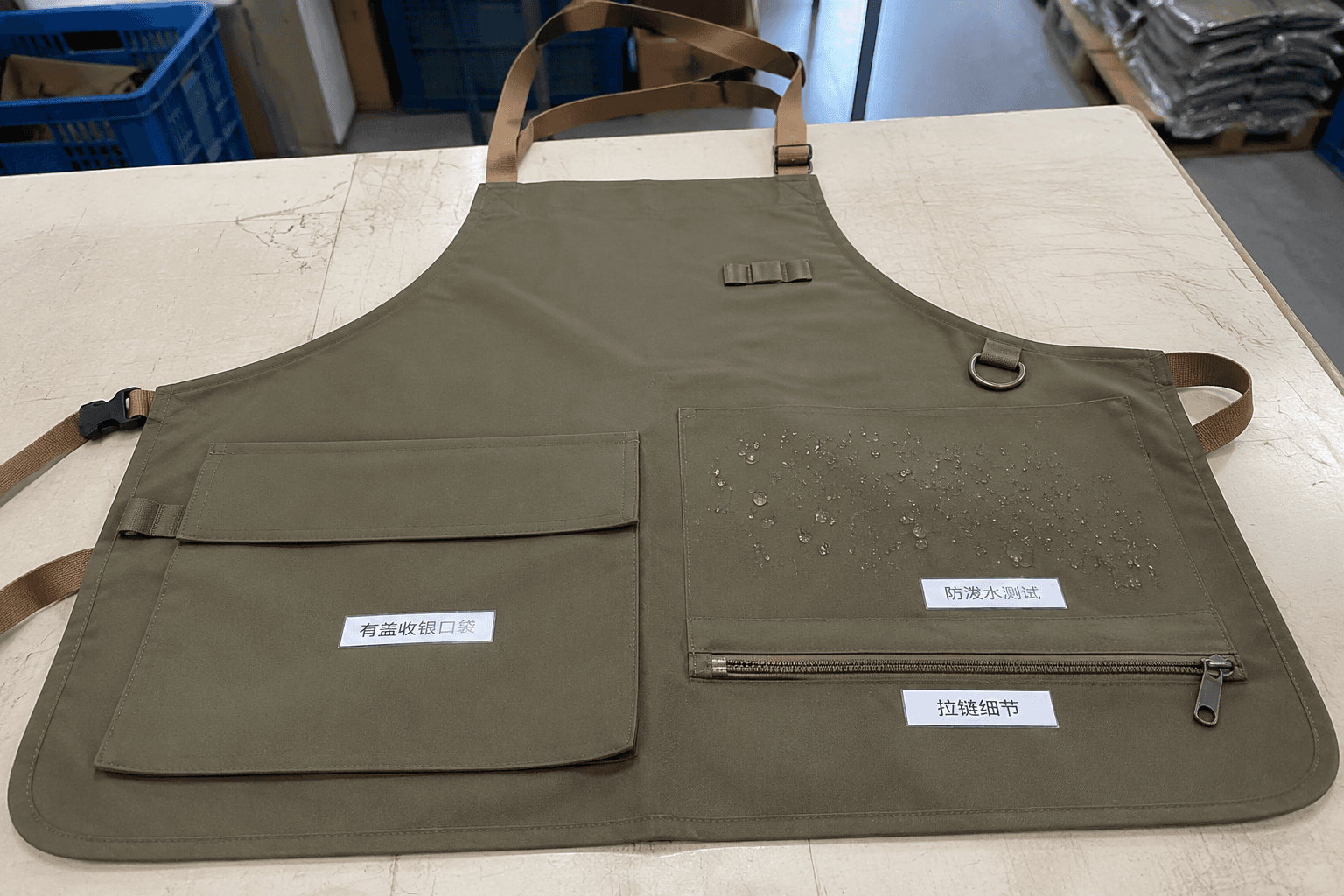
For color bars and wet service areas, buyers often ask for water-repellent or PU-coated fabric. A light water-repellent finish on 210-240 GSM twill can make shampoo splash and diluted dye bead for a short time, giving the stylist a chance to wipe the surface. PU coating gives stronger liquid resistance but reduces breathability and may develop surface cracking if the coating quality is low or washing conditions are too aggressive. A coated salon apron should be tested with the buyer's intended wash temperature, detergent, and drying method before bulk approval.
- 160-180 GSM poly-cotton is suitable for spa, wellness, and light salon service where comfort is the priority.
- 190-240 GSM poly-cotton twill is the most common range for general hairdresser apron orders.
- 240-300 GSM canvas gives a structured premium look but requires stain-release treatment for color service use.
- PU-coated polyester or poly-cotton improves liquid resistance but should be validated for cracking and breathability.
- Stretch blends can improve comfort, but they add cost and may require more careful shrinkage control.
Stain-Shedding Finishes and Chemical Resistance
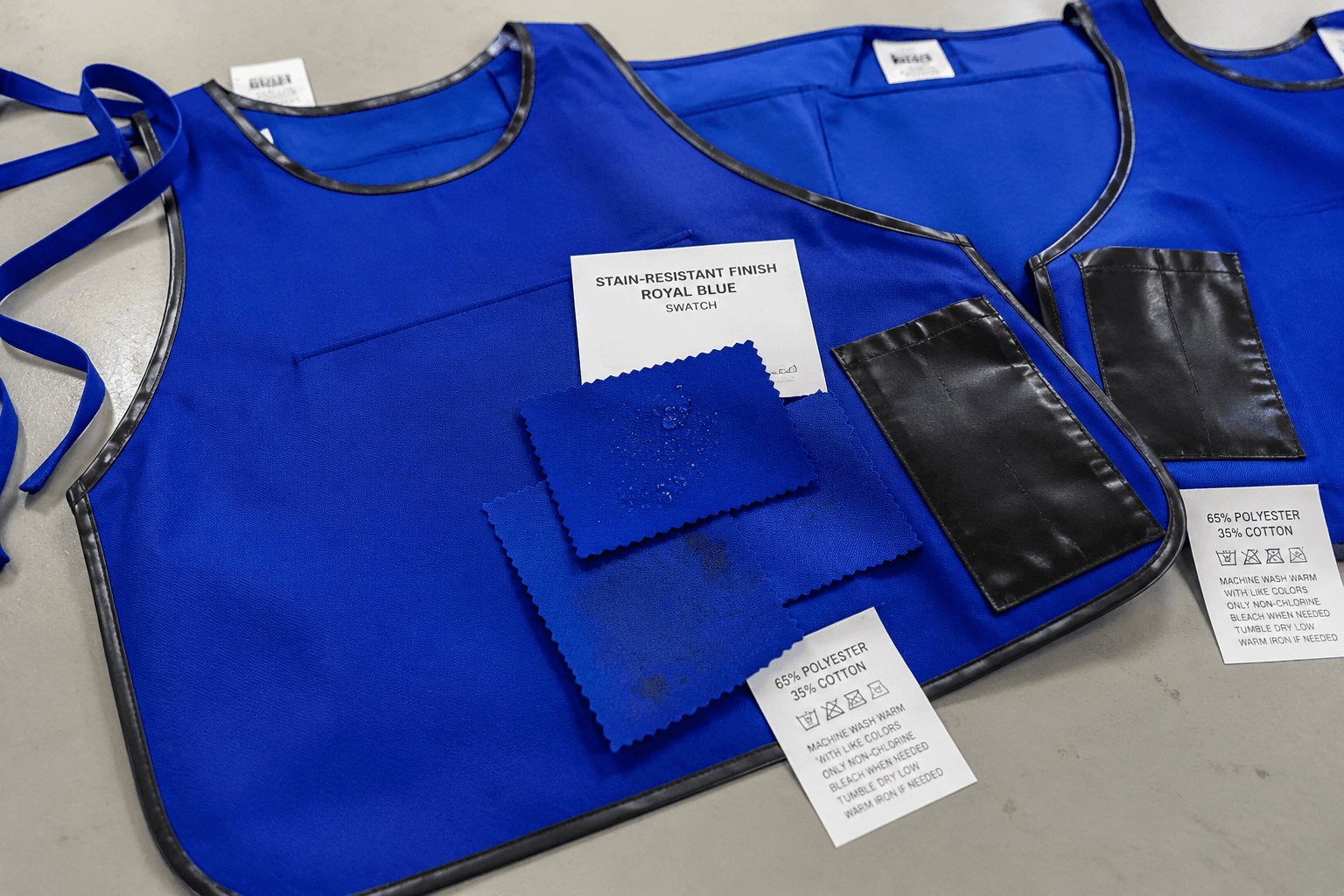
Buyers often use the phrase stain-proof, but in apron manufacturing we prefer to separate three different properties: water repellency, oil repellency, and stain release. Water repellency helps liquid bead on the surface. Oil repellency helps against massage oil, wax residue, and some cosmetic products. Stain release means the fabric may still absorb a mark, but the mark can be removed more easily during washing. A strong salon apron program usually needs a combination, not a single claim.
For hair salons, the most difficult stains are oxidative color, direct dye pigments, and bleach splatter. No normal textile finish can guarantee full resistance against all professional hair color chemicals, especially on light-colored aprons. Dark colors remain the safest commercial choice. Black is common, but very deep charcoal or navy can hide lint and chemical fading better than pure black in some laundry conditions. If the brand requires beige, ivory, pale gray, or pastel tones, we usually recommend limiting the product to spa or front-of-house use rather than hair color service.
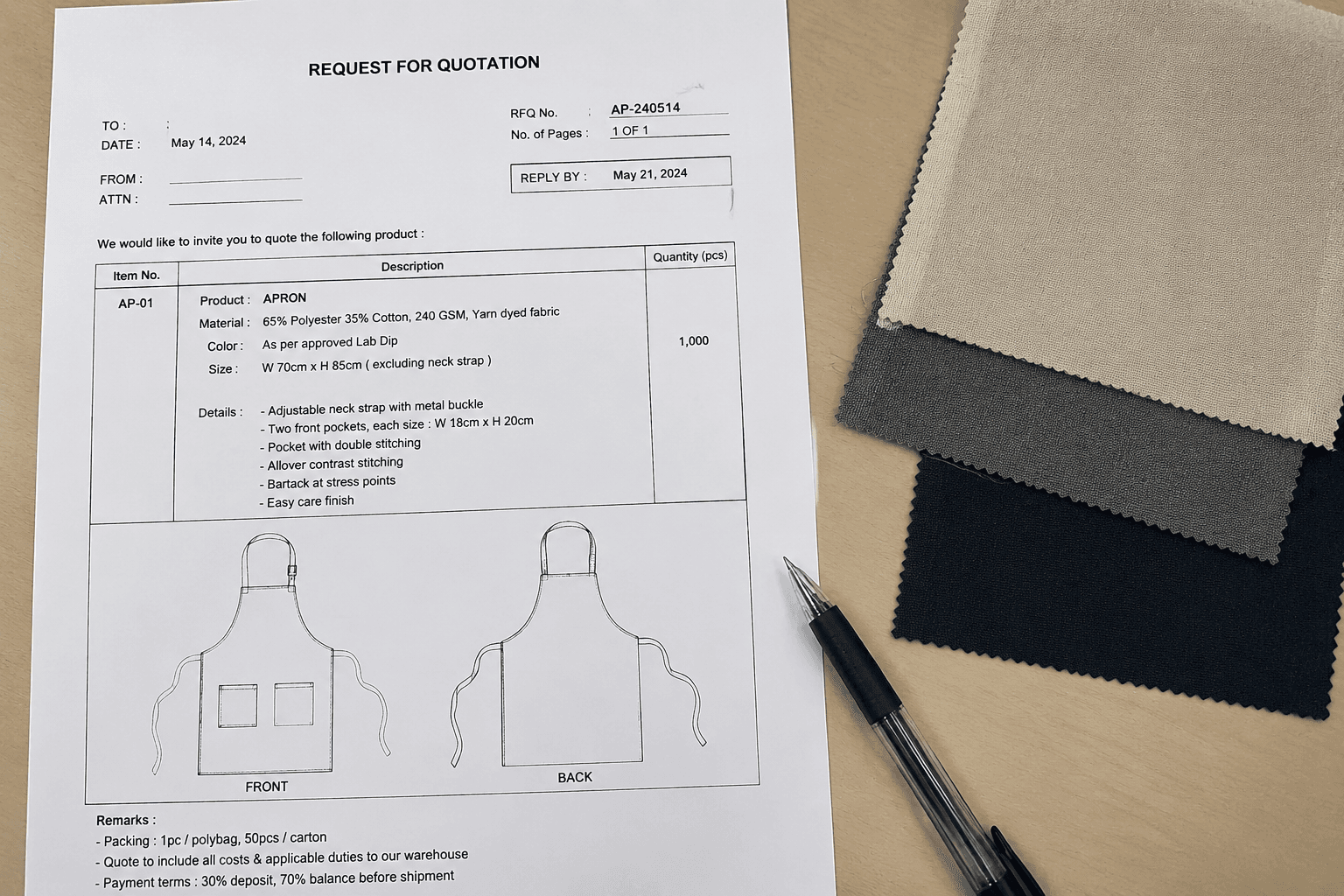
From a sourcing perspective, finishing chemistry affects MOQ and lead time. A standard stock-dyed poly-cotton twill may be available from 300-500 pcs per color if the fabric is in the local market. A custom water-repellent finish, oil-repellent finish, or anti-static finish may push the practical MOQ to 800-1,500 pcs per color and add 7-12 days for fabric processing. If the order also needs custom dyeing to match a Pantone target, buyers should allow lab dip approval, bulk fabric dyeing, and shade band control.
- Water repellency is useful for shampoo splash and diluted product contact, but it does not equal dye resistance.
- Oil repellency matters more for spa apron, massage, waxing, and facial treatment programs.
- Stain-release finishing can support laundering performance even when the fabric is not fully liquid-repellent.
- Light apron colors should be avoided for hair color stations unless the buyer accepts visible staining risk.
- A finish test should include at least 10-20 wash cycles when the apron is intended for daily commercial use.
Fit Engineering for a Salon Apron Across Mixed Staff Sizes
Fit complaints are common when a buyer approves a sample on one person and then issues the same apron to a full team. Salon and spa staff often include a wide height range, different body shapes, and different preferences for how high the bib sits. For this reason, an adjustable neck strap and long waist ties are more important than adding multiple body sizes too early. A single adult size can cover many users if the bib width, body length, neck adjustment, and waist tie length are designed correctly.
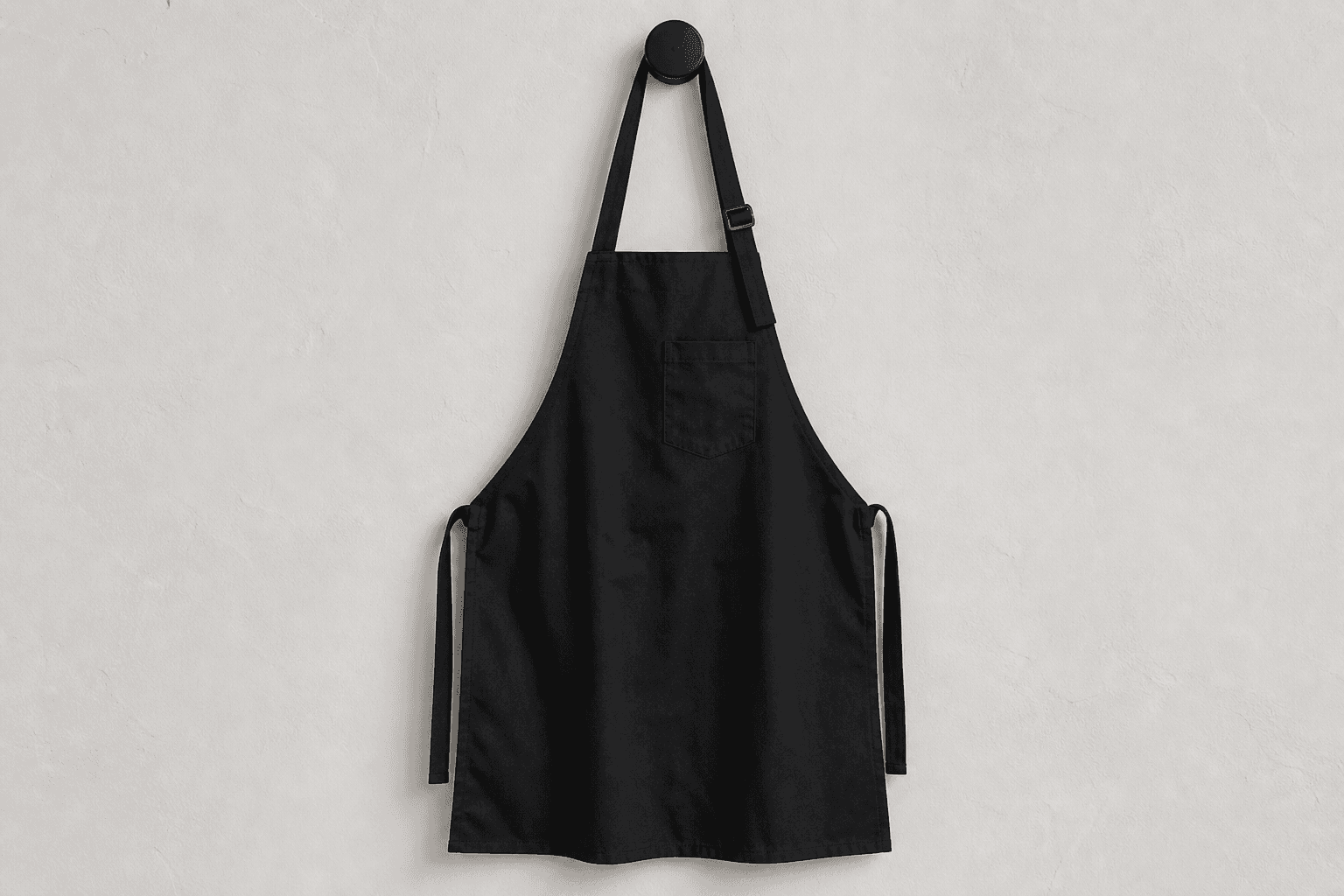
For a bib-style salon apron, common finished dimensions are 68-75 cm wide at the lower body and 78-86 cm long from top bib edge to hem. Shorter staff may prefer 72-78 cm length, while taller barbers or colorists often prefer 85-90 cm. A cross-back design can reduce neck pressure during long shifts, especially when tools are carried in pockets. However, cross-back straps cost more, take longer to sew, and require clearer packing instructions so staff can wear them correctly. For large-volume retail or chain salon orders, detachable or adjustable hardware can reduce returns, but metal quality must be selected carefully.
A spa apron may need a slightly narrower silhouette so it does not interfere with treatment beds or close client contact. For massage and facial services, a 65-70 cm width and 72-80 cm length often works better than a heavy full-coverage style. If the apron is worn over tunics or uniforms, armhole curve and bib height become important. Too high, and it rubs the neck; too low, and it exposes the chest area to product splash. A factory sample should therefore be evaluated during real movements: reaching, bending, washing tools, mixing color, and standing at a treatment table.
Pocket Layout, Tool Carrying, and Trim Selection
Pocket layout determines whether a stylist apron is genuinely useful or only decorative. Hairdressers may carry combs, clips, shears, phone, color brush, notepad, and small product tubes. Spa staff may need gloves, spatulas, wax strips, small bottles, and room cards. Too many pockets create bulk and trap hair or product residue. Too few pockets force staff to overload one area, causing sagging and seam stress. For most salon apron designs, two lower patch pockets plus one narrow tool slot or chest pocket is enough.
Pocket depth should be matched to the tools. A 17-20 cm deep lower pocket holds a phone and small tools without exposing them too much. A narrow 3-4 cm tool division can hold a comb or color brush, but should not be placed where it catches the hand during service. Reinforced pocket corners are important, especially on 190-240 GSM fabric. Bar tacks or triangular reinforcement add a small cost but reduce early tearing. If the apron will carry scissors or sharp tools, buyers should specify whether a reinforced insert or separate holster is required, because normal patch pocket fabric can be punctured.
Trim choice is another frequent source of hidden problems. Nickel-plated metal eyelets and buckles may corrode or discolor after repeated contact with water, peroxide, or disinfectant. Antique brass hardware looks premium but may stain light fabrics if plating is poor. Plastic adjusters reduce corrosion risk and are lighter, but they can look less premium. For spa apron orders, quiet plastic or coated metal hardware may be preferable because loud trim contact can feel out of place in a wellness environment.
- Lower patch pockets should usually be 17-20 cm deep for phones, combs, and small service tools.
- Pocket corner bar tacks are recommended for salon orders above basic promotional quality.
- Chest pockets should not interfere with logo placement or bib curvature.
- Metal hardware should be tested for corrosion risk if the apron contacts water, peroxide, or disinfectant.
- Plastic adjusters are practical for wet spa environments but need adequate thickness to avoid cracking.
Decoration Methods for a Branded Hairdresser Apron
Branding on a salon apron must survive washing and still look clean after surface abrasion. The common decoration options are embroidery, screen printing, heat transfer, woven label, leather or PU patch, and silicone patch. Embroidery gives a durable premium look on twill and canvas, but dense embroidery can pucker on lighter 160-180 GSM fabric. It is also not ideal for very small text. Screen printing is cost-efficient for simple logos and larger orders, but print ink must be selected for wash and chemical exposure. Heat transfer can show fine detail, but low-quality transfers may crack or peel under commercial laundering.
For a stylist apron, the best logo position is often upper chest, centered or slightly offset, with enough clearance from neck straps and pocket openings. If there is a chest pocket, the logo can be placed on the pocket face, but this reduces the printable area and can distort when the pocket is loaded. On black or charcoal fabric, white, light gray, metallic silver, or muted gold logos are common. Buyers should avoid very large high-contrast prints on the lower body if staff will bend or sit often, because abrasion and creasing are more visible there.
Decoration cost varies with order size and method. For 500 pcs, a simple one-color screen print may add around $0.12-$0.35 per pc depending on size. Small embroidery may add $0.25-$0.70 per pc, while larger dense embroidery can exceed $1.00 per pc. A woven label is usually cheaper once the label MOQ is met, but it gives a smaller brand signal. For premium spa apron programs, a small woven label or subtle tonal embroidery often looks cleaner than a large print.
Cost, MOQ, and Lead Time for Salon Apron OEM Orders
Cost depends mainly on fabric, finish, construction time, decoration, packaging, and inspection level. As a general reference, a basic 190-210 GSM poly-cotton salon apron with simple neck loop, waist ties, two pockets, and one-color print may fall around $2.20-$3.60 per pc at 1,000 pcs, depending on fabric market price and size. A better 220-240 GSM twill with adjustable neck strap, reinforced pockets, and embroidery may run around $3.50-$5.80 per pc. A coated or premium canvas hairdresser apron with cross-back straps, metal hardware, and patch branding can move into the $6.00-$10.00 per pc range or higher.
MOQ is usually flexible when using stock fabric colors such as black, navy, gray, or khaki. For a trial order, 300-500 pcs per color may be possible, although unit cost will be higher. For custom dyed fabric, special finish, yarn-dyed stripe, or proprietary trims, 800-1,500 pcs per color is more realistic. Buyers should also consider trim MOQ: custom buckles, branded rivets, special webbing color, or custom woven labels can create minimums even when the apron sewing MOQ is lower.
A normal OEM timeline is 5-10 days for first sample if fabric is available, 3-5 days for buyer review and revision, 7-15 days for fabric or trim preparation, 10-20 days for cutting and sewing, and 2-5 days for final inspection and packing. In practical terms, many salon apron orders ship 25-45 days after final sample approval and deposit. Custom dyeing, lab testing, peak season capacity, or complicated packaging can extend this by 1-3 weeks. Air freight may solve launch timing, but it is expensive for heavy canvas aprons; sea freight should be planned early for chain salon rollouts.
- Basic poly-cotton apron programs may start around $2.20-$3.60 per pc at 1,000 pcs.
- Mid-range adjustable twill aprons with embroidery often land around $3.50-$5.80 per pc.
- Coated, canvas, or cross-back premium aprons can reach $6.00-$10.00 per pc or more.
- Stock fabric colors can support lower MOQ than custom dyed or specially finished fabrics.
- A realistic production window is 25-45 days after final approval for standard OEM orders.
Quality Control Checklist for a Wellness Apron Supplier
When selecting a wellness apron supplier, buyers should request controls that match salon and spa use rather than relying only on general garment inspection. Fabric shade should be checked under consistent light because black and charcoal batches can vary. Finished dimensions should be measured after sewing and, for repeat programs, after wash testing. Strap attachment, pocket corners, embroidery density, coating surface, and hardware plating need close review because these are the areas most likely to fail first in daily use.
Recommended tests depend on the market and claim level. For a basic salon apron, useful checks include colorfastness to washing, rubbing, and perspiration; dimensional stability after washing; seam strength; and inspection of logo durability. For stain-shedding or coated aprons, add spray rating, hydrostatic pressure if relevant, oil repellency if claimed, and surface appearance after washing. If the apron is sold into the EU or US market under a brand's restricted substance policy, fabric, coating, print, and trims may need REACH, Prop 65, or brand-specific chemical compliance review.
Packaging should also be specified. Bulk polybag packing is cheapest, but individual bags keep aprons cleaner for distribution to salon branches. A common carton quantity is 50-100 pcs depending on fabric weight and apron length. Heavy canvas with metal hardware should be packed to avoid hardware pressure marks on the fabric. For chain buyers, size sticker, barcode, branch allocation, and carton mark accuracy can be as important as sewing quality, because a good apron delivered to the wrong store still creates an operational problem.
- Check fabric shade, finished size, seam strength, pocket reinforcement, and logo placement before bulk packing.
- Wash testing should use the buyer's expected detergent, temperature, and drying method when available.
- Coated aprons need surface cracking and peeling review after repeated laundering.
- Hardware should be checked for corrosion, sharp edges, and secure attachment.
- Carton marks, barcodes, and branch allocation should be included in the inspection plan for chain orders.