A retail staff apron is a small garment, but at chain-store scale it becomes a controlled uniform item with cost, color, fit, branding, and replenishment risk. For grocery, convenience, bakery, pharmacy, hardware, and specialty retail buyers, the apron must look consistent across locations, survive frequent washing, and remain comfortable through long standing shifts.
From a factory side, the main sourcing question is not only whether the apron looks good in a showroom sample. The more important question is whether the same store uniform apron can be repeated in 500, 5,000, or 50,000 pieces without shade drift, logo inconsistency, weak pocket stitching, or avoidable packing errors. These details affect store rollout dates, franchise compliance, and the total landed cost per employee.
This article explains practical specifications for a retail staff apron program: fabric weight, construction, sizing, logo application, MOQ planning, inspection points, packaging, and reorder strategy. The focus is bulk custom aprons from China for professional buyers who need predictable uniform branding at scale.
- Most retail staff apron programs use 180-260 GSM twill, canvas, or poly-cotton depending on washing frequency and target price.
- Embroidery is durable but slower and more expensive; screen print and heat transfer are usually better for large front logos.
- For chain retail, one-size adjustable designs reduce SKU complexity, but neck and waist tie dimensions must be tested on real staff ranges.
- Color control should be based on lab dip approval and bulk shade tolerance, not only a photo of the fabric roll.
- MOQ and lead time depend more on fabric dyeing, logo process, and packing rules than on the apron sewing itself.
- A good bulk uniform apron specification includes pocket bartacks, stitch density, carton marking, and reorder color standards.
Why a retail staff apron needs a production specification, not only a design sketch
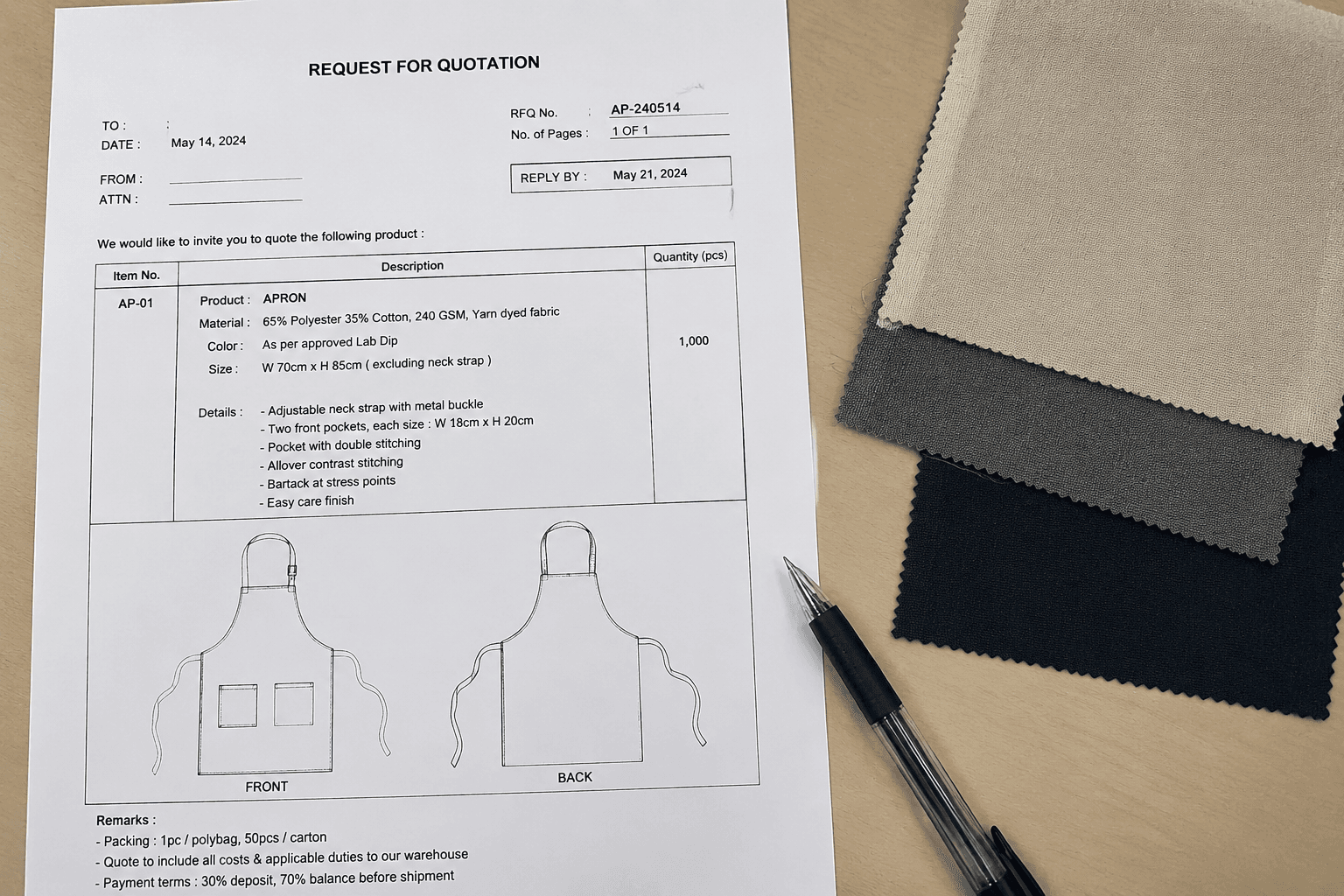
Many buyers begin with a simple design file: black apron, front logo, two pockets. That is enough for a visual quote, but it is not enough for controlled production. A retail staff apron used across many stores needs a specification that defines fabric composition, fabric weight, finished size, strap length, pocket dimensions, thread color, logo size, logo position, packing method, and carton label format. Without these details, two factories can quote the same drawing with very different cost and durability levels.
For example, a 190 GSM poly-cotton twill apron and a 260 GSM cotton canvas apron may look similar in a small digital mockup. In bulk use, they behave differently. The 190 GSM option is lighter, faster drying, and often cheaper by USD 0.25-0.60 per piece at 3,000 pieces, depending on logo process. The 260 GSM cotton canvas option has a firmer handfeel and better perceived quality, but it increases fabric cost, carton weight, and sometimes shrinkage management. Neither is automatically correct. The correct choice depends on store environment, wash cycle, expected service life, and brand position.
A professional apron specification also protects the buyer during reorders. Store uniform programs rarely end after one order. New stores open, staff turnover continues, and regional warehouses need replenishment. If the original order only records a general color name such as navy or forest green, the second order can arrive with visible shade variation. If the original order records Pantone reference, fabric composition, approved lab dip number, logo artwork file, sewing sample, and packing standard, the reorder is much easier to control.
- A complete branded staff apron specification should include finished apron width and length with tolerance, usually +/-1 cm for main body dimensions.
- Pocket placement should be measured from apron top edge and side seam, not described only as center or lower front.
- Logo position should be fixed by distance from top edge or pocket edge, with tolerance usually +/-0.5 cm for print and +/-0.3 cm for woven patch placement.
- Fabric GSM should be tested on bulk fabric, because quoted GSM and finished GSM can differ after dyeing, washing, or coating.
- The approved pre-production sample should be retained by both buyer and factory until final inspection is completed.
Fabric choices for retail staff apron programs
Fabric is the biggest driver of cost, handfeel, wash performance, and visual consistency. For a grocery apron or general retail apron, the most common fabric range is 180-260 GSM. Below 170 GSM, the apron may be too soft for pockets holding scanners, pens, receipt pads, or box cutters. Above 300 GSM, the apron can feel heavy for all-day store use, especially when staff are moving between checkout, stocking, customer service, and food counters.
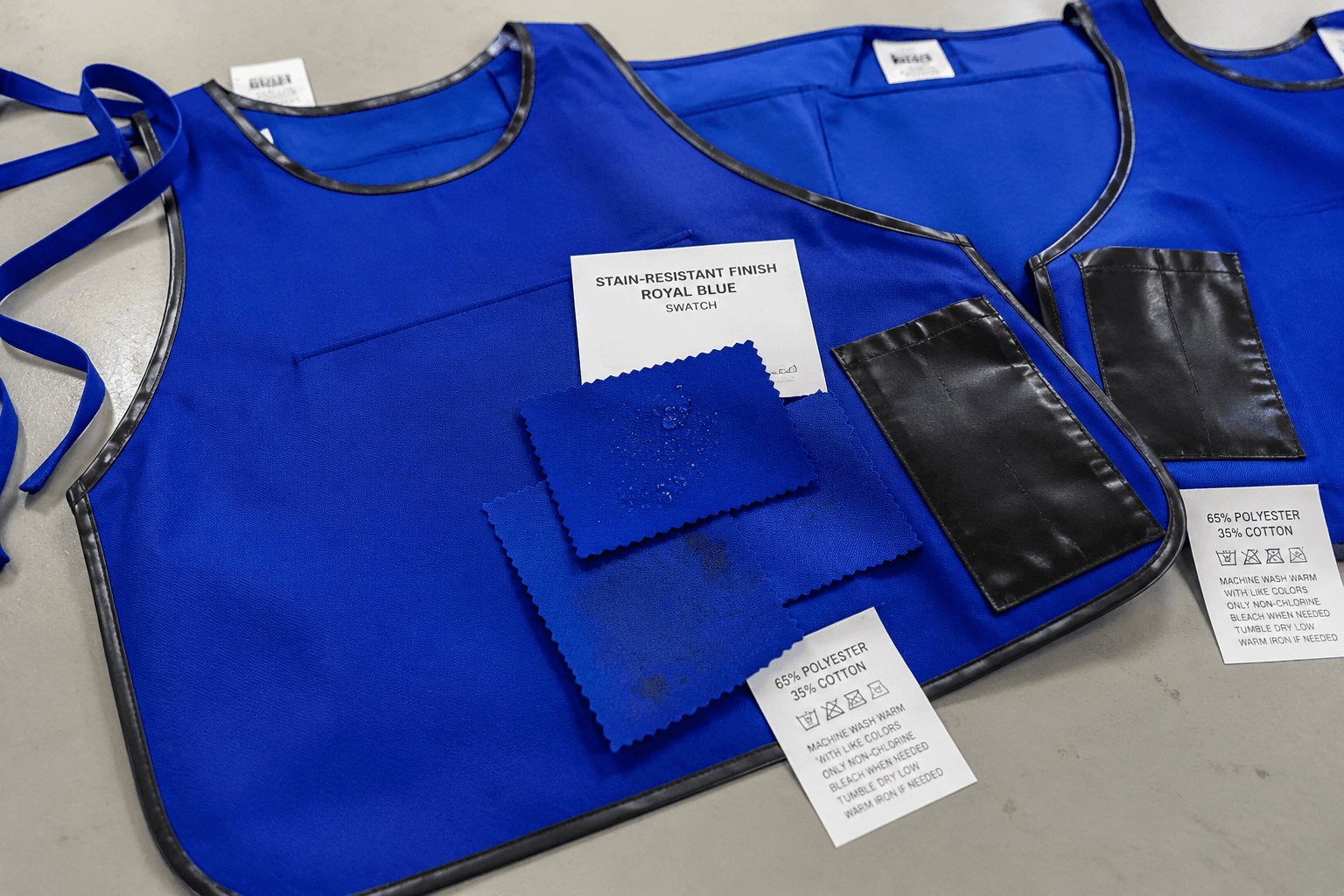
Poly-cotton twill is often the practical middle ground for chain retail. A 65/35 polyester-cotton twill at 200-240 GSM offers good colorfastness, less wrinkling than pure cotton, and reasonable cost. Cotton canvas gives a more natural texture and is preferred by some bakery, coffee, organic grocery, and lifestyle retail brands, but it may shrink 3-5% if not sanforized or pre-shrunk. Polyester Oxford or microfiber can be used when the apron needs water resistance or very fast drying, but the appearance is more functional and less traditional.
For buyers comparing quotes, it is important to confirm whether the fabric is stock fabric or custom dyed. Stock fabric can support lower MOQ and faster sampling, often 7-12 days for sample and 20-30 days for bulk after approval if the fabric is available. Custom dyeing usually requires 500-1,000 meters per color, sometimes more for special fabric constructions, and adds 7-15 days before cutting. A small price difference at quotation stage may hide a large operational difference when rollout timing is tight.
- 180-200 GSM poly-cotton twill is suitable for light retail duty, promotional store campaigns, and lower-cost bulk uniform apron orders.
- 220-240 GSM poly-cotton twill is a common balance for grocery, pharmacy, convenience, and general merchandise staff uniforms.
- 240-280 GSM cotton canvas works well for premium grocery, bakery, coffee, garden, and lifestyle retail concepts where texture matters.
- 210-300D polyester Oxford is useful for wet counters, flower departments, cleaning tasks, or value programs needing wipe-clean performance.
- Denim from 6 oz to 10 oz can work for fashion retail and specialty food, but indigo bleeding and shade variation must be managed carefully.
Retail staff apron construction details that affect daily use
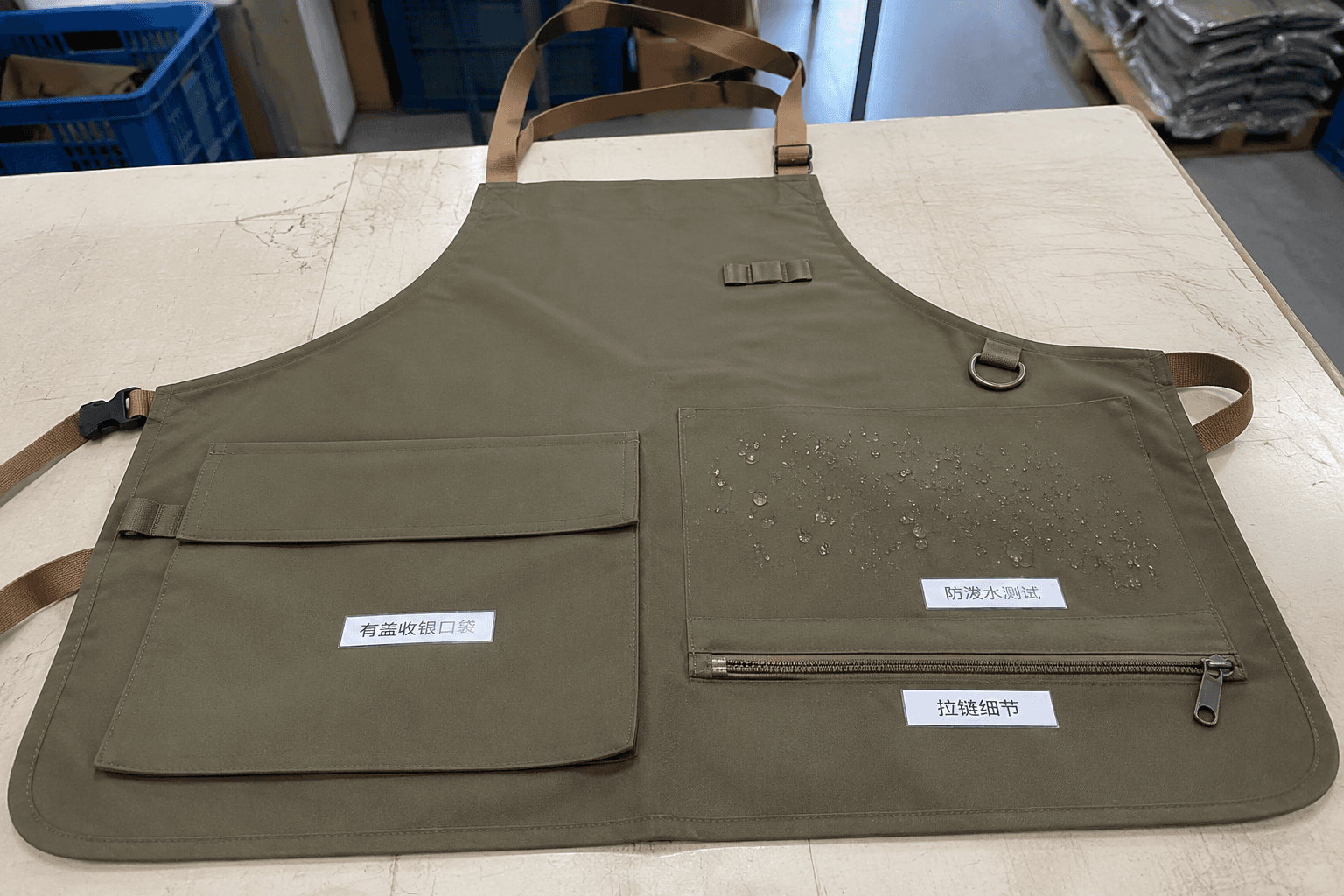
Construction details are easy to miss during sourcing because they are less visible than logo and color. In store use, they are often the reason an apron is accepted or rejected by staff. Neck straps that are too narrow can dig into the neck. Waist ties that are too short cannot fit heavier staff or layered winter uniforms. Pockets without bartacks can tear at the top corners after repeated use. A retail staff apron should be designed around real movements: bending, lifting cartons, reaching shelves, leaning over checkout counters, and walking between departments.
A common full-bib retail apron size is approximately 70 cm wide by 80-90 cm long. For grocery and food retail, 70 x 85 cm is a practical starting point. Shorter aprons around 70 x 75 cm may suit convenience stores and cashiers who need more leg movement. Waist aprons are usually 45-70 cm wide by 30-45 cm long, depending on whether the store needs pockets for small tools or only pens and receipts. Adjustable neck straps are strongly recommended for chain staff because one fixed neck loop rarely fits all body types.
Stitching should be specified clearly. For most retail programs, 8-10 stitches per inch is acceptable for main seams, with reinforced bartacks at pocket openings, tie attachment points, and adjustable buckle ends. Binding tape or double-folded hems prevent raw edge fraying. If the apron uses metal eyelets, rivets, D-rings, or buckles, they should be checked for rust resistance and wash compatibility. Nickel-free metal may be required for some markets or brand compliance rules.
- Use waist ties of 90-100 cm each for standard adult retail aprons; extend to 105-110 cm if staff will wear jackets underneath.
- Use neck tape width of at least 2.5 cm for comfort; 3.0-3.8 cm is better for heavier canvas aprons.
- Add bartacks at pocket top corners, waist tie joints, neck strap joints, and stress points around hardware.
- Specify pocket depth of 16-22 cm for pens, scanners, receipt books, or compact tools, depending on department use.
- Avoid overly deep center pockets for grocery staff if small items can fall to the bottom and slow down work.
Branding options for a branded staff apron
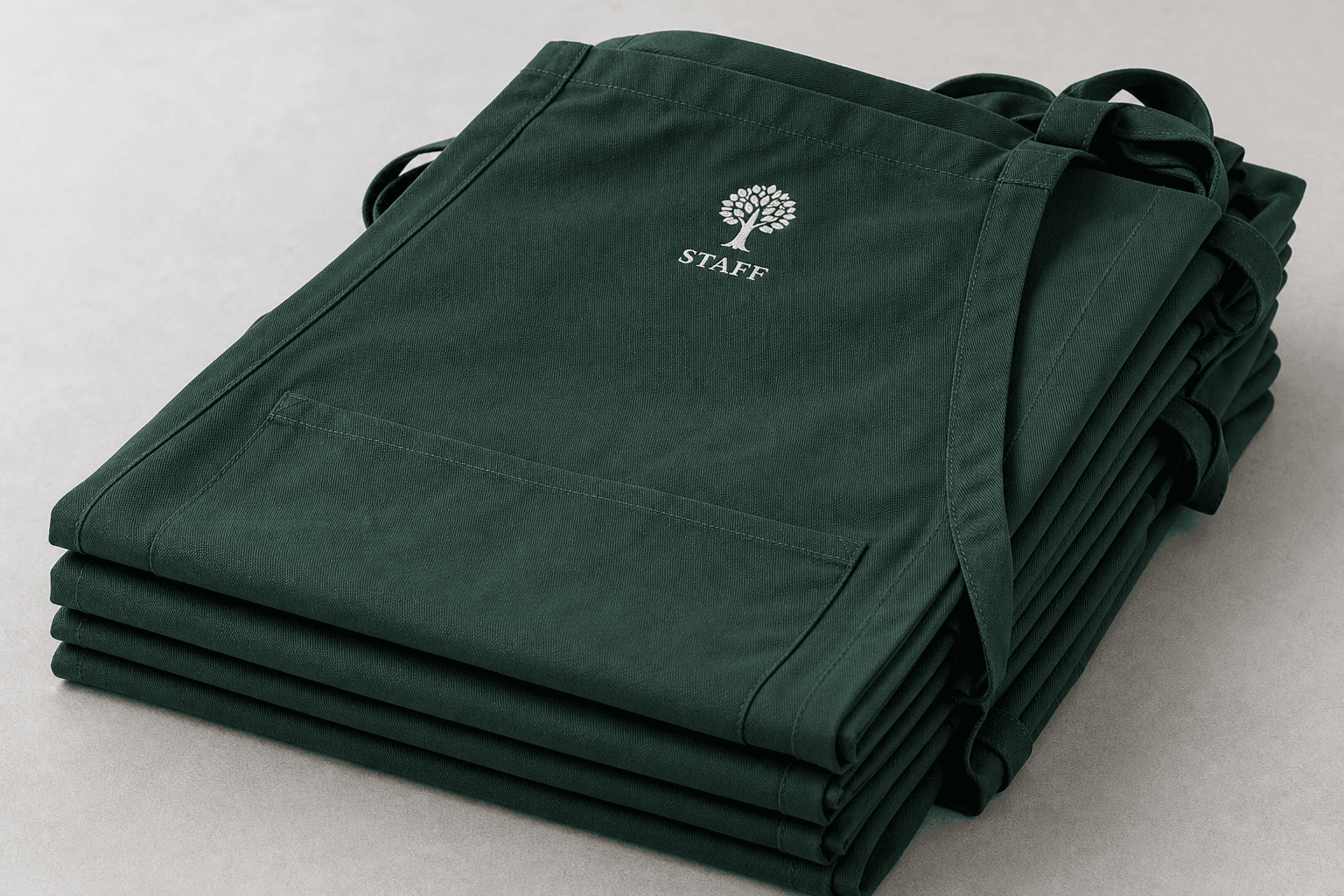
The branding method should be chosen according to logo size, color count, fabric type, washing requirement, and budget. Embroidery has a durable and professional appearance, especially for small chest logos and name-area branding. However, embroidery cost rises with stitch count, and dense embroidery can make lightweight fabric pucker. For a 7 x 3 cm left chest logo, embroidery may be economical. For a 25 cm wide front logo, screen printing or heat transfer is usually more suitable.
Screen printing is efficient for larger order quantities and simple logos. At 1,000-5,000 pieces, a one-color screen print on twill or canvas can be a cost-effective choice, often adding around USD 0.12-0.35 per piece depending on print size and ink type. Multi-color screen printing needs more screens and better registration control. Heat transfer is useful for gradients, small runs, and detailed artwork, but buyers should request wash tests because low-quality transfer can crack or peel after repeated laundering.
Woven patches, PU patches, and rubber badges are also used for retail programs when the brand wants a removable-looking label effect or premium detail. These methods add material MOQ and sewing time. A woven patch may require 500-1,000 pcs minimum per design, while rubber badges often need mold charges, commonly USD 50-150 depending on size and complexity. For chain retail, the simplest durable method is often the best: one approved logo position, one approved color, and one repeatable application method.
- Embroidery is best for small logos, department marks, and premium store uniform apron designs where texture is valued.
- Screen print is best for simple large logos, campaign aprons, and bulk grocery apron production with stable color artwork.
- Heat transfer is best for complex artwork or lower quantities, but it should pass washing and rubbing tests before rollout.
- Woven patch is best for a sewn-label look, but edge quality, placement, and patch color must be controlled tightly.
- Reflective print or tape can be considered for warehouse-adjacent retail staff, delivery pickup zones, or parking-lot collection roles.
Cost structure and MOQ for bulk uniform apron orders
A bulk uniform apron quote is built from fabric, cutting, sewing, logo application, trims, packing, inland transport, export handling, and factory margin. The sewing itself is only one part of the cost. Buyers often compare unit price without checking whether one quote includes custom dyeing, individual polybags, barcode stickers, metal hardware, or carton sorting by store. These items can move the real price by USD 0.05-0.50 per piece, and sometimes more.
For a basic 220 GSM poly-cotton retail staff apron with one-color front screen print, a realistic FOB China price at 3,000 pieces may fall around USD 1.80-3.20 per piece depending on size, fabric market price, order complexity, and compliance requirements. A heavier 260 GSM cotton canvas apron with embroidery, adjustable hardware, two large pockets, and individual retail-style packing may fall around USD 3.20-5.80 per piece. Very low prices below USD 1.50 usually involve lighter fabric, simplified sewing, stock colors, limited inspection tolerance, or large order volume.
MOQ depends on the bottleneck. If the apron uses stock black poly-cotton twill and screen print, some factories can accept 300-500 pieces per design, especially for sample orders or replenishment. If the color is custom dyed, the MOQ may be tied to fabric dye lot, often 1,000-2,000 aprons depending on fabric width and apron size. If the logo uses a custom rubber patch or jacquard tape, the trim supplier MOQ may control the order. Buyers should ask separately for garment MOQ, fabric MOQ, and trim MOQ to avoid surprises after sampling.
- 300-500 pcs may be possible for stock-color aprons with simple print, but unit cost will be higher.
- 1,000-3,000 pcs is a practical range for custom color or chain-store uniform programs with better price stability.
- 5,000-20,000 pcs allows better fabric utilization, print efficiency, and carton-level distribution planning.
- Custom-dyed fabric usually adds 7-15 days before cutting and may require lab dip approval before bulk production.
- Store-level packing, barcode labels, and mixed-size cartons should be quoted separately because they add labor and checking time.
Sampling, approval, and lead time for a retail staff apron rollout
A controlled apron rollout should include at least three approval stages: digital artwork confirmation, physical sample approval, and pre-production sample approval. The first sample confirms size, fabric handfeel, pocket layout, and logo method. The pre-production sample confirms the final bulk materials after lab dip, fabric booking, trim sourcing, and logo setup. Skipping the pre-production sample can save a few days but increases risk when the order quantity is large or the apron will be distributed to many store locations.
Typical sample lead time is 5-10 days when using stock fabric and simple logo methods. Embroidery samples may need 2-4 days for digitizing and trial stitching. Custom-dyed fabric sampling can require 10-18 days because lab dips must be reviewed first. After sample approval and deposit, bulk lead time is often 25-40 days for 1,000-10,000 pieces. Larger orders, complex packing, or third-party inspection may extend the schedule to 45-60 days. Before peak retail seasons, buyers should reserve additional time because fabric mills, dye houses, and logo workshops may be fully booked.
Approval comments should be measurable. A note such as make pocket higher is less useful than raise top edge of pocket by 3 cm. A comment such as logo too small should become change logo width from 8 cm to 10 cm. The factory can control numbers. Vague comments often create repeated samples and lost time. For brand buyers managing several departments, it is also helpful to approve one master apron and then approve department-specific logo or color variations against the same construction standard.
- Allow 5-10 days for a stock-fabric sample with simple print or embroidery.
- Allow 10-18 days when lab dip approval is needed before sample cutting.
- Allow 25-40 days for normal bulk production after sample approval and deposit.
- Allow 45-60 days for large chain rollouts, complex packing, multiple colors, or third-party inspection.
- Freeze artwork, fabric, and packing rules before bulk cutting to prevent partial rework and delivery delay.
Quality control points for grocery apron and retail uniform orders
Quality control for a grocery apron is not only checking whether the apron looks clean. The inspection should focus on function, repeatability, and brand consistency. For food and grocery environments, loose threads, unstable dye, poor pocket reinforcement, and sharp hardware are more serious than small cosmetic differences. If the apron will be worn near fresh food counters, bakery areas, or deli stations, buyers may also require restricted substances compliance, colorfastness reports, or food-contact-adjacent safety documentation depending on market rules.
The most useful inspection points are simple and measurable. Finished apron length and width should be checked against approved tolerance. Pocket sizes should be measured because small pocket variation can affect scanner or tool use. Logo size and placement should be checked across cartons, not only on the top pieces. Sewing strength should be reviewed at waist ties, neck strap joints, and pocket corners. For dark colors such as black, navy, red, and green, rubbing colorfastness should be checked because dye transfer onto shirts is a common complaint in retail uniform programs.
Packing inspection matters because retail aprons often ship to distribution centers, not directly to one buyer office. If carton assortment is wrong, a store may receive 30 black aprons instead of 20 black and 10 green, or English barcode stickers may be missing for warehouse scanning. These are not sewing defects, but they create operational cost. A good factory will treat packing instructions as part of the production specification, not as an afterthought in the last two days before shipment.
- Check fabric GSM, composition, color shade, and handfeel against approved sample before cutting bulk fabric.
- Inspect logo size, position, color, edge sharpness, and wash resistance according to the approved branding method.
- Measure apron body, neck strap, waist ties, and pockets using a clear tolerance table.
- Pull-test tie attachments and pocket corners during inline inspection, especially for aprons with loaded tool pockets.
- Verify carton quantity, polybag marking, barcode stickers, store allocation, and shipping marks before final carton sealing.
Reorder planning for retail staff apron consistency
The first order is only the beginning of a uniform program. Staff turnover, new branches, seasonal campaigns, and damaged garments all create repeat demand. Reorders are where many apron programs lose consistency. The fabric mill may no longer hold the same stock shade. A print workshop may use a slightly different ink mix. A new merchandiser may interpret the old specification differently. These issues are preventable if the buyer and factory build a clear reorder file from the first production.
For a stable retail staff apron program, the factory should keep the approved sample, pattern, logo file, fabric reference, trim references, and packing photos. The buyer should keep the same information internally so a reorder does not depend only on one employee's email history. If annual volume is predictable, reserving fabric or scheduling repeated production windows can reduce lead time. For example, instead of placing one urgent 8,000-piece order every year, a buyer may plan two 4,000-piece production runs with 60-90 days forecast notice. This reduces pressure on dyeing and inspection and can improve shade control.
When a chain operates in multiple countries, local labeling and packing differences should be planned at the SKU level. The physical apron can remain the same while care labels, carton marks, language stickers, or barcode formats differ. Keeping the apron construction common and separating market-specific packing details is usually more efficient than creating too many garment variations. The best long-term cost saving is not always the lowest first unit price; it is a repeatable branded staff apron system with fewer corrections, fewer late shipments, and fewer store complaints.
- Keep one sealed production sample from each bulk order for comparison with future reorders.
- Record Pantone references, lab dip number, fabric mill reference, GSM, composition, and approved logo method.
- Use the same pattern code and measurement table for all reorder quotations and purchase orders.
- Forecast replenishment 60-90 days ahead when custom dyeing, special trims, or store-level packing is required.
- Separate apron design SKUs from packing-market SKUs when the garment is identical but labels or cartons differ.