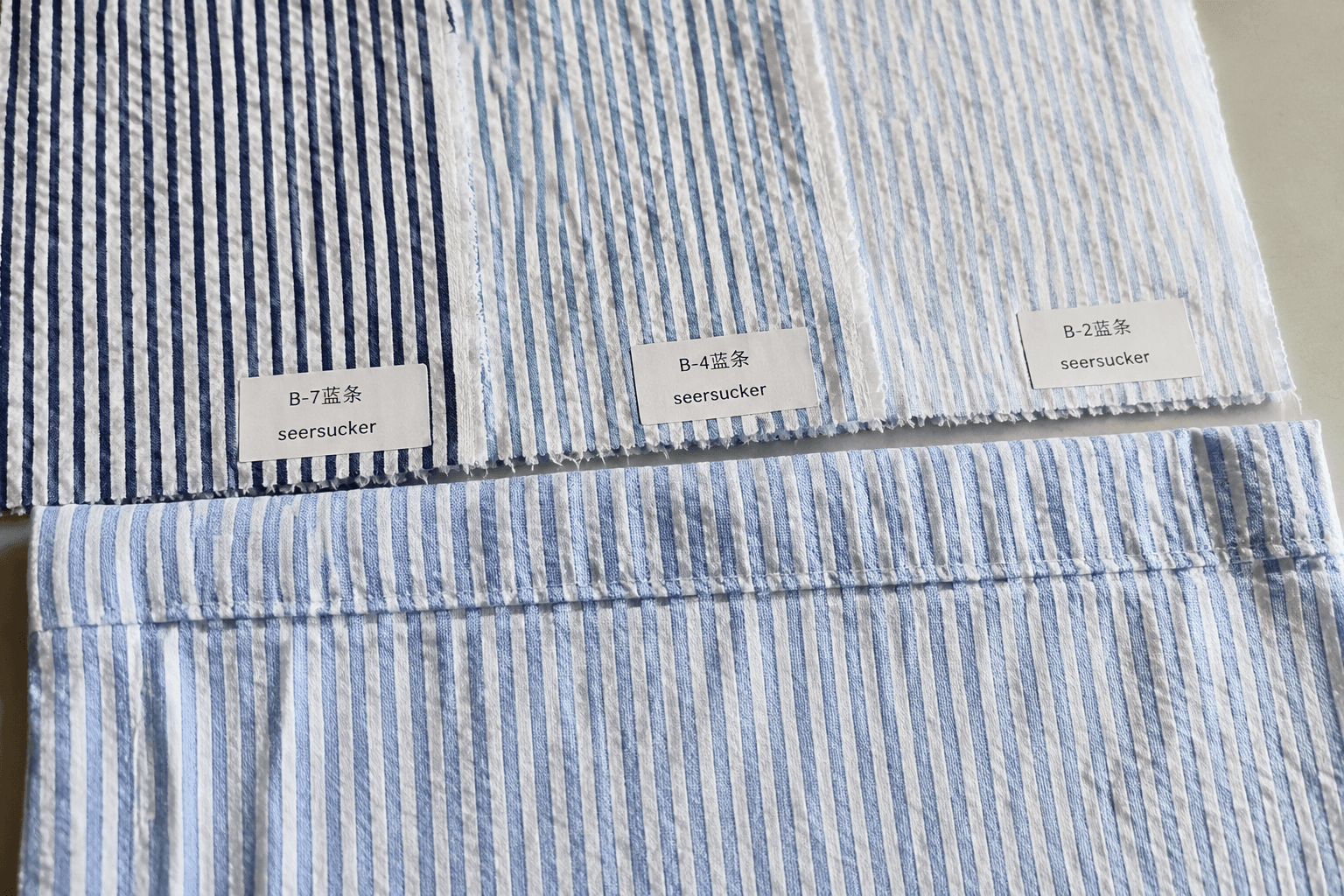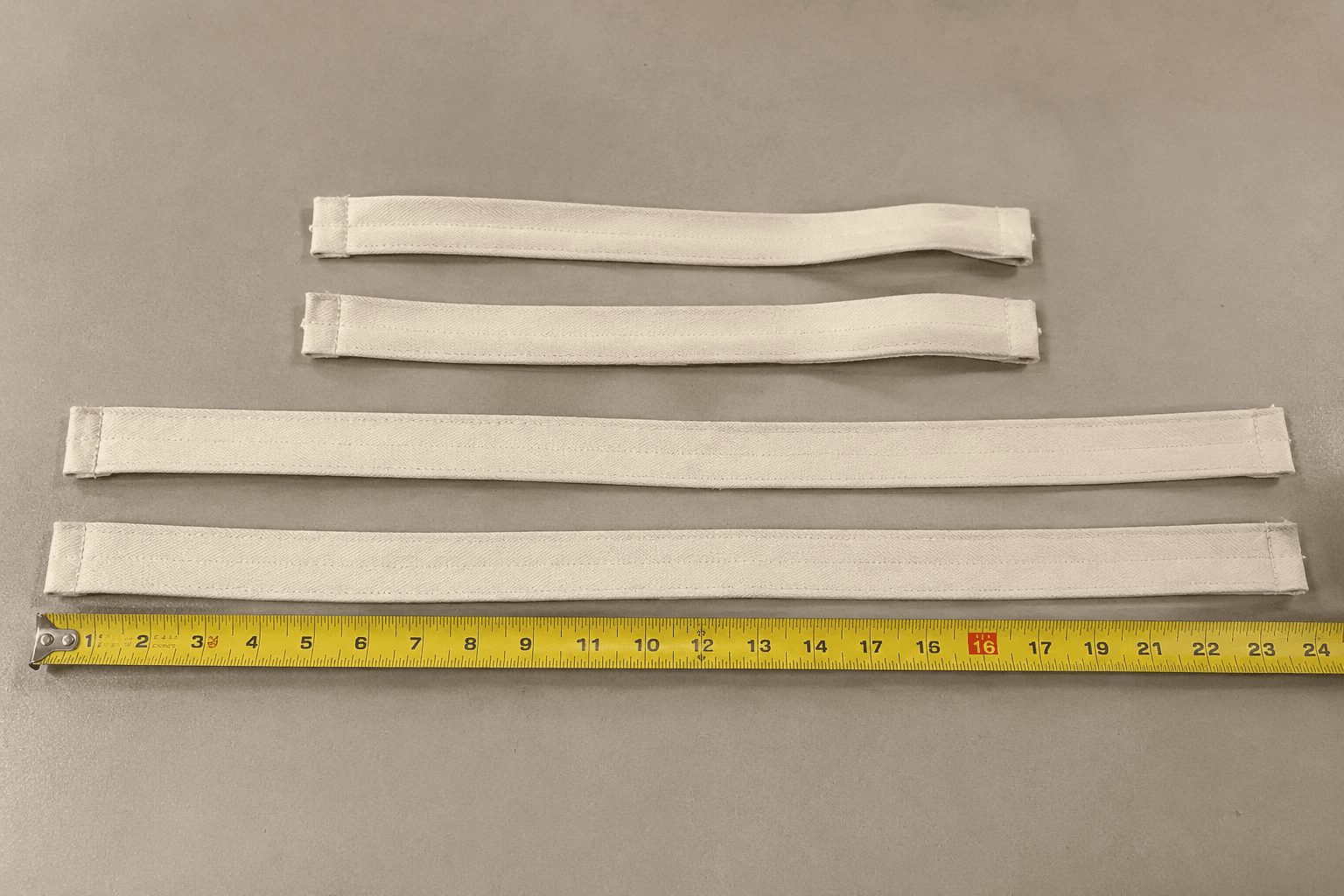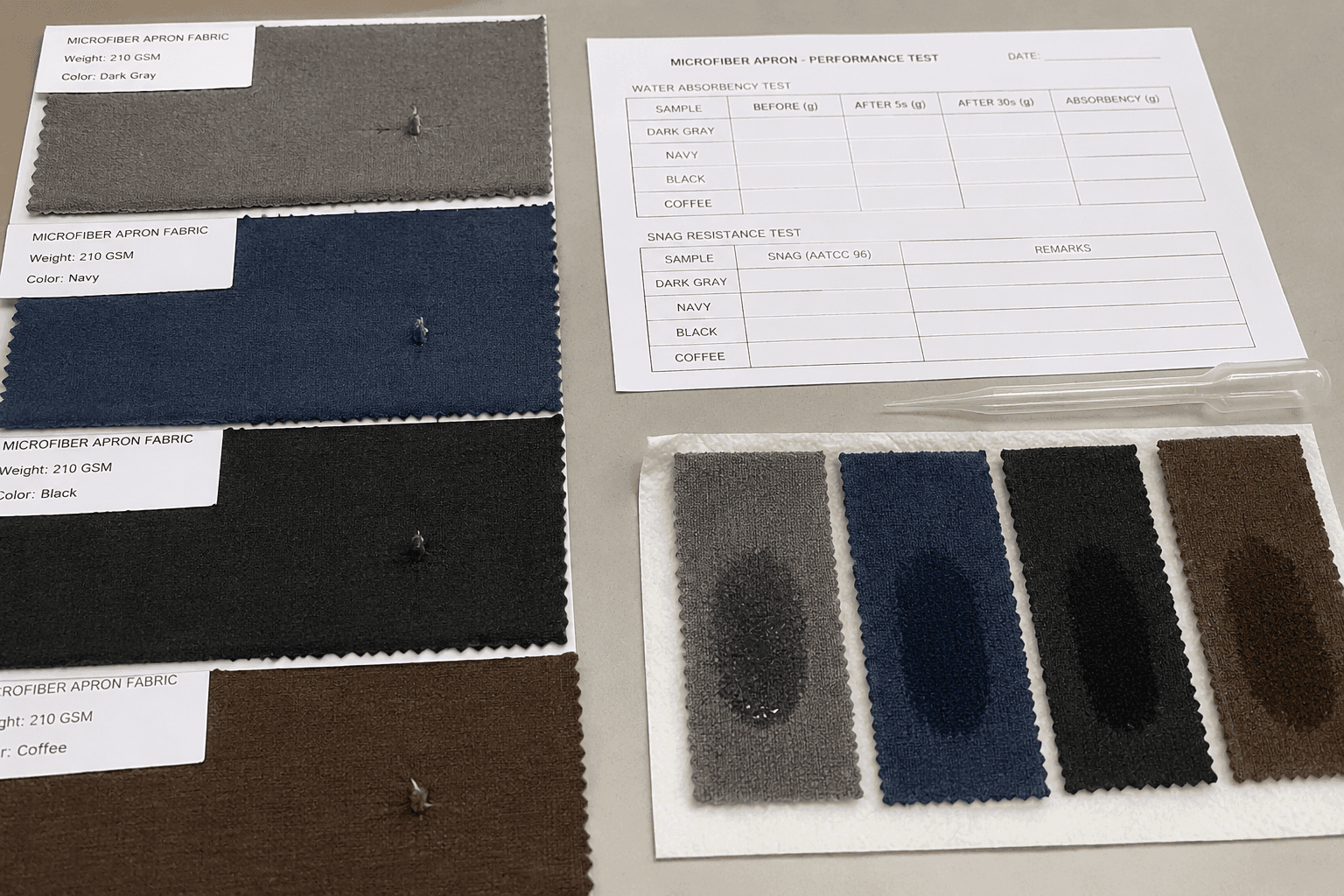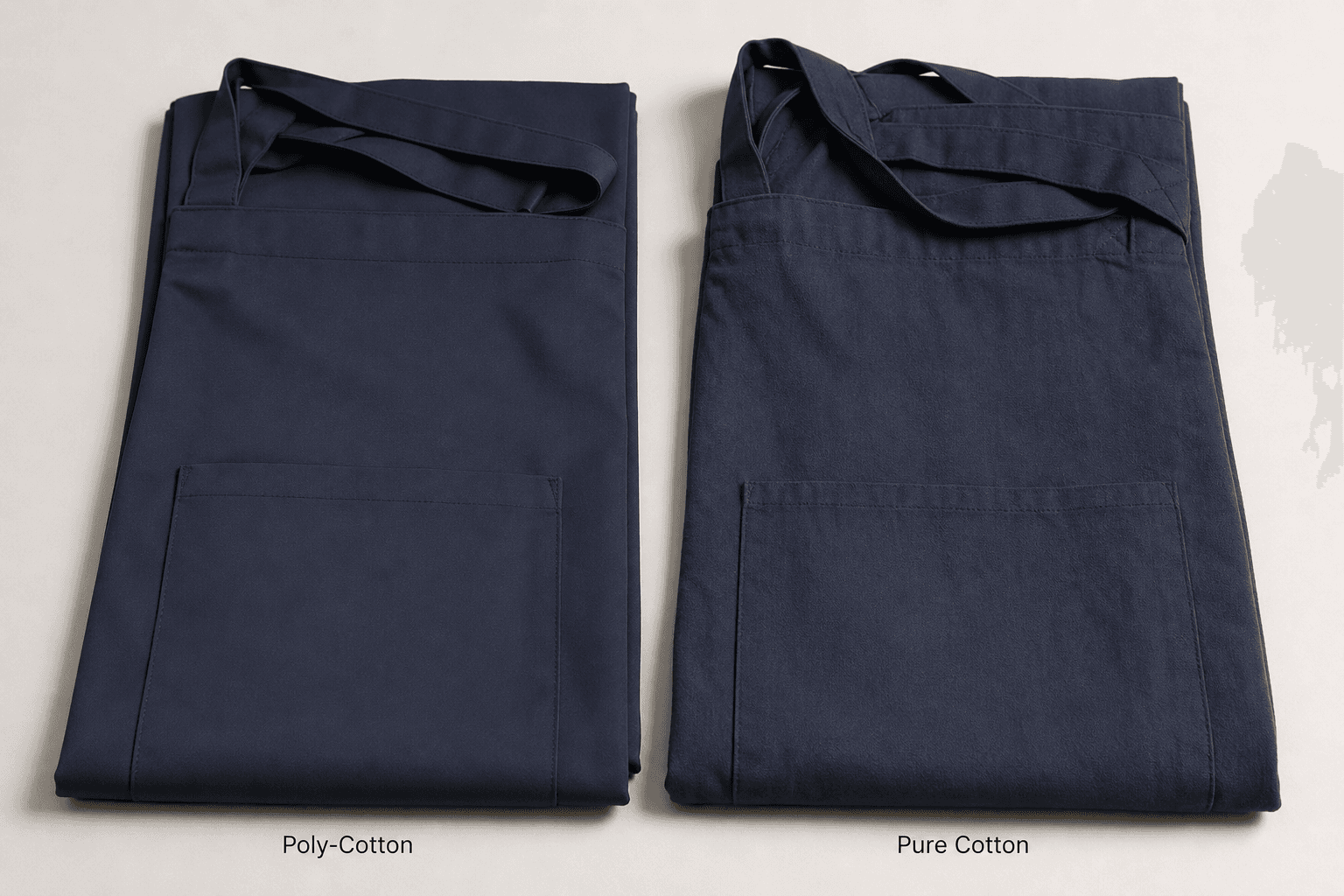
For apron sourcing, the choice between poly-cotton and pure cotton is rarely a simple material preference. It affects unit cost, shrinkage allowance, color stability, ironing workload, embroidery quality, packing volume, care labeling and after-sales complaints. A buyer ordering 3,000 to 50,000 custom aprons from China should treat fabric composition as a production decision, not only a merchandising decision.
In our factory quotation work, the most common comparison is poly cotton vs cotton apron for restaurant chains, coffee shops, kitchenware brands, promotional distributors and workwear suppliers. A poly cotton apron is usually more stable in washing and easier to maintain, while a pure cotton apron gives a more natural hand feel and a stronger premium impression. The best choice depends on how the apron will be worn, washed, branded and priced.
This apron fabric comparison uses practical factory ranges: common GSM, fabric weights, shrinkage behavior, MOQ impact, lead-time differences and approximate FOB cost gaps. Exact figures still depend on yarn price, dyeing method, apron size, pocket structure, logo method, packaging and order quantity.
- Poly-cotton is usually 8% to 18% lower in apron fabric cost than comparable pure cotton at the same GSM range.
- Pure cotton feels softer and more breathable, but it normally has higher shrinkage and wrinkling risk after commercial washing.
- A tc fabric apron is stronger for daily uniform programs where easy care, shape retention and repeat washing matter more than a natural cotton story.
- Pure cotton aprons suit retail, bakery, chef and lifestyle collections where hand feel, texture and perceived value can justify a higher FOB price.
- Pre-shrinking, colorfastness testing and wash testing should be confirmed before bulk cutting, especially for dark colors and heavy cotton canvas.
- The lowest quoted price is not always the lowest landed cost if wrinkling, shrinkage, re-ironing or customer returns increase handling cost.
Poly cotton vs cotton apron: what the fabric difference means in production
In apron manufacturing, poly-cotton usually means a blend of polyester and cotton yarns, commonly 65/35, 80/20 or 60/40. A tc fabric apron often refers to polyester-cotton fabric, especially 65% polyester and 35% cotton. Pure cotton apron fabric is normally 100% cotton twill, plain weave, duck, canvas or denim. The composition changes how the fabric behaves during dyeing, cutting, sewing, washing and daily use.
For bulk apron programs, the most used poly-cotton fabrics are 180 to 240 GSM twill for waist aprons and bib aprons, and 240 to 280 GSM for more structured service uniforms. Pure cotton aprons often start around 200 GSM for lighter kitchen use and go up to 320 to 420 GSM for canvas, denim or workwear styles. If a buyer compares only GSM, the comparison can be misleading. A 240 GSM poly cotton apron may feel smoother and more uniform, while a 240 GSM cotton apron may feel fuller but wrinkle more easily.
From the factory side, poly-cotton is more forgiving. It is less likely to distort during cutting, generally has better dimensional stability, and often gives more consistent bulk results from batch to batch. Cotton gives a more natural surface and better story for premium positioning, but it requires stricter control of shrinkage, dye lot, twisting and pressing.
- Typical poly-cotton apron fabric is 180-280 GSM for food service, hospitality and promotional uniform programs.
- Typical pure cotton apron fabric is 200-420 GSM, with heavier qualities used for canvas, denim and premium retail styles.
- A 65/35 tc fabric apron normally offers better wrinkle recovery than 100% cotton twill at similar weight.
- Pure cotton needs more attention to shrinkage tolerance before cutting, especially for full bib aprons with long ties.
Cost structure: fabric price, cutting loss and realistic FOB gaps
For a standard bib apron, fabric normally represents the largest cost component after labor, especially when the design is simple. A basic adult bib apron may consume around 0.55 to 0.75 meters of 150 cm wide fabric, depending on body size, neck strap, waist ties, pockets and marker efficiency. A waist apron may consume 0.35 to 0.55 meters. When comparing poly cotton vs cotton apron, the fabric price difference is multiplied across every piece, so even a small RMB-per-meter gap becomes meaningful at 10,000 pieces.
As a practical range, a 200-220 GSM poly-cotton twill may be 8% to 18% cheaper than an equivalent cotton twill in a normal market. Heavy cotton canvas, enzyme-washed cotton or dyed denim can be 20% to 45% higher than basic tc fabric. For a simple bib apron with one front pocket, the FOB difference between poly-cotton and pure cotton can be around USD 0.18 to USD 0.55 per piece at 3,000 to 10,000 pcs, depending on fabric weight and finishing. For heavier premium cotton, the gap can exceed USD 0.80 per piece.
Buyers should also consider waste and rework. Cotton fabric with higher shrinkage or skew may require additional allowance or more careful cutting. Dark cotton shades may need extra dyeing control or washing tests. Poly-cotton usually improves cutting efficiency and reduces pressing time before packing. This does not mean poly-cotton is always the better commercial choice, but it normally gives a more predictable cost base for uniform programs.
- Basic poly-cotton bib apron FOB range can start around USD 1.20-2.20 per pc for high-volume simple designs, depending on fabric and packaging.
- Basic pure cotton bib apron FOB range is often around USD 1.45-2.90 per pc for similar construction and quantity.
- Heavy cotton canvas aprons with reinforced pockets, metal eyelets or cross-back straps commonly move into USD 3.20-6.50 per pc.
- At 10,000 pcs, a USD 0.30 fabric-related difference equals USD 3,000 before freight, duty and local handling.
Comfort and wearing experience in restaurants, cafes and kitchens
Comfort is where pure cotton remains strong. Cotton absorbs moisture better, feels more natural against clothing and skin, and has a softer surface after repeated laundering. For chefs, bakers, baristas and retail staff wearing aprons for 6 to 10 hours per shift, cotton can feel less synthetic and more breathable, especially in warm kitchens. This is one reason cotton aprons are common in bakery, coffee, florist and lifestyle retail programs.
A poly cotton apron is not uncomfortable by default. A 65/35 or 60/40 blend at 200-240 GSM can be practical for front-of-house uniforms, catering teams and quick-service restaurants. Polyester improves strength and shape retention, while cotton content improves hand feel compared with 100% polyester. For staff who wear the apron over a T-shirt or uniform shirt, the difference may be acceptable, especially when the apron is not too heavy.
The important point is matching weight to use. Some buyers choose 300 GSM cotton canvas for premium appearance, then receive staff feedback that the apron feels too warm or stiff during long shifts. A lighter 240 GSM cotton twill or 220 GSM poly-cotton twill may perform better in daily service. For workwear-style aprons with tools in pockets, heavier fabric is useful. For restaurant dining service, too much weight becomes fatigue.
- Choose 180-220 GSM poly-cotton for light service aprons, promotions and short-wear events.
- Choose 220-260 GSM poly-cotton or cotton twill for daily restaurant and cafe uniforms.
- Choose 280-420 GSM cotton canvas or denim for premium retail, workshop, bakery or barista aprons where structure matters.
- Avoid specifying heavy canvas only for appearance if the apron will be worn through hot kitchen shifts.
Care performance: wrinkle resistant apron requirements and shrinkage control
Care performance is one of the biggest reasons chain buyers select poly-cotton. A wrinkle resistant apron is easier to process after washing, especially when laundries handle hundreds or thousands of units per week. Poly-cotton dries faster than cotton, creases less, and generally needs less ironing. For restaurants and hotels, this can reduce labor time even if the fabric saving is not the main concern.
Pure cotton is more sensitive. Normal cotton twill may shrink 3% to 6% after washing if not pre-shrunk, and heavier cotton canvas can show more noticeable shrinkage, twisting or puckering if fabric quality and washing method are not controlled. Pre-shrunk or sanforized cotton can reduce the problem, but it adds cost and may increase fabric lead time. For apron sizes with long neck straps and waist ties, shrinkage can affect fit and tying comfort.
For export orders, care labels should be realistic. If the apron is dark cotton and the buyer expects hot washing at 60 degrees C plus tumble drying, the factory should test before confirming bulk. A nice sample washed only once by hand is not enough evidence for a commercial laundry program. We normally recommend at least three wash cycles for approval, and five cycles for chain uniform programs where dimensional stability is critical.
- Poly-cotton shrinkage is commonly around 1% to 3% after standard washing, depending on construction and finishing.
- Pure cotton shrinkage is commonly around 3% to 6%, and can be higher without pre-shrink treatment.
- Dark cotton shades should be checked for colorfastness to washing, rubbing and perspiration before bulk approval.
- For commercial laundry, test the finished apron, not only the fabric swatch, because seams, pockets and straps may react differently.
Branding, printing and embroidery on poly cotton apron and pure cotton apron styles
Logo method can influence fabric choice as much as price. Embroidery works well on both poly-cotton and pure cotton, but the fabric weight and stability matter. A 200 GSM tc fabric apron can support small chest embroidery if backing is used correctly. For large embroidery or dense logos, 240 GSM and above usually gives a cleaner result. Heavy cotton canvas supports embroidery well but may create a more rugged, less refined look depending on the thread and artwork.
Screen printing and heat transfer need separate attention. Cotton accepts many pigment and reactive print effects well, and buyers often prefer cotton for vintage, washed or natural-looking prints. Poly-cotton can print cleanly, but ink system and curing temperature must be matched to the polyester content. Heat transfer on poly-cotton is common for promotional aprons, but poor transfer quality can crack or peel after washing. For food service uniforms, we prefer embroidery or durable screen print over low-cost transfer when the apron will be laundered frequently.
Color appearance is also different. Cotton usually gives a deeper, more natural matte color. Poly-cotton can look slightly smoother or brighter, depending on dyeing. For black aprons, poly-cotton may hold appearance better after repeated washing, while cotton may fade into a softer charcoal tone. Some brands like this fading because it looks authentic; chain buyers often dislike it because uniforms no longer match across locations.
MOQ, lead time and sampling differences for apron fabric comparison
MOQ depends on whether the buyer accepts available fabric or requires custom dyeing. For standard black, navy, white, khaki and red poly-cotton twill, fabric is often available from stock or short-lead dyeing. This supports lower MOQ, faster sampling and more stable reorder timing. For pure cotton, especially heavy canvas, yarn-dyed stripe, denim, enzyme wash or custom Pantone dyeing, MOQ and lead time are usually higher.
For a normal custom apron order, sample lead time is often 5 to 7 days if fabric is available, and 10 to 15 days if the fabric must be sourced or dyed. Bulk lead time is commonly 25 to 35 days after sample approval for 3,000 to 10,000 pcs using available fabric. Custom dyed fabric may add 7 to 15 days. Washed cotton aprons can add another 5 to 10 days because garment washing, drying, inspection and re-pressing take time.
Buyers should check the fabric plan before approving a price. A very low quote may rely on market stock fabric that cannot be repeated in the next order. This can be acceptable for one-time promotion, but it is risky for a chain uniform program. For repeat business, it is better to confirm composition, GSM tolerance, color standard, shrinkage standard and fabric supplier route.
- Available poly-cotton fabric can support apron MOQ around 500-1,000 pcs per color in many standard designs.
- Custom dyed poly-cotton or pure cotton usually needs 1,000-3,000 pcs per color to be efficient.
- Heavy cotton canvas, denim or yarn-dyed fabric may require 2,000-5,000 pcs per color depending on mill MOQ.
- Standard bulk lead time is often 25-35 days after approval, while custom fabric or garment washing can push this to 40-55 days.
When to choose a tc fabric apron, and when pure cotton is worth the premium
A tc fabric apron is usually the sensible choice for high-volume uniform programs where the buyer needs stable cost, easy care and repeatable appearance. Quick-service restaurants, hotel housekeeping, catering teams, school kitchens and promotional distributors often value wrinkle recovery and low shrinkage more than a fully natural fiber claim. In these cases, a 200-240 GSM 65/35 poly-cotton twill gives a practical balance of price, durability and comfort.
Pure cotton is worth the premium when the apron is part of the brand experience. Coffee roasters, bakeries, chefwear labels, home kitchen retailers and premium hospitality brands often choose cotton because the texture supports the product story. Cotton canvas, cotton twill and cotton denim can look better in product photography and feel more substantial in hand. For retail packaging, that first touch matters.
The risk is over-specification. A buyer may request 100% cotton, 320 GSM, garment wash, metal hardware, cross-back straps and individual kraft box packaging, then discover the target retail margin does not work. It is better to build the apron from the intended retail price or uniform budget backward. If the target FOB is under USD 2.00, poly-cotton or lighter cotton twill is usually more realistic. If the target FOB is USD 3.50 and above, premium cotton options become more workable.
- Choose poly-cotton for chain uniforms, catering, hotels, schools, promotions and programs with strict laundering needs.
- Choose pure cotton for premium retail, bakery, barista, chef, handmade-style and lifestyle apron collections.
- Use 65/35 tc fabric when the buyer needs a wrinkle resistant apron with good cost control.
- Use 100% cotton canvas or denim when texture, natural fiber positioning and premium hand feel are more important than ironing time.
Factory recommendation for bulk buyers comparing poly cotton vs cotton apron options
For most B2B apron sourcing projects, we recommend approving two or three fabric options before final costing. For example, request one 220 GSM 65/35 poly-cotton twill, one 240 GSM 100% cotton twill and one 300 GSM cotton canvas if the design is premium. Make the same apron pattern in each fabric, then compare weight, drape, pocket stability, logo appearance, washing result and packed size. This gives a more reliable decision than judging loose swatches.
The factory should provide fabric composition, GSM tolerance, shrinkage range, colorfastness target, sample lead time, bulk lead time and MOQ by color. The buyer should provide expected washing method, target FOB, order quantity, packaging method, logo artwork and required delivery date. Without these details, the quotation may look precise but still be commercially weak.
In practical terms, poly-cotton wins when the apron must be consistent, affordable and easy to maintain. Pure cotton wins when the apron must feel natural, look premium and support a stronger brand position. The correct answer is not one fabric for all projects. The correct answer is the fabric that protects the buyer's margin, staff experience and reorder stability at the same time.