For a nail salon apron or esthetician apron, the buyer is not only choosing a uniform style. The apron has to handle acrylic powder, gel polish, cuticle oil, wax residue, brow tint, disinfectant spray and frequent laundering, while still looking clean in front of clients. In bulk production, the real sourcing question is how to balance stain resistance, wearer comfort, fit range and unit cost without creating a garment that feels plastic or looks cheap.
From a factory point of view, beauty service aprons sit between hospitality aprons and light protective workwear. They need better surface performance than a basic café apron, but they cannot be as stiff as industrial PVC-coated aprons. Most successful programs use 160-240 GSM woven fabrics with a stain-shedding finish, reinforced pocket construction and adjustable neck or cross-back systems. The final specification depends on whether the apron is used mainly for nail stations, facial rooms, waxing, lash service or mixed spa work.
This article explains practical sourcing choices for a nail salon apron, esthetician apron and spa technician apron program: fabric weights, coatings, fit grading, pocket layouts, trims, MOQ, sampling time, bulk lead times and cost drivers. The target is not the lowest possible price per piece, but a repeatable specification that protects the technician’s clothing and presents a consistent brand image after many wash cycles.
- A stain resistant salon apron should shed surface liquids but still breathe during 6-10 hour service shifts.
- For nail salons, 180-220 GSM polyester-cotton twill or 160-200 GSM polyester canvas is usually more practical than heavy waxed cotton.
- Adjustable neck straps, side ties of 90-110 cm and cross-back options improve fit across mixed staff sizes.
- Pocket placement must account for seated work, UV lamps, drill handpieces, brushes, phones and disposable gloves.
- Most custom beauty apron projects need 7-10 days for proto samples, 10-14 days for pre-production samples and 25-40 days for bulk production after approval.
- Unit cost is mainly driven by fabric finish, pocket complexity, logo method, trim quality and order quantity, not only by apron size.
What a nail salon apron must resist in daily use
A nail salon apron faces a different contamination profile from a kitchen or bar apron. Food stains are usually oil, sauce and water-based liquids. Nail service stains include gel polish, air-dry polish, acrylic monomer, acrylic powder, builder gel dust, cuticle oil, hand cream, alcohol spray and disinfectant residue. Some of these materials do not behave like normal washable stains. Once gel polish is cured or semi-cured on fabric, laundering may reduce the mark but often cannot remove the color fully.
This is why buyers should define performance as stain-shedding rather than fully stain-proof. A good beauty apron gives the technician time to wipe off surface contamination before it penetrates the yarn. It reduces everyday staining from dust, oils and light splashes. It does not make a textile immune to uncured pigment, acetone exposure or sharp tool damage. Overpromising this point creates after-sales disputes, especially when stores use strong chemicals or bleach during laundry.
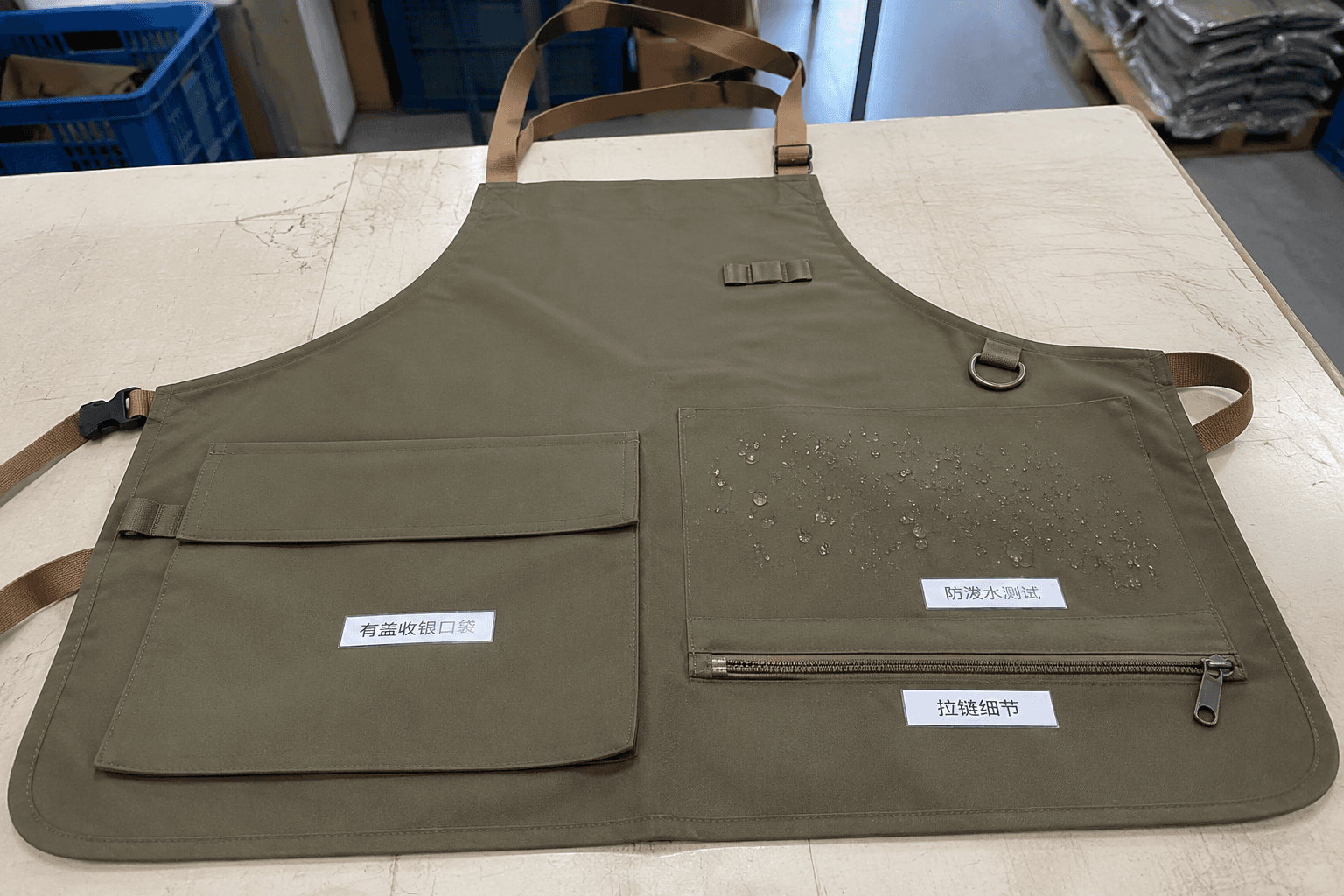
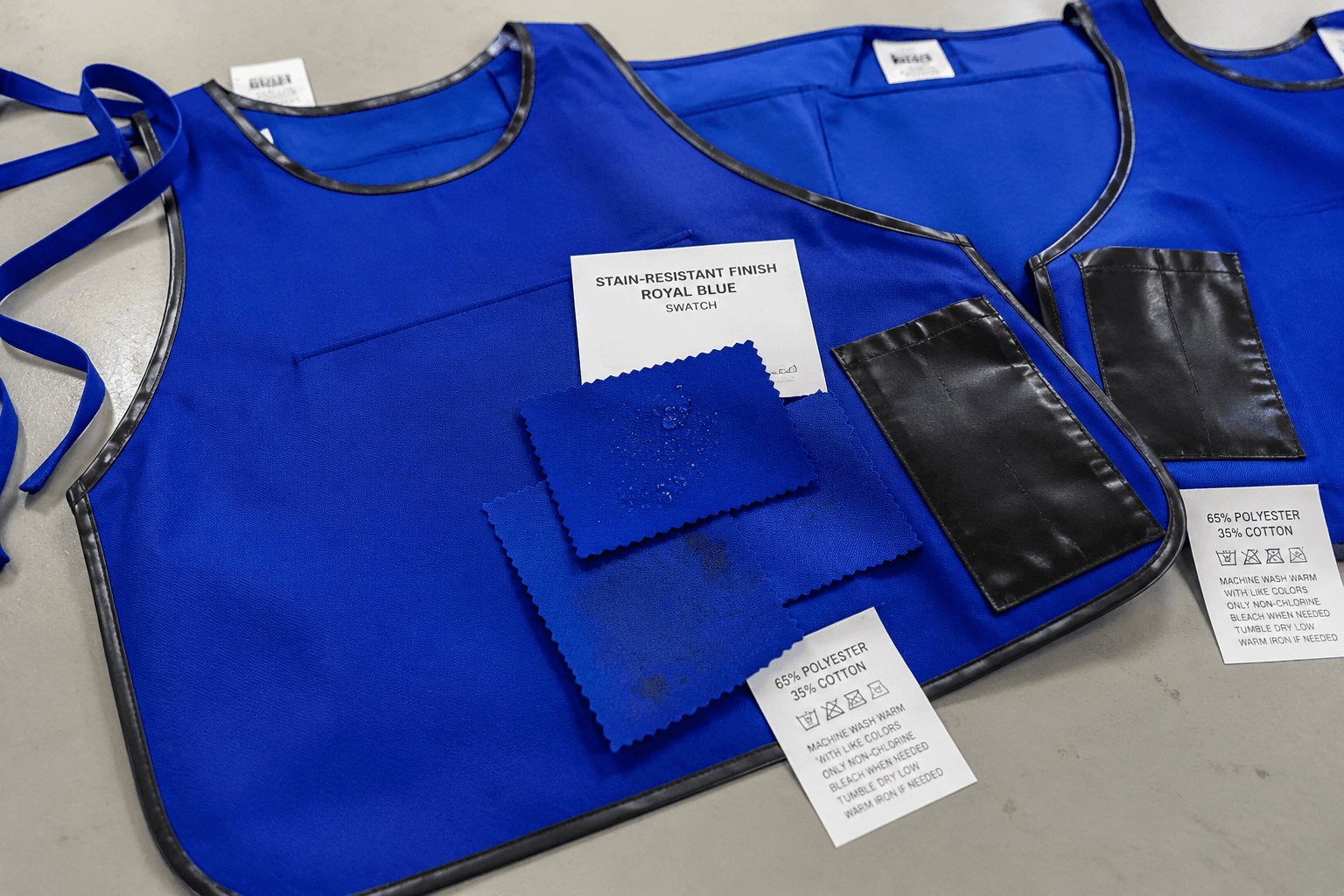
In our factory testing, untreated cotton twill at 200-240 GSM absorbs polish and cuticle oil quickly. Polyester-cotton twill with a fluorine-free water-repellent finish performs better for oils and light liquid splash, while 100% polyester with a PU or acrylic back coating resists penetration more strongly but feels less breathable. For nail salons where staff sit close to clients and work under bright light, the best balance is often a woven fabric with surface finish, not a full rubber-like coating.
- For nail polish and gel splash, specify a smooth face fabric and dark or mid-tone colors to reduce visible marking.
- For acrylic powder and filing dust, specify low-lint fabric and pocket shapes that do not trap powder at the seams.
- For oils and creams, specify a durable water-repellent or oil-repellent finish and confirm performance after 10-20 wash cycles.
- For acetone exposure, avoid claiming full resistance unless the buyer accepts a coated fabric with reduced comfort.
Fabric choices for a stain resistant salon apron
Fabric selection sets the comfort and performance ceiling. For a stain resistant salon apron, most buyer briefs begin with polyester-cotton twill, 100% polyester twill, polyester canvas, nylon-polyester blends or coated polyester. Cotton-rich fabrics feel natural but stain faster and dry slower. Polyester-rich fabrics shed dust and liquids better, show sharper color in dyeing, and hold shape after repeated washing. The trade-off is hand feel: low-cost polyester can look shiny or uniform-like if the yarn and weave are not chosen carefully.
For a nail salon apron, we normally quote three practical tiers. The first is 180-200 GSM T/C twill, often 65/35 polyester-cotton, with a water-repellent finish. This is a cost-efficient option for high-volume chain salons and private-label programs, usually in the USD 2.20-3.80 per piece FOB range depending on design and MOQ. The second is 200-240 GSM polyester-cotton or polyester canvas with a better hand feel and more structured drape, often USD 3.20-5.20 per piece. The third is coated 100% polyester, 160-220 GSM base fabric plus PU or acrylic coating, typically USD 4.20-7.50 per piece because coating, handling and quality control add cost.
GSM alone does not tell the full story. A 190 GSM tightly woven polyester twill can shed dust better than a 240 GSM loose cotton canvas. For beauty service use, the fabric surface should be smooth enough to wipe, dense enough to limit penetration, and stable enough that straps and pockets do not twist after washing. Buyers should ask for fabric swatches before confirming the sample because the same color name, such as black or charcoal, can look very different on matte twill, canvas and coated fabric.
- 180-200 GSM T/C twill is suitable for cost-controlled salon chains, training schools and promotional beauty apron programs.
- 200-240 GSM poly-cotton twill or canvas is suitable for premium nail salons, spa uniforms and branded retail sets.
- 160-220 GSM coated polyester is suitable for higher splash protection, but buyers should test breathability and noise during movement.
- Cotton canvas above 260 GSM looks premium but may be too warm and may retain polish, oil and wax marks.
Fit and coverage for seated technicians
Fit is often under-specified in apron sourcing, but it is one of the main reasons staff stop wearing a uniform item. Nail technicians sit for long periods with arms forward, shoulders slightly rounded and tools close to the torso. A bib apron that pulls at the neck or gapes at the chest becomes uncomfortable by the second half of the shift. For this reason, the pattern should be checked in a seated posture, not only on a standing mannequin.
A practical adult nail salon apron usually has a body width of 68-76 cm and a length of 72-85 cm, depending on whether the buyer wants upper-thigh or knee coverage. Shorter 65-72 cm lengths are common for nail bars and reception-style uniforms, while 80-90 cm lengths protect better during pedicure, waxing and spa services. For petite staff, long aprons can bunch when seated; for taller staff, short aprons leave trousers exposed. A one-size apron can work, but only if strap adjustment is generous.
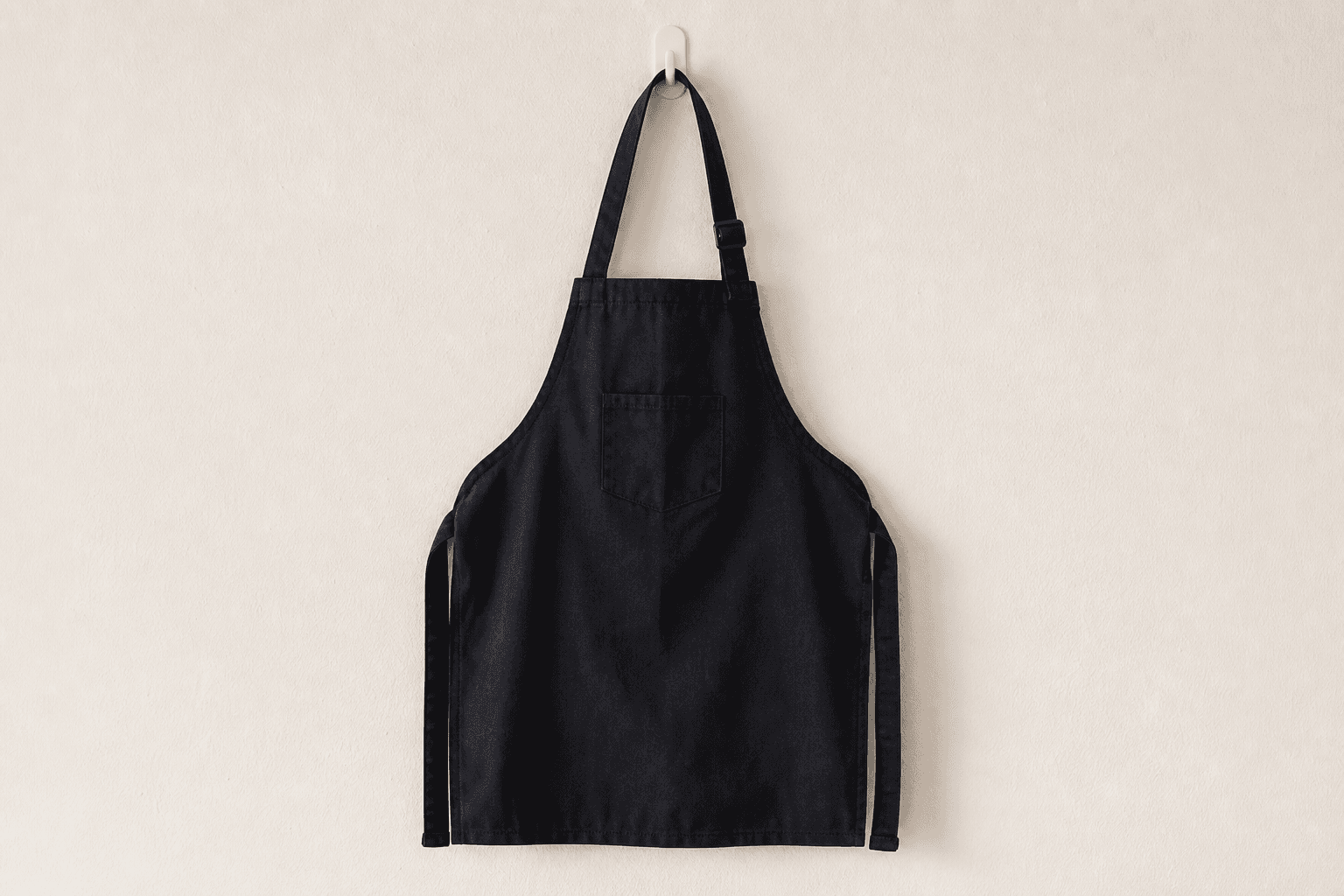
Neck adjustment deserves particular attention. Fixed neck loops are cheap but create fit complaints. Metal slider buckles, plastic ladder locks, buttonhole adjustment or D-ring neck straps add cost, usually USD 0.08-0.30 per piece, but reduce sizing problems. Cross-back straps cost more again because they require longer webbing and more sewing time, but they remove pressure from the neck. For an esthetician apron worn through facial, lash or waxing appointments, cross-back construction can be worth the cost.
- Body width of 70-74 cm fits most mixed salon staff without excessive side flare.
- Length of 75-82 cm is a balanced range for nail, lash and facial service coverage.
- Side ties of 90-110 cm per side allow front tying for smaller staff and back tying for larger staff.
- Cross-back straps are better for all-day wear, while adjustable neck straps are better for lower MOQ and lower unit cost.
- A split hem or curved lower corner can improve movement when technicians sit and stand frequently.
Nail salon apron pocket design and tool access
Pocket design looks simple on a line drawing, but it affects both cost and usability. Nail technicians need access to small items such as brushes, files, buffer blocks, drill bits, gloves, disposable masks, appointment cards, pens and phones. However, too many pockets can collect acrylic powder and cured gel dust. Deep pockets may also interfere with seated work if placed too low on the apron body.
For a nail salon apron, we usually recommend one upper chest pocket only if the buyer needs a pen slot or logo balance. For most nail service staff, lower pockets are more useful. A two-pocket lower layout with a vertical center stitch is cost-efficient and familiar. A three-compartment lower pocket works well when one narrow pocket is reserved for pens or brushes. If the salon uses electric nail drills, avoid very narrow tool loops that encourage staff to place powered handpieces in an unstable position. It is better to design a flat pocket for a handpiece or keep the drill on the table.
Pocket reinforcement should match the fabric. On 180-220 GSM twill, bar tacks at pocket openings are recommended. On coated fabrics, needle holes are permanent, so the factory should avoid excessive resewing and keep pocket construction clean. Pocket corners can be stress points after industrial laundering, especially when staff carry phones or metal tools. Adding bar tacks may add only USD 0.03-0.08 per piece, but it reduces early seam failure.
- For basic nail stations, use two lower patch pockets, each about 17-19 cm wide and 18-21 cm deep.
- For spa technician apron use, add one discreet upper pocket for a pen, consultation card or small tool.
- For esthetician apron use, avoid bulky lower pockets that press against the treatment bed or stool.
- For premium programs, consider pocket lining in self-fabric or reinforced stitching at the upper corners.
- For powder-heavy nail services, avoid flap pockets and heavy pleats because they trap dust.
Color, branding and laundering performance
Beauty apron color is a branding decision, but it is also a maintenance decision. White and pale beige look clean in a spa setting but show polish, tint and oil quickly. Black hides many marks but shows acrylic powder, lint and deodorant transfer. Charcoal, slate grey, deep green, navy, taupe and muted rose are often more practical because they reduce contrast with both dust and liquid marks. For large chains, we recommend testing the selected color in the actual salon environment under service lighting before bulk approval.
Logo method should follow the fabric and washing plan. Embroidery is durable and premium, but dense embroidery can pucker on light fabrics and may catch dust around the thread. Screen printing gives clean flat branding at low cost for larger runs, but it must be tested on repellent finishes because ink adhesion can be weaker. Heat transfer is sharp and suitable for small logos or multi-color designs, but high dryer temperatures can shorten its life. Woven labels are stable and cost-effective, especially for private label beauty apron programs where the logo does not need to dominate the garment.
Laundering needs to be specified before production. Domestic washing at 30-40°C is very different from commercial laundry with stronger detergent, high extraction and tumble drying. Many water-repellent finishes reduce gradually after repeated washes. A buyer who expects 50 commercial wash cycles should not approve the same finish as a buyer selling aprons for occasional home washing. For repeat orders, we recommend locking one fabric mill, one finishing process and one color standard, because small changes in finishing can alter hand feel and stain-shedding performance.
- Embroidery is best for premium salon groups, but sample first on fabric below 200 GSM to check puckering.
- Screen print is cost-efficient above 300-500 pieces per artwork, but adhesion must be checked on repellent fabric.
- Heat transfer is clean for small MOQ and detailed logos, but confirm wash temperature and dryer limits.
- Woven or silicone labels are practical when the apron already has many pockets or a textured fabric surface.
- Dark matte colors hide polish better, while mid-tone colors hide dust better than black.
Cost structure, MOQ and lead time for custom beauty apron orders
For sourcing managers, the main question is not only whether the factory can make the apron. It is whether the factory can repeat the same apron at the agreed cost, shade, fit and finish across multiple purchase orders. Custom beauty apron programs usually start at 300-500 pieces per color for simple stock-fabric designs. For custom-dyed fabric, coated fabric, special webbing or color-matched trims, the practical MOQ is usually 800-1,500 pieces per color because fabric mills and dye houses have their own minimums.
Sampling time depends on how many components are custom. A proto sample using available fabric can normally be made in 7-10 days after artwork and measurements are confirmed. If the buyer needs lab-dip color approval, add 5-7 days. If fabric coating or custom finishing is required, add 7-12 days before garment sampling. A pre-production sample after comments usually takes another 10-14 days. Bulk production for a normal nail salon apron order is usually 25-35 days after sample approval and deposit. More complex coated or multi-color apron programs may need 35-45 days, especially before holiday periods.
Price differences are usually easy to explain when the specification is clear. A plain T/C twill apron with two pockets and screen print may be around USD 2.20-3.50 FOB at 1,000 pieces. A heavier 220 GSM matte poly-cotton apron with adjustable hardware, reinforced pockets and embroidery may be USD 3.80-5.80. A coated polyester stain resistant salon apron with cross-back straps and custom logo can move into USD 5.50-8.50 depending on coating, trim and packaging. Individual quotations will vary with exchange rate, fabric market price, carton volume and inspection requirements.
- 300-500 pieces is a realistic MOQ for stock fabric, simple colors and standard trim.
- 800-1,500 pieces per color is more realistic for custom dyeing, coating or yarn-dyed fabric.
- 7-10 days is typical for a first sample using available materials.
- 25-40 days is typical for bulk production after final sample approval, depending on complexity.
- USD 2.20-8.50 per piece FOB covers most practical custom salon apron specifications from basic to premium.
Quality control points before shipping
A good apron program should be checked before cutting, during sewing and before packing. For a nail salon apron, the most important checks are fabric shade, finish consistency, measurement tolerance, pocket position, strap strength, logo placement and stain-shedding behavior. Measurement tolerance is commonly plus or minus 1 cm for pocket placement and plus or minus 1.5 cm for main body dimensions, though buyers with strict uniform programs may request tighter control.
Before bulk cutting, the factory should confirm fabric roll shade and usable width. Dark colors can vary between dye lots, so all panels for one purchase order should come from approved lots. During sewing, operators should keep strap attachment straight and pocket top edges level. On coated fabric, skipped stitches and needle damage are more visible, so line QC must inspect earlier than on ordinary twill. Final inspection should include random measurement checks, logo checks, loose thread trimming, carton count and packaging review.
For performance, a simple in-house drop test is useful but not a substitute for buyer-defined lab testing. The factory can place water, oil substitute or colored liquid on the fabric surface and observe beading and penetration time. For more formal claims, buyers should define the test method, wash cycles and pass criteria before production. Without that standard, the phrase stain resistant can mean different things to the brand, the factory and the final salon operator.
- Check shade under D65 light or the buyer’s agreed light source, especially for black, grey and muted spa colors.
- Confirm pocket placement on a worn sample, not only on a flat measurement table.
- Pull-test neck straps and side ties, especially on cross-back constructions and metal hardware points.
- Test logo durability after washing before approving bulk branding.
- Keep one approved pre-production sample sealed for comparison during final inspection.
Building a repeatable nail salon apron specification
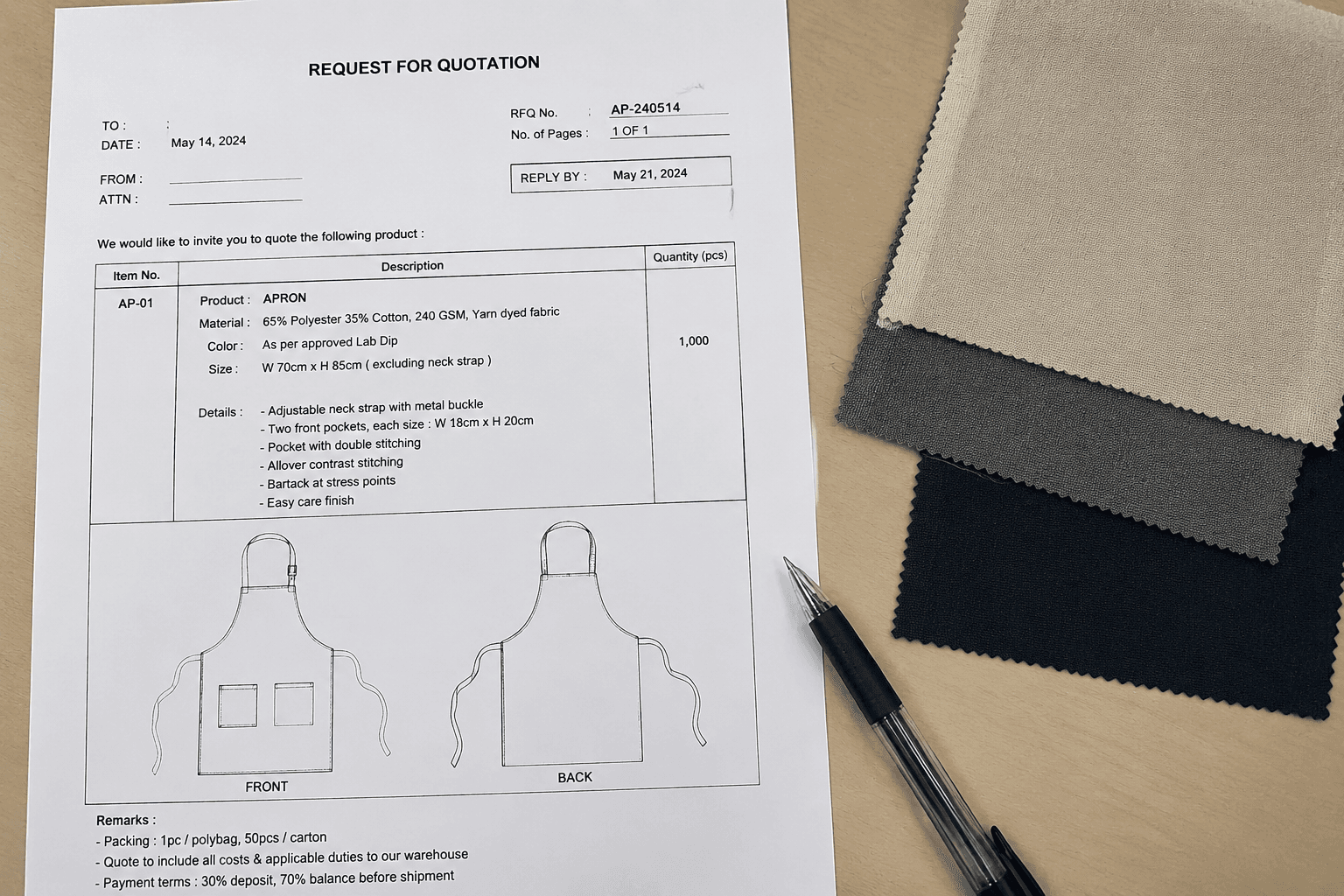
The strongest sourcing briefs are specific but not overcomplicated. A buyer does not need to specify every thread detail at the first inquiry, but should provide the intended service environment, target price range, estimated annual quantity, preferred color, logo method, laundry method and any fit concerns from existing uniforms. With that information, the factory can propose realistic fabric and construction options rather than quoting a generic apron that later needs many revisions.
For a mixed nail and spa chain, a balanced starting specification could be 200-220 GSM polyester-cotton twill, fluorine-free water-repellent finish, matte charcoal or muted green color, adjustable neck strap with metal slider, 100 cm side ties, two reinforced lower pockets, one small upper pen pocket, embroidery or woven label branding, and individual polybag packing only if required by distribution. This kind of esthetician apron is not the cheapest construction, but it usually gives good wearability, presentable branding and manageable factory risk.
For a high-volume promotional beauty apron, a simpler 180 GSM T/C twill with standard neck adjustment, two pockets and one-color print may be more suitable. For a premium spa technician apron, cross-back straps, softer hand feel, hidden pocket reinforcement and better packaging may matter more than saving USD 0.40 per piece. The correct decision depends on how the apron is used, how often it is washed and how visible it is in the customer experience. When those points are clear, the factory can build a repeatable custom apron program with fewer sampling rounds and fewer surprises in bulk.