In apron sourcing, the first quantity question should be fabric, not sewing. A factory may accept 400 bib aprons on the line, but if the selected shell requires a 1,200-meter dye lot or a 3,000-meter weaving run, the textile source sets the real opening commitment. That is why apron fabric moq by source matters more than a generic garment MOQ when a buyer is building a delivery plan, a cost target, and a reorder strategy.
The source route changes five operating variables at the same time: opening volume, ex-factory cost, shade consistency, replenishment stability, and calendar risk. In current apron programs, stock 210 to 240 GSM polycotton twill can often support 300 to 800 pieces per color with a 15 to 25 day production window. Mill-dyed 240 to 300 GSM cotton twill or canvas usually needs 1,000 to 2,500 meters per shade and 30 to 45 days. Custom woven yarn-dyed stripe, herringbone drill, or 10 oz to 12 oz duck commonly starts at 3,000 meters and can push total development to 60 to 90 days.
The mistake many buyers make is approving an apron style on sample appearance alone. The commercial result depends on width, marker efficiency, self-fabric ties versus webbing, shrinkage, defect reserve, trim MOQ, and whether replacement orders must match the first bulk lot. Buyers that convert meters into finished aprons before price approval avoid late surprises on quantity, color, and delivery.
- Stock cloth is usually the lowest-risk opening route for aprons, with practical programs at 300 to 800 pieces per color if one usable fabric lot is available.
- Mill-dyed goods usually open at 1,000 to 2,500 meters per color, which often converts to about 1,050 to 2,900 aprons depending on width, consumption, and allowance.
- Custom weaving is only efficient when forecast volume can absorb stacked weaving, yarn, and finishing minimums.
- A standard adult bib apron typically uses 0.82 to 0.95 meters of shell fabric at 150 cm usable width; waist aprons are often 0.42 to 0.60 meters; long bistro aprons usually land at 0.55 to 0.68 meters.
- For most B2B apron programs, fabric and finished-goods inspection should be aligned at about AQL 2.5 major and AQL 4.0 minor unless the end customer requires a tighter plan.
- The cheapest meter price is often not the lowest sourcing cost if it creates split lots, re-dye delays, shade drift, or dead stock on reorders.
Why apron fabric MOQ, not sewing capacity, sets the real opening order
Every apron program has two minimums: what the factory can cut and sew, and what the fabric source will release. The sewing line might accept 500 bib aprons, but the order is still not workable if the shell is only available in a 1,000-meter dye lot or a 3,000-meter custom weave. For professional buyers, apron fabric moq by source is the usable planning number because it determines whether the style can launch without surcharge, excess stock, or delivery slippage.
The conversion from meters to aprons is specific to the style. In 150 cm usable width, a standard adult bib apron with one chest pocket and two waist pockets commonly consumes 0.82 to 0.90 meters when straps are cotton webbing. If ties and neck straps are self-fabric, consumption often rises to 0.90 to 1.02 meters. A short waist apron is usually 0.42 to 0.58 meters, while a long bistro apron typically reaches 0.55 to 0.68 meters. Buyers then need to add allowance for marker loss, panel replacement, shrinkage, and fabric defects.
Allowance is where many opening-quantity mistakes happen. For solid-dyed apron fabric, 3% to 6% is a realistic booking factor. For yarn-dyed stripes, checks, garment-wash canvas, brushed face cloth, or any construction with pattern matching, 6% to 12% is more realistic. A 1,000-piece bib apron at 0.88 meters net is 880 meters on the marker, but at 6% allowance the booking becomes about 933 meters. If the chosen dyed twill has a 1,000-meter MOQ, the order is still short. At that point the buyer must add pieces, accept a short-lot surcharge, or change fabric route.
- Typical bib apron consumption: 0.82 to 0.90 m with webbing straps; 0.90 to 1.02 m with self-fabric straps and ties.
- Typical waist apron consumption: 0.42 to 0.58 m; long bistro aprons: 0.55 to 0.68 m.
- Practical booking allowance: 3% to 6% for solid fabrics; 6% to 12% for stripes, checks, washed canvas, or pattern-matched goods.
- Common quality target for apron fabric and finished goods: AQL 2.5 major, AQL 4.0 minor.
Stock cloth apron fabric MOQ by source: 300 to 800 pieces with the shortest lead time
Stock cloth is the fastest and lowest-entry option for apron buyers because the fabric already exists in market inventory. Typical apron bases include 180 to 220 GSM plain polycotton, 210 to 240 GSM 65/35 polycotton twill, 230 to 280 GSM cotton canvas, and 8 oz to 10.5 oz denim. Since weaving and bulk dyeing are already complete, the buyer mainly needs roll confirmation, lot reservation, and pre-cut inspection.
For common apron styles, stock cloth usually supports a practical MOQ of 300 to 800 pieces per color and style. A 500-piece bib apron in 220 GSM polycotton twill at 0.86 meters net needs 430 meters. At 4% allowance, the booked quantity is about 447 meters, which many stock suppliers can release from one lot. Fabric cost is also predictable. In current sourcing, common stock twill and canvas used for aprons often run from $1.10 to $2.30 per meter, so shell fabric cost typically lands around $0.95 to $2.00 per apron before sewing, printing, embroidery, or packaging.
The weakness is continuity. A stock code that is available today can sell through within 7 to 15 days, and replenishment may come back with a different width, handfeel, shrinkage rate, or shade band. Black, navy, natural, and khaki are usually the safest stock colors, but even these need lot control if the aprons will ship across multiple POs. For event programs, food-service rollouts, distributor trial orders, and replacement aprons needed inside one month, stock cloth is often the right commercial decision. For chain programs that need the same apron color for six to twelve months, buyers should either reserve enough stock at approval or move to mill-dyed supply.
- Typical MOQ: 300 to 800 aprons per color for standard stock twill, canvas, or denim.
- Typical lead time: 2 to 5 days for stock confirmation, then 12 to 18 days for cutting, sewing, packing, and final inspection.
- Typical stock fabric price: $1.10 to $2.30 per meter; shell-fabric cost usually $0.95 to $2.00 per apron.
- Best use cases: urgent restaurant aprons, launch tests, distributor replenishment, and simple programs under 800 pieces per color.
- Key controls: confirm same-lot quantity, reserve rolls after PPS approval, record usable width, actual GSM, shrinkage, and shade band.
Mill-dyed apron fabric MOQ by source: 1,000 to 2,500 meters for cleaner color control
Mill-dyed goods sit between stock cloth and custom weaving. The construction is standard or semi-standard, but the buyer specifies the shade. This route is common for 210 to 270 GSM cotton twill, 240 to 320 GSM cotton canvas, 65/35 polycotton drill, and selected linen-cotton blends used in premium hospitality aprons. Buyers shift here when stock colors are too generic, when Pantone alignment matters, or when the apron is expected to repeat across a season or contract year.
In mill-dyed apron fabric moq by source, the controlling number is meters per color. For reactive-dyed cotton twill, practical minimums usually start at 1,000 to 1,200 meters per shade. Heavier canvas, sulfur black, deep navy, washed finishes, or special repellency can push the requirement to 1,500 to 2,500 meters. Using a bib apron at 0.88 meters net with 5% allowance, 1,000 booked meters converts to about 1,082 aprons. At 1,500 meters, the same style yields about 1,623 aprons. At 2,500 meters, it yields about 2,705 aprons. Buyers that negotiate only on piece MOQ often discover these thresholds too late, usually after lab dips have already been approved.
Cost and repeat performance are more stable than stock cloth. A 240 GSM dyed cotton twill often lands at $1.90 to $2.80 per meter ex-factory, while 280 to 300 GSM dyed canvas commonly falls between $2.40 and $3.70 per meter. For a basic bib apron, shell fabric cost is often $1.65 to $3.15 per piece. Lead time is typically 30 to 45 days after lab dip approval and deposit receipt, covering greige allocation, dyeing, finishing, inspection, and in-house transfer. For hotel groups, cafe chains, chefwear distributors, and branded uniform programs, this route is usually the most balanced in cost, color control, and reorder stability.
- Typical dye MOQ: 1,000 to 2,500 meters per color for standard apron twill and canvas.
- Typical lead time: 30 to 45 days after lab dip approval; washed or dark shades often land at 38 to 45 days.
- Typical dyed-fabric price: $1.90 to $3.70 per meter depending on fiber content, weight, and finish.
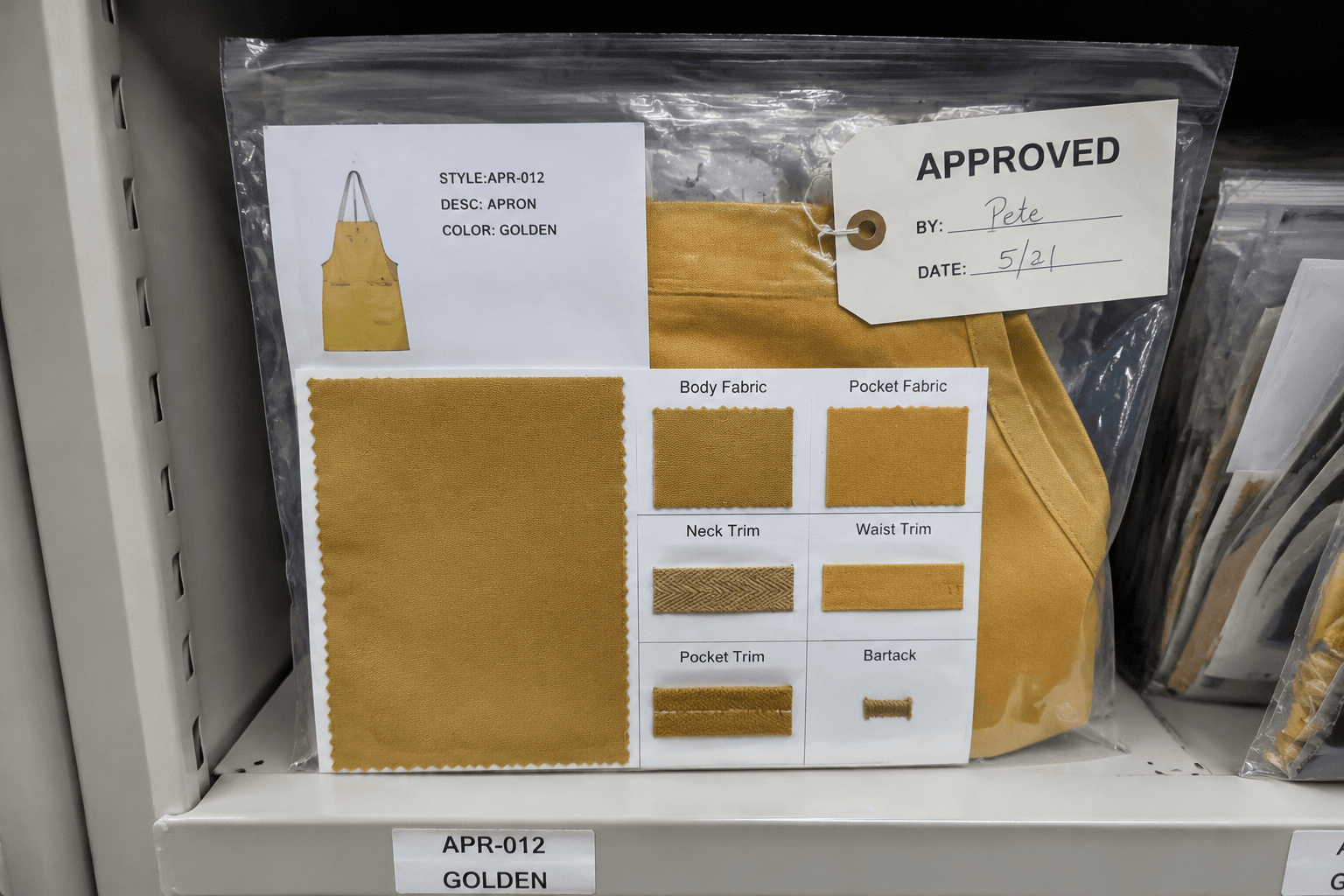
- Standard approval sequence: lab dip, shrinkage and color-fastness test, bulk shade band, PPS, then cutting release.
- Best use cases: hospitality uniform programs, branded cafe aprons, and B2B orders that need repeatable shade control.
Custom woven apron fabrics: when 3,000-plus meters is commercially justified
Custom weaving only makes sense when the apron fabric itself is part of the product value. Typical examples are yarn-dyed chef stripes, herringbone drill, slub canvas, recycled-blend workwear cloth, and heavy 10 oz to 12 oz duck built to a buyer specification. It also applies when the apron needs a controlled yarn count, a non-standard width, a specific warp-weft balance, or a finish that stock and standard dyed goods cannot supply consistently.
MOQ rises sharply because several upstream minimums stack together. The weaving mill may require 3,000 to 5,000 meters per construction. If the design is yarn dyed, each yarn shade can carry its own minimum, often 100 to 250 kg per color depending on yarn count and composition. Water-repellent finishing, peaching, sanforizing, brushing, or wash-compatible finishing can also create separate batch floors. The result is that an apron program requesting 800 pieces is usually far below the commercial threshold before cutting has even been planned.
Timing and cost reflect that development load. Custom woven apron fabrics commonly land at $2.90 to $5.80 per meter ex-factory, with washed yarn-dyed stripe or heavier duck often above that range. For a premium bib apron using 0.92 to 1.00 meters, shell fabric alone can run from about $2.70 to $5.80 per piece. Repeat constructions may ship in 40 to 55 days once a fabric is established, but a new development typically needs 60 to 90 days including yarn booking, trial weaving, lab testing, finish approval, and bulk inspection. This route is appropriate for long-life SKUs, premium retail aprons, and brand-owned fabric programs with committed annual volume.
- Typical weaving MOQ: 3,000 to 5,000 meters per construction.
- Typical yarn MOQ for yarn-dyed apron cloth: 100 to 250 kg per shade.
- Typical lead time: 40 to 55 days for repeat fabric; 60 to 90 days for new development.
- Typical fabric price: $2.90 to $5.80 per meter before trims, decoration, and sewing.
- Best use cases: signature chef aprons, heritage workwear aprons, premium retail lines, and forecasted seasonal programs.
How to convert meters into aprons before you approve price or color
Most apron MOQ disputes come from weak conversion, not from supplier resistance. Before approving a quote, buyers need a style-specific calculation covering usable width, net shell consumption, booking allowance, number of pockets, strap construction, contrast panels, bias binding, and whether logos are printed before or after cutting. Using an average from another apron style is usually enough to create a quantity gap once the fabric is booked.
A practical formula is booked meters = order quantity x net consumption x allowance factor. If a 1,200-piece bib apron consumes 0.89 meters and the allowance is 1.05, the booked quantity is about 1,121 meters. If the selected cotton twill carries a 1,200-meter dye MOQ, the order is still short by 79 meters unless the mill accepts a surcharge or the buyer increases quantity. If the same apron uses yarn-dyed stripes and needs 8% allowance, the booking rises to about 1,153 meters. Small changes in width, pocket layout, or strap method can move the order across a textile MOQ threshold.
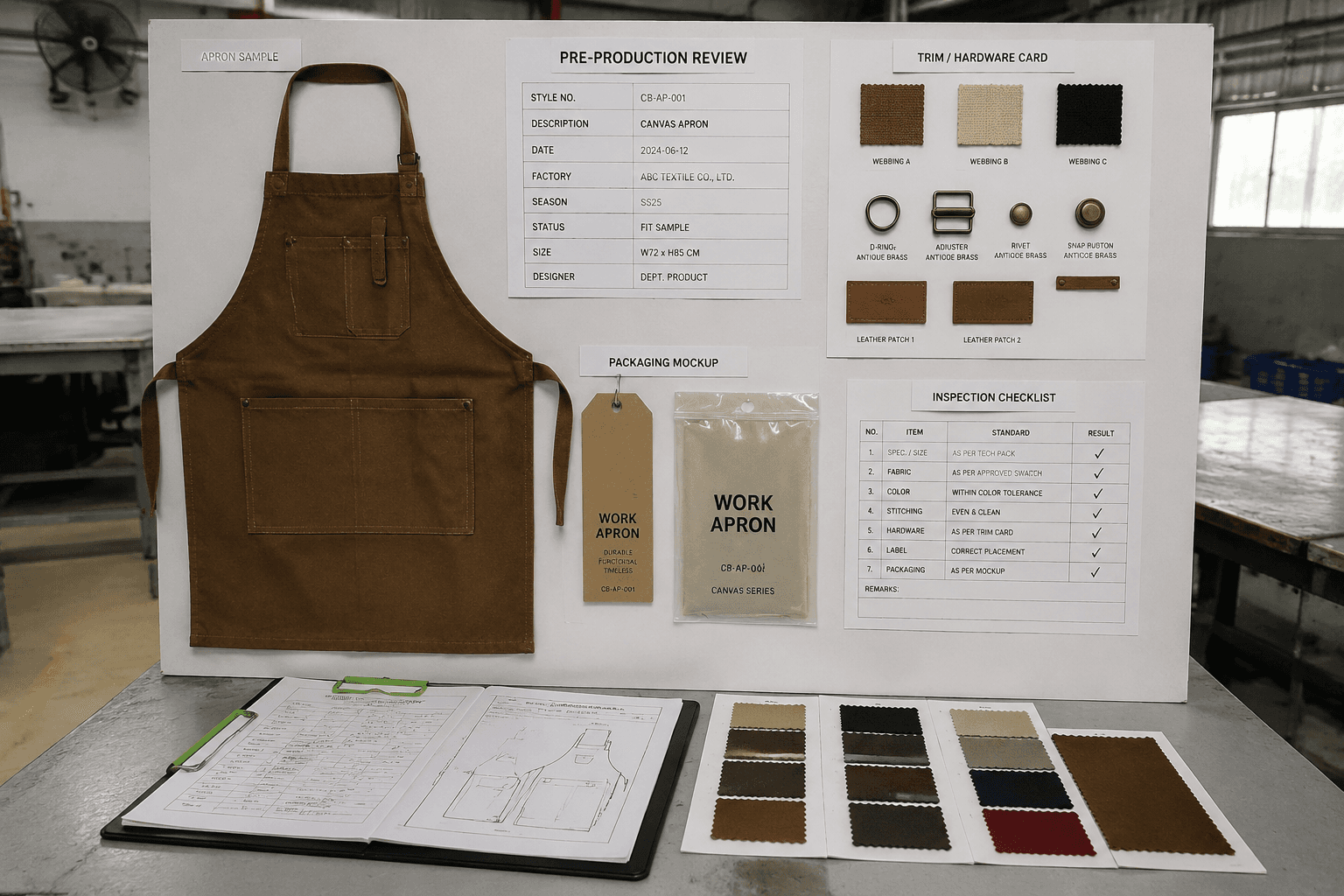
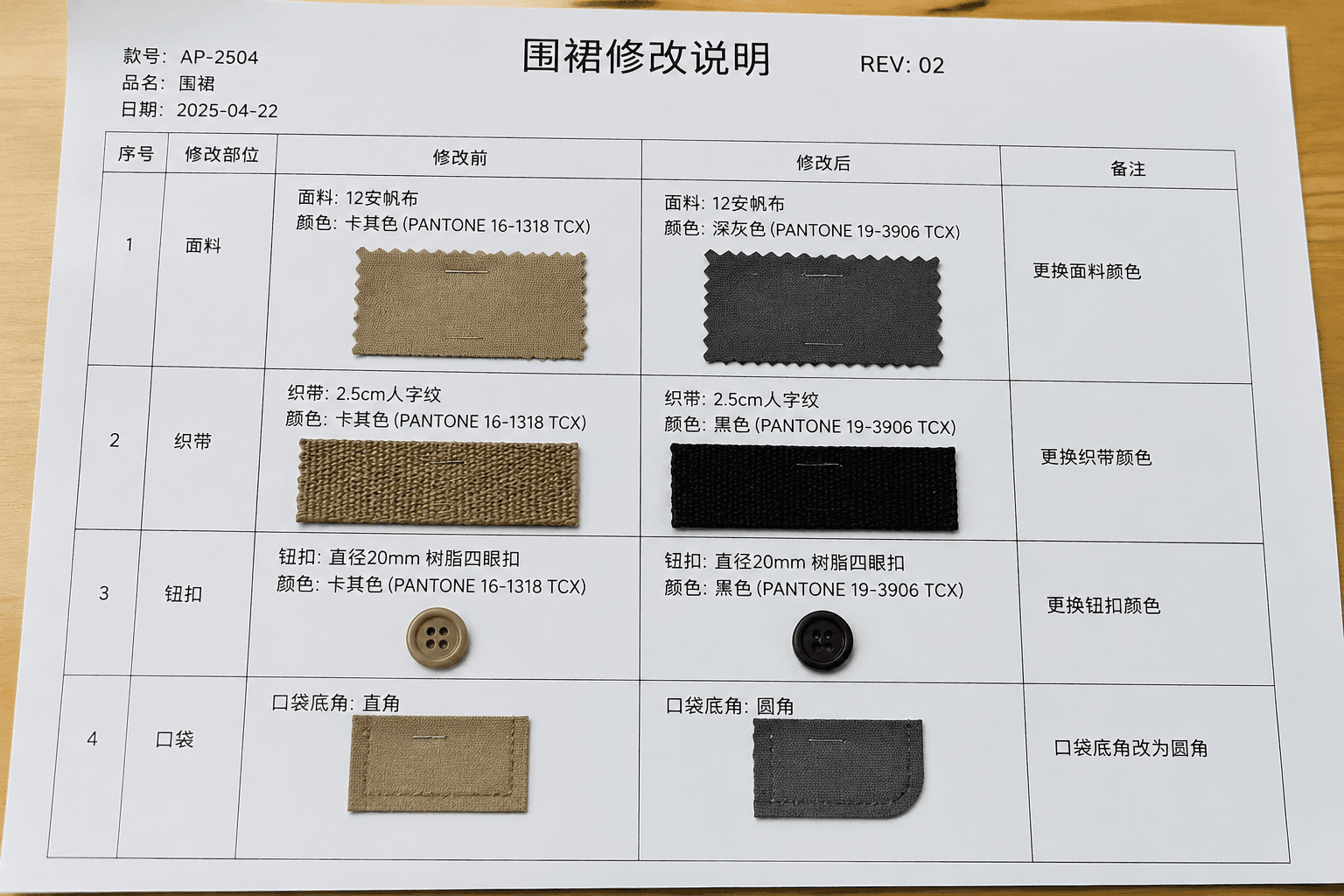
Trim minimums should be checked at the same time because the shell fabric is only one part of the BOM. Cotton webbing, antique brass adjusters, rivets, snaps, leather patches, woven labels, and printed care labels often carry separate minimums. It is common for a stock-cloth apron to work at 600 pieces while the custom buckle requires 2,000 units or the debossed patch requires 3,000 pieces. For a basic hospitality bib apron, total ex-factory cost commonly lands at $2.80 to $4.60 on stock cloth, $3.60 to $5.80 on mill-dyed fabric, and $5.20 to $8.50 on custom woven fabric, depending on trim package and decoration.
- Use approved pattern consumption, not a placeholder estimate from another apron block.
- Add realistic allowance: 3% to 6% for solids; 6% to 12% for stripes, checks, and washed constructions.
- Check trim MOQs with shell-fabric MOQ, especially for custom webbing, hardware, labels, and patches.
- Build ex-factory piece cost from shell fabric, trims, sewing, decoration, packing, and inspection, not meter price alone.
Choosing the right apron fabric route for launch orders, repeat business, and risk control
The correct sourcing route depends on what the buyer is trying to protect. If the priority is speed, low opening quantity, and low inventory exposure, stock cloth is usually the right answer. If the priority is shade accuracy, cleaner reorders, and continuity over a six- to twelve-month program, mill-dyed goods are normally stronger. If the apron fabric is part of the brand identity and annual volume can absorb large textile commitments, custom weaving becomes commercially reasonable.
A few typical scenarios make the logic clear. A distributor needing 400 black waist aprons inside 20 to 25 days should usually stay with stock 200 to 220 GSM polycotton twill. A restaurant group rolling out dark olive bib aprons across 15 sites should usually move to mill-dyed 240 to 260 GSM cotton twill or canvas, even if the opening quantity rises to around 1,200 to 1,600 pieces. A premium retail brand planning a year-round 11 oz striped chef apron at 3,000 to 5,000 units per season can justify a custom woven route because repeat volume absorbs the textile minimum and supports consistent presentation.
For many B2B buyers, the most efficient strategy is staged. Launch the first apron order in the closest acceptable stock cloth to confirm demand, fit, and wash performance, then move the next cycle into mill-dyed or custom woven supply once reorder frequency is proven. That approach reduces cash exposure on the first PO, shortens the opening calendar, and creates a disciplined path toward better continuity. In practical sourcing terms, the best MOQ is not the smallest number on a quotation sheet. It is the apron fabric moq by source that fits target cost, lead time, quality level, and repeatability with the lowest total commercial risk.
- Choose stock cloth for urgent orders, simple colors, and first runs below about 800 pieces per color.
- Choose mill-dyed fabric when branded shade control and stable replenishment matter more than the lowest opening MOQ.
- Choose custom weaving only when forecast volume, margin, and selling season can absorb 3,000-plus meter commitments.
- Before PO approval, ask for meter-to-piece conversion, re-order MOQ, shade policy, and lead time by development stage.