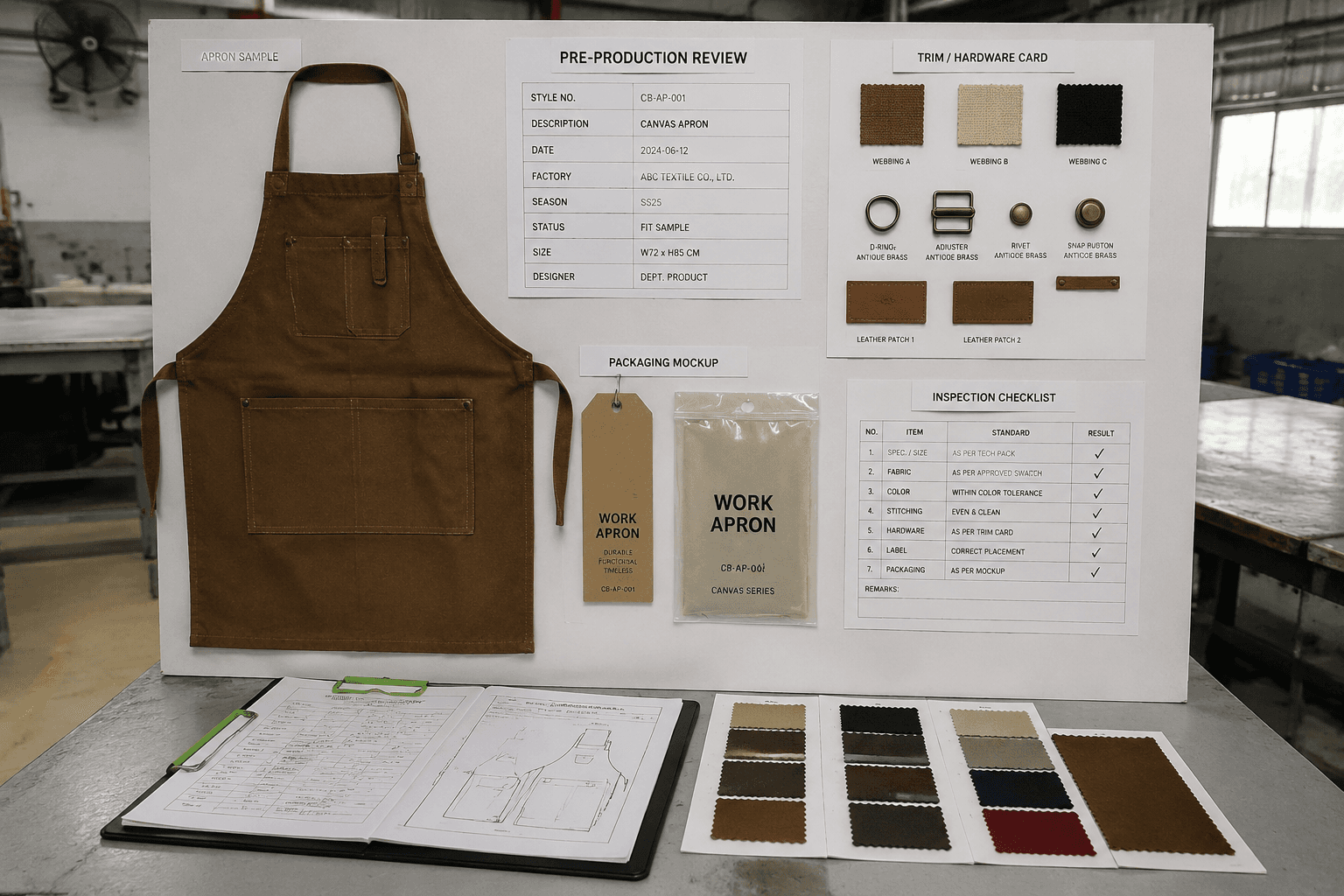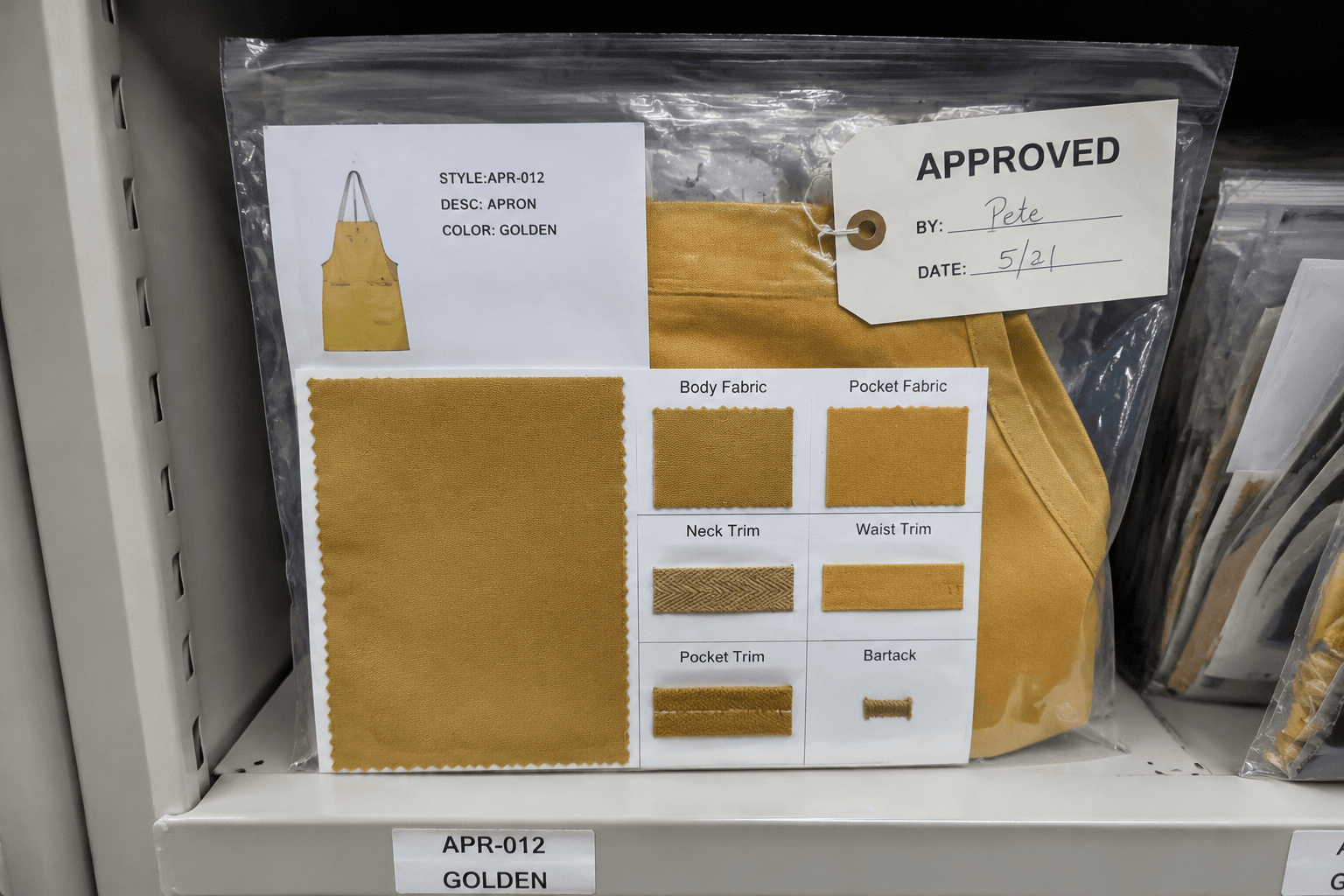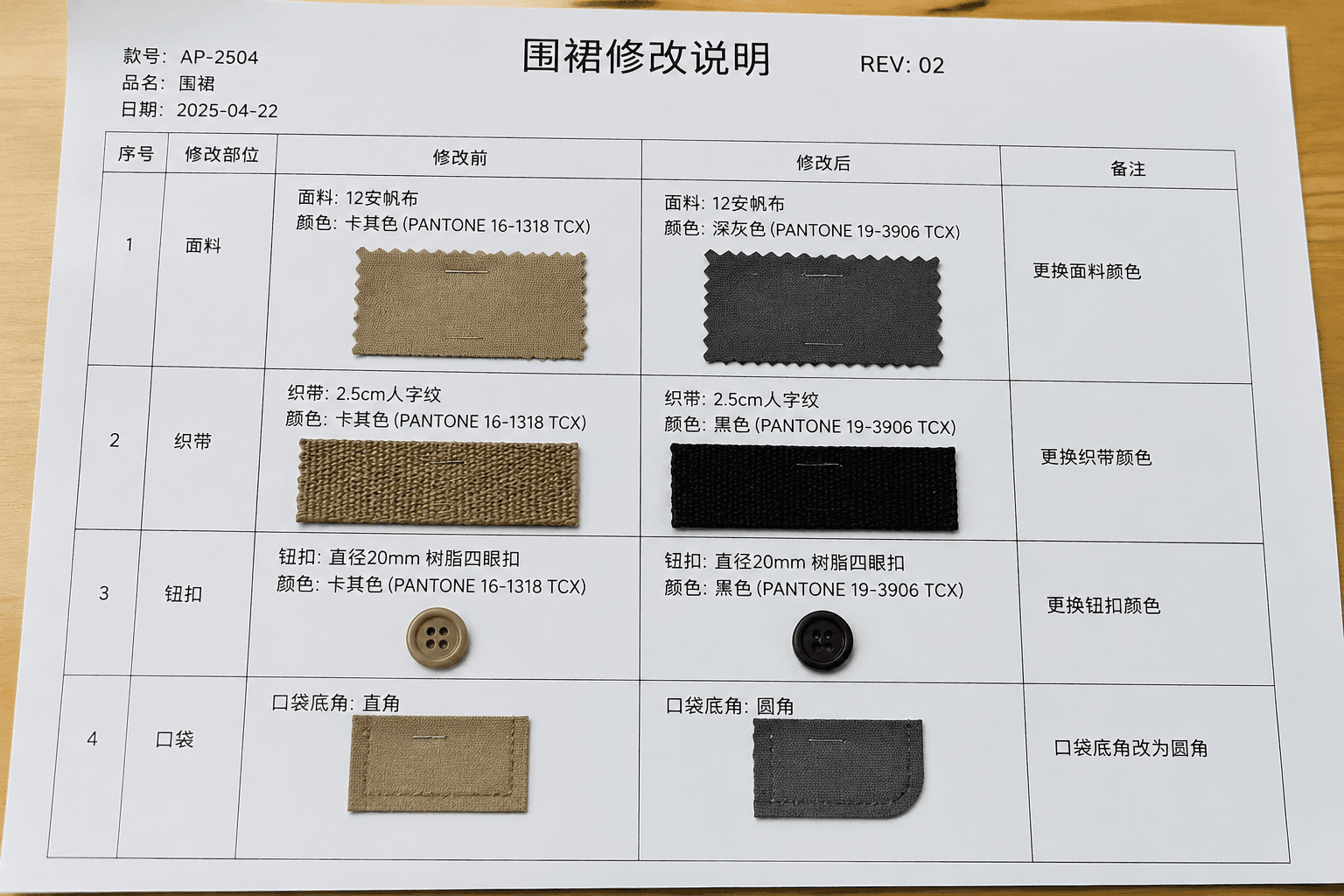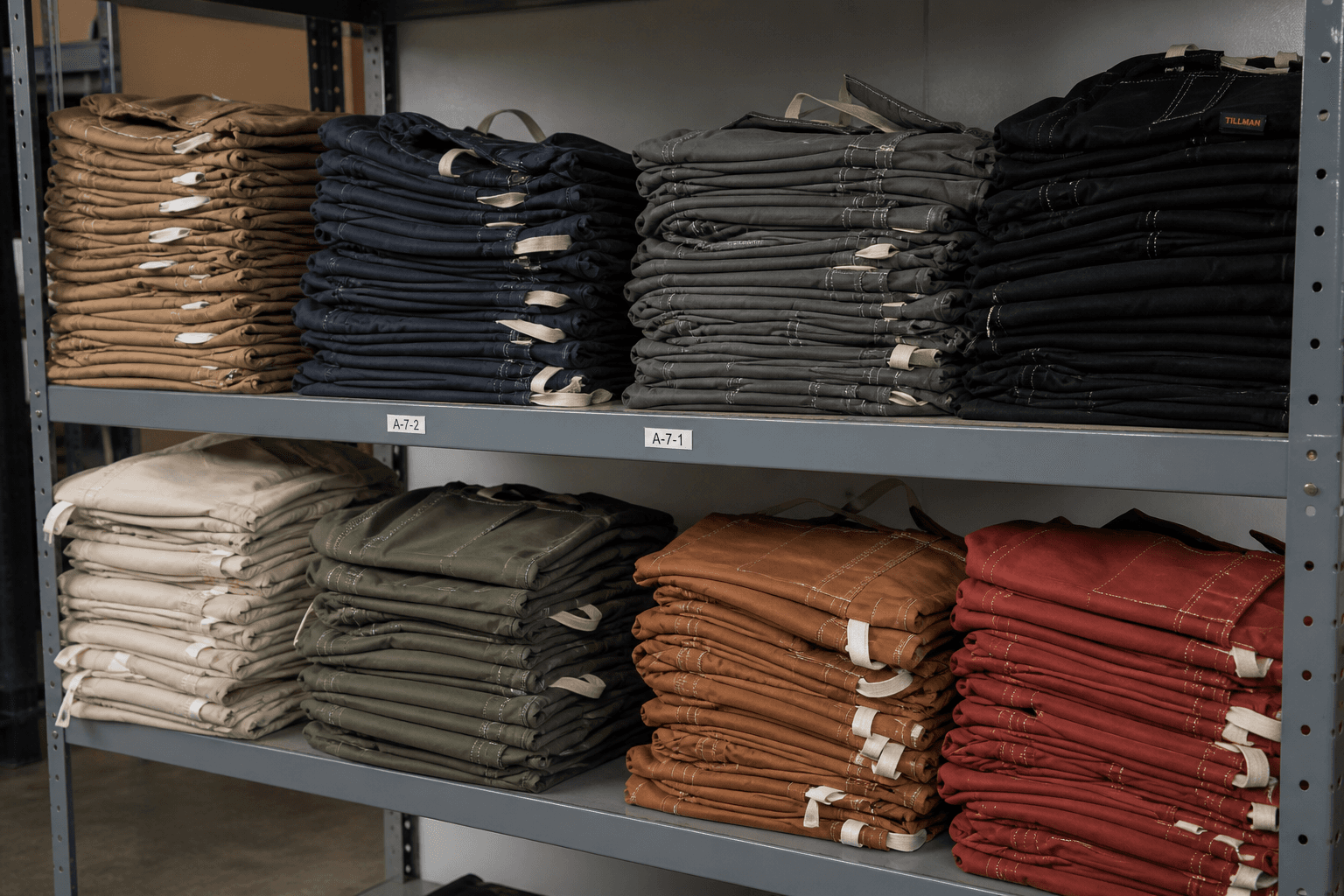
For professional apron buyers, the limiting factor is usually fabric dyeing, not sewing capacity. A factory may cut and sew 250 waist aprons or 400 standard bib aprons in one run, but the dye house may still require 650 to 900 meters per color for 235 GSM TC twill, 270 GSM cotton twill, or 10 oz canvas. That mismatch is why a low moq apron with greige fabric program matters. It shifts the commitment from each finished color to one approved raw-cloth base, so the buyer can lock construction first and split colors later.
In practical apron sourcing, the order sequence changes. The buyer approves the apron pattern, fabric composition, target weight, pocket layout, strap construction, logo method, labels, and export packing standard. The factory or nominated mill then holds greige cloth such as 235 GSM poly-cotton twill, 265 to 275 GSM cotton twill, or 10 oz cotton canvas. When the buyer releases colors, the cloth moves through lab dips, bulk dyeing, finishing, fabric inspection, cutting, sewing, and final packing. Weaving is already out of the path, which reduces opening-order risk and shortens replenishment.
This model works best when the apron body fabric stays stable across several colorways or reorder cycles. It is less useful when each run changes silhouette, wash effect, strap material, hardware finish, or packaging. For importers, uniform distributors, hospitality groups, and private-label brands buying aprons for foodservice, retail, workshop, or promotional use, the value is concrete: lower dyed-fabric exposure, smaller opening color lots, and faster repeats without committing to full finished-goods stock.
- Fabric MOQ usually sets the real floor; sewing MOQ for standard aprons can start around 200 to 500 pcs per style when approved greige and stock trims are already available.
- A workable low moq apron with greige fabric arrangement often means reserving 2,500 to 4,000 meters of one apron base cloth, then releasing colors in smaller finished-goods lots.
- For many bib and waist aprons, opening orders of 300 to 600 pcs per color are realistic when the buyer accepts one total greige commitment instead of separate dyed-fabric MOQs for each shade.
- Repeat speed depends on full BOM control. Webbing, sliders, rivets, labels, thread, polybags, and export cartons should be standardized or reserved alongside the body fabric.
- Quality discipline is tighter on small lots. Buyers should define GSM tolerance, shrinkage, color fastness, finished width, measurement tolerance, and AQL 2.5/4.0 standards before the first bulk dye lot is released.
How a low moq apron with greige fabric program runs from reservation to shipment
A normal custom apron order begins with color confirmation. The mill allocates greige, dyes each shade, finishes the fabric, inspects the lot, and ships finished fabric to the sewing factory. For apron buyers, that sequence can consume 28 to 42 days before cutting starts. If the order covers four colors at modest volume, the usual result is familiar: the dye house pushes for higher meterage, adds a small-lot surcharge, or relaxes shade consistency on undersized runs.
A low moq apron with greige fabric program changes the commitment point. The buyer first approves one stable fabric base, such as 235 GSM TC twill, 270 GSM cotton twill, or 10 oz to 12 oz cotton canvas. The factory, mill, or nominated fabric partner then reserves the raw cloth against the apron program. Pattern, measurements, logo placement, pocket layout, strap construction, labels, and packing details are fixed before any color release. The buyer confirms color breakdown only after sales orders, store approvals, or distributor forecasts are clearer.
This structure suits aprons because one body fabric can support several commercial silhouettes with limited redevelopment. A 245 GSM twill can carry a basic bib apron, a short waist apron, and a workshop bib apron with larger utility pockets, as long as the fabric standard and trim package remain controlled. The flexibility sits in color planning, not in changing the whole product architecture.
Commercially, buyers usually see two versions. In a factory-stock model, the supplier holds approved greige and allocates it to the buyer as needed, often with lower up-front cash exposure but limited exclusivity. In a buyer-reserved model, the buyer prepays part or all of the greige value and the stock is ring-fenced for 60, 90, or 120 days. The second model gives stronger availability protection when black, navy, olive, or stone aprons are expected to repeat.
- Common apron greige bases: 210 to 240 GSM TC twill, 250 to 280 GSM cotton twill, and 10 oz to 12 oz cotton canvas.
- Typical greige reservation: 2,500 to 4,000 meters for one approved apron fabric base.
- Usable color spread from one base cloth: usually 3 to 6 colorways if the apron spec, trims, and finish stay unchanged.
MOQ math for aprons: sewing minimums versus dye-lot thresholds
When buyers ask for a lower apron MOQ, they usually mean a lower per-color commitment. That is not the same as sewing MOQ. Aprons are relatively simple to cut and assemble, so sewing lines can accept smaller runs than mills and dye houses. A basic waist apron with stock ties may open at 200 to 300 pcs. A standard bib apron with patch pockets and adjustable neck hardware may open at 300 to 500 pcs. A heavier workshop apron with cross-back straps, rivets, and embroidery will usually need either more units or a higher conversion price.
The fabric side is less flexible. For twill and canvas used in apron programs, many dye houses still want 650 to 900 meters per color to run efficiently and maintain shade consistency. At 350 to 500 meters, buyers often face a small-lot dye surcharge, longer queue time, or a wider accepted shade band between bulk lots. That is why a factory can genuinely say it can sew 300 aprons while still quoting a higher commercial MOQ.
A greige program solves this by moving the minimum from each color to one raw-cloth pool. A buyer may reserve 3,200 meters of 270 GSM cotton twill, then release 750 meters in black, 700 meters in navy, 650 meters in olive, and hold the balance for a later repeat or a test color. The total commitment is still real, but the buyer avoids overbuying a weak color just to satisfy a single dye-lot threshold.
Buyers should ask for apron fabric consumption in meters per piece before accepting any MOQ claim. On aprons, that math is straightforward and exposes weak quoting quickly. A standard bib apron around 72 x 86 cm with two patch pockets and self ties may consume 1.12 to 1.26 meters per piece after shrinkage allowance and cutting loss. A short waist apron may consume 0.60 to 0.78 meters. Once meter usage is clear, the buyer can test whether the claimed MOQ matches actual dye-lot economics.
- Typical sewing MOQ: 200 to 300 pcs for simple waist aprons and 300 to 500 pcs for standard bib aprons using stock trims.
- Typical dye-lot floor: 650 to 900 meters per color for apron twill or canvas with normal shade control.
- Indicative fabric consumption: 0.60 to 0.78 meters for a waist apron and 1.12 to 1.26 meters for a bib apron, depending on width, pockets, and tie construction.
Cost benchmarks for a low moq apron with greige fabric sourcing model
This sourcing model is not automatically the lowest FOB price per piece. It is a way to buy flexibility, reduce wrong-color inventory risk, and shorten repeat lead times. Buyers should split the quote into four blocks: greige cloth cost, dyeing and finishing, sewing conversion, and storage or reservation charges. Once those lines are visible, comparison against a conventional dyed-fabric order becomes more useful.
For entry-level apron programs in 210 to 240 GSM TC twill, a simple waist apron or bib apron with stock straps and one-color print often lands around $2.20 to $3.60 per piece at 500 to 1,000 pcs. For 260 to 280 GSM cotton twill or 10 oz canvas bib aprons with metal slider, larger pockets, bartacks, and embroidery, the practical range is more often $4.10 to $6.80 per piece. Workshop, retail, or branded café aprons with rivets, cross-back webbing, premium labels, or belly-band retail packing can move to $7.60 to $10.80 per piece, especially below 500 pcs per color.
Greige affects cost in two places. First, it can remove the need to meet separate fabric MOQs for every shade, which protects margin when color demand is uncertain. Second, it usually introduces a greige deposit or a limited free holding window. Common terms are 30% to 50% deposit on the reserved cloth value, 60 to 90 days free storage, then a warehouse charge such as $0.03 to $0.06 per meter per month or a flat pallet fee.
The correct comparison is total exposure, not only unit price. Buyers should calculate the value trapped in slow-selling color inventory, the extra charge created when every reorder starts from a fresh dye lot, and the working capital impact when a repeat takes 45 days instead of 22. On multi-color apron programs, a greige model often produces better commercial control even if the line-item FOB price is marginally higher.
- Entry-level benchmark: $2.20 to $3.60/pc for low-complexity twill aprons at moderate volume.
- Mid-range benchmark: $4.10 to $6.80/pc for cotton twill or canvas bib aprons with hardware, pockets, and logo application.
- Common reservation terms: 30% to 50% greige deposit, 60 to 90 days free holding, then a defined storage charge beyond the agreed window.
Lead-time benchmarks: first orders, repeat releases, and BOM readiness
For most B2B apron programs, the main benefit of reserved greige is repeat speed. When raw cloth is already in the approved mill or factory warehouse, the order no longer waits for yarn booking, loom planning, weaving, and greige transport. The process starts from lab dip approval or color standard confirmation, then moves through dyeing, finishing, inspection, cutting, sewing, and packing.
A realistic first bulk schedule for aprons using reserved greige is 3 to 5 days for pre-production sample confirmation, 4 to 6 days for lab dips, 6 to 8 days for dyeing and finishing, 2 to 3 days for fabric inspection and relaxation, 8 to 12 days for cutting and sewing, and 2 to 3 days for final inspection and packing. That puts many first releases in the 25 to 35 day range after all standards are locked. Straight repeats can often move in 18 to 26 days when shade standard, trims, and packing marks remain unchanged.
The limiting factor is often not fabric alone. Apron buyers sometimes reserve body cloth but forget the rest of the BOM: dyed webbing, sliders, D-rings, rivets, woven labels, care labels, hangtags, polybags, and export cartons. If those items are custom and not stocked, the fabric advantage disappears. A fast replenishment program requires either stock trims or reserved trims matched to the same release window.
This is especially relevant for hospitality and café aprons, where body fabric, webbing color, and hardware finish are all visible brand elements. A black canvas bib apron with stock black webbing and antique-brass slider can usually repeat inside 3 to 4 weeks. A stone twill apron with matching custom webbing, gunmetal hardware, embroidery, and printed belly band will not repeat in 20 days unless those components are already in place.
- Typical first-release lead time after approvals: 25 to 35 days.
- Typical repeat lead time with ready greige and trims: 18 to 26 days.
- Most common delay points: lab dip approval, dye-house queue, custom webbing, custom hardware, and final inspection booking.
Quality controls that matter on small-lot aprons
A greige-based apron program works only when quality standards are locked before the first bulk dye lot is released. Small lots provide flexibility, but they leave less room to absorb mistakes in shade, width loss, skew, or shrinkage. Aprons have large visible panels, so even minor inconsistency shows clearly on a hanger set, store rail, or carton audit, especially in black, navy, olive, khaki, and stone.
Professional buyers should specify both greige and finished-fabric standards in measurable terms. A practical apron spec might read: 270 GSM cotton twill, finished width 57/58 inches, GSM tolerance +/-5%, shrinkage under 3% after one domestic wash at 40 degrees C, dry rubbing grade 4 minimum, wet rubbing grade 3-4, and wash fastness grade 4. For 235 GSM TC twill, the shrinkage profile may differ, but the standard still needs to be written into the purchase order and bulk approval record.
Inspection should separate fabric risk from sewing risk. Fabric should be checked before cutting for barre, streaks, neps, bowing, skew, width shortage, coating marks if any, and shade variation roll to roll. Finished-apron inspection should then focus on body measurement, seam security, bartack position, logo placement, trim attachment, thread color matching, and packing accuracy. If unstable fabric is discovered only at final inspection, the corrective cost is high and delivery dates usually move.
For final acceptance, many importers use AQL 2.5 for major defects and AQL 4.0 for minor defects on apron orders. Measurement tolerance should also be listed by control point. For example, body length +/-1.5 cm, body width +/-1.0 cm, pocket placement +/-0.7 cm, and neck strap length +/-1.0 cm are usable controls. A statement that the apron must be within tolerance is not procurement language; it is only a placeholder.
- Lock fabric standards such as GSM +/-5%, finished width 57/58 inches, and shrinkage under 3% after the agreed care test.
- Set color performance targets such as dry rubbing grade 4, wet rubbing grade 3-4, and wash fastness grade 4 based on apron end use.
- Use a defined inspection rule such as AQL 2.5 major / 4.0 minor and specify measurement tolerance by apron component.
Best-fit apron programs and the contract terms buyers should lock before reserving greige
Greige reservation is a strong fit when the buyer can forecast one stable apron fabric base across at least two buying cycles. That usually includes restaurant chains standardizing uniforms, coffee groups testing several store colorways, importers supplying foodservice distributors, and private-label brands opening a new apron line with uncertain color ranking. In these cases, the buyer may not know the exact color split on day one, but does know that the fabric base, weight, and core construction will stay active for the next 6 to 12 months.
It is a weaker fit when the apron depends on specialty fabric with poor greige availability or when the design changes every release. Linen-rich blends, coated canvases, waxed finishes, enzyme-washed looks, and narrow jacquard details are harder to manage under a simple reserve-and-dye-later structure. The same applies when every reorder changes pocket shape, strap material, hardware finish, logo method, and packaging. In those programs, redevelopment and custom trims become the true bottleneck, so holding raw cloth adds little value.
A sound agreement should define the exact fabric specification, reserved meterage, ownership, exclusivity, holding period, release minimum, consumption assumption, wastage allowance, and treatment of unused balance. One workable structure is 2,400 meters of 245 GSM TC twill held for 90 days, with a release minimum of 300 pcs per color and an assumed usage of 1.18 meters per bib apron. Another is 4,000 meters of 10 oz canvas prepaid by the buyer, reserved exclusively for one apron line, with any unused balance rolled into the next quarter subject to storage charges after day 90.
The operational rule is simple: negotiate raw-cloth terms with the same precision used for finished aprons. If the supplier cannot state meterage, deposit, storage days, release quantity, consumption rate, and liability for unused stock, the claimed low moq apron with greige fabric model is not yet a dependable sourcing tool.
- Best use case: stable apron fabric base, 3 to 6 colorways, and 6 to 12 months of likely repeat demand.
- Weak use case: specialty fabrics, frequent apron redesign, or custom trims that must be redeveloped every run.
- Contract points to lock: meterage, deposit, ownership, holding days, release minimum, consumption rate, wastage %, exclusivity, and treatment of unused greige.