For bulk buyers, a leatherworking apron is not only a protective garment. It is a work platform worn on the body, carrying awls, knives, thread snips, pencils, small rulers, wax blocks, and mobile phones while resisting daily rubbing against benches, lasts, cutting mats, and rough leather edges. The wrong pocket layout can slow production. The wrong fabric weight can feel durable in a sample room but become uncomfortable after an eight-hour shift.
In our Zhejiang apron production work, the most successful leatherworking apron and cobbler apron programs start with a clear definition of use: hand stitching, sole repair, saddle work, pattern cutting, tooling, polishing, dyeing, or classroom craft training. Each use changes the pocket depth, strap system, fabric GSM, reinforcement method, and acceptable unit cost.
This article explains practical sourcing decisions for a leather craft apron, tool pocket apron, and craftsman apron ordered in OEM quantities from China. The focus is on fabric selection, abrasion resistance, pocket engineering, reinforcement, MOQ, sampling, lead times, and cost ranges that sourcing managers can use before confirming a tech pack.
- Fabric weight should match the work type, with 280-360 GSM canvas for craft classes and 400-520 GSM canvas or split leather for heavier cobbler use.
- Pocket layout must be tested with real tools, because awls, utility knives, and edge bevelers require different pocket depths and opening angles.
- Abrasion resistance depends on both material and construction, including bartacks, rivets, seam allowance, and reinforcement patches.
- Cross-back straps reduce neck fatigue, especially for leatherworking apron styles above 450 g finished weight.
- Bulk pricing changes quickly with hardware, because brass rivets, metal buckles, leather patches, and waxed canvas can add USD 0.20-1.80 per piece.
- Sampling should include a tool-load fitting test, not only color, logo, and fabric approval.
Leatherworking apron use cases and buyer specifications
A leatherworking apron used by a hobby craft brand has a different risk profile from a cobbler apron used in a repair shop. Hobby users often need a clean-looking apron for workshops, retail bundles, or online craft kits. Professional cobblers and leather workers usually need stronger pocket anchoring, better coverage at the lap, and materials that tolerate repeated abrasion from tools, shoe soles, glue, polish, and rough hides.
Before requesting a quotation, buyers should define the working position. A seated cobbler needs lower front coverage that drapes over the thighs without bunching at the waist. A standing leather cutter needs chest protection and tool access above the waist. A craft teacher may prefer lighter weight, adjustable sizing, and washable fabric because the apron is shared across users. These details directly affect pattern length, pocket height, strap length, and fabric consumption.
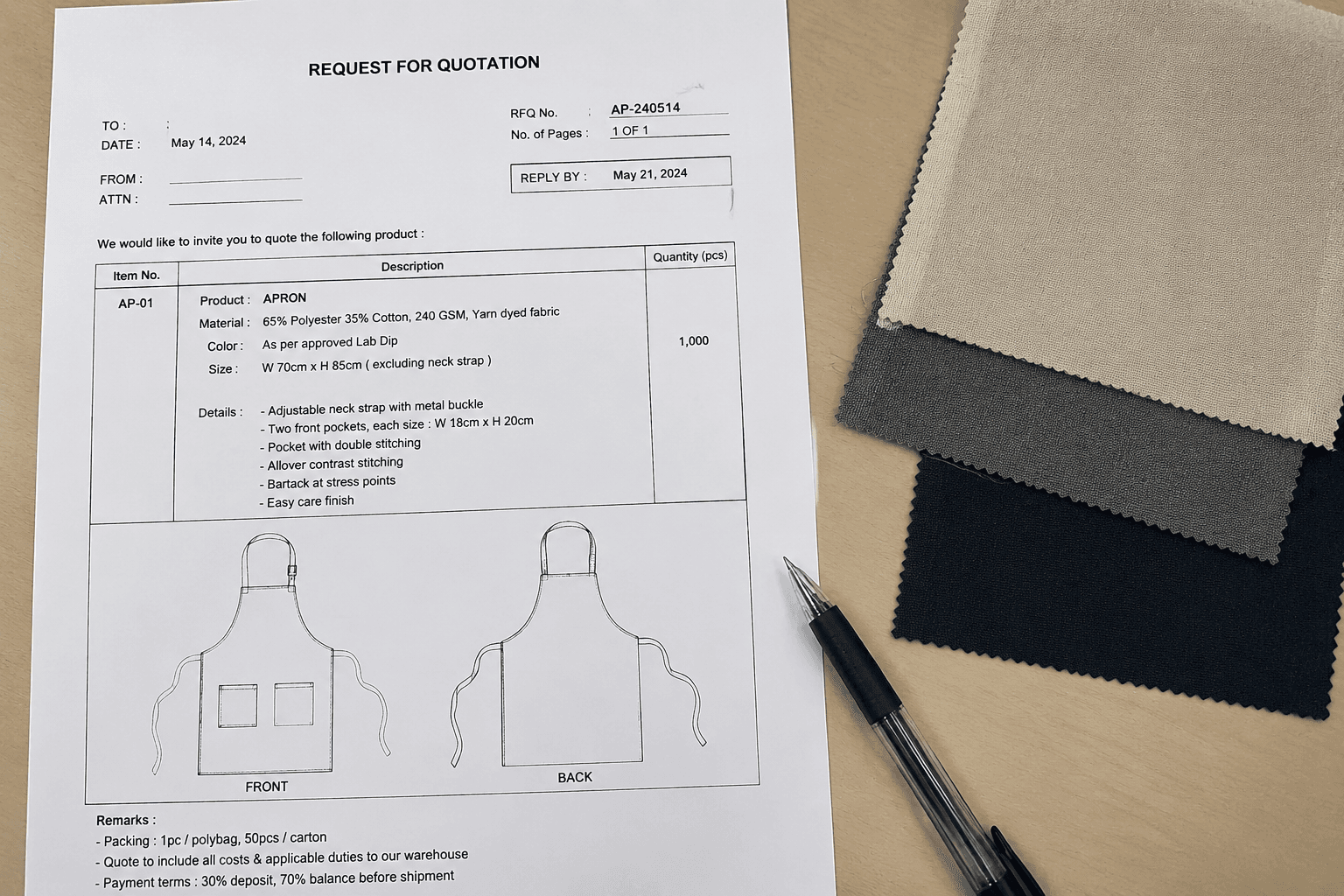
For OEM orders, we normally ask buyers to separate the specification into three levels: required, preferred, and optional. Required items might include apron length of 80-90 cm, canvas weight of 400 GSM, two lower tool pockets, and cross-back straps. Preferred items might include antique brass hardware, contrast stitching, or a PU leather logo patch. Optional items can include removable tool loops, hammer loops, or leather pocket trims. This keeps pricing transparent and prevents the sample from becoming overbuilt.
- Workshop and cobbler repair use usually requires stronger pockets, 10-14 oz canvas, or split leather reinforcement.
- Leather craft class use often works well with 280-360 GSM cotton canvas, especially when washability and price are priorities.
- Premium retail craftsman apron programs often combine waxed canvas, leather trims, and brass hardware for a higher perceived value.
- Industrial or daily repair use should prioritize reinforcement and ergonomic straps over decorative details.
Material choices for abrasion resistance and comfort
Abrasion resistance is the first sourcing question, but it should not be judged by fabric weight alone. A 500 GSM fabric can still fail early if the weave is loose, the pocket corners are not reinforced, or the seams are placed where tools rub continuously. For a leatherworking apron, we usually compare cotton canvas, poly-cotton canvas, denim, waxed canvas, split leather, and PU-coated fabrics. Each has different behavior in cutting, sewing, washing, and packing.
Cotton canvas from 280-360 GSM is suitable for light leather craft apron programs, training studios, and branded retail aprons. It is breathable, cost-efficient, and easy to embroider or screen print. For professional leatherworking, 400-520 GSM canvas gives better abrasion resistance and a firmer hand feel, but it increases finished garment weight and sewing difficulty. At 500 GSM and above, needle selection, seam thickness, and strap comfort become important.
Waxed canvas is often requested for craftsman apron styles because it looks more rugged and resists light moisture and staining. However, waxed canvas is less suitable for high-temperature pressing, may show crease marks during folding, and usually has a higher cutting and handling cost. Split leather panels provide strong abrasion resistance on pockets and lap areas, but full leather aprons have higher material cost, heavier shipping weight, and more complicated color consistency control.
- 280-360 GSM cotton canvas is practical for light leather craft, teaching studios, and price-sensitive retail programs.
- 400-520 GSM cotton or poly-cotton canvas is a common range for a professional leatherworking apron with daily use.
- 10-14 oz denim can work for a softer cobbler apron, but pocket reinforcement is still needed at tool contact points.
- Waxed canvas usually adds USD 0.60-1.50 per piece compared with standard canvas, depending on fabric source and order volume.
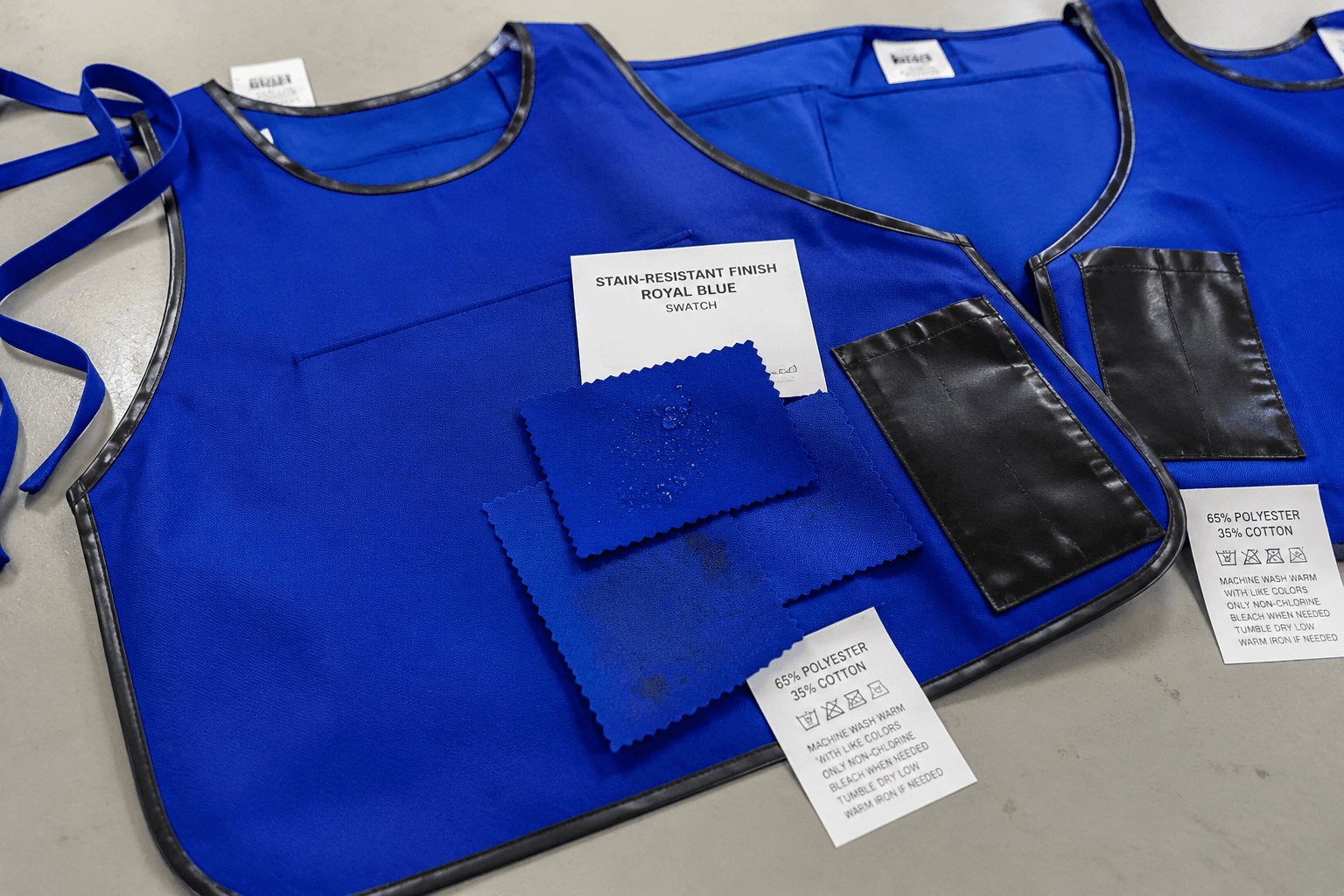
- Split leather reinforcement on pockets can add USD 0.40-1.20 per piece, depending on size, thickness, and color tolerance.
Tool pocket apron design: pocket depth, access, and safety
A tool pocket apron is only useful if the pockets hold the correct tools without creating new hazards. Leatherworkers often carry sharp or pointed tools, including awls, skiving knives, edge bevelers, utility blades, dividers, and small scissors. A generic kitchen apron pocket is usually too shallow and too wide. Tools shift sideways, fall out when the user sits down, or damage the pocket lining.
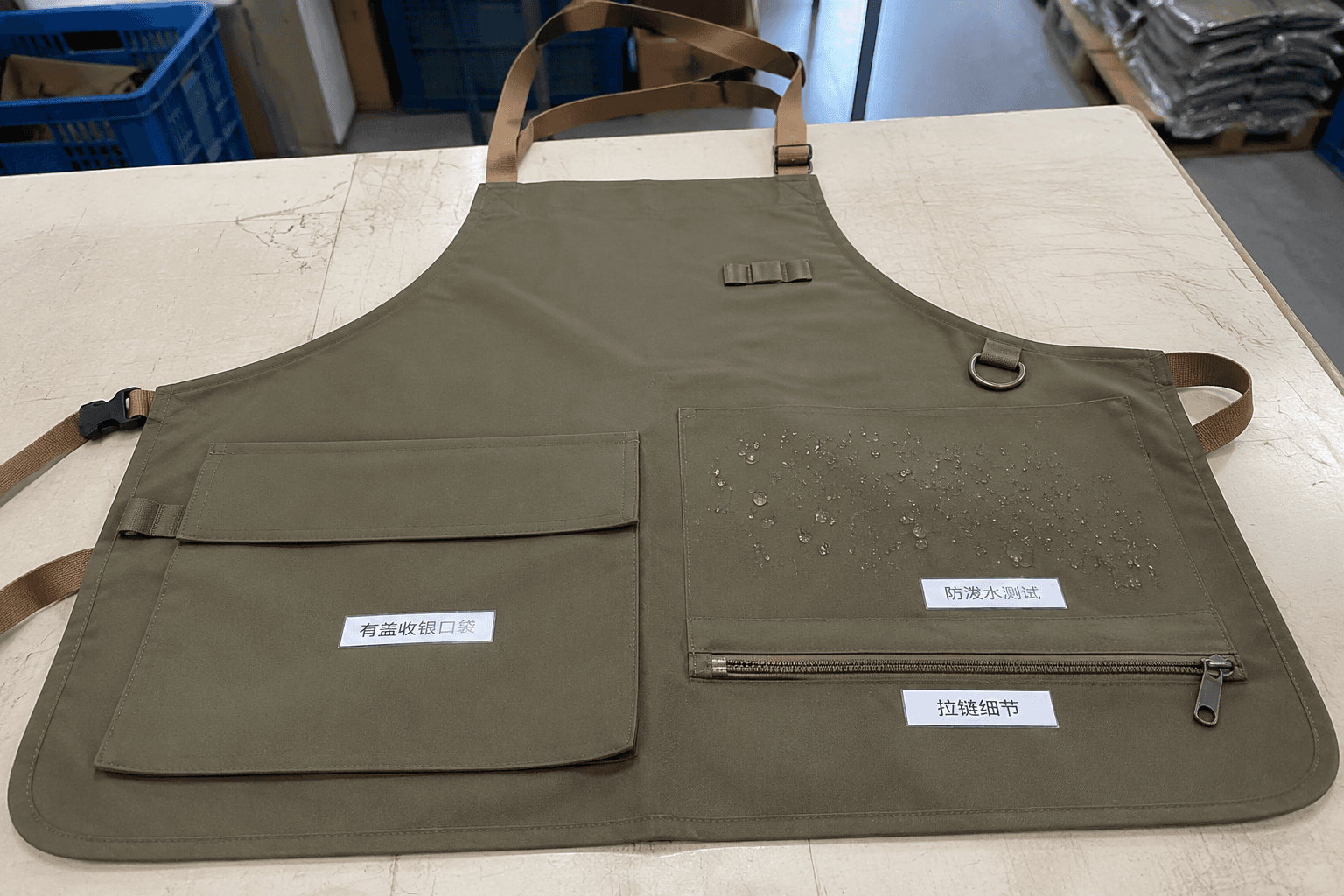
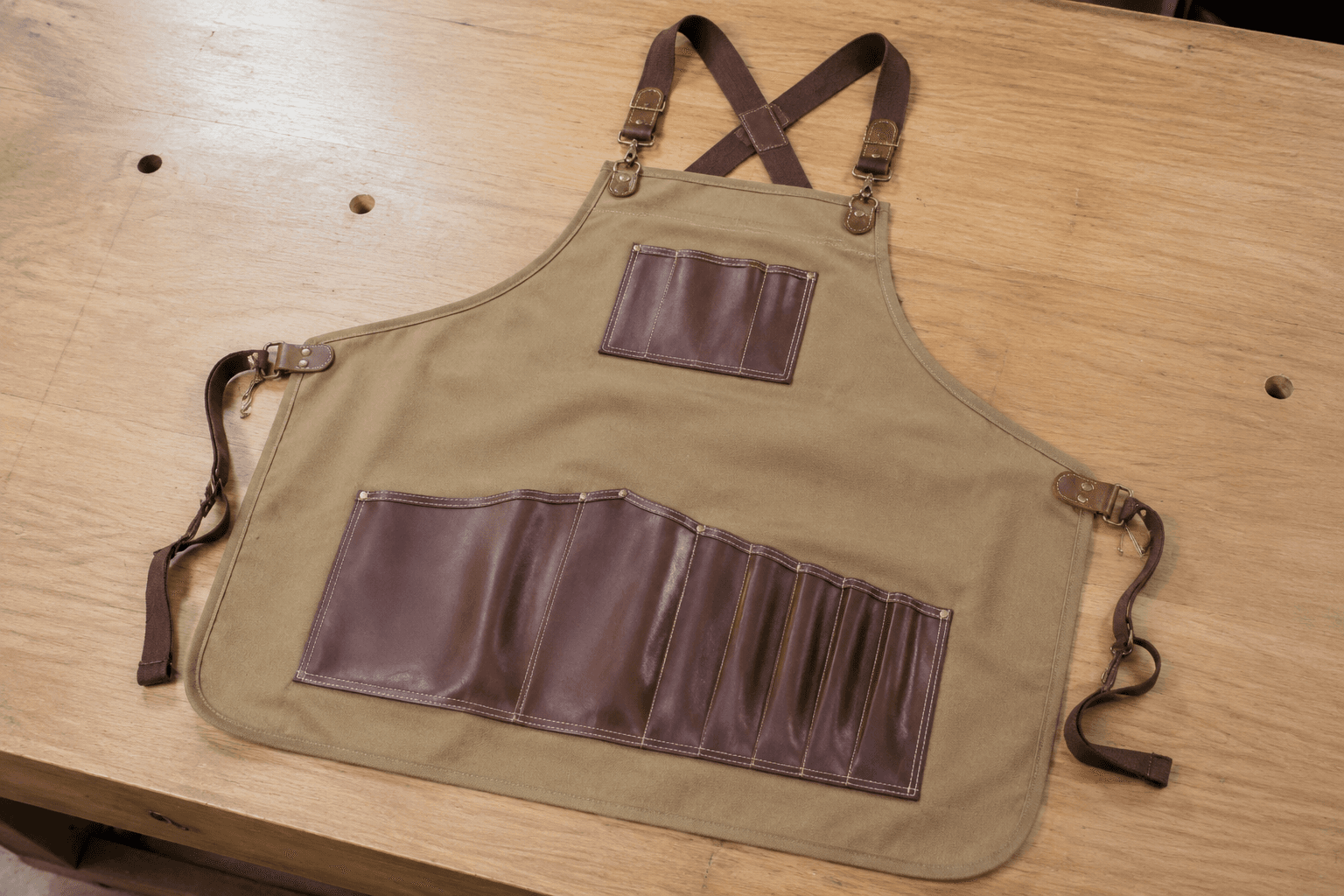
Pocket depth should be matched to tool length. For pencils, thread snips, and small rulers, 10-13 cm depth can be enough. For awls and edge tools, 14-18 cm is safer, especially if the pocket opening is slightly angled. Very deep pockets over 20 cm can slow access and collect dust, leather scraps, and wax. For cobbler apron programs, we often recommend a combination of narrow vertical pockets and one wider lower pouch rather than two large open pockets.
Pocket placement should be tested in both standing and seated positions. A lower pocket that feels convenient while standing may press into the thigh when sitting at a stitching pony or repair bench. A chest pocket may look attractive but can interfere with bending forward. For professional use, tool pockets should sit close enough to the body to reduce swinging, and heavy tools should not be placed only on one side.
- Narrow tool slots of 3-4 cm width are suitable for awls, pens, edge bevelers, and small screwdrivers.
- Medium pockets of 8-12 cm width work for snips, wax blocks, tape measures, and small notebooks.
- Lower pouch pockets of 15-20 cm width can hold rulers, gloves, small parts, or repair tickets.
- Pocket openings should be reinforced with bartacks, rivets, or double stitching where sharp tools enter frequently.
- For safety, blade storage should not rely on a loose open pocket unless the buyer supplies tool dimensions for testing.
Reinforcement methods for a durable leatherworking apron
The life of a leatherworking apron is often decided at stress points rather than across the main fabric panel. Common failure points include pocket top corners, waist strap joins, neck strap joins, hammer loop seams, and lower pocket bottoms. A fabric that passes the buyer's hand-feel check may still fail if these areas are stitched with light thread or without bartacks.
For canvas aprons, bartacking is the most cost-effective reinforcement. We typically use bartacks at pocket corners, strap joins, and tool loops. Double-needle stitching improves appearance and seam stability, especially on pocket edges. Rivets can add strength and a rugged look, but they increase cost and must be placed carefully so they do not scratch benches, tools, or finished leather goods. For export retail products, rivet backs should be checked for burrs and secure setting.
Reinforcement patches are useful when tools repeatedly hit one area. A leather or heavy canvas patch behind a tool pocket spreads stress over a larger surface. For a cobbler apron, lower front reinforcement can protect against rubbing from lasts, shoe soles, and bench edges. However, every added layer increases thickness at seams. Factories must confirm whether standard sewing machines can handle the stack or whether heavier machinery is needed, because this changes production speed and pricing.
- Bartacks at pocket corners usually add small cost but provide a large durability improvement.
- Double-needle stitching is recommended for visible pocket edges and strap attachment areas.
- Rivets can improve perceived strength, but they should not replace proper stitching on load-bearing seams.
- Leather reinforcement patches should be specified by thickness, color, grain side, and acceptable natural variation.
- Heavy seam stacks may reduce daily output from 800-1,200 pieces to 300-600 pieces, depending on style complexity.
Strap systems, sizing, and wearer comfort
A leatherworking apron can be technically durable but rejected by users if the strap system causes neck pressure. This is common when buyers upgrade from a light cotton apron to 450-600 GSM canvas, waxed canvas, or leather-trimmed styles without changing the neck strap design. Once tools are loaded into the pockets, the total worn weight may exceed 700-1,000 g.
For lighter leather craft apron programs, a simple adjustable neck strap is acceptable and keeps cost low. For heavier craftsman apron styles, cross-back straps are usually better. They distribute weight across the shoulders and back, reduce neck fatigue, and improve long-session comfort. The trade-off is higher material use, more sewing time, and more complicated packing because straps must be arranged neatly to avoid tangling.
Sizing should be specified with actual measurements, not only S, M, L labels. A common adult unisex size is 70-75 cm wide by 80-90 cm long. Taller users or cobblers working seated may prefer 95-105 cm length. Waist ties are usually 90-110 cm each side for standard sizes, while cross-back strap systems may require 140-170 cm strap length depending on hardware. For bulk orders, adjustable hardware is helpful, but plastic hardware may look too light for a rugged apron and metal hardware increases weight and cost.
- Simple neck strap systems are lower cost and suitable for aprons below approximately 450 g finished weight.
- Cross-back straps are recommended for waxed canvas, leather-trimmed, or heavily pocketed aprons.
- Cotton webbing of 2.5-3.8 cm width is common; wider straps improve comfort but increase material cost.
- Metal buckles and sliders can add USD 0.15-0.50 per apron compared with basic tie straps.
- Fit samples should be tested with tools loaded, because empty-apron fitting misses the real weight distribution.
Logo decoration and brand presentation for bulk orders
For brand buyers, the apron must function in the workshop and still present well in retail photos, trade shows, or staff uniforms. Decoration choices should be selected according to fabric type and order volume. Embroidery works well on cotton canvas and denim but can be difficult on very thick waxed canvas or leather patches. Screen printing is cost-effective for simple logos on flat panels, while woven labels and leather patches give a cleaner branded finish for premium programs.
Logo position should not interfere with abrasion zones or pocket function. A logo printed across a lower pocket may crack or wear quickly when tools rub against it. A chest logo is visible but should be sized carefully, often 6-10 cm wide for a woven label or 8-15 cm for embroidery. For a cobbler apron, a leather patch at the chest or upper pocket can look appropriate, but buyers should allow natural color variation if genuine leather is used.
Packaging also affects presentation and cost. For B2B workshop supply, simple individual polybags and carton packing are enough. For retail-ready leatherworking apron programs, buyers may request belly bands, hang tags, kraft boxes, or folded presentation packs. These items should be included early in the quotation because retail packaging can add USD 0.15-0.80 per unit and may increase carton volume.
- Embroidery is suitable for cotton canvas and denim, with common logo sizes from 6-15 cm wide.
- Screen printing is economical for 500-3,000 piece orders when the artwork has limited colors.
- Leather patches should be tested for stitch strength, colorfastness, and edge finish before bulk approval.
- Woven labels are consistent and cost-effective for repeat orders, especially when MOQ for labels is planned in advance.
- Retail packaging should be quoted together with the apron because it changes labor time, carton size, and freight calculation.
MOQ, sampling, cost structure, and lead time
MOQ for a custom leatherworking apron depends on fabric availability, color, hardware, and decoration. For standard cotton canvas in stock colors, 300-500 pieces per color is often workable. For custom dyed canvas, waxed canvas, special webbing colors, or exclusive hardware finishes, the practical MOQ may rise to 800-1,500 pieces per color. Genuine leather trims can also have minimum purchase requirements, especially for consistent color across production.
Sampling usually takes 5-10 days after the specification, artwork, and materials are confirmed. If custom dyed fabric, waxed fabric, or special hardware is required, development can extend to 12-20 days. Buyers should not approve a sample only by photo. For a tool pocket apron, the sample should be physically checked with the buyer's actual tools or a tool list supplied to the factory. Pocket depth, strap comfort, rivet position, and apron length are easier to correct before bulk cutting.
Indicative FOB China pricing for a simple 280-320 GSM canvas leather craft apron may start around USD 2.20-3.80 per piece at 1,000 pieces, depending on color and logo. A 400-520 GSM canvas craftsman apron with multiple tool pockets, cross-back straps, and basic logo decoration may sit around USD 4.80-8.50 per piece. A waxed canvas or leather-trimmed cobbler apron with metal hardware and reinforced pockets may range from USD 8.50-16.00 per piece or higher. These ranges are not fixed quotes, but they help buyers understand which details drive cost.
Bulk production lead time is commonly 25-40 days after sample approval and deposit for standard materials. More complex programs can require 45-60 days, especially during peak months before Chinese New Year or when fabric mills have longer queues. For repeat orders, holding approved fabric, labels, and hardware specifications can reduce development time and improve consistency.
- Standard stock canvas programs may start from 300-500 pieces per color when the design is not too complex.
- Custom fabric color, waxed canvas, or special hardware usually pushes MOQ toward 800-1,500 pieces per color.
- Proto sampling normally takes 5-10 days; special materials can extend sampling to 12-20 days.
- Bulk lead time is often 25-40 days after approval, with 45-60 days for complex or seasonal orders.
- Price increases are usually driven by fabric weight, pocket count, strap complexity, hardware, leather trims, decoration, and packaging.
Quality control points before shipment
Quality control for a leatherworking apron should go beyond checking measurements and logo placement. The apron must be inspected as a working item. Pockets should be pulled lightly at corners, straps should be tension checked, rivets should be checked for secure setting, and sharp hardware edges should be rejected. For waxed canvas, inspectors should check excessive crease marks, uneven wax coating, and oil transfer risk.
Measurement tolerances should be realistic for heavy fabrics. For apron body width and length, +/-1.0 cm is common. Pocket placement may use +/-0.5 cm to +/-1.0 cm depending on complexity. Strap length tolerance can be wider, but adjustability must be confirmed. If buyers require very tight tolerances on thick canvas or leather-trimmed styles, production speed slows and inspection rejection may increase.
Carton packing should protect the finished apron without creating permanent fold damage. Heavy canvas and waxed canvas can hold fold lines, so the folding method should be approved during pre-production. For retail orders, barcode placement, hang tag position, and polybag warning text should be included in the QC checklist. A practical final inspection should include AQL sampling, measurement check, workmanship check, decoration check, packing check, and a basic tool-pocket function check.
- Check bartacks, rivets, and pocket corners as functional stress points, not only as visual details.
- Confirm that tool pockets are open, correctly divided, and free of loose threads that can catch tools.
- Inspect strap joins under tension because heavy aprons often fail first at attachment points.
- Review waxed canvas for uneven coating, transfer risk, and unacceptable fold marks.
- Approve folding and packing before bulk shipment, especially for retail-ready craftsman apron programs.