Many apron briefs still start with color card, logo size, stain release and target FOB price. Those points matter, but they do not prevent the failure that drives most repeat claims: aprons that come out of commercial ironing or tunnel finishing twisted, shortened, wavy at the pocket edge or visibly off-grain. In a professional laundry flow, aprons may be washed at 60-75°C, tumble dried, then exposed to steam or press contact that can briefly reach 150-165°C at the surface. At that point, weak specifications show fast. For industrial ironing aprons, dimensional stability is a service-life requirement tied directly to replacement cost.
Buyers should judge performance after repeated laundry-and-finish cycles, not by how flat the apron looks in the export carton. A shell fabric at 220 GSM can still fail if the neck strap shrinks 4.0% while the body shrinks 2.1%, or if the pocketing relaxes more quickly than the front panel. The garment works as a system: shell, ties, pockets, sewing thread, labels, reinforcement layers and seam tension all need similar behavior under heat and steam.
The commercial impact is straightforward. A bib apron quoted at $2.25-$3.85 per piece ex-factory at 3,000 pieces can become the expensive option if tunnel finishing causes rework, deductions or early replacement after 10-20 cycles. The stronger buying method is to define the customer’s real wash, dry and finish process first, then lock the apron specification, PPS criteria, AQL and lead-time plan around that process.
- Best all-around fabric: 65/35 or 80/20 poly-cotton twill at 210-245 GSM, roughly 6.2-7.2 oz, gives the most consistent balance of drape, drying speed and shape retention for repeated commercial finishing.
- Residual shrinkage target: keep shell, pockets and ties at 3.0% or less after the agreed wash-and-finish test; for hotel and central-laundry programs, 2.5% or less is a safer control point.
- Construction causes many failures: a stable shell still performs badly if ties are cut off grain, pocket panels shrink differently, or bulky trims print through after steam exposure.
- Garment testing beats fabric claims: screen with 5 cycles before PPS, then run 10-20 cycles for higher-turn professional laundry accounts using production fabric, thread and trims.
- Upgrade cost is usually modest: moving from a basic 180-190 GSM fabric to a heat-stable apron package often adds $0.18-$0.42 per piece, plus about $0.05-$0.15 for tighter process control or external testing.
- Commercial terms should reflect technical risk: stock fabric programs can start at 500-1,000 pieces per color, while custom-dyed or custom-finished twill often needs 2,000-3,000 meters and a 35-50 day bulk timeline.
Why industrial ironing aprons fail after 5-15 laundry and finishing cycles
New aprons often pass incoming inspection because the panels are flat, seams are fresh and no component has yet been stressed by repeated washing, drying and steam finishing. Problems appear after the first 5-15 cycles, when yarn tension relaxes, seam balance changes and each component starts moving at its own rate. In hotel laundries, institutional kitchens and foodservice uniform programs, that means exposure to 60-75°C washing, high extraction, tumble drying and steam tunnel or flatwork finishing at brief surface temperatures around 150-165°C.
The first failure is usually loss of shape, not fabric rupture. The hem drops unevenly, the front panel torques, the pocket mouth ripples, or the neck and waist ties shorten enough to affect fit and presentation. In bib styles, neckline distortion often starts where the shell, strap and reinforcement layer shrink at different rates. The apron may still be wearable, but it stops looking uniform after pressing, which is exactly when staff presentation matters most.
For professional buyers, these are not minor cosmetic defects. Hotels, bakeries, contract caterers and laundry contractors buy aprons as repeat uniform inventory. If the garment looks tired after 10 cycles, operators read it as poor quality even if tensile strength remains acceptable. That is why industrial ironing aprons should be approved on repeated-cycle appearance and measurement retention, not first-day appearance.
- Hem torque: commonly linked to off-grain cutting, unbalanced twill and weak pre-shrink control.
- Pocket waviness: usually caused by shell and pocket panels shrinking at different rates, often more than 1.0 point apart.
- Tie shortening: typical when lighter tape or decorative straps lose 3.5-5.0% while the body stays under 2.5%.
- Neckline distortion: often triggered by mismatched shrinkage between bib, strap and fusible or woven reinforcement layers.
Fabric specifications that hold shape in industrial ironing aprons
For most B2B apron programs, the safest starting point is 65/35 polyester-cotton twill at 210-235 GSM, about 6.2-6.9 oz. This range provides enough body to hang cleanly after pressing without feeling overly stiff in daily wear. It also keeps cost in a workable band for hospitality, foodservice and housekeeping support uniforms. At order volumes of 2,000-5,000 pieces, this specification usually delivers the best cost-to-claim ratio.
When the laundry process is harder or the account runs frequent tunnel finishing, 80/20 polyester-cotton twill at 220-245 GSM is often the stronger option. The higher polyester content improves dimensional stability, usually shortens drying time and helps the apron face look flatter after repeated steam exposure. For central laundries, institutional catering and high-turn hotel programs processing garments several times each week, this is often the most reliable commercial choice.
Cotton-rich fabrics still have a place, but only when the buyer accepts a narrower performance window. A 100% cotton twill at 230-260 GSM, roughly 6.8-7.7 oz, can suit bakery groups, café brands and retail-facing concepts that want a softer hand and more natural surface. The tradeoff is lower shape retention under repeated pressing, especially below 220 GSM or where sanforization is inconsistent. Lightweight plain weaves under 180 GSM, linen-look textures and slub fabrics usually create avoidable claim risk in professional laundry systems because they lose edge definition and front drape too quickly.
- Best general-use fabric: 65/35 poly-cotton twill at 210-235 GSM for hospitality and chain foodservice.
- Higher-stability fabric: 80/20 poly-cotton twill at 220-245 GSM for central-laundry and tunnel-finish programs.
- Cotton-rich option: 100% cotton twill at 230-260 GSM for image-led accounts with tighter laundry control.
- High-risk choices: under-180 GSM fabrics, loose plain weaves, decorative slubs and linen-look constructions.
Beyond GSM: shrinkage targets, twill density and finishing chemistry
GSM alone does not predict how an apron behaves after steam finishing. Two fabrics can both weigh 220 GSM and still perform very differently if one is a compact 3/1 twill with balanced warp and weft density while the other is a looser construction with lower cover. For aprons, tighter twills usually keep straighter edges, cleaner pocket lines and better visual flatness after repeated pressing. Buyers should request a full mill specification covering blend ratio, weave, yarn count, finished width, warp and weft density, and pre-shrink method instead of approving by handfeel and weight only.
Residual shrinkage is the most useful control number because it directly affects how the finished garment hangs. For routine hospitality programs, a practical target is no more than 3.0% in both warp and weft after the agreed wash-dry-finish method. For hotel laundry, institutional feeding and central-kitchen contracts, 2.5% or below is safer. The critical point is not only the shell result. Pocket cloth, ties, neck straps and reinforcing tapes need to remain close to the shell; a shell at 2.1% with ties at 4.4% still produces a failed garment.
Finish chemistry also changes real use performance. Heavy softener packages can improve handfeel at packing but often reduce the crisp, flat appearance buyers want after ironing. Moderate easy-care or resin systems may help surface recovery, yet they need to be checked against compliance requirements and tested on the finished apron rather than accepted on a mill claim. In practice, stable industrial ironing aprons come from a balanced twill construction with controlled finishing, not from trying to correct an unstable base cloth with chemistry alone.
- Ask for finished-fabric data: unfinished greige or lab-only numbers do not predict tunnel performance well.
- Check every component: shell, ties, pockets and tapes should each carry shrinkage results before PPS.
- Review dark shades closely: black, navy and burgundy can show finish variation and surface change faster after steam.
- Confirm the finish: sanforized, heat-set, easy-care and softener-heavy treatments each affect the apron differently.
Construction details that keep apron fronts flat after pressing
A stable fabric does not guarantee a stable apron. Aprons have wide unsupported panels, long exposed edges and concentrated stress points at the neck, waist and pocket openings. Those features make them sensitive to off-grain cutting, uneven sewing tension, bulky reinforcements and poorly matched straps. After repeated ironing, the visible result is often edge roping, seam impression, twisted ties or a front panel that no longer hangs straight on the wearer.
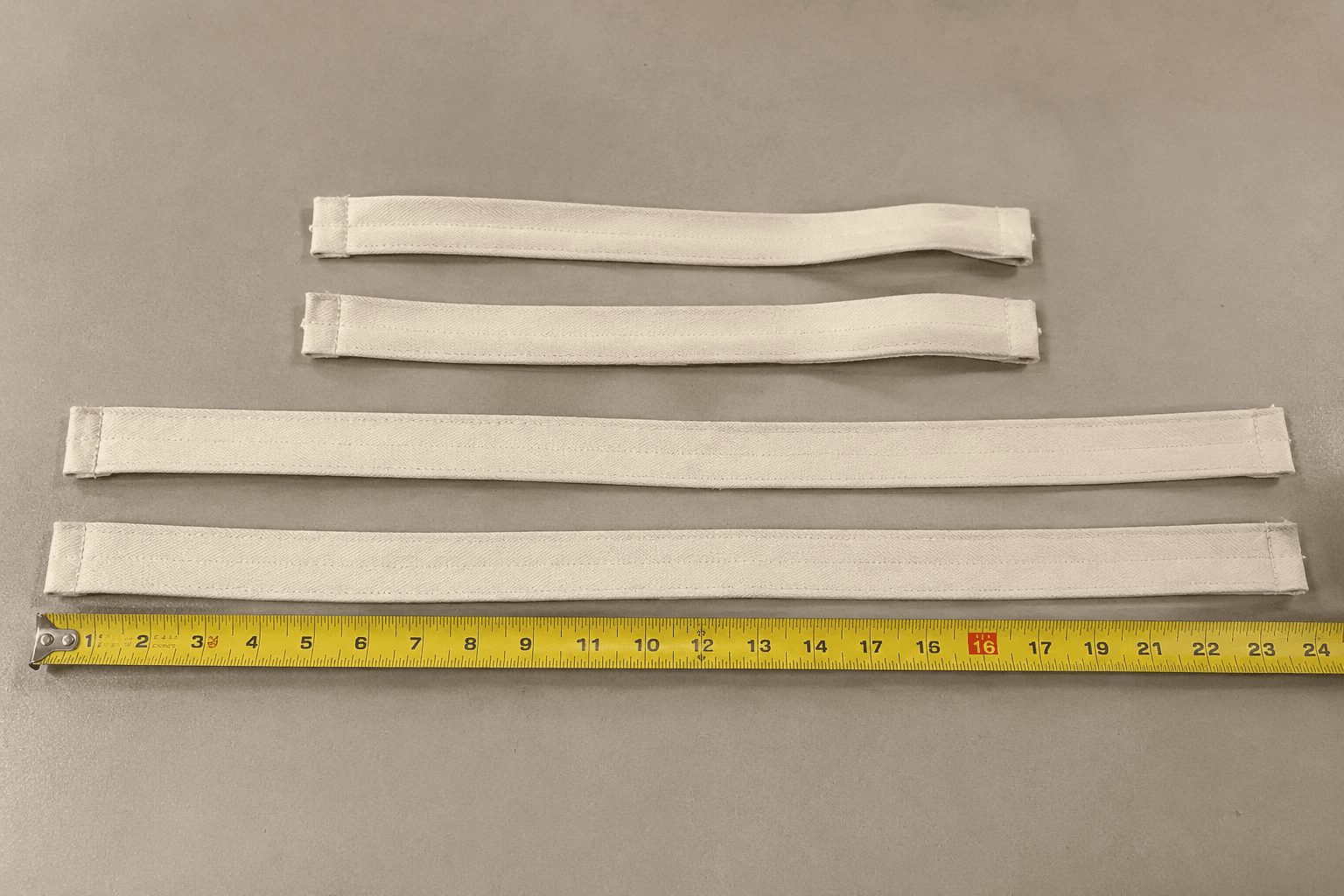
Tie construction is one of the most common failure points. Self-fabric ties cut slightly off grain can spiral after 8-12 cycles. Narrow folded ties can turn cord-like if seam allowance is inconsistent, and decorative herringbone tape may shrink faster than the body panel. In higher-cycle programs, slightly heavier self-fabric ties or proven twill tape with matched shrinkage usually outperform fashion-led strap options. Pocket panels need the same attention; if they are cut on a different grain or sewn from a less stable lot, waviness appears quickly after pressing.
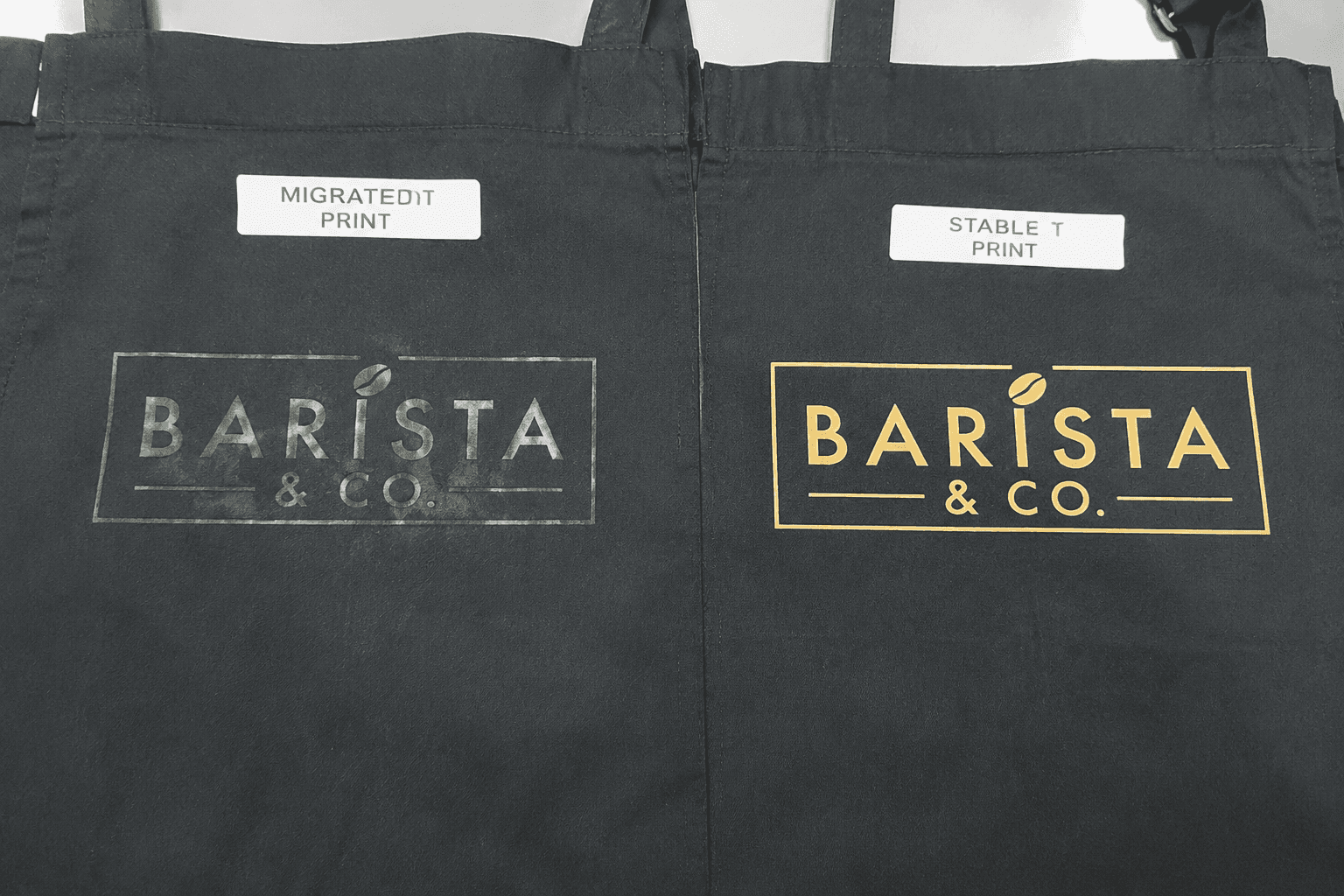
Trim selection also affects service life. Core-spun polyester sewing thread generally withstands repeated commercial laundering better than softer thread packages. Embroidery backings, care labels, fusible supports and decorative patches should be reviewed for bubbling, print-through and pucker under heat and steam. For most uniform buyers, cleaner construction with fewer unstable trim layers produces lower claim rates and more predictable repeat orders.
- Cut ties on grain: reduces spiraling and helps keep length loss within about 3.0% after testing.
- Match pocket direction: pocket pieces should follow the same grain and shrinkage profile as the body panel.
- Use stable thread: core-spun polyester is a common choice for aprons facing 50 or more laundry cycles.
- Limit bulky trims: thick badges, heavy embroidery backings and unstable eyelets often distort after pressing.
Testing protocol, PPS approval and AQL terms for industrial ironing aprons
The most useful test method is a finished-garment simulation using production fabric, production thread and actual construction details. A fabric lab report alone is not enough because many apron failures come from the interaction between shell, ties, pockets and sewing settings. For routine programs, 5 wash-and-finish cycles are a practical screening gate before PPS approval. For hotel groups, central laundries and institutional foodservice accounts, 10-20 cycles give a much more reliable picture of service behavior. Testing should copy the customer’s actual process as closely as possible, including wash temperature, alkali level, drying method and press or tunnel equipment.
Measurement and visual grading should be recorded together. Before and after testing, measure body length, body width, bib depth, tie length and pocket opening width. Then review hem levelness, front-panel skew, seam puckering, edge curl, trim print-through and overall drape on a hanger and on-body. A garment can remain within a 2-3% dimensional tolerance and still fail visually if the apron front looks twisted after finishing.
The schedule is manageable when built into sourcing from the start. Lab dips usually take 4-7 days, sample yardage 7-10 days, prototype sewing 5-7 days and laundry simulation another 7-14 days depending on whether testing is in-house or done through a laundry partner. Final inspection terms should be explicit: AQL 2.5 for major defects and AQL 4.0 for minor defects are common for apron shipments, but heat-and-shape approval should be locked during pre-production rather than left to random carton inspection at the end.
- Screening stage: 5 cycles before PPS using production cloth, trims and thread.
- Higher-risk accounts: 10-20 cycles for hotel, institutional and central-laundry programs.
- Tolerance guide: body dimensions within 2.0-3.0%, tie length within 3.0%, with no visible front torque or pocket distortion.
- Inspection benchmark: AQL 2.5 major and AQL 4.0 minor at final shipment inspection.
MOQ, lead times and ex-factory pricing for heat-stable apron sourcing
Reliable ironing performance does not require luxury pricing, but it does require realistic sourcing terms. For a standard bib apron in 65/35 twill at 210-235 GSM, ex-factory pricing in China typically falls around $2.25-$3.85 per piece at 2,000-5,000 pieces, depending on size, pocket count, adjustable hardware, embroidery and packaging. Moving from a basic 180-190 GSM mixed fabric to a more heat-stable specification usually adds $0.18-$0.42 per piece. If the buyer also requests tighter shrinkage control, better strap matching or garment-cycle testing, another $0.05-$0.15 per piece is a realistic allowance. In most uniform contracts, that is a small premium compared with replacement claims and customer deductions.
MOQ depends mainly on fabric strategy. If the buyer accepts stock-supported twill, production can often start at 500-1,000 pieces per color per style. Once the program requires a custom shade, special finish or tighter mill control, the fabric mill may require 2,000-3,000 meters. Depending on apron size and marker efficiency, that usually converts to roughly 1,200-2,400 pieces. Buyers running multiple related styles can often combine fabric usage to reach the mill minimum more efficiently.
Lead time follows the same logic. With stock or ready greige fabric and simple trims, bulk production after approval may run 25-30 days. With custom dyeing, sanforizing, branded trims and wash-finish testing before bulk release, 35-50 days is more realistic. In peak production windows, or when embroidery and retail packing are included, 45-60 days is the safer planning range. If the account needs dependable industrial ironing aprons, MOQ, calendar, testing and approval sequence should be fixed before the factory books bulk fabric.
- Stock fabric program: MOQ 500-1,000 pieces per color, usually with a 25-30 day bulk lead time.
- Custom fabric program: mill MOQ 2,000-3,000 meters, typically with a 35-50 day lead time.
- Typical ex-factory range: $2.25-$3.85 per piece for bib aprons at 2,000-5,000 pieces.
- Typical upgrade cost: $0.18-$0.42 per piece for better stability, plus $0.05-$0.15 for added controls.
How B2B buyers should choose between cotton-rich and poly-cotton apron programs
The right fabric choice depends on laundry method, replacement interval and presentation standard, not on showroom appearance alone. Cotton-rich aprons are better suited to concepts where natural handfeel and a matte surface matter more than strict post-finish flatness. That can include artisan bakeries, café groups and some retail-facing food brands with more controlled laundry conditions. Even in those cases, buyers are usually safer in a 230-260 GSM twill than in lightweight canvas or loose plain weave fabrics.
Poly-cotton is the stronger default for most professional accounts because it balances cost, stability, drying speed and repeat-order consistency. Restaurant chains, hotel groups, contract caterers, food factories and central kitchens generally see fewer post-laundry claims with 65/35 or 80/20 twill than with cotton-rich alternatives. It also gives the factory a wider process window in bulk production, which helps maintain shade continuity, size consistency and repeat replenishment quality.
Specialty blends should be approved only when there is a clear commercial reason. Recycled polyester-cotton can work if lot-to-lot consistency is verified and each batch is tested under the intended wash-and-finish process. Stretch weaves, very soft fashion finishes and heavily textured surfaces are rarely suitable for uniform programs that depend on flatness after pressing. Buyers usually get the best lifecycle value when apron sourcing starts with the real heat, steam and laundering conditions rather than a softer handfeel in the sample room.
- Choose cotton-rich: when brand image and softer handfeel matter more than maximum shape retention.
- Choose poly-cotton: when low claim risk, stable replenishment and repeat laundry performance matter most.
- Validate specialty blends: confirm lot consistency, shrinkage and heat response before bulk approval.
- Start from use conditions: washing, drying and finishing equipment should drive the apron specification.