Buying aprons for an ice cream business is a uniform sourcing task with unusually strict appearance requirements. Staff move between scoop counters, topping lines, POS, sink areas, and chillers, so the apron must stay presentable after contact with milk, cream, yogurt, soft-serve melt, chocolate syrup, caramel, berry puree, and sanitizing splash. In most stores, apron failure shows up first as visible staining and shape loss, long before the garment is structurally unusable.
For that reason, professional buyers should assess ice cream shop aprons against three linked standards: same-shift splash visibility, cold-room wear comfort, and after-wash stain release. A 180 GSM plain weave may save $0.18-$0.35 per piece, but it tends to show moisture quickly, torque after washing, and lose body at the bib edge and ties. A 220-240 GSM compact twill costs more upfront, yet it usually holds shape better across 20-50 washes and reduces replacement frequency in live store rotation.
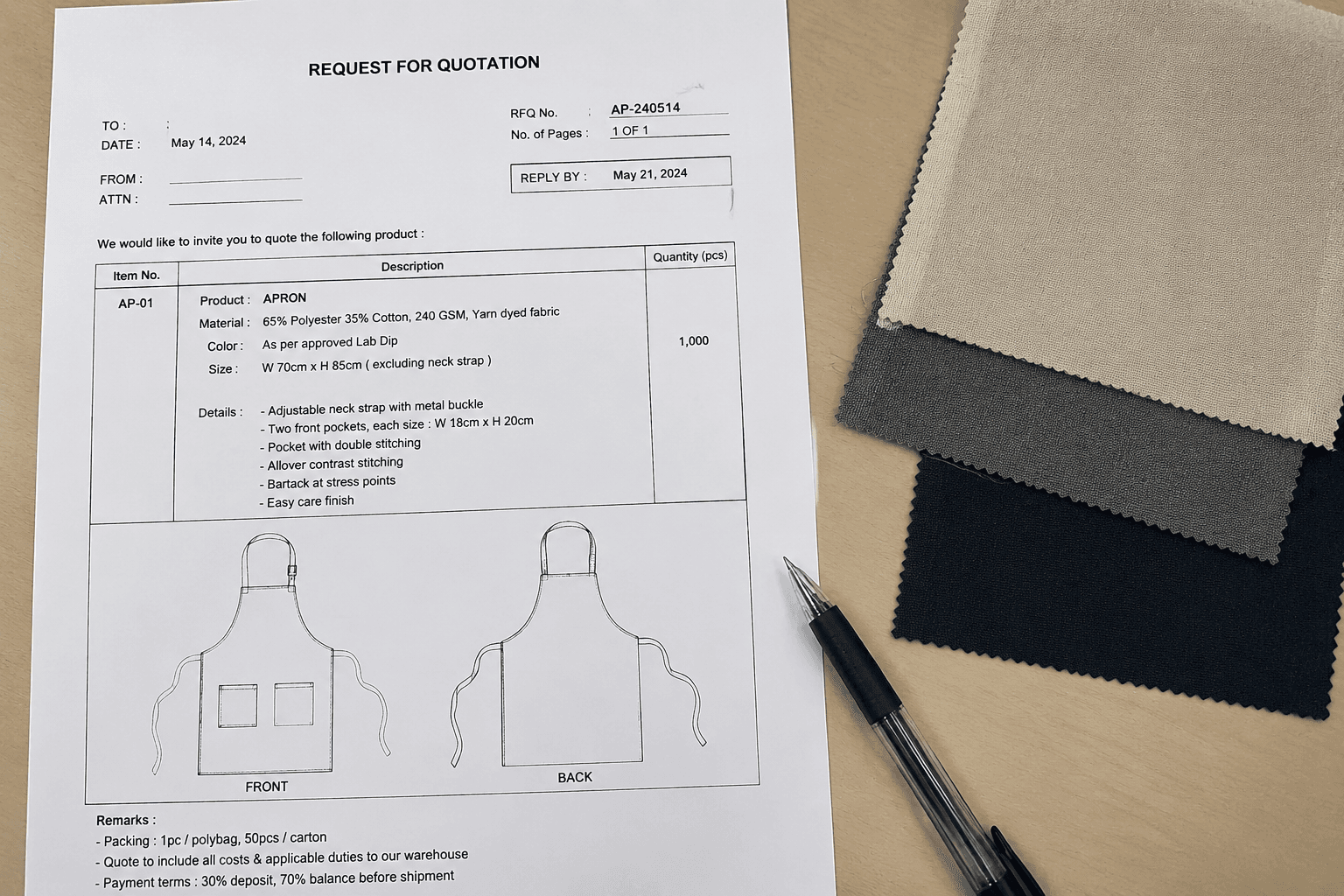
Most sourcing problems come from underwritten specifications. Buyers approve Pantone, logo, and a rough silhouette, but leave fabric face, finish, strap width, pocket geometry, shrinkage target, and reinforcement undefined. The result is predictable: aprons that look dirty within one service window, shrink 3-5% after home wash, or fail at strap joins within a month. A precise OEM brief does more to control cost than arguing over claims after bulk shipment.
- 210-240 GSM compact poly-cotton twill is the safest commercial specification for most ice cream shop aprons, balancing splash masking, drape, wash stability, and price.
- For pastel brand palettes, specify stain-release finishing, approve shade after finishing, and use darker trims or pocket details in high-contact zones to reduce same-shift visibility.
- A practical OEM program usually starts at 300-500 pcs per color per style, with proto samples in 5-7 days, PP samples in 7-14 days, and bulk lead time of 25-40 days after final approval.
- Write construction directly into the PO: 2.5-3.0 cm straps, 3-4 cm strap insertion, bartacks at stress points, shrinkage under 3% after three home-wash cycles, and final inspection at AQL 2.5.
- Typical FOB for chain orders is $2.20-$4.80/pc, depending on GSM, blend ratio, logo method, pocket complexity, finish, and whether cross-back wear is required.
Why ice cream shop aprons need a tighter spec than standard cafe aprons
The stain profile in ice cream service is harsher on appearance than in many coffee-led formats. Fresh dairy splash leaves pale, reflective marks that show immediately on cream, blush, mint, and light blue under 4000K-6500K front-counter lighting. Syrups and fruit toppings create darker spotting on the upper bib, center front, pocket mouth, and waist tie area. After repeated washing, residual milk solids and sugar can leave a yellow-grey cast even when the apron looks structurally intact.
Store movement also changes the comfort requirement. Teams typically work 6-10 hour shifts and move repeatedly between scooping, topping, wiping, rinsing utensils, taking payment, and entering 2-8°C cold rooms for 2-10 minutes at a time. The apron is not a thermal layer, but it must flex over polos, knits, or sweatshirts without neck drag, waist bunching, or bib collapse. Heavy canvas above about 10 oz often looks premium on a hanger and feels cumbersome by mid-shift.
Color strategy is another sourcing pressure point. Ice cream brands often prefer soft, camera-friendly colors, but those shades conflict directly with splash visibility control. Buyers should therefore approve color as an operating decision, not only a branding one. In many chain programs, one pattern works best in two colorways: a pastel front-of-house option and a darker prep-area option using the same pattern, trims, and logo placement.
- Typical shift length: 6-10 hours
- Common chiller exposure: 2-8°C, usually 2-10 minutes per entry
- Highest-contact stain zones: upper bib, lower center front, pocket mouth, waist tie area
- Useful service-life benchmark: 20-50 home or light-commercial wash cycles
Fabric spec for ice cream shop aprons: 210-240 GSM twill and stable blend ratios
For most B2B orders, the correct starting point is a compact twill, not a light plain weave and not a rigid heavy canvas. Compact twill masks fresh splash more effectively, presents a cleaner surface for embroidery or print, and releases dried dairy with less shadowing around yarn intersections. Open plain weaves in the 170-190 GSM range often quote well but show moisture quickly and develop edge curl after repeated washing. Rough canvas can hold shape, but its textured face tends to trap residue around seams and pocket corners.
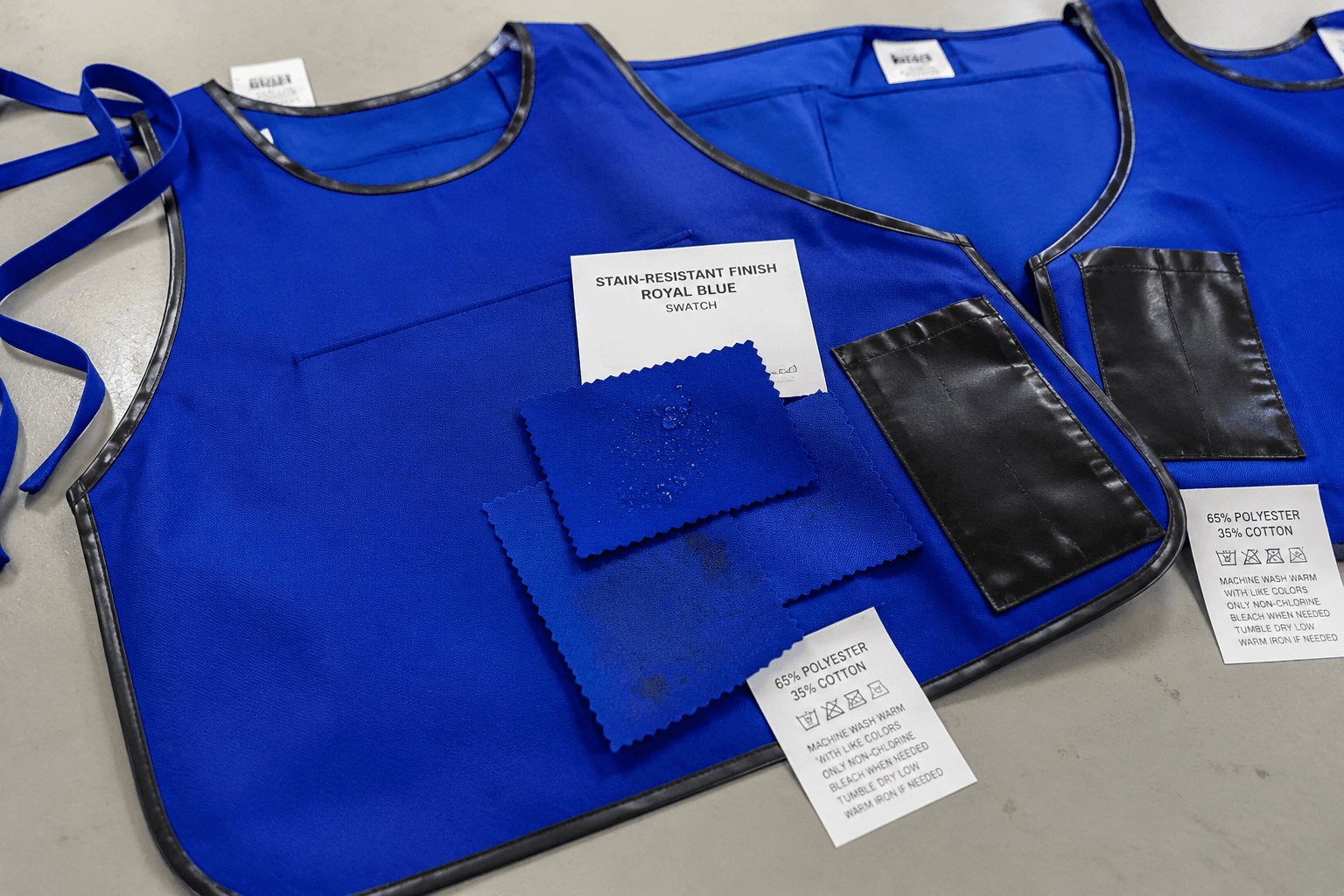
Blend ratio should match the actual wash environment. A 65/35 poly-cotton twill usually gives a softer hand and more natural drape, which suits premium scoop counters that want a less synthetic look. An 80/20 blend generally gives better shrink control, wrinkle recovery, and color retention, especially where staff wash aprons at home three to six times per week. For chains seeking repeat-order consistency across stores, 80/20 is often the safer production base.
Weight should be specified tightly. Around 7.1 oz to 7.7 oz, or roughly 200-220 GSM, a twill apron is workable for darker shades and value-driven programs. The strongest all-round commercial range is 210-230 GSM, while 220-240 GSM is usually better for pale colors, larger bib coverage, and cross-back builds. Once fabric goes above about 8.9 oz, or roughly 260 GSM, mobility often drops unless the concept deliberately wants a structured workwear feel.
Shrinkage and finish targets should be approved before sample sign-off. For standard home laundering, under 3% shrinkage after three wash-and-dry cycles is a realistic benchmark on a stable poly-cotton twill. If the buyer expects commercial laundry or hotter dry settings, the factory should know during development because seam allowance, thread, finish chemistry, and pattern tolerance may need adjustment.
- Recommended face: compact twill
- Preferred commercial weight: 210-230 GSM
- Broader acceptable range: 200-240 GSM
- Common blends: 65/35 and 80/20 poly-cotton
- Target shrinkage: under 3% after three wash-and-dry cycles
Reducing splash visibility in ice cream shop aprons without giving up pastel branding
In sourcing terms, stain release and stain visibility are different issues. A fabric may wash clean later and still look unacceptable during service because fresh dairy contrasts too strongly with the base shade. That is why sample review should happen under actual retail lighting, near freezer glass, and during movement. A swatch viewed on a conference table will not show the same penalty as an apron worn through a live shift.
The safest pastel choices are usually muted rather than bright. Dusty pink, greyed mint, warm cream, and softened lavender tend to hide splash better than pure white, baby pink, or clear candy shades. If the brand requires a clean solid, darker details in the same color family at the pocket mouth, ties, side panel, or bib edge can reduce visible soiling without changing the overall identity. This is a low-cost improvement that often adds only $0.05-$0.18 per piece, depending on panel count and cutting yield.
Finishing needs to be specified in measurable commercial terms. Buyers should request a stain-release finish suitable for frequent home or light commercial laundering, then approve shade after finishing, not before. Pastel fabrics often shift slightly after resin, softener, or stain-release treatment. A better approval path is to review appearance after 5, 20, and 50 wash cycles, because that shows whether the color, hand feel, and surface cleanliness will hold in store rotation.
For multi-store programs, a two-colorway strategy often gives the best operational result. Front-counter staff can wear the branded pastel version, while prep, sink, and back-of-house support use a coordinated darker version based on the same pattern and trim package. Development stays efficient because the block, strap lengths, and pocket layout do not change, while visible staining in the highest-contact roles drops materially.
- Pastels that usually perform better: dusty pink, muted mint, warm cream, greyed lavender
- High-value dark detail zones: pocket opening, waist ties, bib edge, side panel
- Useful wash-review checkpoints: 5 washes, 20 washes, 50 washes
- Typical cost for a simple contrast trim upgrade: about $0.05-$0.18/pc
Cold-room comfort depends on strap geometry, body balance, and pocket control
Cold-room comfort is mainly about load distribution, not insulation. Many low-cost bib aprons place too much weight on a narrow neck loop. Once the bib picks up moisture and the pocket carries a pen, order slip, thermometer, or tasting spoon, neck strain increases quickly. A fitting that seems acceptable for 10 minutes can become tiring after four or five hours of scooping and bending. For that reason, strap width and body balance matter more than decorative topstitching or extra panels.
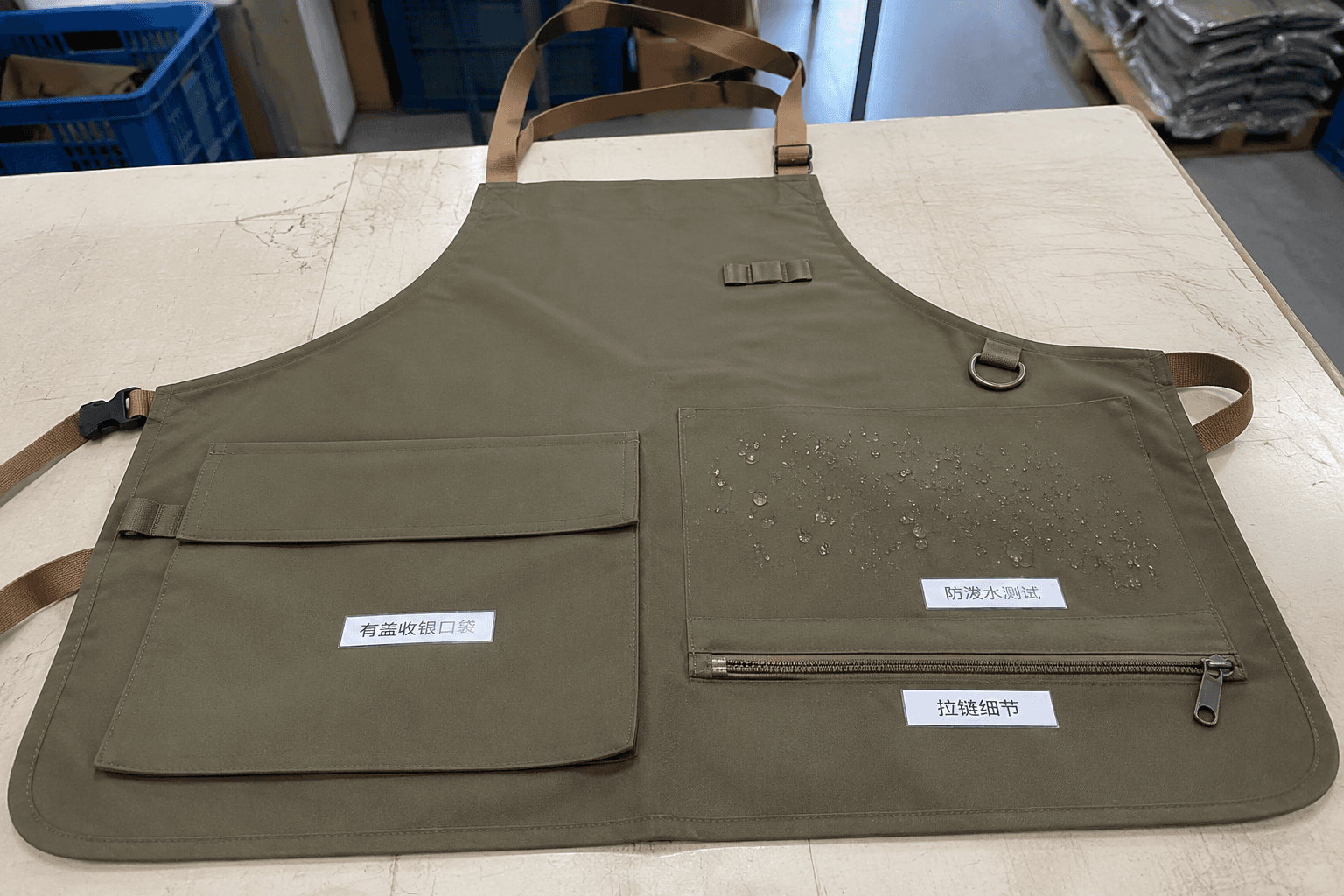
A standard neck-loop bib apron remains the lowest-cost format and can perform well when specified carefully. Strap width should generally be 2.5-3.0 cm, with stable webbing or self-fabric construction and an adjuster that can tolerate repeated wash cycles. Resin or acetal hardware normally outperforms low-grade plated metal because it resists corrosion and detergent exposure. For stores expecting long wear periods or heavier layering, cross-back construction is often worth the premium. In most OEM programs, cross-back adds around $0.20-$0.45 per piece depending on strap length, hardware, and sewing steps.
Body dimensions should fit the workstation, not just look generous on a mannequin. For adult unisex sizing, a bib width of 24-28 cm and body length of 78-86 cm usually gives enough front coverage without catching on under-counter handles or scoop wells. Oversized aprons tend to shift during movement and interfere with fast counter work. Pocket design should also stay disciplined. A divided lower pocket or shallow two-section pouch is usually better than one deep center pocket, which collects sticky residue and is slower to clean thoroughly.
If the store uses sweatshirts or thicker polos in winter, the sample should be worn over the actual uniform during review. That single step often exposes short neck drops, inadequate waist-tie length, and restricted arm movement during scooping. A one-hour in-store wear test provides more useful sourcing data than a static showroom review.
- Recommended strap width: 2.5-3.0 cm
- Typical bib width: 24-28 cm
- Typical body length: 78-86 cm
- Estimated cross-back cost premium: $0.20-$0.45/pc
- Preferred hardware: resin buckle or acetal slider
QC standards for ice cream shop aprons: reinforcement, wash checks, and AQL 2.5
When two factories quote similar FOB, construction detail usually explains the difference in service life. On ice cream shop aprons, the predictable failure points are strap insertion, tie joins, pocket corners, top bib seam, and logo distortion after repeated laundering. A low-cost sample may arrive looking clean, yet fail after 20-30 washes if the tie is inserted only 1.5-2.0 cm without reinforcement. A stronger commercial standard is 3-4 cm insertion at major stress points with bartacks at tie ends, pocket corners, and key strap joins.
Thread and seam balance deserve written control. Polyester sewing thread is generally the right choice because it maintains tensile strength and color stability better than cotton thread through repeated washing. On a 220 GSM twill, stitch density should be balanced for strength without causing puckering along the bib edge or around embroidery. Buyers do not need to over-specify every seam line, but the PO should define reinforcement minimums and acceptable appearance after laundering.
Final inspection should be stated clearly in the order. For mainstream apron programs, AQL 2.5 is a practical benchmark. Core checks should include shade consistency within approved tolerance, symmetrical strap length, logo position, bartack presence, seam puckering, loose thread, front-panel fabric flaws, and finished measurements. Because the logo sits at customer eye level, even a 1.0 cm shift can become a visible reject issue. Measurement tolerance should be written in centimeters, not left as a vague commercial standard.
Wash testing should be part of sample approval on any pale or pastel program. Buyers should review shrinkage, seam roping, spirality, logo integrity, and stain-release performance after repeated cycles. For home-wash use, checks at 5 and 20 cycles are a practical minimum; where active rotation is expected to exceed two months, a 50-cycle appearance review gives a more reliable prediction of store performance.
- Stress-point standard: 3-4 cm insertion with bartacks
- Typical weak spec to avoid: 1.5-2.0 cm insertion without reinforcement
- Inspection benchmark: AQL 2.5
- Logo position tolerance commonly used: within +/-0.5-1.0 cm
- Minimum wash review points: 5 cycles and 20 cycles, with 50 cycles for chain programs
MOQ, sampling sequence, lead times, and cost planning for bulk apron orders
Apron programs run more smoothly when the sample path is fixed before pricing is finalized. First approve the lab dip or color swatch. Second, review a proto sample for pattern, dimensions, strap construction, and pocket layout. Third, approve a PP sample in bulk fabric with final logo method, hardware, and finishing. Skipping one of these steps is how buyers approve a clean color chip and receive bulk aprons with a different pastel cast, stiffer hand feel, or a logo positioned too high on the bib.
MOQ depends on whether the fabric is stock-supported or custom dyed. A basic black or navy bib apron may be possible at 200-300 pcs, but that is not the usual structure for dessert-brand colors. For custom-dyed cream, pink, mint, or lavender in 200-240 GSM twill, a realistic MOQ is normally 300-500 pcs per color per style. At 500 pcs, shade control, marker efficiency, and FOB stability usually improve. Buyers splitting one pattern across several logos should confirm whether MOQ applies to each color, each logo, or the total style quantity.
Lead time should always be counted from approvals, not inquiry date. Proto samples typically require 5-7 days on straightforward apron structures. PP samples usually need 7-14 days once color, trims, and logo method are fixed. Bulk production commonly runs 25-40 days after PP approval and deposit. During peak uniform seasons, or when multiple custom pastel shades and embroidery positions are involved, 40-50 days is a more realistic planning window. Repeat orders can often shorten to 20-30 days if fabric and trims are reserved early.
Cost comparison only works when specifications match. For a standard chain program in 200-220 GSM twill with one pocket, printed logo, stain-release finish, and reinforced construction, FOB often lands around $2.20-$3.00 per piece at workable volumes. A more premium style in 220-240 GSM with cross-back straps, embroidery, upgraded hardware, and cleaner finishing usually falls around $3.20-$4.80 per piece. Logo method affects price materially: a one-color screen print may add $0.10-$0.35 per piece, while embroidery commonly adds $0.25-$0.80 depending on stitch count and placement.
- Typical MOQ for custom pastel twill: 300-500 pcs per color per style
- Proto sample lead time: 5-7 days
- PP sample lead time: 7-14 days
- Bulk production lead time: 25-40 days, or 40-50 days in peak season
- Indicative FOB: $2.20-$3.00/pc standard tier; $3.20-$4.80/pc premium tier
Where buyers should spend and where they should simplify in apron sourcing
The highest-return spend usually goes into fabric stability, stain-release finish, strap comfort, and reinforcement. Moving from a weak 180 GSM plain weave to a stable 210-230 GSM twill often reduces replacement cost more than adding decorative panels or extra branding placements. The same applies to wider straps, bartacks, and durable adjusters. These details do not create showroom drama, but they directly affect how the apron performs after 10, 20, and 50 washes.
Cost can often be reduced safely by simplifying nonfunctional details. Extra pocket layers, decorative rivets, heavy contrast topstitching, and multiple logo positions add labor, increase QC risk, and do little to improve dairy-splash control. Standardizing one apron block across several colorways also lowers development time, improves repeat-order consistency, and makes capacity planning easier for both buyer and factory. Where branding hierarchy is needed, it is usually more efficient to adjust colorway or logo method than to change the whole pattern.
For comparison and negotiation, buyers should request two clean quotation tiers from the start. One tier should target chain deployment with controlled FOB, practical branding, and durable construction. The second should target premium presentation with upgraded comfort and finishing. This keeps specification gaps visible and prevents a common sourcing mistake: comparing prices that look close while hiding meaningful differences in GSM, finish durability, reinforcement, and expected wash life.
- Spend on: 210-230 GSM twill, stain-release finish, 2.5-3.0 cm straps, bartacks, stable adjusters
- Simplify on: decorative hardware, excess panels, multi-position logos, oversized pocket styling
- Use replacement-rate data by store, not first-sample appearance alone, to judge value
- Request standard and premium quote tiers so construction differences stay visible