Many apron RFQs still begin with color, style and target FOB price. In chemical-use roles, that order is wrong. The main driver of visible apron life is often chemical exposure on aprons, not seam strength or abrasion. A black bib apron can remain structurally sound and still look unfit for client-facing use after 15 to 25 working days if peroxide spotting or sanitizer residue is severe.
The exposure profile needs to be written in operating terms. A salon colorist may handle 6% and 9% peroxide cream 15 to 30 times per shift, with occasional 12% developer, short splash contact and spot wiping between clients. A housekeeping attendant may spray 0.2% quat sanitizer 50 to 90 times per shift, carry damp cloths in apron pockets, and wash the apron every one to two days at 40 C or 60 C. Those are different apron sourcing cases and should not share the same default material.
For B2B apron buyers, the practical task is to convert use conditions into factory-ready specifications: fiber content, GSM or oz, coating type, thread grade, trim material, logo method, MOQ, sample timing, bulk lead time, AQL and expected replacement cycle. The buying objective is simple: source aprons to a defined service window and cost-per-wear target, not to generic claims such as water resistant or durable.
- Chemical exposure on aprons should be defined by chemical family, concentration, contact frequency, dwell time and laundry routine, not by broad wording such as heavy duty.
- For peroxide-heavy salon roles, polyester-dominant fabrics at 200 to 260 GSM usually keep an acceptable appearance longer than dark cotton-rich aprons, which often show whitening within 1 to 3 weeks.
- For quat and sanitizer programs, tightly woven polyester, PU-backed polyester or TPU-backed polyester usually outperforms untreated cotton in wipe stability, dry time and residue management.
- Thread, webbing, sliders, buckles and logo applications should be tested with the same chemical and wash routine as the main fabric; trims often fail before the apron body.
- An apron at $2.90 FOB replaced every 8 weeks costs more per wearer per year than an apron at $4.90 FOB replaced every 20 weeks.
- Before bulk production, align on sample timing, a use-based test matrix and inspection to at least AQL 2.5 major and 4.0 minor unless the program needs tighter visual control.
1. Why chemical exposure on aprons needs its own sourcing brief
Aprons used around peroxide, quats and sanitizer sprays should not be bought as standard hospitality aprons with a logo change. The exposure pattern is different, and the failure pattern is different. In salon and cleaning environments, the apron shell, coating, sewing thread, binding, webbing, print system and hardware all face oxidizers, disinfectants, surfactants and frequent laundering. A basic 8 oz cotton twill bib apron quoted at $2.30 to $2.90 FOB may look acceptable at sample stage, then show pale spotting on black panels within 5 to 10 wearing days in a peroxide-heavy salon.
A usable apron brief describes work in measurable terms. Example one: salon color technicians handling 6%, 9% and occasional 12% hydrogen peroxide, splash contact 12 to 20 times per shift, spot wiping with alcohol or damp cloth, and machine washing every two to three days. Example two: contract cleaners using 0.1% to 0.3% quat solution and alkaline sprays, with 40 to 70 spray contacts per shift and laundering every one to two days at 40 C. Those details let the factory quote against real apron use instead of offering unrelated stock fabrics.
It is also important to separate appearance retention, splash performance and structural durability. These fail at different points. An apron can remain intact while the chest panel looks unacceptable after 4 weeks. Another apron can keep its shade while the coating cracks at fold lines after 15 wash cycles. If the sourcing brief states which failure point matters commercially, sample approval and later claim handling become much clearer.
- Appearance retention: resistance to whitening, shade shift, residue marks and logo damage after repeated chemical contact.
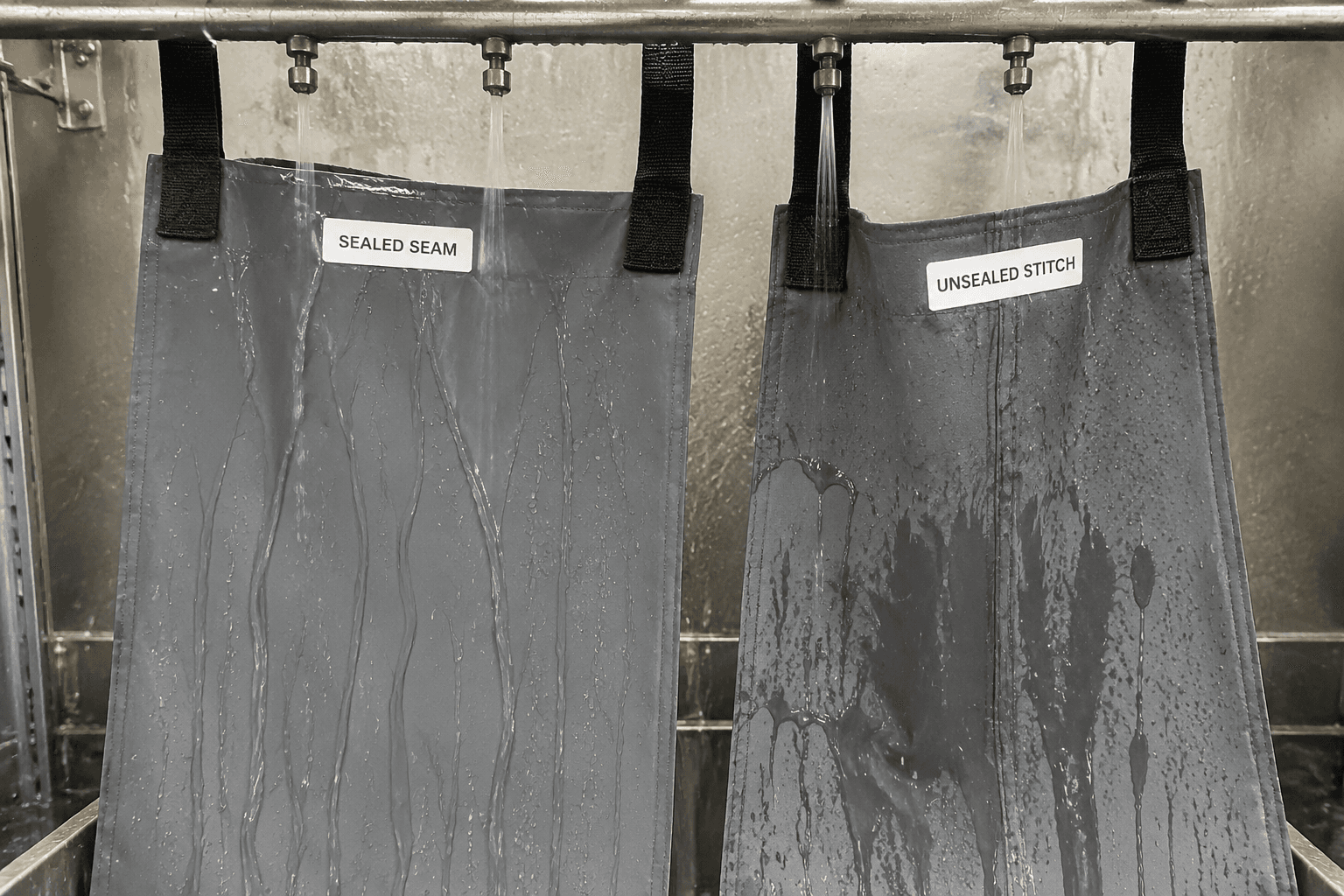
- Splash performance: liquid shedding, soak-through time, seam seepage and strike-through at the lap area.
- Structural durability: stitch strength, coating adhesion, strap wear, buckle reliability and pocket distortion under daily loading.
- Commercial target: expected wearable life per user, such as 10 weeks, 20 weeks or 32 weeks under normal operating conditions.
2. Hydrogen peroxide and chemical exposure on aprons: fabric choices for salon buyers
In salon apron programs, hydrogen peroxide usually destroys appearance before it destroys strength. It attacks dyes and finish systems first, which is why black, navy and forest green aprons often show drip marks long before the fabric tears. Cotton-rich surfaces wet out quickly and hold peroxide on the face of the apron, making bleaching more visible. For peroxide-heavy salons, apron success should be judged by acceptable appearance over time, not by a broad waterproof claim.
Untreated 100% cotton canvas at 240 to 300 GSM, roughly 7 to 9 oz, still has a place when softness, drape and a low opening price matter most. At 1,000 pieces, a simple cotton apron usually lands around $2.50 to $3.30 FOB depending on hardware and logo method. The trade-off is short visual life in color service roles. Under routine contact with 6% and 9% peroxide, visible pale spotting often starts within 1 to 3 weeks, and replacement may be required in 6 to 10 weeks for client-facing staff.
For a longer wearable window, polyester-dominant woven fabrics are usually the better apron base. Common working options are 65/35 poly-cotton twill at 220 to 240 GSM or 100% polyester woven at 190 to 230 GSM. These fabrics generally absorb less, dry faster and show slower visible degradation under splash-and-wipe exposure. If the buyer needs stronger liquid shedding, coated polyester becomes the next step. A 210D or 300D polyester oxford with PU backing can work for moderate salon use, while TPU-backed polyester usually handles repeated wiping and flexing better, though at a higher FOB cost and with lower breathability.
Weight alone does not solve peroxide exposure. Increasing an apron from 230 GSM to 320 GSM will not stop peroxide marking if the fiber, dye system and surface finish remain vulnerable. In most salon apron programs, the best balance of drape, heat comfort, sewability and service life sits around 200 to 260 GSM in a polyester-dominant construction, with the practical understanding that no dark dyed apron is fully peroxide-proof.
- Economy salon apron: 65/35 poly-cotton twill, 220 to 240 GSM, MOQ 1,000 pcs, $2.80 to $3.70 FOB, bulk lead time 25 to 30 days.
- Better appearance-retention apron: 100% polyester woven, 190 to 230 GSM, MOQ 1,000 pcs, $3.40 to $4.50 FOB, sample lead time 7 to 12 days with stock fabric.
- Moderate barrier apron: 210D or 300D PU-backed polyester, total weight about 220 to 280 GSM, MOQ 1,000 to 1,500 pcs, $4.30 to $5.90 FOB.
- Higher wipe-stability apron: TPU-backed polyester, about 240 to 300 GSM, MOQ from 1,500 pcs, $5.30 to $7.40 FOB, with custom material lead times often at 35 to 45 days.
3. Quats, sanitizers and alkaline sprays: specifying aprons for cleaners and housekeeping
Quat-based sanitizers create a different apron failure profile from peroxide. Instead of fast bleaching, buyers usually see residue build-up, localized gloss change, sticky hand feel, finish fatigue and gradual coating breakdown after repeated spray-and-wipe cycles. In these programs, apron selection should prioritize wipe stability, low liquid uptake, fast drying and compatibility with frequent washing rather than only stain resistance.
Untreated cotton is usually the weakest long-term apron option for heavy sanitizer use. It absorbs spray, holds residues and stays damp longer between tasks. That raises visible marking and wearer discomfort, especially in housekeeping and utility roles where aprons are worn 6 to 10 hours per shift. Polyester is a stronger starting point. Tightly woven 100% polyester can work in lighter spray roles. For heavier exposure, coated polyester is more common: 210D PU-backed polyester for light-to-moderate splash conditions, 300D PU-backed polyester where spray frequency is higher, and TPU-backed constructions where the buyer wants a longer replacement cycle under repeated wipe-down and wash use.
Laundry conditions must be included in approval. Quat residue combined with hot drying can accelerate surface changes on lower-grade PU finishes, especially at fold lines and neck curves. A fabric that passes one splash test on the bench may still fail after 10 to 15 wash cycles because the weak point is the finish package, not the base yarn. For contractor apron programs, the sample review should mirror the full field cycle: chemical contact, dwell time, wipe routine, wash temperature, drying method and storage condition.
- Specify polyester or coated polyester when the target apron life is more than 8 to 10 weeks.
- For utility pockets carrying cloths or small bottles, require bartacks at pocket corners and a second stitch line at the pocket opening.
- Use black, charcoal or solution-dyed webbing where possible; light webbing shows sanitizer residue earlier.
- For coated apron fabrics, controlled-density embroidery often outlasts heat transfer, but needle perforation should be reviewed on the sample.
- Ask whether the same apron fabric has prior use in janitorial or housekeeping programs, not only in food-service styles.
4. Where aprons fail first under chemical contact
Most apron disputes come from vague language about durability. In chemical-use programs, damage usually appears in a sequence. First come visible whitening, pale drip marks or residue shadows on the chest and lap panels. Next come surface changes such as roughness, tackiness or local stiffness. Then branding degrades, coatings crease or crack at fold lines, and seam areas distort after repeated wiping and washing. By that stage, the apron may still be wearable, but it is often no longer acceptable for customer-facing use.
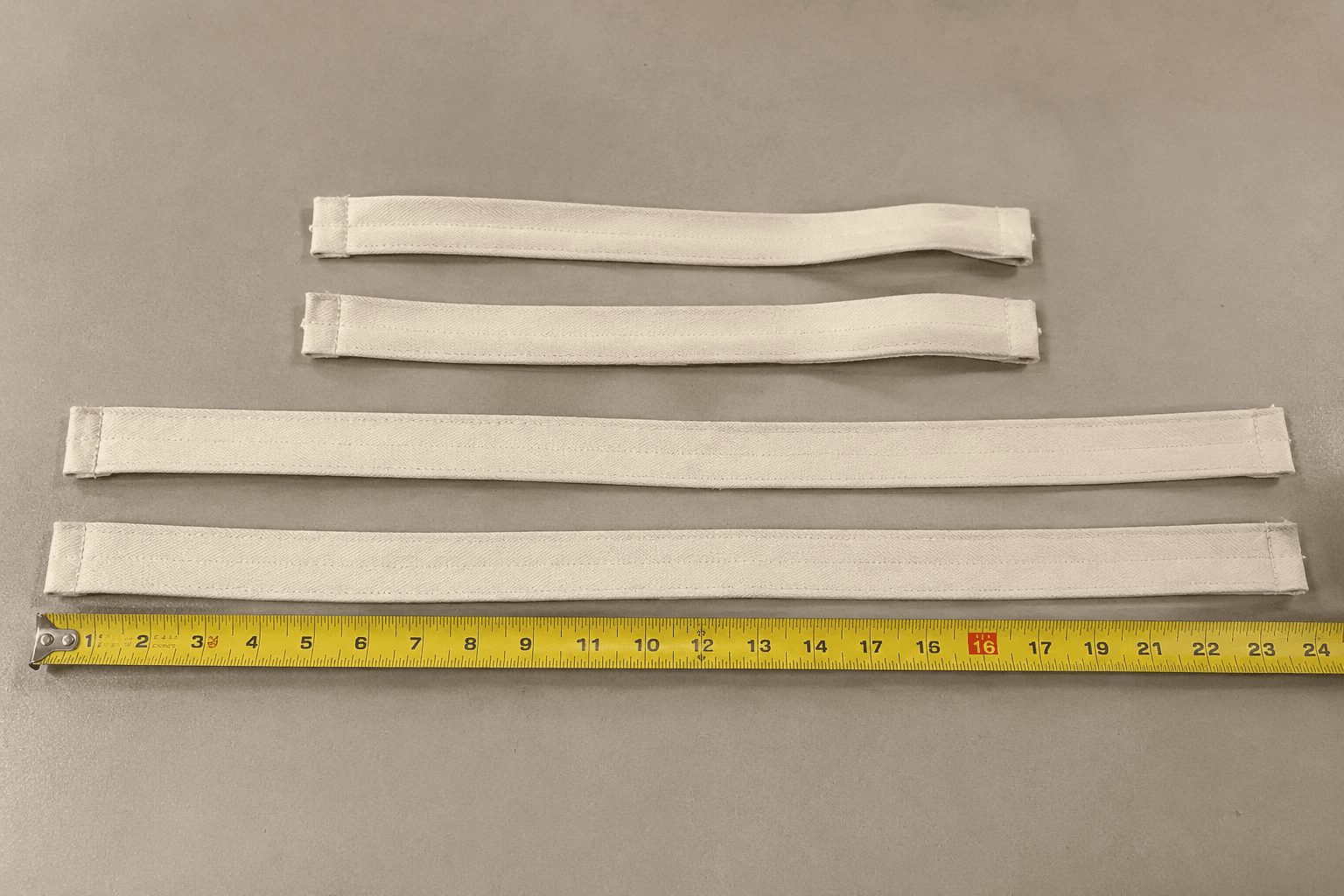
The main fabric is only part of the apron system. Neck straps, waist ties, sliders, buckles, thread and binding all receive transferred chemical contact. A good shell fabric paired with the wrong trims still produces early field failure. Low-grade plated metal sliders can corrode after damp storage. Bright white sewing thread makes peroxide spotting look worse. Cheap stiff webbing can curl after sanitizer exposure and laundering. Pocket tops often fail early when users carry combs, clips, folded cloths or small bottles without enough reinforcement.
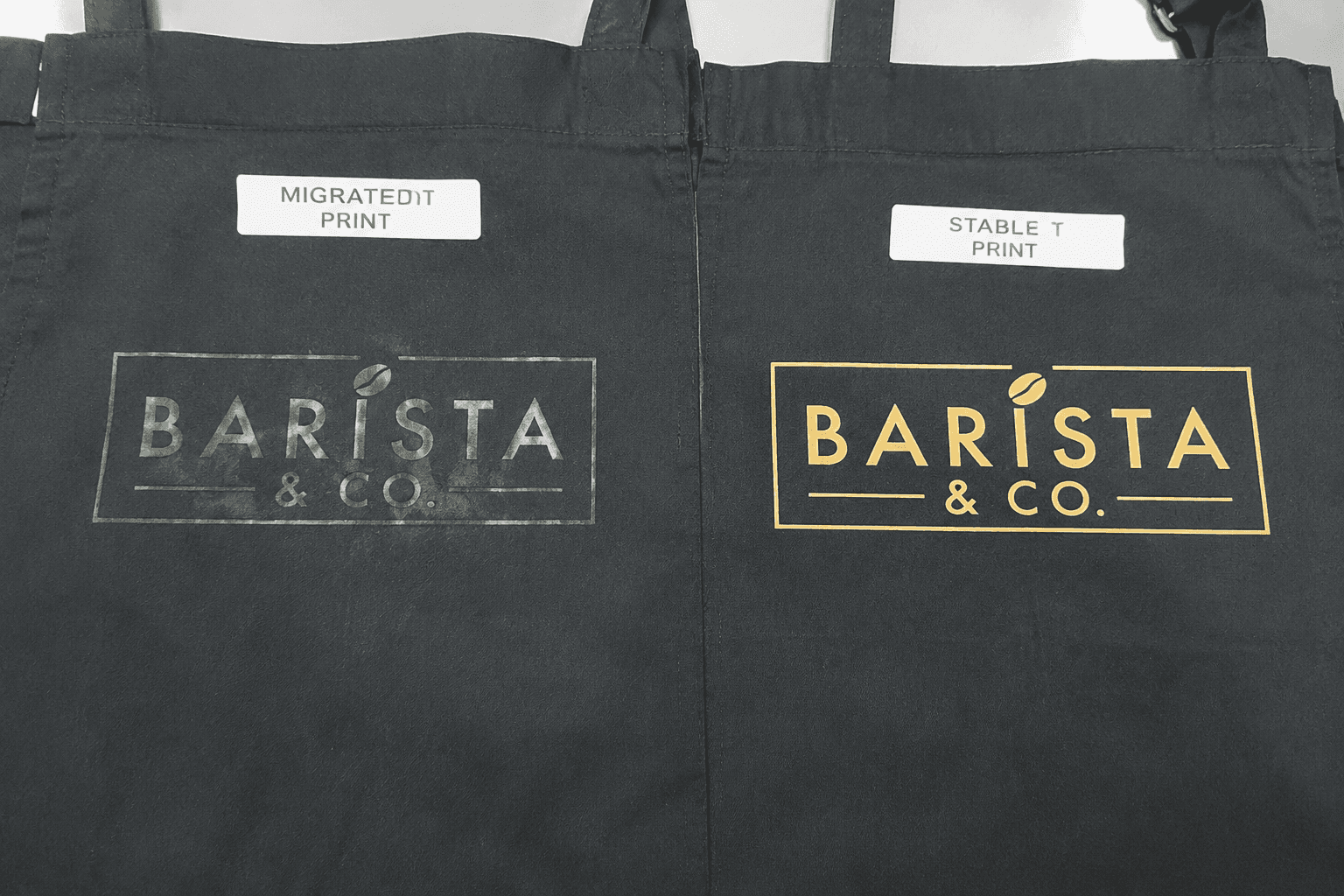
Some design choices reduce visible damage even when they do not eliminate chemical marking. Charcoal usually hides peroxide spotting better than deep black. Heathered surfaces can mask light discoloration better than flat solid shades. Low-contrast logos generally age better than bright white heat transfers on dark aprons. These are not styling details alone; they directly affect replacement timing and claim rates.
- Visible whitening on dark aprons after repeated drips of 6% or 9% peroxide.
- Heat-transfer cracking or edge lift after 20 to 30 sanitizer wipe cycles.
- PU surfaces turning shiny, sticky or brittle at fold points after repeated wash-and-dry use.
- Thread weakening at pocket tops, side ties and strap joins after wet exposure.
- Corrosion, plating wear or seizure on low-grade sliders, D-rings or adjusters.
- Pocket sagging where lower patch pockets carry spray bottles, folded towels or tools.
5. Test matrix and AQL controls for chemical exposure on aprons
Asking whether an apron is chemical resistant is too broad to support production approval. Buyers need a comparative test matrix based on the actual products and routines used in the field. For most salon and cleaning apron orders, this is not a certified PPE project. It is a sourcing control process used to reject apron materials that are commercially unsuitable before bulk fabric is booked and trims are purchased.
A workable protocol should define the substance, concentration, dwell time, number of cycles, wipe method and wash routine. One salon example is 6% peroxide cream, 15-minute dwell, wipe with damp microfiber, repeated for 5 cycles, then washed 5 times at 40 C and line dried. One cleaning example is 0.2% quat sanitizer spray, 10-minute air dry, repeated for 20 cycles, then washed 10 times at 40 C and low-heat tumble dried. The apron review should record color shift, whitening, strike-through, seam seepage, logo damage, coating crack, webbing curl and trim corrosion. Keep an approved control swatch so repeat orders can be checked against the same baseline.
Inspection standards should be agreed at purchase-order stage. For many apron projects, AQL 2.5 major and 4.0 minor is a workable default. For premium salon chains or highly visible housekeeping programs, buyers often keep that AQL and add tighter internal controls on shade variation, logo position, coating streaks and hardware finish. Pre-shipment inspection should cover chemical-relevant points as well as normal sewing defects.
- Required approval inputs: chemical family, concentration range, contact frequency per shift, dwell time, wash temperature, drying method and target apron life in weeks or months.
- Visual checks: whitening, shade change, gloss change, residue marks and logo degradation.
- Functional checks: soak-through time, seam leakage, coating crack, strap slippage and hardware corrosion.
- Bulk controls: retained swatches, approved trim card, shade band reference and pre-shipment inspection to agreed AQL.
- Typical sample timing: 7 to 12 days for a remake with stock fabric; 18 to 25 days when custom dyeing, new trims or repeated chemical tests are required.
6. MOQ, lead time and annual wear cost for apron programs
Once the exposure profile is clear, apron pricing is easier to compare. Entry-level styles for light splash conditions usually sit around $2.30 to $3.20 FOB China in simple polyester or poly-cotton, with MOQs of 800 to 1,500 pieces per color. Mid-range apron programs using polyester-dominant woven fabric, better trims and more stable branding commonly land at $3.60 to $5.20 FOB. Higher-barrier constructions with PU or TPU backing, reinforced pockets and custom hardware often move to $5.20 to $7.80 FOB, with MOQs more often at 1,500 to 2,000 pieces.
Lead time is normally driven by apron materials rather than sewing minutes. If the style uses stock black or charcoal polyester, standard webbing and common hardware, a fit or pre-production sample can often be completed in 5 to 8 days and bulk can ship in 20 to 30 days after approval and deposit. Custom color matching, branded metal trims, special coatings or multiple rounds of chemical testing usually extend the timeline to 35 to 50 days. Buyers should place those days in the purchasing calendar instead of compressing approval and accepting the wrong apron material.
The correct commercial comparison is annual wear cost per user, not FOB alone. An apron priced at $2.90 and replaced every 8 weeks costs about $18.85 per wearer per year if 6.5 units are needed. An apron priced at $4.90 and replaced every 20 weeks costs about $12.74 per wearer per year at 2.6 units. On a 500-person apron program, that difference is more than $3,000 per year before freight, handling and emergency reorders are counted.
- Budget tier: 180 to 240 GSM woven apron, simple trims and logo, MOQ 800 to 1,500 pcs, bulk lead time 20 to 30 days.
- Performance tier: 200 to 260 GSM polyester-rich or coated apron, MOQ 1,000 to 2,000 pcs, bulk lead time 25 to 40 days.
- Custom-material tier: special finish, custom color or branded hardware, MOQ usually from 1,500 pcs, bulk lead time 35 to 50 days.
- Sample-and-test budget: $150 to $400 for one apron sample and one chemical review round is usually cheaper than one failed 1,000-piece bulk order.
7. RFQ wording that gets usable apron quotes
A strong apron RFQ makes the supplier quote against the actual job rather than a vague product category. Replace wording such as durable salon apron or waterproof cleaning apron with operating details: wearer role, daily wear hours, chemicals used, concentration range, contact pattern, wash method and target replacement cycle. That produces more relevant apron sampling and makes price comparisons between factories more meaningful.
It is also worth separating wearer groups. Front desk salon staff, color technicians, housekeeping supervisors and restroom cleaning crews rarely need the same apron construction. Their chemical exposure, branding requirement and comfort expectation differ. One shared apron style may be possible, but one shared specification often shortens service life for the heaviest-use group.
Finally, require the supplier to state limits in writing. If the apron is intended for splash contact rather than prolonged wet saturation, or if peroxide spotting can be reduced but not eliminated on dark colors, that limit should appear on the sample approval record. Clear written limits reduce claims and keep the commercial discussion tied to the approved apron use case.
- State chemical families clearly: hydrogen peroxide, quat disinfectant, alcohol spray, degreaser, acid cleaner or alkaline cleaner.
- Provide concentration ranges such as 3%, 6%, 9% or 12% peroxide and 0.1% to 0.3% quat solution.
- Define contact type: drip, splash, spray-and-wipe, damp-cloth transfer or prolonged wet contact.
- Specify care routine: wipe clean only, machine wash at 40 C, machine wash at 60 C, line dry or low-heat tumble dry.
- Request a target service-life assumption, such as 12 weeks, 24 weeks or 36 weeks under normal use.
- Ask for retained approval swatches and confirmation of inspection standard, for example AQL 2.5 major and 4.0 minor.