Cleaning contractors buy aprons to manage splash exposure, standardize replacement intervals and keep reorders consistent across sites, not to solve a fashion brief. The most common sourcing error is treating every waterproof apron as equivalent when restroom disinfecting, kitchen degreasing and light housekeeping put very different stress on coatings, seams and straps.
The practical sourcing question is which cleaning contractor apron material delivers enough protection without adding so much weight, heat build-up or stiffness that crews stop wearing it. A daytime restroom crew using 0.1%-0.5% sodium hypochlorite and ready-to-use peroxide cleaners usually needs a different apron from a night kitchen team using solvent-boosted degreasers, mineral-oil removers and repeated hose rinse-down.
A disciplined buying process separates exposure into oxidizers, hydrocarbons and low-chemical work, then matches each group to a realistic service-life target such as 90, 180 or 365 days. Once that profile is clear, the supplier can quote the right substrate, coating weight, seam method, MOQ, lead time and AQL standard instead of defaulting to an apron that is either underbuilt or unnecessarily heavy.
- Specify chemistry first: 0.1%-0.5% bleach splash, 0.5%-1.5% peroxide wipe-down and petroleum-based degreaser contact should not share one default apron specification.
- For oxidizer routes, 190-220 GSM PVC/polyester is the usual low-cost starting point, while 210-260 GSM TPU/polyester improves flexibility and cold-crack performance.
- For hydrocarbon exposure, 280-380 GSM nitrile-coated fabrics usually outperform basic PVC, but they raise cost, MOQ and lead time.
- Seams and straps matter: welded seams, polyester thread and cross-back support often improve service life more than adding 20-30 GSM alone.
- Buy on annual wear cost, not unit price only: a $1.90 apron replaced every 90 days can cost more per wearer per year than a $3.30 apron lasting 180 days.
- Use split SKUs when only part of the workforce handles solvent or degreaser splash; that is often cheaper than overengineering the entire apron program.
Specify cleaning contractor apron material by chemical, contact pattern and replacement window
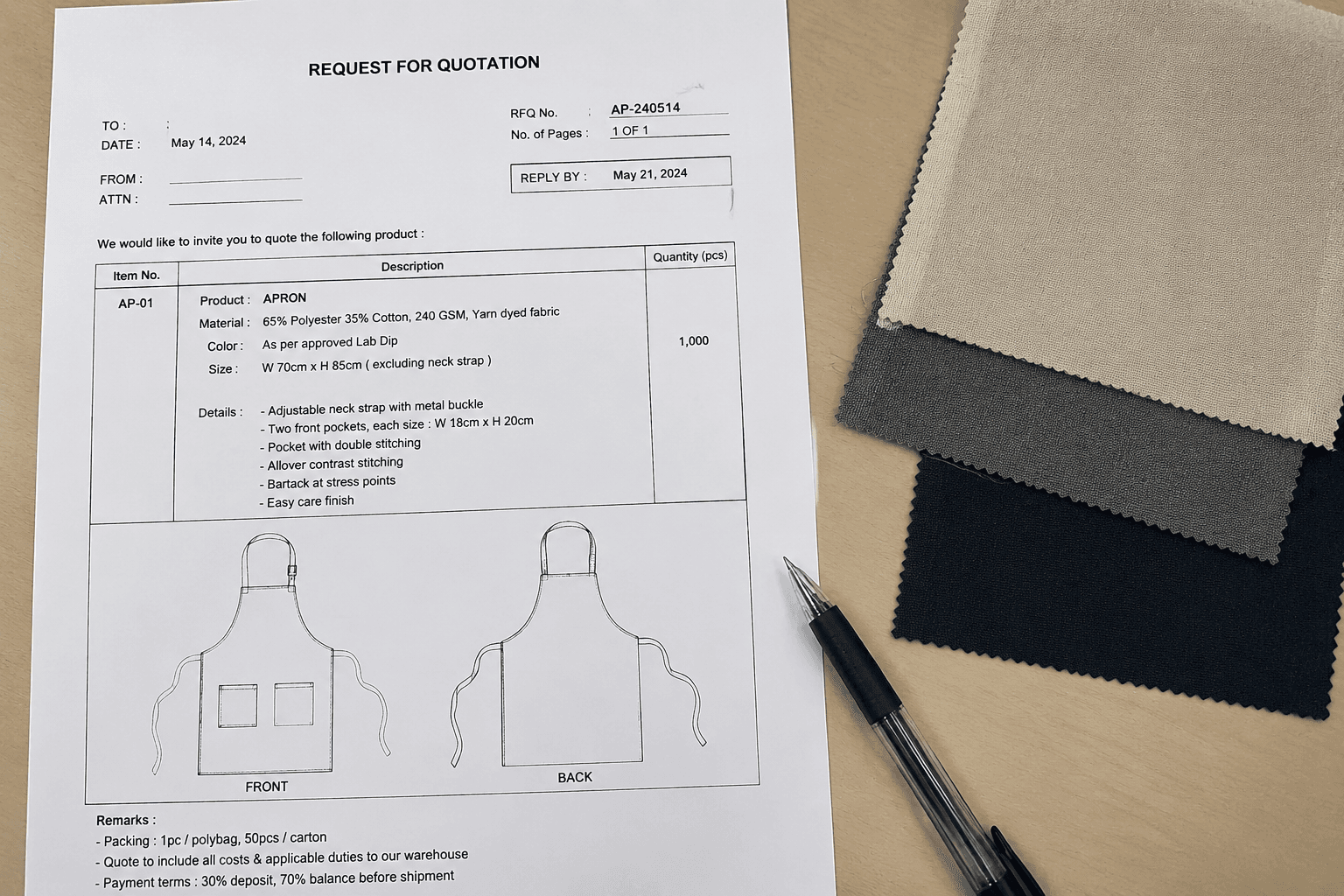
An RFQ for a "chemical-resistant cleaning apron" is too broad to produce a reliable quotation. The factory needs the active chemistry, dilution range, splash pattern, cleaning method after use and target replacement cycle. A bib apron exposed to 10-15 incidental front splashes of 0.1% sodium hypochlorite per shift is a very different sourcing case from an apron that sits wet for 10 minutes during repeated descaling or degreasing tasks.
For professional apron sourcing, exposure is better defined as light splash, repeated wipe contact or short pooling for roughly 5-15 minutes before rinse-off. Most contractor aprons protect the front body only. They are not immersion garments, and they should not be quoted as substitutes for higher-level chemical PPE. If residue stays on the apron through a full task cycle, seam leakage, edge finishing and strap-attachment strength quickly become more important than another 20 GSM of face weight.
Buyers should also fix the intended service window before sampling begins. A 90-day apron for a high-turnover bleach route can be engineered very differently from a 180-day apron for a stable facilities contract. When the replacement target is defined early, suppliers can compare options on annual wear cost, not on headline piece price or marketing claims.
- State the active chemical and concentration, such as 0.1%-0.5% sodium hypochlorite, 0.5%-1.5% hydrogen peroxide or petroleum-based degreaser.
- Describe contact per shift, for example 12 front splashes, 20 minutes of wipe contact or 5-minute pooling before rinse.
- Confirm after-use care: wipe clean, hose rinse or daily machine wash.
- Set the replacement target at 90, 180 or 365 days before approving samples.
- Request bulk inspection at AQL 2.5 major and 4.0 minor as a practical default for apron orders.
Bleach and peroxide exposure: selecting cleaning contractor apron material for oxidizer routes
Bleach and peroxide dominate restroom sanitation, healthcare-adjacent cleaning, mold-remediation support and odor-control work. These oxidizers can discolor textiles, harden some coatings over time and accelerate failure where stitching, binding or printed logos trap residue. For this reason, the buying decision should cover the full apron package: surface coating, backing fabric, seam method, thread, binding and logo placement.
For cost-sensitive contracts, 190-220 GSM PVC-coated polyester remains the most common apron for diluted oxidizer splash. At around 72 x 90 cm with a standard neck loop and waist ties, ex-factory pricing is commonly $1.70-$2.20 per piece at 3,000 pieces. In routine field use, that construction usually handles incidental bleach and peroxide splash well if crews wipe or rinse it promptly. Its limits appear when aprons are repeatedly folded in cold storage, aggressively scrubbed or left with dried residue at the seams.
When buyers need better drape, lower crack risk and easier all-day wear, 210-260 GSM TPU-laminated polyester is the usual upgrade. Pricing often lands around $2.90-$4.20 per piece at comparable volume, with MOQ typically 1,000 pieces per color if the laminate is outside a stock program. TPU does not make the apron indestructible, but it generally improves flexibility and reduces the stiff, board-like feel that causes workers to remove heavier PVC styles mid-shift.
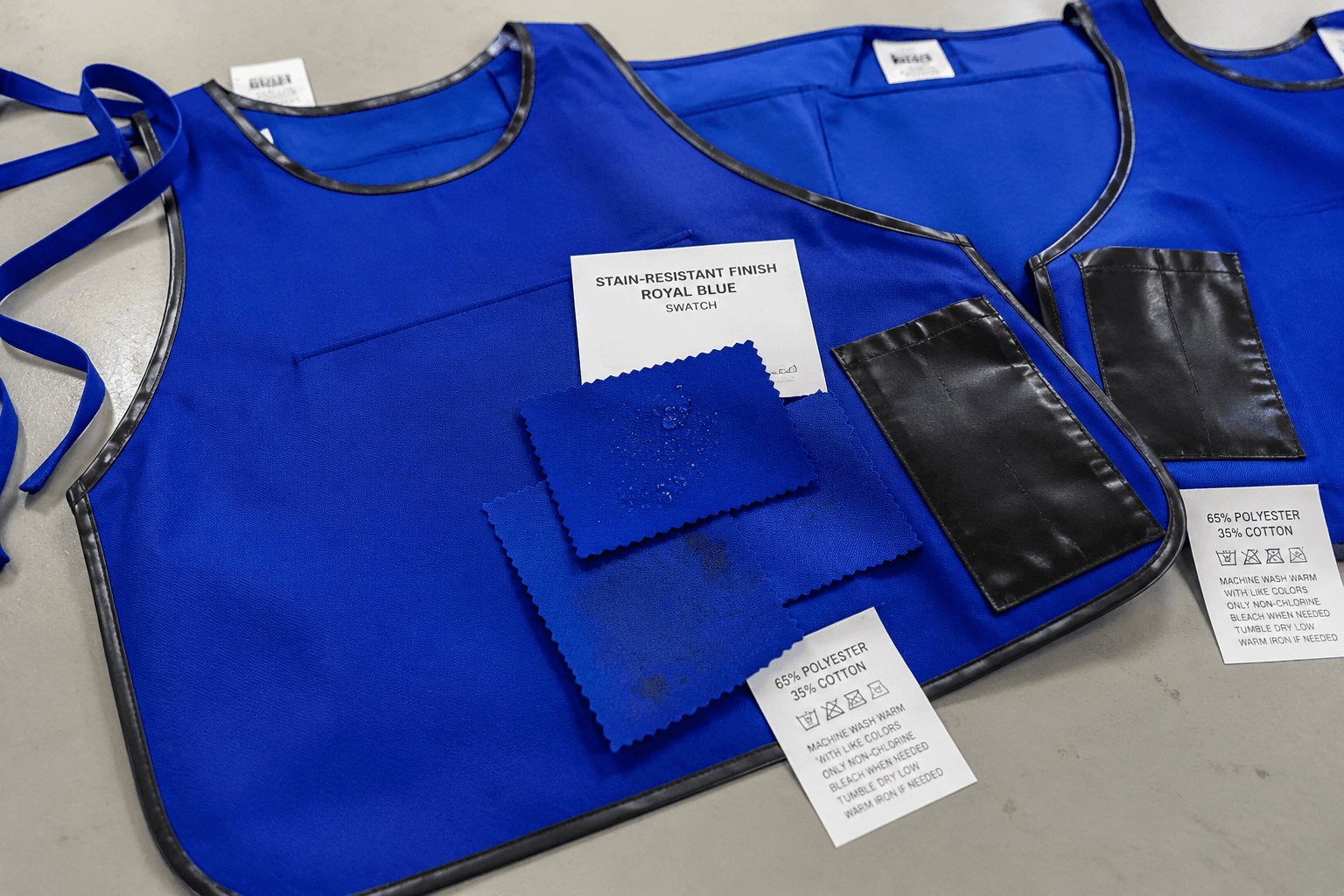
Construction detail often decides whether an oxidizer apron lasts 90 days or 180 days. Welded seams generally resist ingress better than standard sewn seams. If sewing is required, polyester thread is safer than cotton, exposed seam allowance should be minimized, and pockets should stay out of the wettest front zone. A simple one-panel apron with fewer joins often outperforms a shaped style with extra stitching because there are fewer places for peroxide or bleach residue to sit and attack the construction.
- Use 190-220 GSM PVC/polyester for routine bleach and peroxide splash when low unit cost is the priority.
- Move to 210-260 GSM TPU/polyester when flexibility, comfort and cold-crack resistance matter more than the lowest price.
- Prefer welded seams; if seams are sewn, specify polyester thread and tight seam control.
- Keep logos, labels and pockets outside the heaviest splash area.
- Expect dark navy, charcoal and dark green to mask disinfectant marking better than white, beige or pale gray.
Hydrocarbon, bleach and peroxide exposure: where one apron spec fails
Buyers often ask whether one apron can cover disinfecting, kitchen degreasing and general janitorial work. In most B2B programs, the answer is no. Bleach and peroxide are oxidizers; hydrocarbon-based spot removers, petroleum distillates and solvent-assisted degreasers attack materials differently. An apron that survives diluted bleach splash may soften, swell or lose surface integrity when exposed repeatedly to solvent carriers.
This is where many sourcing programs overspend or underspecify. If the buyer forces a single standard across all crews, the result is usually either a low-cost PVC apron that fails too quickly on solvent routes or a heavy specialist apron that costs too much and sees poor wear compliance on general cleaning jobs. The more efficient approach is to map real exposure by crew: restroom sanitation, kitchen deep cleaning, floor-care support, building maintenance and low-chemical housekeeping do not need the same apron package.
A mixed fleet usually works best. General crews handling bleach, peroxide and routine washroom chemicals can often use a 190-220 GSM PVC/polyester or 210-260 GSM TPU/polyester bib apron. Specialist degreasing crews facing mineral oil, grease and solvent carriers usually need a separate SKU with stronger hydrocarbon performance. That split lowers total annual spend because only 10%-20% of users receive the heavier, more expensive construction.
- Do not assume oxidizer resistance equals solvent resistance.
- Segment apron SKUs by crew exposure, not by one company-wide default.
- Reserve heavy specialist aprons for crews with regular degreaser or petroleum contact.
- Use general-use coated aprons for the majority of bleach and peroxide routes.
Choose cleaning contractor apron material for hydrocarbon and degreasing crews
Hydrocarbon splash should be sourced as its own category. Kitchen-cleaning contractors, facility-maintenance teams and some floor-care crews often use solvent-boosted degreasers, mineral-oil removers or petroleum-based spot cleaners that outperform basic disinfectants on grease but are harsher on low-cost apron coatings. Entry-level PVC can work for occasional contact, but repeated solvent exposure often shortens life sharply.
For these tasks, nitrile-coated fabrics and heavier chemical-resistant constructions are usually the safer choice. Common apron weights run from 280 GSM to 380 GSM depending on whether the fabric includes a textile backing for tear support and comfort. Ex-factory pricing commonly falls between $3.90 and $5.40 per piece at 1,000-3,000 pieces, with MOQ usually firmer than stock PVC programs. If the nitrile coating is not in stock, material booking alone can add 10-15 days, making total production time 35-50 days after approval.
The trade-off is comfort. Once apron weight moves above 300 GSM, neck fatigue and heat build-up become real compliance issues, especially on long routes or in humid kitchens. Cross-back straps or an H-back harness typically add about $0.18-$0.45 per piece, but they can materially improve wearer acceptance. Without that support, crews often loosen the neck, tie the apron incorrectly or stop wearing it during the shift, which removes the performance benefit of the stronger material.
For buyers comparing options, it is important to ask for comments on grease, mineral oil and solvent-carrier contact separately. A supplier may quote a hydrocarbon-resistant apron based on coating family, but the practical result still depends on seam sealing, strap durability and whether the apron is repeatedly hosed, folded and hung while contaminated. The right specification is therefore a balanced package, not just the heaviest film available.
- Confirm whether the cleaning chemical is alkaline water-based, solvent-boosted or petroleum-based.
- Use 280-380 GSM nitrile-coated constructions for repeated hydrocarbon exposure.
- Expect MOQ from 1,000 pieces per color when coatings are outside stock programs.
- Allow 35-50 days total lead time when non-stock material booking is required.
- Add cross-back support once apron weight exceeds 300 GSM.
Compare PVC, TPU, nitrile and woven apron options by weight, cost and field use
Most B2B apron programs for cleaning contractors fall into four material families: PVC-coated polyester, TPU-laminated polyester, nitrile-coated fabrics and woven cotton or polycotton. The correct family depends on chemistry, replacement cycle, wearer compliance and reorder economics rather than on one headline claim such as "heavy duty" or "waterproof."
PVC-coated polyester remains the standard entry point because it is widely available, easy to convert and economical at scale. Typical working weights are 170, 190, 210 and 250 GSM, with 190-220 GSM the most common range for general splash protection. TPU-laminated polyester sits one cost band higher but typically gives a softer hand, cleaner drape and better low-temperature flexibility. That makes it useful for buyers who need a wipe-clean apron that crews will wear through a full shift.
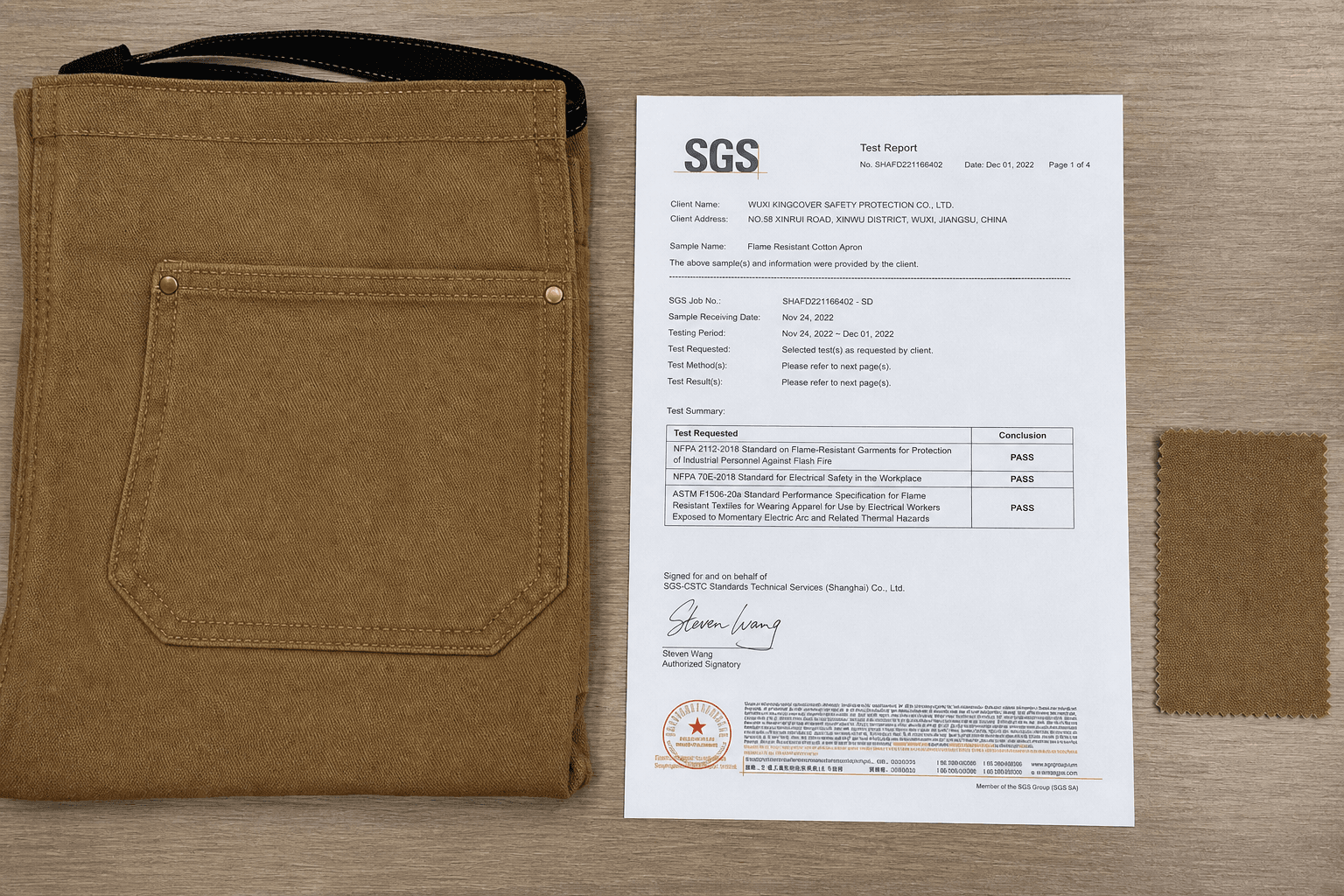
Nitrile-coated fabrics occupy the specialist end of the range. They are less common in mainstream apron supply chains, usually require longer raw-material booking and cost more, but they perform better for hydrocarbon-heavy tasks. Woven cotton and polycotton, often in 8 oz to 10 oz weights, still have a place in low-chemical housekeeping, concierge cleaning or presentation-sensitive duties where repeated bleach or solvent splash is not expected. They should not be specified simply because they feel more familiar or look more like general uniforms.
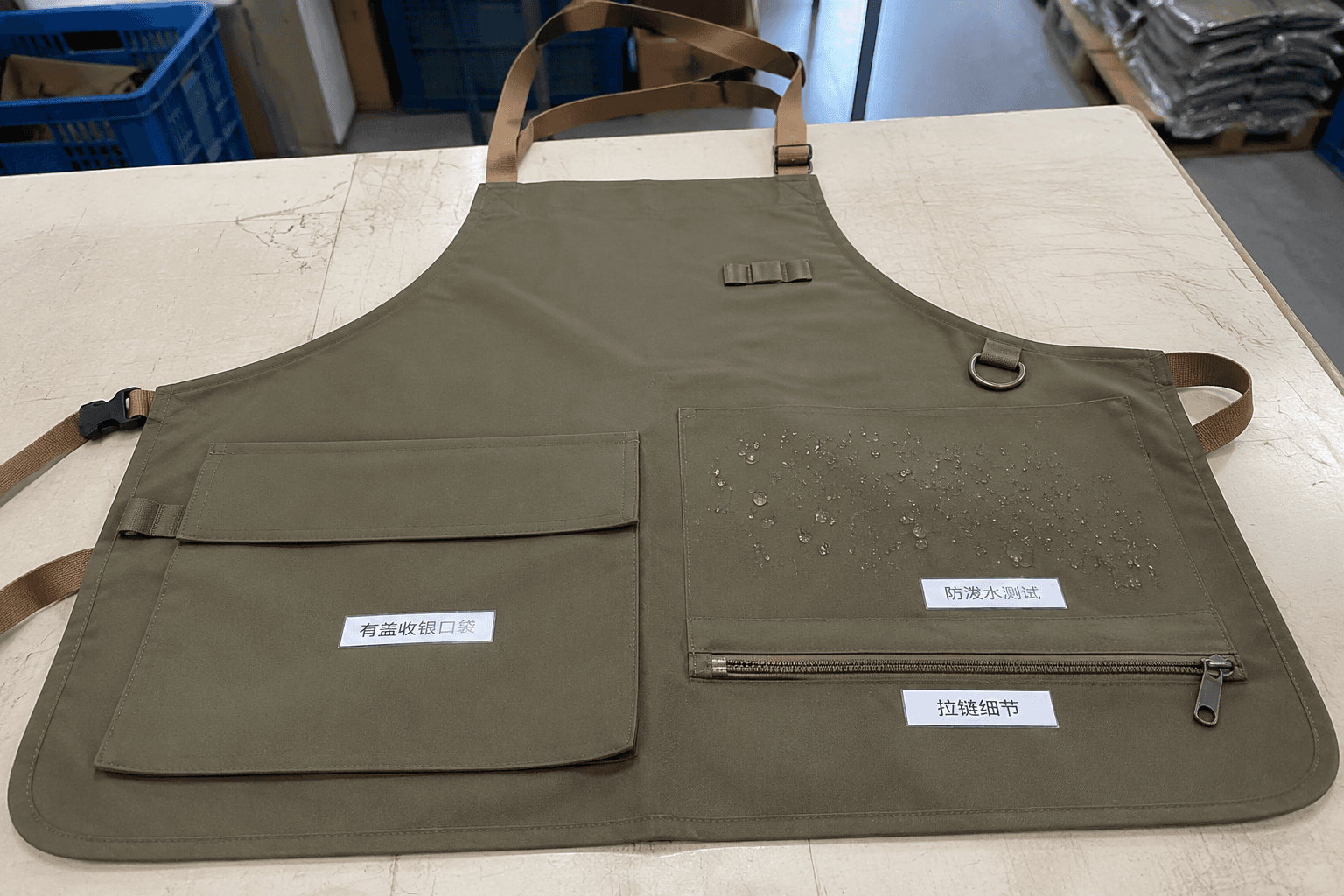
Across all four families, construction detail matters as much as base material. Top-corner reinforcement, binding quality, tie width, neck attachment and pocket placement drive field failure rates. In many cleaning contracts, deleting the front pocket extends useful life more than increasing panel weight from 190 GSM to 210 GSM because pockets trap liquid, create extra stitching and slow down wipe-clean maintenance.
- Choose 190-220 GSM PVC/polyester for low-cost general splash protection.
- Use 210-260 GSM TPU/polyester when all-day comfort and flexibility are priorities.
- Reserve 280-380 GSM nitrile-coated aprons for solvent or hydrocarbon-heavy routes.
- Use 8 oz to 10 oz cotton or polycotton only where chemical splash is minimal.
- Remove front pockets when rinse-down hygiene and longer wear life matter more than storage.
Control annual apron cost through wear life, MOQ, lead time and inspection discipline
The cheapest apron on the quotation sheet is rarely the cheapest apron in service. A 190 GSM PVC/polyester bib at $1.90 replaced every 90 days costs about $7.60 per wearer per year before freight, warehousing and replenishment handling. A 230 GSM TPU apron at $3.30 replaced every 180 days costs about $6.60 per wearer per year if two pieces cover the full cycle. A 320 GSM nitrile-coated apron at $4.80 can still be the right choice for a degreasing team, but it is usually too expensive and too heavy for fleet-wide use where most staff only handle diluted disinfectants.
MOQ and lead time also change the economics. Stock PVC/polyester custom styles commonly start at 500 pieces per color and style, with sample lead time around 5-7 days for a logo revision and 20-35 production days after approval. Non-stock TPU laminations and nitrile-coated materials often push MOQ to 1,000 pieces or more and total lead time to 35-50 days. Buyers with seasonal demand or multi-site rollout plans should account for that gap before standardizing on a specialist material.
Inspection standards should focus on real apron failure points, not fashion-apparel criteria. Top-corner strength, strap security, seam leakage, panel size consistency, logo adhesion and clean edge finishing are the priority checks. AQL 2.5 major and 4.0 minor is a practical benchmark for routine commercial orders. Before bulk approval, the most useful test is usually a controlled swatch or pre-production trial with the buyer’s actual bleach, peroxide or degreaser formula over repeated cycles such as 20, 50 and 100 contact events, followed by rinse and flex checks.
The final objective is simple: buy the apron that survives the agreed service window, passes incoming inspection consistently and can be reordered with stable quality. In B2B apron sourcing, that is a better standard than choosing the thickest sheet or the lowest opening price.
- Compare annual wear cost using 90-day, 180-day and 365-day replacement scenarios.
- Use 500 pieces per color as the common MOQ for stock PVC/polyester custom aprons.
- Expect 1,000-piece MOQ or higher for non-stock TPU and nitrile constructions.
- Plan 20-35 production days for standard coated aprons and 35-50 days for specialist materials.
- Set AQL 2.5 major and 4.0 minor, then test with the actual cleaning formula before mass production.