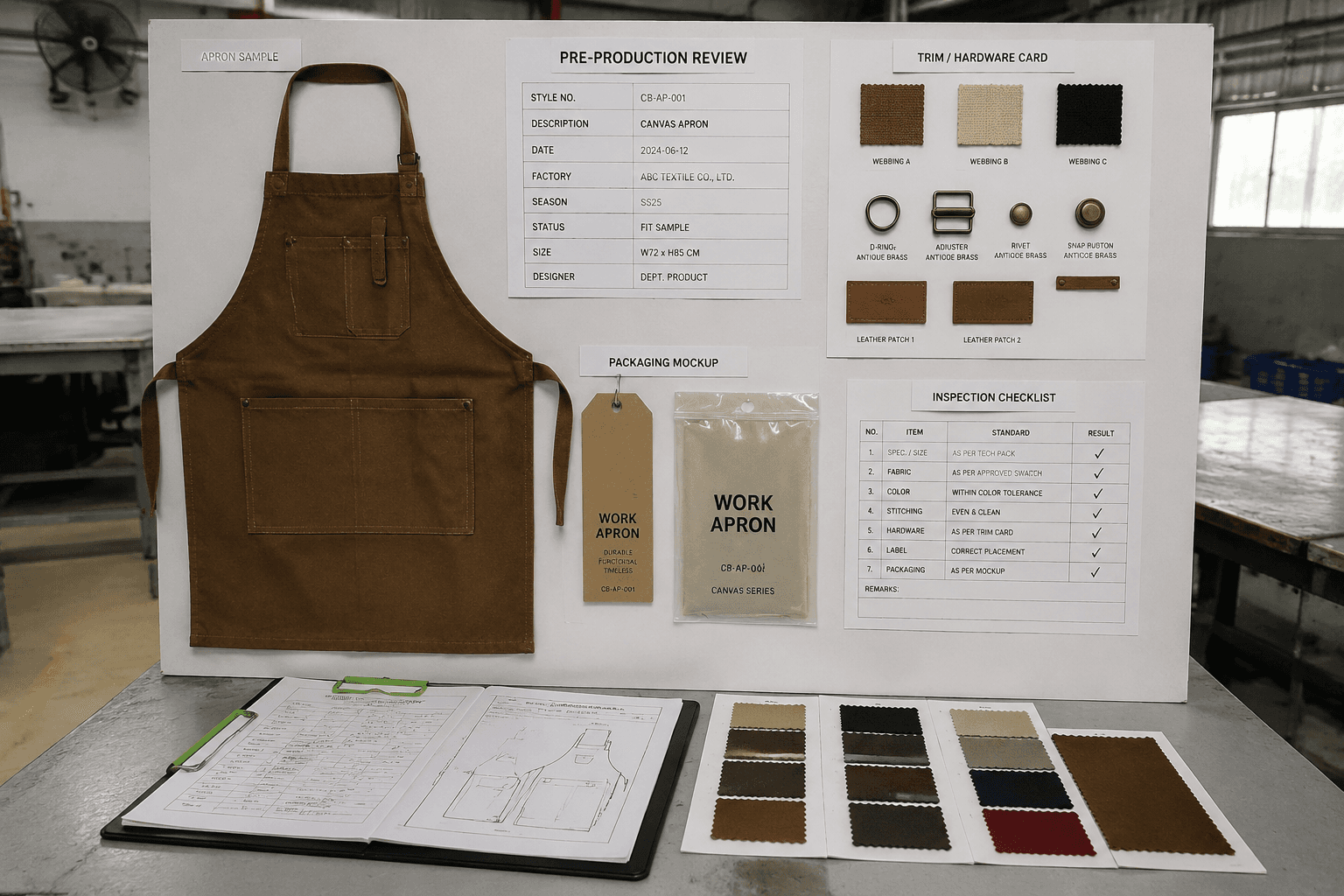
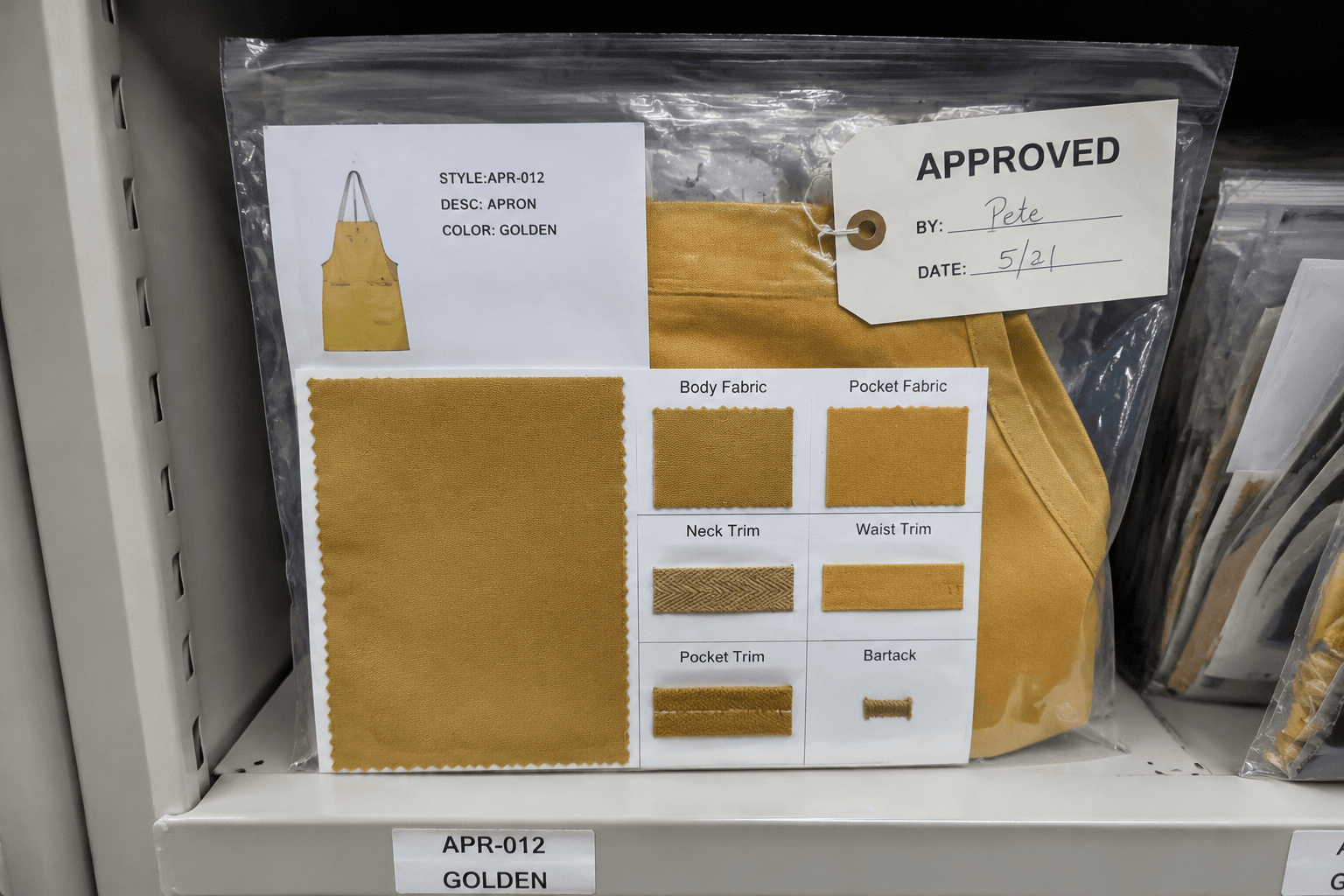
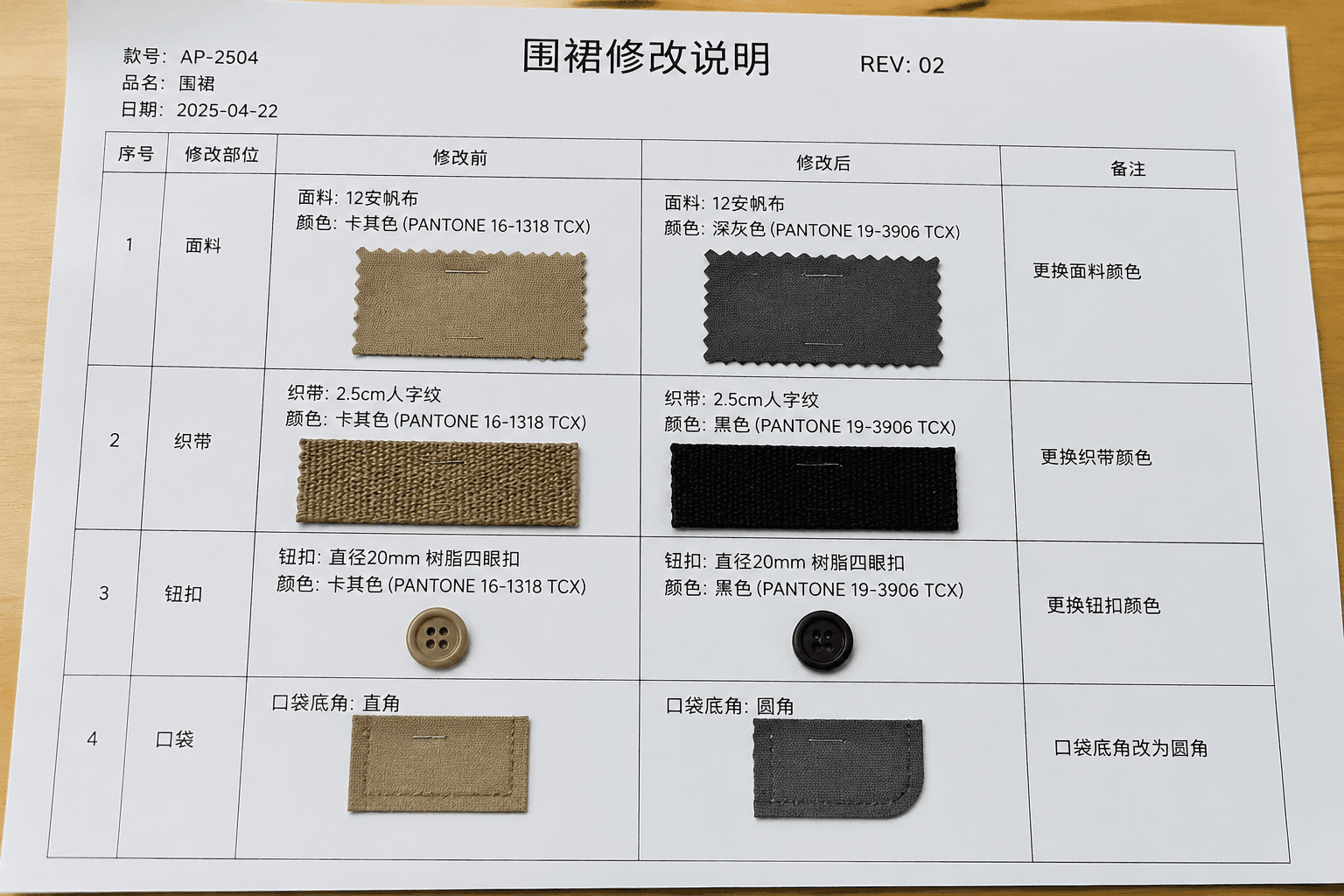
In custom apron manufacturing, base fabric is often easier to control than buyer-nominated accessories. Apron trim nomination delays start when a brand names its own buckle source, webbing mill, woven-label vendor, hangtag printer, or carton supplier, but nobody converts those outside lead times into the apron factory's cut date, strap preparation plan, sewing start, finishing window, and ex-factory booking date.
For a professional B2B buyer, the issue is sequence, not trim value. A bib apron cannot move cleanly through cutting, strap preparation, hardware attachment, sewing, pressing, needle control, folding, packing, final inspection, and shipment if a 25 mm buckle becomes 32 mm after PPS approval, if 38 mm webbing arrives with shade variation outside tolerance, or if retail carton dimensions remain open when finished aprons are waiting to pack.
Well-run nominated-trim programs are not difficult, but they require fixed ownership at PO stage. The buyer, trim vendor, and apron factory must align on specification, artwork, testing, freight, overage, and replacement responsibility before bulk materials move. That is why experienced sourcing teams treat apron trim nomination delays as a schedule-control problem first and a price problem second.
- Buyer-nominated trims typically add 5 to 12 days on domestic apron programs and 10 to 25 days when trims are imported.
- A buckle width change from 25 mm to 32 mm can force webbing, pattern allowance, bartack setting, operator method, and carton review on the same apron PO.
- Labels and packaging often cost only $0.04 to $0.22 per apron combined, but they frequently decide whether final audit can release the shipment.
- A usable trim tracker should show MOQ, approved specification, overage, latest inbound date, transit mode, test requirement, and incoming AQL result for every apron trim.
- Partial trim delivery is risky: sewing may continue for some operations, but one missing hardware item or one late carton lot can still stop 100% of final assembly or final packing.
- Paying for earlier coordination usually costs less than airfreighting nominated trims, which commonly runs $900 to $2,800 per batch on apron orders.
1. Why apron trim nomination delays start before bulk sewing
Many buyers feel comfortable once apron fabric is approved and in-house, but that is only part of the schedule. A custom apron style can depend on 6 to 14 non-fabric items, including sliders, D-rings, side-release buckles, snaps, rivets, eyelets, cotton or polyester webbing, woven brand labels, care labels, size stickers, polybags, inserts, and master cartons. If one nominated item is late, off-spec, or still waiting for artwork signoff, the line plan becomes unstable even though shell fabric is ready to cut.
The financial impact is out of proportion to trim value. A POM buckle may cost $0.05 to $0.11, a woven label $0.03 to $0.06, and a printed hangtag set $0.04 to $0.09, yet losing 10 calendar days on a 10,000-piece apron order can trigger vessel rollover, split packing, overtime, extra warehouse handling, or premium freight. In practice, the delay cost is usually higher than the trim cost itself.
From the factory side, most apron trim nomination delays come from four predictable points: late specification confirmation, late supplier nomination, late physical arrival, or incoming quality failure. Apron production is scheduled by day because cutting, strap preparation, sewing, finishing, inspection, and packing are linked. Trim vendors often quote broad windows such as 7 to 10 days, 10 to 14 days, or 21 days after approval. If the buyer does not turn those windows into a backward calendar tied to apron milestones, the order is exposed before bulk starts.
- A simple waist apron with self-fabric ties may use only 3 to 5 trims and carries relatively low delay risk.
- A 280 GSM canvas cross-back work apron with metal hardware, cotton webbing, woven labels, and retail packaging can involve 8 to 12 separate approvals.
- For 240 to 320 GSM cotton canvas aprons, shell fabric is often ready 4 to 7 days before custom labels, plated hardware, or printed cartons are ready.
- Most apron factories can absorb a 1 to 2 day sewing shift; they cannot absorb a missing trim that blocks all assembly or all packing.
2. Buckles and webbing: the highest-risk nominated trims on apron orders
Buckles and webbing create the most disruption because they affect construction, not just appearance. If a buyer nominates a hardware vendor, the apron factory needs exact inner width, outer width, bridge thickness, finish, pull-strength requirement, and compatibility with the selected webbing. A 38 mm cotton herringbone tape at roughly 1.2 to 1.5 mm thickness does not run the same way as a 38 mm polyester webbing at 1.8 to 2.2 mm thickness. That difference changes fold-back length, bartack density, turning allowance, needle choice, and operator handling speed.
Consider a bib apron in 260 GSM cotton canvas using 32 mm polyester webbing and plated metal sliders. At 3,000 to 5,000 pieces, a realistic FOB range is often $3.90 to $5.40 per piece depending on pocket count, print, wash, and packing standard. If the buyer later changes to a heavier buckle with a wider bridge, the strap end may need a longer fold-back, denser bartack, and slower hardware insertion. That can add 8 to 15 seconds of labor per apron and increase material cost by $0.10 to $0.28 per piece. On 20,000 pieces, that is a real margin issue, not a visual detail.
End use matters. A cafe-service apron, a culinary-school bib apron, and a utility apron with tool pockets do not need the same hardware performance. If the nominated buckle source is chosen only on price and not against wash standard and load requirement, the buyer may save $0.02 to $0.04 on trim and lose more through rework, replacement, or claims after delivery. This is one of the most common forms of apron trim nomination delays because the mismatch is often discovered only when line operators start assembly.
- Check buckle inner width against actual webbing tolerance; nominal 32 mm webbing can measure 31 to 33 mm across production lots.
- Approve hardware finish against the required care standard, such as domestic wash, garment wash, enzyme wash, or repeated industrial laundering.
- Set pull-test requirements before bulk trim production when aprons carry tools, tablets, or heavy chest pockets.
- Freeze buckle and webbing specifications before PPS signoff; late swaps routinely add 5 to 9 days on apron orders.
3. Labels and packaging: low-cost items that still hold finished aprons
Labels and packaging look simple because their unit prices are low, but they often control shipment release. A main label may be approved while care-label legal text, barcode data, suffocation warning copy, or shipping marks remain open. The apron shell can be fully sewn and pressed, yet the order still cannot pass final audit or pack out if labeling and carton specifications are incomplete, inconsistent, or physically late.
A typical timeline shows the exposure. For a 7 oz to 10 oz cotton twill apron, shell fabric may be in-house by day 12 to 15 after PO confirmation. Cutting may start on day 14 to 16, with sewing from day 17 onward. If the woven main label is approved on day 18, the insert on day 21, and the carton marks on day 24, finished aprons begin accumulating in the warehouse while packing materials are still missing. Once that happens, the factory is managing storage, recounting, shade separation, and repacking risk instead of smooth production flow.
The cost tradeoff is usually misunderstood. Saving $0.02 on a care label reduces spend by only $200 on 10,000 aprons. Missing the booking window can cost more through destination penalties, split-shipment handling, overtime, or premium freight. On private-label apron programs, disciplined buyers release artwork, legal copy, barcode rules, and carton marks much earlier than first-time buyers expect.
- Assign one named owner on the buyer side for each item: main label, care label, hangtag, barcode sticker, polybag, insert, and carton mark.
- Set the latest factory inbound date 3 to 5 days before use, not on the day the line plans to consume the trim.
- For buyer-supplied packaging, hold 2% to 3% overage for normal production loss, IQC rejects, and audit replacement.
- For folded retail aprons, confirm the folding method before bulk pressing because insert size and bag dimensions affect final presentation and carton ratio.
4. Lead-time math: where apron trim nomination delays actually enter the calendar
Most nominated-trim issues become manageable once each item is translated into day-by-day ownership. In a straightforward apron order using factory-sourced standard trims, total lead time may run 25 to 38 days after deposit and final approval, depending on fabric status, printing, wash, and order size. In a buyer-nominated trim program, realistic lead time often shifts to 35 to 55 days because outside suppliers add approval loops, transport dependency, and more failure points.
Take a 5,000-piece bib apron in 260 GSM cotton canvas with custom webbing straps, woven main label, printed care label, hangtag, and export cartons. Fabric dyeing may take 12 to 15 days. Cutting and sewing may require 10 to 13 days. On paper, the trims seem short: buckle 10 days, labels 7 days, packaging 8 days. In real sourcing, those lead times run in parallel only if artwork, test standards, and ship dates are locked on day 1. One unresolved point, such as barcode approval or buckle plating confirmation, can stop the whole chain.
Transit is the variable that buyers often understate. Even when a nominated trim vendor is in the same country as the apron factory, courier time is usually 1 to 3 days, and receiving plus IQC adds another 1 to 2 days. Imported trims create more exposure. Customs clearance, incomplete shipping documents, or a missing COO can add 3 to 7 extra days before the factory can release the line or close final packing. That is where many visible cases of apron trim nomination delays actually materialize.
- Factory-sourced standard trims often support 25 to 38 total days for repeat apron styles.
- Buyer-nominated domestic trims commonly add 5 to 12 days.
- Buyer-nominated imported trims commonly add 10 to 25 days depending on freight mode and customs clearance.
- A practical latest-inbound rule is 3 to 5 days before trim use, with buffer for IQC and replacement.
- Rush airfreight may recover only 2 to 4 calendar days but still add $900 to $2,800 per trim batch.
5. MOQ, AQL, and replacement stock: the paper assumptions that break apron schedules
Many apron delays do not start with late production; they start with unrealistic MOQ and overage assumptions. A trim vendor may quote an attractive piece price but require a MOQ that does not fit the apron order pattern. A custom woven label MOQ of 3,000 to 5,000 pieces is usually workable. A custom buckle color MOQ of 10,000 to 30,000 pieces can distort cost on a 2,000-piece apron order or force the buyer to carry excess stock for a style that may not repeat.
Incoming quality is the second weak point. Nominated trims should not bypass inspection simply because the buyer selected the vendor. If a buckle lot has plating scratches, if webbing shade varies beyond approved tolerance, or if woven labels have the wrong fold position, the apron factory still has to stop, sort, or replace. For bulk apron orders, a practical receiving standard is AQL 2.5 for major defects and AQL 4.0 for minor defects, with clear criteria on function, appearance, measurement, and count accuracy.
Replacement stock is where many teams leave no margin. If the buyer orders exact consumption only, a small rejection at incoming inspection immediately creates a shortage. For functional apron trims such as buckles, webbing, seam labels, and packaging, 3% to 5% overage is usually more realistic than 1%. That small buffer is cheaper than split delivery, overtime, or emergency freight after a short receipt.
- Check MOQ by color and size against the actual apron forecast, not just the current PO.
- Set trim overage before placement: 3% is common for labels and packaging, while 3% to 5% is safer for buckles and webbing.
- Define IQC standards in advance, including measurement tolerance, shade tolerance, finish, function, and count verification.
- Confirm replacement lead time when confirming bulk lead time; a 7-day standard lead time is not useful if replacement takes 14 days.
6. A control method buyers can use before placing an apron PO
The best control point is before PO release, not after sample approval. Many buyers negotiate FOB price carefully but never define who owns nominated trims. For apron programs, the factory needs a trim responsibility matrix at PO stage covering who buys, who pays, who approves artwork, who arranges testing, who books freight, who tracks inbound, and who pays for replacement if IQC fails.
Factory-side control should include a simple risk ranking. Class A trims block sewing start, such as webbing, neck straps, or seam-in labels that must be inserted during operation. Class B trims block final assembly, such as snaps, rivets, adjustable hardware, or detachable strap sets. Class C trims block packing or shipment release, such as hangtags, barcode stickers, inserts, polybags, and cartons. Once trims are classified this way, escalation becomes practical because a Class A issue due in two days cannot wait for a weekly meeting.
For first orders, PPS approval and trim readiness should be treated as linked gates. An apron sample approved without physically matched buckle, webbing, and label components is not a complete production approval. The cleaner process is to close specification, inbound date, and incoming inspection standard before bulk line booking. That does more to prevent delay than trying to accelerate freight after the problem is already visible.
- Freeze a trim list before deposit with spec code, material, color, size, MOQ, supplier, overage, and latest inbound date.
- Ask the apron factory to review trim compatibility against sewing method, wash standard, and end use before approving outside suppliers.
- Use incoming inspection standards for nominated trims, such as AQL 2.5 for major defects and AQL 4.0 for minor defects, before bulk release.
- Treat first-order PPS approval and trim readiness as one gate rather than two separate milestones.
7. Questions professional apron buyers should ask before nominating trim vendors
The right question is not whether nomination is allowed. The better question is whether nomination improves control or only transfers risk. In most apron programs, nomination makes sense for brand-sensitive items such as woven labels, signature hangtags, or retail inserts. It is usually less efficient for standard functional parts unless the buyer has already verified vendor capacity, quality consistency, MOQ fit, and lead-time reliability.
A practical sourcing discussion should stay quantitative. Ask the trim vendor for MOQ, ex-stock quantity, production days after final approval, transit mode, replacement lead time, and test capability. Ask the apron factory for the latest safe inbound date and the operational effect if trims miss that date by 3 days, 7 days, or 10 days. Once those numbers are visible, the discussion moves from assumption to schedule management.
The cleanest result usually comes when the buyer nominates only trims that are truly brand-critical and allows the apron factory to source standard functional components locally under approved specifications. That shortens replenishment time, reduces approval loops, and makes repeat apron orders more predictable on cost, quality, and delivery.
- What is the exact MOQ by color and size, and does it fit the apron forecast?
- How many production days are required after final artwork, color, plating, or sample approval?
- What overage will be supplied, and who pays if IQC rejects part of the lot?
- What test reports are required for washfastness, pull strength, plating, or barcode readability?
- If the trim arrives 5 days late, how will shipment date, extra labor, and premium freight be handled contractually?