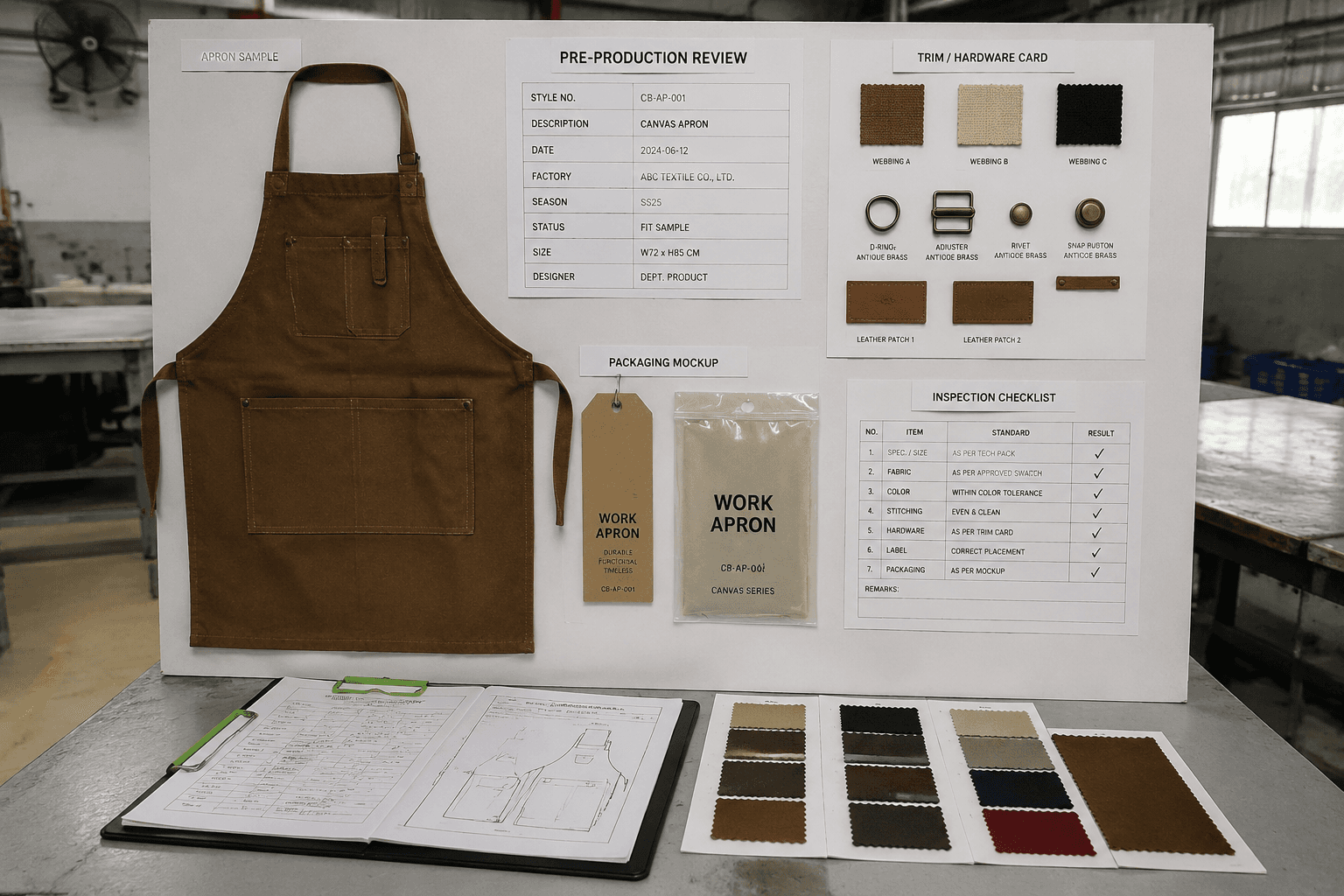
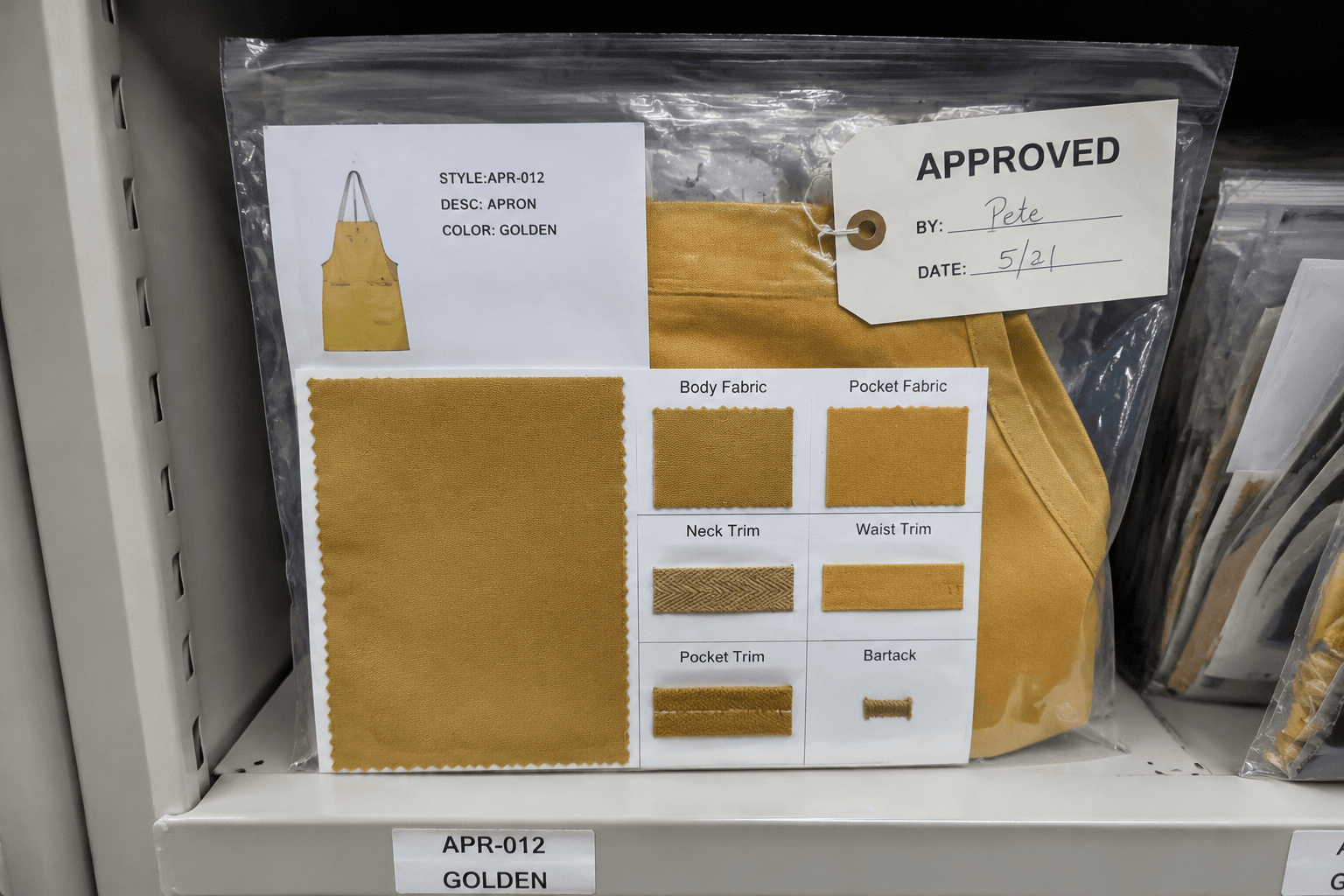
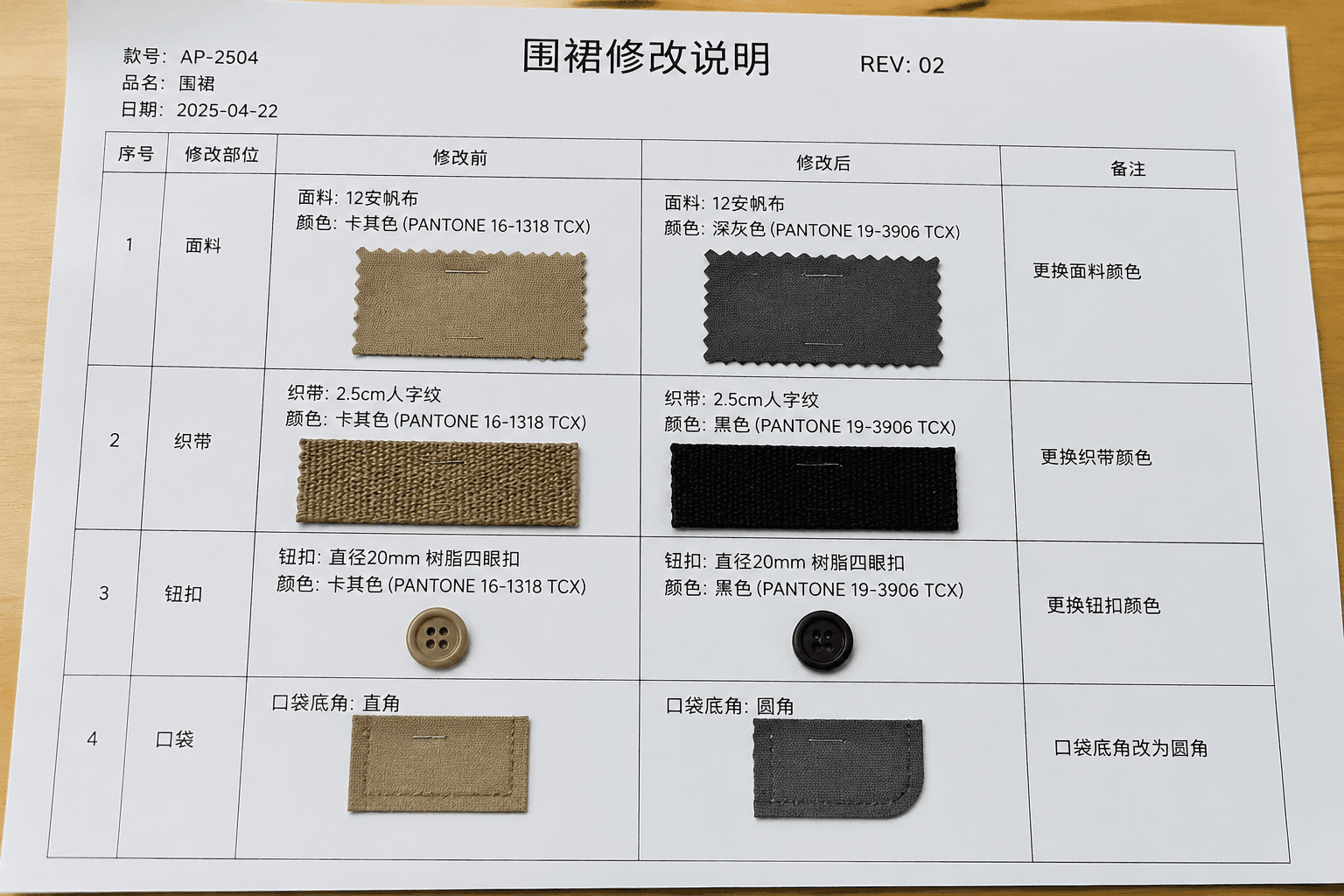
For professional buyers, split shipment apron orders are usually driven by phased store openings, DC space limits, staggered site installations, or budget timing. In apron sourcing, that commercial convenience creates one technical risk that shows up fast at store level: shipment one and shipment two can look different even when the style code, size spec, and approved sample are unchanged. In a single SKU, buyers may see body shade shift, strap tone drift, hardware finish variation, label ground mismatch, or print opacity change. The risk rises when the supplier books only the first delivery, then treats the balance as a later repeat order instead of one reserved apron program.
The problem is easy to quantify. A 12 oz cotton canvas bib apron at about 340 GSM can show visible shade movement if 5,000 units are cut from dye lot A and the remaining 7,000 units are cut 24 to 30 days later from dye lot B. A 7 oz poly-cotton twill waist apron at 240 GSM can drift when self-fabric ties, pocket panels, and dyed 32 mm webbing come from separate lots. Dark colors such as black, navy, olive, charcoal, and burgundy make small differences obvious under restaurant, café, and retail lighting. Trim variation is equally visible: 32 mm webbing may come in at 31 mm actual width, antique brass sliders may read bright brass, and white screen print can lose opacity from one production batch to the next.
The practical rule is simple: reserve the full apron order first, then split only the export date. That means booking total meterage with realistic loss allowance, sealing one bulk shade blanket and one signed trim card, cutting under one technical file, assigning carton ranges by shipment before packing, and applying the same inspection benchmark to both departures. When these controls are written into the PO, time-and-action plan, and QC file, split shipment apron orders stay commercially flexible without turning shipment two into an uncontrolled replenishment.
- Reserve all materials at PO start; shell fabric, webbing, labels, hardware, thread, and packaging should be booked for the full order, not just shipment one.
- Approve one bulk standard; use one sealed PP sample, one shade blanket, and one signed trim card for both shipment dates.
- Cut and allocate before sewing; pre-plan roll usage, bundle allocation, and carton ranges instead of splitting after finishing.
- Budget the split honestly; staged exports usually add $0.04 to $0.18 per apron for storage, handling, duplicate documents, and re-inspection.
- Inspect both departures separately; keep the same acceptance level, commonly AQL 2.5 major / 4.0 minor, and re-check stored goods if shipment two leaves more than 21 to 30 days after packing.
Why split shipment apron orders create mismatch risk on simple-looking styles
Aprons look easier than jackets or uniforms, but consistency is often harder to protect because a small product puts several visible components close together. A standard hospitality bib apron may combine 270 to 340 GSM shell fabric, self-fabric pockets, 25 mm or 32 mm dyed webbing, metal neck hardware, bartack thread, woven labels, care labels, polybags, and printed cartons. In one full shipment, those components usually move through one material issue cycle, one sewing window, and one finishing standard. In split shipment apron orders, the same SKU is separated by export date, which increases the chance of lot mixing, substitute trims, and approval drift.
The risk is broader than body fabric shade. Buyers commonly find hardware plating drift, webbing tone differences, thread depth mismatch on dark fabrics, label ground color changes, zipper tape variation on utility aprons, and print whiteness inconsistency on second departures. None of those defects may stop wear performance, but they are easy to spot when both shipments are sold under one SKU or worn by one branded team. If a café chain buys 10,000 black barista aprons, the customer will not accept a second delivery that looks merely 'commercially similar' under front-of-house lighting.
The root cause is usually poor reservation discipline. If a buyer places 14,000 aprons with 6,000 units ex-factory on day 34 and 8,000 units on day 52, the factory should still book the full 14,000 units plus loss at PO confirmation. A practical reserve is 103% to 105% for dyed shell fabric, 102% to 103% for dyed webbing, and 101% to 102% for labels and printed packaging. If the supplier secures only the first 6,000 units, shipment two is immediately exposed to new dye lots, fresh trim lots, and an extra 10 to 25 days of replenishment risk.
- For dyed canvas or twill, reserve 103% to 105% of fabric usage to cover cutting loss, defects, and shade segregation.
- For dyed tape and webbing, reserve 102% to 103%; repeat dyeing often needs 10 to 18 days even before inland delivery.
- For custom metal sliders, D-rings, and rivets, many suppliers set MOQ 3,000 to 5,000 sets per finish, so late top-up buying costs more per unit.
- For shared commercial SKUs, hold both departures to one acceptance level, commonly AQL 2.5 major / 4.0 minor.
Material reservation rules that keep split shipment apron orders aligned
The safest commercial structure is to reserve the full apron program on day one and split only the shipping milestone. For a 12,000-unit bib apron order in 340 GSM cotton canvas, that means booking the full shell requirement, all color-matched webbing, labels, thread, hardware, and packaging before the mill and trim suppliers start production. If the order needs about 9,800 meters of fabric, the PO should reserve around 10,100 to 10,300 meters depending on marker efficiency, defect allowance, and whether pockets and straps use the same cloth.
MOQ and lead time matter because most mismatches start in the supply chain, not on the sewing line. Custom dyed webbing typically needs 10 to 18 days, woven labels 7 to 10 days, antique brass plated hardware 15 to 25 days, and printed export cartons 5 to 8 days after artwork confirmation. If those items are booked only against shipment one, the second departure becomes vulnerable to replacement lots that are technically usable but visibly different. For repeat black, navy, or natural aprons, buyers sometimes assume stock trims are safe. That assumption fails when the stock supplier changes dyehouse, plating run, or yarn source between shipments.
Professional buyers should also push the factory to show the reservation logic, not just promise consistency. A credible supplier can state fabric lot count, trim booking quantities, expected ex-mill date, and the overage held for claims or balance shortages. On larger programs, it is reasonable to ask for internal booking references before PP approval is complete. That level of control may feel detailed for aprons, but it is cheaper than receiving 4,000 second-shipment pieces with a greener black body or shinier metal hardware.
- Ask for full-program material booking instead of a booking tied only to shipment one quantities.
- Confirm realistic lead times: 7 to 10 days for woven labels, 10 to 18 days for dyed webbing, and 15 to 25 days for plated hardware.
- Reserve packaging too; printed polybags, inserts, and cartons often need 5 to 8 days and can create mix-risk if added late.
- For custom apron programs above 10,000 units, ask the factory to confirm booking references and expected in-house dates.
Shade control for split shipment apron orders starts before cutting, not after packing
Shade control has to be managed at bulk stage, not at sample stage alone. A lab dip or strike-off approval is useful, but it does not protect a production run once the mill delivers multiple lots of dyed apron fabric. For dark or brand-sensitive colors, the factory should receive lot count, lot meterage, and a shade blanket or hand swatch set for each lot before cutting begins. If a 12,000-unit order arrives in three dye lots, the factory needs a written decision on whether all three lots are acceptable for one program or whether one lot must be isolated for a future repeat.
The ideal structure for split shipment apron orders is one dye lot covering the full requirement. In real OEM production, that is not always possible, especially above 10,000 to 18,000 units or during peak season. When multiple lots are unavoidable, the factory should map every roll, relax fabric before spreading, cut lot by lot, and assign each lot to defined shipment or carton ranges. What buyers should avoid is uncontrolled blending: lot A feeding some panels in shipment one, lot B feeding replacement pockets in shipment two, and no traceability after sewing. That is how avoidable claims become impossible to defend.
Fabric construction changes how much variation the eye catches. A 180 to 210 GSM promo waist apron can hide minor movement better than a 300 to 340 GSM canvas bib apron, because heavier cloth shows a broader, flatter visual field. Styles with self-fabric ties, chest pockets, patch pockets, and multi-panel fronts make shade variation easier to see because several pieces of the same cloth sit side by side. If shipment two leaves more than 30 days after shipment one, buyers should require the factory to re-check reserved bulk against the sealed shade standard before the second sewing window opens.
- Seal one bulk shade blanket against the PP sample before bulk cutting starts.
- Request a roll map and cut allocation sheet showing which rolls feed shipment one and shipment two.
- For dark colors, cut lot by lot after relaxation rather than mixing rolls across spreading tables.
- If multiple dye lots are accepted, keep carton ranges traceable by lot so any claim can be isolated fast.
Trim continuity controls for webbing, hardware, labels, and decoration
Trim continuity deserves the same discipline as shell fabric because many apron trims are front-facing. On a bib apron, the neck slider, D-rings, dyed webbing, bartack thread, woven brand label, and print or embroidery all affect shelf appearance. A second shipment can fail visual consistency even when the body fabric is acceptable if matte black hardware shifts to semi-gloss gunmetal, if 32 mm webbing arrives at 31 mm finished width, or if the second print batch shows lower white opacity over a black canvas ground.
The PO and trim spec should use measurable language. A strong spec would read: 32 mm polyester herringbone tape, dyed to approved standard, width tolerance plus or minus 1 mm; adjustable neck slider in approved antique brass finish; thread ticket and shade code approved against sealed shell; woven label with approved ground and logo yarn; white screen print minimum agreed opacity on black fabric; zipper tape shade sealed if utility pockets are included. These details reduce the chance that the supplier substitutes a 'near match' when booking pressure rises.
Trim continuity also depends on inspection conditions. Dyed webbing, labels, and thread should be checked under daylight-equivalent light and warm indoor light because restaurants, coffee bars, and shop floors often reveal undertone differences that look minor in a warehouse. For decorated aprons, the factory should compare print gloss, handfeel, and opacity or embroidery sheen and stitch density across both shipments. A signed trim card alone is not enough unless purchasing, warehouse, line QC, and final inspection all reference the same sealed standard.
- Seal one signed trim card per style-color before materials move to cutting.
- Record trim lot numbers on internal production sheets, not only on supplier invoices.
- Check dyed trims under D65 and warm light because hospitality interiors expose tone differences quickly.
- For printed aprons, compare opacity, gloss, and handfeel; for embroidery, compare thread sheen and stitch density.
Production scheduling, carton allocation, and storage rules for two apron departures
The factory should schedule the order as one production block with two export milestones. Many mismatch claims begin when shipment one is produced, packed, and closed, then shipment two is restarted weeks later based on line availability. That approach looks flexible, but it breaks continuity in material issue, operator handling, machine settings, pressing conditions, and packing control. A safer method is to cut the full order together, bundle by shipment code, and sew in one continuous flow or two tightly linked windows using the same technical file, QC team, and finishing standard.
A realistic example makes the discipline clear. Suppose a buyer places 16,000 barista bib aprons in 240 GSM poly-cotton twill with custom antique brass hardware, with 7,000 units ex-factory on day 33 and 9,000 units on day 48 after PP approval. A controlled plan can run as follows: materials in-house by day 11; incoming inspection and sealing on days 12 to 14; full cutting on days 15 to 18; shipment one sewing on days 19 to 26; shipment two sewing on days 27 to 35; finishing and packing by pre-assigned carton ranges; then palletized storage until each ETD. That schedule protects one workmanship standard while still meeting two delivery dates.
Storage conditions become critical once packed aprons wait for the second loading. Cotton-rich dark aprons can pick up compression marks, humidity odor, dust, or light exposure if cartons sit badly. Finished cartons should stay on pallets in a dry area, away from direct sunlight and high-moisture walls. If shipment two slips beyond 21 to 30 days after packing, a stored-goods re-inspection is usually cheaper than handling a destination claim across several thousand units.
- Use one cut plan for the full PO even when sewing and export dates are split.
- Assign carton ranges before packing, such as cartons 1-240 for shipment one and 241-560 for shipment two.
- Require stored-goods re-inspection if shipment two leaves more than 21 to 30 days after packing.
- Keep packed aprons in a dry, palletized warehouse with no direct sunlight and limited carton stacking pressure.
Cost, lead-time, and QC terms buyers should write into the apron PO
Commercial terms need to reflect production reality. For a custom apron using dyed shell fabric, dyed webbing, woven labels, plated hardware, and basic decoration, a realistic lead time is usually 35 to 55 days from PP approval depending on order size and trim complexity. Trying to force the first split shipment in 18 to 22 days often pushes the supplier toward stock fabric, mixed trim lots, rushed buying, or parallel substitutions. Aprons are simpler than jackets, but custom apron sourcing still depends on mill, trim, decoration, sewing, finishing, inspection, and export timing working in one sequence.
Split delivery also has a measurable unit-cost effect. Even when sewing SMV stays stable, the supplier adds warehouse segregation, second-stage carton marking, duplicate booking work, extra loading preparation, and often a second final inspection. On common OEM apron programs, the incremental cost usually lands between $0.04 and $0.18 per pc. On a basic waist apron priced at $1.80 to $3.20 FOB, that premium matters. On a branded 10 oz to 12 oz bib apron priced at $3.80 to $7.50 FOB, buyers often accept it because it protects rollout timing and lowers the risk of chargebacks tied to presentation inconsistency.
The PO should state who pays for storage, re-inspection, and document duplication if shipment two moves later than planned. It should also state the latest PP approval date that still keeps the first ETD achievable, because even a 3 to 5 day delay can collapse an already tight split schedule. Finally, QC terms should be identical across both departures: same sealed references, same measurement tolerance, same AQL level, same visual checkpoints for shade and trim, and the same claim traceability expectations.
- State the latest PP approval date; even a 3 to 5 day delay can put the first ETD at risk.
- Confirm whether quoted pricing includes storage for shipment two after packing.
- Define who pays for re-inspection, extra warehousing, and duplicate documents if the buyer delays the second ETD.
- Write one QC rule for both departures, commonly AQL 2.5 major / 4.0 minor, with specific checks for shade, trim, and decoration.
When split shipment apron orders are the wrong commercial choice
Not every apron program should be split. Garment-washed canvas aprons, enzyme-washed work aprons, mineral-dyed styles, wax-finish utility aprons, and other special-finish products carry higher appearance risk because final color and handfeel depend on finishing batch behavior, not only greige fabric or dye formula. Recycled-yarn fabrics can also show wider natural tone movement, and low-volume custom trims may not repeat economically for a delayed second shipment. In those cases, the logistics benefit of splitting is often smaller than the commercial risk of visible mismatch.
Small second lots are another warning sign. If shipment one is 4,800 premium bib aprons and shipment two is only 1,200 units with custom webbing, special labels, and plated hardware, the factory may need to hold leftovers for weeks with poor yield and weak trim economics. That pressure usually comes back as higher storage cost, a higher unit price, or substitution risk. In many cases, the cleaner decision is one full shipment or two separately costed orders with clear tolerance language, rather than pretending the second batch will match perfectly under the original quote.
As a practical sourcing rule, the best split candidates are stable core aprons: solid-color bib aprons or waist aprons in repeat fabrics, standard hardware, and proven supply chains. The more customized the style, the longer the gap between ETDs, and the smaller the second lot, the tighter the controls must be. If those controls are not realistic, avoiding split shipment apron orders is safer than defending preventable shade and trim claims to stores, franchisees, or contract clients.
- Avoid splitting washed, over-dyed, waxed, or special-finish aprons unless the full quantity runs in one finishing batch.
- Use caution when the shipment gap exceeds 45 days and full materials were not reserved on day one.
- Prefer one delivery when the second lot falls below trim MOQ or is too small to justify exact repeat hardware and labels.
- Use split exports mainly for repeat core apron styles with stable mills, standard trims, and predictable decoration.