For hotel procurement and uniform managers, the apron used by room attendants is a working garment that absorbs daily abuse. A typical hotel housekeeping apron is worn for 8 to 10 hours per shift, rubs against trolley frames and door hardware, carries cloths, gloves, room lists, liners, and spray bottles, and is exposed to glass cleaner, scale remover, diluted bleach, dust, body soil, and damp linen contact. After use, it usually enters washer-extractor or tunnel systems at 60 to 75°C, followed by high extraction and tumble or tunnel drying. When the purchase brief covers only color, logo, and a rough size range, the result is often visible shrinkage, pocket corner failure, seam grin, tie distortion, or greying after only 20 to 40 industrial washes.
A more reliable sourcing method starts with fixed, measurable controls. For most hotel programs, that means 65/35 or 80/20 poly-cotton twill at 205 to 225 GSM, spun-poly core thread, bartacks at pocket corners and tie insertions, and a finished shrinkage limit of 2% to 3% after agreed industrial-wash testing. In many OEM factories, these upgrades add only about $0.15 to $0.40 per piece compared with a light promotional apron, but they usually reduce replacement frequency, guest-facing appearance issues, and reordering inconsistency.
For chains, serviced apartments, and management groups, the better approach is to treat the apron as a replenishment SKU with approved fabric, locked pocket layout, approved shade standard, and repeatable carton and barcode rules. With that discipline, a hotel housekeeping apron stays commercially consistent over multiple order cycles instead of becoming a recurring quality complaint.
- 65/35 poly-cotton twill at 205 to 220 GSM remains the most common balance of cost, drying speed, soil release, and wearer comfort for housekeeping use.
- Test every hotel housekeeping apron after 20, 50, and ideally 80 industrial wash cycles; shipment appearance alone is not a dependable buying standard.
- Bartacks, pocket segmentation, tie insertion depth, and spun-poly core thread usually affect service life more than a small 10 GSM fabric difference.
- Typical OEM MOQ is 800 to 1,500 pcs per color on stock-supported fabric and 1,500 to 3,000 pcs on custom-dyed shades.
- A realistic first-order lead time is 35 to 50 days after PPS approval, while repeat orders on approved stock fabric often ship in 25 to 35 days.
Why hotel housekeeping aprons fail early under industrial laundry
Most early failures in a hotel housekeeping apron come from the combination of wear stress during room cleaning and wash stress in institutional laundry. During use, the apron picks up makeup transfer, dust, body soil, bathroom chemical overspray, and abrasion from carts, counters, lift walls, and bed frames. In laundering, the same garment then faces alkaline detergent, oxygen bleach, extraction force, and drying heat. If the fabric is underweight, the thread is weak, or the seam balance is poor, the apron may pass visual inspection at shipment yet start showing hem roping, tie twist, seam puckering, or pocket distortion within 15 to 30 wash cycles.
Buyers should therefore judge durability by retained appearance and usable dimensions after commercial processing, not by handfeel at sample approval. A dense twill can still torque if tie insertions are shallow or unreinforced, and a cotton-richer sample can feel softer on day one but lose size stability faster in tunnel finishing. For hotel use, dimensional stability, stain release, and seam retention usually matter more than showroom softness.
Replacement targets also differ by property type and laundry discipline. Boutique properties may accept a 6 to 9 month wear cycle if styling takes priority. High-turn chain hotels usually target 9 to 12 months in rotation and prefer a simplified, replenishable specification that can be reordered without redesign. That is why experienced buyers move quickly from appearance approval to wash-life validation when selecting aprons.
- Common early failures: pocket corner tearing, tie seam cracking, bleach spotting, hem fray, seam grin, and shrinkage above 3%.
- Typical heavy-use replacement target: 9 to 12 months when issue quantity per wearer is adequate and laundering is controlled.
- Review checkpoints should cover appearance, pocket stability, seam behavior, and shrinkage after 20, 50, and 80 wash cycles.
Hotel housekeeping apron fabric specs: blend, GSM, weave, and finish
For most B2B hotel programs, poly-cotton twill is the safest starting point because it balances abrasion resistance, shape retention, drying speed, and price better than light plain weave. The two most common commercial blends are 65/35 poly-cotton and 80/20 poly-cotton. A 65/35 blend gives a familiar hand and broad acceptance in midscale and upscale housekeeping uniforms. An 80/20 blend usually shrinks less, dries faster, and releases particulate soil more easily, which suits high-turn city hotels and outsourced laundries running aggressive throughput.
Fabric weight is one of the clearest cost-versus-performance controls. Below 190 GSM, a housekeeping apron often feels too light for loaded pockets and repeated trolley abrasion. The strongest commercial range is usually 205 to 225 GSM. At 205 to 210 GSM, buyers get a lighter bib or waist style with acceptable structure and sharper pricing. At 215 to 220 GSM, opacity, drape, and pocket stability improve with only a moderate ex-works increase, often around $0.08 to $0.18 per piece at the same order quantity. Above 235 to 240 GSM, drying time increases, and the garment can feel heavy during long shifts in humid properties.
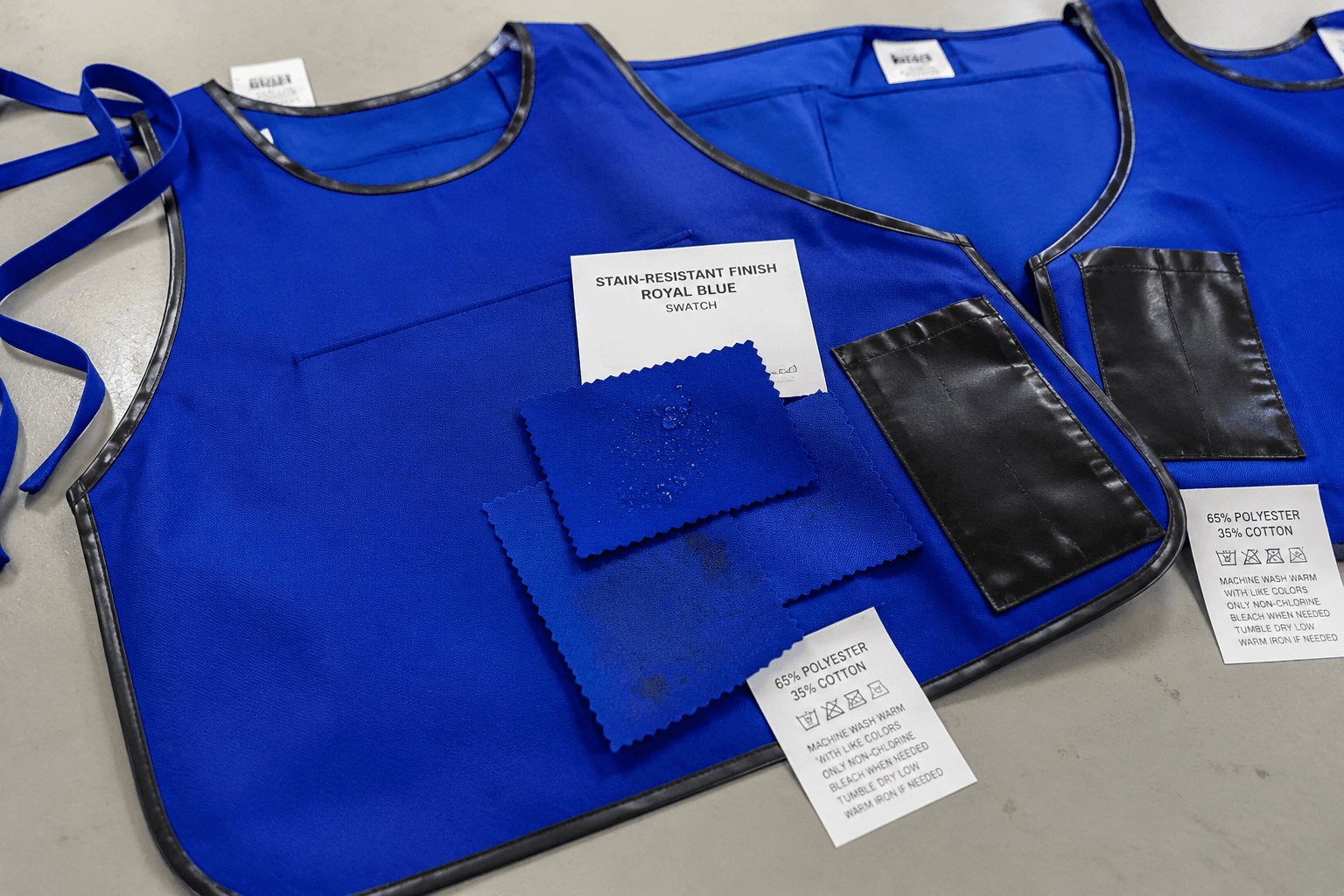
The finish deserves the same scrutiny as the base cloth. A credible soil-release finish should improve wash-off of body oil, dust, makeup transfer, and light cleaner residue under institutional detergent conditions, not just make a lab swatch look cleaner after one cycle. Buyers should confirm whether the finish is applied after dyeing, whether it changes shade depth, and whether the stated performance still holds after 20 to 30 industrial washes. In many OEM programs, moving from a basic 195 GSM twill to a 215 to 220 GSM soil-release twill adds about $0.15 to $0.35 per piece depending on color, volume, and fabric source.
- Common chain spec: 65/35 poly-cotton twill, 205 to 220 GSM, pre-shrunk, in black, navy, charcoal, slate blue, or medium grey.
- Higher-stability option: 80/20 poly-cotton twill, 215 to 230 GSM, for faster drying and lower shrinkage.
- Preferred construction: compact twill rather than open weave, because loose fabrics distort faster under pocket load and repeated drying.
- Required mill data: finished GSM tolerance, weave density, and industrial-wash shrinkage results, not only home-laundry test reports.
How to test soil-release performance on a hotel housekeeping apron
A hotel housekeeping apron should be tested against the soils and chemicals found in guest-room work, not against generic foodservice stains. Housekeeping soils usually include body soil, dust, makeup transfer, diluted bathroom cleaner, light oil from trolley or hinge contact, and occasional pen or rust marks. If a supplier presents only first-wash photos or generic stain cards, the buyer still does not know how the apron will look after 30, 50, or 80 laundry cycles.
The most useful method is staged industrial laundering with recorded checkpoints. If the hotel expects roughly 100 washes of usable service life, the supplier should present observations after 5, 20, 50, and ideally 80 cycles. At each stage, the review should cover stain shadowing, shade retention, seam puckering, tie behavior, pocket edge stability, and finished measurement change. Some finishes perform well in the first few cycles and then drop off sharply, while others hold more stable soil release over time.
Buyers should also be cautious about development samples that feel unusually soft. Heavy softener use can make a sample feel premium while masking the firmer hand that often supports better shape retention in service. For commercial housekeeping, consistent appearance after repeated wash is usually more valuable than luxurious first-touch softness. An apron that feels slightly crisper at delivery but remains square, clean-looking, and wearable after 50 cycles is often the better B2B decision.
- Request stain panels that include makeup, dust soil, light oil, diluted bathroom cleaner, and trolley-contact grime.
- Review results at 5, 20, 50, and 80 cycles for color loss, stain shadowing, seam appearance, and shrinkage.
- Confirm compatibility with oxygen bleach and the detergent route used by the hotel or its contracted laundry.
- Where bleach spotting is common, medium grey, taupe, slate blue, and muted navy usually age better than black or saturated fashion colors.
Construction points that extend hotel housekeeping apron service life
Construction quality often determines whether a housekeeping apron lasts 30 washes or 90. Buyers should specify stitch density, thread type, bartack placement, hem depth, tie construction, and pocket dimensions instead of approving only a visual counter sample. For most twill aprons, 8 to 10 stitches per inch is a workable range on main seams and topstitching. Too few stitches can open under extraction force; too many can create puckering, especially on polyester-richer cloth.
Thread selection is critical. Spun-poly core thread generally performs better than cotton thread in repeated industrial laundering because it holds strength and shade more consistently. Pocket corners and tie insertion points should be bartacked, and hems should usually be double turned at about 1.0 to 1.5 cm for edge stability. Self-fabric ties work best when they are folded, topstitched, and inserted deep enough into the body seam. Narrow single-layer straps save a few cents but often twist, curl, or crack at the seam after repeated drying.
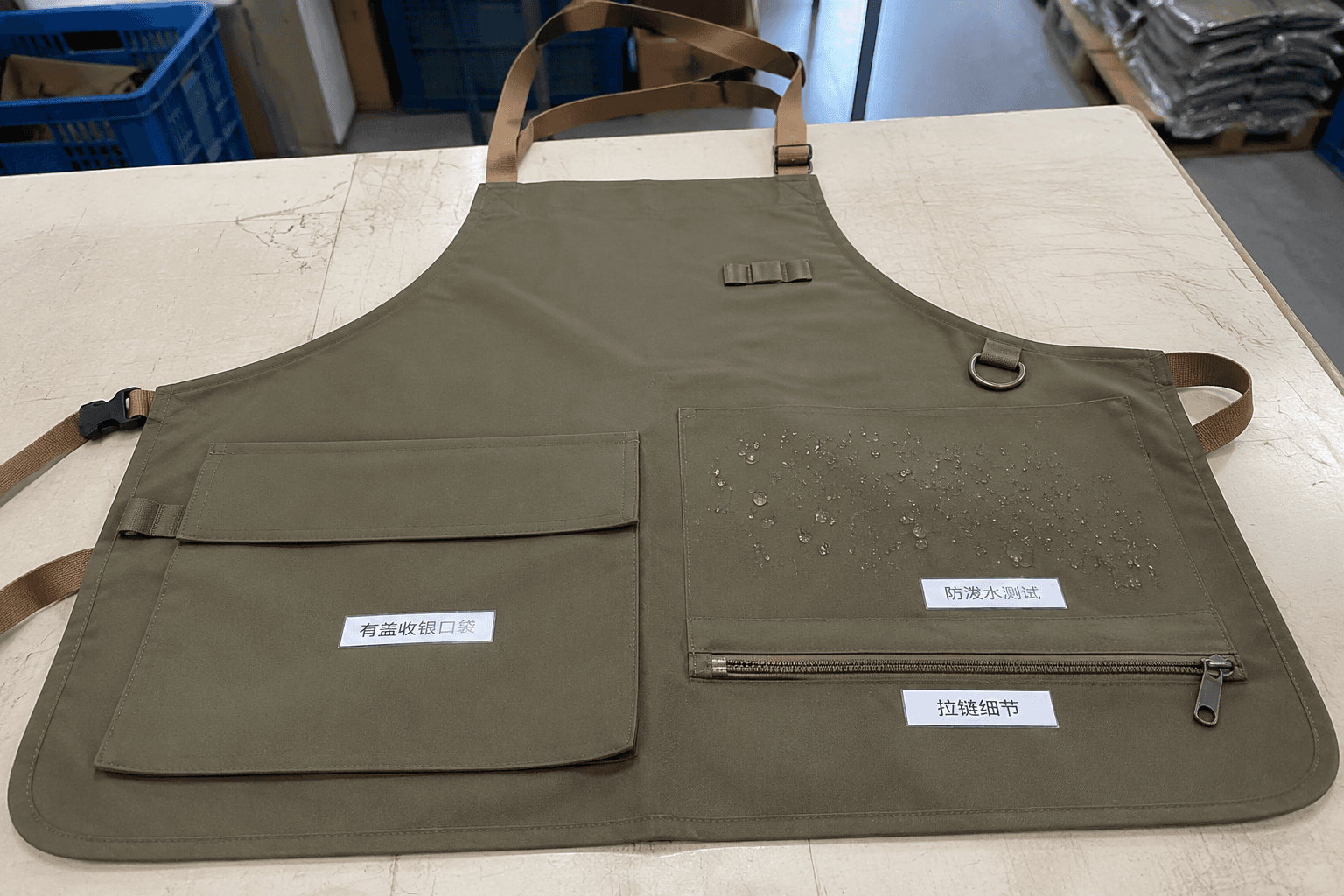
Pocket design should match housekeeping tasks rather than sample-room styling. One large patch pocket often sags when unevenly loaded with cloths, gloves, amenities, and work sheets. Two or three compartments distribute weight better and reduce distortion. On bib styles, adjustable hardware should be reviewed carefully because low-grade plated metal can corrode or mark fabric in industrial wash conditions. Many hotel buyers reduce that risk by using fixed-length straps, reinforced button systems, or proven slide adjusters already validated in laundry programs.
- Specify bartacks at pocket corners, tie ends, bib stress points, and segmented pocket divider tops.
- Target pocket depth of 18 to 22 cm so folded cloths fit without excessive sag.
- Set finished shrinkage tolerance at 2% to 3% after agreed wash testing.
- Avoid decorative piping, rivets, contrast tabs, and other trims that add cost but complicate laundering.
Hotel housekeeping apron costing, MOQ, and lead-time benchmarks
Ex-works pricing for a hotel housekeeping apron is driven mainly by fabric blend, finished GSM, pocket complexity, trim count, logo method, and whether the color is stock-supported or custom dyed. In current OEM sourcing, a basic waist apron in 65/35 twill at 205 to 210 GSM commonly lands around $1.70 to $2.40 per piece at 3,000 to 5,000 pieces. A bib style with segmented pockets, reinforced ties, and embroidery usually falls in the $2.70 to $4.30 range. Recycled polyester content, contrast trims, low-volume logo placement changes, or custom woven labels can add another $0.10 to $0.60 per piece depending on complexity.
MOQ is usually controlled more by fabric and dyeing than by sewing capacity. If the buyer accepts stock black, navy, charcoal, slate blue, or medium grey, many factories can work from 800 to 1,500 pieces per color and style. Once a custom Pantone is required, realistic MOQ often rises to 1,500 to 3,000 pieces because dyeing minimums, shade control, and surplus cloth risk all increase. Buyers should also define overrun tolerance in the purchase agreement; 3% to 5% is common unless the hotel's distribution plan requires tighter control.
Lead time should be separated into development, material, and production stages. A proto sample usually needs 5 to 10 days, and a corrected pre-production sample another 7 to 12 days after comments. Stock-supported fabric may take 7 to 15 days to reserve and finish, while custom dyeing often needs 20 to 30 days. Cutting, sewing, inline inspection, finishing, and packing then require roughly 20 to 30 more days depending on line loading and quantity. In practice, a first order normally needs 35 to 50 days after PPS approval and deposit, while repeat orders on approved stock fabric often ship in 25 to 35 days.
- Basic waist apron: about $1.70 to $2.40 per piece ex works at 3,000 to 5,000 pieces.
- Bib apron with segmented pockets and logo: about $2.70 to $4.30 per piece, depending on trim and logo complexity.
- Typical MOQ: 800 to 1,500 pieces with stock fabric; 1,500 to 3,000 pieces with custom-dyed shades.
- Timing benchmark: 5 to 10 days for proto, 7 to 12 days for PPS, then 35 to 50 days for first bulk production.
AQL, approvals, and bulk controls for repeat apron sourcing
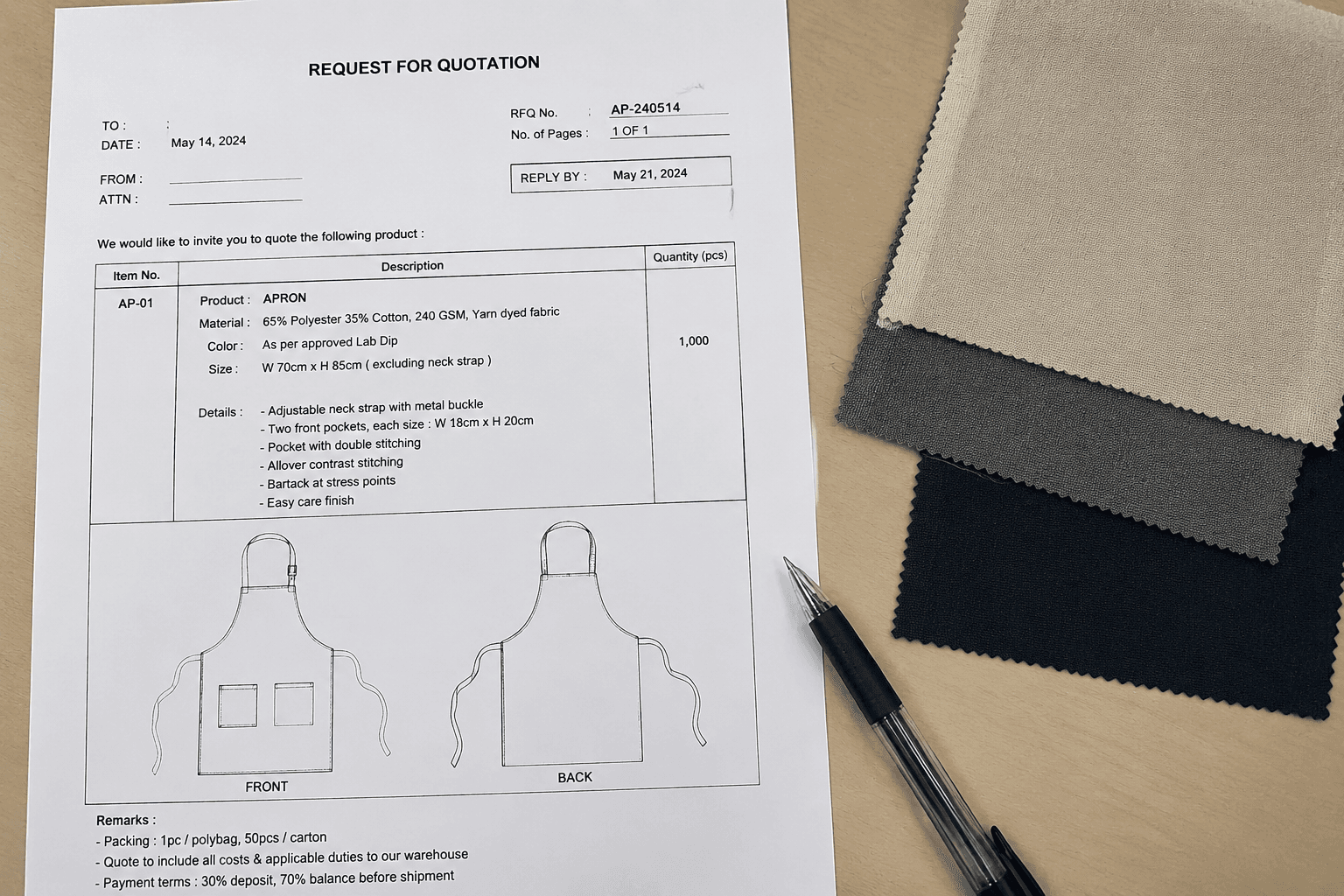
A reliable apron program starts with a complete technical pack and a wash-approved sample, not with a simple color swatch sign-off. Buyers should document fabric composition tolerance, finished GSM tolerance, size tolerance, approved shade standard, pocket dimensions, stitch count, shrinkage limit, thread specification, logo position, and packing method before issuing the purchase order. Without that detail, disputes after shipment become subjective, especially when the fault appears only after laundering.
For finished goods, many professional buyers use AQL 2.5 for major defects and AQL 4.0 for minor defects. In housekeeping aprons, major defects usually include open seams, missed bartacks, wrong size outside tolerance, severe shade variation, twisted ties, or pocket misplacement that affects use. Minor defects usually include small thread ends, slight topstitch waviness, or packing errors that do not affect wear. The critical point is not only the AQL number but clear agreement on defect classification before bulk cutting starts.
The most valuable approval step is a pre-production laundry simulation using the hotel's actual wash route or a credible third-party equivalent. That trial can expose seam twist, puckering, shade loss, shrinkage, and pocket distortion before the factory commits full fabric. Buyers should also lock carton ratio, barcode format, property code labeling, pack quantity, and carton marking early. In multi-property programs, packing mistakes can create more downstream cost than a minor sewing defect.
- Document composition, GSM, dimensions, pocket layout, shrinkage limit, shade standard, and thread type directly in the PO.
- Use agreed inspection rules such as AQL 2.5 major and AQL 4.0 minor unless the program requires tighter limits.
- Run pre-production laundry testing before approving bulk cutting and trim booking.
- Confirm barcode rules, carton marks, replenishment SKU coding, and pack ratio before shipment release.
Building a repeatable replenishment program for hotel housekeeping aprons
The strongest sourcing result is not the cheapest first quote; it is a replenishment program that keeps the same apron commercially stable across seasons, properties, and reorder cycles. That requires buyers to limit unnecessary variation in fabric, trims, pocket layout, and approved shades. When the base cloth, dye route, thread type, and construction details stay fixed, factories can maintain more reliable color continuity, repeat pricing, and production planning over 6, 12, or 24 months.
For hotel groups, standardizing one or two core styles in two or three practical colors usually works better than developing separate aprons for each property. It reduces MOQ pressure, lowers dead-stock risk, simplifies staff transfer between locations, and makes repeat inspection easier because every delivery can be checked against sealed reference samples and approved wash reports. This becomes even more important when several hotels share one laundry partner or central procurement office.
From a total-cost perspective, an apron priced $0.20 to $0.40 higher can still be the lower-cost option if it delivers 20 to 30 additional industrial wash cycles before replacement. That is the metric professional buyers should use when comparing suppliers. A dependable hotel housekeeping apron program is defined by measurable wash performance, disciplined construction control, realistic MOQ, and stable replenishment planning rather than by the lowest headline unit price.
- Standardize core fabrics and approved colors across properties to reduce dye-lot variation on reorders.
- Keep sealed reference samples, approved specs, and wash reports for each season or fabric lot.
- Track annual replacement cost per wearer, not only initial ex-works unit price.
- Favor stock-supported materials when replenishment speed matters more than custom shade exclusivity.