A home kitchen apron retail program looks simple on a line sheet, but the factory cost is built from many small decisions: fabric GSM, pocket construction, tie length, shrinkage allowance, print method, retail packaging, and inspection standard. For an apron retail buyer, the difference between a 2.80 USD landed-cost item and a 4.20 USD item is rarely one big feature. It is usually ten construction and merchandising choices added together.
In Zhejiang, we see two main types of retail orders for home kitchen aprons. The first is a price-led kitchen apron wholesale program for supermarket, discount, or seasonal channels, usually 3,000 to 20,000 pcs per colorway. The second is a design-led retail apron program for homeware brands, cooking shops, gift retailers, or private-label lifestyle ranges, usually 800 to 5,000 pcs per design. Both can be profitable, but they need different fabric, packaging, and MOQ logic.
This article explains how a home kitchen apron retail buyer can protect margin while still giving the shelf enough visual value. The examples are based on normal factory quotations for cotton, cotton-poly, canvas, twill, and linen home apron production, with practical ranges for GSM, MOQ, lead time, and unit cost.
- Fabric weight drives both perceived value and carton cost, so 180-240 GSM is usually the working range for mainstream home kitchen aprons.
- Retail packaging can add 0.08-0.45 USD/pc, depending on belly band, header card, printed carton insert, or recycled kraft sleeve.
- Print placement and color count affect defect rate, especially on dark cotton, slub linen blends, and large all-over patterns.
- A single universal adult size reduces SKU risk, but adjustable neck hardware and longer waist ties can add 0.06-0.18 USD/pc.
- MOQ should be planned by fabric dye lot and decoration method, not only by finished apron design.
- Retail margin is protected earlier at sampling stage, before the buyer locks artwork, packaging, and size specs.
How home kitchen apron retail cost is actually built
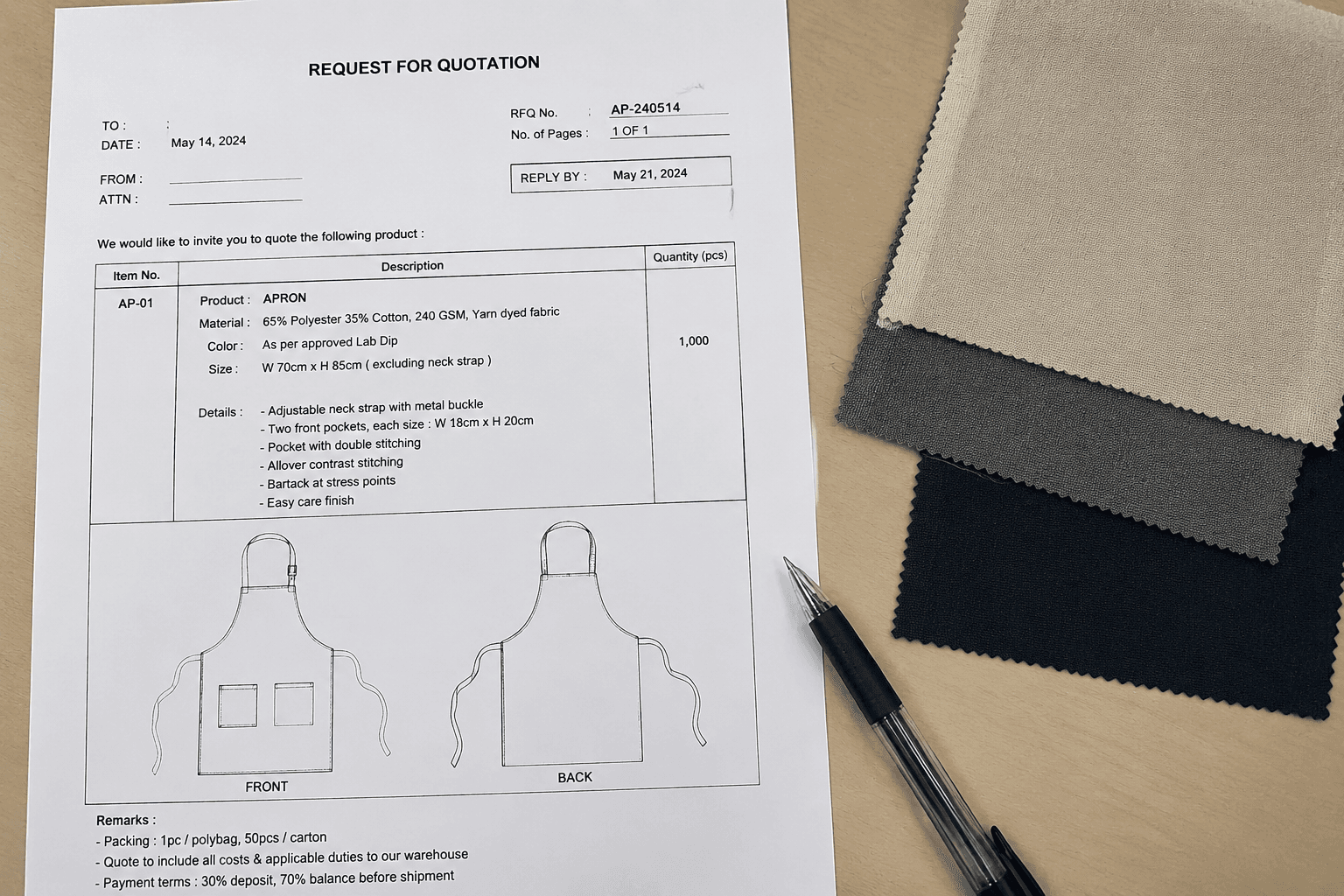
For a retail apron, FOB cost normally contains fabric, cutting, sewing, trimming, decoration, finishing, inspection, inner packing, export carton, and overhead. When buyers compare two quotations, they often focus only on the fabric name, such as cotton twill or linen blend. That is not enough. A 200 GSM cotton twill apron with one patch pocket and simple waist ties can be very different from a 260 GSM canvas apron with contrast straps, antique brass buckle, printed pocket, and kraft retail sleeve.
For standard home kitchen apron retail programs, FOB Ningbo or Shanghai pricing usually sits in the following practical range: 1.60-2.40 USD/pc for basic cotton-poly or light cotton apron in bulk polybag; 2.50-3.60 USD/pc for mid-weight cotton twill or canvas with retail band; 3.80-6.20 USD/pc for linen home apron, washed cotton canvas, yarn-dyed stripe, embroidery, or premium packaging. These are working ranges, not promises, because cotton price, RMB exchange rate, and order quantity can move the quote.
The factory calculates risk as well as material. A simple solid-color apron in 5,000 pcs can run smoothly. A 1,000 pcs order split into four prints, each with different hangtag, folded size, and barcode label, uses more setup time and creates higher packing risk. For the buyer, the best margin is usually not the cheapest possible apron. It is the apron that sells at the target retail price with controlled defect rate, stable replenishment, and no unexpected rework before shipment.
- A basic 180 GSM cotton-poly apron with one pocket can target FOB 1.60-2.10 USD/pc at 5,000 pcs.
- A 220 GSM cotton twill retail apron with adjustable neck and belly band can target FOB 2.60-3.40 USD/pc at 3,000 pcs.
- A 240-260 GSM cotton canvas apron with pigment print and kraft sleeve often sits around FOB 3.20-4.60 USD/pc.
- A washed linen-cotton apron with premium label and hanger packing can reach FOB 4.50-6.80 USD/pc depending on linen content.
Fabric choices for home kitchen apron retail margin
Fabric selection is the largest cost lever and the strongest merchandising signal. For a home kitchen apron, the buyer should not only ask for cotton, linen, or canvas. The factory needs GSM, composition, weave, finishing, color, shrinkage target, and hand-feel requirement. A 160 GSM plain cotton may look acceptable in a flat photo but feel thin on a retail fixture. A 280 GSM canvas may feel premium but increase sewing cost, shipping weight, and folded pack thickness.
For mainstream home kitchen apron retail, 180-240 GSM is usually the practical band. Below 170 GSM, the apron may crease heavily and feel promotional unless the channel is price-led. Above 260 GSM, the apron gains structure but can become too stiff for daily home cooking unless washed or softened. Linen home apron ranges need extra care because linen price and shrinkage vary. A 55% linen, 45% cotton blend at 200-230 GSM can give a natural look with better cost control than 100% linen.
Color also changes cost. Natural, white, black, navy, charcoal, and red are usually easier to source in greige-to-dye programs. Small custom colors can require 300-500 kg fabric MOQ per shade, which may equal 2,000-4,000 aprons depending on width and consumption. If the retail buyer wants six seasonal colors at 800 pcs each, stock fabric or yarn-dyed ready goods may be more realistic than custom dyeing.
- Cotton-poly 65/35, 170-210 GSM: best for price-led kitchen apron wholesale and promotional retail packs.
- 100% cotton twill, 200-240 GSM: balanced option for most homeware retail buyers needing good printability and perceived quality.
- Cotton canvas, 240-280 GSM: suitable for premium cooking, barbecue, and giftable apron programs, but increases carton weight.
- Linen-cotton blend, 200-240 GSM: good for natural lifestyle ranges where texture is more important than bright print clarity.
- Recycled cotton-poly, 180-220 GSM: useful for sustainability positioning, but buyers should approve shade variation and hand-feel early.
Retail apron construction details that change sell-through
A retail apron must look good on a hanger, on a folded shelf, and in customer photos. Small construction choices influence the consumer's first impression. A pocket that sits too low looks cheap when folded. Waist ties that are too short create fit complaints. A neck loop without adjustability can limit sizing for taller customers. These details are not expensive individually, but changing them after bulk cutting is costly.
For adult home kitchen aprons, a common size is 70 x 80 cm or 72 x 84 cm. Larger Western retail sizes may use 75 x 85 cm or 80 x 90 cm. Waist ties are commonly 85-95 cm each for basic retail, but 100-110 cm gives more flexible front-tying. Neck straps can be fixed, adjustable with metal slider, adjustable with D-ring, or continuous strap through side casing. Each method affects both cost and fit. A metal slider set may add 0.05-0.10 USD/pc; D-rings may add 0.04-0.08 USD/pc; longer straps add fabric consumption.
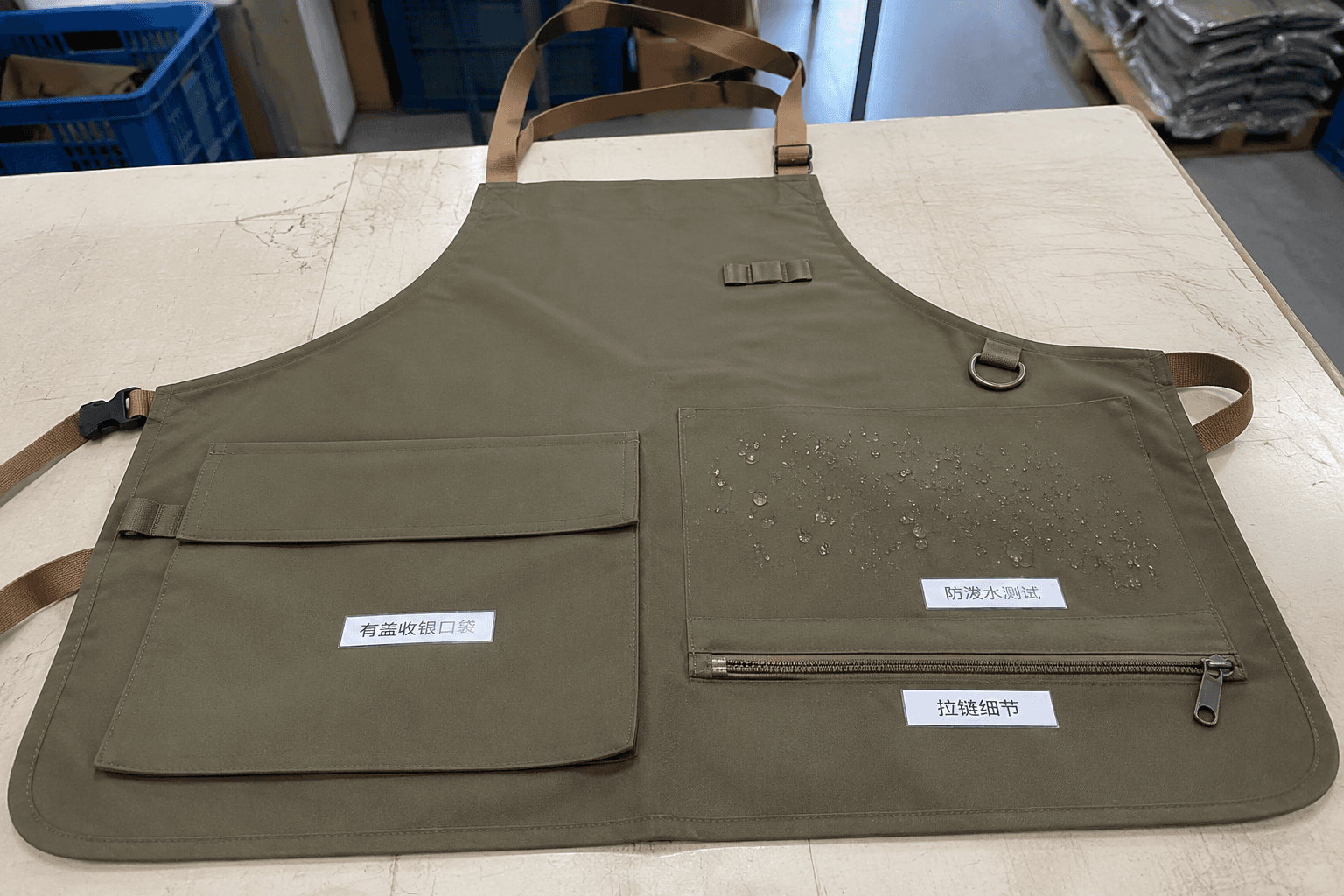
Pocket design should match retail use. One center pocket is cheaper and easier to align. Two divided pockets look more functional for cooking and gardening crossover programs. A chest pocket adds professional styling but may not be useful for home cooking. Contrast binding, bar-tacks, and double-needle topstitching improve visual value, but they also add sewing minutes. A buyer targeting a 12.99 USD shelf price may not need all of these. A buyer targeting 29.99 USD usually does.
- Use 70 x 80 cm for compact price-led programs and 75 x 85 cm for broader adult fit.
- Specify tie length separately from apron body size, because tie shortage is a common consumer complaint.
- Keep pocket placement visible after retail folding if the pocket carries print, embroidery, or brand label.
- Use bar-tacks at pocket corners and strap joints for aprons positioned as durable or giftable.
- Approve the folded retail presentation during sample stage, not only the flat apron photo.
Home kitchen apron retail packaging and shelf economics
Packaging is where many buyers lose margin quietly. A kitchen apron wholesale order packed one piece per polybag is efficient for warehouse handling but weak for retail display. A retail apron packed with belly band, header card, hanger, or kraft sleeve sells better in some channels, but every addition has material cost, labor cost, barcode control, and carton volume impact. The right choice depends on the selling environment.
For ecommerce, simple individual polybag with suffocation warning, barcode sticker, and folded insert may be enough. For department store or gift retail, a paper belly band or kraft sleeve improves presentation. For peg display, a header card with reinforced hole or hanger is needed. A cotton tape bundle looks attractive for linen home apron ranges, but manual tying is slower and can add 0.06-0.12 USD/pc in labor alone.
Approximate packaging adders are useful for early costing. A barcode sticker may add 0.01-0.02 USD/pc. A printed belly band may add 0.05-0.12 USD/pc depending on paper weight and MOQ. A custom kraft sleeve can add 0.12-0.28 USD/pc. A hanger plus header card can add 0.10-0.25 USD/pc. A gift box is rarely efficient for aprons unless the retail price is high, because carton volume and freight cost rise quickly.
- Polybag plus barcode sticker is practical for ecommerce fulfillment and warehouse-controlled retail.
- Paper belly band gives strong shelf presence at low cost if the apron fold is consistent.
- Header card works for peg displays but needs a reinforced hole and clear carton packing direction.
- Kraft sleeve suits linen home apron and natural cotton ranges, but paper MOQ can exceed apron MOQ.
- Gift box should be tested against freight cost because folded apron thickness can reduce carton efficiency.
Decoration methods for a profitable retail apron
Decoration choice should be decided together with fabric. Screen print is usually economical for simple artwork and medium to large runs. Digital print is useful for detailed artwork or small design splits but can be more expensive per piece. Embroidery gives perceived value but is slower, heavier, and limited for fine detail. Woven labels and faux leather patches can support branding without making the whole apron decoration-heavy.
For home kitchen aprons, the most common decoration area is chest center, lower pocket, or all-over repeat. Chest center print is easiest to inspect and control. Pocket print needs accurate pocket sewing after printing, otherwise the design may tilt. All-over printing has strong merchandising value but increases fabric planning risk, especially for repeat alignment, color consistency, and cutting loss. On dark fabric, underbase printing may be needed, which adds cost and can create a thicker hand-feel.
A practical buyer brief should include artwork size in cm, Pantone or TCX colors, print position from top edge and center line, wash requirement, and acceptable color tolerance. If the apron will be sold as a cooking item, we recommend at least 3-5 home-laundry test cycles before bulk approval. For darker cotton, color crocking should also be checked, especially when waist ties rub against light garments.
- Screen print is efficient for 1-4 color artwork when each design reaches 1,000 pcs or more.
- Digital print is better for many artworks at 300-800 pcs each, but unit cost is usually higher.
- Embroidery is suitable for logos, monograms, and premium pocket details, but large embroidery can distort lighter fabrics.
- Woven labels add brand value at low cost, usually 0.03-0.08 USD/pc depending on size and fold type.
- All-over print should include extra fabric allowance, often 3%-8%, to manage pattern placement and cutting loss.
MOQ, lead time, and replenishment planning for apron retail buyers
MOQ is not only a factory preference. It comes from fabric mill minimums, dye vat size, printing setup, packaging MOQ, and sewing line efficiency. For a plain stock-fabric apron, a factory may accept 500-1,000 pcs per color. For custom dyed cotton twill, the practical MOQ may be 2,000-3,000 pcs per color. For yarn-dyed stripe or special linen blend, the fabric MOQ can push finished apron MOQ to 3,000-5,000 pcs.
Lead time also depends on what is custom. A repeat order using approved stock fabric and existing packaging can ship in 25-35 days after deposit and artwork confirmation. A new custom dyed fabric program usually needs 45-60 days. If packaging is custom printed and requires barcode approval from the retailer, add 5-10 days for artwork and proofing. If the buyer needs third-party inspection, the inspection window should be booked at least 7 days before planned shipment.
For seasonal home kitchen apron retail, buyers should separate launch orders from replenishment orders. The first order may include more colorways and smaller quantities to test sell-through. Replenishment should concentrate on the top colors and designs with enough volume to meet fabric MOQ. This reduces leftover packaging, shade mismatch, and slow-moving SKUs. A practical replenishment plan often uses 60% core colors, 25% seasonal designs, and 15% test items.
- Sampling usually takes 7-12 days for simple aprons and 12-18 days for custom print, wash, or premium packaging.
- Bulk production usually takes 30-45 days for stock fabric and 45-60 days for custom dyed or woven fabric.
- Minimum practical order can be 500 pcs for stock fabric, but 2,000-5,000 pcs is more realistic for custom color or custom packaging.
- Retailer barcode, carton mark, and inner pack approval should be completed before bulk packing starts.
- Reorders should keep approved fabric code, shrinkage record, and packaging die-line to avoid unnecessary resampling.
Quality control points specific to home kitchen aprons
Aprons are simple garments, but retail complaints usually come from fit, shrinkage, color, stitching, and packaging mistakes. A factory inspection plan should reflect how the consumer uses the product: tying and untying, washing, wiping hands, putting utensils in pockets, and storing the apron folded. For home kitchen apron retail, AQL 2.5 for major defects and 4.0 for minor defects is common, but premium retailers may request tighter limits.
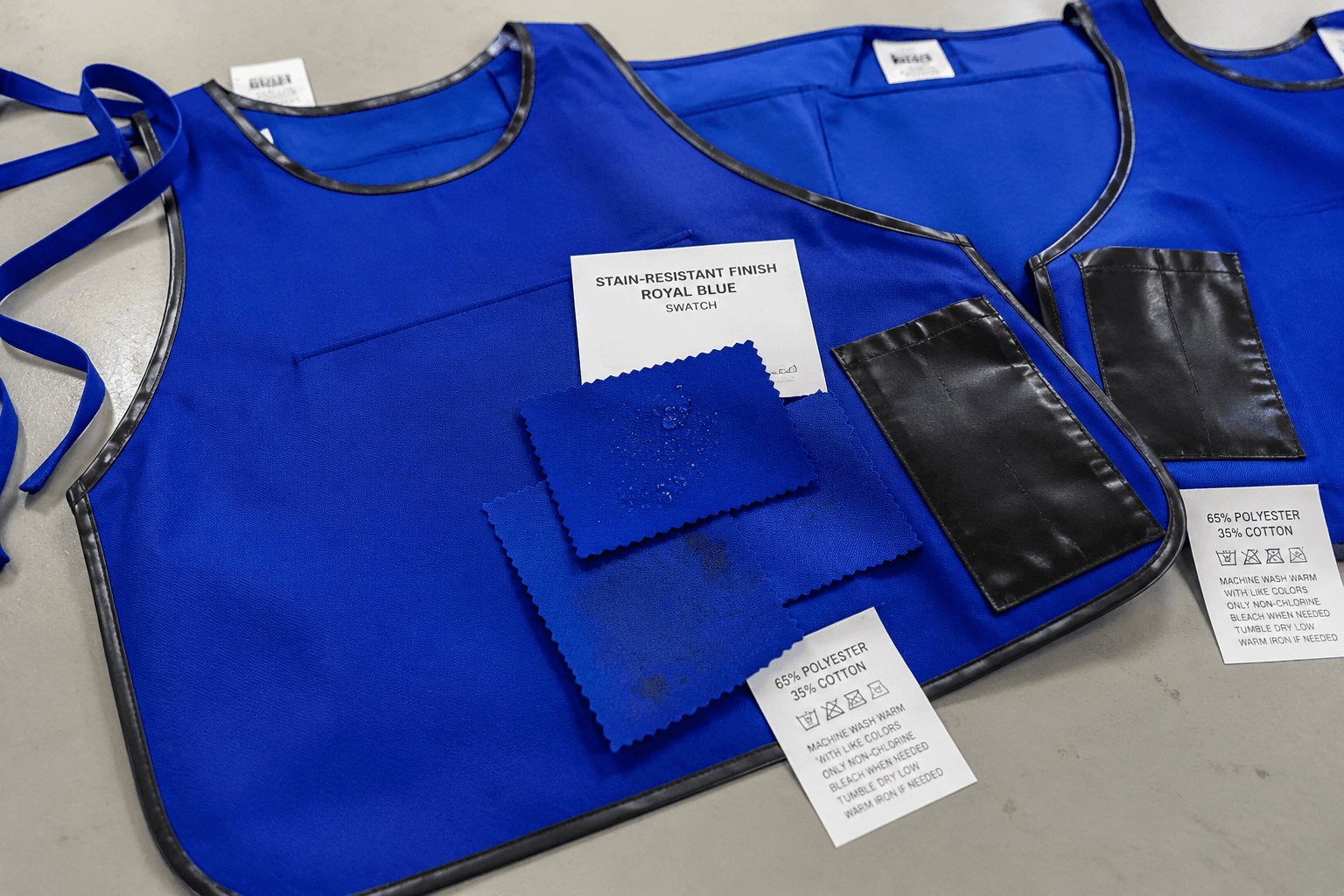
Shrinkage must be agreed before bulk production. For cotton and cotton-linen aprons, after-wash shrinkage within +/-3% to +/-5% is a practical target depending on fabric and wash process. If the buyer wants a relaxed washed look, the garment size spec should be based on after-wash measurement, not before-wash cutting size. Colorfastness to washing and rubbing should be checked, particularly for black, navy, red, forest green, and pigment-dyed items.
Packaging QC is just as important as sewing QC for retail. A good apron can still fail receiving inspection if the barcode is wrong, the belly band is upside down, the country-of-origin label is missing, or mixed designs are packed into the same carton. For multi-SKU programs, carton-level scanning or at least SKU separation by carton is worth the extra discipline. It reduces chargebacks and warehouse delays.
- Measure apron body width, body length, neck strap, waist ties, and pocket position on pre-production and bulk samples.
- Check strap joint strength with pull testing, especially for heavier canvas and adjustable neck designs.
- Test shrinkage after 3 wash cycles when the apron uses cotton, linen, or garment wash finishing.
- Inspect print cracking, color migration, and pocket alignment before final packing.
- Verify barcode, hangtag, care label, country of origin, carton mark, and SKU ratio against the buyer's packing instruction.
Building a home kitchen apron retail range with margin discipline
A profitable home kitchen apron retail range usually has a clear good-better-best structure. The good tier may use 180-200 GSM cotton-poly or basic cotton with simple print and polybag. The better tier may use 220 GSM cotton twill, adjustable neck, stronger pocket design, and belly band. The best tier may use washed canvas, linen-cotton, embroidery, woven label, or kraft sleeve. This structure lets the buyer serve different price points without redesigning every detail from zero.
For example, a retailer may plan three shelf prices: 9.99 USD, 16.99 USD, and 29.99 USD. The factory target FOB might be around 1.80-2.20 USD, 2.80-3.60 USD, and 4.80-6.20 USD respectively, depending on freight, duty, distributor margin, and retailer margin model. If the buyer needs a 60%-70% gross margin after landed cost, packaging and freight must be calculated early. A beautiful 5.80 USD FOB linen home apron may not work at a 19.99 USD shelf price once ocean freight, duty, domestic handling, and markdown allowance are included.
The most efficient development method is to lock the base body first, then vary fabric color, pocket print, label, and packaging. For kitchen apron wholesale, this keeps sewing stable and allows artwork variety without changing line setup. For brand buyers, it also helps build a recognizable fit and silhouette across seasons. The factory can hold the approved pattern, consumption, and sewing standard, while the buyer refreshes merchandising with lower technical risk.
- Use one approved adult pattern across multiple colors to reduce sampling time and fit inconsistency.
- Limit new fabric qualities in each season so MOQ is concentrated and shade control is easier.
- Plan packaging as part of margin, not as an afterthought after the apron quote is approved.
- Keep high-cost details for the best tier, where the shelf price can carry them.
- Review landed cost by carton volume as well as FOB price, especially for canvas and gift-packed aprons.