For a gardening apron program, the main sourcing question is not only fabric color or logo position. The product has to carry hand tools, seed packets, labels, gloves, pruning shears and sometimes damp soil residue while still looking acceptable after repeated washing. In factory development, this means the apron must be treated more like a light utility garment than a simple promotional apron.
Buyers ordering from China usually ask for a canvas gardening apron because canvas gives a familiar outdoor look and can handle abrasion better than thin twill. The correct specification still depends on end use. A retail garden tool apron for hobby gardeners may use 10 oz cotton canvas with multiple pockets, while a nursery apron for daily staff may need 12-14 oz cotton-poly canvas, bar-tacked stress points and a simpler pocket layout that is faster to clean.
This article explains the practical decisions we handle during OEM apron development in Zhejiang: fabric GSM, pocket layout, strap systems, reinforcement, logo methods, MOQ and lead time. The goal is to help sourcing managers brief suppliers clearly, avoid expensive overbuilding and still receive an apron that performs in garden centers, nurseries and potting areas.
- 10-12 oz canvas is the usual range for a durable retail gardening apron, while nursery staff programs often move to 12-14 oz or cotton-poly blends.
- Pocket depth and bar-tack placement matter more than simply adding more pockets, because tools create concentrated stress at pocket corners.
- Waxed canvas, coated canvas and heavy hardware improve perceived value but increase cost, lead time and export packing care.
- MOQ commonly starts from 500-1,000 pcs per color for custom canvas dyeing or full OEM construction, with lower MOQ possible when using stock fabric.
- Sampling should test real tools, including pruners, plant labels, seed packets, gloves and a phone, before confirming bulk pocket dimensions.
- Typical production lead time is 25-45 days after sample approval and deposit, depending on fabric availability, logo process and pocket complexity.
What a gardening apron must do in real use
A gardening apron is used differently from a kitchen apron or service apron. It is pulled forward by loaded pockets, rubbed against benches, exposed to potting mix and occasionally damp surfaces, and washed less gently than hospitality uniforms. For OEM sourcing, the design should be evaluated by load points, soil contact and cleaning behavior rather than only by appearance on a flat sample.
In retail, the apron may be sold as a giftable gardening accessory, so presentation and handfeel are important. In nursery or garden center use, the apron is a staff tool. The buyer normally cares more about durability, consistent sizing, colorfastness and replacement repeatability. These two use cases may look similar in a catalog, but they should not always share the same bill of materials.
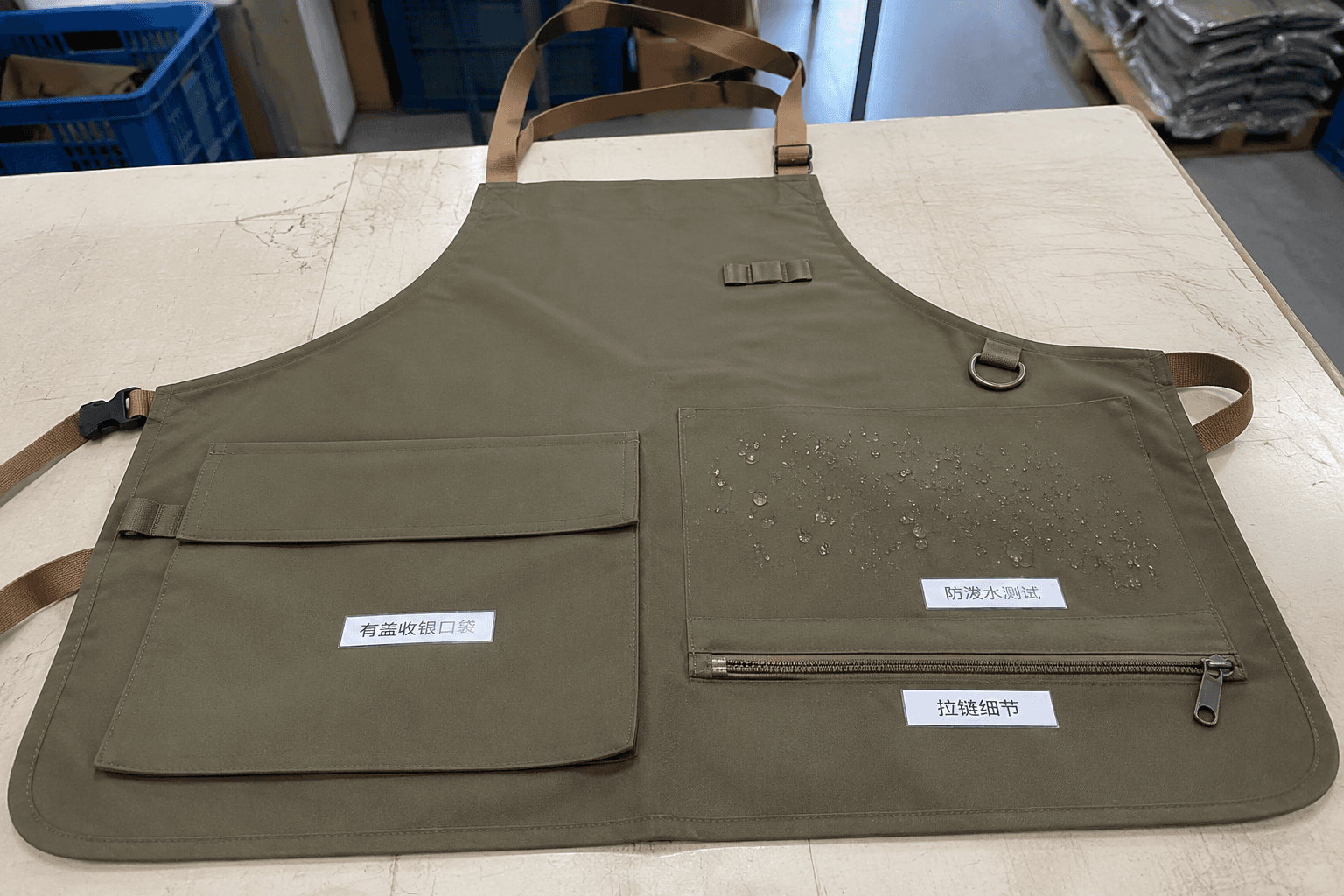
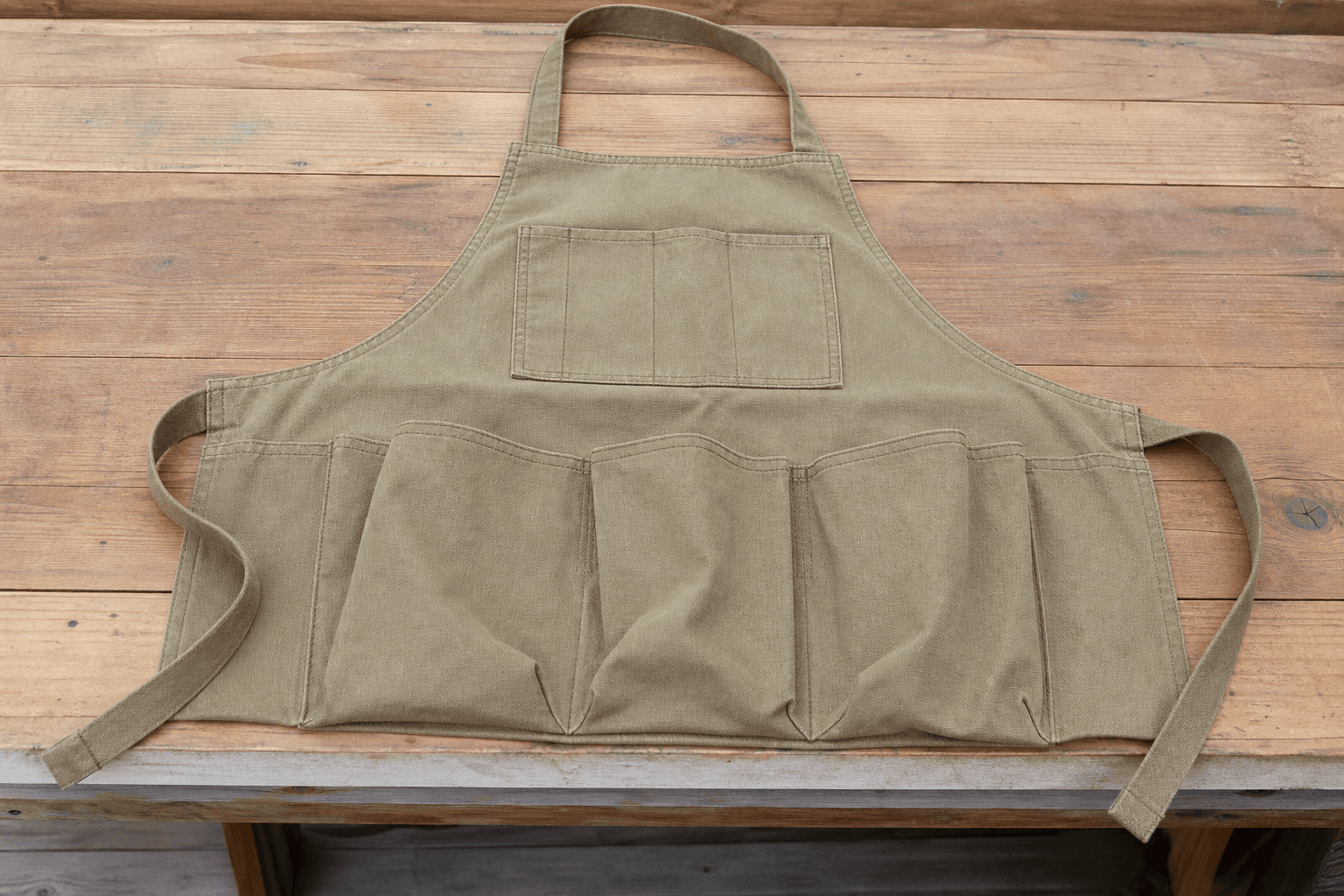
A common mistake is adding too many narrow pockets because the sketch looks functional. In real production, every pocket seam adds labor, every pocket opening becomes a possible distortion point after washing, and very narrow compartments may not fit actual tools. For a garden tool apron, fewer pockets with correct width, depth and reinforcement usually perform better than a crowded pocket panel.
- A retail potting apron normally prioritizes attractive canvas texture, gift-ready color and balanced pocket styling.
- A nursery apron for staff normally prioritizes washing durability, strap comfort and repeatable bulk replacement.
- A garden tool apron should be tested with real tools, not only measured against a paper drawing.
- A canvas gardening apron should avoid excessive seam bulk at waist and pocket corners, especially above 12 oz fabric.
Canvas choices for a durable gardening apron
Canvas is the most common fabric for this category because it gives structure to pockets and resists abrasion better than plain thin cotton. In export apron manufacturing, fabric may be specified by GSM or by ounces per square yard. As a rough reference, 8 oz canvas is about 270 GSM, 10 oz is about 340 GSM, 12 oz is about 407 GSM and 14 oz is about 475 GSM. Actual values vary by weave and finishing, so pre-production fabric testing is still needed.
For most retail gardening apron orders, 10 oz cotton canvas is a practical middle point. It feels substantial, folds well in retail packing and can be sewn efficiently with standard heavy-duty apron machinery. For nursery staff use, 12 oz canvas gives better pocket support, especially when the wearer carries pruners or metal plant tags. Above 14 oz, the apron becomes stiffer, sewing speed slows, needle marks become more visible and freight weight increases.
Cotton canvas has a natural handfeel and accepts pigment dyeing and enzyme washing well. Cotton-poly canvas can be more stable in repeated washing and can reduce shrinkage risk, often around 2-4% after controlled washing compared with 5-8% for some untreated cotton canvas. Recycled cotton blends are possible, but the buyer should confirm tensile strength and color consistency, especially for dark olive, charcoal and khaki programs.
- 8 oz canvas, around 270 GSM, is suitable for light promotional garden aprons but may sag when pockets are loaded.
- 10 oz canvas, around 340 GSM, is a balanced choice for retail gardening apron programs.
- 12 oz canvas, around 407 GSM, is suitable for better pocket structure and more frequent use.
- 14 oz canvas, around 475 GSM, is strong but increases sewing difficulty, unit cost and carton weight.
- Cotton-poly canvas is useful when shrinkage control and staff uniform repeat orders matter more than a pure cotton story.
Pocket engineering for nursery apron and garden tool apron programs
Pockets are the main functional feature, but they are also the main cost driver. A plain bib apron may have one large pocket and require simple stitching. A garden tool apron can include divided waist pockets, upper pencil slots, a phone pocket, loop holders and reinforced corners. Each additional pocket requires cutting, folding, positioning, stitching and inspection. On a 1,000 pc order, a complex pocket system can add several hundred labor minutes compared with a simple two-pocket layout.
For garden tools, the most important dimensions are pocket opening width, depth and bottom shape. A pruning shear pocket may need 8-9 cm opening width and 16-18 cm depth. A packet pocket for seeds can be shallower, around 12-14 cm, but should not be so tight that the user needs both hands to remove the packet. For plant labels or pencils, a 3-4 cm channel is workable. For phones, buyers should specify market size; many current phones need at least 9.5-10.5 cm clear width and 16 cm depth if the pocket is vertical.
Bar-tacks should be placed at pocket opening corners, waist tie attachment points and tool loop ends. For heavy canvas, a 28-42 stitch bar-tack is typical, depending on machine setting and fabric bulk. Rivets can be used for a rugged retail look, but they add metal detection and corrosion considerations. In nursery staff aprons, bar-tacks are usually more practical than rivets because they are washable, flexible and easier to repair.
- Use 2-3 main waist pockets when the apron must carry gloves, packets and small hand tools.
- Add a narrow 3-4 cm slot only when the product clearly needs pencils, labels or markers.
- Keep phone pockets away from the lowest soil-contact area unless the buyer accepts dirt exposure.
- Place bar-tacks at every pocket opening corner that may receive tool weight or pulling force.
- Avoid very deep open pockets if the apron is used while bending, because contents can become hard to reach.
Straps, fit and comfort for long nursery shifts
The strap system often receives less attention than pockets, but it affects return rates and staff acceptance. A neck strap is cheap and familiar, but loaded lower pockets can pull the bib downward and create neck pressure. Cross-back straps distribute weight better and are preferred for heavier nursery apron designs, especially when the apron has large front pockets. The trade-off is higher labor cost and more complicated size adjustment.
For a standard adult gardening apron, body width often falls between 68-75 cm and total length between 75-85 cm. Shorter waist aprons may be 40-55 cm long, but they do not protect the upper body from potting mix. For garden center staff, a bib apron around 72 cm wide by 82 cm long is a common starting point. Buyers should confirm whether the apron will be worn over light clothing, hoodies or outdoor jackets, because this changes strap length and buckle position.
Cotton webbing ties are soft and match cotton canvas well. Polyester webbing gives better colorfastness and lower stretch in wet conditions. Metal buckles have a premium feel but can scratch retail packing if not wrapped properly. Plastic adjusters reduce cost and weight, but they may not suit high-end canvas gardening apron collections. In bulk OEM production, strap hardware should be locked before PP sample approval because even a small buckle size change can affect the cut length of webbing.
Finishing, washing and logo methods on canvas gardening apron orders
Finishing changes both appearance and measurement stability. Raw canvas looks crisp but may shrink more in the first wash. Pre-washed canvas feels softer and gives a more casual garden lifestyle look, but garment washing adds cost and may create shade variation between lots. Pigment dyeing is popular for olive, rust, clay, navy and charcoal, yet buyers should expect controlled variation rather than a perfectly flat synthetic color.
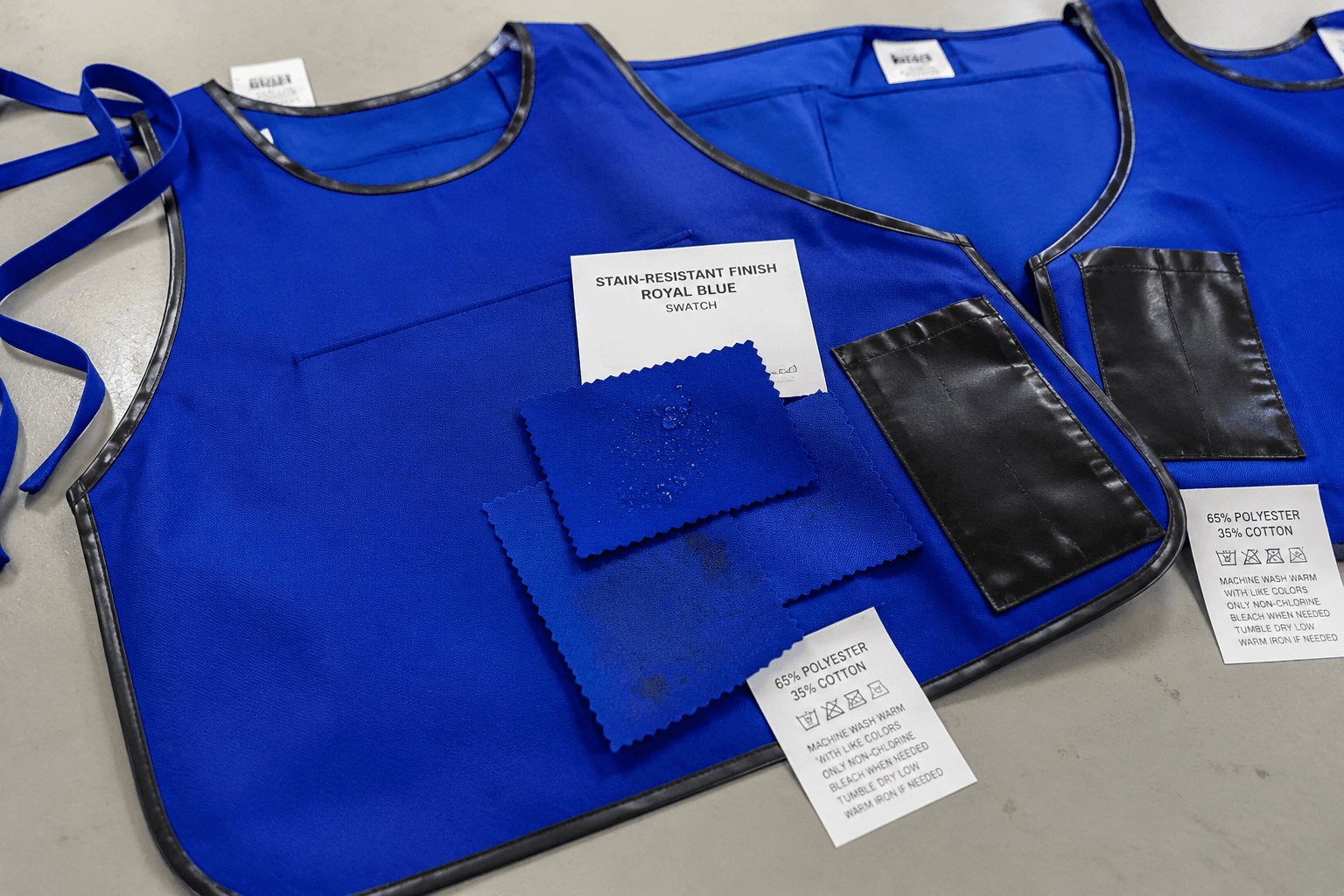
Waxed canvas is requested for premium gardening apron lines because it improves water resistance and gives a heritage outdoor feel. It is not always the best choice for nursery uniforms. Waxed fabric can mark during folding, require interleaving paper, and behave differently under embroidery. For damp greenhouse conditions, a PU-coated or acrylic-coated canvas may be more practical, but coating can reduce breathability and create sewing needle marks. The buyer should decide whether water resistance is a functional need or only a retail story.
Logo application should match the fabric surface and expected washing. Screen printing works well for flat cotton canvas and is cost-effective above 500 pcs, often adding around US$0.15-0.45 per pc depending on size and color count. Embroidery gives a stronger brand impression but adds weight and can pucker on lighter canvas if backing is not controlled. Woven labels, leather patches and rubber patches are common for garden brands; leather-look PU patches are more stable for export compliance and washing.
- Screen print is economical for simple one-color logos on 10-12 oz canvas.
- Embroidery is suitable for small chest logos or premium retail programs, but stitch density must be tested.
- Woven labels are stable, repeatable and efficient for multiple colorways under one brand program.
- PU or leather patches should be tested for washing, crocking and needle perforation before bulk approval.
- Garment washing should be approved with measurement tolerance, because shrinkage can affect apron length and pocket opening.
Cost, MOQ and lead time for OEM gardening apron sourcing
Cost depends mainly on fabric weight, pocket complexity, strap system, logo method and packing. For a simple 10 oz canvas gardening apron with two waist pockets and screen print, FOB China pricing may fall around US$3.20-5.20 per pc at 1,000-3,000 pcs, depending on fabric and order timing. A heavier 12 oz garden tool apron with cross-back straps, multiple reinforced pockets and a woven label may be closer to US$5.50-8.50 per pc. Waxed canvas, metal hardware and retail gift packing can push the price higher.
MOQ is often misunderstood. If the buyer uses stock canvas colors, some factories can support 300-500 pcs per color for sampling or small batch production, though unit cost will be higher. For custom dyed canvas, MOQ is commonly 800-1,500 meters per color from the fabric mill, which may translate to 800-1,500 aprons depending on consumption. For fully custom yarn-dyed stripes or special coatings, MOQ can be higher and lead time longer.
A normal development schedule is 5-7 days for first pattern and sample if stock fabric is available, 7-12 days if custom trims or washed finishing are involved, and 25-45 days for bulk production after approval and deposit. Fabric dyeing can add 12-20 days before cutting. For seasonal garden retail, buyers should avoid approving final samples too close to spring launch dates. A practical calendar leaves time for sample correction, lab testing, bulk production, inspection and sea or air shipment decisions.
- Stock fabric sample lead time is usually 5-7 days after artwork and dimensions are confirmed.
- Custom dyed canvas normally adds 12-20 days before cutting can begin.
- Bulk production commonly requires 25-45 days after PP sample approval and deposit.
- Factory MOQ may be 300-500 pcs with stock fabric, but custom fabric usually requires 800-1,500 pcs per color.
- Complex pocket construction can add US$0.40-1.20 per pc compared with a simple pocket layout.
Quality control points before approving bulk production
A gardening apron should be checked as a working product, not only as a stitched textile item. Before PP sample approval, the buyer and supplier should load the pockets with typical tools and observe pocket sag, strap pressure and access angle. If a pocket corner begins to twist on the sample table, it will usually perform worse after washing and daily use. This is the right stage to adjust pocket depth, add bar-tacks or reduce unnecessary compartments.
For canvas, inspection should include fabric weight tolerance, color shade, shrinkage, crocking and seam strength. A common commercial tolerance for apron measurements is +/-1 cm for small dimensions and +/-2 cm for body length or width, but washed canvas programs may need a wider agreed tolerance. Dark colors should be checked for dry and wet rubbing, especially if the apron will be worn over light shirts. For export retail, needle detection and metal trim control may also be required depending on the buyer's compliance manual.
Bulk inspection should focus on pocket symmetry, strap length consistency, bar-tack position, logo placement and packing. Pocket position variation is more visible on a canvas gardening apron than on a soft kitchen apron because the fabric holds shape. If the logo is placed above a large pocket panel, even a 1 cm shift can look incorrect. For carton packing, heavy canvas aprons should not be compressed too tightly, especially if they include waxed finish or raised patches.
- Confirm actual GSM or oz weight against the approved fabric swatch before cutting.
- Measure shrinkage after washing if the apron is sold as washable or used as staff uniform.
- Check dry and wet crocking for dark olive, black, navy, charcoal and pigment-dyed colors.
- Load pockets during sample review to confirm sagging, reach and corner stress.
- Inspect bar-tacks at pocket corners, strap joins and tool loops during inline production.
- Verify logo position after the apron is worn or placed on a form, not only while flat.
How to brief a supplier for a better potting apron sample
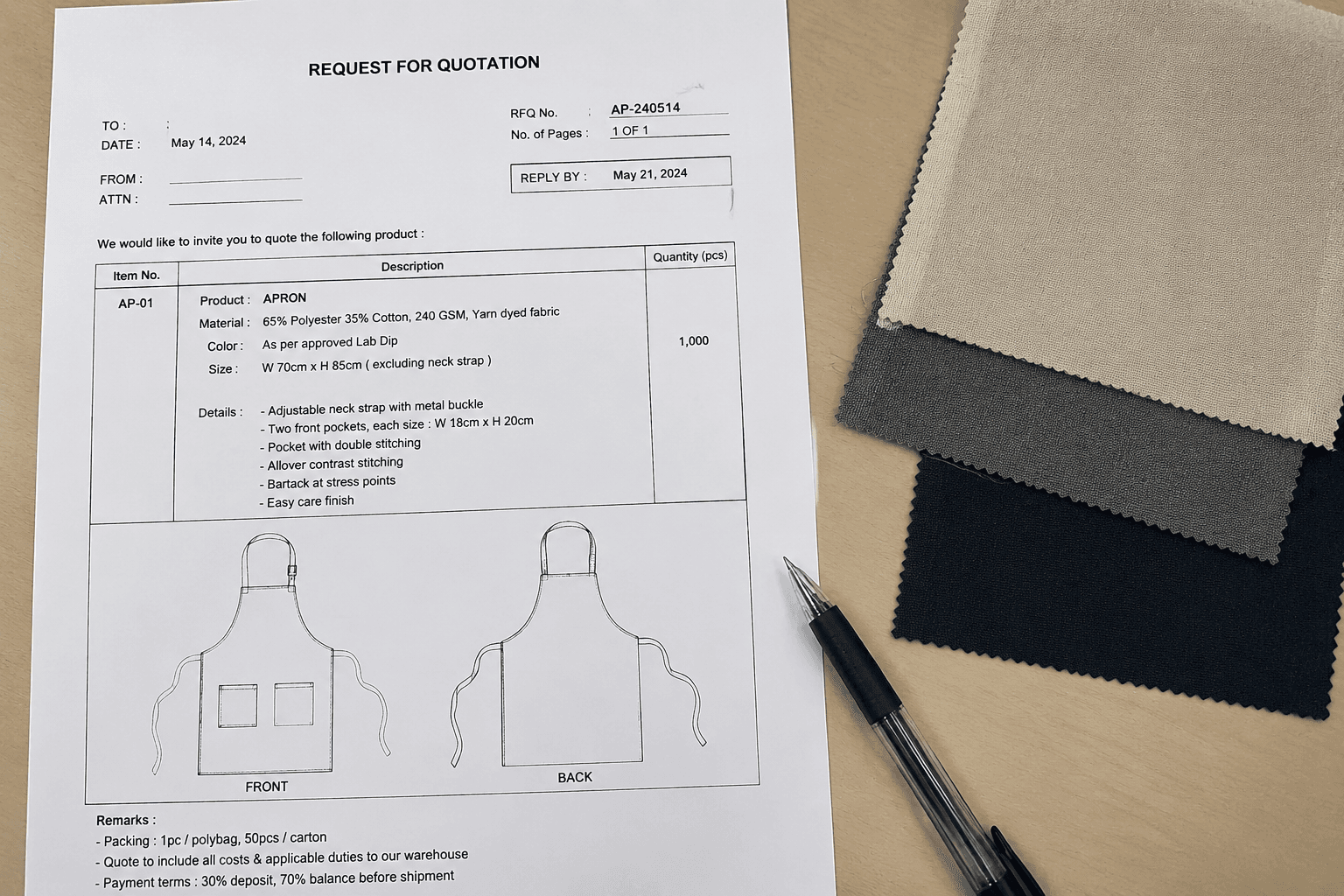
A clear tech pack reduces sampling rounds. For a potting apron or nursery apron, the most useful buyer information includes target user, expected load, fabric preference, color standard, pocket sketch, logo file, packing method and compliance requirements. If the buyer only sends a reference photo and asks for a similar item, the first sample may look acceptable but fail in pocket dimensions or strap comfort.
The best briefs specify function in plain terms. For example, state that the apron must hold one pruning shear, one pair of gloves, five seed packets, a marker and a phone. This lets the factory propose pocket widths and reinforcement. If the apron is for retail sale, provide target retail price and expected FOB range. A factory can then balance fabric weight, trim quality and pocket labor against the commercial target instead of overengineering the sample.
For repeat bulk orders, keep construction stable across seasons. Changing canvas weight from 10 oz to 12 oz, replacing ties with cross-back straps or adding a new patch may require a new PP sample and updated carton data. A small design change can also affect sewing line speed. When the supplier understands annual volume, launch date and reorder pattern, they can reserve fabric, prepare trims and control shade continuity more effectively.
- Provide target fabric weight, such as 10 oz cotton canvas or 12 oz cotton-poly canvas.
- List the exact tools and items the pockets must carry during use.
- Specify logo size, placement and method before the first sample is cut.
- Share target MOQ, FOB price range and delivery window so the factory can engineer within the correct limits.
- Confirm whether the apron is for retail gifting, staff uniform use or promotional distribution.