Garden center cashier aprons work in a tougher environment than typical front-end retail styles. Cashiers handle damp nursery trays, bark dust, fertilizer residue, ceramic pots, receipt rolls, handheld scanners and mobile POS devices in the same shift, often moving between indoor tills and outdoor sales areas. That combination puts unusual stress on fabric face, pocket entry, strap joins and visible color retention.
For B2B uniform buyers, the difference shows up quickly in replacement rates. A low-cost apron that looks acceptable in a showroom can fail in stores within 8-12 weeks of spring traffic if black fabric highlights pale soil marks, pockets sag under scanner weight, or neck seams distort when worn over jackets. In this category, a better OEM brief usually matters more than chasing the lowest quoted unit price.
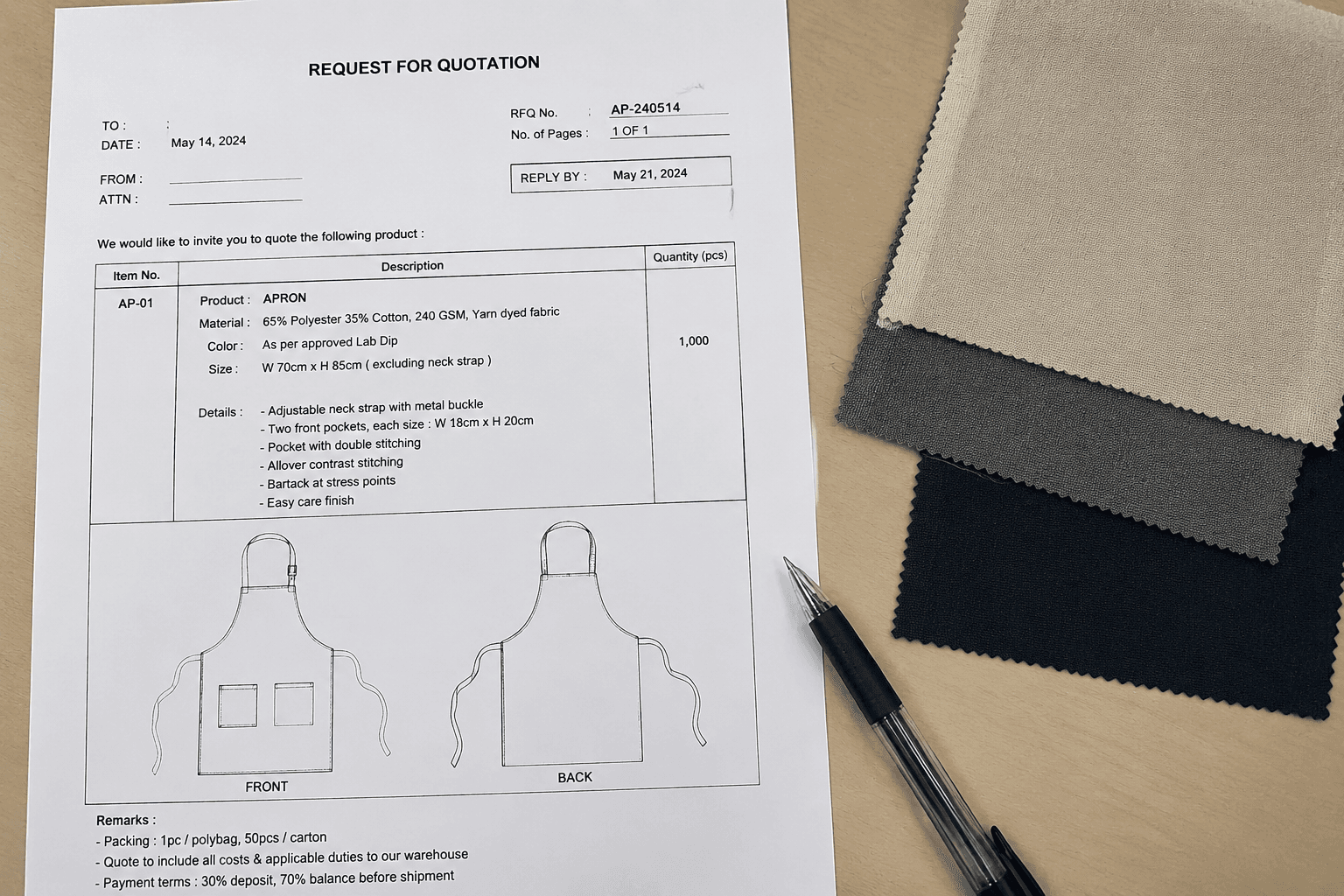
The most reliable approach is to define the apron as a repeatable uniform program: fabric composition, finished dimensions, scanner-pocket geometry, stitch reinforcement, branding method, wash expectation, carton assortment and reorder window before RFQ. Moving from 240 GSM 65/35 poly-cotton twill to 300 GSM canvas may add US$0.45-0.85/pc, while adding a reinforced angled scanner pocket often adds only US$0.12-0.28/pc. For most buyers, that is a good trade if it reduces replacements and avoids reengineering every season.
- Specify mid-to-dark earth tones such as bark brown, slate green, dark olive, muted navy or charcoal khaki; these usually mask peat dust, pollen and hard-water marks better than flat black.
- Use 240-270 GSM poly-cotton twill for cashier-only programs and 280-320 GSM canvas when the same apron is shared with staff handling carts, bagged soil or outdoor resets.
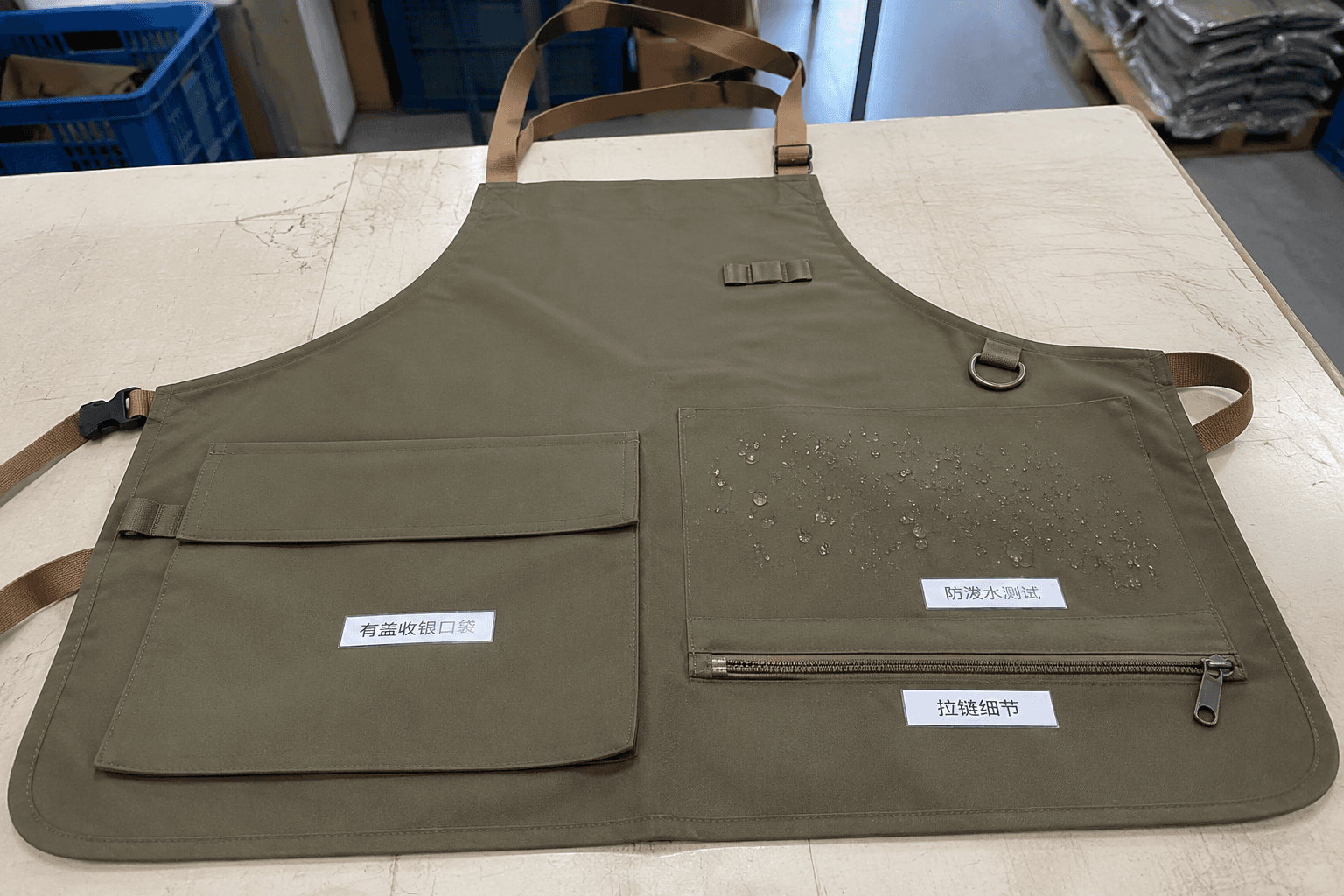
- Engineer the barcode pocket around the actual scanner model, dominant hand and counter reach; a decorative center pocket is often the wrong solution for garden center cashier aprons.
- Expect bulk pricing around US$3.20-6.80/pc FOB China, with stock-fabric MOQ commonly 300-500 pcs/color and custom-dyed programs more stable from 800-1,000 pcs/color.
- Plan volume as 60-70% preseason production, 20-30% reserved reorder capacity and 5-10% contingency, with main spring POs released by January whenever possible.
- Inspect to at least AQL 2.5 major / 4.0 minor, with extra focus on pocket opening width, bartack placement, strap attachment, logo alignment and shade continuity against the approved swatch.
Why garden center cashier aprons need a stricter sourcing brief than standard cashier styles
A generic retail apron brief assumes clean interiors, light carrying and mostly cosmetic use. Garden center cashier aprons face a different wear pattern. Lower fronts pick up bark dust and compost smears, bib areas contact damp trays, pocket corners get struck by ceramic pots, and repeated wiping leaves mineral marks that become visible under store lighting. In practice, that makes color depth, fabric face and reinforcement placement more important than on a fashion, gift or bakery cashier apron.
Workflow is also less predictable. In one 6-8 hour shift, a cashier may use a fixed scanner, handheld barcode gun, pen, radio, receipt pad and store phone while layering the apron over fleece, rainwear or a quilted vest. If the brief leaves pocket size or tie length vague, staff stop using the intended compartments, overload a single pocket or knot straps in ways that twist the body panel. The result is usually early seam failure at stress points, not a factory defect that looks obvious at final inspection.
That is why buyers should source these aprons as a uniform program rather than a promotional item. Before requesting quotes, lock the finished size, fabric weight, scanner-pocket dimensions, wash method, strap construction, branding position and carton assortment. Saving 3-5 days by issuing a loose RFQ often creates more delay later through fit revisions, pocket corrections or color disputes.
- Common finished size for a bib apron is 72 x 86 cm to 75 x 90 cm, depending on pocket depth and logo area.
- Stock-color MOQ is usually 300-500 pcs per color; custom-dyed programs are more stable from 800 pcs per color.
- Standard bulk lead time is often 25-40 days after PP approval and deposit, but late-Q1 congestion can extend this to 45-55 days.
- For chain distribution, 25 pcs or 50 pcs per carton is common because it simplifies DC counting and store allocation.
Fabric weight and soil-masking colors for garden center cashier aprons
Black is often the wrong color choice for this channel. Under warm checkout lighting, black fabric tends to show pale peat dust, fertilizer residue, lint and dried water streaks more sharply than buyers expect. Mid-to-dark muted tones usually perform better because they disguise variation in soil color without making the uniform look dull or industrial. The most practical shades for this market are bark brown, slate green, dark olive, charcoal khaki and muted navy.
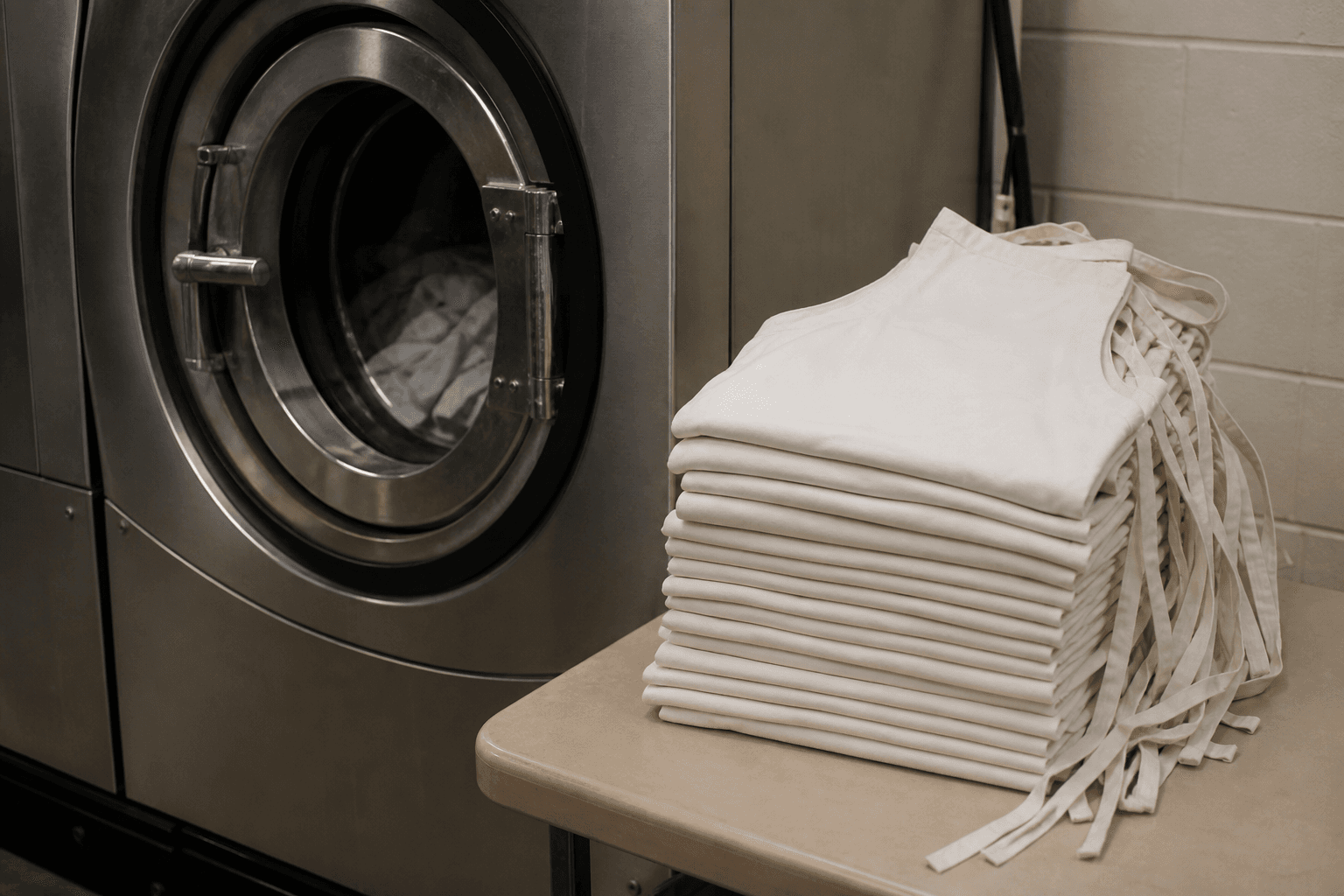
Fabric should be selected by task, not by appearance alone. For cashier-only use, 240-270 GSM poly-cotton twill usually gives the best balance of drape, easy care, drying speed and FOB control. If the same apron is shared with staff who move trolleys, reset plant tables or handle bagged compost, stepping up to 280-320 GSM canvas generally improves service life, but it adds weight and often raises cost by US$0.40-0.90/pc. Pure cotton can feel softer, yet unless pre-shrunk or sanforized, buyers should expect 3-5% wash shrinkage and more wrinkling after repeated laundering.
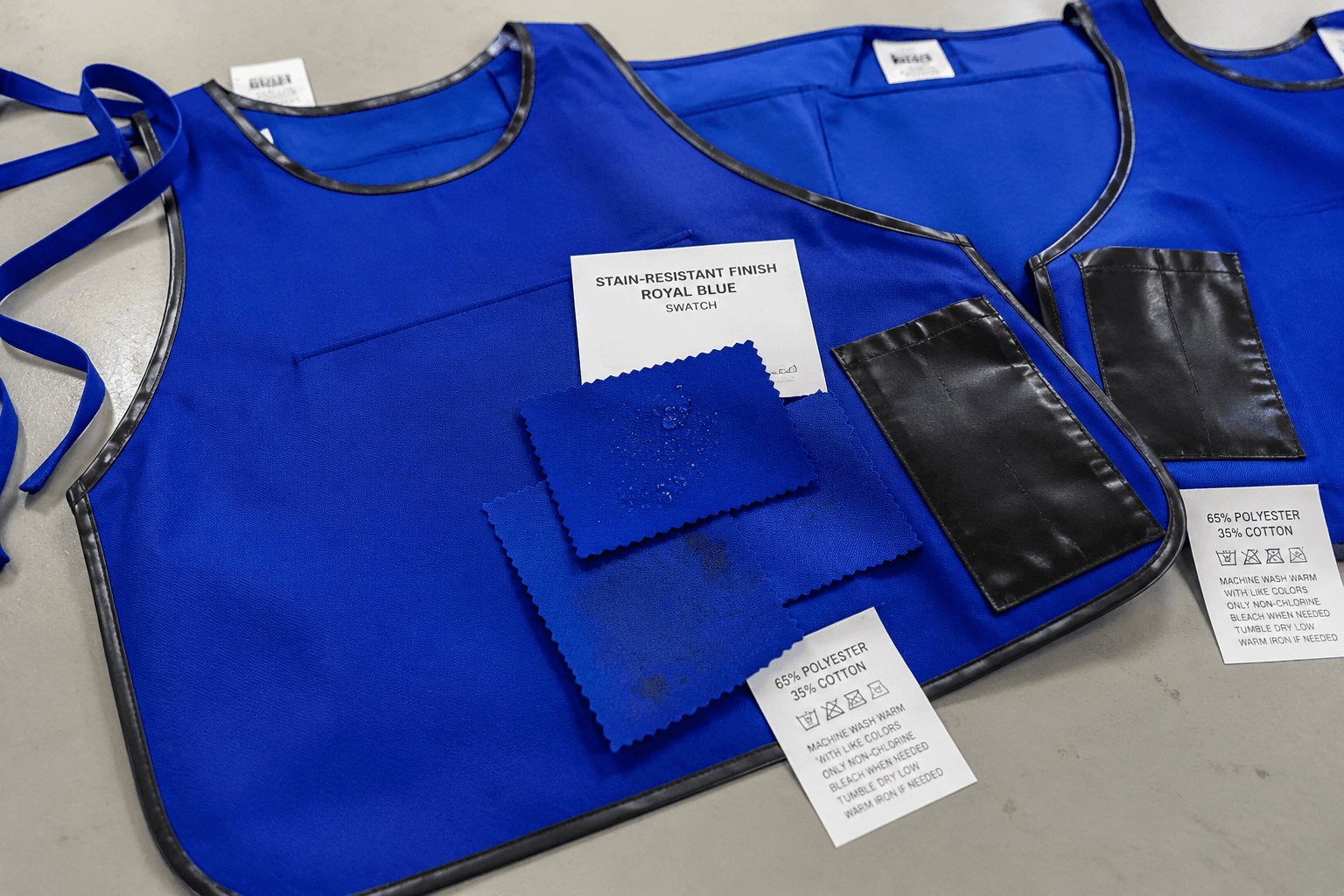
Color control needs formal management because green and brown dye lots can drift visibly between orders. Approve lab dips against a sealed standard, retain a signed swatch and check logo contrast under actual store lighting, not desk daylight only. On textured twill, a pale logo that looks clean on a sample table can lose edge definition at the till. For repeat programs, staying with the same mill and finish is often worth more than saving US$0.08-0.15/pc by switching fabric source.
- Recommended working range is 240-300 GSM for most professional cashier apron programs.
- A common composition is 65/35 poly-cotton; buyers prioritizing faster drying sometimes move to 80/20.
- Useful minimum performance targets are colorfastness grade 3-4 for washing and rubbing, subject to market requirements.
- Yarn-dyed constructions can improve depth and shade consistency but often add US$0.30-0.80/pc and 5-7 days to material preparation.
Scanner-pocket geometry and barcode access that protect checkout speed
Pocket design should begin with device handling, not with front-view symmetry. One of the most common failures in garden center cashier aprons is a pocket layout that looks balanced on a drawing but does not match the scanner body, the cashier's dominant hand or the angle needed to reach across a deep counter. Once the opening is too narrow, too upright or partially blocked by embroidery backing, staff stop holstering the device properly. They carry it by hand or force it into the wrong compartment, which quickly stresses the pocket mouth.
For many compact handheld scanners used in garden retail, a slightly angled side-entry pocket works better than a centered flat patch pocket. A finished opening of 10-12 cm and depth of 16-20 cm suits many common units, while larger mobile POS devices may need a gusseted pocket with up to 4 cm depth. Reinforcing the upper corners with bartacks or equivalent stitching usually adds only US$0.08-0.18/pc, but it prevents one of the highest-frequency field failures.
Placement is as important as size. Garden-center cashiers often lean over wider benches than apparel-store staff and scan bulky pots, trays and bagged goods from awkward angles. A high center pocket can catch the counter edge and interrupt reach. In most cases, the cleanest working layout is an uncluttered upper bib for branding, one lower scanner pocket on the dominant side, one pen slot and one wider pocket for receipts, gloves or loyalty materials.
- Hold scanner-pocket opening tolerance to +/- 0.5 cm across bulk production.
- Use reinforcement whenever the carried device weighs more than about 150-200 g.
- Approve fit with the actual scanner model, not a paper outline only.
- If embroidery sits near the pocket entry, confirm the backing does not reduce usable width.
Bib coverage, fit range and strap construction for mixed indoor-outdoor shifts
A bib apron is usually the right format for this sector because it protects the chest and upper torso from damp tray contact, dusty sleeve transfer and repeated front-body abrasion. The key is to keep that coverage without making movement cumbersome. For most adult unisex programs, a finished body length of 82-88 cm gives a practical balance between protection and mobility. Stores expecting more kneeling, cart handling or walking between checkout and yard areas often shorten the body to 78-82 cm.
Strap design has a direct effect on comfort and failure rate. Self-fabric neck straps are the lowest-cost option and look clean, but on 300 GSM+ canvas they can feel stiff across a full shift. Adjustable hardware usually adds US$0.15-0.35/pc, depending on buckle type and finish, yet it improves fit across mixed-height teams and layered outerwear. Waist ties should normally run 75-90 cm per side so staff can tie in front or back without pulling the body panel off-center.
Buyers should also resist feature creep. D-rings, towel loops, snaps and decorative rivets all add sewing minutes, wash risk and extra QC points. For cashier use, the highest-value improvements are simpler: stable strap joins, balanced body width, correct pocket depth and a fabric weight that employees will actually keep wearing through peak season.
- Use box-X stitching or equivalent reinforcement at strap attachment points.
- A body width of about 68-72 cm usually balances coverage and reach for cashier roles.
- An upper bib lining is rarely needed unless the shell is below 220 GSM or a stiffer premium look is required.
- Extra hardware can increase sewing time by roughly 5-12%, depending on the attachment method.
MOQ, FOB pricing and sample control for repeat apron programs
Costing only becomes comparable when the specification is disciplined. For this product, the main price drivers are fabric weight, blend, dye route, branding method, pocket complexity and hardware. As a realistic benchmark, a simple bib apron in 240 GSM poly-cotton twill with one standard pocket and a one-color print often lands around US$3.20-4.20/pc FOB China at 1,000 pcs. A more engineered style in 300 GSM canvas with custom dyeing, embroidery, adjustable neck hardware and reinforced scanner pockets usually falls around US$5.20-6.80/pc FOB China. Retail-ready packaging, metal trims and split low-volume color runs can push the price higher.
MOQ should match the rollout plan. For a pilot covering 20-50 stores, 300-500 pcs per color can work if stock fabric is acceptable. For regional or chain-wide programs where color continuity matters more than entry volume, buyers usually get better repeat stability at 1,000-3,000 pcs per color. That volume also makes it easier to negotiate woven labels, barcode stickers, mixed carton ratios and sample-charge offsets.
Sampling should be staged rather than compressed. A digital mockup can confirm logo placement, but the real failures in this category appear on physical testing: scanner entry too tight, straps too short over jackets, or the pocket sitting too high against the counter edge. A disciplined flow is one proto sample, one revised fit sample if utility placement changes, and one PP sample in final fabric, color and branding. Typical timing is 5-10 days for a proto and 7-12 days for a PP sample once fabric is ready.
- Custom Pantone dyeing often adds 7-12 days compared with stock-color material.
- Embroidery usually outperforms print on textured canvas but often adds US$0.25-0.90/pc, depending on stitch count.
- Quantity tolerance is commonly +/- 5%, subject to contract terms.
- Freeze polybag labels, carton marks and store assortments before PP approval to avoid packing delays.
Seasonal reorder planning, AQL checkpoints and spring-capacity protection
The most expensive sourcing mistake in this category is usually timing, not unit price. Garden retail demand compresses before spring, and once buyers place meaningful orders in late Q1, fabric mills, trim suppliers and sewing lines are already under pressure. Lead times lengthen, shade flexibility narrows and expedite costs rise. A stronger model is to place the main order in November-January, then protect reorder capacity by retaining approved trims, reserving greige fabric or pre-booking line space for repeat runs.
For stable programs, a practical split is 60-70% preseason production, 20-30% planned reorder volume and 5-10% contingency. If body pattern, fabric, color, logo file and packaging all stay unchanged, repeat orders can often ship in 20-30 days. If the buyer changes the pocket shape, logo size, label pack or carton assortment, the timeline usually returns to 30-45 days because approvals restart.
QC should focus on the defects that drive replacement cost fastest. In-line inspection during cutting, pocket setting and strap sewing usually prevents more claims than relying on final random inspection alone. For professional buyers, AQL 2.5 major / 4.0 minor is a practical minimum, with special attention to scanner-pocket opening, bartack location, strap attachment, overall measurement tolerance, logo placement and shade continuity versus the sealed standard. Keeping one approved production sample from each PO also shortens future repeat-order approval.
- Release the main spring PO by January if ocean transit and DC intake are part of the calendar.
- Use the 20-30 day repeat-order lead time only when materials and specifications are unchanged.
- Check shrinkage, seam stability and color shift before bulk cutting, especially on cotton-rich fabrics.
- Retain approved swatches, strike-offs, embroidery panels and one sealed bulk sample from every order.