For buyers sourcing a food truck apron from China, the main mistake is treating it like a generic cafe accessory. A street operation needs a compact work apron that is easy to put on between orders, does not snag in a tight service window, and still looks consistent after repeated laundering. The cut, pocket layout, strap system, and print method all affect whether the apron works in real service or just looks good in a photo sample.
From a factory point of view, the best programs are the ones where the buyer defines the use case clearly: front-of-house vending, grill support, beverage prep, or mobile market selling. Each one changes the weight target, pocket count, and branding method. A food truck apron for a burger truck in summer is not the same as a market stall apron for a cold-weather coffee seller. If the spec is too broad, the factory will default to an average apron that is neither compact nor durable enough.
Bulk buyers also need to think in production terms, not only design terms. A branded vendor apron with screen print on cotton twill can be very efficient at 1,000 pieces, but the same order may be less suitable for multi-color logos, short lead times, or customers who wash daily. The right answer is usually a controlled fabric choice, a simple pattern, and branding that fits the order size and service environment.
- A food truck apron should be compact enough for movement in a small service area, but still long enough to protect the front body from spills and heat.
- For most street vendor apron programs, 220-260 gsm cotton twill or 240-280 gsm canvas gives a better durability-to-weight balance than very heavy fabric.
- Branding is usually fastest and cheapest with one-color screen print, while woven labels and embroidery are better when the logo has to survive repeated wash cycles.
- Pocket count should be limited to what the user actually carries, because too many compartments add sewing time, cost, and failure points.
- Apron strap design matters as much as fabric; cross-back straps reduce neck load and improve comfort during 8-12 hour shifts.
- For bulk sourcing, a realistic MOQ for custom aprons from China is often 300-500 pieces per color, with 25-35 days for production after sample approval.
What a food truck apron must do in real service
A food truck apron has a different job from a restaurant bib apron. The wearer is often bending into a service window, turning sideways to hand over orders, reaching under counters, and moving between hot equipment and cash handling. The garment must protect the torso without adding bulk at the waist or creating loose ends that can catch on carts, doors, or machine handles. In practice, buyers should ask for compact coverage, not maximum coverage.
The best working length for many street vendor apron programs is 68-80 cm from top edge to hem for waist aprons, or 85-95 cm for shorter bib styles. Longer aprons look more premium, but in a confined truck they can interfere with movement and collect splash at the lower edge. If the team is serving over a counter or working near fryers, a mid-length profile often outperforms a full-length bib in comfort and cleanliness.
Fabric weight is another practical decision. A 220 gsm cotton twill feels light enough for long service, but still has enough body to hold a logo and keep its shape after washing. At 280 gsm, the apron feels more substantial and can support embroidered branding better, but the added weight becomes noticeable in warm weather. For most food truck apron orders, the sweet spot is between 240 and 260 gsm if the apron must serve both summer and shoulder-season use.
- Choose a length that suits the service window and task area, not the longest size your pattern can support.
- Use fabric weight to balance comfort and structure, rather than assuming heavier always means better.
- Keep the silhouette tight and controlled so the apron stays out of the way during fast movement.
- Specify colorfast finishing if the team will wash the apron frequently, especially in dark shades.
Pattern choices for a compact work apron
The phrase compact work apron is not just a style description; it is a production requirement. The pattern should be efficient to cut, simple to sew, and easy for staff to wear quickly. In food truck environments, time matters. A waist tie that is too long, a bib that is too wide, or a strap system that needs adjustment every time will slow the team down during peak service.
For most buyers, there are three useful pattern families. First is the classic waist apron with a split or single pocket set, which works well for order pads, pens, and small tools. Second is the short bib apron, which provides more chest protection and a better logo field. Third is the cross-back service apron, which avoids neck strain and is better for all-day use. The decision should be based on the job function, not on what is most common in catalog photos.
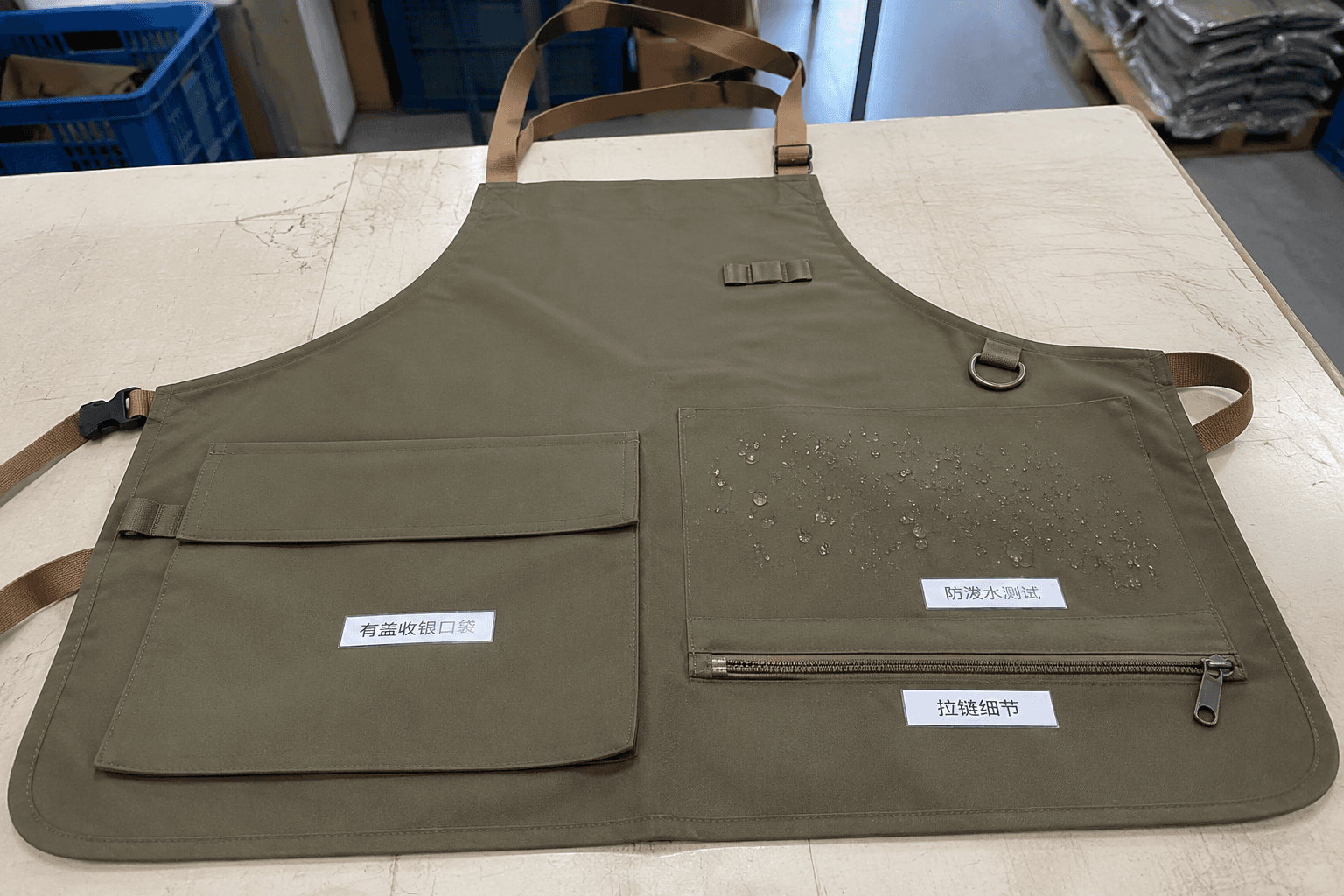
A market stall apron may benefit from slightly more pocket depth because vendors carry cash, barcode scanners, and small packaging tools. A food truck apron used by grill staff, however, should keep pockets shallow and positioned away from heat exposure. When the apron is being used around oil, steam, or sharp equipment, fewer pockets are often safer than more pockets. The buyer should define pocket use cases before approving the sample.
- Waist aprons are best when speed and freedom of movement matter more than chest coverage.
- Short bib aprons work when the brand wants a larger logo area and more front protection.
- Cross-back styles reduce neck stress and are better for longer shifts or heavier fabrics.
- Pocket depth should match the actual tools used by the team, not a generic retail layout.
Fabric and stitch specs that hold up to daily washing
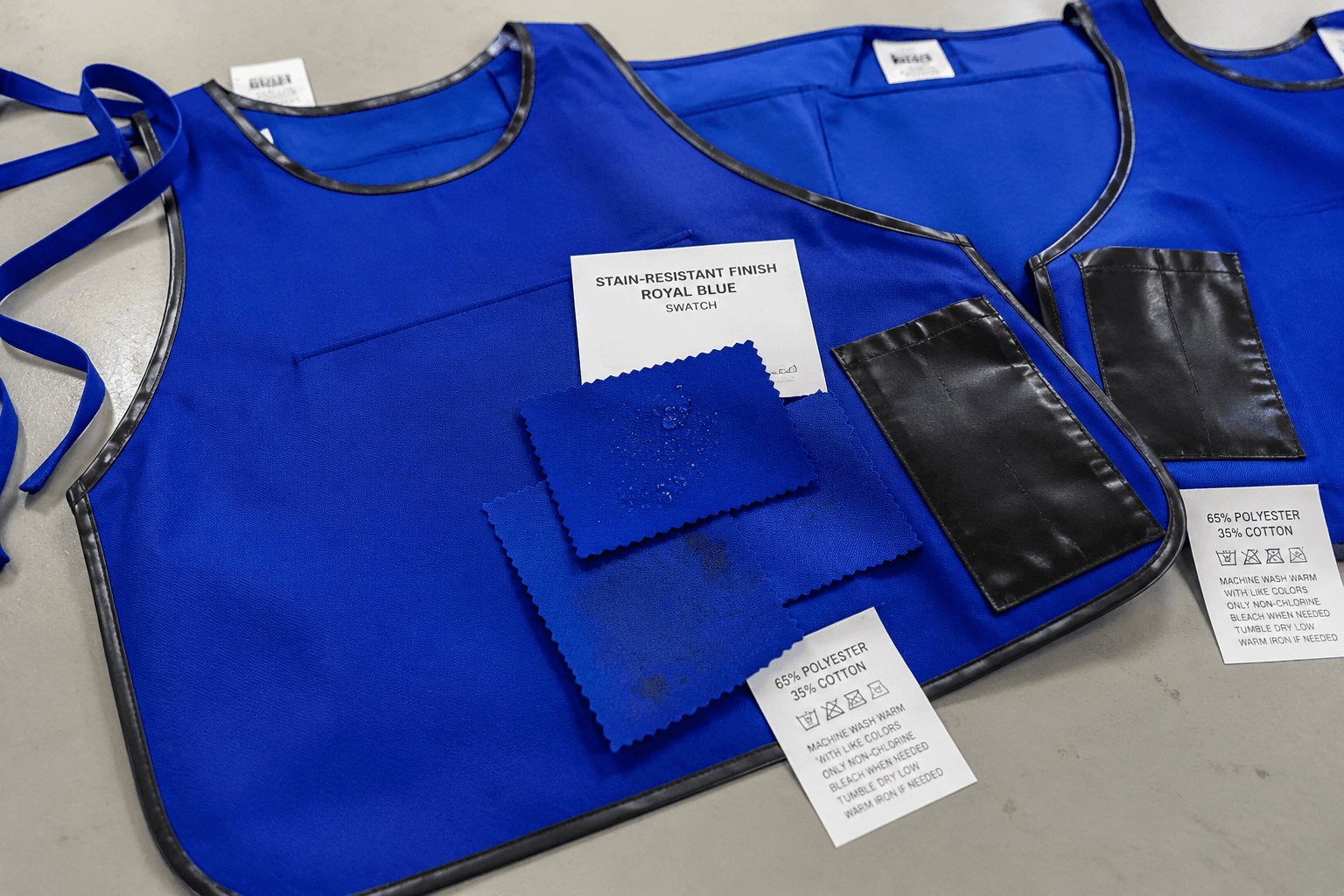
In apron sourcing, the fabric spec should be written in terms that the factory can actually control. Cotton twill at 240 gsm, poly-cotton at 65/35 around 230-250 gsm, and canvas around 280 gsm are all common options for branded vendor apron programs. The right answer depends on the wash cycle, print method, and the climate in which the apron will be used. Cotton gives a better natural hand feel and usually takes screen print well, while poly-cotton can dry faster and hold shape more consistently after laundering.
For daily wash programs, seam construction is often more important than fabric marketing language. A good apron needs bar-tacks at pocket corners, reinforced stress points at strap joins, and a stable top edge that does not curl after washing. If the apron is intended for a food truck or street stall where grease and sauces are common, use thread and stitching that tolerate heat and detergent without loosening. In many factory specs, a 3-thread overlock plus topstitch at exposed edges is sufficient, but the exact construction should match the budget.
Color choice also affects lifespan. Black, navy, charcoal, and deep olive are standard because they hide minor stains better than light shades. However, a dark apron can show lint and fading if the dye quality is weak. If the buyer wants a premium look with lower visual wear, a mid-tone color with controlled contrast stitching can be more forgiving than pure black. For a market stall apron used outdoors, colorfastness and UV resistance matter more than an elevated fashion look.
- Cotton twill around 240-260 gsm is a practical default for many food truck apron programs.
- Poly-cotton can improve dry time and crease recovery when the apron is washed daily.
- Reinforce pocket corners and strap joins with bar-tacks or extra topstitching.
- Use dye and finishing standards that match the expected wash frequency and exposure to grease.
Branding a street vendor apron without slowing production
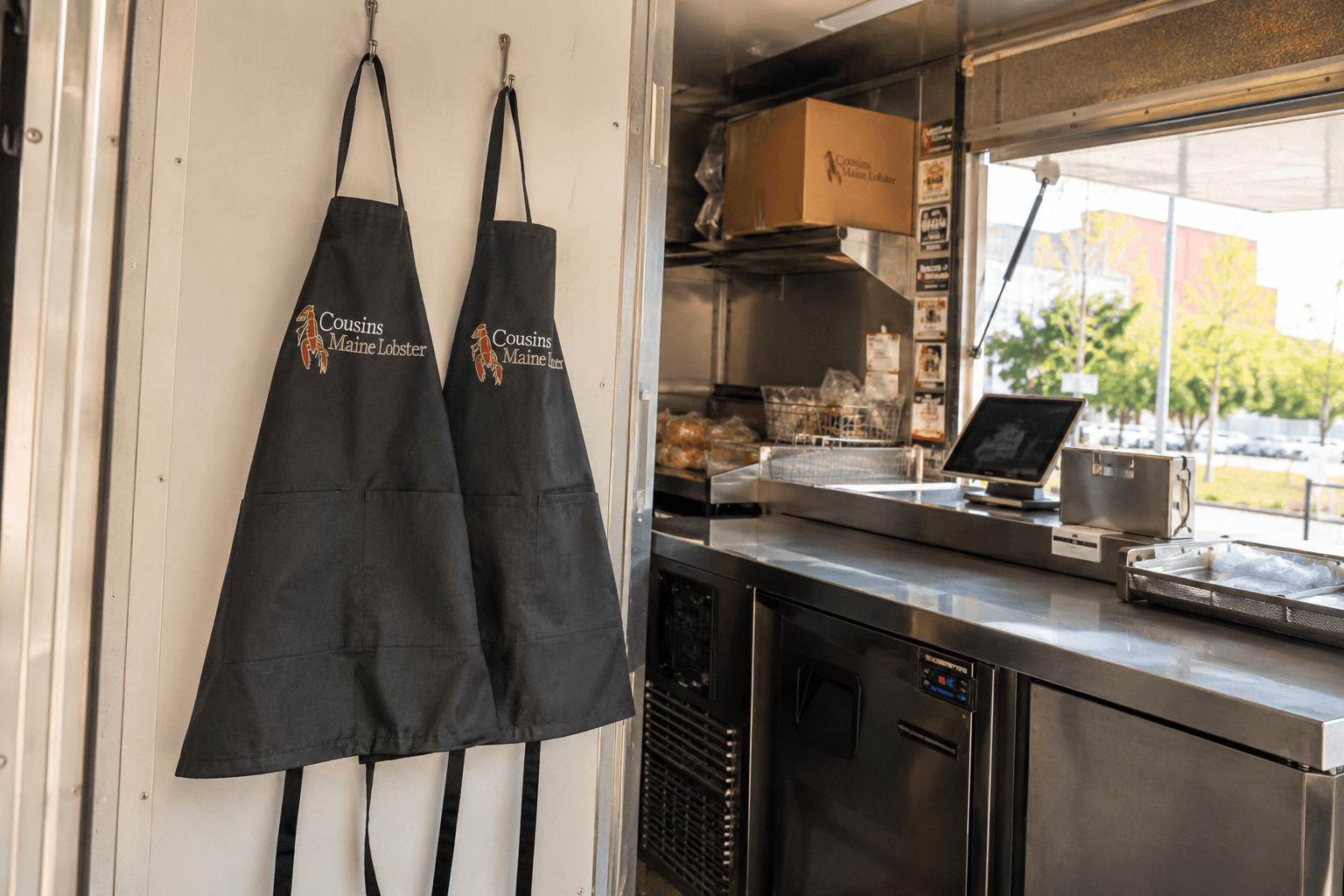
Branding is usually the main reason a buyer commissions a custom apron, but it should not overcomplicate the line. A branded vendor apron must be readable at a distance, survive washing, and fit the budget of a bulk order. For standard production, the fastest method is often one-color screen print on the chest, pocket, or lower front panel. If the logo is simple and the order is large, this keeps unit cost low and speeds approval.
Embroidery looks more durable and is often preferred for a premium food truck apron, but it adds cost, increases setup time, and can feel stiff on lighter fabric. In many cases, embroidery is best for small chest logos or name marks, while larger graphics are better handled with screen print or heat transfer, depending on the artwork. A very detailed logo with gradients or thin lines can become expensive quickly if converted to embroidery. Buyers should request artwork simplification early, before sampling.
The location of the branding is just as important as the method. On a compact work apron, a chest logo is easy to see when the wearer is facing customers, while a pocket print can be blocked by hands and tools. For a street vendor apron, a center-front logo can be effective if the apron length is short enough not to distort the design when the wearer bends. The best result is usually one primary mark and, if needed, one small secondary label, not three or four competing placements.
- Use one-color screen print when speed, cost, and order volume are the main priorities.
- Use embroidery when the brand wants a more permanent, tactile finish and can accept higher unit cost.
- Keep logo placement visible during real service, not only in standing pose photos.
- Simplify complex artwork before sample production to avoid delay and unexpected setup charges.
MOQ, pricing, and lead time for bulk apron orders
For sourcing managers, the commercial structure matters as much as the product spec. A typical custom apron MOQ from a Zhejiang factory is 300-500 pieces per color or per design, though some lines can accept 200 pieces if the fabric and trim are standard stock. Once a buyer asks for multiple colors, mixed sizes, custom woven labels, and special packaging, the practical MOQ rises fast. That is normal and should be expected in factory planning.
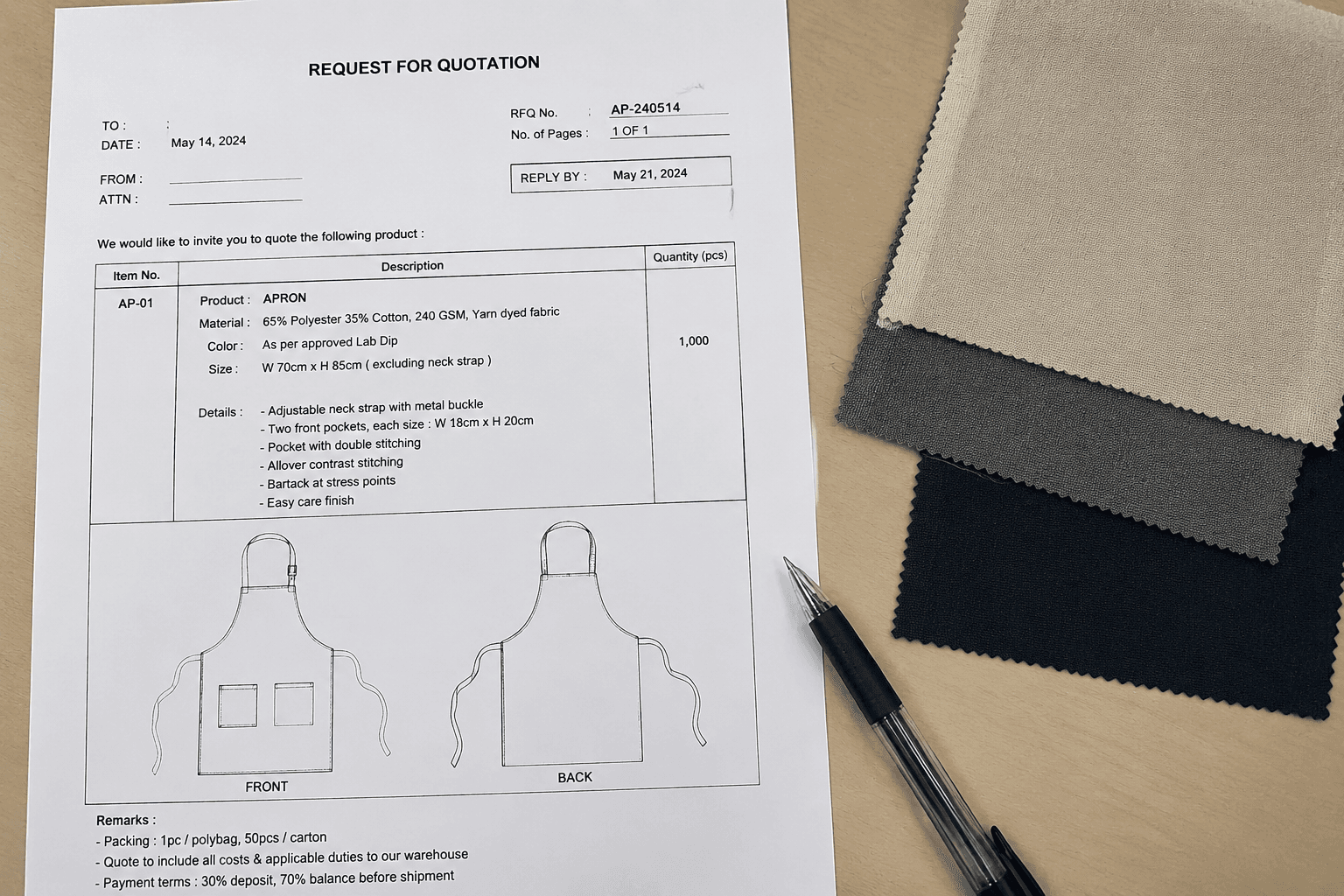
For a basic food truck apron in cotton twill with one-color screen print, bulk pricing often falls into a workable range depending on size, fabric weight, and order quantity. At 500 pieces, a simple build may land around $2.80-$4.20 per piece ex-factory. Add embroidery, custom hardware, or heavier canvas, and the price can move to $4.50-$7.50 per piece or more. Buyers should compare quotes on the same basis: fabric weight, stitch count, branding method, and packing standard. Without that, price comparisons are not meaningful.
Lead time is usually 25-35 days after sample approval for standard custom production, plus 5-10 days if the buyer needs special fabric sourcing or a complicated branding process. Shipping time is separate. If the order is time-sensitive for a store opening, the buyer should leave room for strike-off approval, pre-production sample confirmation, and carton packaging review. The fastest way to lose time is to change the logo or fabric after the sample has already been approved.
A well-run order will usually proceed in this sequence: confirm fabric and color, approve the sample, lock artwork, place the bulk order, inspect first production output, then pack and ship. If the buyer has a launch date, the factory should know the hard deadline at the quotation stage. That allows realistic planning on dyeing, cutting, sewing, and finishing slots.
- Plan on 300-500 pieces MOQ per design for standard custom apron production.
- Expect roughly $2.80-$4.20 per piece for simple printed cotton styles at mid-volume, with higher pricing for embroidery or heavier fabric.
- Allow 25-35 days after sample approval for standard production, longer if sourcing special materials.
- Treat shipping, inspection, and artwork revisions as separate time items, not part of sewing lead time.
Quality control points for a branded vendor apron
A bulk apron order should be checked for consistency, not only appearance. The first point is size tolerance. If the aprons vary too much in strap length or body width, the team will notice immediately in wear. The second point is print registration or embroidery placement. If the logo shifts from piece to piece, the uniform effect is lost and the product looks cheaper than it is. The third point is wash behavior. A sample may look correct when new, but the real test is whether the seams stay flat and the print stays legible after multiple wash cycles.
Factories should verify needle performance, seam strength, and thread color match during in-line QC. For aprons used in food service, edges should be checked for loose threads and rough hand feel, because staff will be wearing them for long periods. If the program includes metal grommets, rivets, or adjustable hardware, the buyer should ask for rust-resistant finishes, especially for outdoor market use. A street vendor apron often sees humidity, grease, and frequent wiping, so hardware failure becomes visible quickly.
The buyer should also define accept/reject standards before production starts. A simple tolerance note on logo position, pocket alignment, and stitch defects is enough for most orders. If the order is high visibility or tied to a brand launch, request a pre-shipment inspection against the sealed sample. That is cheaper than dealing with inconsistent units after delivery.
- Set tolerance limits for size, logo placement, and pocket alignment before bulk production.
- Inspect seam finish, loose threads, and hardware quality, not just the front appearance.
- Use wash-tested samples when the apron will be laundered daily or exposed to grease.
- Define reject criteria early so the factory can control quality to the same standard across the run.
How buyers should spec a food truck apron program
The most reliable way to source a food truck apron is to write the spec around use, not around a generic product category. State who will wear it, what they carry, how often it will be washed, and whether the brand priority is visibility or durability. A well-written spec usually reduces revision cycles and improves the first sample. In practical terms, that means naming the fabric weight, apron type, pocket count, strap style, logo method, and target delivery date before quoting starts.
For teams that need both fast branding and functional wear, the safest option is often a mid-weight cotton twill apron with one-color print, a short bib or waist pattern, reinforced stress points, and a limited pocket layout. If the brand wants a more elevated look, move to cross-back construction or embroidery, but accept the higher cost and longer lead time. If the apron must be used outdoors in a market stall, prioritize stain control, color stability, and drying speed over decorative detail. These trade-offs are straightforward once the buyer frames the use case clearly.
The real sourcing advantage comes from matching the apron to the operation. A branded vendor apron should support work, not interfere with it. When the pattern, fabric, and branding method align with the service environment, the order is easier to produce, easier to inspect, and more likely to be reordered without revision. That is the standard that matters in bulk OEM sourcing.
- Define user role, wash frequency, and service environment before requesting a quote.
- Choose one primary objective for the program: speed, durability, or premium branding.
- Keep the construction simple enough for stable mass production and repeat orders.
- Treat the apron as a working tool first and a branding surface second.