For hospitality, catering, welding support, foundry handling, and maintenance uniforms, the apron is often the first layer exposed to sparks, radiant heat, hot oil, steam, or brief flame contact. Buyers ask for a fire safety apron because the risk is visible, but the correct specification depends on the end use: a chef near open gas flame does not need the same construction as a metalworking operator near molten splash.
From the factory side, the most common sourcing problem is not fabric availability. It is an unclear performance target. One buyer may request “FR cotton apron, 280 GSM, black,” while another asks for an “NFPA apron” without defining whether the garment must be certified as PPE or simply made from flame-resistant fabric. These two projects have different test costs, lead times, labeling rules, and liability exposure.
This article explains how apron buyers can define flame retardant standard requirements, choose fabric and trims, control fr apron compliance documentation, and avoid over-specifying products that become too expensive or too stiff for daily use.
- A fire safety apron should be specified by hazard type, such as heat, flame, sparks, hot oil, or molten metal splash.
- NFPA and EN 11612 are not interchangeable; they use different test methods, classifications, and documentation expectations.
- Fabric certification alone is not the same as garment compliance, especially when pockets, straps, trims, and labels are added.
- Permanent FR fibers and treated cotton behave differently after 25 to 50 industrial wash cycles.
- Small design details affect compliance, including thread, eyelets, waist ties, neck straps, reinforcement patches, and pocket placement.
- Testing and sampling should be planned early because lab reports can add 10 to 25 days before bulk approval.
What a fire safety apron needs to protect against
Aprons are partial-body garments, so their role is different from a full jacket, coverall, or welding suit. A fire safety apron normally protects the front torso and upper legs from short-duration exposure. It is not designed to replace full PPE where the worker faces continuous flame, electrical arc, or heavy molten metal. This distinction matters when a buyer prepares the product brief and when the factory selects material thickness, pattern coverage, and reinforcement zones.
For hospitality aprons, the main hazards are open flame near gas cooking lines, hot pans, oil splash, and high-temperature washing. Many restaurants want a cotton-rich apron with better ignition resistance, but they still require comfort during 8 to 12 hour shifts. A 240 to 320 GSM FR-treated cotton or cotton-poly blend may be acceptable for this use, provided the buyer understands the laundering limits and avoids synthetic trims that can melt.
For industrial aprons, the hazards are usually more severe and more specific. Welding support, maintenance, metal grinding, glass handling, and foundry work may require protection from sparks, radiant heat, contact heat, or molten iron/aluminum splash. In these cases, the apron may need heavier fabric, often 330 to 520 GSM, with FR sewing thread and metal or FR-rated fastening components. The product brief should describe the actual work process, not only the desired standard name.
- Gas kitchen and barbecue use usually needs ignition resistance, heat tolerance, and washable color stability.
- Welding-adjacent use usually needs spark resistance, limited flame spread performance, and stronger front coverage.
- Foundry or molten splash use requires a much stricter review and may need EN ISO 11612 classification by exposure type.
- Laboratory and maintenance use may require chemical resistance in addition to flame resistance, which changes the fabric choice.
- Retail promotional aprons with FR wording should be avoided unless performance claims are supported by actual test reports.
How flame retardant standard choices affect apron sourcing
A flame retardant standard is not a decoration on the care label. It defines test methods, pass/fail criteria, sample conditioning, and in many cases the way a garment claim can be made. For apron sourcing, the buyer should first decide whether the order requires fabric-level testing, garment-level testing, or formal certification for a regulated PPE market.
The two standard families most often discussed in apron projects are NFPA-related requirements for North American buyers and EN ISO 11612 for European or international industrial buyers. In daily sourcing language, buyers may say “nfpa apron” or “en 11612 apron,” but the factory must clarify which exact clause, hazard level, and certification route is expected. A simple fabric report from a mill may not satisfy a distributor, end user, or customs documentation request.
Testing also affects cost and timing. A fabric test for limited flame spread may cost approximately USD 180 to 450 per fabric/color/finish depending on the lab and test package. A more complete garment evaluation can cost USD 800 to 2,500 or more. Lead time for lab testing is commonly 7 to 15 working days for fabric tests and 15 to 30 working days for broader certification packages, not including failed retesting.
- Fabric-level claim: the fabric has passed a stated test, but the finished apron may not be certified as PPE.
- Garment-level claim: the finished apron construction is tested, including seams, trims, and design features.
- Certification claim: a notified body or recognized certification route confirms conformity for a defined market.
- Marketing claim: phrases such as “heat resistant” or “flame retardant” should be checked carefully because they may be too vague for regulated sales.
NFPA apron requirements versus EN 11612 apron requirements
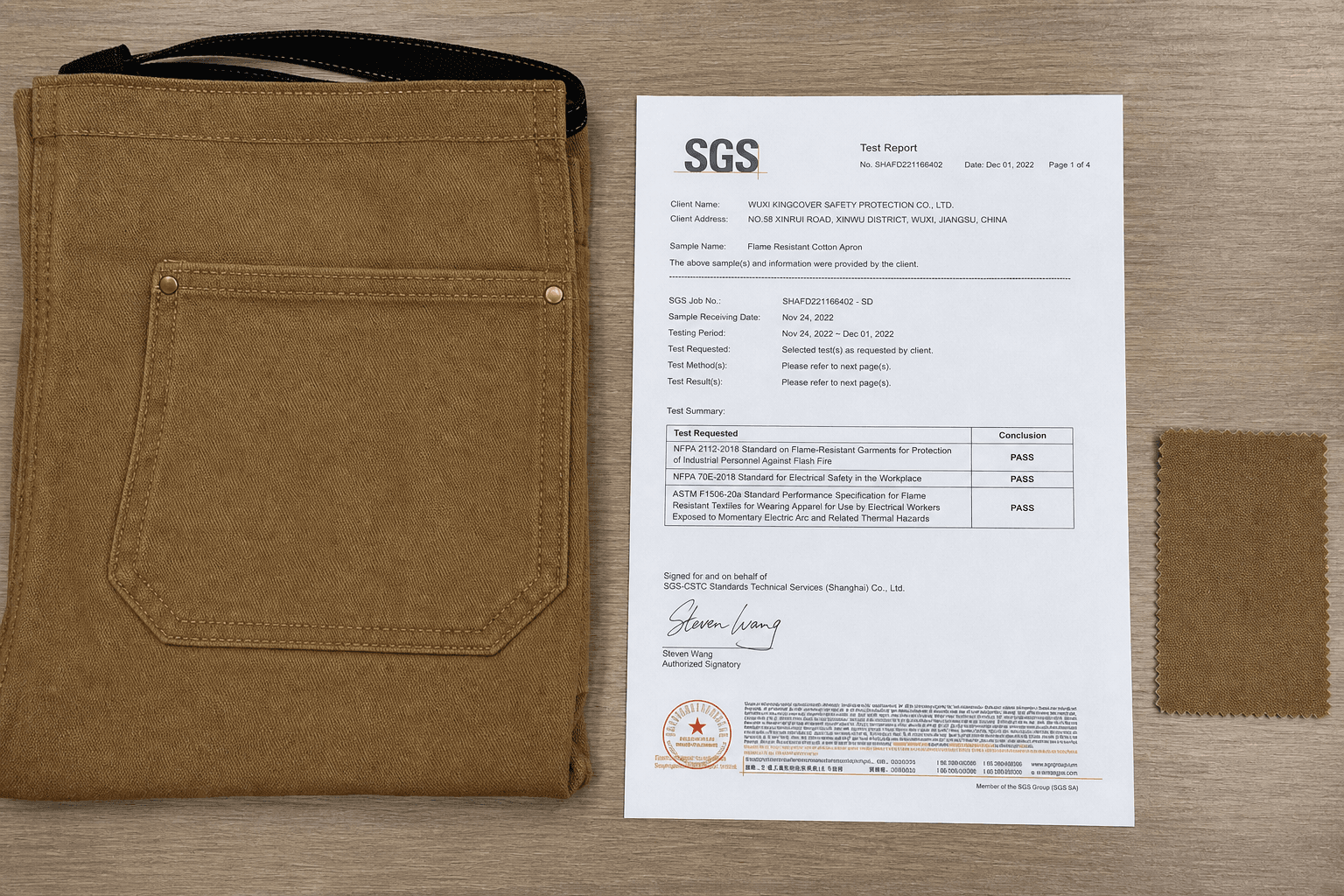
For North American buyers, NFPA standards are often referenced in fire service, industrial safety, and workplace PPE procurement. However, there is no single universal “NFPA apron” category that automatically applies to all apron designs. Buyers sometimes mention NFPA 2112 for industrial flash fire protection, NFPA 70E for electrical arc-related workwear, or other NFPA standards depending on the workplace. Each has a different scope, and many apron products do not fit neatly unless the end use is defined.
EN ISO 11612 is commonly used for protective clothing against heat and flame. For an en 11612 apron, the buyer must pay attention to code letters and performance levels, such as limited flame spread, convective heat, radiant heat, molten aluminum splash, molten iron splash, and contact heat. Aprons for front-body protection may be evaluated differently from full garments, and the technical file should confirm whether partial-body protection is acceptable for the buyer’s market.
The practical difference in sourcing is that EN 11612 projects usually require a clear classification target before sampling. For example, a buyer asking for A1 and A2 limited flame spread performance plus B1 convective heat is different from a buyer asking for E2 molten iron splash resistance. Fabric weight, fiber, coating, and apron length may change substantially. NFPA-related projects often require closer discussion with the buyer’s safety manager or distributor because the correct standard may be tied to a workplace risk assessment.
- Use NFPA wording only after confirming the exact NFPA standard, edition, and required certification route.
- Use EN ISO 11612 wording only with the required code letters and performance levels, not only the standard number.
- Ask whether the apron is sold as PPE, part of a uniform kit, or a non-certified protective accessory.
- Confirm the target market because EU, UK, US, Canada, and Australia may require different documentation and labeling.
- Do not assume a fabric report can be transferred to a different apron design, color, coating, or washing process.
Fabric choices for a practical fire safety apron
The fabric decision controls most of the apron’s cost, comfort, durability, and compliance risk. FR-treated cotton is common for hospitality and light industrial use because it has a natural hand feel and can be produced in familiar colors. Typical weights are 240, 280, 320, and 350 GSM. The cost can range from about USD 2.20 to 4.80 per meter for basic treated cotton, depending on yarn count, dyeing, finish, and order volume. The buyer must confirm whether the treatment is durable to home wash, industrial wash, dry cleaning, or a specified number of cycles.
Inherent FR fabrics, such as aramid blends, modacrylic blends, FR viscose blends, and specialty technical fabrics, usually cost more but maintain flame resistance through the fiber structure rather than only a post-treatment. These materials are used where repeated washing and higher risk exposure make treated cotton less suitable. Typical fabric costs may range from USD 6.50 to 18.00 per meter or higher, and MOQ may start from 500 to 1,000 meters per color for stocked items but 2,000 to 5,000 meters for custom dyeing.
Coated fabrics and leather combinations are also used in welding and heavy-duty aprons. Split leather, aluminized fabric, silicone-coated glass fiber, and FR canvas each solve different problems. Leather can handle sparks well but is heavy and has limited washability. Aluminized fabrics can reflect radiant heat but are not comfortable for kitchen service and may crack under repeated folding. A good sourcing decision balances hazard level, wearing time, laundering, and acceptable unit price.
- 240-280 GSM FR cotton: suitable for lighter hospitality aprons where comfort and drape are important.
- 300-360 GSM FR cotton or FR canvas: better for grill stations, barbecue, maintenance, and workshop use.
- 380-520 GSM FR canvas or specialty fabric: more suitable for spark exposure, but comfort and flexibility decrease.
- Aramid or modacrylic blends: higher cost, stronger long-term FR performance, and better choice for repeat industrial washing.
- Leather or leather reinforcement: useful for welding sparks, but bulk packing weight and care instructions must be considered.
Construction details that decide fr apron compliance
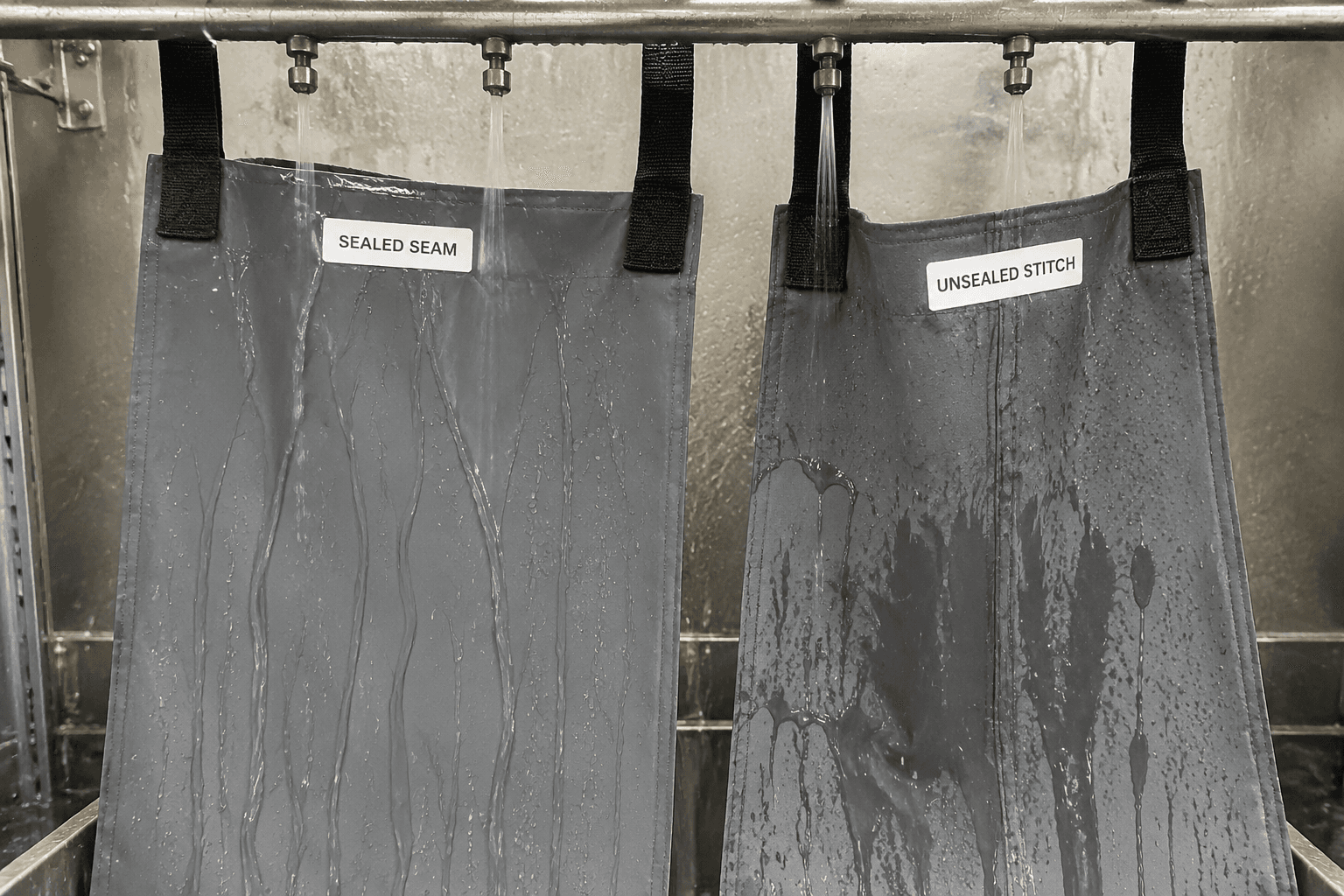
Many failed apron projects fail in the details, not in the main fabric. A buyer may approve a certified FR fabric but then request polyester webbing straps, plastic buckles, decorative synthetic labels, or non-FR thread. Under flame or heat exposure, these components can melt, ignite, drip, shrink, or break. If the finished product is claimed as a fire safety apron, all exposed components should be reviewed against the same hazard logic as the shell fabric.
Thread is a frequent weak point. Regular polyester thread is cheap and strong, but it is not appropriate for serious FR claims. Aramid thread or FR-treated cotton thread is normally used for higher compliance targets. Aramid thread may add USD 0.03 to 0.12 per apron depending on seam length and thread size, which is small compared with the risk of seam failure. For industrial aprons, bar-tacking at stress points should also use compatible FR thread.
Pattern design affects protection. A long bib apron with 86 to 100 cm body length covers more of the torso and thighs than a short waist apron, but it may interfere with walking, climbing, or seated work. Pocket placement is another issue. Large front pockets can catch sparks or hot particles if the top opening is exposed. For welding-adjacent aprons, pockets may need flaps, angled openings, or removal from the high-risk zone.
- Specify FR thread type, such as aramid 40/3 or equivalent, for seams and bar-tacks.
- Avoid ordinary plastic buckles unless they are positioned away from heat exposure and no FR garment claim is made.
- Use metal eyelets carefully because they can transfer heat and may corrode after industrial washing.
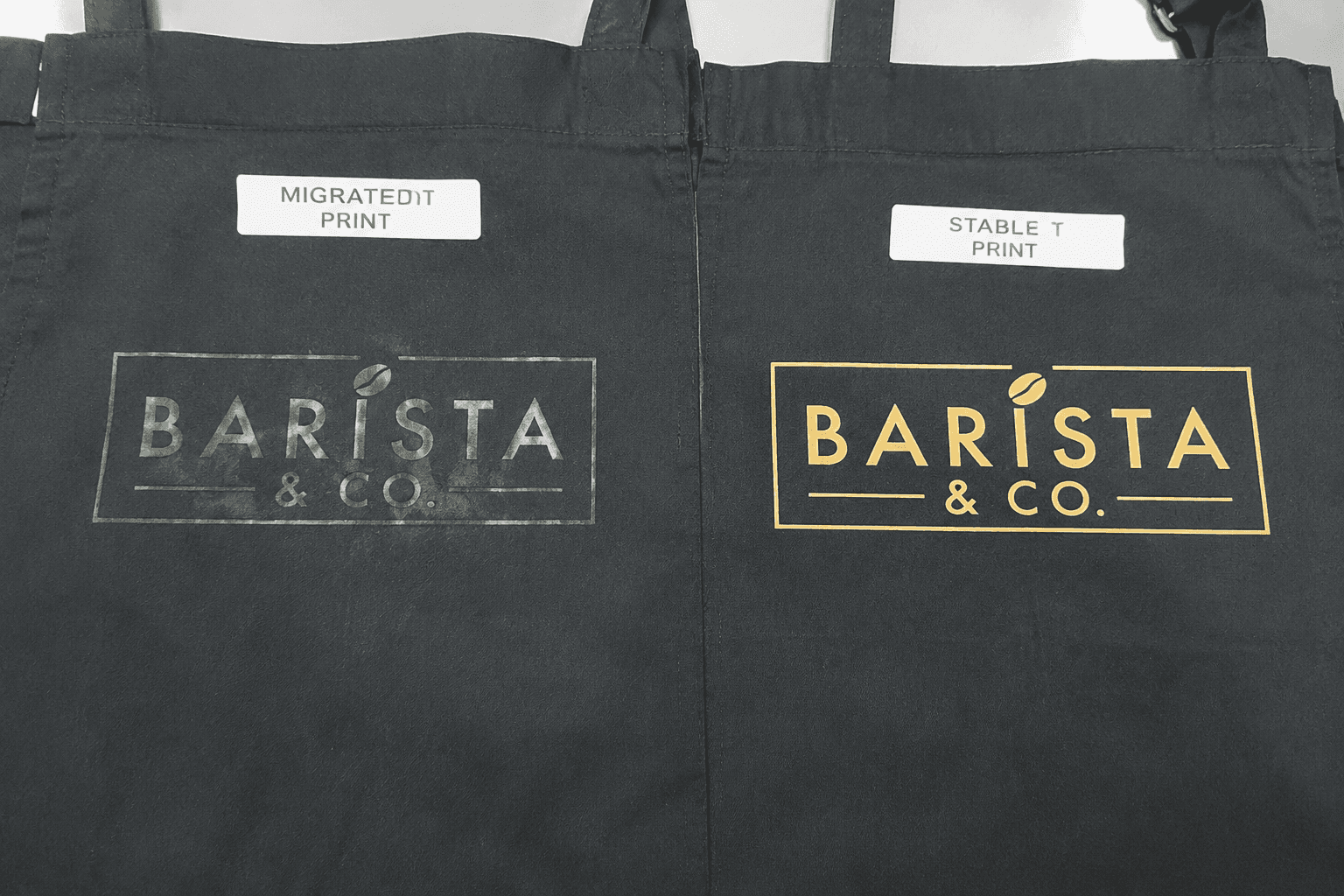
- Check printed logos because some inks can affect flame spread or crack after heat exposure.
- Review pockets, pen slots, towel loops, and tool loops as part of the compliance design, not decoration.
Testing, documentation, and factory control before bulk order
For bulk apron orders, testing should be built into the development calendar. A normal sourcing path is 3 to 7 days for fabric sourcing, 5 to 10 days for first sample making, 7 to 20 working days for lab testing, and 20 to 45 days for bulk production after approval. If the buyer requires custom dyeing, custom FR finishing, or third-party garment certification, the schedule can easily extend by another 15 to 35 days.
The factory should provide a clear document package before the purchase order is locked. At minimum, this includes fabric composition, GSM, width, color standard, FR finish description, washing limitations, available test reports, and confirmation of trim materials. For stricter fr apron compliance, the buyer should also request the report holder name, report date, tested standard, tested color, test sample description, and whether the report covers fabric only or finished garment.
Quality control must include more than visual inspection. Incoming fabric GSM should be checked with a cutter and scale, shrinkage should be tested before cutting, and shade lots should be controlled because FR-treated fabric can show batch variation. For an apron order of 3,000 pieces, a reasonable production plan may include 100% fabric roll inspection, pre-production sample approval, inline inspection at 20% to 30% completion, and final AQL inspection before shipment.
- Request test reports before sales samples are used for customer presentation.
- Keep one sealed approved sample at the factory and one with the buyer for production comparison.
- Confirm whether testing is needed for every color because FR performance can vary after dyeing and finishing.
- Include wash method and maximum wash temperature in the specification, such as 60 C industrial wash or 40 C domestic wash.
- Check that hangtags, care labels, and product descriptions use the same compliance wording as the test documents.
Cost, MOQ, and lead-time planning for custom FR aprons
A custom FR apron is usually not priced like a standard promotional apron. Fabric MOQ, lab testing, special thread, slower sewing, and documentation control all add cost. For a basic 280 GSM FR-treated cotton bib apron with simple waist ties, a factory FOB price may fall around USD 3.20 to 5.80 per piece at 1,000 to 3,000 pieces, depending on fabric source and logo method. A heavier 360 GSM FR canvas apron with FR thread, reinforced stress points, and metal hardware may range from USD 5.80 to 9.50 per piece.
Higher-grade industrial aprons using aramid blends, aluminized fabric, leather reinforcement, or certified technical textiles can move into USD 12 to 35 per piece or more. The buyer should not compare these directly with regular cotton kitchen aprons. The material yield is different, sewing speed is slower, and defect tolerance is lower. Heavy aprons also increase carton weight and freight cost; a 500 GSM apron can weigh 450 to 750 g before packaging, while a lighter hospitality apron may weigh only 220 to 380 g.
MOQ depends mainly on fabric availability. If the factory can source stock FR fabric, MOQ may be 300 to 500 pieces per color for a simple apron. If custom dyeing or special finishing is needed, practical MOQ is often 1,000 to 3,000 pieces per color, or 1,000 to 3,000 meters of fabric. Buyers who need multiple restaurant colors or small industrial department quantities should consider stock colors first, then move to custom colors after the design is proven.
- Plan 7 to 12 days for development samples when stock FR fabric is available.
- Plan 20 to 35 days for bulk production after sample and lab report approval for simple FR cotton aprons.
- Plan 45 to 75 days when custom fabric weaving, dyeing, finishing, testing, and certification are required.
- Budget extra sampling time if embroidery, heat transfer, or screen printing must also be checked for FR impact.
- Use a pilot order of 300 to 800 pieces when the end user must validate comfort and laundering before full rollout.
Buyer specification checklist for a fire safety apron RFQ
The best RFQ is specific enough for the supplier to quote correctly but not so narrow that it blocks suitable alternatives. Instead of asking only for “black fire safety apron with logo,” the buyer should define the workplace, exposure type, target standard, fabric preference, washing method, size range, quantity, and documentation needs. This lets the factory separate a hospitality FR apron from an industrial PPE apron at the first quotation stage.
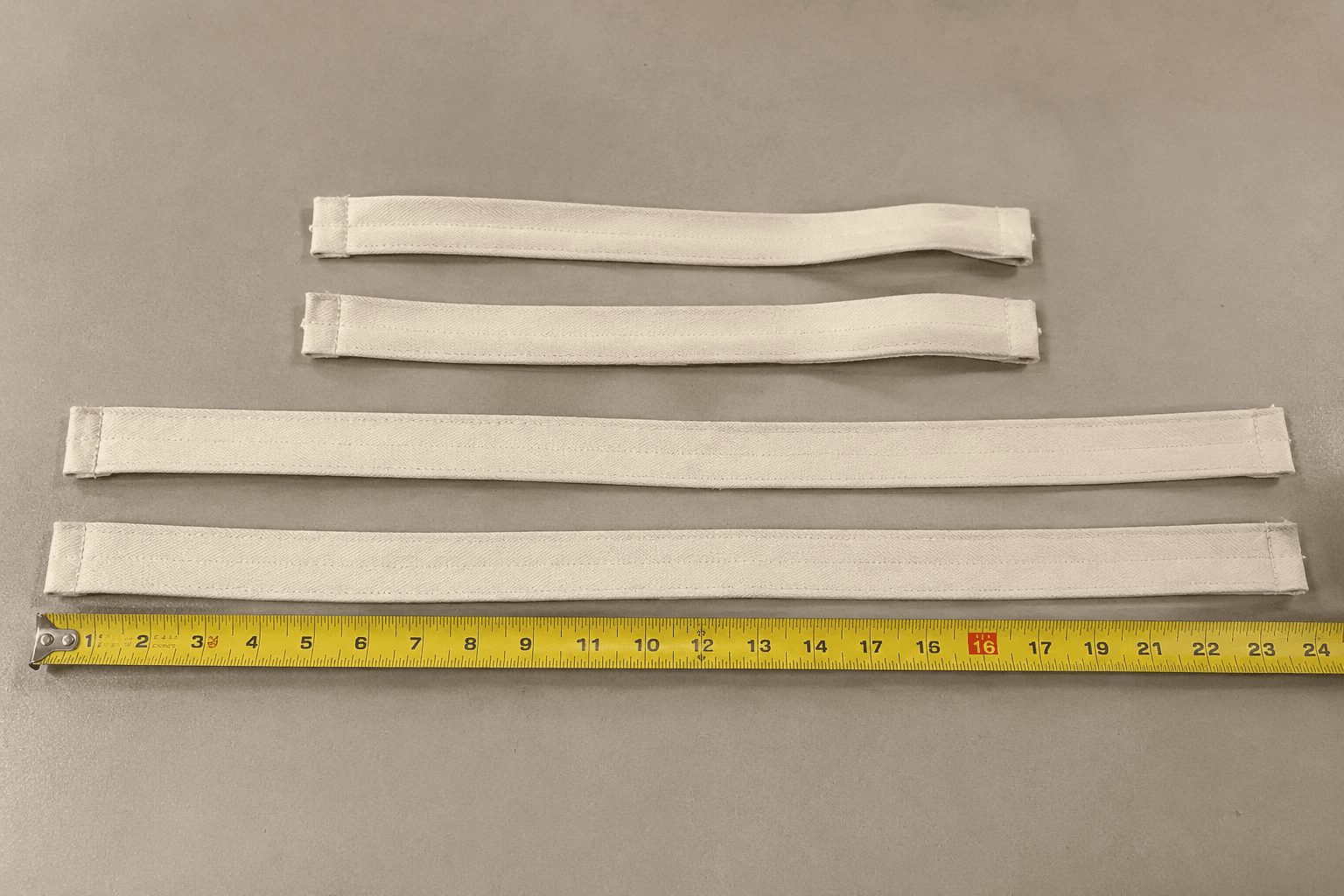
A practical specification should include size dimensions in centimeters, not only S/M/L. Common bib apron dimensions are 70 x 85 cm, 72 x 90 cm, and 80 x 100 cm, but industrial buyers may need wider front coverage or split-leg design for mobility. Strap length, neck adjustment, and waist tie length should be checked for workers wearing jackets or gloves. For heavy aprons, cross-back straps can reduce neck pressure, but they add sewing cost and packing complexity.
The final point is claim discipline. If the apron is tested only at fabric level, the product description should not imply full PPE certification. If the finished garment is certified, the label and documentation should match that certificate exactly. Clear compliance language protects the buyer, the distributor, and the factory. It also prevents last-minute disputes when the goods are ready but the customer’s safety department rejects the paperwork.
- State the end use, such as commercial kitchen, grill station, welding support, maintenance, glass handling, or foundry.
- Name the required standard and level, such as EN ISO 11612 A1/A2 or the exact NFPA standard requested by the end customer.
- Specify fabric composition, target GSM, color, finish, and acceptable alternatives.
- Confirm whether the order needs fabric report, garment test report, declaration of conformity, or formal certification.
- Define wash cycle expectations, such as 25 home washes, 50 industrial washes, or dry-clean only.
- List all trims and branding methods, including thread, buckle, eyelet, label, logo print, embroidery, and packaging.