Sourcing farm to table restaurant aprons is a technical buying decision disguised as a styling brief. Operators want aprons that suit wood tables, open kitchens, produce displays, and muted interiors; procurement teams need the same apron to hold size, pocket shape, seam strength, and color after daily knotting, stain treatment, and repeated machine washing.
The main sourcing mistake is approving a rustic sample on first impression. Slub yarns, linen content, garment washing, overdye effects, and antique-look trims can all support the right visual language, but each one changes shrinkage, crocking, seam torque, abrasion, and lot consistency. In bulk, the real test is not day-one appearance. It is whether the apron still looks guest-facing after 30, 50, or 75 washes in the operator’s actual care process.
Professional buyers reduce claims by locking the full apron package before PP approval: fiber blend, GSM, weave, dye route, pre-shrink control, thread type, bartack count, pocket construction, trim restrictions, inspection standard, MOQ, and lead time. When those points are fixed early, farm to table restaurant aprons can keep a softened, handcrafted look without becoming an expensive replacement cycle problem.
- 270 to 340 GSM cotton canvas or textured twill is the safest core fabric for farm to table restaurant aprons that need visible texture and stable wash performance.
- Linen-blend options can look more premium, but buyers should expect 3% to 6% residual shrinkage risk, stronger wrinkling, and wider lot variation unless the fabric is tightly stabilized.
- Durability comes mainly from reactive dye, poly-core thread, reinforced pocket mouths, 6 to 10 bartacks, and wash-safe trims, not from heavier fabric alone.
- A realistic OEM starting point is usually 300 pcs per style per color, with better FOB efficiency from 500 pcs+; standard bib aprons often land around $3.80 to $7.50/pc FOB.
- Typical timing is 7 to 10 days for first samples, 5 to 7 days for revision samples, and 30 to 45 days bulk after PP approval; yarn-dyed or garment-washed programs often need 45 to 60 days.
- Use AQL 2.5 for major defects and AQL 4.0 for minor defects as a practical inspection baseline for hospitality apron orders.
Why farm to table restaurant aprons fail when texture is approved before wash testing
The most common failure point is simple: the approved sample is judged by handfeel and color alone. A loose 240 GSM slub canvas or an unstable cotton-linen blend may look ideal in the showroom, then lose body, twist at the side seam, or shrink unevenly after 15 to 25 washes. The apron may still function, but it stops looking brand-right across the dining room.
Most failures are predictable rather than random. Bib corners curl, neck seams extend, waist ties pull at the join, chest pockets sag, and top edges ripple after heat drying. Those issues usually come from under-specified stabilization, narrow seam allowances, weak reinforcement, or trims chosen for appearance instead of laundry resistance.
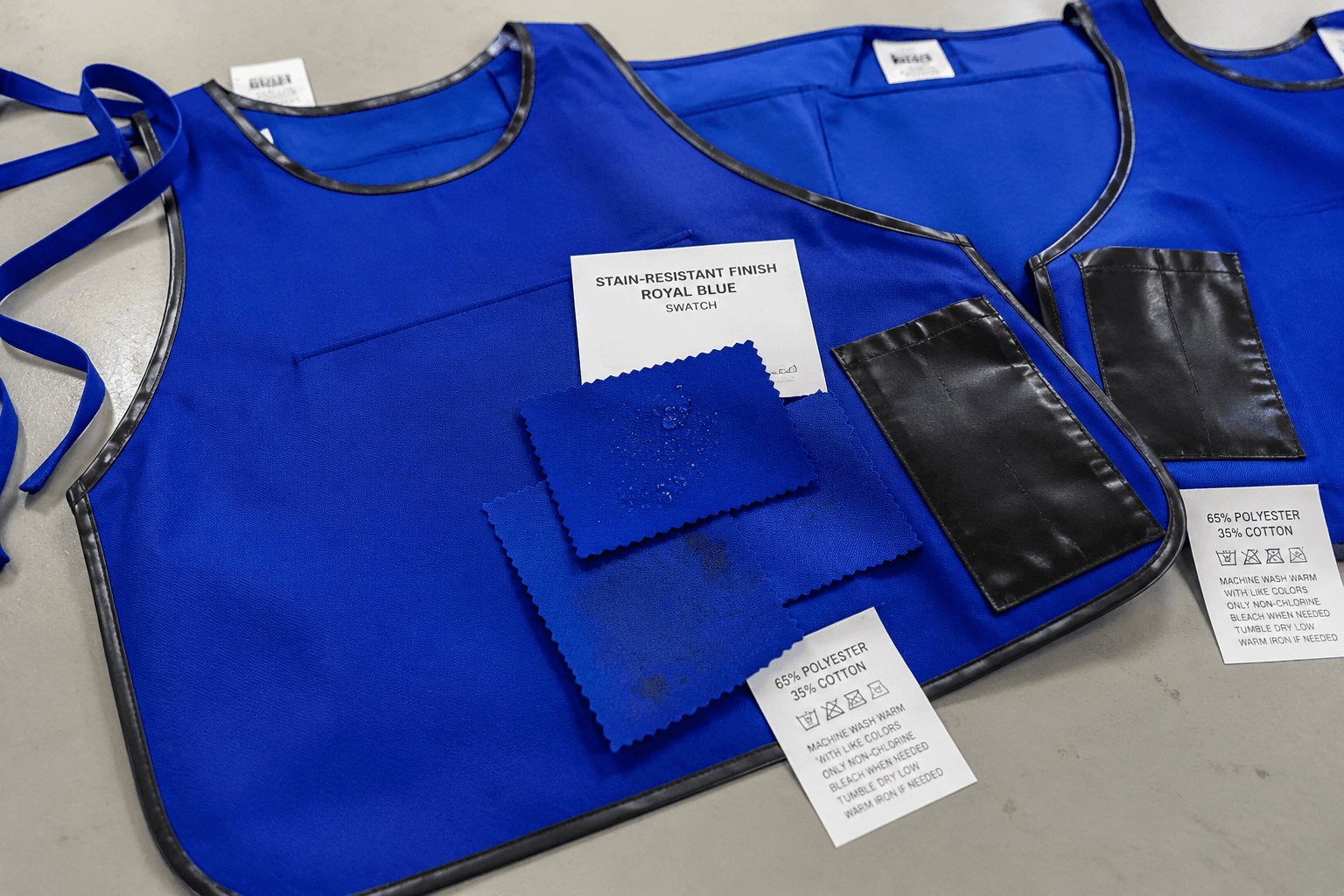
A stronger approval path includes a washed sample review, not just a fit review. Buyers should check residual shrinkage, color fastness to washing, wet and dry rubbing, seam slippage, pilling, and trim reaction to detergent and heat. A PP sample washed 3 to 5 times reveals problems that a clean proto sample hides, especially in olive, tobacco, clay, charcoal, and natural-ecru shades.
For restaurant groups, this matters because apron inconsistency becomes visible fast. If one delivery lot softens too much, shrinks by 4%, or fades unevenly after the first month, staff start mixing old and new aprons on the floor. The result is not only replacement cost; it is a less controlled brand presentation across sites.
- Set residual shrinkage targets at under 3% for stabilized cotton programs and under 5% for cotton-linen developments.
- Require wash tests on fabric and trims before PP approval using the buyer’s real care route or the closest commercial equivalent.
- Check seam torque, pocket distortion, tie extension, and top-edge rippling after 3 to 5 wash-and-dry cycles.
- Compare cost per wear, not sample softness alone; a cheaper apron that fails after 20 washes is rarely the better buy.
Best base fabrics for farm to table restaurant aprons in bulk production
For most B2B programs, the safest base is 100% cotton canvas at 270 to 340 GSM, about 8 to 10 oz. This weight gives enough body for a clean bib shape, supports reactive dye well, and can take enzyme washing without collapsing too quickly. It also cuts and sews more consistently than lighter, open constructions that distort after finishing.
A second strong option is 240 to 300 GSM textured cotton twill. Twill reads slightly cleaner and more tailored than canvas while still feeling warm and natural under restaurant lighting. It usually performs better at folded hems and pocket edges because the weave is more stable during sewing and laundering.
Cotton-linen blends can work, especially in 55/45 or 70/30 cotton-linen at 220 to 280 GSM, but they need tighter control. Linen adds dry texture and a premium visual, yet it also increases wrinkle visibility, edge abrasion, and dimensional movement. For many buyers, yarn-dyed chambray, broken twill, or fine herringbone is a safer way to create depth without the same shrinkage risk.
Stock position matters as much as composition. Mill-stocked canvas or twill can shorten raw-material timing by 7 to 15 days. Custom yarn-dyed or exclusive woven programs can improve brand distinction, but they often add 10 to 20 days to material preparation and push MOQ higher because dye and weave minimums are less flexible.
- 270 to 340 GSM cotton canvas: stable choice for bib and waist aprons, commonly $3.20 to $6.20/pc FOB at 500 to 3000 pcs.
- 240 to 300 GSM textured twill: cleaner sewing performance, commonly $3.50 to $6.80/pc depending on pocket count, strap system, and branding.
- 220 to 280 GSM cotton-linen blend: more premium handfeel, commonly $4.80 to $8.80/pc with greater stabilization risk.
- Yarn-dyed chambray or herringbone: strong visual depth, but fabric lead time may add 10 to 20 days if the mill does not hold stock.
Construction specs that keep rustic aprons serviceable through 50 to 75 washes
Commercial wash performance depends more on construction discipline than on fabric weight alone. A badly built 12 oz apron can fail faster than a well-made 9 oz apron if pocket mouths are unsupported, seams are narrow, or hardware oxidizes in the wash. Aprons are soaked, rubbed, heated, untied, and retied every day, so the build has to match that use pattern.
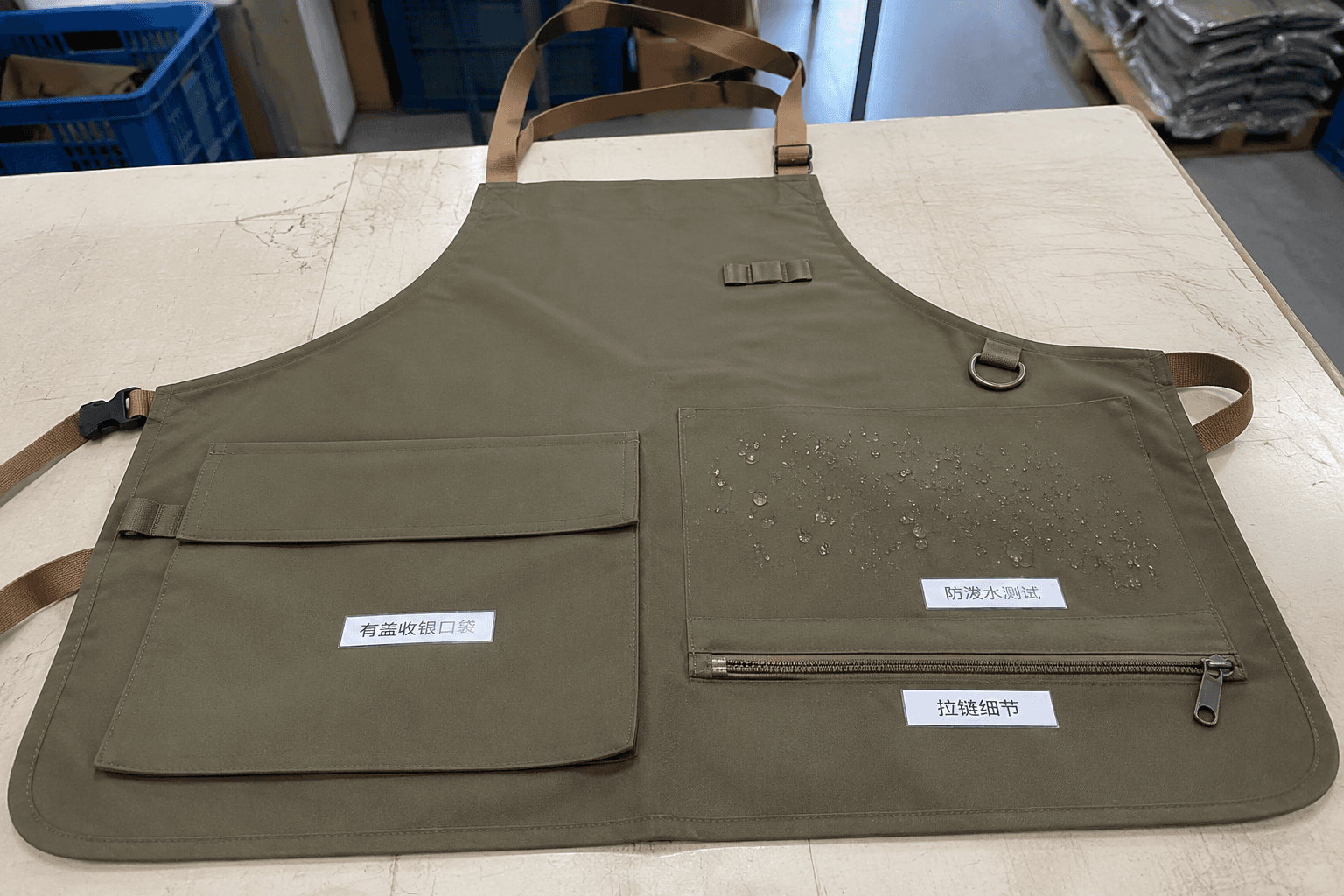
A practical baseline for bib aprons is lockstitch construction, double-turned hems, reinforced pocket openings, and bartacks at every stress point. Most bib styles need 6 to 10 bartacks, depending on chest pockets, split waist pockets, towel loops, cross-back anchors, and neck adjustment. Seam allowances should be wide enough to reduce torque after washing, particularly on washed canvas and linen blends.
Thread selection is equally important. Poly-core cotton thread usually outperforms standard spun cotton in repeated laundering because it provides better tensile strength while keeping a cotton-rich seam appearance. For earthy shades, reactive dye remains the safer route for wash fastness and shade retention than lower-cost pigment approaches, which can fade unevenly at fold lines and pocket edges.
Trim choice often determines whether a rustic concept survives actual use. Leather tabs, glued patches, decorative rivets, and low-grade antique hardware may fit a mood board, but they regularly reduce usable life in outsourced laundry conditions. If the brand wants an artisanal look, it is usually safer to achieve it through washed finishing, matte woven tapes, self-fabric straps, and texture in the base cloth rather than fragile add-ons.
- Use double-needle topstitching at bib edges, pocket mouths, tie joins, and other high-use seams.
- Specify poly-core thread, reinforced pocket corners, and wash-safe strap adjusters as the default build.
- Avoid glued badges, leather trims, and low-grade metal hardware if the operator uses high-heat commercial laundering.
- Target a finished apron that remains presentable through 50 to 75 commercial wash cycles in front-of-house service.
FOB cost, MOQ, and wear-life math for professional apron buyers
Piece price is only the starting point. Buyers should compare cost per wear, replacement frequency, and replenishment practicality across the apron program. A $4.20 bib apron that loses shape after 20 to 25 washes is usually more expensive over a year than a $5.80 apron that still presents well after 55 to 60 washes. That calculation matters even more for multi-unit restaurant groups, where visible inconsistency between locations weakens the brand.
For a standard custom bib apron made in China with one chest pocket, two waist pockets, self-fabric ties, adjustable neck, woven label, and export packing, a realistic FOB range is usually $3.80 to $7.50/pc at 500 to 3000 units. A linen-blend or garment-washed premium bib apron with custom hardware, embroidery, or yarn-dyed cloth often lands at $6.50 to $11.00/pc. Waist aprons usually sit around $2.20 to $4.80/pc unless utility pockets, branded tapes, or retail-style packing are added.
MOQ strongly affects efficiency. Many factories can accept 300 pcs per style per color on straightforward developments, but the more efficient level is usually 500 pcs+ because fabric utilization, dye minimums, trim procurement, and line setup all improve. Buyers handling several colorways should confirm whether MOQ applies per color, per fabric, or across the assortment; that detail often causes avoidable delays.
Replacement-cycle planning should be discussed before sampling starts. If the operator expects a 9- to 12-month service life, the brief should prioritize seam strength, shrinkage control, and replenishable fabric availability over first-day softness. If the rollout is tied to a seasonal concept with a 4- to 6-month wear window, a softer handfeel or more fashion-led wash finish may be commercially acceptable.
- Simple waist apron: around 300 pcs MOQ, usually $2.20 to $4.80/pc FOB.
- Standard bib apron: around 300 to 500 pcs MOQ, usually $3.80 to $7.50/pc FOB.
- Premium linen-blend bib apron: often 500 pcs MOQ, usually $6.50 to $11.00/pc FOB.
- Garment wash, embroidery, custom tape, and premium packing typically add $0.40 to $1.80/pc depending on volume and complexity.
Lead times, approval gates, and AQL controls for hospitality apron orders
Lead-time problems usually start with vague approvals rather than sewing capacity. When buyers want exact earthy shades, softened handfeel, and visible natural texture, they need enough time for lab dips, fabric confirmation, sample review, fit comments, and washed PP approval. Rustic apron programs carry more variables than standard black poly-cotton servicewear, so the approval path needs tighter control if the order supports a store opening or group-wide uniform reset.
A practical timeline starts with 3 to 5 days for quotation, construction review, and material confirmation. First samples normally take 7 to 10 days. A second sample round for comments and revisions often needs another 5 to 7 days. After PP approval and deposit, standard bulk production usually runs 30 to 45 days for stocked-fabric programs. If the style uses yarn-dyed cloth, custom weaving, special dye lots, or garment washing, production often extends to 45 to 60 days, with peak season adding another 10 to 20 days.
Inspection standards should be fixed before cutting. A practical baseline is AQL 2.5 for major defects and AQL 4.0 for minor defects. On apron orders, major defects usually include broken seams, missing bartacks, measurement out of tolerance, severe shade mismatch, or non-functioning strap adjustment. Minor defects more often include uneven topstitching, small weave slubs within standard, or limited shade variance inside approved tolerance.
Measurement control deserves as much attention as fabric testing. If tie length varies too much, waist bows sit unevenly. If bib width shifts by more than tolerance, the apron reads cheaper on-body. If pocket placement drifts, the whole front view looks wrong even when the sewing is technically acceptable.
- Approve against a washed PP sample whenever the style depends on enzyme wash or garment wash.
- Set tolerances for body length, bib width, tie length, and pocket placement before bulk cutting starts.
- Use AQL 2.5 / 4.0 as the standard inspection rule unless the program requires tighter control.
- Build in launch buffer if the order uses exclusive yarn-dyed fabrics or custom-dyed earthy shades.
How to brief factories for repeatable farm to table restaurant aprons replenishment
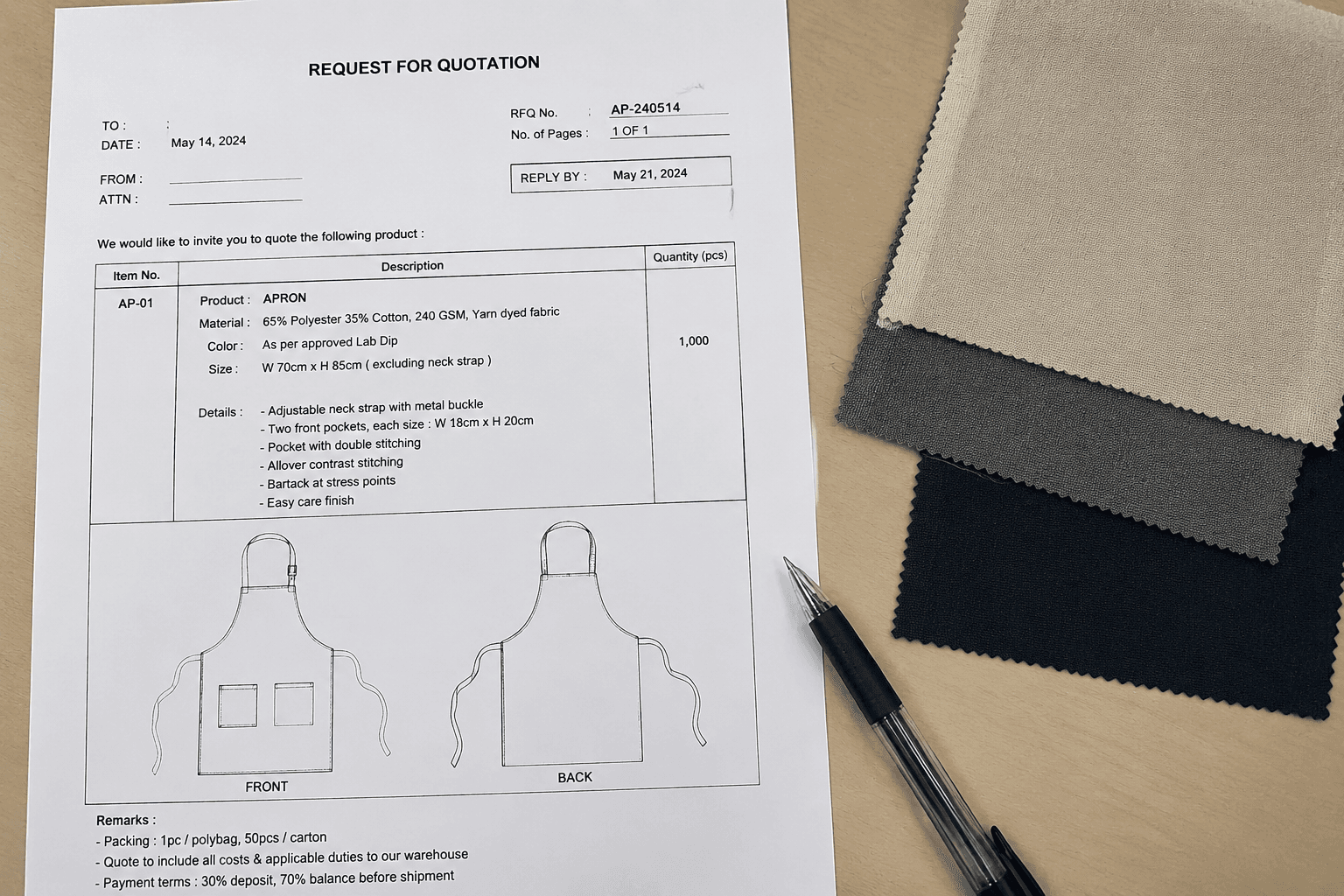
The strongest sourcing outcomes come from a technical brief that defines what the apron must do in service, not just how it should look in a concept deck. For repeatable farm to table restaurant aprons, buyers should specify fiber content, GSM, weave, dye method, finish, finished dimensions, pocket layout, strap style, branding method, target care environment, and acceptable shrinkage. If these points are left open, the factory has to guess how to balance rustic appearance and durability, and that usually creates avoidable revisions.
A useful OEM brief should also state the commercial priority. One restaurant group may care most about a soft first-wear handfeel for opening-week presentation. Another may care more about a stable appearance through a 9- to 12-month replacement cycle across 20 sites. Those are different product targets, and the factory should know which one leads before sampling starts.
For replenishment, approved standards need to be locked in writing. That includes exact fabric construction, shade reference, measurement chart, trim list, sewing method, wash finish, folding method, carton ratio, and inspection requirement. This matters because repeat orders often come 4 to 8 months later, when greige availability, dye lots, or subcontract laundry conditions may have changed.
The more complete the brief, the easier it is to quote accurately and protect consistency on second and third runs. Good sourcing of farm to table restaurant aprons is not about finding the cheapest opening sample. It is about making sure replenishment bulk still matches the first approved standard closely enough for guest-facing use.
- State the fabric clearly, for example 100% cotton canvas, 300 GSM, reactive dyed, enzyme washed.
- Define the care route, such as 40°C on-premise wash or outsourced commercial laundry with tumble drying.
- Specify shrinkage limits, bartack positions, pocket reinforcement, color-fastness expectations, and trim restrictions.
- Request both a cost-optimized option and a higher-durability option if the budget is still under review.
- Keep PP comments, approved trims, size specs, and packing standards on file to stabilize repeat orders.