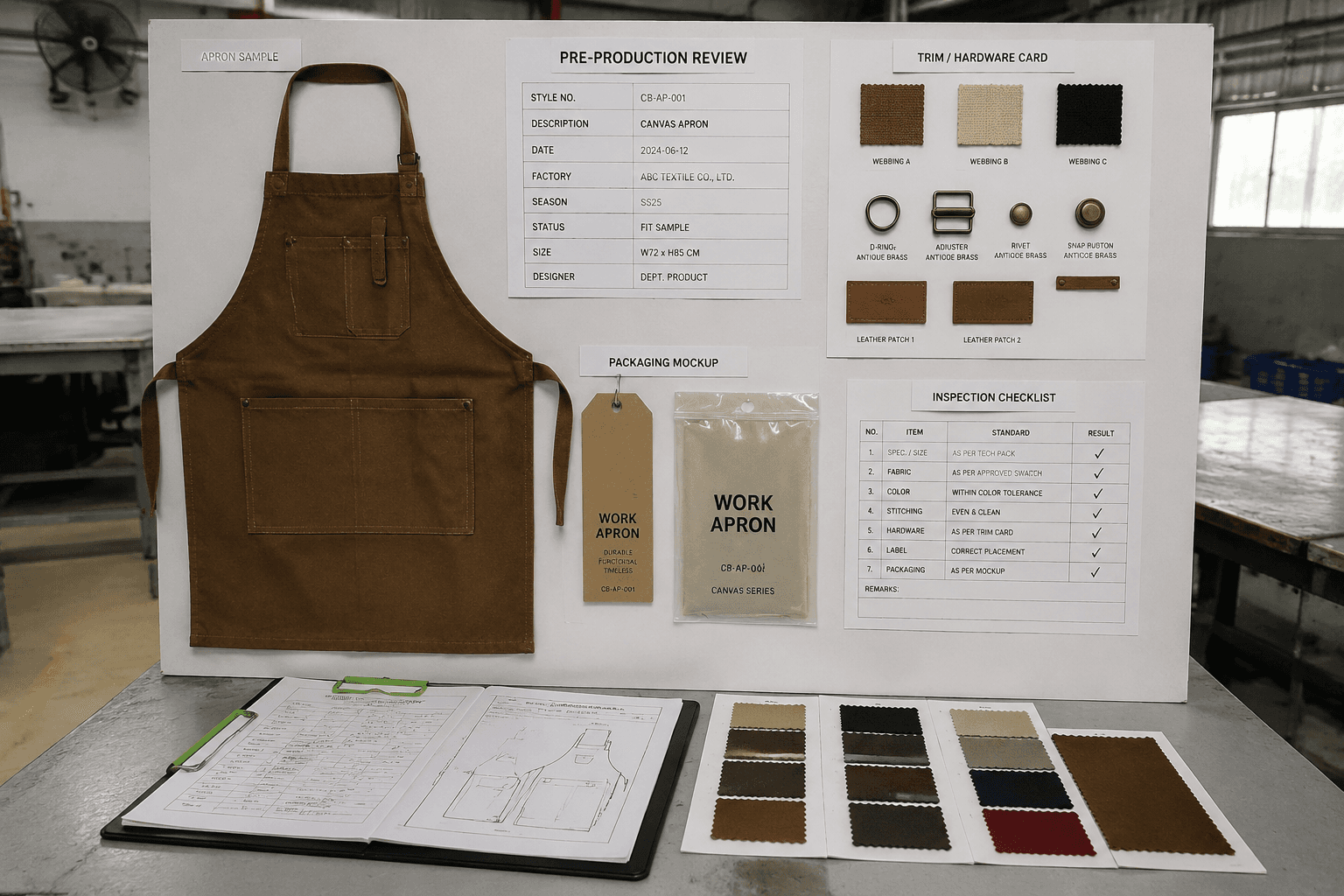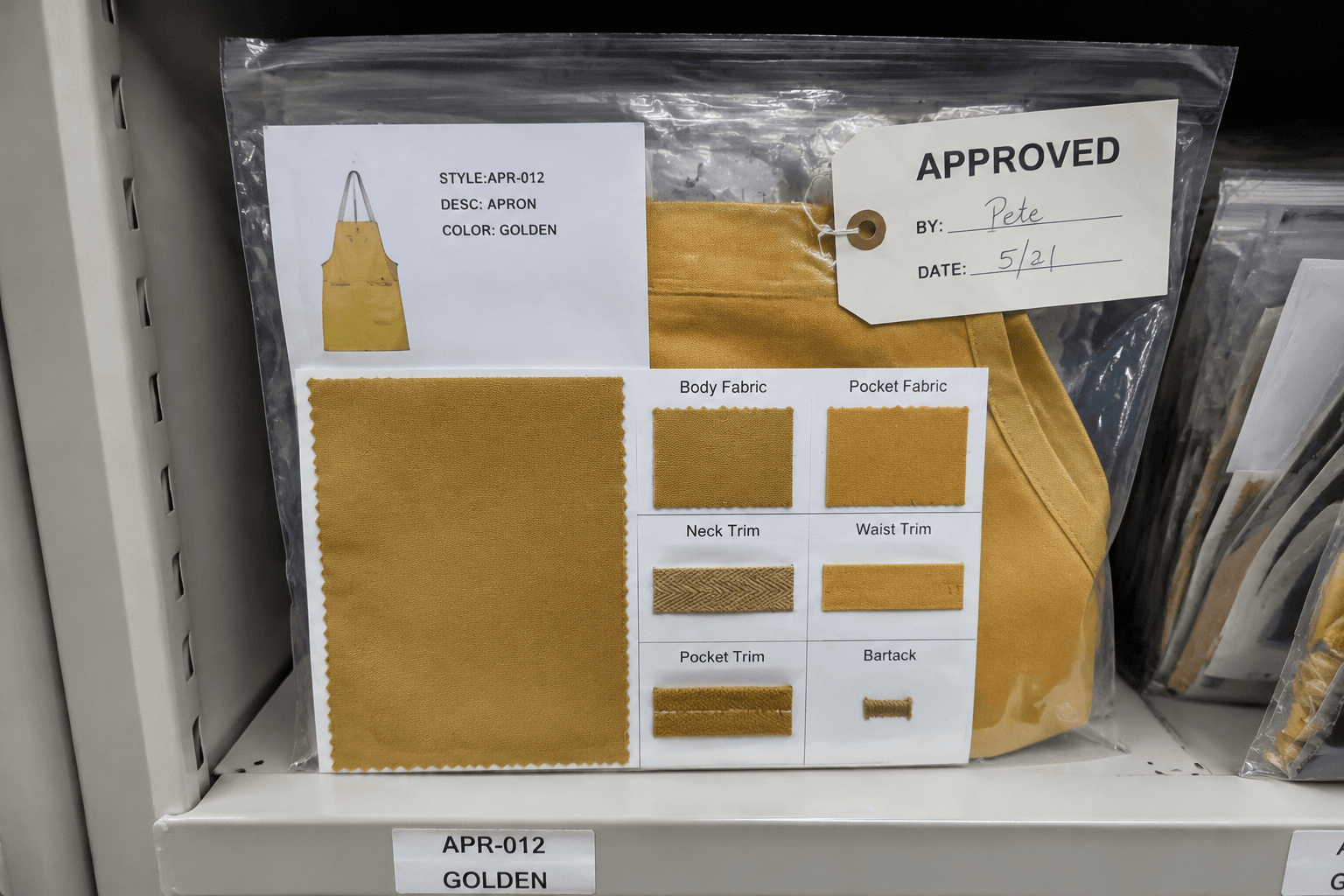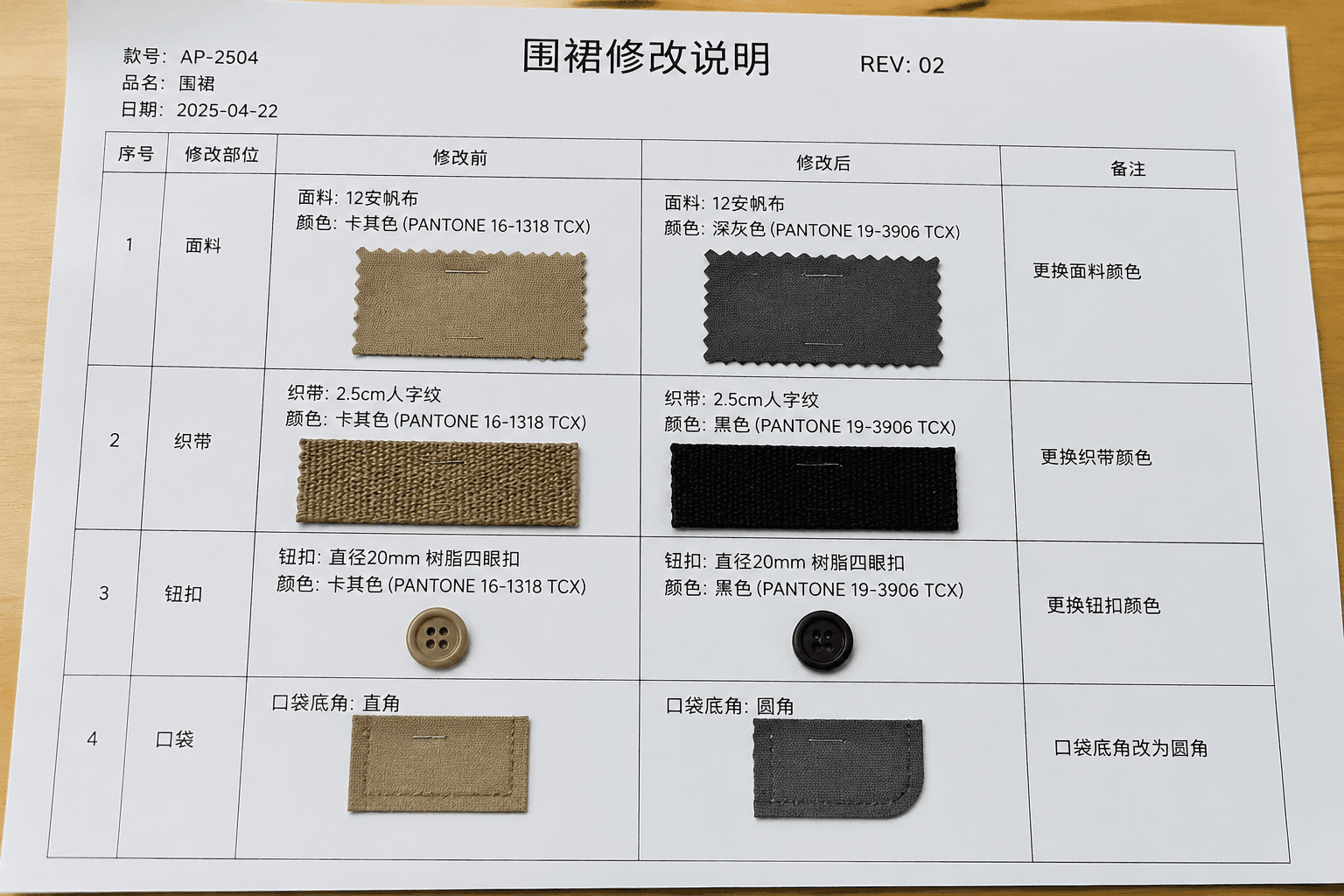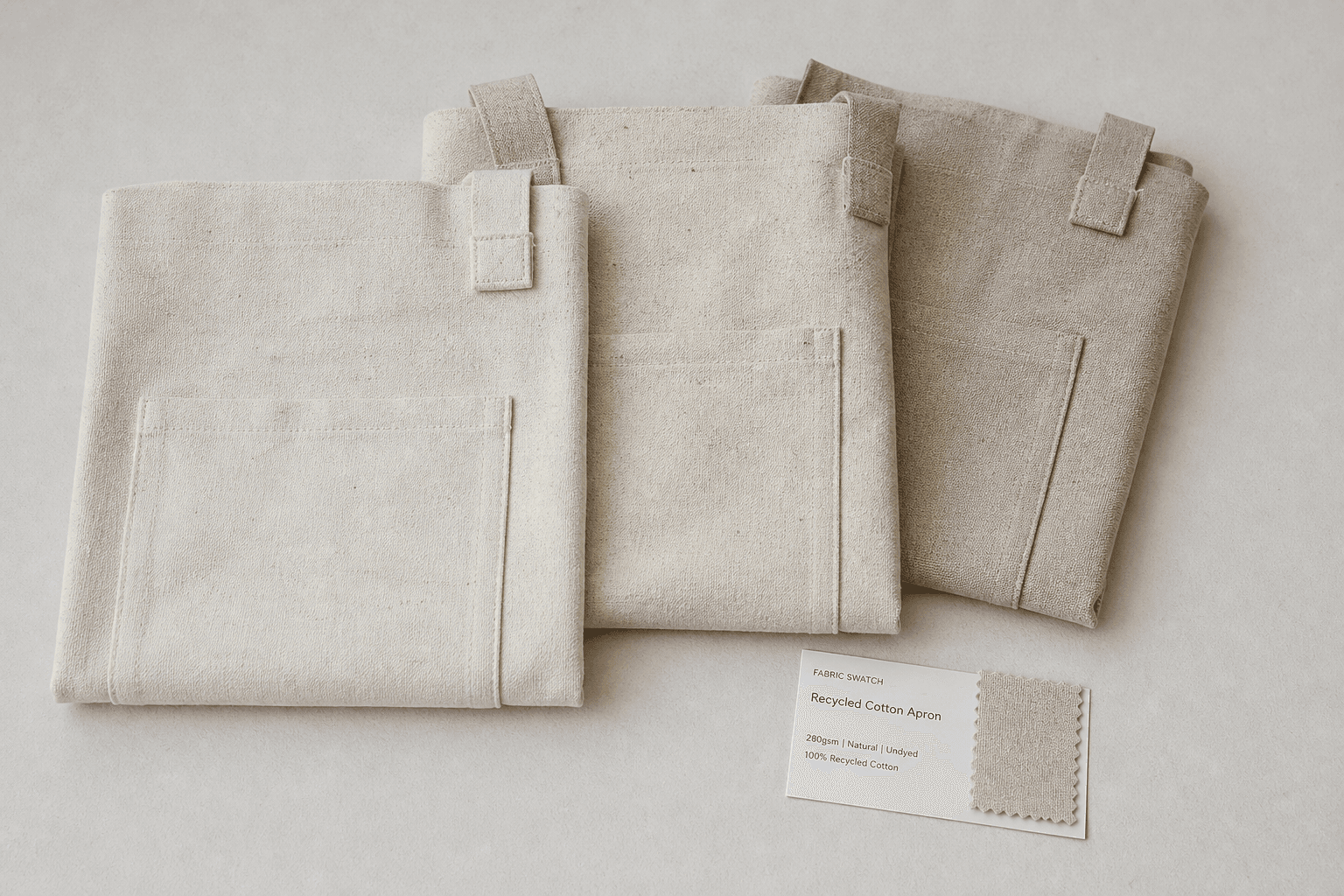
For restaurant groups, hotel operators, foodservice distributors, uniform rental companies and private-label buyers, dual sourcing apron programs reduce supply risk only when the backup factory can deliver aprons that look, fit and wear like the primary source. The business case is clear: a second source protects against port disruption, fabric shortages, labor gaps or sudden demand spikes. The technical requirement is stricter: black bib aprons from two factories cannot read differently under TL84 light, neck drop cannot vary by 1.0-1.5 cm, and antique brass hardware cannot shift from a muted brown tone to a bright yellow finish within the same program.
Most mismatch starts with open specifications rather than obvious factory failure. One supplier may reorder approved 10 oz washed canvas from the nominated mill, while the other books a local 260-265 GSM fabric to save $0.12-$0.25 per piece and 7-10 days. One line follows a sealed CAD pattern; the other copies a salesman sample without the same neck-strap fold-back or pocket placement method. On bib aprons commonly bought at $4.80-$8.90 per piece in 2,000-5,000 unit runs, those small sourcing decisions create visible inconsistency across the same uniform issue.
Reliable dual sourcing apron programs are built on practical controls: freeze the fabric system, seal the pattern and point-of-measure method, nominate trims, qualify the backup factory before the rush, and inspect both sources against identical pass-fail rules. The goal is not identical sewing-floor technique. The goal is that aprons from Factory A and Factory B can be issued in the same kitchen, bar, bakery or hotel opening with no visible difference in shade, drape, fit, hardware finish, branding or packaging presentation.
- Freeze fabric by construction, finish and tolerance: write fiber content, weave, dye route, wash process, GSM tolerance, shrinkage limit and light-source review into the apron spec rather than approving shade alone.
- Control fit through measurement method: define finished dimensions after wash, neck adjustment range, tie length, pocket coordinates and visible-point tolerances tightly enough that two factories cannot interpret the same apron differently.
- Nominate trims before booking bulk: 25 mm buckles, D-rings, webbing, labels, snaps and rivets create obvious mismatch on aprons when suppliers substitute local equivalents.
- Qualify the backup source 60-90 days ahead: run a 300-800 piece waist apron pilot or a 1,000-1,500 piece bib apron pilot before the season opens, not during a stock shortage.
- Keep QC identical across both factories: use the same checkpoints, defect definitions and AQL 2.5 major / 4.0 minor standard unless the brand already enforces tighter rules.
Where dual sourcing apron programs fail after first bulk approval
Many apron programs are tightly managed during development and then allowed to loosen on repeat orders. During sampling, buyers compare lab dips, proto samples, pre-production samples and trim cards side by side. On replenishment, that discipline often drops. The primary factory may reorder the approved 270 GSM enzyme-washed cotton canvas from the original mill, while the secondary source buys a nominally similar local fabric to protect a 30-35 day ex-factory target. Both can still call it “10 oz canvas,” yet the aprons will not hang, wash or show black, navy or olive in the same way.
Aprons reveal variation faster than jackets or shirts because there is very little garment structure to hide it. On a bib apron, a 0.8 cm loss in finished width after wash, a 0.7 cm shift in pocket height or a slightly thicker neck adjuster is visible on a hanger and even more visible when staff stand together. On a waist apron, tie width moving from 3.0 cm to 2.5 cm or pocket opening widening by 0.6 cm changes both appearance and daily function.
In practice, spec drift starts in four predictable places: fabric substitution, pattern interpretation, trim substitution and uneven inspection thresholds. None of these problems is unusual in production. The avoidable mistake is leaving them open until after the purchase order is split across suppliers.
- A 270 GSM washed canvas and a 260 GSM unwashed twill can both be sold as 10 oz apron fabric, but drape, shade depth and shrinkage will differ.
- A note that says only “neck strap 70 cm” is incomplete unless fold-back length, buckle size and finished adjustment range are also defined.
- A seam allowance change of 0.2 cm can move pocket placement, reduce finished width and alter apron balance after wash.
- If one supplier is inspected at AQL 2.5/4.0 and the other is accepted more loosely, the buyer creates spec drift inside its own control system.
Fabric and shade controls in dual sourcing apron programs
Color drift usually appears first, but the cause sits upstream in the fabric system. Apron buyers often approve a color swatch without freezing the material behind it. For aprons, shade must be tied to fiber content, yarn construction where relevant, weave, dye method, finish and wash route. A black 100% cotton 2/1 twill at 245 GSM will not match a black 100% cotton canvas at 270 GSM after enzyme wash, even if both looked acceptable against the same chip during development.
A stronger approach is to seal one master fabric standard and write the bulk approval rules around it. A workable bib apron spec can state: 100% cotton canvas, 10 oz nominal before wash, 270 GSM finished average after wash, reactive dyed, enzyme washed, usable width 58/60 inches, skew under 3%, shrinkage under 3% in warp and weft, and bulk judged against the sealed standard under D65, TL84 and natural daylight. For a poly-cotton waist apron, the spec might instead lock 65/35 poly-cotton 3/1 twill at 245 GSM ±5%, pigment dyed, no garment wash, shrinkage under 2.5%. Those details make “close enough” testable.
Where annual volume supports it, both factories should buy from one nominated mill or from two mills pre-qualified against the same golden standard. Fabric lead-time may increase from 18-22 days to 25-30 days, but that extra week is usually cheaper than field complaints, returns or mixed shade stock on programs shipping 8,000-20,000 aprons per color over multiple drops. In apron sourcing, the cost of non-matching replenishment is almost always higher than the cost of disciplined fabric reservation.
- Seal one fabric hanger with composition, weave, finished GSM, color code, wash finish and handfeel notes for each apron color.
- Review black, navy, olive, burgundy and khaki under D65, TL84 and daylight because those shades shift most visibly by light source.
- State whether bulk is approved against the master standard, the last approved lot or a sealed hanger set, and apply the same rule to both factories.
- Record an acceptable GSM tolerance, such as 270 GSM ±5% or 245 GSM ±5%, rather than relying on a nominal ounce claim.
Fit, pattern and pocket controls for dual-sourced bib and waist aprons
Fit consistency in aprons comes from pattern governance, not from a simple one-size label. A one-size bib apron still has multiple control points: finished body width, finished body length, top width, neck adjustment range, tie length, pocket dimensions and the exact attachment points of straps and pockets. If Factory A works from a sealed CAD pattern and Factory B reverse-engineers from a sample, both can say they made the same apron while producing visibly different fit.
The fix is to define the measurement method as tightly as the dimensions. A robust washed bib apron spec might read: finished body width 71.0 cm ±0.7 cm, finished body length from top edge to hem 86.0 cm ±0.7 cm, top width 27.0 cm ±0.5 cm, waist ties 95.0 cm each side ±1.0 cm, neck strap cut length 76.0 cm, shortest finished neck drop 58.0 cm, longest finished neck drop 68.0 cm, all measured after wash, pressing and 24-hour conditioning. A waist apron spec might lock finished width at 80.0 cm ±0.7 cm, finished length at 45.0 cm ±0.7 cm and ties at 90.0 cm each side ±1.0 cm. This removes the gap between what the buyer expects and what each sewing line interprets.
Pocket placement requires the same discipline because it is one of the fastest giveaway points in mixed-source shipments. A two-compartment patch pocket should be anchored from the apron centerline and finished hem, not from cut panel edges. If one factory places the pocket 7.0 cm above hem and the other at 8.0 cm, or if finished width shifts from 32.0 cm to 33.0 cm, staff will notice immediately. On front-of-house programs, visible-point tolerances are often best held to ±0.5 cm even when less visible points can run at ±1.0 cm.
- State clearly that all critical measurements are taken after wash if the apron is garment washed or enzyme washed.
- Fix strap adjustment range, not only cut length, because buckle geometry changes actual neck drop on the wearer.
- Anchor pocket placement from centerline and hem with visible-point tolerances commonly held to ±0.5 cm.
- Seal the digital pattern file, grading notes and fold-back method when reorder volume is high or the style will run across multiple seasons.
Trim nomination in dual sourcing apron programs: hardware, webbing and branding
Trim inconsistency can make a well-matched apron fabric program look unmanaged in seconds. Buyers often focus on shade and overlook the fact that buckles, D-rings, rivets, snaps, webbing, herringbone tape, woven labels and patches are frequently sourced locally unless they are explicitly nominated. Two 25 mm antique brass buckles may both be usable, yet one can be glossier, yellower and 0.3 mm thicker than the approved item. On black or dark olive canvas aprons, that difference is obvious.
Trim variation also affects wear performance. A softer polyester webbing twists more easily through the neck and does not lie flat after laundering. A thicker adjuster changes how far the strap stands off the chest. A low-grade snap may lose holding power after repeated wash cycles. A PU logo patch with shallow embossing and thin edge paint may crack after 5 commercial washes. These are not small aesthetic issues; they are sourcing decisions that change how the apron performs in daily service.
The practical answer is exact nomination. If direct global nomination is possible, both factories should purchase the same buckle, webbing, label and snap references. If not, both should work from a sealed trim card that states material, dimensions, finish, thickness, approved supplier code and pass-fail notes. For custom aprons landing at roughly $4.80-$9.50 per piece, trim standardization is usually one of the lowest-cost controls a buyer can add, and one of the most visible when ignored.
- Specify hardware by size and finish, such as 25 mm matte black, 25 mm antique brass or 25 mm brushed nickel, and reject bright substitutes unless reapproved.
- Lock strap width and thickness together, for example 25 mm width and 1.6-1.8 mm thickness, because equal width does not guarantee equal handfeel or drape.
- Define woven label type, fold, stitch color and placement because label differences show quickly on small apron bodies.
- For leather or PU patches, state thickness, logo depth, edge paint color and required wash result before bulk approval.
Qualify the backup factory before peak season, not during shortage
A second supplier should be qualified before the apron program is under pressure. In disciplined dual sourcing apron programs, the backup factory is developed in normal calendar time, not during a stock-out. If the buyer waits until the primary source is overloaded or delayed, there is rarely enough time to align fabric lots, match trims, prove shrinkage, confirm embroidery position and correct pattern interpretation. The shipment may still leave, but the inconsistency cost shows up later at unit level.
Qualification should be done against the actual apron SKU family that will be split, not a simplified development sample. That means the same washed bib apron or waist apron, the same embroidery, the same hardware, the same woven labels and the same packing standard. For a simple poly-cotton waist apron, a 300-800 piece pilot usually exposes sewing, measuring and packing variation. For a washed 270 GSM cotton bib apron with 25 mm hardware, bartacks, embroidery and branded labels, a 1,000-1,500 piece pilot is more realistic because wash consistency, hardware assembly and finished measurement stability must be proven at scale.
Capacity claims also need to be translated into style complexity. A factory quoting 30,000 aprons per month may be assuming simple unwashed waist aprons with no adjusters. Your actual requirement may be a washed canvas bib apron with metal hardware, divided pocket, embroidery and individual barcode sticker. Qualification should therefore test realistic timing: 7-10 days for lab dip or shade confirmation, 20-30 days for fabric booking, 15-25 days for cut-make-trim and 3-7 days for final inspection and booking on repeat business. If that calendar does not hold during the pilot, it will not hold in peak season.
- Run the secondary-factory pilot 60-90 days before peak demand rather than during a replenishment emergency.
- Use the same approved trims, care labels, carton ratio, barcode layout and polybag standard as the primary source.
- Compare pilot production from both factories side by side before approving any split allocation.
- Keep a live approval archive for fabric, trims, patterns, wash comments, pack specs and inspection photos so reorders do not restart from memory.
Inspection rules that keep two apron factories aligned
Final random inspection alone is too late to protect a split apron program. Both factories need the same sequence of checkpoints so the buyer is comparing like with like. A practical control flow includes raw material approval, pre-production confirmation, inline inspection and final random inspection. Raw material approval checks fabric shade, GSM, width and trims against sealed standards. Pre-production confirms pattern, construction, embroidery position, label placement and packing method. Inline inspection catches operator-driven drift such as skewed pockets, uneven topstitch width, wrong bartack position or mixed hardware before too much output is complete.
For most professional apron orders, aligned AQL rules are essential. A common commercial baseline is AQL 2.5 for major defects and 4.0 for minor defects, with some tighter hospitality programs working to 1.5 major / 2.5 minor. The critical point is consistency. If one factory gets broader tolerance on measurement, shade or hardware finish, the dual-source program will diverge even if both shipments technically pass final inspection.
Side-by-side wear review is worth adding because aprons can pass lay-flat measurement while still looking different when worn. Drape, finish, buckle thickness, strap recovery and pocket balance all affect visual uniformity. Reviewing sealed samples from both factories on a hanger and on-body catches the mismatch that creates complaints in kitchen, café and front-of-house use: two “approved” aprons that do not appear to be the same apron once issued.
- Use one shared defect manual and one shared AQL level across both apron factories.
- Measure at least 5-8 critical points per inspected apron, including body width, body length, neck drop, tie length and pocket placement.
- Check shade continuity within cartons and across cartons, not only against a single sealed swatch.
- Photograph pre-production, inline and final approvals with date, PO number, color and factory code for traceable comparison.
MOQ, cost and lead-time math for stable apron dual sourcing
Dual sourcing adds control cost, but in apron sourcing that premium is usually modest compared with the cost of stock-outs, emergency air freight or visibly inconsistent uniforms. Buyers commonly see a secondary-source premium of $0.20-$0.60 per apron when order volume is lower, fabric booking is split or nominated trims are required. On a landed basis, that often equals a 3%-8% program premium for materially better continuity and lower disruption risk.
MOQ needs to be planned at three levels: finished apron MOQ, trim MOQ and fabric mill MOQ. A simple poly-cotton waist apron may start at 500-1,000 pieces per color per shipment. A custom washed cotton canvas bib apron with metal hardware, embroidery and branded labels may require 1,500-3,000 pieces per color to run efficiently across two sources. The real constraint is often fabric. For custom-dyed canvas or twill, mills commonly ask for 1,000-2,000 meters per color, and some require 3,000 meters if both factories must draw from matched lots within one booking window.
Lead-time discipline matters as much as cost negotiation. If two factories are meant to ship the same apron color in the same launch window, fabric reservation should be synchronized before the purchase order split is issued. Splitting orders without aligned fabric booking is one of the fastest ways to create shade separation and uneven delivery. The right commercial question is not whether dual sourcing apron programs cost more in isolation. It is whether that added control cost is lower than the operational cost of missed opening dates, mixed non-matching aprons in the field, markdowns on private-label inventory or rework under peak pressure.
- Budget for a small control premium instead of forcing the backup source to quote unrealistically low and substitute inputs later.
- Align fabric reservation dates across both factories if the same apron color will ship in one season or opening window.
- Plan MOQ at fabric, trim and finished-apron level before splitting orders, not after purchase orders are placed.
- Build second-source development time into the sourcing calendar because compressed onboarding almost always raises hidden quality cost later.