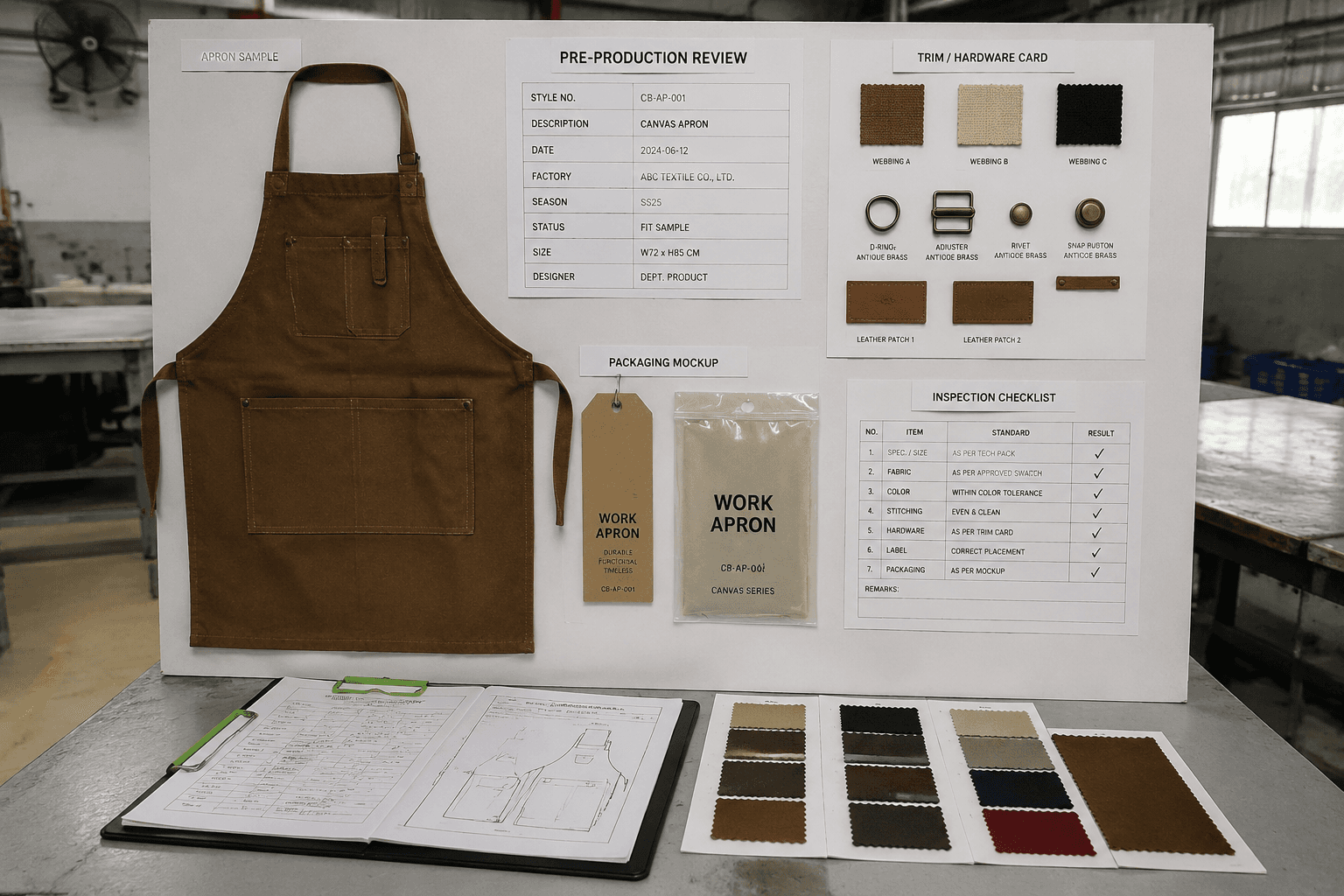
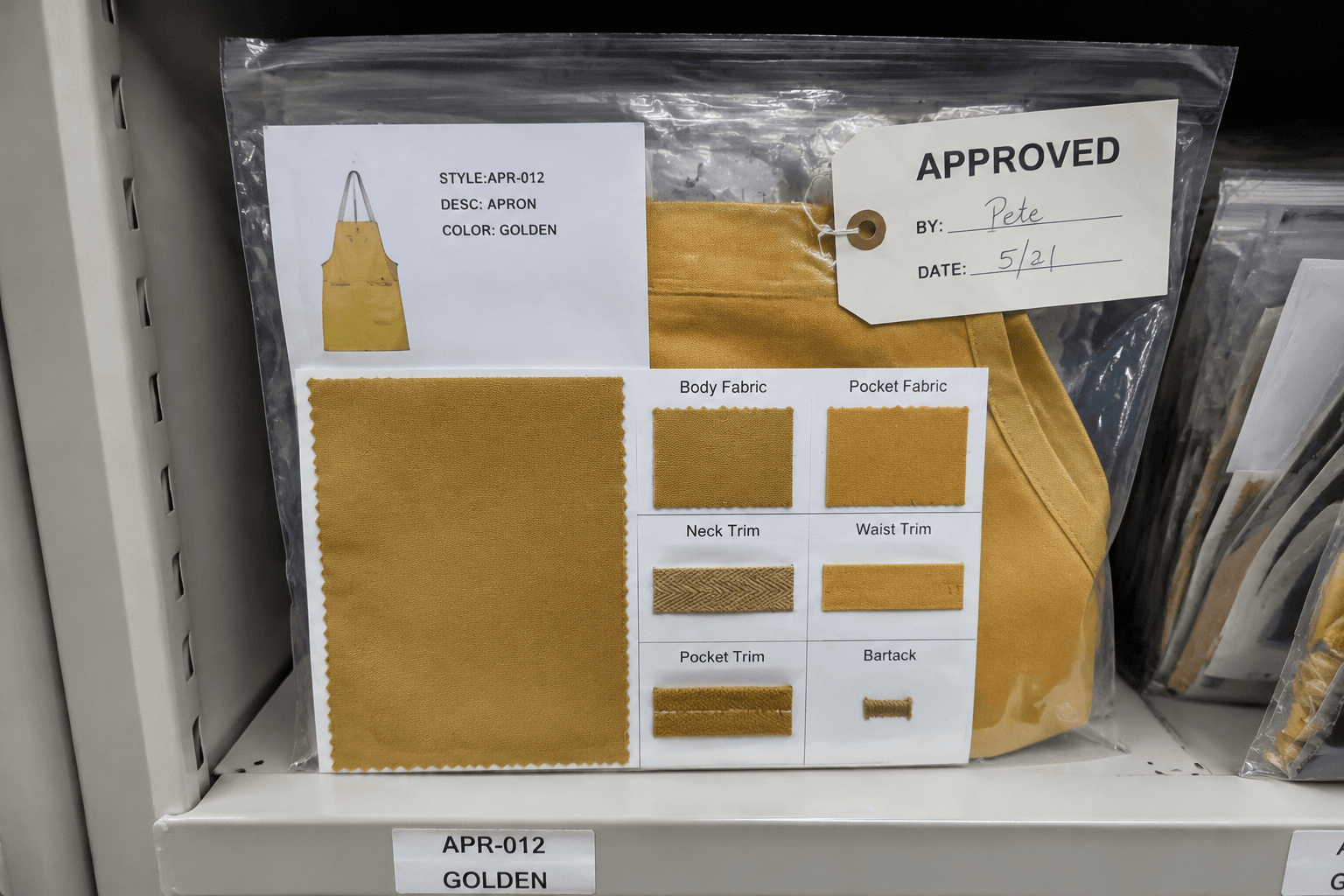
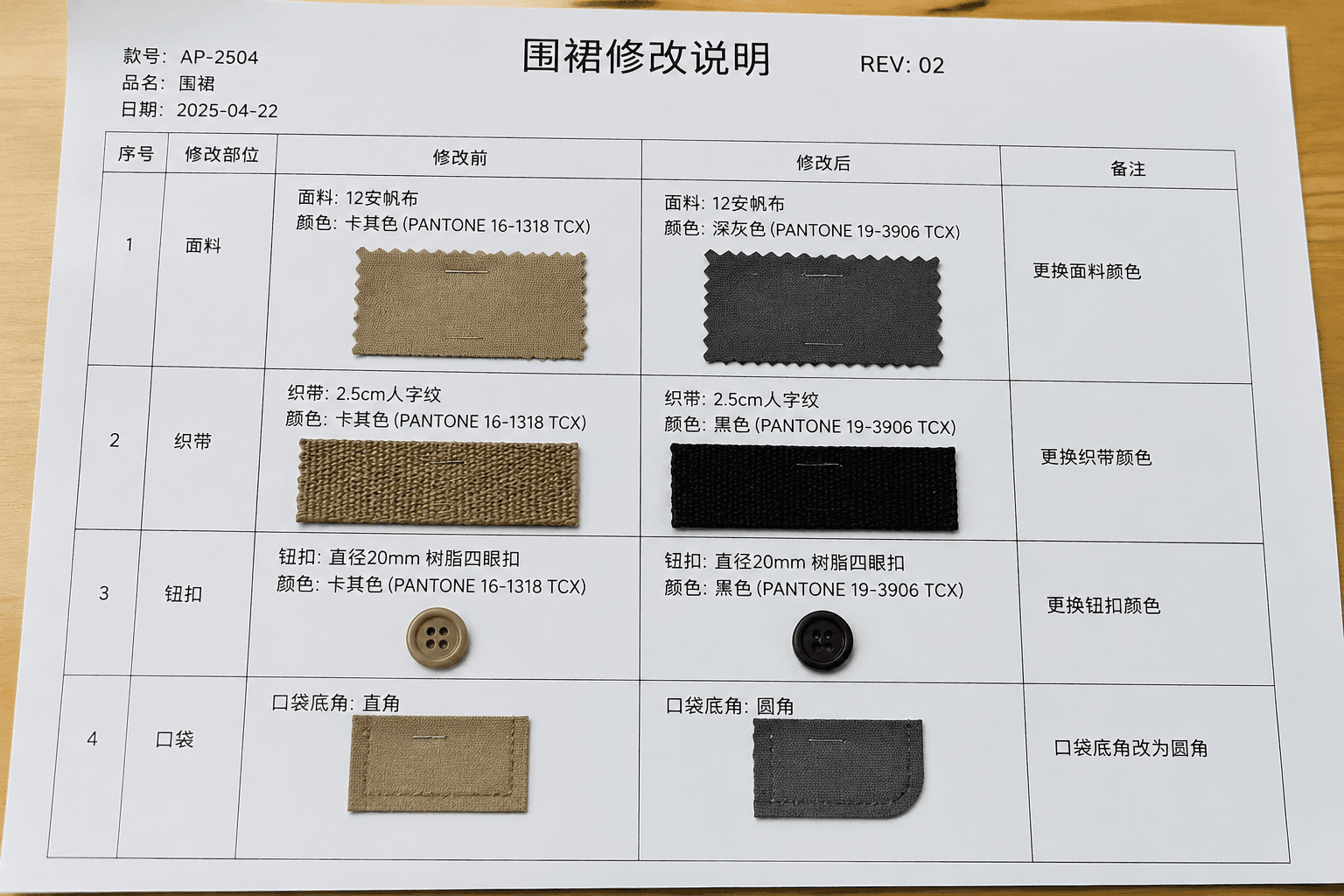
In apron sourcing, fabric is usually the easy part to compare: 210 GSM polycotton twill versus 260 GSM cotton canvas, or 8 oz canvas versus 10 oz canvas. Labor is less visible, yet it often shifts the quote more than the shell fabric. Two bib aprons can use near-identical fabric and still land at $2.90 FOB versus $4.10 FOB because one style needs slower strap construction, more precise pocket assembly, hardware setting, cleaner topstitch control, and more final trimming.
A reliable apron sewing cost breakdown has to go past panel count. Professional buyers need to know which operations add real time per piece: strap turning, pocket segmentation, binding, bartacks, hardware insertion, pressing, thread cleanup, and in-line QC. On a basic waist apron these steps are limited. On a utility bib apron they can add 3.5 to 8.5 extra labor minutes per unit.
Those minutes affect three decisions directly: supplier comparison, target-price engineering, and delivery planning. If a factory quotes 3,000 custom aprons at AQL 2.5 major and AQL 4.0 minor with a 28-day bulk lead time, the quote only works if the sewing sequence, line efficiency, and defect allowance match the spec. This article breaks down apron labor by operation so B2B buyers can review pricing with clearer cost logic and simplify styles where the savings are real.
- Handling-heavy, visible operations such as strap turning, pocket divisions, edge binding, adjustable hardware, and topstitch alignment usually add more labor than long straight seams.
- A basic bulk waist apron typically sews in 4.5 to 6.0 minutes, a standard bib apron in 6.5 to 9.5 minutes, and a utility bib apron in 11.0 to 16.0 minutes, depending on fabric weight, trim count, and workmanship level.
- For China OEM production, cut-make-trim conversion often runs about $0.95 to $1.55 for simple aprons, $1.45 to $2.60 for standard bib aprons, and $2.40 to $4.20 for complex utility styles, excluding fabric, printing, embroidery, and export freight.
- MOQ directly changes sewing efficiency. Many factories accept 500 pcs per color/style, but labor pricing usually improves more clearly at 1,500 to 3,000 pcs because setup loss and learning-curve loss are spread across more units.
- A useful costing sheet separates pocket work, strap construction, hardware setting, edge finishing, bartacks, inspection, and packing assumptions instead of hiding all labor inside one sewing line.
- Small spec changes such as switching self-fabric ties to 25 mm cotton webbing or removing one pocket divider can save 0.2 to 1.0 minutes per apron, which becomes material at 5,000 pcs and above.
1. Why apron sewing cost breakdown matters in quote review
Aprons are compact products, but they are often dense with sewing operations. A 75 x 85 cm bib apron in 260 GSM cotton canvas may use modest fabric value, yet it still needs body hemming, pocket preparation, tie attachment, neck construction, hardware setting, bartacks, pressing, loose-thread cleaning, and visible topstitch inspection. That operation density is why sewing labor can outweigh a small fabric difference in the final quote.
In most OEM factories, costing teams do not price apron sewing as a rough markup. They estimate operation minutes first, then adjust for line efficiency, operator skill, helper support, expected defect loss, and order size. A repeat restaurant bib apron may run at 75% to 85% line efficiency after startup. A new 10 oz utility apron with divided pockets, metal slider hardware, and contrast stitching may run closer to 55% to 65% until the line stabilizes. The nominal SMV can be similar, but the actual cost outcome will not be.
For buyers, this means the quote is really a production assumption. If one supplier specializes in 210 to 280 GSM apron twill and canvas, its apron sewing cost breakdown is usually more dependable than that of a factory focused on lightweight home textiles. Labor lines only make sense when they reflect real apron capability, not generic wage arithmetic.
- Typical custom apron quote blocks are fabric, trims, cutting, sewing, finishing, inspection, packing, overhead, and margin.
- Visible operations create more cost risk than hidden seams because rework depends on stitch appearance, pocket symmetry, and strap alignment.
- Factories experienced with 8 oz to 10 oz apron canvas usually estimate labor more accurately than factories used to lighter woven items.
2. Apron sewing cost breakdown by operation: where labor minutes actually build
The longest seam is rarely the biggest cost driver on an apron. Labor usually builds in operations that combine manual handling, precision, and repetition. A straight side hem is fast and stable. A narrow self-fabric strap is slower because it must be folded, stitched, turned, trimmed, pressed, and often topstitched. A segmented patch pocket is slower than a single pocket because the operator has to prepare the pocket mouth, position it squarely, sew the perimeter, add divider lines, and reinforce stress points without visible drift.
On a standard bib apron, the base sewing sequence often includes body edge finishing, neck loop or neck strap construction, waist tie preparation, pocket assembly, pocket placement, reinforcement, thread trimming, pressing, and final inspection. Once the style adds contrast topstitching, antique brass sliders, cross-back straps, towel loops, or bound edges, the line slows in two ways: more machine passes and more handling per pass. That is why an apron with similar fabric consumption can still cost $0.60 to $1.30 more per piece.
For sourcing review, it helps to group operations into fast seams, handling-heavy seams, and control steps. Fast seams include straight hems and simple joins. Handling-heavy steps include strap turning, exact pocket placement, edge binding, and hardware insertion. Control steps include bartacks, loose-thread cleaning, pressing, stain check, and final measurement. In apron production, the second and third groups usually explain the labor increase more clearly than seam length alone.
- Pocket work: fold and press, top hem, placement, perimeter stitch, divider stitch, bartacks.
- Strap work: fold, tube stitch, turn, press, topstitch, cut to length, insert hardware.
- Edge finishing: double-fold hems are usually faster than full binding, especially on thick corners and curves.
- Control work: thread trimming, loose-end cleaning, pressing, measurement, and in-line QC add seconds that multiply across volume.
3. Benchmark sewing minutes by apron style, fabric weight, and trim complexity
Benchmarks are only useful when they match a real apron type. A simple waist apron in 180 to 210 GSM polycotton twill, with one patch pocket and basic ties, often runs about 4.5 to 6.0 sewing minutes in stable bulk production at 2,000 pcs or more. A standard bib apron in 210 to 280 GSM cotton canvas, with a neck loop, two waist ties, and one divided front pocket, commonly falls around 6.5 to 9.5 minutes. These ranges assume standard pressing, normal bundle flow, and export-ready inspection.
Complexity rises quickly once utility details are added. A bib apron in 280 to 320 GSM canvas with a slider-adjustable neck strap, towel loop, two-pocket layout, bartack reinforcements, and visible contrast topstitching often moves into the 11.0 to 14.0 minute range. If the style also uses cross-back straps, full-edge binding, rivets, heavy 10 oz to 12 oz fabric, or four to six narrow tool compartments, total sewing time can reach 14.0 to 16.0 minutes or more, especially below 1,000 pcs per color.
These ranges are buyer-side checkpoints, not universal rules. If a supplier prices a feature-heavy apron like a simple promotional style, ask what assumptions are being made about seam finish, topstitch quality, pressing, thread cleaning, and inspection tolerance. A realistic apron sewing cost breakdown must match the required workmanship level.
- Simple waist apron, 180-210 GSM twill: about 4.5-6.0 minutes.
- Standard bib apron, 210-280 GSM canvas: about 6.5-9.5 minutes.
- Utility bib apron, 280-320 GSM canvas with hardware: about 11.0-14.0 minutes.
- Heavy-duty bib apron, 10-12 oz canvas with binding and multi-compartment pockets: about 14.0-16.0+ minutes.
4. How factories convert apron minutes into unit sewing cost
Most factories start from standard minute values, then translate those minutes into actual cost using local labor conditions and line efficiency. In China, a practical loaded sewing labor rate for export quoting often falls around $4.80 to $7.20 per operator hour, depending on province, compliance requirements, season, and product mix. At an actual 7.5 minutes per apron, direct sewing labor contributes roughly $0.60 to $0.90 per piece before overhead and margin. At 12.0 actual minutes, the labor contribution rises to about $0.96 to $1.44 per piece.
Buyers usually see a blended cut-make-trim figure rather than a separate labor line. Many suppliers combine sewing, helper support, pressing, in-line QC, final inspection, and a small rejection allowance into one conversion price. For a 3,000-piece order of simple waist aprons, that conversion may run around $0.95 to $1.55 per piece, excluding fabric, labels, print, embroidery, and packaging upgrades. A standard bib apron often lands around $1.45 to $2.60. A complex utility bib apron with hardware and tighter visual standards can reach $2.40 to $4.20.
Order size changes that math materially. At 500 pcs per color/style, setup loss, smaller bundles, trim wastage, and lower learning-curve recovery push the unit cost up. At 1,500 to 3,000 pcs, the factory can spread setup time across more units, keep the line running more steadily, and reduce per-piece handling loss. MOQ is therefore part of the real labor calculation, not just a sales rule.
- Typical workable MOQ for custom aprons: 500 pcs per color/style.
- More efficient pricing band: 1,500-3,000 pcs and above.
- Illustrative conversion for simple aprons: $0.95-$1.55 per piece excluding fabric.
- Illustrative conversion for standard bib aprons: $1.45-$2.60 per piece excluding fabric.
- Illustrative conversion for utility bib aprons: $2.40-$4.20 per piece excluding fabric.
5. The apron features that raise labor cost fastest
The quickest labor increases usually come from details that add handling without adding much seam length. Adjustable neck systems are a common example. A fixed neck loop is relatively efficient. A neck strap with D-rings or a metal slider needs extra strap preparation, hardware loading, reinforcement stitching, and final length control. On many production lines, that difference alone adds about 0.4 to 0.8 minutes per piece.
Pocket architecture is another major driver. One large patch pocket is efficient. A two-tier utility pocket with pen slots, a towel loop, and three vertical divisions is not. Every added divider needs marking discipline, accurate placement, and reinforcement at stress points. On visible front pockets, even 2 to 3 mm drift can trigger repair or rejection on retail-grade programs inspected to AQL 2.5 major.
Fabric behavior also changes labor. A 190 GSM polycotton twill folds cleanly and feeds quickly. A 300 to 340 GSM washed canvas creates seam bulk, slows topstitching, and may require lower machine speed, needle changes, or extra pressing. Full self-fabric binding on heavy canvas is one of the most common hidden labor adders in custom apron development, especially around corners and side curves.
- Adjustable neck hardware often adds 0.4-0.8 minutes compared with a fixed loop.
- One extra pocket divider commonly adds 0.1-0.25 minutes, depending on size and reinforcement.
- Self-fabric ties are usually slower than 25 mm ready-made cotton webbing of similar appearance.
- Full-edge binding can add about 0.8-1.8 minutes versus double-fold hems, depending on shape and fabric thickness.
- Canvas above 300 GSM often reduces line speed enough to increase labor cost even when operation count stays constant.
6. What buyers should verify on costing sheets, AQL standards, and lead times
A usable apron costing sheet should show enough detail to confirm that the supplier understood the spec. It does not need to disclose internal wage tables, but it should state fabric composition and GSM or oz weight, pocket count, strap type, hardware, decoration method, label package, carton pack, and the main sewing difficulty points. When all labor is reduced to one unexplained number, supplier comparison becomes weak because buyers cannot see what standard is actually being quoted.
Quality assumptions must also be explicit. If the buyer expects straight visible topstitching, symmetrical pocket placement, bartacked stress points, clean thread trimming, and low oil-mark risk, those standards have labor consequences. Many export apron programs use AQL 2.5 major and AQL 4.0 minor, with checks focused on measurement tolerance, pocket position, stitch appearance, seam puckering, stains, and hardware security. A supplier quoting to a looser internal standard may look cheaper while carrying higher claim risk.
Lead time belongs in the same review. For many custom apron orders, a realistic schedule is 3 to 5 days for fabric and trim confirmation when stock materials are available, 7 to 10 days for PP sample approval, 20 to 30 days for bulk sewing after materials are ready, and 3 to 5 days for final inspection and packing. In total, many standard programs finish in 25 to 40 days after PP approval. A new utility apron promised in 15 to 20 days usually implies overtime, parallel process pressure, or simplified control steps, and each of those has cost or quality consequences.
- Confirm that pocket divisions, loops, bartacks, hardware, labels, and packing method are included in the cost basis.
- Check whether embroidery or print is applied before or after sewing because this affects pocket assembly and rework exposure.
- Verify the inspection standard, commonly AQL 2.5 major and AQL 4.0 minor for export apron orders.
- Compare lead time against style complexity; a new 500-piece utility apron should not be judged like a 5,000-piece reorder of a basic bib apron.
7. Using apron sewing cost breakdown to value-engineer without weakening function
The most effective response to a high quote is not a broad request for a discount. It is a request to identify which operations consume the most minutes. In apron development, that often leads to practical changes with measurable savings. Replacing narrow self-fabric waist ties with 25 mm cotton webbing can remove folding, turning, and topstitch work. Reducing a three-channel pocket to two channels removes one placement-sensitive stitch line and lowers rework risk. Changing full binding to double-fold hems on straight edges can cut meaningful handling time.
These changes matter because buyers can protect the features that drive end use while removing low-value complexity. A hospitality buyer may keep a divided pocket because staff need separation for order pads and tools, but drop contrast binding that adds labor without improving function. A workshop brand may keep 10 oz canvas and bartack reinforcement for durability, but simplify the neck system from a metal slider to a fixed loop sized for the target user range.
Early cost engineering is where these gains are easiest to capture. Before PP approval, buyers should ask for two versions of the same apron: one full-spec version and one value-engineered version using the same base pattern. On a 5,000-piece order, a $0.22 reduction saves $1,100. A $0.45 reduction saves $2,250. That is why operation-level review is one of the most practical tools in custom apron sourcing.
- Ask the factory to identify the top three time-consuming operations on the current apron spec.
- Request side-by-side costing for self-fabric ties versus 25 mm cotton webbing ties.
- Test whether each pocket divider adds end-use value or only visual complexity.
- Freeze strap type, pocket layout, and edge finish before bulk booking to avoid repeated sampling, recosting, and lead-time drift.