B2B apron buying decisions should not rest on vague fabric claims such as "easy care" or "stain resistant." The useful question is narrower: after 5, 10 or 20 commercial laundry cycles, will the apron still look acceptable in the service channel where it is worn? Apron stain removal testing becomes commercially useful only when the stain mix reflects the end use, the fabric is tested as both flat swatch and sewn garment, and the wash route matches the customer laundry process. A 240 GSM black bib apron used in a coffee chain, a 280 GSM natural waist apron used in a bakery and a 245 GSM 65/35 poly-cotton butcher apron used in a central kitchen do not fail in the same way, so they should not be approved with the same generic stain panel.
The sourcing risk usually appears after fabric nomination but before bulk fabric is booked. A mill may quote a 235 to 250 GSM 65/35 poly-cotton twill at USD 2.45 to 3.05 per simple bib apron on a 3,000 to 5,000 piece order, with acceptable shade continuity, seam slippage and tensile data. The buyer then sees curry-oil ghosting after five washes, tomato-paste outlines around pocket topstitching, or milk-protein yellowing after tunnel drying. In many cases the problem is not only the fabric. The approval method was too soft: easy soils, short dwell time, domestic detergent, no heat-set step, or no agreed pass-fail scale.
A practical approval protocol is specific. The buyer identifies the dominant soils, applies controlled stain weights to actual apron zones, ages those soils for 4, 16 or 24 hours based on the laundry route, and grades results after 1, 3, 5 and 10 wash cycles. The target is not perfect stain disappearance. The target is to choose the fabric construction, finish and shade that can deliver acceptable appearance at the planned service life, lead time, MOQ and cost.
- Apron stain removal testing should be built around the real soil mix for the apron program, not a generic coffee or sauce check.
- A usable approval standard defines stain weight, zone, dwell time, wash temperature, chemistry, drying method, cycle count and grading scale before bulk fabric is ordered.
- For most professional apron programs, comparing at least 2 fabric options through 5 to 10 commercial wash cycles gives a much stronger sourcing decision than a one-cycle report.
- In foodservice aprons, 230 to 270 GSM poly-cotton twills usually release mixed oil-and-pigment soils better than 180 to 240 GSM cotton twills, but finish durability still needs repeated-laundry verification.
- Light shades such as natural, oat, sand and stone should be approved to stricter visible-stain standards than black, navy or charcoal.
- Testing that costs about USD 250 to 1,000 and adds 7 to 14 days is usually cheaper than a stain-related claim on a 2,000 to 10,000 piece apron order.
- Stain-release performance should be approved before cutting, while final sewn-garment inspection can still follow AQL 2.5 major and 4.0 minor.
Why swatch-only approvals fail in apron stain removal testing
The most common approval error is using stain panels that are too simple and too easy to wash out. Commercial apron soils are usually mixed soils. Fryer oil carries pigment into yarn gaps, milk and egg proteins set under heat, sugar syrups harden during service, and fine particles such as cocoa, flour or carbon residue settle into twill lines, seam channels and pocket edges. If the test uses only diluted coffee and one mild wash, the result can overstate real performance by 0.5 to 1.0 grade on a 1 to 5 visual scale.
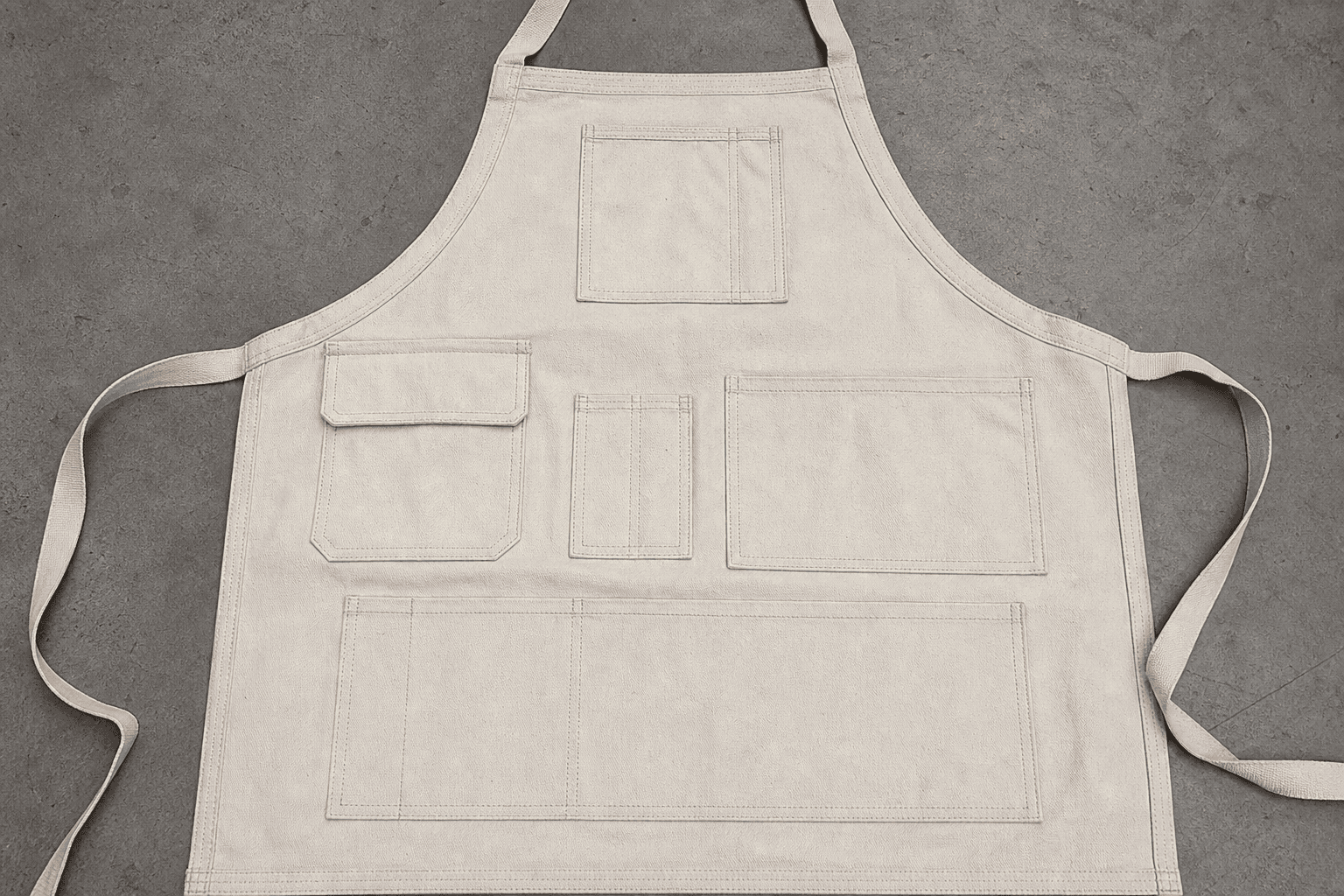
Aprons also stain by zone, not as a flat laboratory square. Bib aprons pick up splashes on the chest, hand transfer on the lower body and concentrated residue around pocket openings. Waist aprons collect bench-contact staining, tie-end transfer and fold-line shadowing. Butcher aprons usually show heavier contamination at the mid-body and lower front where fat, broth and grease hit repeatedly. A 10 cm x 10 cm swatch is useful for early screening, but it does not fully show stain retention at bartacks, double-needle seams, turned hems or patch-pocket corners.
For sourcing teams, that means swatch-only approval is weak evidence. A 245 GSM twill may score grade 4.0 on a flat panel after three washes, then drop to grade 3.0 on a sewn apron because tomato paste and curry oil stay trapped around topstitch channels. That gap is where returns, credits and replacement claims usually begin. At final approval stage, each fabric candidate should be tested as both swatch and at least one sewn apron in the target style.
- Use flat swatches for first-round screening, but include at least 1 sewn apron per fabric candidate before bulk approval.
- Apply stains to chest, lower body and pocket zones instead of one center square only.
- Review results after 1, 3, 5 and 10 wash cycles to capture both early failure and progressive build-up.
- Photograph the same stained zones before washing and after each cycle under consistent lighting and distance.
Build a channel-specific soil set for apron stain removal testing
The most useful soil matrix starts with the end-use channel. A cafe, bakery, quick-service restaurant, hotel kitchen and butcher counter do not contaminate aprons in the same way, so they should not share one approval panel. For restaurant and open-kitchen programs, a practical 6- to 8-soil set often includes fryer oil, tomato paste, chili oil, curry sauce, protein broth, soy-based dark sauce and carbonized grease. For cafes, espresso concentrate, whole milk, chocolate syrup, berry puree, pastry butter and pen ink are often more predictive than grill residue. For bakery programs, butter oil, jam, cream filling, cocoa slurry, flour paste and sugar syrup better match daily wear.
The panel should stay selective. Expanding to 12 or 15 stains usually adds cost and variability without improving the sourcing decision. In most apron programs, 6 to 8 representative soils are enough if the application method is fixed. A workable standard is 0.15 to 0.20 g for oil-based stains and 0.20 to 0.30 g for paste or water-based stains on a 10 cm x 10 cm area. Powder soils such as cocoa or carbon residue should be controlled at 0.05 to 0.10 g and lightly pressed into the wetted fabric so different labs can repeat the load with limited deviation.
Dwell time matters as much as stain choice. Four hours may be valid for a same-shift cafe laundry route. Sixteen hours is more realistic for overnight processing, and 24 hours better reflects central collection or industrial laundry schedules. Some buyers should also add a heat-set step for selected stains. Pressing protein broth or sauce stains at 120 C for 30 to 60 seconds before washing can better simulate line heat, steam and body temperature that fix soils during actual use.
- Restaurant panel: fryer oil, tomato paste, chili oil, curry sauce, protein broth, dark sauce, carbon grease.
- Cafe panel: espresso concentrate, whole milk, chocolate syrup, berry puree, pastry butter, pen ink.
- Bakery panel: butter oil, jam, cream filling, cocoa slurry, flour paste, sugar syrup.
- Standardize stain weight, zone size, dwell time and any heat-set step so two mills are compared on the same basis.
Run apron stain removal testing under the actual laundry route
The wash stage is where many approvals become commercially misleading. Factories sometimes present a stain-release report based on a 40 C domestic wash with mild detergent, while the customer launders at 60 C to 75 C with alkali, oxygen bleach and stronger mechanical action. The reverse also happens: a lab uses chemistry harsher than the end user will run, making the fabric look weaker than it will be in service. In either case, the report does not support a real sourcing decision.
For most foodservice apron programs, two wash scenarios are enough. The first should mirror normal operation, for example a 60 C main wash for 18 to 22 minutes, medium alkali, non-chlorine oxygen bleach, two rinses and tumble or tunnel drying. The second should be a stress route designed to expose finish breakdown, typically 70 C to 75 C, higher alkali, oxygen bleach and five consecutive cycles. If the expected apron life is 30 to 50 industrial laundry turns, a single-cycle result is too shallow. The first meaningful comparison point is usually after five cycles, while ten cycles gives a stronger view of finish durability and shade retention.
Every report should record temperature, chemistry type, liquor ratio, machine type, load level, wash time, rinse count and drying method. These are not minor lab details. A 245 GSM 65/35 twill that performs well in a low-alkali wash may lose stain-release finish in a stronger route, while a 280 GSM cotton canvas may hold shape but retain oil shadows after tunnel drying. Buyers should request the full wash record, not only the final grade.
- Normal route example: 60 C wash, 20 minutes, medium alkali, oxygen bleach, 2 rinses, tumble dry.
- Stress route example: 75 C wash, 20 minutes, higher alkali, oxygen bleach, 5 consecutive cycles, tunnel dry.
- Record machine type, liquor ratio, chemistry, cycle time, drying method and completed cycle count.
- Score stain removal together with shrinkage, seam appearance, shade change and handfeel.
Compare apron fabrics by blend, GSM, construction and shade
For custom apron sourcing, the most common candidates are 100% cotton twill or canvas from 180 to 300 GSM and poly-cotton twill from 220 to 270 GSM. Their stain-release behavior has direct cost implications because it affects replacement rate and complaint risk. Cotton usually absorbs oil and pigment more readily, especially when the surface is softer or more open. It supports a natural look, but buyers should expect either stricter laundering or earlier visible staining. Poly-cotton, especially in compact twill constructions, usually releases mixed kitchen soils more effectively and dries faster, which is why chain programs continue to favor it.
Blend ratio matters. A 65/35 polyester-cotton twill at 235 to 250 GSM is often the best balance for hospitality and foodservice buyers because it combines acceptable comfort, stable dimensions and reliable stain release at moderate cost. On a simple bib apron with one front pocket, this fabric commonly lands around USD 2.40 to 3.10 per piece at 3,000 to 5,000 pieces, depending on trim, print and embroidery. An 80/20 blend can improve soil release and drying speed further, but some buyers reject the hand for visible front-of-house use. Heavier canvas in the 260 to 300 GSM range can look more premium, yet it often holds paste stains more deeply at folds, pocket edges and seam intersections unless the finish is strong and durable through repeated laundry.
Shade changes the approval standard. Black, navy and charcoal hide many residual soils but can show detergent streaking, lint and oil halos. Stone, khaki, oat and natural expose even light tomato or curry shadowing after relatively few washes. As a result, a fabric that passes in black after five cycles may fail in sand under the same protocol. For light shades, buyers should usually require either a higher stain-removal grade or an added review point at 10 washes before bulk approval.
- 180 to 220 GSM cotton twill: softer hand and natural look, but weaker oil-pigment release over repeated laundering.
- 230 to 270 GSM 65/35 poly-cotton twill: the standard all-round choice for many restaurant and hospitality apron programs.
- 260 to 300 GSM canvas: stronger visual weight, but seams, pockets and folds need stricter stain review.
- Light neutrals should be approved to a tougher visible-appearance standard than black or navy.
Set pass-fail rules before bulk apron fabric booking
A stain test without a written decision rule creates argument instead of clarity. Before fabric booking, the buyer, apron factory and mill should agree on the grading system, critical stains, acceptable shade change and limits for shrinkage and seam distortion. For many B2B apron programs, a practical target is an average stain-removal grade of 3.5 or higher after five cycles, with no critical stain below grade 3.0 in the primary use zone. Critical stains are usually curry oil, tomato paste, chili oil and protein-based sauce rather than coffee or diluted beverage marks.
Instrumental data can improve consistency on larger programs, but it should support visual judgment rather than replace it. Delta E after laundering, image-based contrast measurement and reflectance comparison help when two mills are close. Still, apron users judge garments at roughly one meter under service lighting. If the pocket edge still looks shadowed, a good numerical reading alone will not protect the program. Retained photo standards remain the most practical baseline for commercial approval.
Commercial tolerance should also match replacement economics. A cafe chain replacing bib aprons every 4 to 6 months may accept slight residual staining on a USD 2.60 to 3.10 unit if construction and branding are correct. A hotel, butcher chain or open-kitchen concept targeting 9 to 12 months of use should set a higher bar and may need to accept a fabric and finish package in the USD 3.80 to 5.90 range depending on style complexity, embroidery count, hardware and pocket configuration. Final sewn-garment inspection can still follow AQL 2.5 major and 4.0 minor, but stain-release approval should be locked at fabric and pre-production sample stage, before cutting starts.
- Define a 1 to 5 visual scale with retained photo references for each key stain.
- Set average grade and critical-stain minimum grade as separate requirements.
- Add physical limits such as shrinkage below 3%, seam puckering limit and acceptable shade change.
- Approve stain performance before bulk cutting; use AQL only for final garment workmanship inspection.
Plan MOQ, lead time and testing cost into the apron sourcing calendar
Realistic testing adds development time, but it usually shortens the total sourcing cycle by preventing late disputes. A typical custom apron development path runs as follows: lab-dip approval in 3 to 5 days, fabric sampling in 5 to 7 days, proto sewing in 5 to 8 days, and stain testing in 7 to 14 days depending on cycle count and whether an external lab or industrial laundry is used. In practice, buyers should reserve 20 to 35 calendar days from fabric nomination to final stain-performance approval before bulk fabric booking is locked. Compressing the process into one week usually produces weak data and expensive changes later.
MOQ affects how much support the mill will provide. For standard dyed poly-cotton twill, practical fabric MOQ often starts at 1,000 to 1,500 meters per color. For custom stain-release finishing, a special blend ratio or a new shade that must pass repeated laundry testing, 3,000 meters per color is more realistic and some mills will ask for 5,000 meters. On the cut-and-sew side, many OEM factories can start at 500 to 1,000 aprons per style and color for simple bib or waist styles, but meaningful fabric optimization usually becomes more economical at 2,000 to 5,000 pieces because testing, sewing setup and mill attention are better absorbed.
The cost of apron stain removal testing is modest compared with failure cost. Internal factory or laundry evaluation may run USD 250 to 450 for two fabrics and one style. External lab work with multiple cycles, sewn garments and image documentation often runs USD 650 to 1,000. That is still small against a 5,000-piece order if weak stain release triggers complaints, credits, replacements or an emergency re-buy. From a factory and buyer perspective, solving the issue before bulk cutting is materially cheaper than settling a post-shipment claim.
- Typical approval timeline with testing: 20 to 35 calendar days before final bulk fabric sign-off.
- Standard dyed twill MOQ: about 1,000 to 1,500 meters per color.
- Custom finish or new-shade MOQ: often 3,000 to 5,000 meters per color.
- Simple OEM apron MOQ: commonly 500 to 1,000 pcs, but 2,000 to 5,000 pcs improves development efficiency.
- Testing spend of about USD 250 to 1,000 is usually lower than one bulk quality claim.
Use a factory-ready checklist to keep repeat apron orders consistent
The strongest approvals are captured in one working standard shared by sourcing, development, factory QA and, when relevant, the customer laundry operator. The document should define apron style, end-use channel, fabric code, GSM, blend, construction, shade, soil panel, stain weight, dwell time, wash route, cycle count and pass-fail rules. This turns apron stain removal testing from a vague request into a usable commercial control point.
Factories should also retain one approved control from the same fabric lot used in testing, together with the wash log, grading sheet and post-wash photos. If a repeat order uses a different lot, a revised finish or a replenishment shade, the original benchmark allows direct comparison. This matters on recurring apron programs because a good first shipment does not guarantee the next lot will perform the same way if the approval basis was not recorded clearly.
For B2B buyers, the conclusion is straightforward. Treat stain-removal approval as part of apron fabric sourcing, not as a late lab exercise after price negotiation is finished. When the soil set is realistic and the wash route is commercial, the buyer can select fabric type, shade, MOQ and target cost with fewer assumptions and lower claim risk.
- Confirm end-use channel: kitchen, cafe, bakery, butcher, hotel or food production.
- Select 6 to 8 representative soils and define weight, dwell time and test zones.
- Compare at least 2 fabric candidates and include 1 sewn apron per candidate.
- Wash through 5 to 10 cycles using the real or simulated commercial laundry route.
- Approve against written visual and physical standards before placing the bulk fabric PO.
- Retain approved control samples and records for repeat orders, lot comparison and claim review.