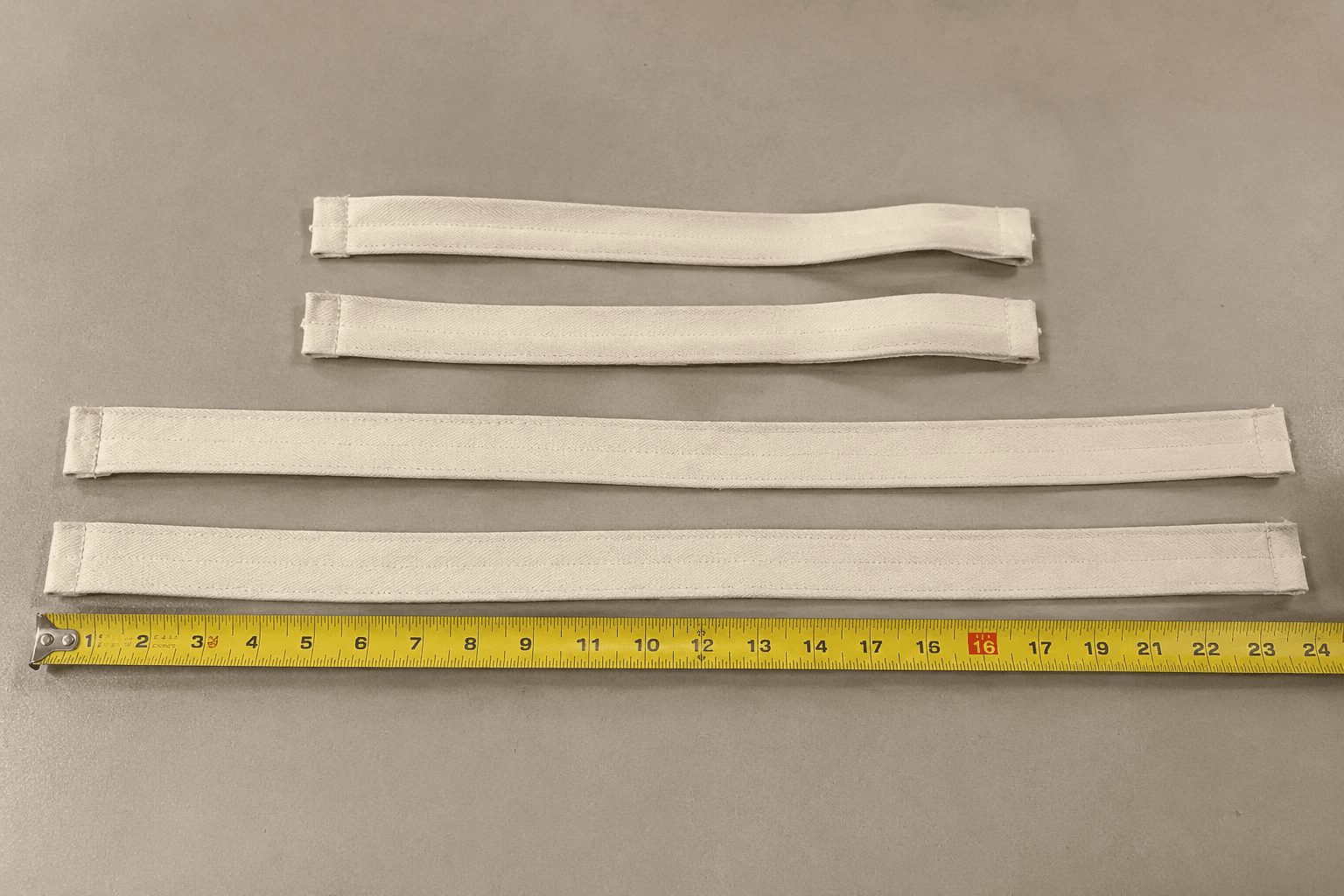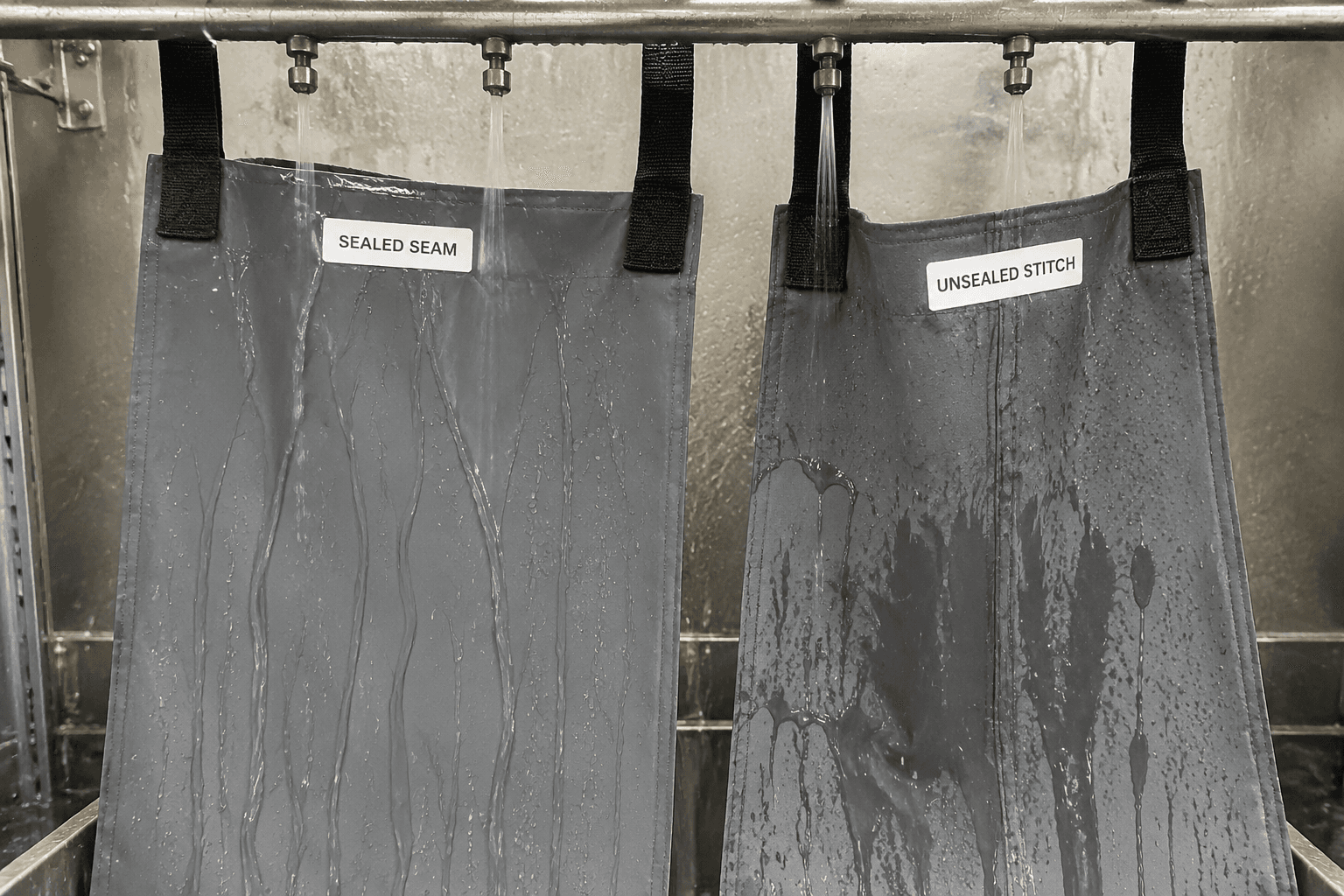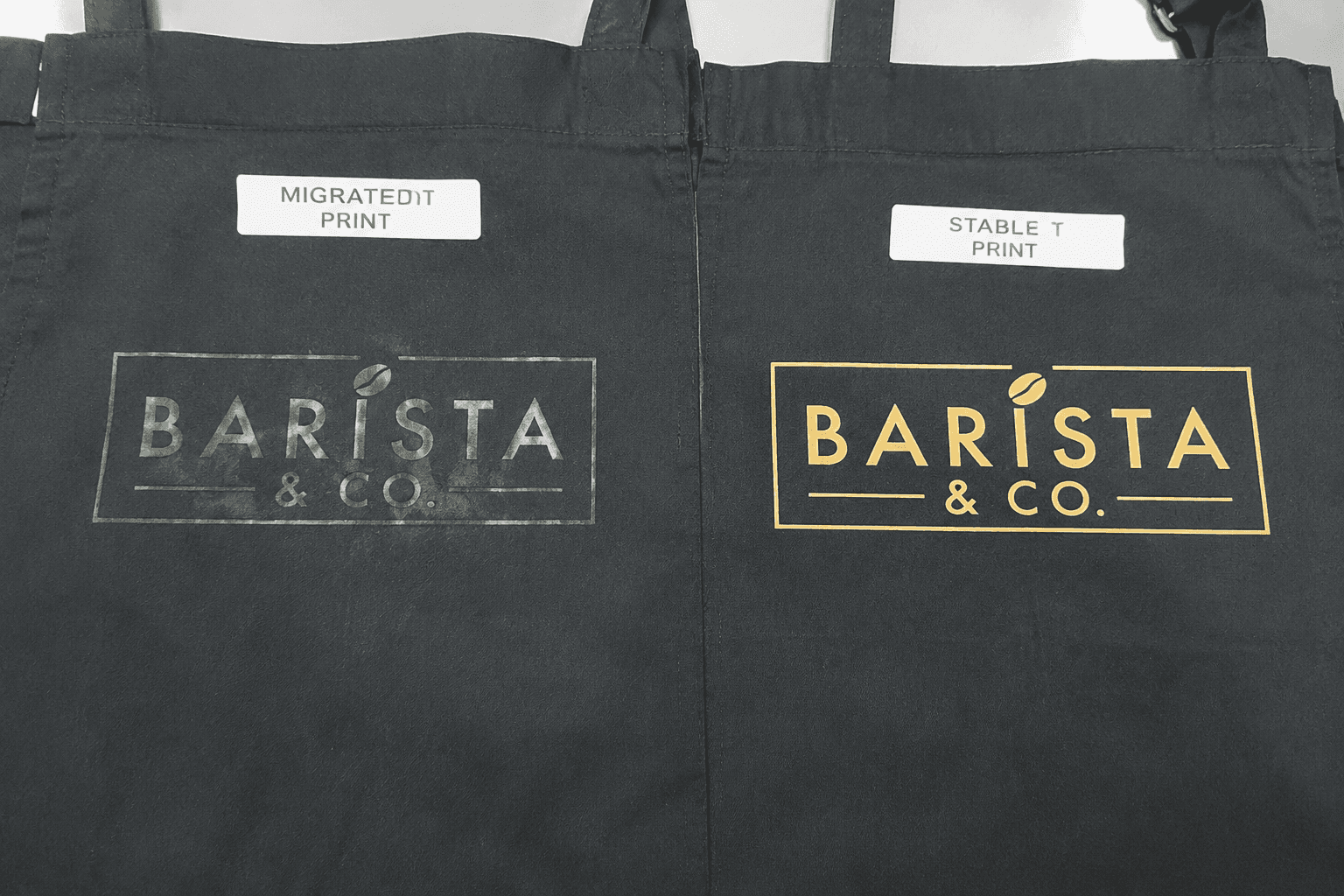
In apron sourcing, buyers often sign off fabric weight, pocket layout, hardware, and wash appearance before they study perspiration risk. That sequence is backwards for dark trim. apron perspiration colorfastness is usually a component issue, not a whole-garment issue, because the neck strap and waist ties experience more skin contact, more pressure, and more friction than the apron body.
A typical OEM apron program may use a 240-300 GSM cotton twill or 8-10 oz canvas for the body, then pair it with a separate black or navy neck strap made from herringbone tape, self-fabric, or webbing. The body can pass visual shade approval and still fail in use if the dark trim releases dye onto a white chef coat, polo collar, blouse, or T-shirt. That is why a garment-level pass is not enough when trim and body are not identical.
This matters most in food service, barista, hotel, brewery, catering, and retail uniform programs, where aprons are worn for long shifts and often washed on a weekly cycle of 1-3 industrial washes. If the strap supplier changes, the dye lot changes, or the finish changes, the buyer should treat the dark component as a separate risk item. In practice, a component-level perspiration test adds about 3-5 working days and roughly USD 35-90 per component or colorway, which is far cheaper than rework on 3,000-20,000 aprons or a customer debit note after launch.
- Dark neck straps and waist ties should be tested separately whenever they differ from the body in supplier, fiber, dye lot, construction, or finish.
- A pass on the apron body does not prove that black or navy straps will meet sweat staining requirements in actual wear.
- The highest-risk components are usually black, navy, charcoal, burgundy, and dark green cotton or cotton-rich trims.
- For most B2B apron programs, buyers should require both acidic and alkaline perspiration tests with separate minimum grades for color change and staining.
- Separate component testing usually adds 3-5 working days and can be budgeted at about USD 0.01-0.05 per piece at scale.
- The most reliable control is traceability by component code, lot code, test report, and approval stage before cutting starts.
Why apron perspiration colorfastness fails first in dark straps and ties
Buyers often inspect the apron body first because it is the largest visible surface, but perspiration failures usually begin where the fabric is narrow, dark, and pressed against skin. A neck strap can sit against the neck for a full 8-12 hour shift, while waist ties remain tight around the body in hot kitchens, coffee bars, catering tents, and outdoor event work. Sweat, heat, pressure, and friction combine in those areas, which increases dye transfer risk.
The body and the trim are often made through different supply chains. A body may be cut from 260 GSM cotton canvas or 8 oz denim, while the neck strap is sourced separately as black herringbone tape, cotton webbing, or self-fabric from another mill. Even if both are described as black cotton, the dye recipe, fixation method, washing-off process, and softener finish may be different. A 240 GSM black cotton tie can fail perspiration testing while a 280 GSM natural or stone-colored body fabric passes without difficulty.
This is the core sourcing lesson behind apron perspiration colorfastness: the component with the highest skin contact and the deepest dye load deserves its own test record. If the trim touches the wearer directly and has a separate dye history, it should not rely on a report issued for the apron body. Buyers should treat it as a separate approval item at development, pre-production, and bulk release.
For professional apron programs, the highest-risk combinations are easy to predict: dark trim on light shirts, black or navy straps on white chef coats, and long-shift use in warm environments. In those cases, separate testing is not over-control; it is basic claim prevention. If the failure cost is a return, replacement, or discount on a 5,000-piece order, the test fee is negligible.
- Highest-risk colors: black, navy, charcoal, burgundy, bottle green.
- Highest-risk materials: 100% cotton, cotton/poly blends above 65% cotton, viscose blends, dyed linen-look tapes.
- Highest-risk end uses: chef bib aprons, barista aprons, brewery aprons, catering aprons, retail staff aprons worn for long shifts.
When separate testing for apron perspiration colorfastness is mandatory
Separate testing is mandatory whenever the strap or tie is not identical to the body in material history. If the body is 8 oz cotton canvas from mill A and the ties are 220 GSM herringbone tape from supplier B, one garment-level result does not prove the other part will perform the same way. The same rule applies when the body is piece dyed but the ties are stock pre-dyed tape, when a sample uses self-fabric ties but bulk switches to webbing, or when a factory changes trim sourcing to protect price or lead time.
The trigger is not only material difference; it is also wear risk. On first orders, separate testing should be standard when the dark component is black, navy, or another deep shade that sits against skin. On repeat orders, historical approval is not enough if there is a new dye lot, a substitute trim mill, a revised softener, or a new finishing route. A minor change in wash-off quality can move a result from acceptable to claim-prone.
Commercially, this control is small. In China, a standard perspiration test for one component commonly costs USD 35-60, while rush handling or an expanded adjacent-fabric review may reach USD 60-90. On a 5,000-piece apron order priced around USD 3.20-6.80 FOB per piece, the preventive spend is minimal compared with the cost of sorting, rework, customer credits, or replacement stock if dark ties stain light uniforms.
In supplier negotiations, buyers should also separate the test logic from the visual approval logic. A dark neck strap can match the approved shade and still release excess dye under sweat conditions. Shade approval confirms appearance; perspiration testing confirms performance. Both are needed when the trim is part of a professional uniform program and will be worn daily.
- Test separately when the strap or tie comes from a different supplier than the body fabric.
- Test separately when the trim is stock tape or webbing rather than self-fabric from the body lot.
- Test separately when dark ties are worn directly against light shirts, chef coats, or polo collars.
- Test separately on every new dye lot, trim substitution, or repeat order after a long production gap of one season or more.
- Treat shade approval and perspiration approval as two different gates in the PO and pre-production file.
How to write apron perspiration colorfastness requirements into the tech pack and PO
A common sourcing mistake is writing only 'colorfastness required' in the purchase order. That wording is too vague to control a dark trim that may stain the wearer. Buyers should specify the component, the test condition, the minimum grade, and the approval timing. A practical requirement would read: body fabric, neck strap, and waist ties tested separately; acidic and alkaline perspiration required; minimum grade 4 for color change; minimum grade 3-4 or 4 for staining depending on end use.
The BOM should be equally precise. Instead of 'black cotton tie,' write the construction and source detail: neck strap, 240 GSM, 100% cotton twill, reactive-dyed black, supplier code T118-BK; waist ties, 1.5 inch black herringbone tape, approximately 220 GSM equivalent, supplier code HT22-BK. If the body is natural 270 GSM cotton canvas and the ties are black dyed cotton, list them as separate BOM lines with separate approval points. That prevents the factory from assuming one report covers all dark parts.
For most apron programs, buyers should request testing on the bulk lot, not only on lab dips or development swatches. A lab dip confirms shade direction; it does not confirm fixation on the production lot. The stronger sequence is: development sample approval, bulk shade approval, then pre-production testing on the exact dark strap and tie lots before cutting begins. If the factory proposes a trim substitution to meet MOQ or lead time, the change should require written approval plus repeat testing.
To keep procurement disciplined, tie the test result to the PO language. For example, state that any substitution of strap supplier, tape mill, dye lot, or finish requires new test evidence before bulk release. That is the simplest way to stop informal changes that are common in OEM apron production and hard to trace after a complaint.
- State the scope clearly: acidic perspiration, alkaline perspiration, or both.
- State minimum grades separately for color change and staining.
- List body, neck strap, and waist ties as separate BOM items with supplier or item codes.
- Require testing on the bulk production lot, not only on development swatches.
- Tie approval to a stage such as pre-production, each new dye lot, or each trim substitution.
Test methods, grades, and lab targets for dark apron components
Most professional buyers follow a recognized perspiration fastness method aligned with brand manuals, importer standards, or retailer compliance rules. The technical principle is consistent: the specimen is exposed to acidic and alkaline sweat solutions, pressed under controlled conditions, held at temperature for a set period, then graded for color change and staining against adjacent fabrics. For aprons, the important point is not just the method name. It is whether the neck strap and waist ties are submitted as separate specimens instead of being assumed to behave like the apron body.
A practical target for many apron programs is grade 4 minimum for color change and grade 3-4 minimum for staining. Premium hospitality, hotel service, and white-shirt uniform programs often require grade 4 for both, especially for black neck straps. That stricter target is justified because the commercial risk is visible transfer onto a light garment, not only shade loss on the apron itself.
Adjacent-fabric selection matters. Cotton staining is usually the first concern because aprons are commonly worn over cotton chef coats, polos, and woven shirts, but polyester and nylon may also be relevant in blended uniforms. A report that simply says 'pass' is weak evidence. Buyers should ask for the actual grade numbers and the adjacent-fabric breakdown so the result can be reviewed by QA, sourcing, and the end customer if needed.
When comparing labs, ask how they handle dark trims with high dye load. Some labs will test only one side or one condition unless the buyer specifies both acidic and alkaline perspiration. Others will grade only the strap and not the adjacent fabric. For apron programs, that is not enough. The report should clearly show the component name, color code, condition tested, and separate grades for color change and staining.
- Typical baseline target: color change grade 4, staining grade 3-4.
- Typical stricter hospitality target: color change grade 4, staining grade 4 on dark neck straps and waist ties.
- Review both acidic and alkaline results; one condition alone is not enough.
- Confirm which adjacent fabrics were graded: cotton, polyester, nylon, wool, acrylic, acetate.
- Request the report to identify the specific apron component, not only the garment style number.
Common root causes of dark tie bleed in apron production
When dark apron ties bleed under sweat conditions, the cause is usually a production control issue. The most common problem is incomplete fixation or poor wash-off on deep reactive shades. Black and navy cotton need more thorough soaping and rinsing than medium shades. If a dyehouse shortens the cycle to meet an ex-factory date, excess surface dye can remain on the fiber. That residue may not appear in visual inspection, but it can migrate under moisture, heat, and pressure during wear.
A second pattern is substitution after sample approval. The buyer may approve a salesman sample with one black cotton tape, then the factory switches to a lower-cost or faster-available lot in bulk. If the substitute matches the shade but not the fastness, the original approval no longer protects the program. The same risk appears when self-fabric ties in development become stock herringbone tape in production, or when a softener, enzyme wash, or water-repellent finish is added late to improve hand feel.
A third issue is weak lot traceability. In multi-supplier apron production, the body fabric roll, trim lot, and sewing output may be recorded in separate files or not linked cleanly at all. Once a complaint arrives, the buyer cannot quickly identify whether the failure came from mill processing, trim sourcing, or finishing. That delay raises claim cost and slows the decision on rework, replacement, or a debit note.
The solution is to lock the dark component early and verify it again before sewing. If a factory wants to change a black neck strap from one tape supplier to another, the buyer should require a new sample, a new lot code, and fresh perspiration evidence. The same discipline should apply to waist ties, especially on aprons sold into white-uniform or front-of-house programs.
- Incomplete soaping and rinsing on reactive-dyed black or navy cotton ties.
- Trim substitution after sample approval without repeat testing.
- Late-added softener, enzyme, or finish changing perspiration behavior.
- Weak lot traceability between body fabric, tie trim, and finished cartons.
- Bulk use of a different tape width or weave than the approved sample.
MOQ, lead time, and per-piece cost for separate apron perspiration colorfastness control
Some buyers worry that separate testing will disrupt MOQ planning or delay shipment. In most apron programs, the lab test itself does not change cut-and-sew MOQ, but custom dark trims can create their own minimums. A standard apron order often runs at 500-1,000 pieces per style and color, while a custom black tie fabric or tape may need 300-800 meters per color to run efficiently. Stock black webbing can reduce MOQ pressure, but stock trim still needs qualification because supplier-to-supplier fastness performance can vary.
Lead time is manageable if the control is built in early. A custom body fabric may require 12-18 days for dyeing and finishing, while black tie tape or self-fabric trim may take 7-12 days if sourced locally. Standard perspiration testing usually adds 3-5 working days, and some labs can deliver a rush result in 1-2 working days at a higher fee. If the buyer waits until finished garments are packed, the check becomes slower, more expensive, and harder to correct.
The cost is similarly limited. On a 10,000-piece order, two extra component tests may add less than USD 120 in lab fees, or around USD 0.012 per piece before admin cost. Even if the full control process reaches USD 0.03-0.05 per piece, it is still far cheaper than replacing a failed lot or dealing with stained-uniform complaints after delivery. For a FOB apron range of roughly USD 2.80-8.50 per piece depending on fabric, hardware, pockets, and packaging, that is a small insurance cost.
If the buyer wants a clean QA framework, the commercial file should also include an AQL checkpoint for visual defects on the finished apron and a separate pass/fail record for perspiration performance on the dark components. AQL 2.5 is common for major defects in apparel programs, but the fastness requirement should not be diluted into the same inspection bucket as seam or measurement checks. It needs its own technical evidence.
- Typical cut-and-sew MOQ: 500-1,000 pieces per style and color.
- Typical custom dark trim MOQ: 300-800 meters per color.
- Typical standard lab timing: 3-5 working days.
- Typical rush lab timing: 1-2 working days.
- Typical apron FOB range: USD 2.80-8.50 per piece depending on fabric, hardware, pockets, and packaging.
- AQL 2.5 is common for major visual defects, but perspiration fastness should be documented separately.
A buyer workflow for controlling apron perspiration colorfastness in OEM sourcing
A practical workflow starts at design stage. If the apron includes black, navy, burgundy, or dark green neck straps or waist ties, classify those parts as separate risk items immediately. In development, record fiber content, construction, GSM or oz, dye method if known, supplier name, supplier code, and color code. During bulk booking, lock the approved trim source and state that substitution requires written approval plus repeat testing.
Before cutting, require bulk-lot reports for the exact dark trim that will enter production. On first orders, this should be mandatory. On repeat orders, keep the same rule whenever there is a new dye lot, new trim supplier, price-led change, or restart after a long gap. When the report arrives, cross-check it against the BOM and lot code. If the neck strap passes but the waist tie comes from another lot, the approval is incomplete.
This workflow is especially useful in OEM apron production where body fabric, trim, and sewing may be handled by different partners. It gives the buyer a clear go or no-go control before assembly, speeds root-cause analysis if a complaint appears, and turns apron perspiration colorfastness from a vague quality promise into a measurable sourcing standard. For professional B2B apron buyers, that means fewer claims, faster resolution, and more stable repeat orders.
A final discipline is document retention. Keep the approved sample, the lab report, the lot code, and the PO revision together for at least 24 months, or longer if the apron program is recurring. That record supports claim defense, repeat ordering, and vendor scorecards. If a supplier changes the strap or tie without notice, the file should make that change visible within minutes, not after the customer has already filed a complaint.
- Flag dark neck straps and waist ties as separate risk items at design stage.
- Record supplier code, lot code, GSM or oz, and color code for each dark component.
- Require pre-production pass reports before cutting on first orders and all new dye lots.
- Reject shade-only substitutions unless matching fastness data is supplied.
- File body, strap, and tie approvals by component for later claim tracing and AQL review.
- Retain samples and reports for at least 24 months for repeat orders and claim defense.